Exhibition | Enlightenment Princess: Marie Catherine de Brignole-Sale
Now on view at Chantilly:
From Monaco to Chantilly, A Princess of the Enlightenment in Search of Freedom
Château de Chantilly, 18 October 2025 — 4 January 2026
Curated by Mathieu Deldicque and Thomas Fouilleron
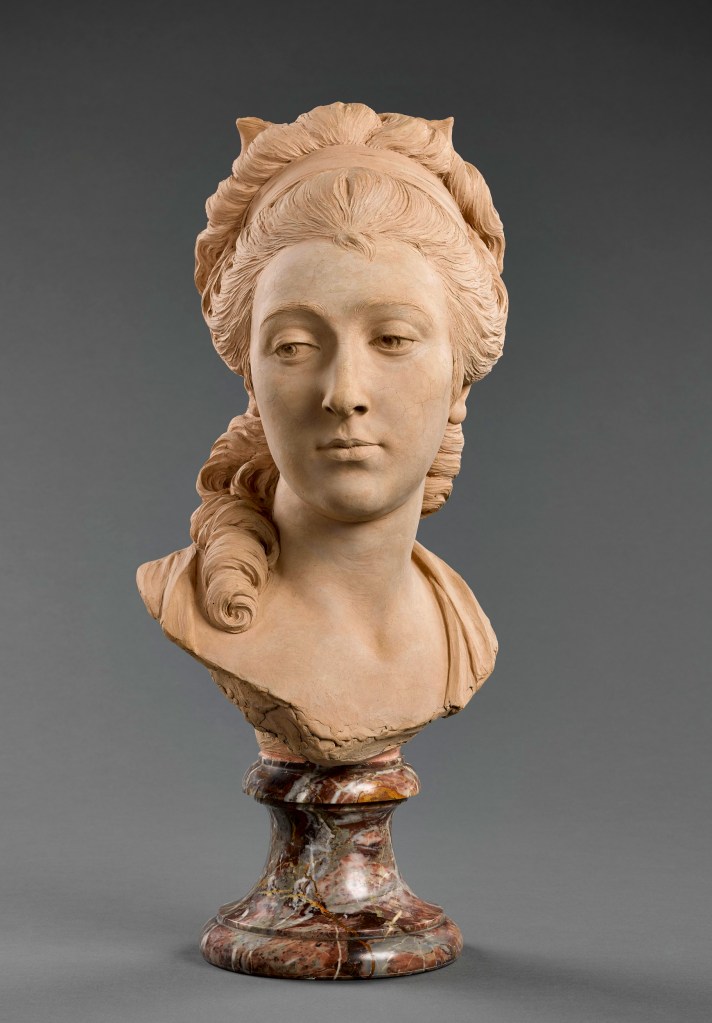
Claude Dejoux, The Princess of Monaco (Marie Catherine de Brignole-Sale), 1783, terracotta (Paris: Musée du Louvre).
Following the 2024 exhibition on the romantic destiny of Louise d’Orléans, the first Queen of the Belgians, the Musée Condé now turns its attention to another little-known yet remarkable woman who left a lasting mark on its history: Marie Catherine de Brignole-Sale, Princess of Monaco and later Princess of Condé (1739–1813). Thanks to an ambitious partnership with the Princely Palace of Monaco, this landmark exhibition, a collaborative research project involving the archives of the palace and those of the Condé Museum, sheds new light on the romantic life and artistic patronage of an extraordinary figure whose influence spanned the Age of Enlightenment and the French Revolution.
The Princess from the Sea
Born in Genoa on 16 September 1738, the only daughter of the Marquis of Brignole-Sale and a doge’s niece, Marie Catherine came from one of the most powerful families in this influential Mediterranean republic. Raised in Paris, she was celebrated as “the prettiest woman in France” and soon caught the attention of Prince Honoré III of Monaco (1720–1795). Though significantly older and initially hoping for a more prestigious match within the French nobility, the Prince ultimately opted for a less exalted but more financially advantageous alliance. After the sumptuous wedding on 15 June 1757, which was fraught with formal tensions, the new, young Princess of Monaco lived up to expectations by giving birth to two little princes. She is a regular at Parisian salons and confidently navigates the Hôtel de Matignon, the royal couple’s Parisian residence. The collections from the Prince’s Palace of Monaco will allow visitors to relive the splendour of Monaco and admire, among other treasures, dynastic portraits exceptionally leaving the palace walls to be exhibited at Chantilly.
A Resounding Split
The marriage did not last. Marie Catherine’s growing boredom, persistent rumours of an affair with the Prince of Condé, her refusal to move to Monaco, and the jealous nature of Honoré III, along with accounts of his mistreatment, gradually led to a deepening crisis. This culminated in the princess petitioning the Parliament of Paris for a legal separation of property and person. Swayed by the influence of the Prince of Condé, the court ruled in her favour on 31 December 1770.
Love and Friendship: The Princess of Monaco and the Prince of Condé
From then on, the Princess of Monaco was emancipated. As a reader of the philosophers of the Enlightenment, she existed in her own right and was free to live out her passions alongside her dear friend, Louis Joseph de Bourbon, Prince de Condé (1736–1818), whom she never left. In Paris, near the Palais Bourbon, which the Prince had expanded at great cost as a reflection of his love for the princess, architect Alexandre Brongniart designed the Hôtel de Monaco for the Princess in the 1770s. Though the residence was destroyed during the Revolution, it was later rebuilt and has housed the Polish Embassy since 1937. Brongniart’s monumental architectural plans reflect the ambition of a princess who was both builder and patron, offering a glimpse into the refined interiors she envisioned.
The Betz Refuge of a Woman of the Enlightenment
Not far from Chantilly, but still at somewhat of a distance, Marie Catherine chose the Château de Betz (now Crépy-en-Valois in the Oise department) as the ultimate refuge and expression of her personal preferences. There, echoing what the Prince of Condé envisioned at the Palais Bourbon and at Chantilly, she championed a new Rousseau-inspired taste: a return to nature and the rise of English-style gardens. At the same time, she embraced the latest Asian exotic trends and supported the early stirrings of a neo-medieval aesthetic destined for a brilliant future. They were surrounded by some of the most innovative and gifted architects, sculptors, landscape designers, painters, and draughtsmen of the final years of the Ancien Régime. From one Temple of Friendship to another, the emotions shared by this aesthetically minded couple were immortalised in stone, marble, and plaster by artists such as Jean-Baptiste Pigalle and Claude Dejoux. Hubert Robert— the great stylist, painter, and garden designer—worked for the princess. Superb leaves from his work illustrate the innovative aesthetic that Marie Catherine deploys in her gardens at Betz: the neo-Gothic style.
The Monaco Migrant in the Revolution
The French Revolution hit the Princess of Monaco and the Prince of Condé hard. The ruthless prince of the blood quickly took command of one of the main armies of the counter-revolution, and the Princess of Monaco followed him on the roads of emigration throughout Europe, from Italy to Russia. The exhibition traces the romantic journey of a couple caught in the upheaval of revolution, torn between despair and a deep sense of honour.
Princess of Condé, at Last
Her hardships only really came to an end during her final years in England (1801–1813), when the now widowed Princess of Monaco was finally able to marry her eternal lover and become, at last, the Princess of Condé, before breathing her last in 1813 at Wimbledon, without ever having had the chance to return to France. The touching marriage contract of a couple over 70 years old, far from their homeland, brings this first monographic exhibition dedicated to the Princess of Monaco to a close. Its aim is to restore this great patron to her rightful place, to better understand her role in the arts, and to bring her hotels, parks, and châteaux back to life through previously unseen sculptures, paintings, drawings, engravings, and archival documents.
Curators
Thomas Fouilleron, Director of the Archives and Library of the Prince’s Palace of Monaco
Mathieu Deldicque, Lead Heritage Conservator, Director of the Condé Museum
Mathieu Deldicque and Thomas Fouilleron, eds., De Monaco à Chantilly, une princesse des Lumières en quête de liberté (Paris: In Fine éditions d’art, 2025), 208 pages, ISBN: 978-2382032336, €35.










 Enfilade
leave a comment