Exhibition | Turner & Constable
Opening soon at Tate Britain:
Turner & Constable: Rivals and Originals
Tate Britain, London, 27 November 2025 — 12 April 2026
Curated by Amy Concannon, with Nicole Cochrane and Bethany Husband
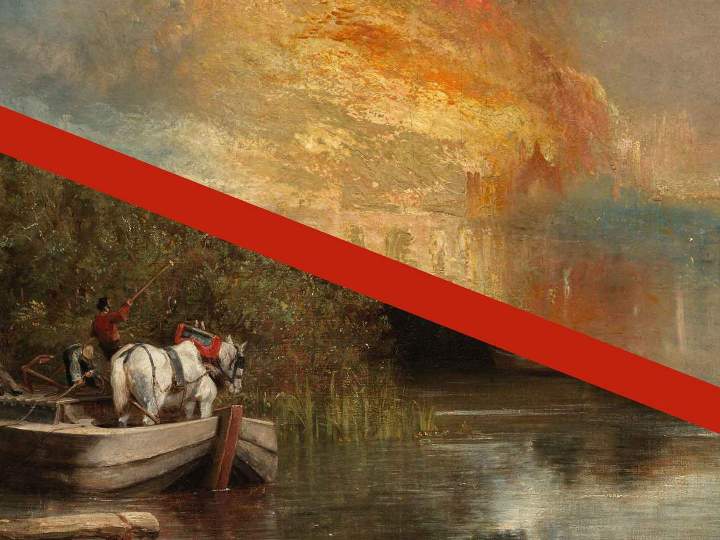 The definitive exhibition of two pivotal British artists in the 250th year of their births
Two of Britain’s greatest painters, J.M.W. Turner and John Constable were also the greatest of rivals. Born within a year of each other—Turner in 1775, Constable in 1776—the art critics of the day compared their paintings to a clash of ‘fire and water’.
Raised in the gritty heart of Georgian London, Turner quickly became a young star of the art world despite his humble beginnings. Meanwhile Constable, the son of a wealthy Suffolk merchant, was equally determined to forge his own path as an artist but faced a longer, more arduous rise to acclaim. Though from different worlds, both artists were united in their desire to transform landscape painting for the better.
With the two painters vying for success through very different but equally bold approaches, the scene was soon set for a heady rivalry within the competitive world of landscape art. Turner painted blazing sunsets and sublime scenes from his travels, while Constable often returned to depictions of a handful of beloved places, striving for freshness and authenticity in his portrayal of nature.
Marking 250 years since their births, this landmark exhibition explores Turner and Constable’s intertwined lives and legacies. Discover unexpected sides to both artists alongside intimate insights seen through sketchbooks and personal items. Experience many of the artists’ greatest works, with over 170 paintings and works on paper. Highlights include Turner’s momentous 1835 The Burning of the Houses of Lords and Commons, not seen in Britain for over a century and The White Horse 1819, one of Constable’s greatest artistic achievements. This is a one in a lifetime opportunity to explore the careers of the two greatest British landscape painters, seen—as they often were in their own time—side by side.
Amy Concannon, ed., Turner and Constable: Rivals and Originals (London: Tate Publishing, 2025), 240 pages, ISBN: 978-1849769853, £32. With additional contributions from Thomas Ardill, Nicole Cochrane, Sarah Gould, Katharine Martin, Nicola Moorby, Nick Robbins, Emma Roodhouse, and Joyce Townsend.
New Book | Turner & Constable: Art, Life, Landscape
From Yale UP (with a paperback edition scheduled for publication in January) . . .
Nicola Moorby, Turner and Constable: Art, Life, Landscape (New Haven: Yale University Press, 2025), 352 pages, ISBN: 978-0300266481, $35.
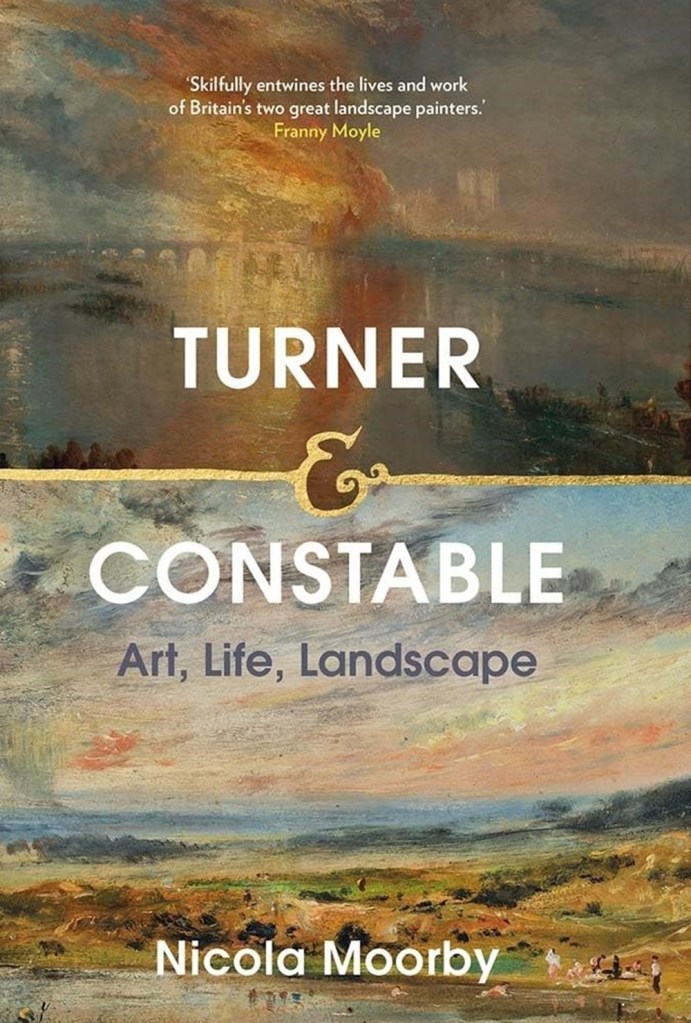 Born just fourteen months apart, one in London and the other in rural Suffolk, J.M.W. Turner and John Constable went on to change the face of British art. The two men have routinely been seen as polar opposites, not least by their peers. Differing in temperament, background, beliefs, and vision, they created images as dissimilar as their personalities.
Yet in many ways they were fellow travellers. As children of the late eighteenth century, both faced the same challenges and opportunities. Above all, they shared common cause as champions of a distinctively British art. Through their work, they fought for the recognition and appreciation of landscape painting—and in doing so ensured their reputations were forever intertwined and interlinked. Nicola Moorby offers us a fresh perspective on two extraordinary artists, uncovering the layers of fiction that have embellished and disguised their greatest achievements. For Turner & Constable is not just a tale of two artists; it is also the story of the triumph of landscape painting.
Nicola Moorby is an independent art historian and curator specialising in British art of the nineteenth and early twentieth centuries, particularly J.M.W. Turner, British watercolour, and early British modernism.
Conference | Turner 250
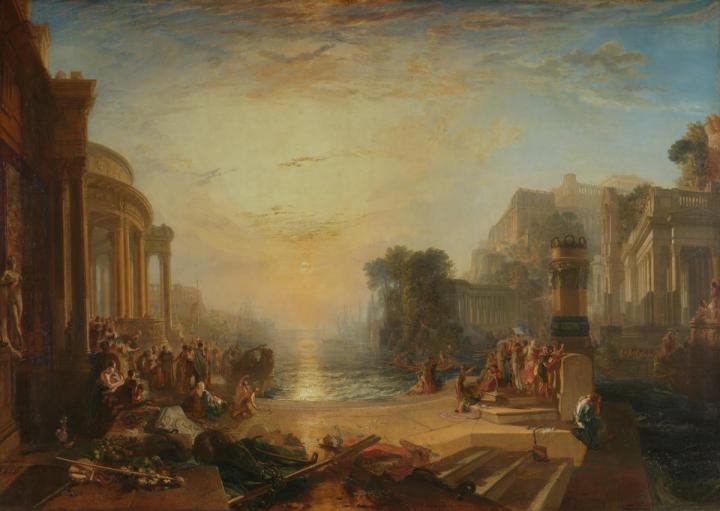
J.M.W. Turner, The Decline of the Carthaginian Empire, exhibited in 1817, oil on canvas, 170 × 239 cm (London: Tate, accepted by the nation as part of the Turner Bequest 1856, N00499).
◊ ◊ ◊ ◊ ◊
From the Paul Mellon Centre:
Turner 250
Tate Britain, London, 4–5 December 2025
2025 marks two hundred and fifty years since the birth of Romantic painter J.M.W. Turner (1775–1851). Timed to coincide with the Turner and Constable exhibition at Tate Britain and to help bring celebrations of Turner’s 250th anniversary year to a close, this conference will take Turner’s art and life as a starting point for exploring what it means to research Turner and to curate his work today.
t h u r s d a y , 4 d e c e m b e r
9.30 Registration with tea and coffee
10.00 Opening Remarks — Amy Concannon (Manton Senior Curator of Historic British Art at Tate)
10.10 Panel 1 | Curating Turner Now
Chair: Esther Chadwick (senior lecturer in history of art and Head of the History of Art Department, The Courtauld)
• Turner as Teacher: Lessons in Perspective — Helen Cobby (curator and lecturer, Bath Spa University)
• A Maligned Masterpiece? Displaying Turner’s The Battle of Trafalgar in Greenwich — Katherine Gazzard (Curator of Art (Post-1800), Royal Museums Greenwich)
• Reimagining the Liber Studiorum: Reasserting the Primacy of Print in Turner’s Art — Imogen Holmes-Roe (Curator (Historic Art), the Whitworth, University of Manchester)
• Curating Turner in East Anglia — Emma Roodhouse (curator and researcher) and Francesca Vanke (Senior Curator and Keeper of Fine and Decorative Art, Norwich Museums)
• A Site of Inspiration: Curating Turner at Petworth — Emily Knight (Property Curator, Petworth House) and Sue Rhodes (Visitor Experience Manager, Petworth House)
• The New Carthaginian: Turner, Memory, and Imperial Echoes (Performative Lecture) — Nick Makoha (poet and playwright)
12.50 Lunch break
Completing the Turner Cataloguing Project, the Paul Mellon Centre (PMC) film to be screened
2.00 Panel 2 | Researching Turner’s Bequest
Chair: Nicola Moorby (Curator, British Art 1790–1850, Tate)
• Introduction to Turner Bequest Catalogue — Matthew Imms (former Senior Cataloguer and Editor: Turner Bequest, Tate)
• The Discovery and Assembly of the 1838 Tour — Hayley Flynn (former Turner Cataloguer, Tate), with support from the Turner Society.
• Turner Technical Studies: Their Legacy and Preservation — Joyce Townsend (Senior Conservation Scientist, Tate)
3.10 Tea and coffee break
Completing the Turner Cataloguing Project, PMC film to be screened
3.40 Panel 3 | Building Turner’s Reputation
• About Carthage – An Exhibition of Seven Paintings by Stephen Farthing RA Held at the UK Ambassador’s Residence in Carthage 2025 — Stephen Farthing (artist)
• Turner and Robert Hills: Collaborating Contemporaries? — Kimberly Rhodes (professor of art history, Drew University)
• Paper Galleries and the Mediation of Art: Turner, John Constable, and Clarkson Stanfield in The Royal Gallery of British Art (ca. 1851) — Chia-Chuan Hsieh (professor, Graduate Institute of Art Studies, National Central University, Taiwan)
• From Patriotic Patronage to National Property: The Trajectory of the Petworth Turners, 1805–1956 — Andrew Loukes (Curator of the Egremont Collection, Petworth House)
5.20 Drinks reception
6.15 Evening Lecture
• Art, Music, and the Sublime — Tim Barringer, with live performance by the Kyan Quartet of Franz Schubert’s string quartet no.14 in D minor, D.810, Death and the Maiden
f r i d a y , 5 d e c e m b e r
10.00 Registration with tea and coffee
10.30 Panel 4 | Eco-critical Approaches to the Artist
Chair: Tom Ardill (Curator of Paintings, Prints and Drawings, London Museum)
• Out of the Blue: Exploring Water in Turner’s Work — Martha Cattell (artist, curator and researcher)
• Watermarks: Environmental Contingencies and the Turner Bequest — Tobah Aukland-Peck (postdoctoral fellow, PMC), with support from the Turner Society.
• Rethinking Turner’s Human Landscape — Caterina Franciosi (PhD candidate in the history of art, Yale University), with support from the Turner Society.
• What Was in Turner’s Lungs? — Sarah Gould (assistant professor, Université Paris 1, Panthéon-Sorbonne)
• Necro-Geographies of the Sublime: A Posthuman Reckoning with Turner’s Horizon (Multimedia Video-Essay) — Parham Ghalmdar (artist and researcher, The New Centre for Research & Practice)
12.40 Lunch break
Completing the Turner Cataloguing Project, PMC film to be screened
1.40 Panel 5 | Artistic Legacies
Chair: John Bonehill (senior lecturer in history of art, University of Glasgow)
• Encounters at MoMA: Turner, Rothko, and the Invention of ‘Modernist’ — Nicole Cochrane (Assistant Curator, Historic Art, 1790–1850, Tate Britain)
• 1966: Turner, Frank Bowling, and the Subject of Modernism — Ed Kettleborough (PhD candidate in history of art, University of Bristol), with support from the Turner Society.
• Where Sky Meets Ground: Turner and Sheila Fell in the Solway Firth — Kate Brock (researcher, Royal College of Art)
• Reservoirs of Recollection: John Akomfrah and the Oceanic Afterlives of Turner’s Sublime — Sabo Kpade (writer, curator, and researcher)
• What Can We Find in Turner’s Shadows? Artist Libby Heaney at Orleans House Gallery — Julia DeFabo (curator and creative producer), with support from the Turner Society.
4.20 Historical Fiction
• Varnishing Day: Ruskin, Turner, and the End of Idolatry — Cal Barton (writer and teacher)
4.40 Closing Remarks — Nicola Moorby and Amy Concannon (Tate) and Martin Myrone (PMC)
New Book | Patriots Before Revolution
From Yale UP:
Amy Watson, Patriots Before Revolution: The Rise of Party Politics in the British Atlantic, 1714–1763 (New Haven: Yale University Press, 2025), 344 pages, ISBN: 978-0300263213, $65. Series: The Lewis Walpole Series in Eighteenth-Century Culture and History
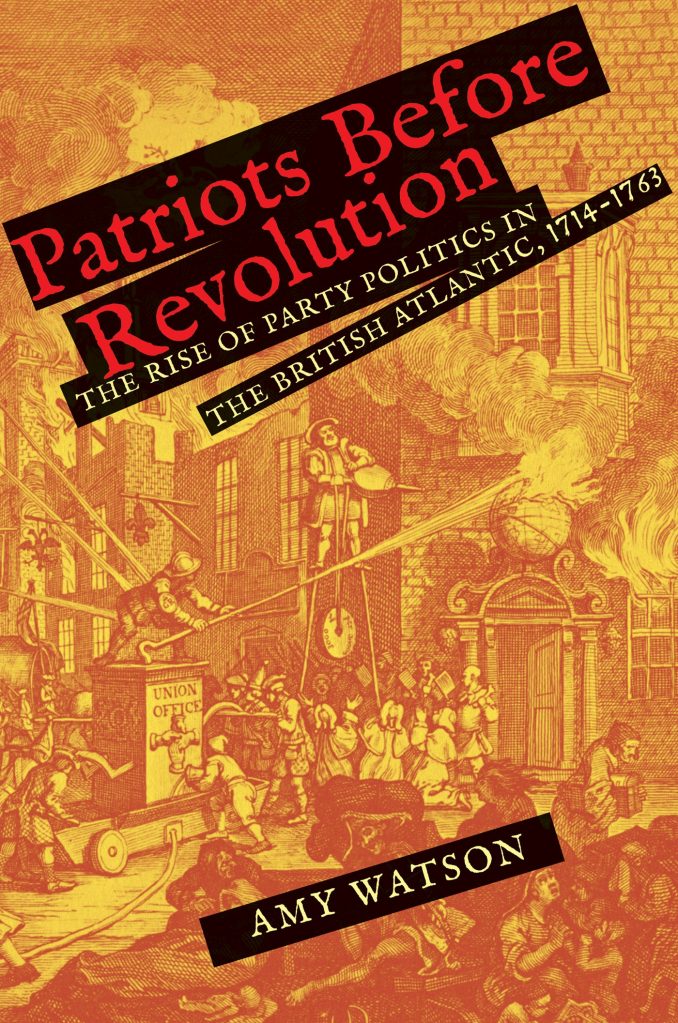 A new history of the Patriot movement before the American Revolution, tracing its origins to reform movements in British politics
The American revolutionaries—George Washington, Thomas Jefferson, John and Abigail Adams—called themselves Patriots. But what exactly did it mean to be a Patriot? Historian Amy Watson locates the origins of Patriotism in British politics of the early eighteenth century, showing that the label ‘Patriot’ was first adopted by a network of British politicians with radical ideas about the principles and purpose of the British Empire. The early Patriots’ ideological mission was not American independence but, rather, imperial reform: Patriots sought to create a British Empire that was militant, expansionist, confederal, and free.
Over the course of the next half century, these British reformers used print media and grassroots mobilization efforts to build an empire-wide political party with adherents in London, Edinburgh, New York City, and the new colony of Georgia. While building this party, the Patriots’ advocacy drew Britons into a series of violent political conflicts over taxes and civil liberty, as well as three expansive global wars, the War of Jenkins’ Ear (1739–48), the War of the Austrian Succession (1740–48), and the Seven Years’ War (1756–63). Patriot ideas and organizations came to divide Britons on increasingly sharp political lines, laying the groundwork for the revolutionary decades to come.
Amy Watson is assistant professor of history at the University of Alabama at Birmingham.










 Enfilade
leave a comment