Exhibition | The Grand Dauphin (1661–1711)
Now on view at Versailles:
The Grand Dauphin (1661–1711): Son of a King, Father of a King, but Never a King
Château de Versailles, 14 October 2025 — 15 February 2026
Curated by Lionel Arsac and Lorène Legrand
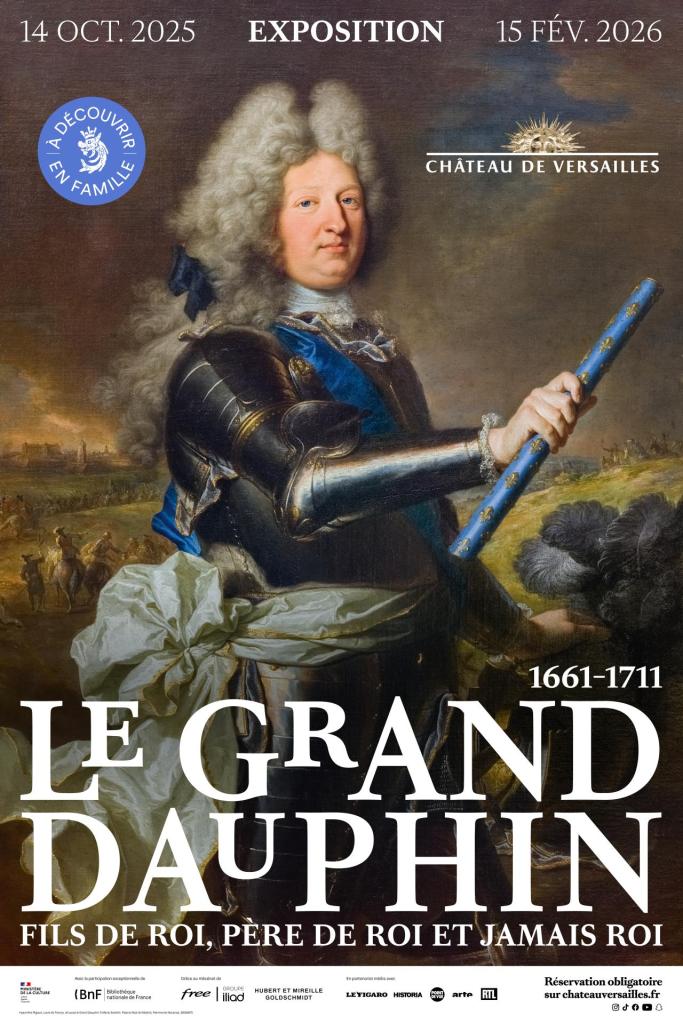 The Palace of Versailles is presenting an exhibition devoted to the Grand Dauphin, Louis de France, the eldest child of Louis XIV. It traces the life of this often overlooked prince through nearly 250 works from French and international collections. As heir to the throne, he was the focal point of Bourbon dynastic ambitions, without ever reigning, but his education, residences, and taste for the arts reflect the destiny which was his due.
Born in 1661 at the château de Fontainebleau, Louis de France was the first son of Louis XIV and Maria Theresa of Spain. During his lifetime as Dauphin, he was called ‘Monseigneur’ but was given the name ‘Grand Dauphin’ after his death in 1711, to distinguish him from his son, the Duke of Burgundy.
This heir to the crown died prematurely of smallpox in April 1711 at the château de Meudon, four years before his father. His eldest son, the Duke of Burgundy, died a year later, leaving behind two children. The eldest child, the two-year-old Duke of Anjou, became the dauphin and acceded to the throne in 1715 after the death of Louis XIV under the name Louis XV. Although the Grand Dauphin did not reign, he remains a key figure in the Bourbon dynasty: grandfather to Louis XV, great-great-grandfather to Louis XVI, Louis XVIII and Charles X, and father of Philip V, first sovereign of the Spanish branch of the Bourbons, which still reigns to this day.
The Grand Dauphin’s entire life was spent preparing to be king, and he received a rigorous education in the arts, war, and government. His life was summed up by Saint-Simon in the famous formula: “Son of a king, father of a king, but never a king.” It embodies the paradox of a prince who was trained to rule, but was never crowned.
Aside from his political duties, the Grand Dauphin also developed a keen taste for the arts and the pleasures of the court. He was an avid collector and assembled a large number of works of art, some of which will be exhibited for the first time due to exceptional loans, notably from the Prado Museum in Madrid.
The exhibition, created with the exceptional participation of the BnF Museum, turns the spotlight on what it meant to be the Dauphin of France under the Ancien Régime by retracing the major stages of the life of the Grand Dauphin. It is presented in three sections mirroring Saint Simon’s formula, and explores his education as a prince, his life at court, and his involvement in affairs of state.
Lionel Arsac and Lorène Legrand, eds., Le Grand Dauphin: Fils de Roi, Père de Roi et Jamais Roi (Dijon: Éditions Faton, 2025), 472 pages, ISBN: 978-2878444087, €54.










 Enfilade
leave a comment