New Book | BVRB’s Commodes
From Giles:
Marie-Laure Buku Pongo and William Christie, BVRB’s Commodes (London: D. Giles, 2025), 72 pages, ISBN: 978-1917273121, $30. Frick Diptych 16.
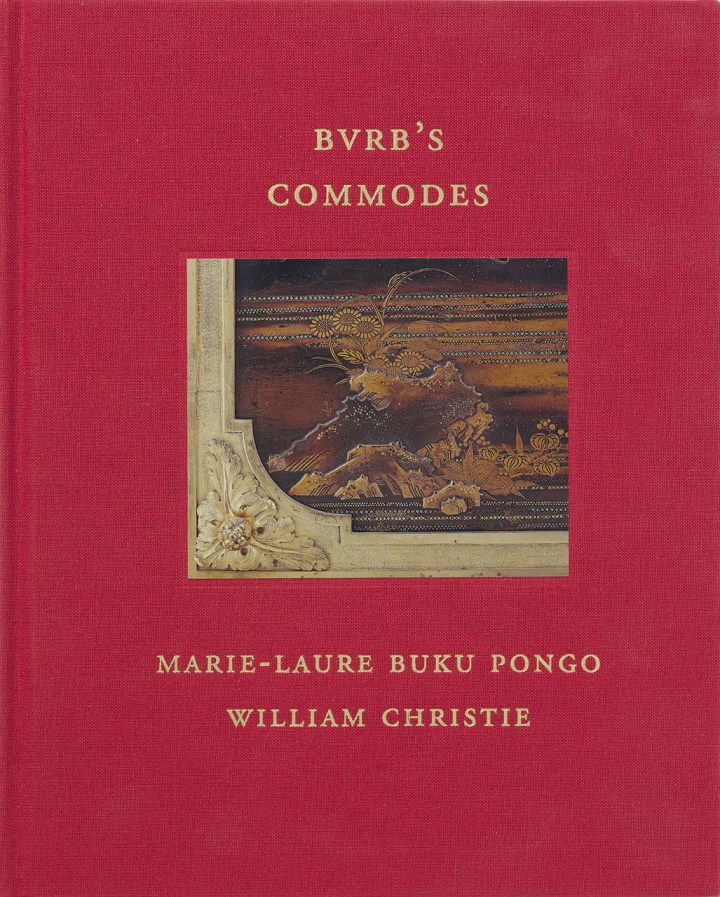 This new volume in the Frick Diptych series features an essay by Frick curator Marie-Laure Buku Pongo paired with a contribution by world-renowned conductor and keyboardist William Christie.
These two cabinets, stamped BVRB, may well be the last pieces of furniture made by the celebrated Parisian cabinetmaker Bernard van Risenburgh II just before he retired in 1764 and sold his workshop to his son, Bernard van Risenburgh III, who finished them. The cabinets feature panels of black-and-gold Japanese lacquer of exceptionally high quality taken from a seventeenth-century Japanese cabinet, chest, or screen. Beginning in the 1730s, the older van Risenburgh worked almost exclusively with the influential marchands-merciers or merchants of luxury goods, who provided the cabinetmaker with the rare and costly Oriental lacquers and sometimes with the design for the furniture on which to mount them.
Marie-Laure Buku Pongo is assistant curator of Decorative Arts at The Frick Collection. Conductor and harpsichordist William Christie is a specialist in the baroque and classical repertoire; he is the founder of the ensemble Les Arts Florissants.
H-France Salon 17.1 (2025): The Myth of French Taste
The following articles are all available free of charge . . .
H-France Salon 17.1 (2025) — The Myth of French Taste
Edited by Oliver Wunsch
The concept of goût français has been central to French national identity since at least the late seventeenth century, yet the centuries since have yielded no clear consensus on its meaning. Does ‘French taste’ signify the cosmopolitanism of a nation whose defining feature is its role as a cultural crossroads? Or does it name the very quality that shields France from foreign influence and the pressures of globalization?
The essays in this special issue of H-France Salon show how the idea of French taste has, for over three hundred years, mediated between these opposing visions of France’s place in the world. From the luxury trades of the ancien régime to postwar debates over abstraction, ‘French taste’ has been invoked as a unifying principle precisely when the conception of France itself was most in flux. Yet a closer look at its history reveals the limits of its power to reconcile the antipodes of cosmopolitan universalism and nationalistic chauvinism.
c o n t e n t s
• The Vexations of French Taste — Oliver Wunsch (Boston College)
• French Taste, Absolutism, and Economic Competition in the Eighteenth Century — Natacha Coquery (University of Lyon 2, LARHRA)
• From le Goût Universel to le Goût de Terroir: ‘French Taste’ in Modern Gastronomic Discourse — Benjamin Poole (Texas Tech University)
• Was (and Is) ‘French Fashion’ Just a Myth? — Sophie Kurkdjian (American University of Paris)
• Toying with Taste: Play and Aesthetic Education in Modern France — Shana Cooperstein (School of Humanities, IE University)
• Expressionist Abstraction and the Tradition Française — Linda Stratford (Asbury University)
• Globalizing French Luxury: The Comité Colbert and L’Art de Vivre, 1983–2025 — Grace Allen (The College Preparatory School in Oakland, California)










 Enfilade
leave a comment