Exhibition | Teatime: Chinese Enamels from the Taft Collection
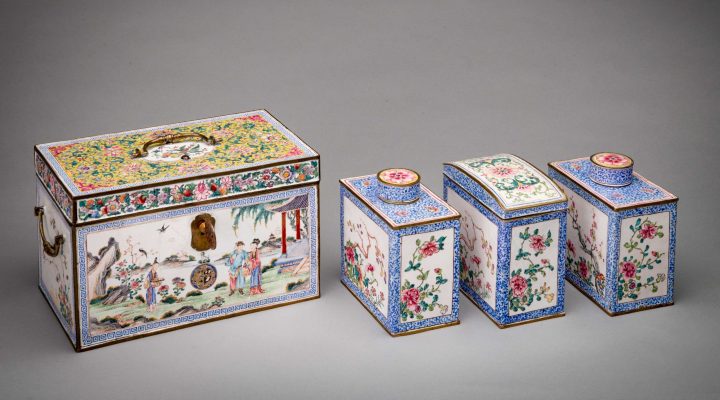
Tea Caddy with Armorial Decoration, ca. 1750–60, Qing dynasty, enamel on copper with gilded copper mounts (Cincinnati: Taft Museum of Art, Bequest of Compton Allyn, 2014.1.27.1, 2a-b, 3a-b, 4a-b).
◊ ◊ ◊ ◊ ◊
From the press release for the exhibition:
Teatime: Chinese Enamels from the Taft Collection
Taft Museum of Art, Cincinnati, 15 November 2025 — 22 March 2026
The Taft Museum of Art presents Teatime: Chinese Enamels from the Taft Collection, the museum’s first exhibition dedicated to the history of tea and its cultural legacy. Adorned with colorful designs, the works of art included in the show are part of a bequest of 89 enamels from the late Reverend Compton Allyn. His 2014 donation forms one of the world’s largest known public collections of Chinese painted enamels. Featuring 24 rarely seen works from the museum’s collection—most of which are typically in storage—Teatime offers a unique opportunity to explore the beauty, symbolism, and craftsmanship of enamelware in the context of tea culture in China and beyond.
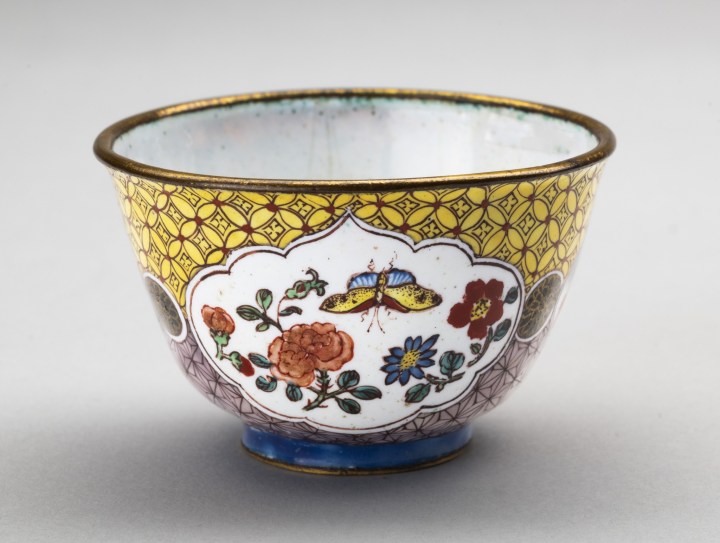
Cup with Flowers and Insects, ca. 1740–95, Qing dynasty, enamel on copper (Cincinnati: Taft Museum of Art, Bequest of Compton Allyn, 2014.1.40.1).
From intricately decorated teapots and cups to saucers and tea caddies, the objects on view reflect the skill of Qing dynasty artisans. These works were probably intended for Western buyers, as the passion for tea spread from China to Europe and America in the 1700s. Dutch merchants had first begun importing tea into Europe in the early 1600s. In 1662, King Charles II of England married the Portuguese noblewoman Catherine of Braganza, who brought her love of tea to the English court. The beverage quickly became popular with the aristocracy, and eventually the craze for tea permeated Western society. Of course, Westerners not only wanted tea leaves from China, they wanted teapots, cups, saucers, and accessories. Today, the skillfully created works of art in Teatime help tell the story of tea’s roots in China and how it became all the rage in 18th-century Europe and America.
“The Taft has a long history steeped in tea traditions—from New Year’s Day parties thrown by museum founders, Anna Sinton Taft and Charles Phelps Taft, in the early 1900s to festive holiday teas offered to visitors today—so it is fitting to celebrate this beloved beverage in an exhibition that also highlights some of the beautiful works of art in the collection,” says Taft Museum of Art Associate Curator, Ann Glasscock.
Visitors who want to extend the tea experience can explore the museum’s Chinese porcelain teapots and other tea-related objects on view in the collection galleries, and through Sunday, January 4, they can enjoy a tea-themed holiday tree with decorations by contemporary artists in the Duncanson Foyer and see the annual holiday display in the Dining Room, “All Set for Afternoon Tea.”
The museum’s 200-year-old historic house was once home to notable Cincinnatians such as Nicholas Longworth and museum co-founders Anna Sinton Taft and Charles Phelps Taft. The one-of-a-kind landmark is now a destination of international cultural significance. The museum’s collection of more than 800 objects includes important Chinese porcelains, European decorative arts, French Renaissance enamels, American furniture, and masterpiece paintings by Thomas Gainsborough, Francisco Goya, Rembrandt van Rijn, John Singer Sargent, J. M. W. Turner, and James McNeill Whistler. Eight monumental landscape murals by Robert S. Duncanson, the first Black American artist to achieve global acclaim, also adorn the walls of the museum’s foyer.










 Enfilade
leave a comment