Attingham Courses in 2026
Attingham offerings for 2026:
The Study Programme | Sweden: Stockholm and Its Hinterland
Led by David Adshead with Beatrice Goddard, 8–14 June 2026
Applications due by 30 January 2026
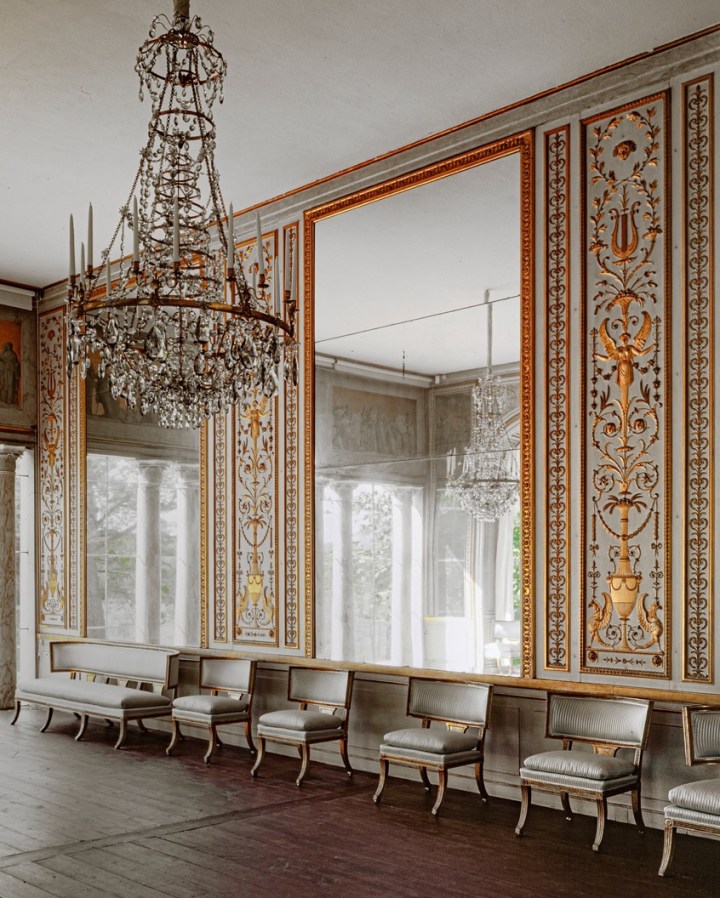
The Hall of Mirrors, Gustav III’s Pavilion at Haga Park. The Royal Palaces, Sweden (Photograph: ©Jens Markus Lindhe).
This intensive seven-day course will study the patronage of successive Swedish royal dynasties and that of the nobility and wealthy merchant class, in Stockholm’s palaces and the castles and country houses of its hinterland—Svealand, the nation’s historic core. With earlier outliers, it will focus on the arts and architecture of the mid 17th to early 19th centuries, encompassing the Baroque, Rococo, neo-Classical and ‘Empire’ styles.
For more than a hundred years, from the accession of Gustavus Adolphus in 1611 to its loss of territory at the end of the Great Northern War in 1721, Sweden was a European military superpower and enjoyed an ‘Age of Greatness’, its fortunes reflected in the richness of buildings, interiors, and collections of fine and decorative arts, particularly those of the monarchy. A new political compact with power-sharing between government and parliament—the so-called ‘Age of Liberty’—subsequently encouraged a flowering of the arts and sciences and the further influence of all things French. During the following ‘Gustavian Age’, led by the energetic but latterly autocratic, Gustav III, Sweden’s elegant interpretation of neo-Classicism reached its apogee.
In Stockholm, visits will be made to the Riddarhuset, Riddarholmskyrkan, the Royal Palace, and Gustav III’s Museum of Antiquities. Outside Stockholm, in addition to a number of private houses, visits will include, Tullgarns Palace, Drottningholm Palace, Svartsjö Palace, the English landscape park at Haga, Rosersberg Palace, Svindersvik a summer residence, Gripsholm Castle, the manor house at Grönsöo, and Skokloster Castle. For the last two nights we will be staying in the town of Mariefred on the south-west tip of Lake Mälaren.
◊ ◊ ◊ ◊ ◊
The 73rd Summer School
Led by David Adshead and Tessa Wild, with Sabrina Silva, 27 June — 12 July 2026
Applications due by 30 January 2026
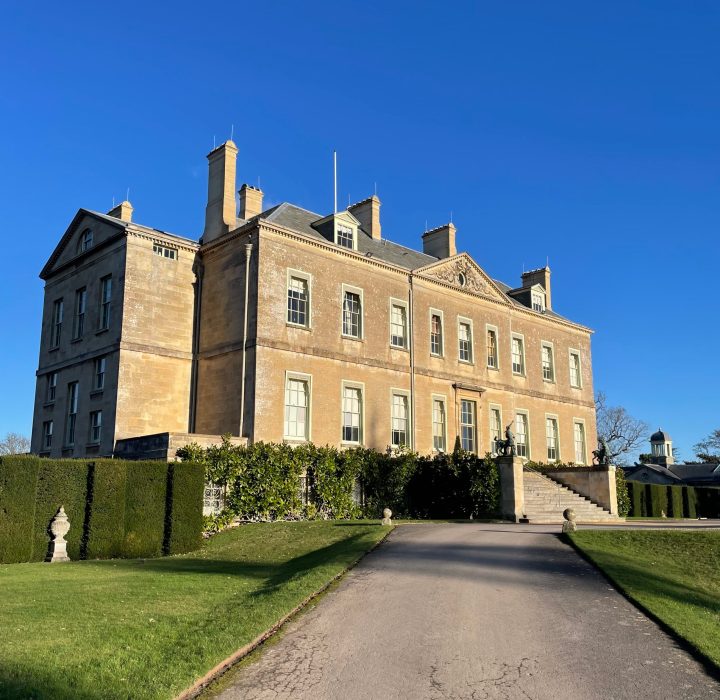
Buscot Park, Faringdon, Oxfordshire, 1780–83.
The 73rd Attingham Summer School, a 16-day residential course will visit country houses in Sussex, Derbyshire, Nottinghamshire, Buckinghamshire, and Oxfordshire. From West Dean, our first base, we will study, amongst other houses and gardens: Petworth House, where the patronage of great British artists such as Turner and Flaxman enrich its Baroque interiors; Parham, a fine Elizabethan house in an unrivalled setting; and Standen, an Arts and Crafts reinterpretation of the country house.
In the Midlands, a series of related houses will be examined: Hardwick Hall, unique amongst Elizabethan houses for its survival of late 16th-century decoration and contents; Bolsover Castle, a Jacobean masque setting frozen in stone; and Chatsworth, where the collections and gardens of the Cavendishes and Dukes of Devonshire span more than four centuries. Other highlights include Robert Adam’s crisp neo-Classical interior and Fishing Pavilion at Kedleston Hall.
The final part of the course will focus on the rich estates and collections of Oxfordshire. Our itinerary will include Broughton Castle, a moated and fortified manor house with a chapel first consecrated for Christian worship in 1331, and Buscot Park, with its superb collection with works by Rembrandt, Botticelli, Rubens, Edward Burne-Jones and Dante Gabriel Rossetti, and furniture by Robert Adam and Thomas Hope. While at Buscot we will have the opportunity to explore one of the country’s finest water gardens, designed by Harold Peto in 1904 and extended from 1911–13, and a surviving country house theatre created in 1936 for the 2nd Lord Faringdon. We will also visit the much more modest 17th-century stone-built, Kelmscott Manor, the beloved country home of William Morris and his family, and the place that he described as ‘Heaven on Earth’.
◊ ◊ ◊ ◊ ◊
Royal Collection Studies
Led by Helen Jacobsen, with Beatrice Goddard, 6–15 September 2026
Applications due by 15 February 2026

James Roberts, The Pavilion Breakfast Room at Buckingham Palace (known by 1873 as the Queen’s Luncheon Room), 1850, watercolour and bodycolour with gum arabic, paper: 26 × 38 cm (RCIN 919918).
The Royal Collection is one of the world’s leading collections of fine and decorative art, with over one million works from six continents, many of them masterpieces. Working in partnership with The Royal Collection Trust, this ten-day residential course offers participants the opportunity to study the magnificent holdings of paintings, furniture, metalwork, porcelain, jewellery, sculpture, arms and armour, books, and works on paper and to examine the architecture and interiors of the palaces which house them. Based near Windsor, the course also examines the history of the collection and the key roles played by monarchs and their consorts over the centuries. Combining a mixture of lectures and tutorials, visits to both the occupied and unoccupied palaces in and around London and close-up object study, Royal Collection Studies aims to give experienced professionals in the heritage sector a deeper understanding of this remarkable collection.
◊ ◊ ◊ ◊ ◊
From College Library to Country House
Led by Andrew Moore, with Rita Grudzien, 7–11 September 2026
Applications due by 15 February 2026
This course is conceived from the perspective of the British aristocracy and gentry whose education centred upon preparing them to run their country estate, including the house and collections, and argues for the importance of the library and the book collection in this process. Too often in country house studies the architecture, interior design, and art collections have held sway; this course aims to foreground the College book collections at the disposal of tutors and the subsequent development of the country house library. Libraries reveal not only the intellectual or recreational interests of past generations, but also how books manifest taste, fashion, and opportunities for display. Book historians and tutors well known in their respective fields will conduct the course, attending to a broad variety of subjects including book binding, the development of the idea of rare books and of book collections, library portraiture, and questions of spatial analysis and mobility—all in the context of the collections housed in some of the oldest and most complete book rooms in Britain.
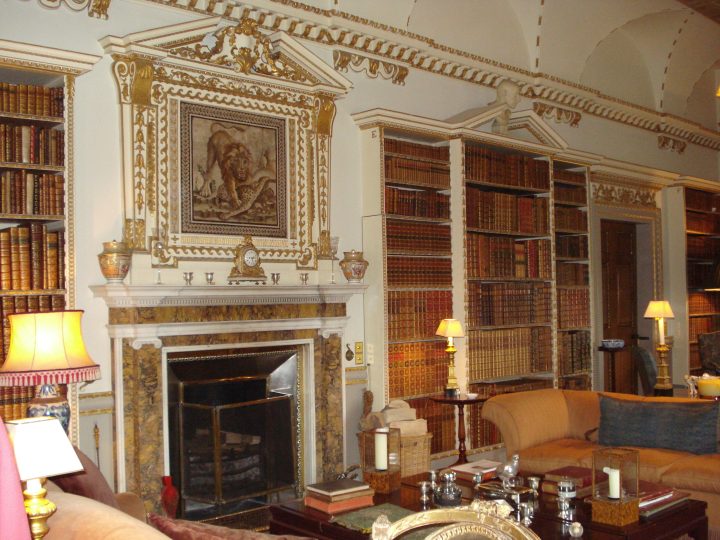
Library at Holkham Hall.
This intensive residential five-day course is based in the exceptional surroundings of St Catharine’s College, a constituent college of the University of Cambridge. Directed by Dr Andrew Moore, the programme plans to visit a series of iconic libraries. These include the historic private library of Houghton Hall, created by Robert Walpole, and Holkham Hall, home to one of the greatest private manuscript and printed book collections in Britain, housed today in three of the country’s most important country house library rooms. The course will also visit the library designed by James Gibbs for Edward Harley, Earl of Oxford at Wimpole Hall in Cambridgeshire, and the Braybrooke library rooms at Audley End, of considerable interest for being reconstituted from dressing rooms into the 3rd Lord Braybrooke’s library, incorporating the inherited Neville family books. The library at Audley End functioned as an informal family sitting room, with the adjacent study (the South Library) still displayed as it looked in the early 19th century.
The course includes the Old Libraries of St John’s College and Queens’ College; the Wren Library, Trinity; the Perne Library at Peterhouse; the Parker Library at Corpus Christi; and the Founder’s Library at the Fitzwilliam Museum. Additional seminars will take place in the context of the historic book collections in the Cambridge University Library designed by Giles Gilbert Scott (1880–1960). St Catharine’s College will host a seminar on the medical book collection of John Addenbrooke (1680–1719), founder of Addenbrooke’s Hospital, Cambridge.
◊ ◊ ◊ ◊ ◊
Note (added 14 January 2026) — From Attingham’s Instagram account (6 January 2026) . . .
We are thrilled to congratulate Annabel Westman on being awarded an MBE in the New Year Honours “for services to heritage, particularly to The Attingham Trust and historic textiles.” Annabel’s time as Director of the Attingham Summer School (1993–2005) and Executive Director of The Attingham Trust (2005–2021) helped shape Attingham into the vibrant, welcoming, and extraordinary community it is today. Alongside this, her distinguished career as a textile historian and consultant has enriched the understanding and restoration of historic interiors worldwide. This honour is richly deserved, and we are so proud to celebrate Annabel and all she continues to give to the field.
New Book | Bluestockings and Landscape in Eighteenth-Century Britain
From Boydell & Brewer:
Markman Ellis and Jack Orchard, eds., Bluestockings and Landscape in Eighteenth-Century Britain: The Prospect of Improvement (London: Boydell Press, 2025), 292 pages, ISBN: 978-1837650507, £85. Available as an ebook for £19. Studies in the Eighteenth Century series, Volume 16.
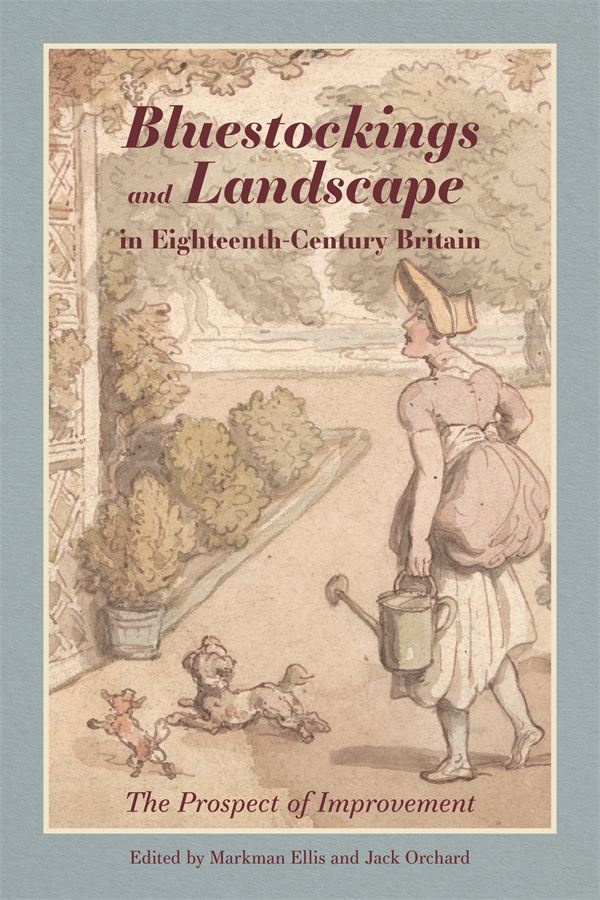 Situated within the broader context of eighteenth-century intellectual and cultural history, this collection redefines the role of the Bluestocking circle in shaping Britain’s landscapes and social ideals. Against the backdrop of Whiggish notions of ‘improvement’—encompassing agricultural innovation, aesthetic refinement, and moral progress—it explores how women such as Elizabeth Montagu, Mary Delany, and Elizabeth Carter navigated the intersections of polite sociability, intellectual production, and estate management. Their contributions reveal a dynamic interplay between cultural critique and practical reform, positioning them as active participants in the period’s debates on land, labour, and national identity.
Drawing on insights from the Elizabeth Montagu’s Correspondence Online (EMCO) project, these essays uncover the creative and social tensions embedded in iconic estates such as Montagu’s Sandleford and Lord Lyttelton’s Hagley Hall. They delve into the poetic and philosophical musings of James Woodhouse, the sociable artistry of Mary Delany, and the symbolic landscapes of Wrest Park. By examining correspondence, poetry, visual arts, and cartography, this volume offers an unprecedented exploration of the ways Bluestocking women engaged with and redefined the designed landscape as a site of intellectual and environmental innovation. This interdisciplinary collection reshapes the historiography of gender, environment, and cultural progress, offering fresh insights into the enduring significance of eighteenth-century landscapes and the intellectual communities that shaped them.
Markman Ellis is Professor of Eighteenth-Century Studies at Queen Mary University of London.
Jack Orchard is Content Editor of the Electronic Enlightenment project based at the Bodleian Libraries, Oxford.
c o n t e n t s
List of Illustrations
Notes on Contributors
Acknowledgements
Foreword: ‘Bringing Elizabeth Montagu to the World’ — Joanna Barker and Nicole Pohl
Introduction: ‘The Prospect of Improvement: Bluestockings and Landscape in Eighteenth-Century Britain’ — Markman Ellis and Jack Orchard
Section One
1 Idioms of Improvement: Gender and Social Relations on the Montagu Estates, 1730–1800 — Steve Hindle
2 Religious Faith, Class Politics, and Equitable Progress: James Woodhouse and Elizabeth Montagu’s Contending Visions of Improvement — Adam Bridgen and Steve Van Hagen
3 Cultivating Wilderness — Ve-Yin Tee
Section Two
4 ‘Another Little Excursion’: On Tour with Mrs Montagu and Lord Lyttelton — Michael Cousins
5 Cultivating Land, Literature, Letters: Textualities of Improvement in Elizabeth Montagu’s Travels in Scotland — Millie Schurch
6 ‘She had no eyes nor understanding to see that it was not a common vulgar garden’: Mary Delany’s Landscapes of Improvement — Kristina Decker
7 Ladies of Landscape: The Discovery of Lady Harriett Garnier’s ferme ornée at Rookesbury, Hampshire — Rosemary Baird Andreae
Section Three
8 ‘The Genius of Rest … those Happy Groves Inspired’: Literary Composition, Coterie Sociability, and the Gardens at Wrest Park — Jemima Hubberstey
9 ‘Fate Led Me from my Lov’d Retreat’: The City and the Country in Elizabeth Harcourt’s Writings — Mary Chadwick
10 ‘Death’s Refreshing Shade’: Elizabeth Carter, ‘Church-yard Poetry’ and Contemplative Retirement in the Gardens of the Dead — James Metcalf
Afterword: Bluestocking Landscapes — Stephen Bending
Bibliography










 Enfilade
leave a comment