Call for Papers | Visualizing Antiquity: The Copy of the Copy
From the Call for Papers and ArtHist.net (which includes the Call for Papers in German). . .
Visualizing Antiquity: On the Episteme of Early Modern Drawings and Prints V:
The Copy of the Copy … of the Copy: Techniques of Pictorial Reception of
Antiquity in the Early Modern Period
Berlin-Brandenburgische Akademie der Wissenschaften, 3 July 2026
Organized by Elisabeth Décultot, Arnold Nesselrath, Cristina Ruggero, and Timo Strauch
Proposals due by 11 January 2026
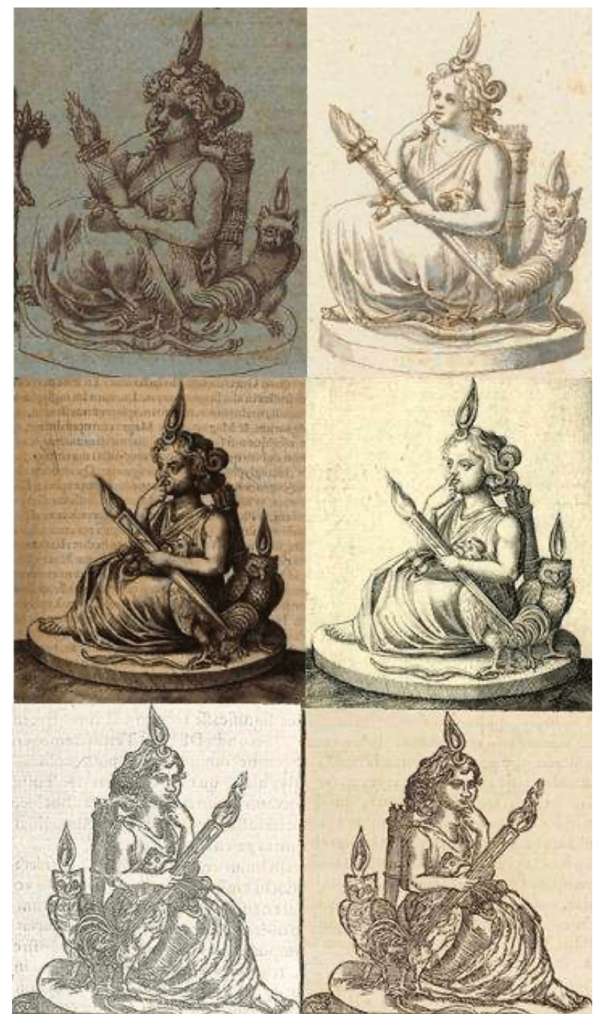
Various early modern depictions of Harpocrates (the Greek form of the Egyptian child-god Horus).
In virtually all domains of human creativity, the outcomes—whether deliberately or inadvertently—are subject to the principle of repetition. This phenomenon likewise characterizes the history of acquiring knowledge about antiquity. Once information has been recorded in written or visual form, it typically becomes the point of departure for subsequent reproductions. The material documented at the beginning of the transmission process is copied and disseminated for as long as it is considered useful, with the copies themselves generally functioning as further agents of replication.
In this process, copies function not merely as duplicates in a subordinate hierarchical relationship to the ‘original’, but as powerful resources of knowledge. They enable the preservation, transmission and creative transformation of knowledge about specific objects, monuments and forms. In transmission chains that are often only partially preserved—and frequently lack the now-lost ‘original’—, copies are rather the standard means of transmission. As such, they provide essential insights into historical developments, reveal methodological approaches, and support the production of knowledge by making ongoing engagement with ancient models visible.
The fifth colloquium in the series Visualizing Antiquity: On the Episteme of Early Modern Drawings and Prints focuses on copying processes in graphic arts that deal with antique or supposedly antique artefacts. The primary aim is not to examine the function of repetition as an artistic exercise or attempt at stylistic emulation, but rather the role of copies in the context of the transmission and transformation of knowledge. Images ‘live on’ by being traced, redrawn, re-engraved or otherwise transformed in order to preserve and convey concepts, forms and concrete objects, or to illustrate and continue discourses about them.
The entire chain of possible lines of transmission will be examined: from the study of the ‘original’—a term that in this context needs to be questioned itself—to proven or inferred copies in drawing or print, to their use in antiquarian, academic or artistic contexts. What material, institutional and epistemic structures determined the circulation of these images? How did repeated transmission influence the perception of antiquity, and were objects and images reinterpreted or creatively transformed despite being copies? Did the actors involved—draughtsmen, engravers, antiquarians or publishers—address the methodology of copying and the quality of the reproductions? What significance did the point of origin of the tradition have, and how did the status of graphic art as a medium between documentation, illustration and imagination change? Are there differences depending on the type of objects being passed on, for example in the case of records of antique architecture and their use in architectural theory (editions of Vitruvius)?
Possible topics, with further suggestions also welcome:
• Examples of ‘long-chain’ transmission of ancient artefacts and monuments in 17th- and 18th-century graphic arts
• (Non-)availability of lost and missing artefacts and monuments
• Manipulation and conjecture in the process of replication
• Breaks and ruptures in established patterns
• Copying as practice and method
• Technical reproduction processes: from drawing to drawing, from drawing to print, from print back to drawing
• Copies in drawing and print as instruments of knowledge circulation and preservation
• Academic, antiquarian and publishing contexts of graphic reproduction
• Copies as a means of documentation, systematisation and virtual collections
The colloquium thus aims to highlight the process of copying as a mode of cultural and media transmission—as a process in which images, and with them knowledge, remain in motion.
Researchers are invited to submit proposals for 20-minute presentations in German, English, French, or Italian, ideally combining case studies with broader perspectives. Proposals (max. 400 words) can be submitted until 11 January 2026, together with a short CV (max. 150 words) to thesaurus@bbaw.de with the keyword ‘Episteme V’. Hotel and travel expenses (economy-class flight or train; 2 nights’ accommodation) will be reimbursed according to the Federal Law on Travel Expenses (BRKG). Publication of the contributions to the colloquium in expanded form is planned.
Bildwerdung der Antike: Zur Episteme von Zeichnungen und Druckgrafiken der
Frühen Neuzeit V: Die Kopie der Kopie … der Kopie: Techniken der bildlichen
Antikenrezeption in der Frühen Neuzeit Bildwerdung der Antike
Organized by the Academy Research Project Antiquitatum Thesaurus. Antiquities in European Visual Sources from the Seventeenth and Eighteenth Centuries. Conceived by Elisabeth Décultot, Arnold Nesselrath, Cristina Ruggero, Timo Strauch.










 Enfilade
leave a comment