Exhibition | Stan Douglas: Tales of Empire
From the press release for the exhibition:
Stan Douglas: Tales of Empire
McMichael Canadian Art Collection, Kleinburg, Ontario, 5 December 2025 — 22 March 2026
Curated by Sarah Milroy
This winter, the McMichael Canadian Art Collection presents Stan Douglas: Tales of Empire, a landmark exhibition surveying three decades of work by internationally acclaimed Vancouver-based artist Stan Douglas. The exhibition brings together five major photographic series that explore the histories, legacies, and enduring reverberations of colonialism across continents and centuries. Curated by Frances & Tim Price Executive Director and Chief Curator Sarah Milroy, Tales of Empire investigates the power structures, mythologies, and lived realities shaped by imperialism through Douglas’s technically masterful and conceptually incisive lens.
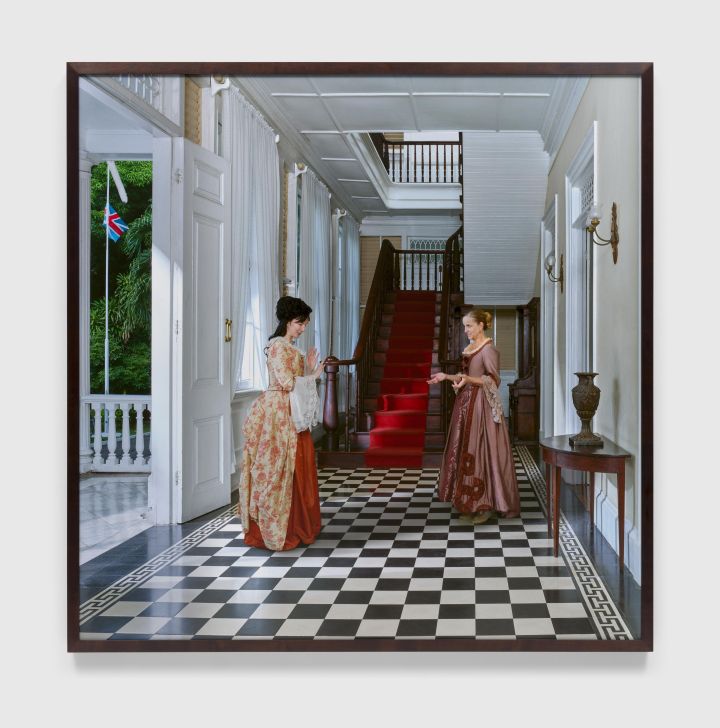
Stan Douglas, Act I, Scene V: In which Polly Peachum is Greeted at the Ducat Estate by Family Friend Diana Trapes, who Will Ultimately Betray Her, 2024, inkjet print on Dibond aluminum, 150 × 150 cm (courtesy of the artist, Victoria Miro, and David Zwirner).
• The Nootka Series (1996) — Created on the northwest coast of Vancouver Island, this series traces the enduring presence of Indigenous communities and moments of early contact with European settlers. At the McMichael, these photographs are being shown in dialogue with historical paintings by A.Y. Jackson, opening a compelling conversation between Douglas’s contemporary vision and the Group of Seven’s early twentieth century perspective.
• The Cuba Series (2005) — Capturing the complex architectural and political landscape of Havana and other Cuban towns, these images illuminate how centuries of Spanish, American, and Soviet influence have shaped the city’s identity and visual fabric.
• The Western Series (2006) — Set in British Columbia’s interior, this series examines landscapes marked by resource extraction, revealing how settler-driven development has altered the environment and reshaped the region.
• The Klatsassin Series (2006) — A cinematic re-imagining of a violent episode of Indigenous resistance in nineteenth-century British Columbia. Douglas invents a cast of characters associated with the event, blurring the boundaries between fact and fiction while probing how stories of colonial conflict are constructed and remembered.
• The Enemy of All Mankind (2024) — Douglas’s most recent project draws inspiration from Polly (1729), the satirical sequel to John Gay’s The Beggar’s Opera. Featuring a costumed ensemble, the series restages scenes of decadence, intrigue, and misadventure in the Caribbean, using Enlightenment-era satire to critique the moral bankruptcy of colonialism for a contemporary audience.
Across these bodies of work, Douglas dissects and dramatizes the machinery of empire—its spectacle, its systems, and its violence—while inviting viewers to reconsider how histories are recorded, contested, and retold.
◊ ◊ ◊ ◊ ◊
 Stan Douglas (b. 1960, Vancouver) is an internationally renowned artist whose multidisciplinary practice spans photography, film, video, installation, and theatre. Since the 1980s, he has created technically ambitious works that explore the complexities of history, collective memory, and the lasting imprint of colonialism. Through innovative uses of both analog and digital media, Douglas restages pivotal historical moments—often at cultural, political, or social tipping points—blurring the boundaries between documentary and fiction, cinema, and visual art.
Douglas has been featured at the Venice Biennale five times, most recently in 2022 with the acclaimed video installation ISDN. His work has been presented in solo exhibitions at major institutions worldwide, including the Centre Pompidou, MoMA, and the National Gallery of Canada and is held in leading museum collections across North America and Europe. Recent projects include a permanent public commission at New York’s Moynihan Train Hall (2021) and the recent survey Stan Douglas: Ghostlight at Bard College’s Hessel Museum of Art in 2025. He is the recipient of numerous awards, including the Audain Prize for Visual Art (2019); the Hasselblad Foundation International Award in Photography (2016); the third annual Scotiabank Photography Award (2013); and the Infinity Award from the International Center of Photography, New York (2012). In 2021, Douglas was knighted as a Chevalier of the Ordre des Arts et des Lettres by the French Minister of Culture, and in 2023 he was awarded an honorary doctorate by Simon Fraser University, Greater Vancouver. Douglas lives and works in Vancouver.
Stan Douglas: Tales of Empire (Kleinburg: McMichael Canadian Art Collection, 2025), 128 pages, $35 CAD. Introduction by Sarah Milroy, an interview with the artist, and an essay by André Alexis.
New Book | Race and the Scottish Enlightenment
From Yale UP:
Linda Andersson Burnett and Bruce Buchan, Race and the Scottish Enlightenment: A Colonial History, 1750–1820 (New Haven: Yale University Press, 2025), 304 pages, ISBN: 978-0300264388, $65. Series: The Lewis Walpole Series in Eighteenth-Century Culture and History.
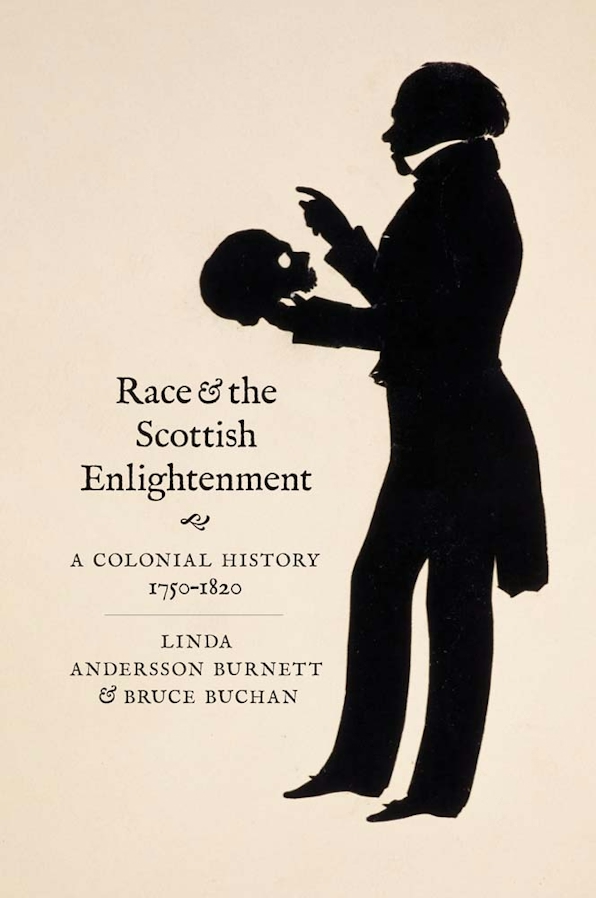 In the decades after 1750, an increasing number of former medical students from the University of Edinburgh construed humanity as a subject of both intellectual curiosity and colonial interest. They drew on a shared educational background, blending medicine with natural history and moral philosophy, in a range of encounters with non-European and Indigenous peoples across the globe whom they began to classify as races. Focusing on a surprising number of these understudied students, this book reveals the gradual predominance of race in Scottish Enlightenment thought.
Teaching provided a toolbox of concepts and theories for students who went on to careers as military and naval surgeons, colonial administrators, and natural historians. While some, such as Mungo Park—who traveled in Africa—are well known, many others such as the long-term residents in the Russian Empire, Matthew Guthrie and his wife, Maria Guthrie, or the Caribbean botanist Alexander Anderson are less remembered. Among this group were those such as the Pacific traveler Archibald Menzies and the circumnavigator of Australia, Robert Brown, who are known primarily as botanists rather than as ethnographers. Together they formed a global network of colonial travelers and natural historians sharing a common educational background and a growing interest in race.
Linda Andersson Burnett is a senior lecturer in the Department of History of Science and Ideas at Uppsala University, Sweden. Bruce Buchan is a professor in the School of Humanities, Languages, and Social Science at Griffith University, Australia.










 Enfilade
leave a comment