New Book | Baroque Architecture in Bohemia
Distributed by The University of Chicago Press:
Petr Macek, Richard Biegel, and Jakub Bachtík, eds., Baroque Architecture in Bohemia, translated by Anna Bryson, Branislava Kuburovic, and Lea Bennis (Prague: Karolinum Press, Charles University, 2026), 767 pages, ISBN: 978-8024655185, $95.
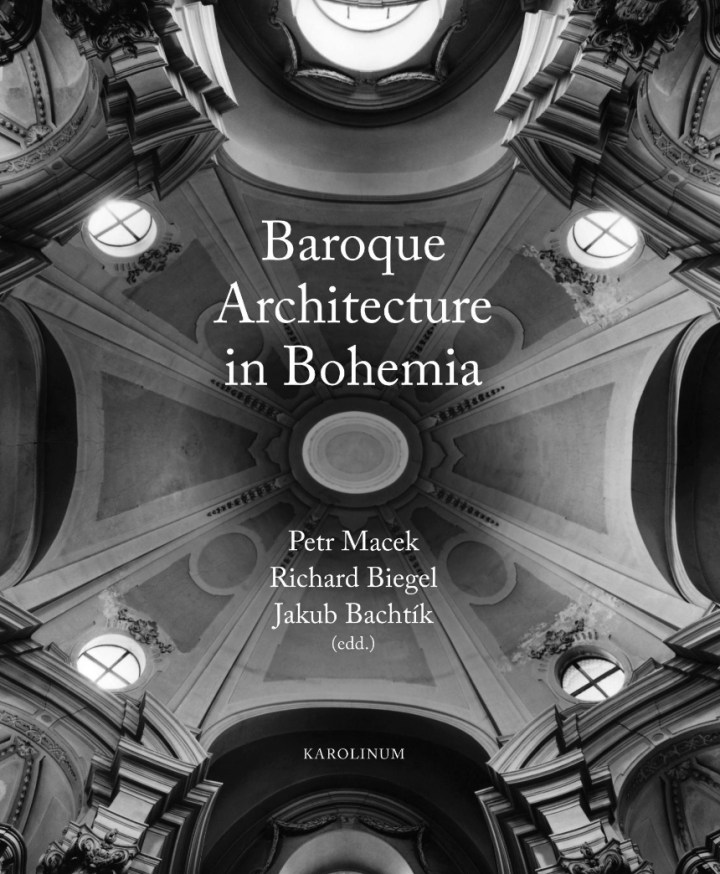 A complete history of Bohemian architecture during the seventeenth and eighteenth centuries.
The art of the seventeenth and eighteenth centuries forms one of the most important chapters in the cultural history of Bohemia. In this period, art attained a remarkably high level, with Bohemia emerging as a rival to the other cultural centers of Europe. This was especially true in terms of architecture, which not only transformed the appearance of towns and villages in Bohemia but also played a part in the creation of the phenomenon known as the Baroque, which to this day remains an essential part of Czech cultural identity.
The monumental Baroque Architecture in Bohemia brings together multiple generations of art historians from Charles University and the Czech Academy of Sciences to offer the single most comprehensive examination and exploration of Bohemian architecture during this extraordinary period. The book begins with the Renaissance roots of Baroque Bohemia: it introduces readers to the influence of the cultured and eccentric Rudolf II, who moved the seat of the Holy Roman Empire back to Prague, inviting foreign artists, architects, and alchemists with him; it shows the importance of Albrecht von Wallenstein, whose military success in the Thirty Years’ War heralded a massive building campaign that helped usher in the Baroque age. When the book moves to the period commonly understood as the Baroque, it discusses leading Czech architects, such as Jan Blažej Santini-Aichel and Kilian Ignaz Dientzenhofer, but also focuses on lesser-known regional architects and the important Italian architects and artists that left their mark on Bohemia. The architectural and artistic developments are all set among the broader cultural and social context of the seventeenth and eighteenth centuries. The book contains extensive pictorial documentation—most impressively Vladimír Uher and Martin Micka’s gorgeous architectural photographs.
c o n t e n t s
Prologue: The Renaissance Roots of the Architecture of the Modern Era in Bohemia
1 The Architecture of the Rudolfine Court
2 Art in the Thirty Years’ War: Lost and Found
3 From Lurago to Mathey: The Crystallization of an Architectural Language in the Later 17th Century
4 The Era of Great Themes and Groundbreaking Innovators
5 Architectural Synthesis in the Work of Kilian Ignaz Dientzenhofer
6 Between the Baroque and the Neoclassical: The Era of Architectural Plurality
7 Art, Life, Culture: Contexts of Baroque Architecture
Call for Papers | Foreign Artists in Czech Lands and Czech Artists Abroad
From ArtHist.net:
Artists Overseas: Foreign Artists in the Czech Lands and Czech Artists Abroad
Prague, 21–22 May 2026
Proposals due by 31 December 2025
Mobility, migration, and cultural exchange have profoundly shaped visual culture across the centuries. Owing to their location in the heart of Europe, the Czech lands have long served not only as an important crossroads through which many artists passed, but also as an attractive destination for foreign creators, particularly during periods of cultural flourishing. At the same time, movement occurred in the opposite direction: artists born or trained in the Czech environment frequently undertook shorter or longer journeys abroad. The motivations for mobility were diverse—from forced emigration for political, religious, or economic reasons to the pursuit of more stimulating training, new professional experiences, or more prestigious commissions. This two-way movement significantly influenced the local visual language, aesthetic preferences, and institutional frameworks of artistic life.
The conference aims to examine this topic from multiple perspectives ranging from the Middle Ages to the twentieth century. We welcome papers focusing both on biographical portraits of figures who experienced artistic mobility, as well as on broader analyses of migration patterns among artists within particular periods or between specific countries and regions. Attention may also be given to the cultural transfer that mobility generated, or to the social aspects of the issue, such as the ways in which foreign artists became integrated into local structures and adapted to new environments. On a more general level, contributions may address perceptions of otherness and foreignness that the work and lives of migrant artists typically represented for their host societies. Finally, we also welcome papers dealing with the characteristics of important sources or source types, and analyses of how such materials can be used for research purposes.
The theme is open to art historians, archivists, historians, and specialists from related fields. The only requirement is that each paper should be grounded in the evidence of archival sources. We invite those interested in active participation to submit a proposal in the form of an abstract (maximum 1000 characters) accompanied by a brief biographical note. The expected length of each presentation is 20 minutes. Publication of the papers is planned. The conference languages are Czech and English. The organising committee reserves the right to select papers. Please send abstracts with brief biographies to uhlikova@udu.cas.cz and radka.heisslerova@ngprague.cz by 31 December 2025.
Organized by the National Gallery Prague and the Institute of Art History of the Czech Academy of Sciences.










 Enfilade
leave a comment