Installation | Revolution!

Paul Revere Jr., after Henry Pelham, The Boston Massacre, or, The Bloody Massacre perpetrated in King Street, Boston on 5 March 1770 by a party of the 29th Regiment, detail, 1770, hand-colored engraving and etching, second state, sheet: 11 × 9.5 inches (New York: The Metropolitan Museum of Art, Gift of Mrs. Russell Sage, 1910, 10.125.103).
◊ ◊ ◊ ◊ ◊
Opening soon at The Met:
Revolution!
The Metropolitan Museum of Art, New York, 19 January — 6 August 2026
Curated by Sylvia Yount, Constance McPhee, and Wolf Burchard
This special installation marks the 250th anniversary of the Declaration of Independence, the founding document of the United States of America. Works drawn from many different areas of The Met offer a wide view of the roots, course, and aftermath of the Revolutionary War (1775–1783)—from early conflicts between colonists and Indigenous peoples and the 1765 Stamp Act imposed by the British government on its North American colonies to George Washington’s voluntary retirement, in 1797, from his two-term presidency.
Rarely seen prints reveal the transatlantic circulation of news about the struggle for independence during a fractious political era. This window into the era’s print culture highlights the global dimensions of the rebellion, the contested ideas about liberty that shaped it, and its consequential outcomes. Also on view are American and European works of art that depict a range of significant individuals. These include iconic contributors to the Declaration of Independence John Adams, Benjamin Franklin, and Thomas Jefferson; patriots and presidents such as Paul Revere and George Washington; the Wampanoag chief Metacomet, whose conflicts with early British colonists laid the groundwork for revolution; Mohawk leader Thayendanegea, who allied with the British in an effort to retain Indigenous sovereignty; and African American poet Phillis Wheatley, who raised her voice against an expansive tyranny in her call for emancipation. Together, these artworks acknowledge multiple complex and intertwined histories that continue to resonate in the United States and beyond, some two and half centuries later.
Revolution! is curated by Sylvia Yount, Lawrence A. Fleischman Curator in Charge of the American Wing; Constance McPhee, Curator, Department of Drawings and Prints; and Wolf Burchard, Curator, Department of European Sculpture and Decorative Arts.
◊ ◊ ◊ ◊ ◊
With this additional information from the press release:
The American Wing will also feature in its Alexandria Ballroom (Gallery 719), an historical interior focused on George Washington and his complex legacy—from fall 2025 through early August 2026—with artist Titus Kaphar’s 2016 ‘tar’ portraits of Ona Judge and William Lee, both enslaved members of the Washington family’s households, on loan from private collections. In addition, from March through summer 2026, a recent acquisition by Carla Hemlock (Mohawk) will be on view in dialogue with Rembrandt Peale’s portrait of Washington in the foyer of the Art of Native America installation (Gallery 746 South).
◊ ◊ ◊ ◊ ◊
The Art of the American Revolution: A Conversation with Ken Burns and Sarah Botstein
Thursday, 29 January 2026, 6pm
The Museum will present a panel discussion on the “Art of Revolution” with filmmakers Ken Burns and Sarah Botstein, co-directors with David Schmidt of their new documentary, The American Revolution; historians Philip Deloria and Jane Kamensky; and art historian Gwendolyn DuBois Shaw, along with a screening of excerpts from the PBS series, produced exclusively for The Met, highlighting the creative process of visual storytelling. The conversation will provide an opportunity to reflect on the continued relevance of historical imagery and the power of art to explore the varied stories of the country’s founding.
Exhibition | Ringleaders of Rebellion: Charleston in Revolt, 1775–1783
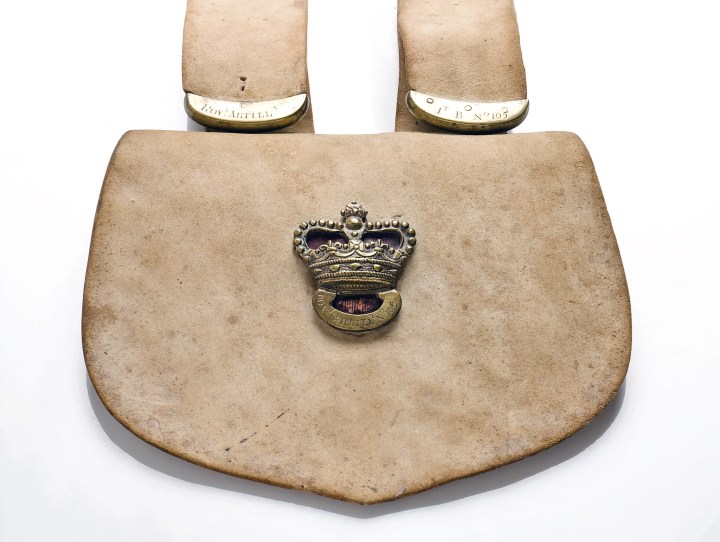
Cartridge Box, one of the best-preserved examples of its kind from the Revolutionary War
(Charleston Museum)
◊ ◊ ◊ ◊ ◊
From the press release for the exhibition:
Ringleaders of Rebellion: Charleston in Revolt, 1775–1783
Charleston Museum, 31 January — 20 September 2026
To mark 250th anniversary of the Declaration of Independence, the Charleston Museum will present a special exhibition in the Historic Textiles Gallery; Ringleaders of Rebellion: Charleston in Revolt, 1775–1783 provides an in-depth overview of the Lowcountry’s role in the Revolutionary War, featuring objects from the Museum’s collections alongside special pieces on loan during certain months of the display.
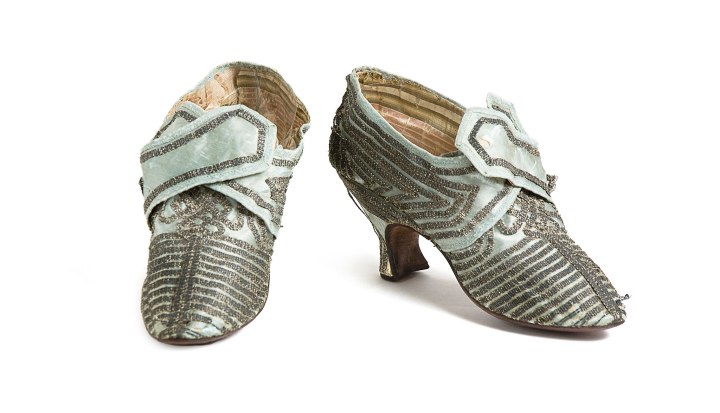
Shoes that belonged to Eliza Lucas Pinckney (Charleston Museum).
Among the latter will be a broadside of the Declaration of Independence, one of the first copies of the document printed in Charleston after news of its adoption reached the city in August 1776. The document, loaned from the Gilder-Lehrman Institute of American History, will be shown May 29 to August 30. Another remarkable piece is the logbook of the Royal Navy’s HMS Bristol, the flagship of Commodore Peter Parker during the Battle of Sullivan’s Island. This record of the ship’s daily activities (on view from June 15 to September 20) comes from the Royal Museums of Greenwich and will be a key addition to the exhibition as 2026 also represents the 250th anniversary of the Battle of Sullivan’s Island. In addition, the show will feature archaeological pieces from battlefields around the state including Camden, Ninety Six, Fort Motte, and Fort Watson. From May 23 to July 26, the Museum will present Eliza Lucas Pinckney’s silk gown, along with her recently conserved shoes and sash (supported by the fundraising efforts of the Eliza Lucas Pinckney chapter of the Daughters of the American Revolution).
Several new acquisitions will also be featured, including a ‘Brown Bess’ musket (the primary infantry weapon of the British army during the Revolutionary War), an officer’s camp bed from the era, a pair of period leather horseman’s breeches, and a William Lee bracket clock. William Lee, a Charleston clockmaker, was one of the paroled prisoners whom the British exiled to St. Augustine, Florida in 1780 for clandestinely continuing rebellious activities. British officers referred to them as the “Ringleaders of Rebellion.”
Funding for the Ringleaders exhibit was made available by SC250, the Therblig Foundation, the Post and Courier Foundation, and Henry and Sylvia Yaschik Foundation.
Collecting250 Educator Guides Available from The Decorative Arts Trust
From the press release:
 The Decorative Arts Trust is excited to announce the publication of four complimentary educator guides related to Collecting250.org, a free, public resource that commemorates the United States Semiquincentennial with a celebration of 250 historic objects from all 50 states and the District of Columbia. The online collection includes meaningful and impactful objects that represent independence, identity, and community, which were submitted by over 140 museums and historic associations from across the country. This resource demonstrates how objects can tell the story of America.
The Trust’s new educator guides feature complimentary lessons and worksheets to teach art and history through the exploration of objects on Collecting250. A team of experienced educators provided lesson plans, worksheets, and extension ideas aligned with the National Standards for Visual Arts Education and the Common Core Standards. These exciting and interactive lessons are designed to encourage students at the middle and high school levels to view objects—whether historic or more modern—in a whole new way.
The educator guides focus on four themes: function, collecting, story, and traditions. The Functions of Objects: An American Collection asks students to examine various objects in Collecting250 and determine their function through the question, “What job does this object do?” Students present a proposal (in trading card form) for the acquisition of an object, antique or present-day, that they believe should be included in the collection. Students’ trading cards can be shared in a school display in recognition of the Semiquincentennial.
For Collecting: Uncovering America through Its Objects, students explore reasons why humans engage in collecting. They share their knowledge of collections and role-play as private collectors. Then students curate a series of objects from Collecting250 for their own museum spaces, with peers discussing which collection is the most historically significant, the most expensive, etc. Students also investigate an object and create a ‘missing’ poster.
The Weaving a Storyline across 250 Years guide has students investigating various objects in Collecting250 and considering the underlying history of those objects through the question, “What story does this object have to share?” Students create a historical fiction narrative that threads the stories of various objects from the collection into a storyboard that interweaves personal student stories with the stories told by objects found in the collection.
Objects and Traditions: History Revealed guides students to consider Collecting250 objects through the lens of tradition. Students discuss traditions that are important in their families and communities, and then students examine objects and discuss how they might have been made in association with traditions. As students investigate objects, they discuss how cultural beliefs, values, and artistic expression influence the making of an object.
The Decorative Arts Trust would like to thank Dr. Marilyn Stewart, Professor Emerita of Art Education at Kutztown University of Pennsylvania, for coordinating the team that developed these educator guides. The Trust learned of Dr. Stewart and her talented colleagues through the fantastic resources they have developed for Craft in America. Collecting250 will be available for the next few years, so these lessons will be applicable for the 2026–27 and 2027–28 school years as well. Visit Collecting250.org to explore these new resources.










 Enfilade
leave a comment