Funding | Burlington Bursaries for Researching Drawings
From ArtHist.net:
The Burlington Magazine’s Travel Bursaries for Researching European Drawings
Applications due by 1 February 2026
We are delighted to announce a new initiative: The Burlington Magazine Travel Bursaries, generously funded by the Rick Mather David Scrase Foundation. These bursaries are designed to support emerging art historians undertaking research on old master drawings. The awards will fund travel to major collections worldwide to study works of Western art on paper from the Renaissance to 1900.
Typical awards will range from £2,000 to 2,500 for travel within Europe and £3,000–3,500 for intercontinental travel. Applications are welcomed from postgraduate and curatorial researchers worldwide. The deadline for applications is Sunday, 1 February 2026. Further details and application guidelines can be found at The Burlington website.
Call for Papers | Framing the Drawing / Drawing the Frame
From the Call for Papers as noted at ArtHist.net:
Framing the Drawing / Drawing the Frame
Bibliotheca Hertziana—Max Planck Institute for Art History, Rome, 13–15 May 2026
Organized by Tatjana Bartsch, Ariella Minden, and Johannes Röll
Proposals due by 16 January 2026
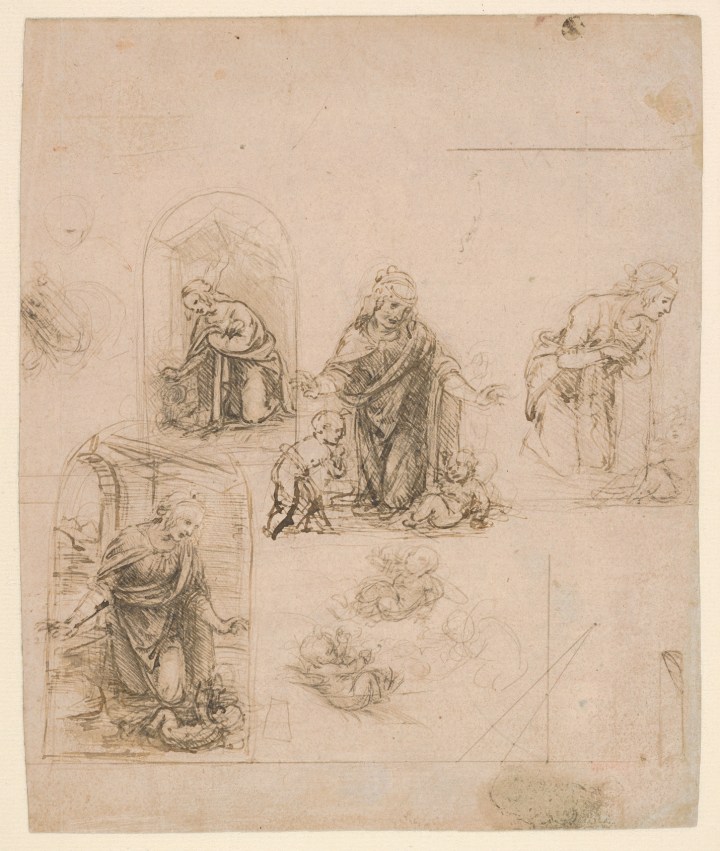
Leonardo da Vinci, Compositional Sketches for the Virgin Adoring the Christ Child, with and without the Infant St. John the Baptist, silverpoint, pen and brown ink, ca. 1480–85 (New York: The Metropolitan Museum of Art, 17.142.1). As Carmen Bambach notes in her entry for the drawing, “The geometric constructions at the lower right represent his attempts to work out the perspective within the composition, with respect to the spectator’s vantage point.”
The 2026 Gernsheim Study Days seek to explore the relationship between early modern drawings, frames, and framing.
In the early modern period, the frame as a physical object was something that could and, not infrequently, did cost more than the artwork it was framing. Together with the understanding of its economic value, the frame performed a monumentalizing role. The microarchitectural structure was used to signal the importance of an image through the imposition of new hierarchies of space. The symbolic dimension of the frame was both mobilized by artists as an integral part of compositional ensembles and retroactively applied to underscore the importance of certain images.
In the medium of drawing, with the physicality of the wrought object removed, the symbolic connotations associated with acts of framing came to be transposed to a two-dimensional plane, emphasizing the practice as a cultural technique. The form of elevation accomplished by the frame was transformed into a personal referencing system for the artist, part of a creative practice, where the addition of the drawn frame could transform a sheet of paper from an open field, a space for ideas to emerge, to a closed one, creating new hierarchies of space in the mise-en-page. Similarly, a drawn frame around a single motif on a sheet of paper with several motifs serves to illustrate the artist’s selection process and offers an opportunity for reflection on the connection between artist, viewer, and message to be conveyed. It is the goal of this conference to examine these semiotic potentials in and related to drawing in their multiplicity.
In addition to the generative role that forms of framing played in early modern drawings, we are interested in the framing of drawings themselves as it pertains to histories of collecting, reception, and museums. From Vasari’s Libro dei disegni to the modern passepartout, we seek to address how acts of framing shape or change our perception of drawings.
Finally, given the practical, economic, and symbolic significance of the frame, drawings for actual frames comprise an important line of inquiry in interrogating the relationship between drawing, frames, and framing. Alongside the use of the word cornice in Italian to refer to the frame in the early modern period, decorative surrounds were also identified in contemporary sources as ornamenti, a term that could refer both to the celebratory quality of frames as well as the nature of the frame as a liminal space or threshold where artists were able to reflect on the inventiveness of art making. In this context, papers might address the relationship between frame design and drawing and what impact—if any—the expanded drawing practices of the early modern period had on practices of framing.
We invite papers that treat frames and framing, broadly conceived, as they relate to drawing. Possible topics and questions that we hope to address include:
• Frame design and drawing for the decorative arts
• The role of frames and framing in the making or changing of meaning
• Inscriptions on drawings or, later, passepartouts, as a form of framing
• Marginalia as paratextual frames
• How the frame in drawing complicates our understanding of the frame
• The frame as mediator of drawings
• The frame as a metapictorial device
To submit a proposal, please upload a title, a 250-word abstract, and brief CV (no more than 2 pages) as a PDF document at https://recruitment.biblhertz.it/position/19759108 by 16 January 2026.
Conference languages are English, German, and Italian. The Bibliotheca Hertziana will organize and pay for accommodation and reimburse travel costs (economy class) in accordance with the provisions of the German Travel Expenses Act (Bundesreisekostengesetz).










 Enfilade
leave a comment