Call for Papers | Visualizing Antiquity: The Copy of the Copy
From the Call for Papers and ArtHist.net (which includes the Call for Papers in German). . .
Visualizing Antiquity: On the Episteme of Early Modern Drawings and Prints V:
The Copy of the Copy … of the Copy: Techniques of Pictorial Reception of
Antiquity in the Early Modern Period
Berlin-Brandenburgische Akademie der Wissenschaften, 3 July 2026
Organized by Elisabeth Décultot, Arnold Nesselrath, Cristina Ruggero, and Timo Strauch
Proposals due by 11 January 2026
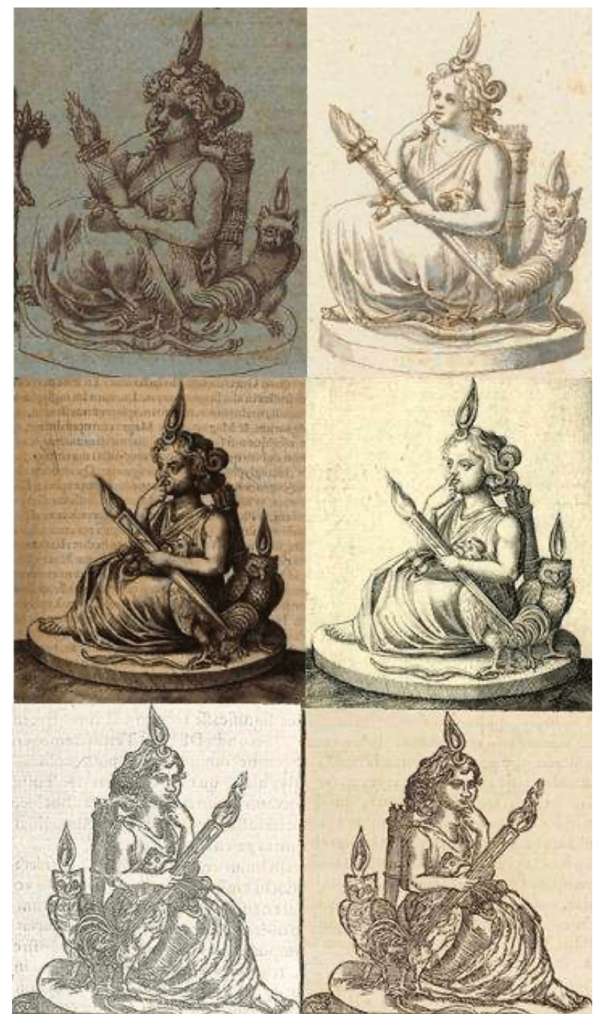
Various early modern depictions of Harpocrates (the Greek form of the Egyptian child-god Horus).
In virtually all domains of human creativity, the outcomes—whether deliberately or inadvertently—are subject to the principle of repetition. This phenomenon likewise characterizes the history of acquiring knowledge about antiquity. Once information has been recorded in written or visual form, it typically becomes the point of departure for subsequent reproductions. The material documented at the beginning of the transmission process is copied and disseminated for as long as it is considered useful, with the copies themselves generally functioning as further agents of replication.
In this process, copies function not merely as duplicates in a subordinate hierarchical relationship to the ‘original’, but as powerful resources of knowledge. They enable the preservation, transmission and creative transformation of knowledge about specific objects, monuments and forms. In transmission chains that are often only partially preserved—and frequently lack the now-lost ‘original’—, copies are rather the standard means of transmission. As such, they provide essential insights into historical developments, reveal methodological approaches, and support the production of knowledge by making ongoing engagement with ancient models visible.
The fifth colloquium in the series Visualizing Antiquity: On the Episteme of Early Modern Drawings and Prints focuses on copying processes in graphic arts that deal with antique or supposedly antique artefacts. The primary aim is not to examine the function of repetition as an artistic exercise or attempt at stylistic emulation, but rather the role of copies in the context of the transmission and transformation of knowledge. Images ‘live on’ by being traced, redrawn, re-engraved or otherwise transformed in order to preserve and convey concepts, forms and concrete objects, or to illustrate and continue discourses about them.
The entire chain of possible lines of transmission will be examined: from the study of the ‘original’—a term that in this context needs to be questioned itself—to proven or inferred copies in drawing or print, to their use in antiquarian, academic or artistic contexts. What material, institutional and epistemic structures determined the circulation of these images? How did repeated transmission influence the perception of antiquity, and were objects and images reinterpreted or creatively transformed despite being copies? Did the actors involved—draughtsmen, engravers, antiquarians or publishers—address the methodology of copying and the quality of the reproductions? What significance did the point of origin of the tradition have, and how did the status of graphic art as a medium between documentation, illustration and imagination change? Are there differences depending on the type of objects being passed on, for example in the case of records of antique architecture and their use in architectural theory (editions of Vitruvius)?
Possible topics, with further suggestions also welcome:
• Examples of ‘long-chain’ transmission of ancient artefacts and monuments in 17th- and 18th-century graphic arts
• (Non-)availability of lost and missing artefacts and monuments
• Manipulation and conjecture in the process of replication
• Breaks and ruptures in established patterns
• Copying as practice and method
• Technical reproduction processes: from drawing to drawing, from drawing to print, from print back to drawing
• Copies in drawing and print as instruments of knowledge circulation and preservation
• Academic, antiquarian and publishing contexts of graphic reproduction
• Copies as a means of documentation, systematisation and virtual collections
The colloquium thus aims to highlight the process of copying as a mode of cultural and media transmission—as a process in which images, and with them knowledge, remain in motion.
Researchers are invited to submit proposals for 20-minute presentations in German, English, French, or Italian, ideally combining case studies with broader perspectives. Proposals (max. 400 words) can be submitted until 11 January 2026, together with a short CV (max. 150 words) to thesaurus@bbaw.de with the keyword ‘Episteme V’. Hotel and travel expenses (economy-class flight or train; 2 nights’ accommodation) will be reimbursed according to the Federal Law on Travel Expenses (BRKG). Publication of the contributions to the colloquium in expanded form is planned.
Bildwerdung der Antike: Zur Episteme von Zeichnungen und Druckgrafiken der
Frühen Neuzeit V: Die Kopie der Kopie … der Kopie: Techniken der bildlichen
Antikenrezeption in der Frühen Neuzeit Bildwerdung der Antike
Organized by the Academy Research Project Antiquitatum Thesaurus. Antiquities in European Visual Sources from the Seventeenth and Eighteenth Centuries. Conceived by Elisabeth Décultot, Arnold Nesselrath, Cristina Ruggero, Timo Strauch.
New Book | Picturing Landscape in an Age of Extraction
From The University of Chicago Press:
Stephanie O’Rourke, Picturing Landscape in an Age of Extraction: Europe and Its Colonial Networks, 1780–1850 (Chicago: The University of Chicago Press, 2025), 240 pages, ISBN: 978-0226841557, $45.
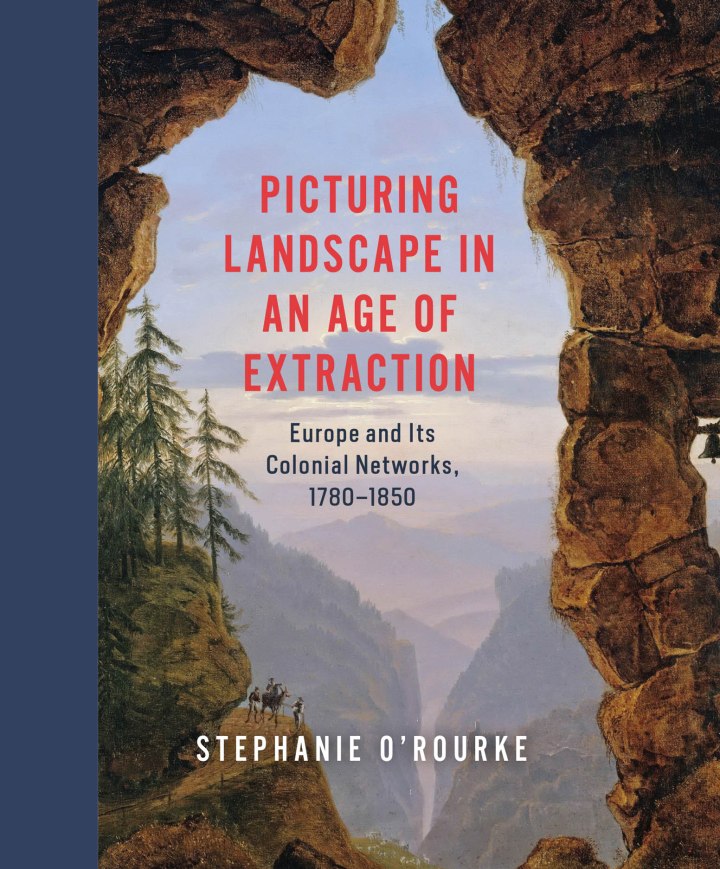 In the late eighteenth and early nineteenth centuries, European artists confronted the emergence of a new way of thinking about and treating the Earth and its resources. Centered on extraction, this new paradigm was characterized by large-scale efforts to transform and monetize the physical environment across the globe. With this book, Stephanie O’Rourke considers such practices, looking at what was at stake in visual representations of the natural world during the first decades of Europe’s industrial revolutions. O’Rourke argues that key developments in the European landscape painting tradition were profoundly shaped by industries including mining and timber harvesting, as well as by interlinked ideas about race, climate, and waste. Focusing on developments in Britain, France, Germany, and across Europe’s colonial networks, she explores how artworks and technical illustrations portrayed landscapes in ways that promoted—or pushed against—the logic of resource extraction.
Stephanie O’Rourke is a senior lecturer in art history at the University of St. Andrews, Scotland. She is the author of Art, Science, and the Body in Early Romanticism.
c o n t e n t s
Introduction
1 The French Landscape and the Colonial Forest
2 Mining Romanticism and the Abyss of Time
3 How to Scale a Volcano
4 Human Resources
Conclusion
Acknowledgments
Notes
Bibliography
Index
Exhibition | Versailles and the Origins of French Diplomacy
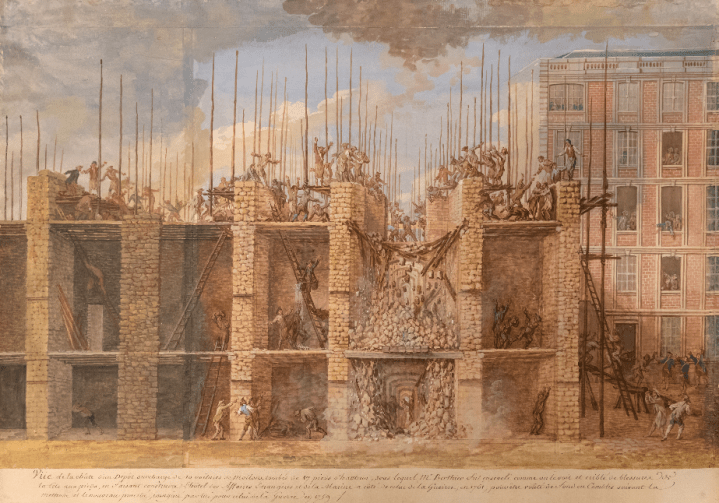
Louis-Nicolas van Blarenberghe, Accident survenu lors de la construction de l’hôtel des Affaires étrangères et de la Marine, à Versailles en 1761, ca. 1761, gouache over black chalk on paper, 38 × 56 cm (Bibliothèque Municipale de Versailles, Inv. 29359).
◊ ◊ ◊ ◊ ◊
Now on view at Versailles:
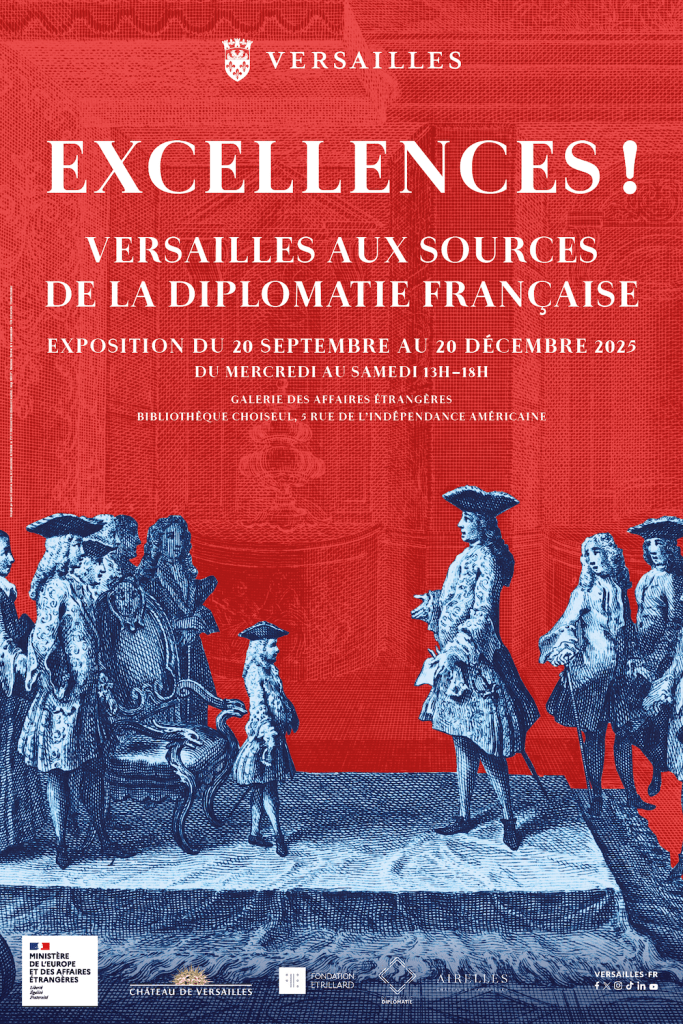
Excellences! Versailles aux Sources de la Diplomatie Française
Bibliothèque Choiseul, Versailles, 20 September — 20 December 2025
Curated by Sophie Astier and Vincent Haegele
La Ville de Versailles en collaboration avec les archives du Ministère de l’Europe et des Affaires étrangères présente l’exposition Excellences ! Versailles aux sources de la diplomatie française, dans un cadre emblématique : la Galerie des Affaires étrangères, lieu de diplomatie française et de la construction d’une administration moderne de la diplomatie. Une sélection exceptionnelle de documents retrace l’histoire de la diplomatie française sous l’Ancien Régime : 157 pièces originales dont près de la moitié, appartenant aux archives des Affaires étrangères, reviendront à Versailles pour la première fois depuis la Révolution française.
 Parmi ces pièces, on peut admirer des documents chargés d’histoire comme le traité de Cambrai dit Paix des Dames (1529), le traité de Westphalie qui termine la guerre de Trente Ans (1648), le traité de Paris (1763), la ratification du contrat de mariage scellant l’union de Louis XVI et Marie-Antoinette (1770), le traité de Versailles concluant la guerre d’Indépendance américaine (1783)…
Du règne de François Ier jusqu’à la guerre d’Indépendance américaine, découvrez l’histoire de la diplomatie française ainsi que la formalisation de ses pratiques et la construction d’une administration moderne. Le propos sera complété par différents portraits et objets d’arts permettant d’illustrer la vie d’ambassade et l’importance des cadeaux diplomatiques.
Une autre thématique abordée sera celle de la diplomatie officieuse, celle des espions, des messages codés et des opérations occultes, en faisant la part belle à ses acteurs les plus mystérieux, comme le chevalier d’Eon, qui sera évoqué par des correspondances, mais aussi par un étonnant portrait mi-homme mi-femme conservé dans les collections de la bibliothèque.
Le parcours de l’exposition est organisé en cinq étapes, qui sont à la fois chronologiques et thématiques. On y trouve une sélection de pièces tirées des collections de la bibliothèque municipale et des Archives diplomatiques, enrichies par quelques prêts exceptionnels venus d’autres institutions, notamment le Musée national des châteaux de Versailles et de Trianon. Dans chaque salle, un ou plusieurs documents constituent un « focus géographique » en lien avec les intitulés historiques des lieux. Le parcours se conclut sur la reconstitution d’un bureau de commis, tel qu’il existait dans la galerie sous Louis XV et Louis XVI.
The exhibition brochure is available here»
Excellences! Versailles aux sources de la diplomatie Française (Dijon: Éditions Faton, 2025), 192 pages, ISBN: 978-2878444056, €27. With contributions by Sophie Astier, Virginie Bergeret-Maës, Guillaume Frantzwa, and Vincent Haegele.
Call for Papers | Sculpture and Trompe l’œil in European Ceramics
From ArtHist.net:
Sculpture and Trompe l’œil in European Ceramics,
From Bernard Palissy to the Present
Hôtel de la Roche, Mons, Belgium, 10–13 July 2026
Proposals due by 12 December 2025; full papers due by 30 April 2026
Second Edition of the Annual Conference on European Sculpture and Decorative Arts
A combined effort of the Centre de Recherches Historiques sur les Maîtres Ébénistes and the Low Countries Sculpture Society, whose libraries and archives have merged and are housed in the Hôtel de la Roche (1750) at Mons, the Annual International Conference had its inaugural edition in July 2025. This edition, dedicated to European ceramics, aims to address issues relating to figurative sculpture in the round, to relief sculpture and to trompe l’oeil, all in the medium of ceramics. This includes the imitation of other materials, such as wood or precious stones, and the mimetic representation of animals and plants. Sculpture and trompe l’oeil are recurring themes but have been little studied in a comprehensive manner in European ceramic art, not even in Art Deco ceramics, which frequently use sculptural forms, both in tableware and in purely decorative pieces.
The term trompe l’oeil comes from the world of easel painting, and the conference will be an opportunity to define more precisely the use and usefulness of this term in the world of ceramics. Our conference proposes to study cases that can shed light on this practice, from the Renaissance to the present day, in terms of the rendering of forms, colours, and textures. These cases may concern the production, consumption, collecting and display of these types of ceramics throughout Europe and North America, from the Renaissance to the present day. Issues of design history, collaborations between creators and producers, artists and artisans, as well as the relations with any other people involved in the production of these ceramics may be studied. The theme will draw, in particular but not exclusively, on the rich tradition of ceramics in the Low Countries, from Antwerp majolica, via Tournai porcelain and Bouffioulx stoneware, to contemporary productions.
The conference has an international and multidisciplinary orientation. As such, we hope to attract lively participation from junior and senior scholars in the history of ceramics, sculpture, archaeology, ethnography, as well as practitioners of restoration-conservation in the same and other relevant fields. Short papers (maximum 30 minutes) of new research or work in progress may be presented in English or French. A minimal passive knowledge of English and French are highly recommended to enable full participation in the ensuing discussions, which form the core of the seminar. The Society covers accommodation expenses for foreign speakers at the conference, as well as group meals and the optional excursions. On the other hand, travel arrangements to and from Mons are the responsibility of the individual participants and their travel expenses will not be reimbursed.
The conference will take place without audience (apart from the speakers, moderators and a few benefactors), but it will be filmed and broadcast live on YouTube for free, on our dedicated channel, The Low Countries Sculpture Society. The conference proceedings will be published in 2027 in a new academic journal dedicated to European sculpture and decorative arts, based on our annual international conferences.
Please send participation proposals with a 200-word abstract of the intended paper and a 200-word CV by email to info@lcsculpture.art. We prefer to receive your abstract written in your mother tongue. We will then have it professionally translated into English and French for our Scientific Committee. We will inform of the Scientific Committee’s decision in December. Full papers, with their accompanying PowerPoint presentation, will then be due by 30 April for peer review and final paper acceptance.
Scientific Committee
Jean-Dominique Augarde, Centre de Recherches Historiques sur les Maîtres Ebénistes, Paris / Mons
Yves De Leeuw, collector and exhibition curator at the château d’Ecaussinnes-Lalaing, Fondation van der Burch
Bernard Dragesco, Dragesco-Cramoisan Gallery, Paris / Château de Barly
Errol Manners, E & H Manners Gallery, London
Sylvie Milasseau-Wengraf, art historian, Switzerland
Tamara Préaud, formerly Cité de la Céramique, Sèvres, and president, The French Porcelain Society, London
Miriam E. Schefzyk, The J. Paul Getty Museum, Los Angeles
Volker Seiberth, University of Heidelberg / The Low Countries Sculpture Society
Pier Terwen, art historian and conservator of sculpture and ceramics, Leiden
Organizing Committee
Katia Berseneva, Ecole du Louvre, Paris / The Low Countries Sculpture Society
Théodore and Clotilde de Brouwer, château d’Ecaussinnes-Lalaing, Fondation van der Burch
Guillaume Hambye, notary, Mons
Laurence Lenne, Galerie Art & Patrimoine, Ath
Léon Lock, The Low Countries Sculpture Society, Brussels / Mons
Grégory Maugé, Centre de Recherches Historiques sur les Maîtres Ébénistes, Paris / Mons
Thierry Naveaux, The Low Countries Sculpture Society, Brussels / Mons
Sébastien Tercelin de Joigny, Tercelin de Joigny Gallery, Mons / Seneffe
Jenny Tondreau, Collegiate church of Sainte-Waudru, Mons
Attingham Courses in 2026
Attingham offerings for 2026:
The Study Programme | Sweden: Stockholm and Its Hinterland
Led by David Adshead with Beatrice Goddard, 8–14 June 2026
Applications due by 30 January 2026
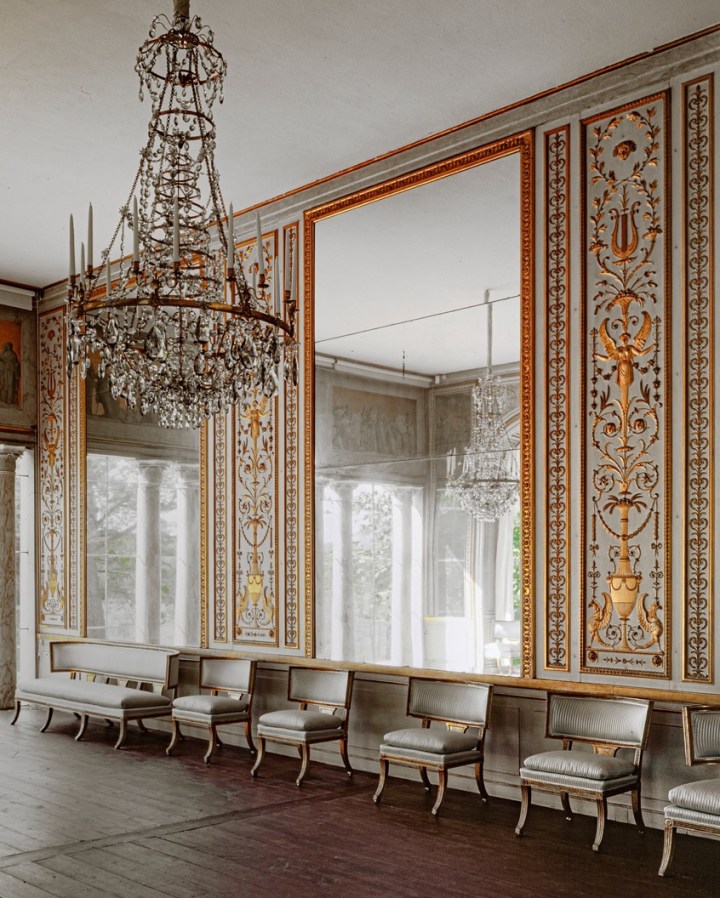
The Hall of Mirrors, Gustav III’s Pavilion at Haga Park. The Royal Palaces, Sweden (Photograph: ©Jens Markus Lindhe).
This intensive seven-day course will study the patronage of successive Swedish royal dynasties and that of the nobility and wealthy merchant class, in Stockholm’s palaces and the castles and country houses of its hinterland—Svealand, the nation’s historic core. With earlier outliers, it will focus on the arts and architecture of the mid 17th to early 19th centuries, encompassing the Baroque, Rococo, neo-Classical and ‘Empire’ styles.
For more than a hundred years, from the accession of Gustavus Adolphus in 1611 to its loss of territory at the end of the Great Northern War in 1721, Sweden was a European military superpower and enjoyed an ‘Age of Greatness’, its fortunes reflected in the richness of buildings, interiors, and collections of fine and decorative arts, particularly those of the monarchy. A new political compact with power-sharing between government and parliament—the so-called ‘Age of Liberty’—subsequently encouraged a flowering of the arts and sciences and the further influence of all things French. During the following ‘Gustavian Age’, led by the energetic but latterly autocratic, Gustav III, Sweden’s elegant interpretation of neo-Classicism reached its apogee.
In Stockholm, visits will be made to the Riddarhuset, Riddarholmskyrkan, the Royal Palace, and Gustav III’s Museum of Antiquities. Outside Stockholm, in addition to a number of private houses, visits will include, Tullgarns Palace, Drottningholm Palace, Svartsjö Palace, the English landscape park at Haga, Rosersberg Palace, Svindersvik a summer residence, Gripsholm Castle, the manor house at Grönsöo, and Skokloster Castle. For the last two nights we will be staying in the town of Mariefred on the south-west tip of Lake Mälaren.
◊ ◊ ◊ ◊ ◊
The 73rd Summer School
Led by David Adshead and Tessa Wild, with Sabrina Silva, 27 June — 12 July 2026
Applications due by 30 January 2026
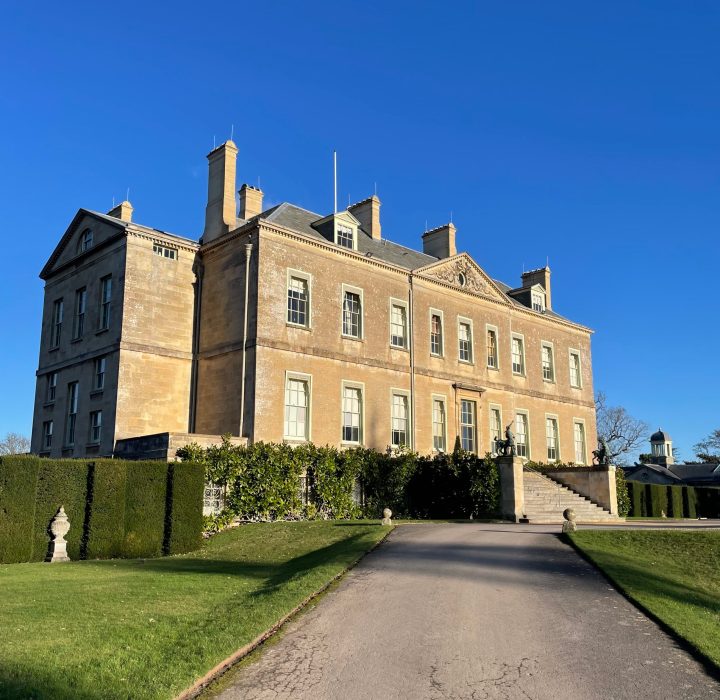
Buscot Park, Faringdon, Oxfordshire, 1780–83.
The 73rd Attingham Summer School, a 16-day residential course will visit country houses in Sussex, Derbyshire, Nottinghamshire, Buckinghamshire, and Oxfordshire. From West Dean, our first base, we will study, amongst other houses and gardens: Petworth House, where the patronage of great British artists such as Turner and Flaxman enrich its Baroque interiors; Parham, a fine Elizabethan house in an unrivalled setting; and Standen, an Arts and Crafts reinterpretation of the country house.
In the Midlands, a series of related houses will be examined: Hardwick Hall, unique amongst Elizabethan houses for its survival of late 16th-century decoration and contents; Bolsover Castle, a Jacobean masque setting frozen in stone; and Chatsworth, where the collections and gardens of the Cavendishes and Dukes of Devonshire span more than four centuries. Other highlights include Robert Adam’s crisp neo-Classical interior and Fishing Pavilion at Kedleston Hall.
The final part of the course will focus on the rich estates and collections of Oxfordshire. Our itinerary will include Broughton Castle, a moated and fortified manor house with a chapel first consecrated for Christian worship in 1331, and Buscot Park, with its superb collection with works by Rembrandt, Botticelli, Rubens, Edward Burne-Jones and Dante Gabriel Rossetti, and furniture by Robert Adam and Thomas Hope. While at Buscot we will have the opportunity to explore one of the country’s finest water gardens, designed by Harold Peto in 1904 and extended from 1911–13, and a surviving country house theatre created in 1936 for the 2nd Lord Faringdon. We will also visit the much more modest 17th-century stone-built, Kelmscott Manor, the beloved country home of William Morris and his family, and the place that he described as ‘Heaven on Earth’.
◊ ◊ ◊ ◊ ◊
Royal Collection Studies
Led by Helen Jacobsen, with Beatrice Goddard, 6–15 September 2026
Applications due by 15 February 2026

James Roberts, The Pavilion Breakfast Room at Buckingham Palace (known by 1873 as the Queen’s Luncheon Room), 1850, watercolour and bodycolour with gum arabic, paper: 26 × 38 cm (RCIN 919918).
The Royal Collection is one of the world’s leading collections of fine and decorative art, with over one million works from six continents, many of them masterpieces. Working in partnership with The Royal Collection Trust, this ten-day residential course offers participants the opportunity to study the magnificent holdings of paintings, furniture, metalwork, porcelain, jewellery, sculpture, arms and armour, books, and works on paper and to examine the architecture and interiors of the palaces which house them. Based near Windsor, the course also examines the history of the collection and the key roles played by monarchs and their consorts over the centuries. Combining a mixture of lectures and tutorials, visits to both the occupied and unoccupied palaces in and around London and close-up object study, Royal Collection Studies aims to give experienced professionals in the heritage sector a deeper understanding of this remarkable collection.
◊ ◊ ◊ ◊ ◊
From College Library to Country House
Led by Andrew Moore, with Rita Grudzien, 7–11 September 2026
Applications due by 15 February 2026
This course is conceived from the perspective of the British aristocracy and gentry whose education centred upon preparing them to run their country estate, including the house and collections, and argues for the importance of the library and the book collection in this process. Too often in country house studies the architecture, interior design, and art collections have held sway; this course aims to foreground the College book collections at the disposal of tutors and the subsequent development of the country house library. Libraries reveal not only the intellectual or recreational interests of past generations, but also how books manifest taste, fashion, and opportunities for display. Book historians and tutors well known in their respective fields will conduct the course, attending to a broad variety of subjects including book binding, the development of the idea of rare books and of book collections, library portraiture, and questions of spatial analysis and mobility—all in the context of the collections housed in some of the oldest and most complete book rooms in Britain.
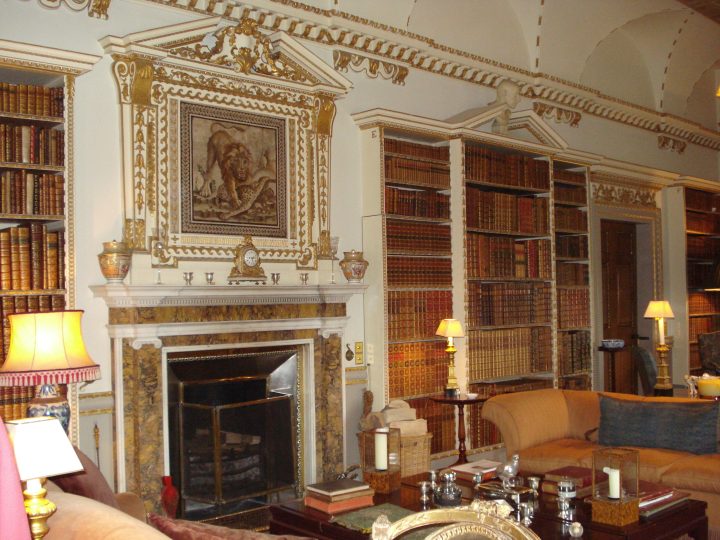
Library at Holkham Hall.
This intensive residential five-day course is based in the exceptional surroundings of St Catharine’s College, a constituent college of the University of Cambridge. Directed by Dr Andrew Moore, the programme plans to visit a series of iconic libraries. These include the historic private library of Houghton Hall, created by Robert Walpole, and Holkham Hall, home to one of the greatest private manuscript and printed book collections in Britain, housed today in three of the country’s most important country house library rooms. The course will also visit the library designed by James Gibbs for Edward Harley, Earl of Oxford at Wimpole Hall in Cambridgeshire, and the Braybrooke library rooms at Audley End, of considerable interest for being reconstituted from dressing rooms into the 3rd Lord Braybrooke’s library, incorporating the inherited Neville family books. The library at Audley End functioned as an informal family sitting room, with the adjacent study (the South Library) still displayed as it looked in the early 19th century.
The course includes the Old Libraries of St John’s College and Queens’ College; the Wren Library, Trinity; the Perne Library at Peterhouse; the Parker Library at Corpus Christi; and the Founder’s Library at the Fitzwilliam Museum. Additional seminars will take place in the context of the historic book collections in the Cambridge University Library designed by Giles Gilbert Scott (1880–1960). St Catharine’s College will host a seminar on the medical book collection of John Addenbrooke (1680–1719), founder of Addenbrooke’s Hospital, Cambridge.
◊ ◊ ◊ ◊ ◊
Note (added 14 January 2026) — From Attingham’s Instagram account (6 January 2026) . . .
We are thrilled to congratulate Annabel Westman on being awarded an MBE in the New Year Honours “for services to heritage, particularly to The Attingham Trust and historic textiles.” Annabel’s time as Director of the Attingham Summer School (1993–2005) and Executive Director of The Attingham Trust (2005–2021) helped shape Attingham into the vibrant, welcoming, and extraordinary community it is today. Alongside this, her distinguished career as a textile historian and consultant has enriched the understanding and restoration of historic interiors worldwide. This honour is richly deserved, and we are so proud to celebrate Annabel and all she continues to give to the field.
New Book | Bluestockings and Landscape in Eighteenth-Century Britain
From Boydell & Brewer:
Markman Ellis and Jack Orchard, eds., Bluestockings and Landscape in Eighteenth-Century Britain: The Prospect of Improvement (London: Boydell Press, 2025), 292 pages, ISBN: 978-1837650507, £85. Available as an ebook for £19. Studies in the Eighteenth Century series, Volume 16.
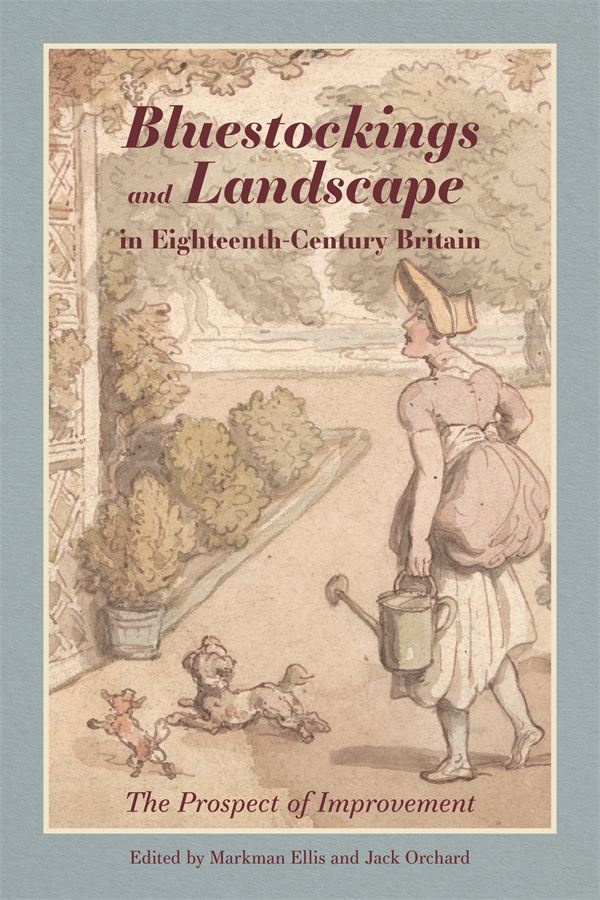 Situated within the broader context of eighteenth-century intellectual and cultural history, this collection redefines the role of the Bluestocking circle in shaping Britain’s landscapes and social ideals. Against the backdrop of Whiggish notions of ‘improvement’—encompassing agricultural innovation, aesthetic refinement, and moral progress—it explores how women such as Elizabeth Montagu, Mary Delany, and Elizabeth Carter navigated the intersections of polite sociability, intellectual production, and estate management. Their contributions reveal a dynamic interplay between cultural critique and practical reform, positioning them as active participants in the period’s debates on land, labour, and national identity.
Drawing on insights from the Elizabeth Montagu’s Correspondence Online (EMCO) project, these essays uncover the creative and social tensions embedded in iconic estates such as Montagu’s Sandleford and Lord Lyttelton’s Hagley Hall. They delve into the poetic and philosophical musings of James Woodhouse, the sociable artistry of Mary Delany, and the symbolic landscapes of Wrest Park. By examining correspondence, poetry, visual arts, and cartography, this volume offers an unprecedented exploration of the ways Bluestocking women engaged with and redefined the designed landscape as a site of intellectual and environmental innovation. This interdisciplinary collection reshapes the historiography of gender, environment, and cultural progress, offering fresh insights into the enduring significance of eighteenth-century landscapes and the intellectual communities that shaped them.
Markman Ellis is Professor of Eighteenth-Century Studies at Queen Mary University of London.
Jack Orchard is Content Editor of the Electronic Enlightenment project based at the Bodleian Libraries, Oxford.
c o n t e n t s
List of Illustrations
Notes on Contributors
Acknowledgements
Foreword: ‘Bringing Elizabeth Montagu to the World’ — Joanna Barker and Nicole Pohl
Introduction: ‘The Prospect of Improvement: Bluestockings and Landscape in Eighteenth-Century Britain’ — Markman Ellis and Jack Orchard
Section One
1 Idioms of Improvement: Gender and Social Relations on the Montagu Estates, 1730–1800 — Steve Hindle
2 Religious Faith, Class Politics, and Equitable Progress: James Woodhouse and Elizabeth Montagu’s Contending Visions of Improvement — Adam Bridgen and Steve Van Hagen
3 Cultivating Wilderness — Ve-Yin Tee
Section Two
4 ‘Another Little Excursion’: On Tour with Mrs Montagu and Lord Lyttelton — Michael Cousins
5 Cultivating Land, Literature, Letters: Textualities of Improvement in Elizabeth Montagu’s Travels in Scotland — Millie Schurch
6 ‘She had no eyes nor understanding to see that it was not a common vulgar garden’: Mary Delany’s Landscapes of Improvement — Kristina Decker
7 Ladies of Landscape: The Discovery of Lady Harriett Garnier’s ferme ornée at Rookesbury, Hampshire — Rosemary Baird Andreae
Section Three
8 ‘The Genius of Rest … those Happy Groves Inspired’: Literary Composition, Coterie Sociability, and the Gardens at Wrest Park — Jemima Hubberstey
9 ‘Fate Led Me from my Lov’d Retreat’: The City and the Country in Elizabeth Harcourt’s Writings — Mary Chadwick
10 ‘Death’s Refreshing Shade’: Elizabeth Carter, ‘Church-yard Poetry’ and Contemplative Retirement in the Gardens of the Dead — James Metcalf
Afterword: Bluestocking Landscapes — Stephen Bending
Bibliography










 Enfilade
leave a comment