Exhibition | Painters, Ports, and Profits
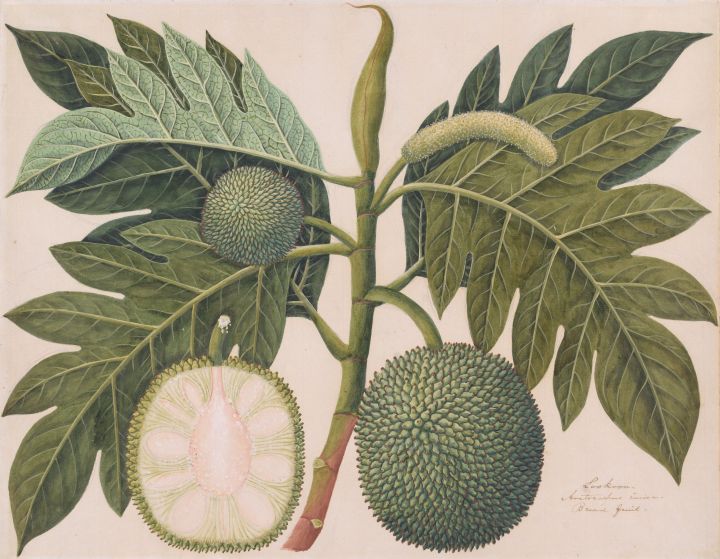
Unknown artist (Company style), Breadnut (Artocarpus camansi), ca. 1825, watercolor, gouache, and graphite on medium, slightly textured, cream laid paper, sheet: 15 × 19 1/4 inches (New Haven: Yale Center for British Art, Paul Mellon Fund, B2022.5).
◊ ◊ ◊ ◊ ◊
From the press release for the exhibition, which opens today:
Painters, Ports, and Profits: Artists and the East India Company, 1750–1850
Yale Center for British Art, New Haven, 8 January — 21 June 2026
Curated by Laurel Peterson and Holly Shaffer
The Yale Center for British Art presents Painters, Ports, and Profits: Artists and the East India Company, 1750–1850 from January 8 through June 21, 2026. Spanning a century of artistic production, the exhibition reveals the material and technical innovations of the Indian, Chinese, and British artists whose work and lives were shaped by the British East India Company’s global reach. Featuring more than one hundred objects, Painters, Ports, and Profits highlights the beauty and range of the extraordinary artwork produced within the context of one of the most powerful and ruthless corporations in history.
 “This exhibition brings to light an astonishing chapter of global art history, when artistic innovation and exchange flourished under the shadow of empire,” said Martina Droth, Paul Mellon Director of the Yale Center for British Art. “It tells the story of direct encounters between artists from different continents and traditions, who responded to one another by experimenting with new materials and methods. We are thrilled to share these important, and rarely seen, works from our collection and to invite new reflection on their artistic legacy.”
Between 1750 and 1850, the Company’s growing commercial, military, and political operations linked an incredibly varied group of artists—amateurs, soldiers, and professionals—into a vast network that stretched from London to Calcutta (Kolkata) to Canton (Guangzhou). As goods, people, and ideas circulated through the Company’s networks, artists experimented with papers, pigments, and methods, adapting techniques from different traditions to develop a striking visual language that connected art to the expanding global economy.
“We are excited to take visitors on a journey to ports and trading cities across India and China where artists produced captivating and innovative works of art,” said exhibition curators Laurel O. Peterson and Holly Shaffer. “The period of the East India Company is one in which art and business intersected. There is a profound tension between the ventures of a global corporation and the works of beauty created by the artists in its orbit. With technical brilliance, these artists ingeniously fused traditions and materials together to develop new ways of making, picturing, and selling.”
Years in development, the preparations for Painters, Ports and Profits included extensive original research and careful technical study by curators and conservators at the YCBA in collaboration with conservation scientists at Yale’s Institute for the Preservation of Cultural Heritage. The resulting exhibition illuminates the museum’s deep holdings of Asian art, showcasing many exceptional works that have hardly ever or never been displayed. Highlights of the exhibition include stunning small- and large-scale portraits, such as the monumental Woman Holding a Hookah at Faizabad, India (1772) by Tilly Kettle and the intimate Portrait of a Woman (ca. 1850) by an artist from the circle of eminent painter Lam Qua. Watercolor drawings of a great Indian fruit bat by Bhawani Das (1778–82) and breadnut by an artist once known (ca. 1825), among others, record the flora and fauna of the Company’s domain with striking naturalism. A spectacular thirty-seven-foot-long scroll uses delicate watercolor to depict the city of Lucknow, India, in panoramic detail, which recent technical analysis has revealed was completed by multiple artists working in collaboration.
Painters, Ports, and Profits: Artists and the East India Company, 1750–1850 is organized by the Yale Center for British Art. The exhibition is curated by Laurel O. Peterson, Assistant Curator of Prints and Drawings at the YCBA, and Holly Shaffer, Associate Professor in the Department of the History of Art and Architecture at Brown University.
r e l a t e d p r o g r a m m i n g
First Look | Painters, Ports, and Profits: Artists and the East India Company, 1750–1850
Thursday, 15 January, 4pm, Lecture Hall and Livestream
Spring Exhibitions Openings
Thursday, 26 February, 4pm, Lecture Hall and Livestream
Curator Tours
Thursdays, 22 January, 26 March, 16 April, 21 May, and 18 June, 4pm
Docent Tours
Saturdays, 3pm
The catalogue is published by YCBA and distributed by Yale UP:
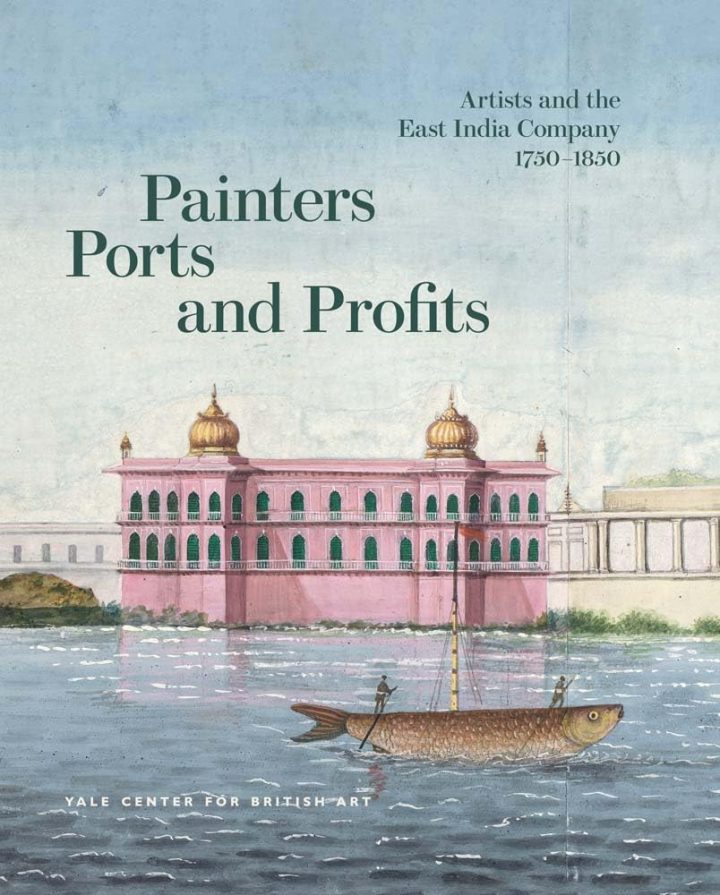
Laurel O. Peterson and Holly Shaffer, eds., Painters, Ports, and Profits: Artists and the East India Company, 1750–1850 (New Haven: Yale Center for British Art, 2026), 280 pages, ISBN: 978-0300286540, $65. With contributions by Mark Aronson, Tim Barringer, Swati Chattopadhyay, Soyeon Choi, Anita Dey, Gillian Forrester, Navina Najat Haidar, Richard R. Hark, Emma Hartman, Brooke Krancer, Margaret Masselli, Kaylani Madhura Ramachandran, Romita Ray, Yuthika Sharma, Marcie Wiggins, Winnie Wong, and Tom Young.
Featuring more than one hundred objects drawn primarily from the YCBA’s collection, including architectural drawings, watercolors, and hand-colored aquatints, the catalog critically reconsiders the vibrant creative exchanges between artists in India, China, and Britain during a period driven by ruthless commercial and colonial expansion.










 Enfilade
leave a comment