Symposium | New Discoveries in Furniture and Historic Interiors
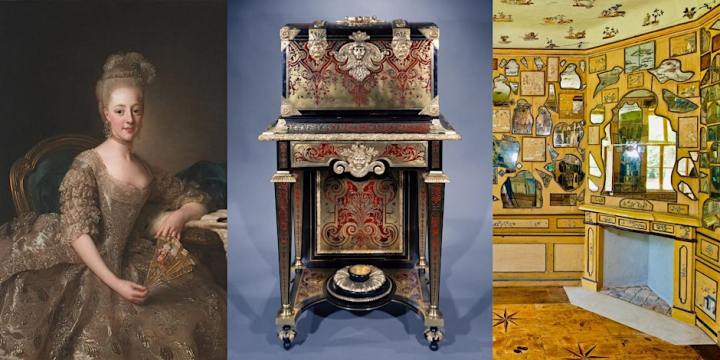
Left: Alexander Roslin, Portrait of Hedvig Elisabet Charlotta, Princess of Sweden, detail, 1775 (Nationalmuseum, Sweden). Center: André-Charles Boulle, Coffer-on-stand (Chatsworth House Trust). Right: Mirror shard cabinet, Apartment of Margravine Wilhelmine of Bayreuth, ca. 1750 (Old Palace of the Hermitage in Bayreuth; photo by Achim Bunz).
◊ ◊ ◊ ◊ ◊
From the reservation page at Eventbrite:
New Discoveries in Furniture and Historic Interiors
University of Buckingham, London Campus, 23 January 2026
Registration due by 19 January 2026
The Furniture History Society invites you to its eighth Early Career Research Symposium, to be held at the University of Buckingham’s London campus, 51 Gower Street, from 9.30am to 5pm on Friday, 23 January. Part of the Society’s Early Career Group (ECG) programme, the symposium features current research by emerging scholars in furniture history, the decorative arts, and historic interiors. The programme reflects the wide range of interests among early-career researchers, with speakers from Britain, Sweden, France, Italy, Germany, and the United States. The event is free to attend, but advance registration via Eventbrite is required by midnight (GMT) on Monday, 19 January. The limited number of places are allocated on a first-come, first-served basis. The symposium will be recorded and made available for one month to registered participants. Any enquiries about this event or the Early Career programme should be directed to grants@furniturehistorysociety.org.
The day is made possible thanks to the generous support of the University of Buckingham, the Della Howard Fund, and the Oliver Ford Trust.
p r e s e n t a t i o n s
• Mary Algood (V&A/RCD History of Design Programme, UK) — Makers of Funeral Furniture in 17th-Century England
• Tristan Fourmy (Institut National du Patrimoine, France) — Hercules in the Decorative Arts in 18th-Century France
• Laini Farrare (University of Delaware, USA) — Atlantic Mahogany: Enslavement, Labor, and the Early American Windsor Chair
• Francesco Montuori (European University Institute, Italy) — Beyond Chinoiserie: The Gabinetto di Porcellana and its Floor
• Anne Weiss (University of Cologne, Germany) — Status and Space: Dynastic References in the Furnishings of Wilhelmine von Bayreuth’s Apartments in the New Palace and Old Palace of the Hermitage in Bayreuth, 1735–1758
• Karolina Laszczukowska (University of Uppsala, Sweden) — The Material Hierarchies in the Furnishings and Interiors of the Private Apartments of Princess Sofia Magdalena and Duchess Hedvig Elisabet Charlotta at Stockholm Palace in 1766 and 1774
• Katherine Hardwick (Chatsworth House, UK) — Garrets Full of the Commodity? Collecting Boulle at Chatsworth
• Paul Giraud (Institut National du Patrimoine, France) — Collecting Italian 18th-Century Furniture at the Belle Epoque: The Origins of Interior Design
• Justine Lecuyer (Sorbonne, France) — Crafting Comfort: Upholstery and Textile Aesthetics in 19th-Century Interiors
• Eleonora Drago (Civic Museums of Treviso, Italy) — Paul Albert Bernard and the Decoration of the French Room at the Biennale in 1905: An Homage to Venice and France from a Decorative Skylight
Exhibition | The Count of Artois, Prince and Patron
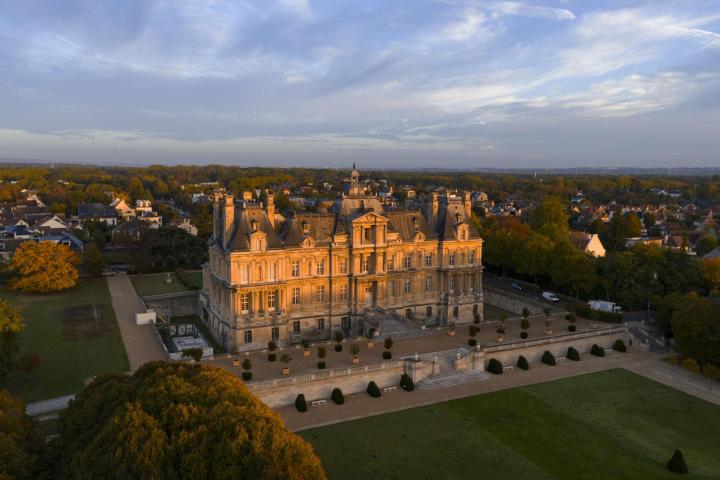
Château de Maisons, in Maisons-Laffitte, a northwest outer suburb of Paris, about 12 miles from the city center
(Photo: © EPV / Thomas Garnier)
◊ ◊ ◊ ◊ ◊
From the Château de Versailles:
The Count of Artois, Prince and Patron: The Youth of the Last King of France
Château de Maisons, Maisons-Laffitte, 14 November 2025 — 2 March 2026
The result of a partnership between the Centre des Monuments Nationaux and the Palace of Versailles, this exhibition traces the life of the Count of Artois (1757–1836), brother of Louis XVI and the future Charles X, through his residences, his artistic projects, and his passions. From the splendor of the Château de Maisons to the count’s exile in 1789, it reveals the journey of a refined prince at the heart of the 18th century.
The exhibition begins with a presentation of the Château de Maisons in the 18th century and then traces the life of the Prince of Artois from his birth to his exile. The prince’s personality, his life, his patronage, and his taste are explored through a great variety of objects: graphic arts, paintings, objets d’art, sculptures, furniture, curiosities, and books. The exhibition also highlights the prince’s interest in architecture, as he was the last owner of the Château de Maisons under the Ancien Régime. Sourced primarily from the collections of the Palace of Versailles, the exhibition benefits from additional prestigious loans from the National Archives, the National Library of France, the Louvre Museum, the Mobilier National, the Château de Fontainebleau, the Carnavalet Museum, the Musée de l’Armée – Invalides, the municipal library of Versailles, and the Fine Arts Museums of Amiens and Reims, as well as from private collections.
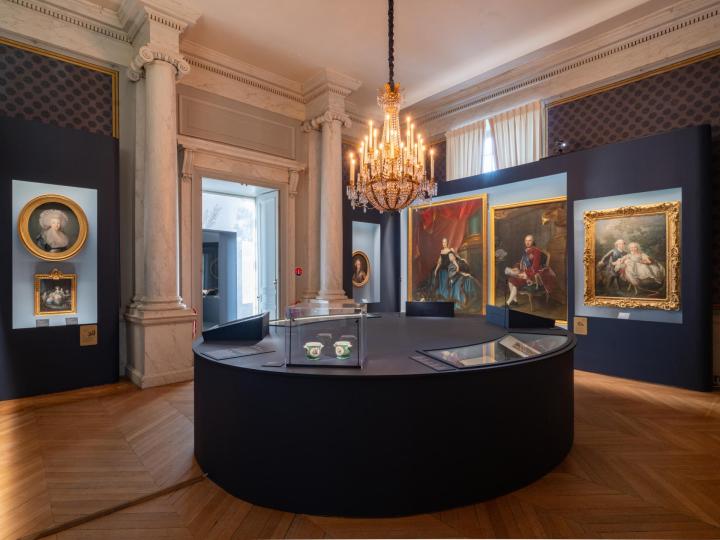
The exhibition as installed at the Château de Maisons
(Photo: © EPV / Thomas Garnier)
◊ ◊ ◊ ◊ ◊
The Count of Artois, Future Charles X
Reputed for his frivolous spirit and taste for luxury, the Count of Artois was both an attractive and controversial figure, eccentric yet conservative. Charles-Philippe of France, known under the title Count of Artois, was born in Versailles on 9 October 1757. He was the grandson of Louis XV and the brother of Louis XVI and the future Louis XVIII. He became King of France upon the death of the latter in 1824, under the name Charles X, and soon emerged as the representative of the most uncompromising Catholic faction. He was consecrated at Reims the following year. The July Ordinances of 1830, which restricted freedom of the press and dissolved the Chamber, triggered an uprising that became known as the Three Glorious Days. Faced with the revolt, Charles X abdicated and left France. His exile led him first to Scotland, then to Prague, and finally to Istria (a peninsula shared by Slovenia, Croatia, and Italy), where he died on 6 November 1836.
A Taste for Innovation
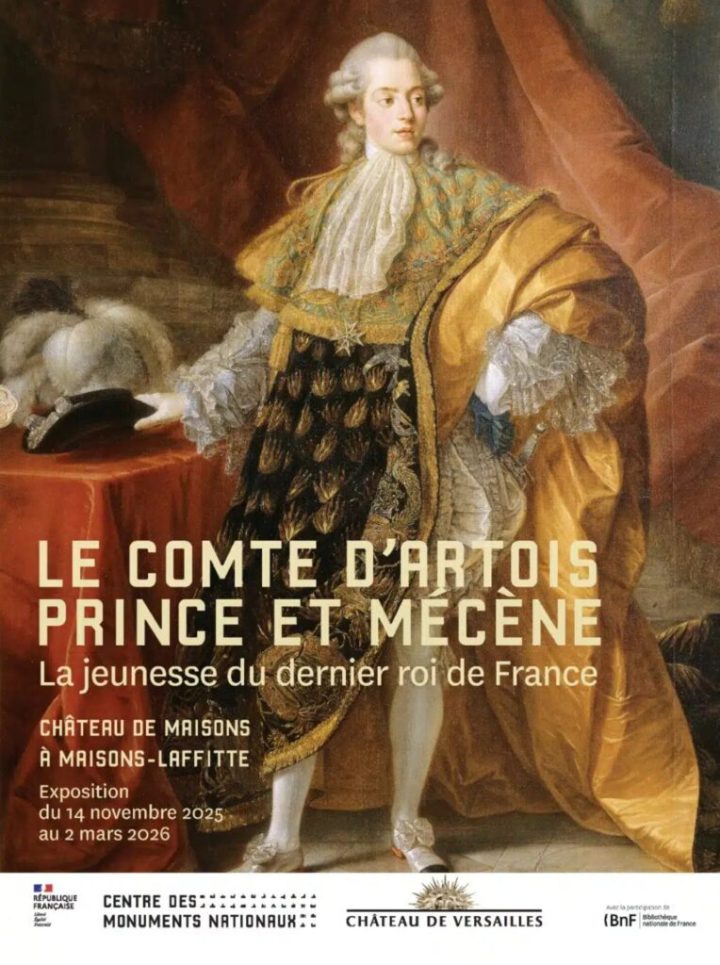 From an early age, the Count of Artois distinguished himself through his marked interest in splendor and refinement, coupled with an unrestrained passion for the modern currents of art and fashion. He was very close to Marie-Antoinette at the beginning of her reign, and they shared this common enthusiasm. However, unlike the queen, constrained by the demands of court etiquette, the Count of Artois enjoyed far greater freedom to adopt and promote the latest trends.
The château de Maisons, a masterpiece by François Mansart, was built from 1633 onward for René de Longueil, a magistrate of the Parliament of Paris. Designed as a pleasure residence, it became, as early as the 17th century, a place admired by the court. King Louis XIV himself visited it several times. In the following century, the estate entered a new era of splendor when, in 1777, the Count of Artois acquired it. He commissioned the architect François-Joseph Bélanger to transform the château with ambitious embellishment projects, refined interior decoration, and modern gardens. The count intended to make it both a setting for entertainment and a symbol of aristocratic refinement. But the upheavals of 1789 brought the work to a halt, and the prince’s property was confiscated.
After the Revolution, the château passed through various hands, from Marshal Lannes under the Empire to the banker Jacques Laffitte, who subdivided the park. The château was saved from ruin at the beginning of the 20th century thanks to its listing as a historic monument and its acquisition by the State. Today, restored and open to the public, the Château de Maisons remains a jewel of the Grand Siècle and still bears the mark of the Count of Artois’s lavish ambitions, whose tenure constitutes one of the most brilliant episodes in its history.
A Dialogue between Collections
The partnership established in 2013 between the Centre des Monuments Nationaux and the Palace of Versailles creates a dialogue between collections that are too often overlooked and major landmarks of France’s national heritage. Temporary exhibitions allow both institutions to pool their resources in order to offer as many people as possible the opportunity to discover, or rediscover, chapters of French history within the prestigious setting of national monuments. The CMN and the Palace of Versailles have concluded a deposit agreement that will allow the return and presentation, in situ, of works that were once at Maisons during the time of the Count of Artois, seized during the Revolution, and later kept at Versailles.
Curators
• Laurent Salomé, director of the National Museum of the Palaces of Versailles and Trianon
• Vincent Bastien, scientific collaborator at the Palace of Versailles
• Benoît Delcourte, chief curator at the Palace of Versailles
• Raphaël Masson, chief curator at the Palace of Versailles
• Clotilde Roy, responsible for enriching the collections of the Centre des Monuments Nationaux
• Gabriel Wick, doctor of history
Vincent Bastien, Benoît Delcourte, and Clotilde Roy, eds., Le Comte d’Artois, Prince et Mécène: La Jeunesse du Dernier Roi de France (Paris: Éditions du patrimoine, 2025), 96 pages, ISBN: 978-2757710821, €16.










 Enfilade
leave a comment