Online Talks | Patricia Ferguson, Ivan Day, Neil Buttery, and Paul Crane
From the Museum of Royal Worcester:
Museum of Royal Worcester | Online Winter Talk Series, 2025–26
The Museum of Royal Worcester is thrilled to present another season of fascinating online talks to keep the winter blues at bay. Curl up with a warm drink and join us as we explore art, food, and history with three brilliant speakers.
◊ ◊ ◊ ◊ ◊
Ivan Day | Frozen Delights: A History of Porcelain and Ice Cream
Wednesday, 21 January 2026, 6pm
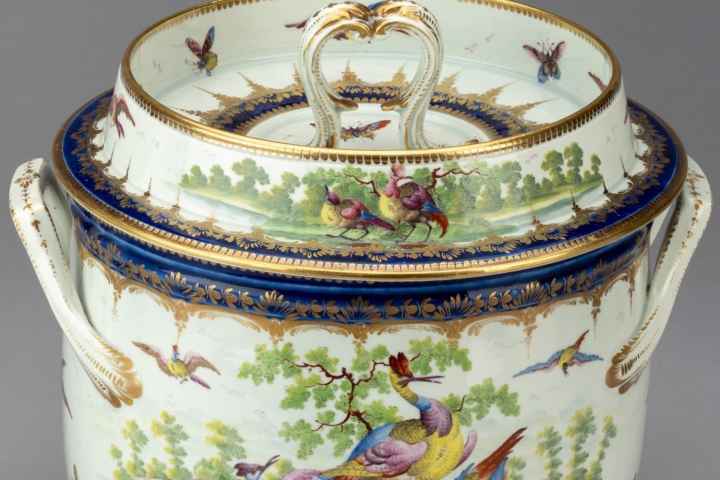
Ice Pail, 1776, William Davis Factory (Museum of Royal Worcester).
During the eighteenth century, ice cream became the ultimate show-off luxury for adorning a fashionable dinner table. As a result, new items for serving this novelty dish started to appear on the market. The challenge was to produce an attractive container which could be displayed centre stage on the sideboard or table, but which was also capable of preventing the ice cream from melting. These specialised three-part vessels first appeared in France in 1720s, where they were called seaux à glace—ice cream coolers. They employed a mixture of ice and salt to refrigerate their contents. By the 1770s the fashion for these beautiful vessels became an aristocratic craze, and nearly every European manufactory was producing them. In England, the Worcester factory played a leading role in developing some of the finest of these vessels. Ivan Day will guide us through the development of ice cream coolers and ice cream cups, with a focus on the marvellous examples produced at Worcester. Book here»
Ivan Day is one of the UK’s most celebrated food historians, broadcasters, writers, and curators, specialising in the reconstruction of period kitchens and historic table displays. His work has been exhibited in many institutions worldwide, including the Museum of London, the Metropolitan Museum of Art, and the Getty Research Institute. His publications include Cooking in Europe, 1650–1850 and Ice Cream: A History.
◊ ◊ ◊ ◊ ◊
Neil Buttery and Paul Crane | Sugar, Slavery and Empire / The Evolution of Worcester Sucriers
Wednesday, 4 March 2026, 6pm

A rare early Dr Wall Worcester Sucrier and Cover with Flame finial, ca. 1753. A unique example retaining its cover, the shape derived from silver. Ex Rous Lench collection Worcestershire.
Join food historian Neil Buttery and ceramics expert Paul Crane in a presentation discussing the role of sugar and the associated enslavement of African peoples in the growth and development of the British Empire and Worcester Porcelain in the eighteenth century. Neil will explore how the reach of the ‘sugar-slave complex’ was all-pervading, influencing the sale and evolution of fancy goods, especially those associated with the tea table, which, of course, included porcelain. As a case study, Paul will focus on the evolution of the sucrier in the first fifty years of Worcester Porcelain. Book here»
Neil Buttery is a multi award-winning food historian, author, podcaster, and chef. He hosts The British Food History Podcast and co-hosts A is for Apple: An Encyclopaedia of Food & Drink. His publications include A Dark History of Sugar, Before Mrs Beeton: Elizabeth Raffald, England’s Most Influential Housekeeper, Knead to Know: A History of Baking, and The Philosophy of Puddings. Dr. Buttery has recently collaborated with the Museum of Royal Worcester on projects to deliver narratives on the history of food and porcelain to wider communities. His permanent display “Dr. Wall’s Dinner” at MoRW recently won the Food on Display Award at the British Library Food Season Awards in 2025.
Paul Crane is an independent historian and consultant to the Brian Haughton Gallery, London. He is a descendant of Dr. John Wall (1708–1776), who founded the Worcester Porcelain Manufactory in 1751. Paul presently sits as a Trustee of the Museum of Royal Worcester, formerly the Dyson Perrins Museum in the city of Worcester. He also is a Fellow of the Society of Antiquaries, an independent historian and researcher, and a Liveryman of the Worshipful Company of Art Scholars.
◊ ◊ ◊ ◊ ◊
Patricia Ferguson | Exploring the Rococo through Chelsea’s Gold Anchor Vases
Tuesday, 2 December 2025, 6pm — A recording is available here»
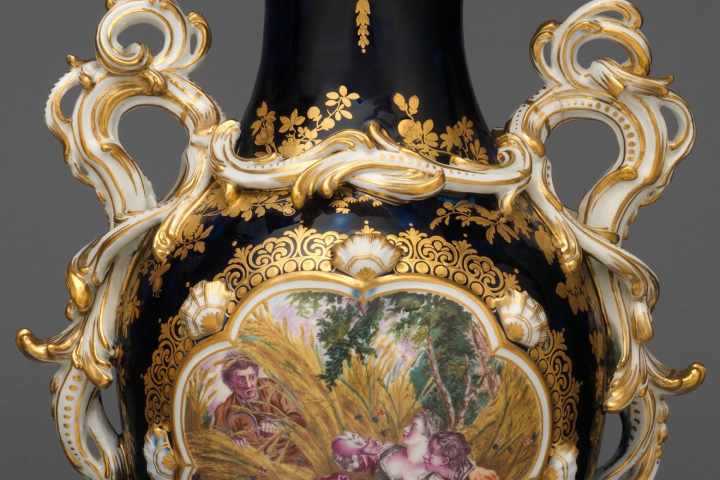
Vase (one of a pair), Chelsea Porcelain Factory, ca. 1762 (New York: The Metropolitan Museum, 1970.313.2a, b).
Of all design styles, Rococo was perhaps the most rebellious—ornate, theatrical, and a true ‘style without rules’. Emerging in France in the 1720s–30s, it featured curved, asymmetrical motifs drawn from nature, especially the acanthus leaf, and marine-inspired forms that gave rise to its name, from rocaille (‘rock’ or ‘shell’). Its greatest achievements appeared in the decorative arts—furniture, silver, and ceramics. By the 1750s–60s, English porcelain factories like Worcester and Chelsea embraced Rococo, even as taste was shifting toward Classical order. Worcester adapted Rococo silver shapes for tablewares, but Chelsea—under Flemish silversmith Nicholas Sprimont—produced some of the boldest Rococo porcelain in Europe, rivaling Meissen and Sèvres. This talk explores Chelsea’s gold anchor period (ca. 1758–64), its spectacular vases, its rivals, and its enduring legacy.
Patricia F. Ferguson is a ceramic researcher, a former curatorial consultant at the Victoria and Albert Museum and the British Museum, she is an advisor on ceramics for the National Trust and other heritage organizations. Her publications include Pots, Prints, and Politics: Ceramics with an Agenda, from the 14th to the 20th Century (2021); Ceramics: 400 years of British Collecting in 100 Masterpieces (2017); and Garnitures: Vase Sets from National Trust Houses (2017).










 Enfilade
leave a comment