Online Conversation | Reflecting on Turner in 2025
Registration for this HECAA Great Conversation (open to non-HECAA members) is available here:
Turner in 2025: Reflecting on the Anniversary Year’s Exhibitions
With Chloe Wigston Smith, Richard Johns, Lucinda Lax, and Melissa Gustin
Online, 23 January 2026, 12.30 EST / 5.30 GMT
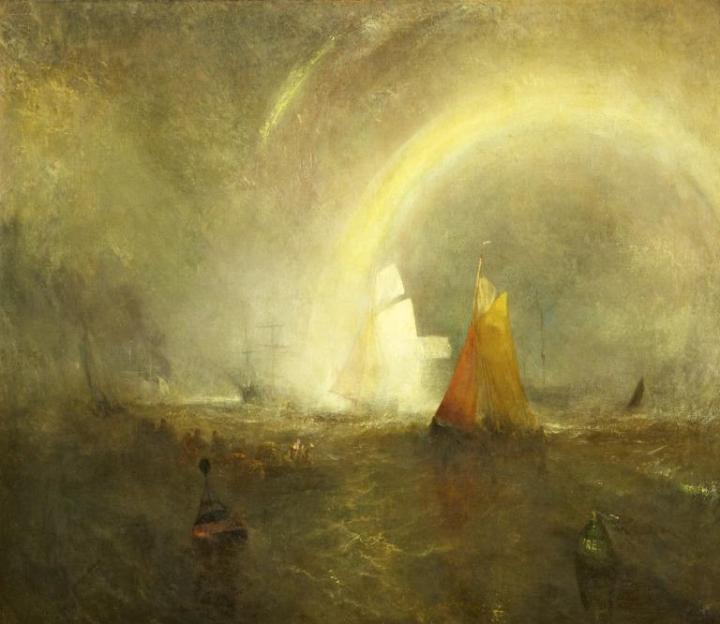
J.M.W. Turner, The Wreck Buoy, first exhibited in 1849, oil on canvas, canvas: 93 × 123 cm (Liverpool: Walker Art Gallery).
Joseph Mallord William Turner was born in 1775. To mark 250 years since his birth, a number of anniversary exhibitions were organized across the United Kingdom and the United States in 2025. Some contextualized Turner with other notable contemporaries; others focused on specific aspects of his career or mined collection holdings. This roundtable will bring together four curators of three Turner anniversary exhibitions to ask them to reflect on their exhibitions and ponder together what it means to exhibit Turner today.
• Melissa Gustin is Curator of British Art at the National Museums Liverpool, and curator of Turner: Always Contemporary at the Walker Art Gallery.
• Lucinda Lax is Interim Head of the Curatorial Division and Curator of Paintings and Sculpture at the Yale Center for British Art, and curator of J.M.W. Turner: Romance and Reality.
• Richard Johns is Senior Lecturer in the Department of History of Art at the University of York. Along with Smith, he was a co-curator of Austen and Turner at Harewood House.
• Chloe Wigston Smith is Professor in the Department of English at the University of York and Director of its Centre for Eighteenth-Century Studies. Along with Johns, she was a co-curator of Austen and Turner at Harewood House.
Join us on Friday, 23 January 2026 at 12.30pm EST / 5.30pm GMT for this HECAA Great (Zoom) Conversation. The event is open to current and prospective HECAA members; so please share widely in your networks.
Conference | Reflections at Work
From ArtHist.net:
Reflections at Work / Le reflet à l’oeuvre
Institut national d’histoire de l’art (INHA), Paris, 22–23 January 2026
Organized by Anne Pillonnet, Marie Thébaut-Sorger, and Romain Thomas
How do reflections (both physical and depicted) and lighting influence our perception of artworks and their presentation? Art historians, physicists, digital specialists and experts in perceptual phenomena will gather to discuss this question at the international conference ‘Reflections at Work’. Jointly organised by the teams of AORUM project (Analyse de l’Or et de ses Usages comme Matériau pictural, XVIe–XVIIe siècles) and FabLight project (La fabrique de l’éclairage dans les arts visuels au temps des Lumières, 1760–1820), this event is part of an interdisciplinary research initiative that aims to promote a collective exploration of reflections, light, and their role in past and present aesthetic experience.
t h u r s d a y , 2 2 j a n u a r y
9.00 Accueil des participants
9.10 Mot de bienvenue — Anne-Solène Rolland (INHA)
9.15 Introduction — Anne Pillonnet (Institut Lumière Matière, université Lyon 1), Marie Thébaud-Sorger (Centre Alexandre-Koyré CAK-CNRS, Paris) et Romain Thomas (INHA)
9.40 Session 1 | Reflection of Matter, Matter of Reflection
Présidence: Christophe Renaud (Laboratoire d’Informatique Signal et Image LISIC, université du Littoral Côte d’Opale) et Romain Thomas (INHA)
• ‘Alle de verwen van een regenboog vertoonend’ (« Montrant toutes les couleurs d’un arc-en-ciel ») : peindre l’iridescence de la nacre dans la nature morte néerlandaise du XVIIe siècle — Clara Langer (Laboratoire de Recherche Historique Rhône-Alpes LARHRA, université Lyon 2 /université de Constance)
• Reflets de matière, ce qu’ils révèlent — Anne Pillonnet (Institut Lumière Matière, université Lyon 1)
• La perception visuelle du brillant et des reflets — Pascal Mamassian (Laboratoire des Systèmes Percerptifs LSP, École normale supérieure PSL)
• Rendu des surfaces brillantes : entre réalisme physique et réalisme perceptuel — Samuel Delepoulle (Laboratoire d’Informatique Signal et Image LISIC, Université du Littoral Côte d’Opale)
• Peindre la lumière : les femmes, le portrait et la luminosité matérielle dans la Gênes du début de l’époque moderne / Painting Light: Women, Portraiture, and Material Luminosity in Early Modern Genoa — Ana Howie (Département d’histoire de l’art et d’études visuelles, université Cornell, Ithaca) (Intervention en anglais)
12.45 Pause déjeuner
14.00 Session 2 | Reflection on the Artwork: The Lighting Atmosphere
Présidence: Christine Andraud (Centre de Recherche sur la Conservation CRC, Muséum national d’Histoire naturelle) et Ralph Dekoninck (Faculté de philosophie, arts et lettres, université catholique de Louvain)
• Du bruit à l’extase, en quête de contemplation — Viviana Gobbato (Département Culture et Education Arc de Triomphe – CMN / Centre d’Histoire Culturelle des Sociétés Contemporaines CHCSC, université Paris-Saclay)
• L’art aux mains de la fée Électricité. Visiter le Salon la nuit (1879–1880) — Agathe Ménétrier (INHA)
• Capter le reflet, sonder la matière : dispositifs d’imagerie pour l’œuvre d’art et le corps humain — Mathieu Hébert (Institut d’Optique, université Jean Monnet Saint-Étienne)
• La lumière du jour comme source lisible pour les contextes spatiaux et visuels de la fin du Moyen Âge : la nef de la cathédrale Notre-Dame de Freiberg (Saxe) / Daylight as a readable Source for Late Medieval Spatial and Visual Contexts: The Hall Nave of St. Mary’s Cathedral, Freiberg (Saxony) (Intervention en anglais) — Lia Bertram (École des Beaux-Arts, Dresde)
• Le calcul des reflets — Christophe Renaud (Laboratoire d’Informatique Signal et Image LISIC, université du Littoral Côte d’Opale)
17.00 Conclusion de la journée
f r i d a y , 2 3 j a n u a r y
9.00 Accueil des participants
9.20 Session 3 | Reflection in the Artwork: Symbol and ‘Off-screen’
Présidence: Martial Guédron (Laboratoire Arts, civilisation et histoire de l’europe ARCHE, université de Strasbourg) et Marie Thébaud-Sorger (Centre Alexandre-Koyré CAK-CNRS, Paris)
• Au miroir de l’armure — Diane Bodart (Département d’histoire de l’art et d’archéologie, université Columbia, New York)
• Quelques dispositifs réflexifs chez Philippe de Champaigne à Port-Royal de Paris : retour sur « une hypothèse saugrenue » de Louis Marin — Frédéric Cousinié (Groupement de Recherche en Histoire GRHis, université de Rouen-Normandie)
• Usages du reflet chez Clara Peeters, Pieter Janssens Elinga et Jean Siméon Chardin — Matthieu Somon (Institut de recherche Religions, Spiritualités, Cultures, Sociétés RSCS, université catholique de Louvain)
• Réfléchir les reflets dans l’emblématique du XVIIe siècle — Ralph Dekoninck (Faculté de philosophie, arts et lettres, université catholique de Louvain)
• « Une journée au XVIIIe siècle. Chronique d’un hôtel particulier » : Lumière sur une exposition — Ariane James-Sarrazin (Musée des Arts décoratifs)
11.55 Discussion










 Enfilade
leave a comment