Call for Papers | Views of their Own: The Work of Women Artists
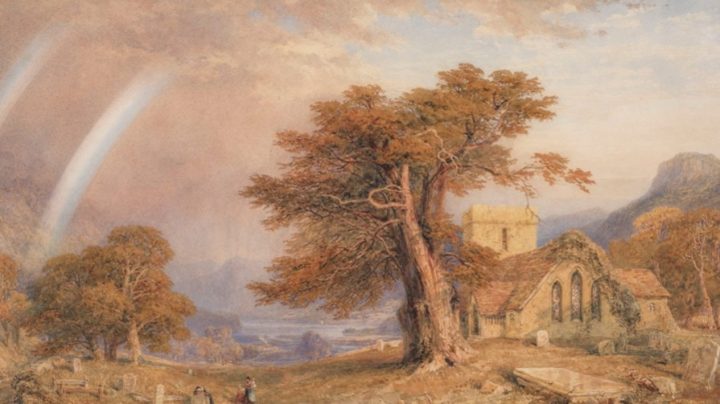
Fanny Blake, A Rainbow over Patterdale Churchyard, Cumbria, 1849, watercolour and opaque watercolour over graphite, with scratching out, on wove paper (Jointly owned by the Samuel Courtauld Trust and The Wordsworth Trust, Gift from a private collection in memory of W. W. Spooner, 2025).
◊ ◊ ◊ ◊ ◊
From The Courtauld:
Views of Their Own: Rediscovering and Re-presenting the Work of Women Artists
The Courtauld Institute of Art, London, 13 March 2026
Organized by Rachel Sloan
Proposals due by 6 February 2026
Timed to coincide with the Courtauld Gallery’s current exhibition, A View of One’s Own: Landscapes by British Women Artists, 1760–1860, this conference aims to investigate the challenges and opportunities presented by the recovery and re-presentation of historic women artists whose work and reputations have fallen out of art historical narratives.
Bringing together art historians and curators, this conference will explore various approaches to the complexities of bringing to light artists long overlooked by art history, whether via exhibition (permanent or temporary) or through the written word. Although the exhibition focuses on British artists, working both at home and abroad, from the mid-18th to the mid-19th centuries, we welcome papers that move beyond these chronological and geographical boundaries. The conference seeks to examine how attitudes and approaches to restoring to view the lives and work of women lost to art history have evolved, and continue to evolve, over recent decades, and the complexities, discoveries and rewards of charting overlooked artists and their work.
We would particularly welcome submissions in the following areas:
• Negotiating the grey area between the categories of ‘amateur’ and ‘professional’ in women artists’ careers
• The presentation of women artists’ work in settings other than temporary exhibitions
• Institutions and networks that fostered and supported the work of women artists
• Women artists’ strategies for publicising their work
Please submit an abstract of 300–500 words for a 20-minute paper, with a title, your affiliation (if any), and a short biographical summary to Rachel.Sloan@courtauld.ac.uk by 6 February 2026. Selected papers will be confirmed by 10 February.
Organised by The Manton Centre for British Art, The Courtauld Institute of Art.
Call for Papers | Women Conservators in Europe, 1750–1970
From ArtHist.net:
Women Conservators between Europe and Italy, 1750–1970
Sapienza University of Rome, 14–15 May 2026
Proposals due by 15 February 2026
In recent years, gender studies have profoundly reshaped the historiography of art and heritage preservation, bringing renewed attention to the role of women as key protagonists in the culture of heritage and expanding scholarly perspectives beyond the limits imposed by traditional narratives. The contribution of women to the history of conservation and restoration, however, remains largely understudied and only fragmentarily documented.
The earliest women active in collecting, museum, and private contexts can be traced back to the eighteenth century in Italy and across Europe. Figures now better known, such as Margherita Bernini, documented in Rome in the service of major aristocratic families, or Marie-Éléonore Godefroid, involved in the restoration of paintings for the collections of the Musée du Louvre and other Parisian institutions, stand alongside many other professionals whose work is only now being brought to light by recent research. In many cases, their activity emerges in connection with that of their husbands, whom they often succeeded in the management of workshops and restoration sites, assuming significant technical and administrative responsibilities that nevertheless remained largely invisible in historical sources. During the twentieth century, women’s presence became increasingly established within public institutions responsible for heritage protection, contributing substantially to the definition of the professional identity of the conservator at a time of profound transformation in the discipline. In this period, restoration gradually developed into a critically structured practice, grounded in technical, methodological, and historical expertise and embedded within an increasingly complex institutional framework, in which women played a far from marginal role.
This conference aims to offer a first systematic survey of women active in the field of heritage conservation and restoration between the mid-eighteenth century and the second half of the twentieth century, not only from the perspective of gender studies, but more broadly within the history of preservation and conservation in Italy and Europe.
The conference will explore the relationships between:
• restoration practices and techniques in different European contexts
• institutional transformations (museums, heritage authorities, conservation bodies)
• individual and collective careers, professional networks, and regional contexts
• diverse geographies and chronologies of restoration
• relationships between theory, practice, and training
• phenomena of family continuity and ‘professional inheritance’
• material, documentary, and photographic sources relevant to reconstructing women’s professional profiles
We invite proposals addressing, but not limited to, the following topics:
• studies on women conservators active in Italy or Europe between 1750 and 1970
• workshops, laboratories, restoration sites, museums, or archival institutions where women conservators worked
• restoration of paintings, works on paper, textiles, decorative arts, frescoes, sculpture, and architectural heritage
• patronage networks, professional collaborations, and working relationships with senior figures within state heritage institutions
• conservation methodologies, diagnostic practices, and operational protocols
• family-based transmission of skills and professional knowledge, continuity of practice, and workshop inheritance
• comparative and transnational perspectives.
Submission Guidelines
Abstract: maximum of 300 words
Short bio: maximum of 150 words
Languages: Italian and English
Submission address: convegnorestauratrici@gmail.com
Deadline: 15 February 2026
Notification of acceptance: 10 March 2026
Conference dates: 14–15 May 2026
Conference papers will be published. Further information regarding editorial arrangements and publication timelines will be provided in due course. Speakers selected through the call are kindly asked to note that the conference organization will not be able to cover travel and accommodation expenses.
Scientific Committee
Eliana Billi (Sapienza University of Rome)
Giuseppina Perusini (formerly University of Udine)
Simona Rinaldi (University of Tuscia)
Martina Visentin (University of Udine)
Organising Secretariat
Laura D’Angelo (University of Arkansas, Rome Center)
Call for Papers | Revolutions, Art, and the Market
From ArtHist.net:
Revolutions, Art, and the Market
Sotheby’s Institute of Art, London, 4–5 June 2026
Proposals due by 1 March 2026
Art market trends and practices, whether historical or contemporary, are affected by networks of complex and often competing forces. As moments of political, economic, intellectual or technological rupture, revolutions have significantly shaped art market systems and fortunes, refracting and redirecting collecting ambitions, displacing existing markets and creating new ones, and promoting novel modes of commercialisation of art.
Embracing wide chronological and geographical spans, this conference will consider how revolutions have inflected the circulation and consumption of art and facilitated the emergence of new art market practices and collecting paradigms. The conference is deliberately adopting a broad definition of the term Revolution, intending to encompass its political, cultural, intellectual, economic, and technological incarnations.
Interdisciplinary proposals and methodological approaches including empirical evaluations, economic analyses, and studies from the digital humanities are welcome. The conference is intended to foster rich discussions at the intersection of academic scholarship and professional practices, and contributions from both academics and art market professionals are actively sought. Papers addressing contemporary perspectives and practices, as well as under-represented regions of the art market and the Global South are particularly encouraged.
Proposals offering critical perspectives may consider (but are not limited to) the following themes:
• Political revolutions and shifting art market geographies
• The dispersal and looting of collections
• Revolutions and markets for luxury goods
• Political revolutions and artistic migrations
• The markets for revolutionary art
• The American Revolutionary War and transatlantic artistic exchanges
• The Russian Revolutions
• The aftermath of PCR’s Cultural Revolution
• Iran’s White and Islamic Revolutions and the national and international markets for Iranian art.
• The artistic expressions of the Arab Springs
• The Scientific Revolution and its new collecting paradigms
• The Printing Revolution and the markets for prints
• The digital revolution and the emergence of new art market commercial platforms
• Technological revolutions and innovations: NFTs, Blockchain, AR, VR, AI-generated art
Please submit an abstract of no more than 300 words for a 25-minute paper, along with a brief biography to Barbara Lasic, b.lasic@sia.edu, by 1 March 2026. Successful papers will be notified by 15 March.










 Enfilade
leave a comment