Exhibition | 1725: Native American Allies at the Court of Louis XV
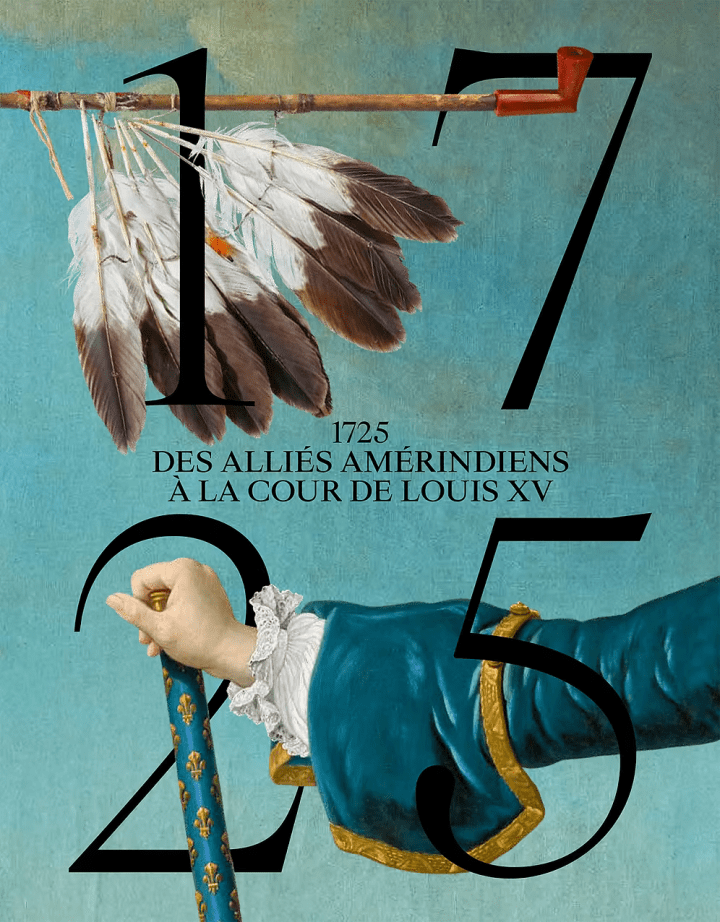
1725: Native American Allies at the Court of Louis XV
1725: Des alliés amérindiens à la cour de Louis XV
Château de Versailles, 25 November 2025 — 3 May 2026
Curated by Jonas Musco, Paz Núñez-Regueiro, and Bertrand Rondot
In 1725, four Native American chiefs and a Native American woman from the Mississippi Valley were received in France as part of an unprecedented diplomatic mission. The event marked the climax of efforts by the French crown to build relationships with Indigenous nations in North America, amidst ongoing conflicts between European colonial powers and the Indigenous allies. This exhibition offers a rare opportunity to explore the history and lives of the Native American nations of the Mississippi Valley in the 18th century, their connections with France, the extraordinary Atlantic crossing undertaken by their leaders, and their meeting with Louis XV, the royal court, and the capital.
The Indigenous Mississippi Valley in the 18th Century
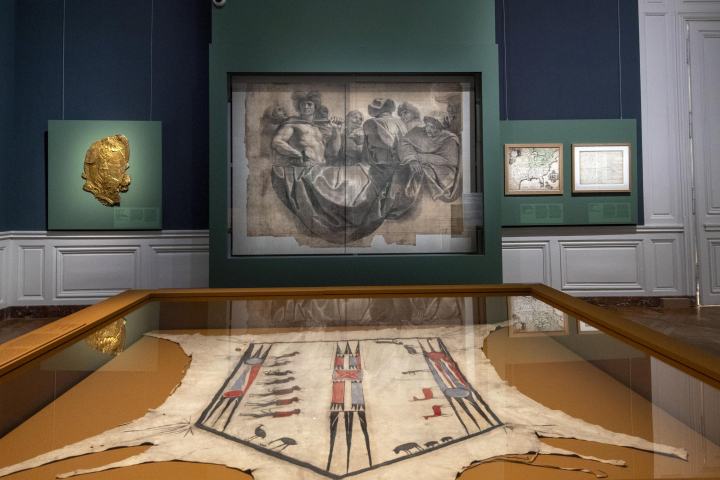
 The first section of the exhibition immerses visitors in the complex world of Native American societies of the Mississippi Valley at the time the French began exploring and settling the area. The encounter between these two civilizations soon led to a lasting alliance based on close diplomatic ties. The exhibition introduces the major Indigenous nations at the heart of this story through a contemporary map specially created for the show, alongside rare 18th-century maps. Some of these nations were already allied with the French through earlier treaties, notably reinforced in 1701 by the Great Peace of Montreal, a historic treaty exceptionally presented to the public.
Through a series of rare portraits—some of the only surviving from that period—a different image of Native societies emerges, far from the 19th-century Plains stereotypes. The selection of artefacts includes a remarkable feathered headdress made in the 18th century for a high-ranking chief, likely the oldest of this type known in the world. The presentation continues with a glimpse into their seasonal way of life, alternating between farming and hunting. Their relationship with the living world is also spiritual, involving social connections with more-than-human beings, such as the thunderbirds—powerful spirits often depicted on hides presented to the French as diplomatic gifts.
The Founding of a French Colony: Louisiana
The second section focuses on the close ties developed between the French and their Indigenous allies after the founding of the Louisiana colony. A selection of objects illustrates the cultural blending that emerged in the early 18th century: war clubs decorated with fleur-de-lis, necklaces made of imported beads, and European knives sheated in Native-style scabbards. The most emblematic items are a peace pipe richly decorated with feathers and a painted hide depicting it.
In 1724, to strengthen the alliance, the Compagnie des Indes proposed inviting the Native leaders to the court of young Louis XV. Étienne Véniard de Bourgmont, commander of the Missouri post, contacted the Otoe, Osage, and Missouria nations—their responses, transcribed in diplomatic correspondence, will be featured in the exhibition—while the Illinois sent Chicagou, the Michigamea chief and conveyed the words of Mamantouensa, chief of the Kaskadia, through Jesuit missionary Nicolas Ignace de Beaubois.
Forming the delegation was not without difficulty. Several other nations planned to send representatives, but the shipwreck of the vessel meant to transport them to France discouraged many from continuing. Ultimately, the delegation consisted of four chiefs and the daughter of a Missouri chief. They set sail in the spring of 1725. From that moment, the delegates were treated as international ambassadors, and a document reveals they were served ‘at the captain’s table’, an honor reserved for elite guests.
The Delegation’s Reception at Court
The final section traces the steps of the Native American chiefs’ visit to France—Paris, Versailles, and Fontainebleau—and details the royal court’s diplomatic protocol for receiving foreign embassies. Thanks to invaluable accounts from the Mercure de France, we follow their movements: meetings with the directors of the Compagnie des Indes, the organizers of the journey, and with princes and princesses of the royal blood.
The exhibition highlights the audience granted by Louis XV to the chiefs on November 25, 1725, at Fontainebleau. This was the most symbolic moment of the visit, during which the chiefs gave speeches to the king, who responded with marked interest in his guests. After touring Versailles, Marly, and Trianon, the delegates were honored with an invitation to hunt alongside with the king at Fontainebleau. They gladly accepted and participated ‘in their own way’—on foot and armed with bows.
The exhibition pathway, punctuated with excerpts from the Mercure de France, presents gifts similar to those exchanged between the Native delegates, the king and the government: prestigious headdresses, bows, and a peace pipe for the Native visitors, and a gold medal and other precious artifacts for the French. Portraits of the main French figures and, for the first time in France, a portrait of a Miami Native American will bring this historic meeting to life.
The exhibition concludes with a reference to the ‘Danse des Sauvages’, a famous piece by Jean-Philippe Rameau added to his opera Les Indes galantes. Inspired by the dance of two Native chiefs at the Comédie-Italienne, this rarely discussed source of inspiration reveals the enduring cultural impact of the 1725 delegation in France.
A special visitor program will allow guests to hear from Native members of the exhibition’s scientific committee as they reflect on the modern-day relationship between their nations and France, echoing this long-shared history.
Curators
• Jonas Musco, Historian, Research Associate
• Paz Núñez-Regueiro, Chief Curator of Heritage, Musée du quai Branly–Jacques Chirac
• Bertrand Rondot, Chief Curator of Heritage, Palace of Versailles
The exhibition is developed within the framework of the research project CRoyAN – Royal Collections of North America—coordinated by the musée du quai Branly–Jacques Chirac, in dialogue with four Native nations: the Choctaw Nation of Oklahoma, the Quapaw Nation, the Miami Tribe of Oklahoma, and the Peoria Tribe of Indians of Oklahoma. The exhibition is organized thanks to the patronage of The CORA Foundation. The exhibition is co-organized with the musée du quai Branly–Jacques Chirac.
Jonas Musco, Paz Núñez-Regueiro, and Bertrand Rondot, 1725: Des alliés amérindiens à la cour de Louis XV (Paris: Liénart, 2025), 160 pages, ISBN: 978-2359064766, €29.










 Enfilade
leave a comment