Strawberry Hill Launches Appeal to Acquire Early View of the Villa
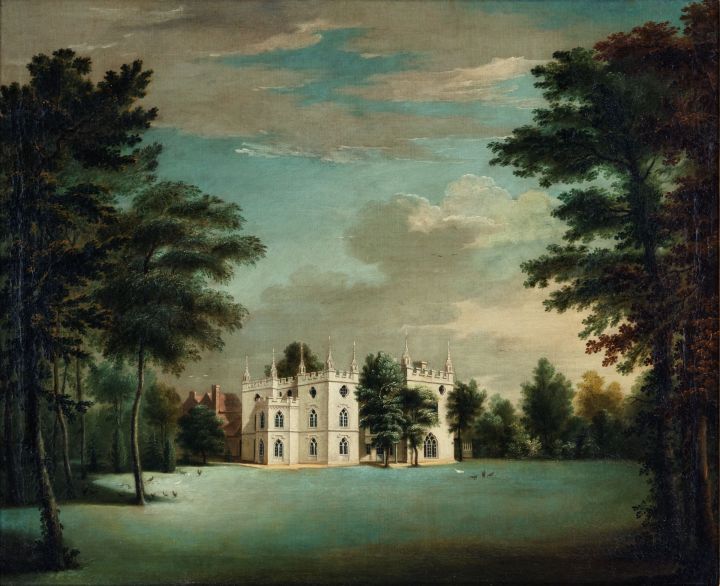
Johann Heinrich Müntz, South-East View of Strawberry Hill House, ca. 1755–58,
oil on canvas, 25 × 30 inches.
◊ ◊ ◊ ◊ ◊
From the press release:
Strawberry Hill House & Garden has launched an appeal to raise £85,000 to acquire South East View of Strawberry Hill House by Johann Heinrich Müntz (c.1755–58), a rare contemporary painting that captures Horace Walpole’s Gothic villa at the very moment the Gothic Revival was being born. Commissioned by Walpole himself, the painting offers an extraordinary glimpse of Strawberry Hill before its dramatic transformation of 1759, when the Gallery and Round Tower were added to create the iconic silhouette we recognise today. It is one of only two known oil paintings of the house by Müntz, whose companion view is now held at the Lewis Walpole Library, Yale University.
More than a record, the painting reveals Strawberry Hill in the process of invention. At the time it was made, the Swiss artist Johann Heinrich Müntz (1727–1798) was living and working at the house as Walpole’s artist in residence, contributing directly to its evolving architectural vision. What he depicts is not a finished monument, but a creative experiment taking shape—house and garden emerging together as a new kind of Gothic design.
The painting is currently on short-term loan and will be on display in the Red Bedchamber at Strawberry Hill House from 30 March 2026, where it can be viewed free with general admission.
Painted for Walpole and long kept at his London residence on Berkeley Street, this view of Strawberry Hill has never hung in the house it was created to record. Acquiring it now would bring the painting home for the first time, reuniting a formative moment in Strawberry Hill’s history with the place that inspired it.
Two generous supporters have pledged to match donations to the appeal pound-for-pound, meaning every contribution will go twice as far until the £85,000 target is reached.
Dr Silvia Davoli, Senior Curator, said: “Strawberry Hill was conceived as a complete work of art, where architecture, interiors, landscape and collections were designed to speak to one another. This painting is central to that vision. It is not simply a depiction of the house, but part of the creative process that shaped it. Bringing it back would restore a missing piece of that story—returning it, for the first time, to the place it was made to record.”
More information about the painting is available from Thomas Coulborn & Sons.
Strawberry Hill Launches Appeal to Recreate Shell Seat
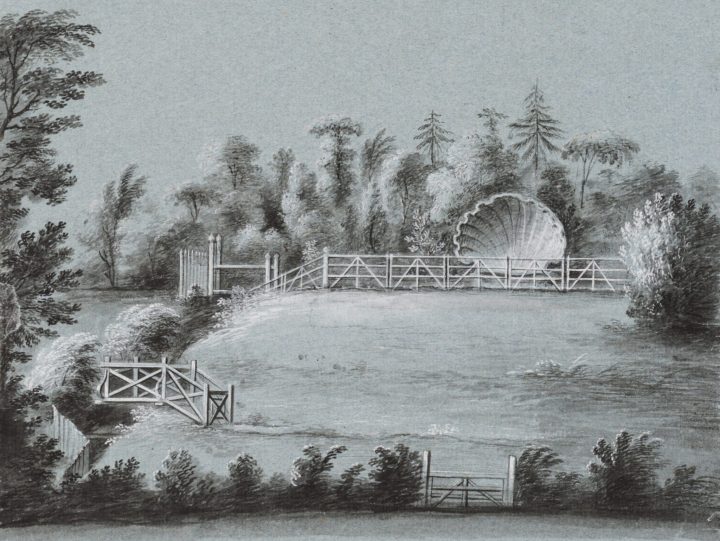
Jean-Henri Müntz, View of the Shell Seat and Bridge at Strawberry Hill, 1755, ink drawing
(Yale University, Lewis Walpole Library)
◊ ◊ ◊ ◊ ◊
From the press release (March 2026) . . .
Strawberry Hill House & Garden is launching an appeal to raise £30,000 to recreate the Shell Seat, one of the most visually arresting and evocative features of Horace Walpole’s eighteenth-century garden. Designed as a place for rest, conversation and delight, the Shell Seat formed part of Walpole’s celebrated ‘land of beauties’—a landscape shaped by imagination, sociability and theatrical effect. This ambitious project will employ cutting-edge digital mapping technology from Factum Arte to design and create a faithful, weather-resistant replica based on the original eighteenth-century drawings, ensuring the seat endures for future generations.
The Shell Seat was designed in 1754 by Richard Bentley, Horace Walpole’s close collaborator and later a member of his celebrated ‘Committee of Taste’. Constructed under the direction of architect William Robinson, it took the form of a monumental half-clam shell—a striking example of eighteenth-century fascination with natural forms transformed into architectural ornament. Positioned on Walpole’s ‘sweet walk’ in the south-west corner of the garden, the bench was carefully oriented to frame a breathtaking view of the River Thames. It was both a visual spectacle and a place of sociable retreat, designed to contrast the house’s Gothic ‘gloomth’ with an enlivening garden experience. Its impact was immediate. Writing to George Montagu in 1759, Walpole delighted in the sight of the Duchesses of Hamilton and Richmond and Lady Ailesbury seated together: “There never was so pretty a sight as to see all three of them sitting in the shell.”
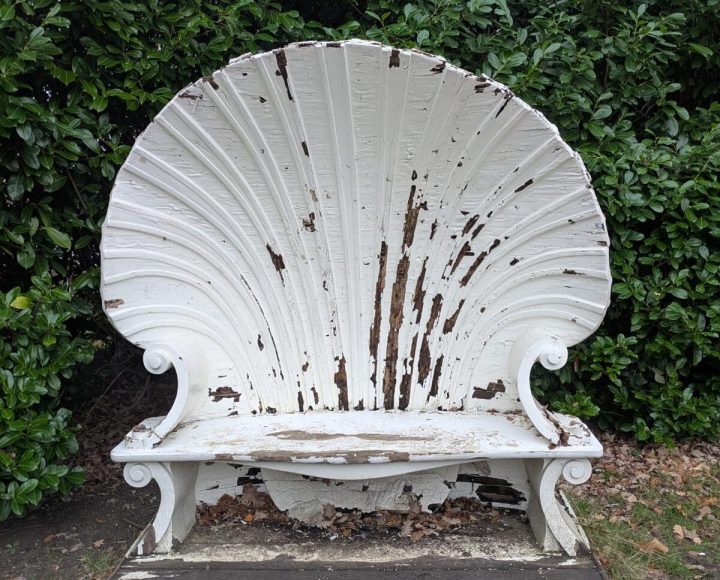
The current bench, photographed in December 2025.
The original Shell Seat was lost, likely long before the dispersal of Walpole’s collection in the great sale of 1842. A full-scale replica, constructed in oak using laminated techniques, was installed during the major restoration of Strawberry Hill between 2007 and 2010. After fifteen years exposed to the elements, this replica is now in a serious state of disrepair. Without intervention, the Shell Seat—once a centrepiece of Walpole’s garden design—risks being lost once again.
To secure the future of the Shell Seat, we are working with Factum Arte, internationally renowned specialists in digital heritage documentation and historically informed reconstruction. Using advanced 3D digital mapping, they will create an exact digital record of Bentley’s original eighteenth-century design. This will allow us to produce a new seat that is: faithful to the original, constructed using durable, weather-resistant materials, and designed to endure in the garden for generations to come.
Strawberry Hill House has worked closely with Factum Arte and its sister organisation, the Factum Foundation, a not-for-profit dedicated to digital preservation, for over a decade. Over this time, they have created numerous facsimiles for Strawberry Hill, helping to restore Horace Walpole’s dispersed collection to the house. These include major works such as Joshua Reynolds’s The Ladies Waldegrave, portraits of Horace Walpole and his family, and a wide range of miniatures, drawings, and decorative objects recorded from collections including the Lewis Walpole Library at Yale University, the Scottish National Gallery, and the British Museum. The Shell Seat restoration builds naturally on this long-standing collaboration and shared commitment to research-led, imaginative reconstruction.
This restoration will also stand as a lasting memorial to Derek Purnell, who served as Director of Strawberry Hill House from 2020 to 2024, and tragically died last year. Derek believed deeply that Strawberry Hill was not a static monument, but a living, imaginative place where house and garden work together to tell a story. He spoke often of the Shell Seat, recognising it as one of those rare objects that instantly captures the imagination and opens a doorway into Horace Walpole’s creative genius. Restoring the Shell Seat is a fitting tribute to Derek’s vision: not a plaque or a monument, but a living, functional part of Strawberry Hill’s continuing story.










 Enfilade
leave a comment