New Book | Rethinking Lessing’s Laocoon
From Oxford UP:
Avi Lifschitz and Michael Squire, eds., Rethinking Lessing’s Laocoon: Antiquity, Enlightenment, and the ‘Limits’ of Painting and Poetry (Oxford: Oxford University Press, 2017), 480 pages, ISBN: 978-0198802228, $110.
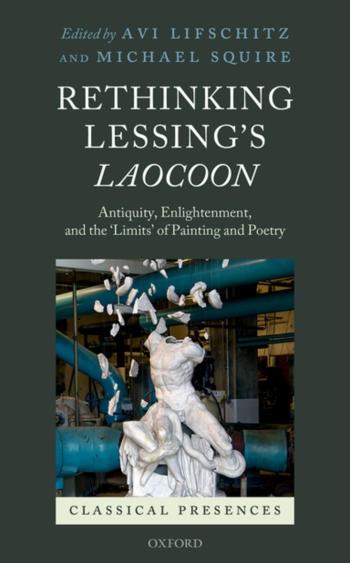 Gotthold Ephraim Lessing first published Laokoon, oder uber die Grenzen der Mahlerey und Poesie (Laocoon, or on the Limits of Painting and Poetry) in 1766. Over the last 250 years, Lessing’s essay has exerted an incalculable influence on western critical thinking. Not only has it directed the history of post-Enlightenment aesthetics, it has also shaped the very practices of ‘poetry’ and ‘painting’ in a myriad of different ways.
In this anthology of specially commissioned chapters—comprising the first ever edited book on the Laocoon in English—a range of leading critical voices has been brought together to reassess Lessing’s essay on its 250th anniversary. Combining perspectives from multiple disciplines (including classics, intellectual history, philosophy, aesthetics, media studies, comparative literature, and art history), the book explores the Laocoon from a plethora of critical angles. Chapters discuss Lessing’s interpretation of ancient art and poetry, the cultural backdrops of the eighteenth century, and the validity of the Laocoon‘s observations in the fields of aesthetics, semiotics, and philosophy. The volume shows how the Laocoon exploits Greek and Roman models to sketch the proper spatial and temporal ‘limits’ (Grenzen) of what Lessing called ‘poetry’ and ‘painting’; at the same time it demonstrates how Lessing’s essay is embedded within Enlightenment theories of art, perception, and historical interpretation, as well as within nascent eighteenth-century ideas about the ‘scientific’ study of Classical antiquity (Altertumswissenschaft). To engage critically with the Laocoon, and to make sense of its legacy over the last 250 years, consequently involves excavating various ‘classical presences’: by looking back to the Graeco-Roman past, the volume demonstrates, Lessing forged a whole new tradition of modern aesthetics.
Avi Lifschitz is Associate Professor of European History and Fellow of Magdalen College at the University of Oxford. Among his publications are Language and Enlightenment: The Berlin Debates of the Eighteenth Century and the edited volumes Engaging with Rousseau and Epicurus in the Enlightenment (the latter co-edited with Neven Leddy). Michael Squire is Reader in Classical Art at King’s College London. His books include The Iliad in a Nutshell: Visualizing Epic on the Tabulae Iliacae and The Art of the Body: Antiquity and Its Legacy.
C O N T E N T S
List of Illustrations
List of Tables
Note on Laocoon Editions
Foreword: Why Lessing’s Laocoon Still Matters, W. J. T. Mitchell
1 Introduction: Rethinking Lessings Laocoon from across the Humanities, Avi Lifschitz and Michael Squire
2 Laocoon Today: On the Conceptual Infrastructure of Lessing’s Treatise, David Wellbery
3 Laocoon among the Gods, or: On the Theological Limits of Lessing’s Grenzen, Michael Squire
4 Lessing’s Laocoon as Analytical Instrument: The Perspectives of a Classical Archaeologist, Luca Giuliani
5 Sympathy, Tragedy, and the Morality of Sentiment in Lessing’s Laocoon, Katherine Harloe
6 Mendelssohn’s Critique of Lessing’s Laocoon, Frederick Beiser
7 Naturalizing the Arbitrary: Lessing’s Laocoon and Enlightenment Semiotics, Avi Lifschitz
8 Temporalizationa Lessing’s Laocoon and the Problem of Narration in Eighteenth-Century Historiography, Daniel Fulda, translated from the German by Steven Tester
9 Criticism as Poetry? Lessing’s Laocoon and the Limits of Critique, Élisabeth Décultot, translated from the German by Steven Tester
10 Suffering in Art: Laocoon between Lessing and Goethe, Ritchie Robertson
11 Transparency and Imaginative Engagement: Material as Medium in Lessing’s Laocoon, Jason Gaiger
12 Lessing’s Laocoon and the ‘As-If’ of Aesthetic Experience, Jonas Grethlein
13 Art and Necessity: Rethinking Lessing’s Critical Practice, Paul Kottman
14 Image and Text in Lessing’s Laocoon: From Friendly Semiotic Neighbours to Articulatory Twins, Jurgen Trabant
15 Envoi: The Two-Fold Liminality of Lessing’s Laocoon, Hans Ulrich Gumbrecht
Notes on Contributors
Bibliography
Index
Chatsworth Reopens after £33m Restoration

Before and after restoration at Chatsworth, from Treasure House of England.
◊ ◊ ◊ ◊ ◊
Press release, via Art Daily (24 March 2018) . . .
Chatsworth Renewed: The House Past, Present, and Future
Chatsworth, 24 March — 21 October 2018
With its gold leaf and pale yellow stonework glinting in the spring sunshine, Chatsworth reopens on 24 March 2018 following the biggest restoration and conservation of the house, garden, and park since the 1820s. The 10-year long programme, costing more than £32m, sees Chatsworth restored to its full glory, inside and out. The Chatsworth Renewed exhibition, running between March and October, highlights the work of those involved in the restoration process. From rebuilding the Belvedere turrets to replacing vast tracts of lead on the roof, carving the tiniest details in stone using dentistry tools to replacing huge blocks in the walls, careful restoration of priceless artworks to the renovation of famous water features in the garden, over the last decade Chatsworth has been fully restored and made ready for the next century.
The Duke of Devonshire: “The level of forensic research, expertise, and craftsmanship applied by so many people has been absolutely inspiring. It has always been a thrilling moment to see the house come into view as you drive across the park and now that view has been made even more magical. With the years of blackened grime now removed from the stone, it looks truly magnificent.”
In 1981, the charitable Chatsworth House Trust was set up by the 11th Duke to ensure the long-term survival of the house and collection. Since 1949 the entrance money paid by more than 25 million visitors has made a vital contribution to the maintenance of the house and garden, and it is this income, rather than any public funding, that has enabled the current restoration works to be completed.
Visitors will also be able to see the artwork of Linder Sterling, artist-in-residence at Chatsworth and a Paul Hamlyn Foundation award winning artist.

Linder Sterling, Eidothea (left), 2017, and Latona, 2018 (right).
◊ ◊ ◊ ◊ ◊
Her Grace Land by Linder Sterling
Chatsworth, 24 March — 21 October 2018
Award-winning artist Linder Sterling (b. 1954) spent several months over winter 2017 immersing herself in the life of the Chatsworth Estate as the inaugural artist-in-residence. As well as creating a new image bank for future photo montages to take Chatsworth ‘out into the world’, some of the pieces created during her residency will go on display at Chatsworth. Her Grace Land features four installations exploring the female voice at Chatsworth in the centenary year of the Act of Representation.
N.B. — At the risk of puncturing the joke with an explanation, I would note that the former Duchess of Devonshire, Deborah Cavendish nee Mitford (1920–2014), was an ardent Elvis fan. –CH
Exhibition | Heavenly Bodies: Fashion and the Catholic Imagination
Press release (9 March 2018) from The Met:
Heavenly Bodies: Fashion and the Catholic Imagination
The Metropolitan Museum of Art and The Met Cloisters, New York, 10 May — 8 October 2018
Curated by Andrew Bolton, with C. Griffith Mann, Barbara Drake Boehm, Helen Evans, and Melanie Holcomb
The Costume Institute’s spring 2018 exhibition, Heavenly Bodies: Fashion and the Catholic Imagination, on view from May 10 through October 8, 2018 (preceded on May 7 by The Costume Institute Benefit) will be presented in two Metropolitan Museum of Art locations: at The Met Fifth Avenue—in the medieval galleries, Mary and Michael Jaharis Galleries for Byzantine Art, part of The Robert Lehman Wing, and the Anna Wintour Costume Center—and uptown at The Met Cloisters. The thematic exhibition will feature a dialogue between fashion and masterworks of medieval art in The Met collection to examine fashion’s ongoing engagement with the devotional practices and traditions of Catholicism. A group of papal robes and accessories from the Vatican will travel to the United States to serve as the cornerstone of the exhibition, highlighting the enduring influence of liturgical vestments on designers.
“The Catholic imagination is rooted in and sustained by artistic practice, and fashion’s embrace of sacred images, objects, and customs continues the ever-evolving relationship between art and religion,” said Daniel H. Weiss, President and CEO of The Met. “The Museum’s collection of Byzantine and western medieval art, in combination with the architecture and galleries that house these collections at The Met, provide the perfect context for these remarkable fashions.”
In celebration of the opening, the Museum’s Costume Institute Benefit, also known as The Met Gala, will take place on Monday, May 7, 2018. The evening’s co-chairs will be Amal Clooney, Rihanna, Donatella Versace, and Anna Wintour. Christine and Stephen A. Schwarzman will serve as Honorary Chairs. The event is The Costume Institute’s main source of annual funding for exhibitions, publications, acquisitions, and capital improvements.
“Fashion and religion have long been intertwined, mutually inspiring and informing one another,” said Andrew Bolton, Curator in Charge of The Costume Institute. “Although this relationship has been complex and sometimes contested, it has produced some of the most inventive and innovative creations in the history of fashion.”
The exhibition will feature approximately 40 ecclesiastical masterworks from the Sistine Chapel sacristy, many of which have never been seen outside the Vatican. These will be on view in the Anna Wintour Costume Center galleries and will include papal vestments and accessories, such as rings and tiaras, from the 18th to the early 21st century, encompassing more than 15 papacies. The last time the Vatican sent a loan of this magnitude to The Met was in 1983, for The Vatican Collections exhibition, which is the Museum’s third most-visited show.
In addition, more than 150 ensembles, primarily womenswear, from the early 20th century to the present will be shown in the Byzantine and medieval galleries, part of the Robert Lehman Wing, and at The Met Cloisters alongside medieval art from The Met collection, providing an interpretative context for fashion’s engagement with Catholicism. The presentation situates these designs within the broader context of religious artistic production to analyze their connection to the historiography of material Christianity and their contribution to the construction of the Catholic imagination.
Designers in the exhibition will include A.F.Vandevorst, Azzedine Alaïa, Cristobal Balenciaga, Geoffrey Beene, Marc Bohan (for House of Dior), Thom Browne, Roberto Capucci, Jean Charles de Castelbajac, Gabrielle “Coco” Chanel, Ann Demeulemeester, Sorelle Fontana, Domenico Dolce and Stefano Gabbana (for Dolce & Gabbana), John Galliano (for House of Dior), Gattinoni, Jean Paul Gaultier, Craig Green, Madame Grès (Alix Barton), Demna Gvasalia (for Balenciaga), Rosella Jardini (for Moschino), Stephen Jones, Christopher Kane, Christian Lacroix, Karl Lagerfeld (for House of Chanel), Jeanne Lanvin, Shaun Leane, Claire McCardell, Mariuccia Mandelli (for Krizia), Laura and Kate Mulleavy (for Rodarte), Thierry Mugler, Rick Owens, Carli Pearson (for Cimone), Maria Grazia Chiuri and Pierpaolo Piccioli (for Valentino), Pierpaolo Piccioli (for Valentino), Stefano Pilati (for Saint Laurent), Gareth Pugh, Simone Rocha, Yves Saint Laurent, Elsa Schiaparelli, Raf Simons (for his own label and House of Dior), Viktor Horsting and Rolf Snoeren (for Viktor & Rolf), Olivier Theyskens, Josephus Thimister, Riccardo Tisci, Jun Takahashi (for Undercover), Philip Treacy, Donatella Versace (for Versace), Gianni Versace, Valentina, and Madeleine Vionnet.
The exhibition—a collaboration between The Costume Institute and the Department of Medieval Art and The Cloisters—is organized by Andrew Bolton, Curator in Charge of The Costume Institute, working together with colleagues in The Met’s Medieval department: C. Griffith Mann, Michel David-Weill Curator in Charge of the Department of Medieval Art and The Cloisters; Barbara Drake Boehm, Paul and Jill Ruddock Senior Curator for The Met Cloisters; Helen C. Evans, Mary and Michael Jaharis Curator of Byzantine Art; and Melanie Holcomb, Curator. The interdisciplinary architecture and design firm Diller Scofidio + Renfro (DS+R) will create the exhibition design with The Met’s Design Department. Raul Avila will produce the gala décor, which he has done since 2007.
A publication by Andrew Bolton will accompany the exhibition and will include texts by Barbara Drake Boehm, Marzia Cataldi Gallo, C. Griffith Mann, David Morgan, Gianfranco Cardinal Ravasi, and David Tracy in addition to new images by Katerina Jebb. It will be published by The Metropolitan Museum of Art and distributed by Yale University Press.
Andrew Bolton, ed., Heavenly Bodies: Fashion and the Catholic Imagination (New York: The Metropolitan Museum of Art, 2018), 336 pages, ISBN: 978 1588396457, $65.
Exhibition | UnSeen: Our Past in a New Light
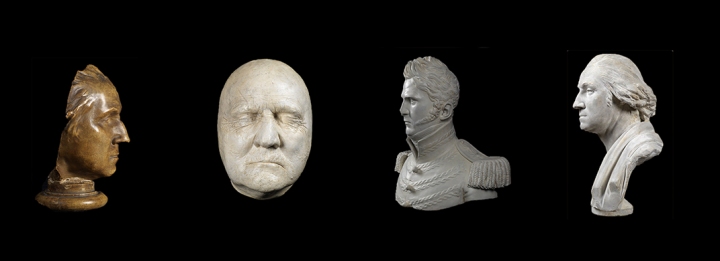
Ken Gonzales-Day, 13 Plasters [Row 3], 2014 (printed 2017), Chromogenic print / Courtesy of the artist and Luis De Jesus, Los Angeles.
◊ ◊ ◊ ◊ ◊
From the press release (8 March 2018) for the exhibition:
UnSeen: Our Past in a New Light: Ken Gonzales-Day and Titus Kaphar
Smithsonian National Portrait Gallery, Washington, D.C., 23 March 2018 — 6 January 2019
Curated by Taína Caragol and Asma Naeem
As the Smithsonian’s National Portrait Gallery marks its 50th anniversary, it will not only honor the past with special exhibitions but also shape the museum’s next chapter. The first contemporary exhibition of the museum’s anniversary season, UnSeen: Our Past in a New Light: Ken Gonzales-Day and Titus Kaphar examines how people of color are missing in historical portraiture and how their contributions to the nation’s past were rendered equally invisible. Focused around two contemporary artists, Ken Gonzales-Day and Titus Kaphar, the exhibition brings to the forefront African Americans, Native Americans, and Latino Americans to amend America’s historical narrative. Reworking traditional art presentations, Gonzales-Day and Kaphar aim to expose mainstream cultural biases and social constructions of race.
This exhibition continues the National Portrait Gallery’s Portraiture Now series and is curated by the museum’s Curator of Latino Art and History Taina Caragol and Curator of Prints, Drawing and Media Arts Asma Naeem.
“The history of early American portraiture favored white men who owned land, and it defined American identity in ways that excluded women and people of color from our nation’s visual record,” said National Portrait Gallery Director, Kim Sajet. “UnSeen: Our Past in a New Light presents the perspectives of two leading contemporary artists who create powerful works of art that re-frame history.”

Titus Kaphar, Behind the Myth of Benevolence, 2014, oil on canvas, Guillermo Nicolas and Jim Foster.
While obtaining his Master of Fine Arts from Yale University, the New Haven-based artist Titus Kaphar (b. 1976) realized how Euro-American colonial paintings, specifically the genre of portraiture, coded racial difference. His work is included in the collections of major museums, including Birmingham Museum of Art, Alabama; Brooklyn Museum, New York; Museum of Modern Art, New York; Perez Art Museum, Miami; Seattle Museum of Art, Seattle; Studio Museum of Harlem, New York; and Virginia Museum of Fine Arts, Richmond. In this exhibition of 17 paintings and one sculpture by the artist—the largest exhibition of his work to date—Kaphar invites viewers to reflect on the absence of race in traditional representations of America’s history by recreating well-known paintings to include those traditionally left out. Kaphar smears tar, erases with white paint, shreds the canvas into strips, and peels it back to reveal another story. His portion of the exhibition is divided into three sections: ‘Darkened National Histories’, ‘Deconstructed Portraits’, and ‘Disappearing Bloodlines’. All of Kaphar’s examples point to how portraiture in the 18th and 19th centuries aggrandized people in power while ignoring the powerless.
Los Angeles-based artist Ken Gonzales-Day (b. 1964) will present works across three themes: ‘Absence’, ‘Distance’, and ‘Naming’. His work has been widely exhibited at major institutions, including the Los Angeles County Museum of Art, Los Angeles; LAXART, Los Angeles; The New Museum, New York; Palais de Tokyo, Paris; and Tamayo Museum, Mexico City. Recipient of a Bachelor of Fine Arts from Pratt Institute, a Master of Fine Arts from the University of California in Irvine, and a master’s in art history from Hunter College, City University of New York, Gonzales-Day explores how ideas of racial difference, otherness, and national identity have taken shape historically and visually. This artistic investigation has yielded two bodies of work. Erased Lynchings grew out of Gonzales-Day’s archival research into lynching in the American West and the recovery of little-known histories of racial violence against Latinos, Native Americans, and Asian Americans. In parallel, his series Profiled examines how race and ideal beauty have been represented in sculpture, by photographing the collections of international museums and creating compositions that look comparatively at the representation of white bodies and bodies of color. Gonzales-Day’s juxtapositions prompt the question: “Who is recognized and remembered in the national history, and why?” The National Portrait Gallery’s presentation features work from both of these series.
Exhibition | John Goto’s ‘High Summer’
From the YCBA:
Art in Focus: John Goto’s ‘High Summer’
Yale Center for British Art, New Haven, 6 April — 19 August 2018

John Goto, High Summer: Society, 2000–01, digital print (New Haven: Yale Center for British Art).
In his series High Summer (2000–2001), a portfolio of fifteen digital prints, the photographer John Goto creates composite scenes in which contemporary figures disrupt the landscape gardens of eighteenth-century British country estates. These intrusive arrangements of people complicate the carefully contrived gardens with their seemingly natural planting and emblematic classical buildings. Goto’s integration of contemporary characters into historic landscape gardens encourages the viewer to think critically about nature and culture both past and present, and the politics of these gardens then and now.
This student-curated exhibition will explore the historical sites that Goto references in eight of his photographs. Drawing on eighteenth-century views of the gardens at Stowe in Buckinghamshire and Stourhead in Wiltshire from the Center’s collection, Goto’s work will be contextualized to highlight the ways in which these picturesque landscapes have been created, adapted, and represented over time to serve particular and sometimes competing ideologies.
Art in Focus is an annual initiative for members of the Center’s Student Guide Program, providing Yale undergraduates with curatorial experience and an introduction to all aspects of exhibition practice. The student guide curators for Art in Focus: John Goto’s ‘High Summer’ are Kelly Fu, DC ’19; Matthew Klineman, BK ’19; Jordan Schmolka, BK ’20; and Jackson Willis, BK ’19. In researching and presenting the exhibition the students are led by Linda Friedlaender, Senior Curator of Education; Jennifer Reynolds-Kaye, Curator of Education and Academic Outreach; and Courtney Skipton Long, Postdoctoral Research Associate, Art Collections.
This exhibition and the accompanying brochure, which will be available in the gallery and online, have been generously supported by the Dr. Carolyn M. Kaelin Memorial Fund and the Marlene Burston Fund.
Exhibition | World on the Horizon: Swahili Arts across the Indian Ocean

Frederick de Wit, Portolan Chart Indiarum Orientalum, from Harmonia macrocosmica, plate 56 (Amsterdam, 1708).
◊ ◊ ◊ ◊ ◊
Press release (9 March 2018) from The Smithsonian (also see the “Curators’ Notes,” which includes helpful installation photographs, from Journal18, published in October 2017). . .
World on the Horizon: Swahili Arts across the Indian Ocean
Krannert Art Museum, University of Illinois at Urbana-Champaign, 31 August 2017 — 24 March 2018
Smithsonian National Museum of African Art, Washington, D.C., 9 May — 3 September 2018
Fowler Museum, University of California at Los Angeles, 21 October 2018 — 10 February 2019
Curated by Allyson Purpura and Prita Meier
World on the Horizon: Swahili Arts Across the Indian Ocean opens at the Smithsonian’s National Museum of African Art May 9. The exhibition, on view through September 3 in the International Gallery, reveals the diverse interchanges that break down barriers between Africa and Asia in a space that physically connects the Smithsonian’s African and Asian art museums.
The Swahili coast, where East Africa meets the Indian Ocean, has long been a significant cultural, diplomatic, and commercial intersection for Africa, Asia, and Europe for millennia. World on the Horizon offers audiences an unprecedented opportunity to view over 160 artworks brought together from public and private collections from four continents. The artworks, through an intricate network of trade and diplomacy, have historically deep and enduring connections to eastern and central Africa, the port towns of the western Indian Ocean, Europe, and the eastern seaboard of the United States. One-of-a-kind objects loaned from the National Museums of Kenya and the Bait Al Zubair Museum in Oman will make their debut to North American audiences. The exhibition is thematically organized and features objects and images recognized for not only their artistic excellence, but also how they visualize wide-reaching networks of mobility and encounter. Ranging from intimate pieces of jewelry to impressive architectural elements, the exhibition includes exquisitely illuminated Qur’ans, carved doorposts, furniture, maps, and other works.
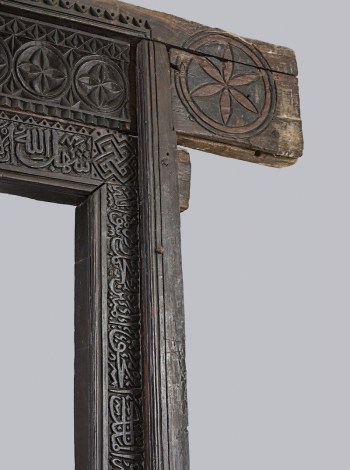
Door frame, detail, Kenya, Pate Island, Siyu, ca. 18th–19th century, African mahogany wood (Lamu Museum, National Museums of Kenya; photo: chrisbrownphoto.com).
“The arts of Africa are truly global, inspiring artists across the world,” said National Museum of African Art Director Gus Casely-Hayford. “But that inspiration also moves in multiple directions, and it includes African artists’ awareness and reflection of the aesthetic vision of other cultures. As the stunning and surprising works on view in this exhibition reveal, the seemingly rigid frontiers that have come to define places like Africa and Asia are in fact remarkably fluid, connected through the intersections of art, commerce, and culture.”
Swahili objects embody multiple cultural histories and aesthetic trends that are themselves itinerant and open to interpretation. World on the Horizon demonstrates how the Swahili coast is a vibrant site of global cultural convergence and to Africa’s contributions to the artistic vocabulary of the wider Indian Ocean world.
The exhibition is curated by Allyson Purpura, senior curator and curator of Global African Art at Krannert Art Museum in Urbana-Champaign, Illinois, and Prita Meier, assistant professor of art history at New York University, and overseen in Washington by Kevin Dumouchelle, curator at the National Museum of African Art. The exhibition opened at the Krannert in August 2017, and following its showing at the National Museum of African Art, it will travel to the Fowler Museum at UCLA in fall 2018.
“World on the Horizon is the exciting realization of years of research, collaboration and relationship building in the Swahili coast,” Dumouchelle said. “Loans secured from public and private collections in Kenya, Tanzania, Oman, Europe and the United States represent a once-in-a-lifetime opportunity for our audiences to see these artworks together in conversation.”
Allyson Purpura is senior curator and curator of Global African Art at the Krannert Art Museum at the University of Illinois at Urbana-Champaign. Her research on the politics of Islamic knowledge practices in Zanzibar led to her current interest in the broader connections between knowledge and power, particularly as they play out in the representational practices of museums. In addition to her teaching and curatorial practice, Purpura has published on a range of topics, including Islamic charisma and piety in Zanzibar, script and image in African art, ‘undisciplined’ knowledge, ephemeral art, and the politics of exhibiting African art. She has a Ph.D. from CUNY Graduate Center.
Prita S. Meier is assistant professor of art history at New York University. Her research focuses on the arts and architectures of east African port cities and the histories of transcontinental exchange and conflict. She is the author of Swahili Port Cities: The Architecture of Elsewhere (Indiana University Press, 2016). Meier is working on a new book about the social and aesthetic history of photography in Zanzibar and Mombasa. She is currently the William C. Seitz Senior Fellow at the Center for Advanced Study of the Visual Arts at the National Gallery of Art (Washington, D.C.). Meier has a Ph.D. from Harvard University.
Kevin D. Dumouchelle has served as curator at the National Museum of African Art since October 2016. He was the lead curator for Visionary: Viewpoints on Africa’s Arts (2017), the museum’s most recent, comprehensive presentation of its permanent collection. From 2007 to 2016, he was the Brooklyn Museum’s curator in charge of its African and Pacific Islands collections. At Brooklyn, he conceived two award-winning reinstallations of the African collection: African Innovations (2014) and Double Take: African Innovations (2014). He has written books and articles and curated a range of exhibitions on contemporary and historical African art, including Power Incarnate: Allan Stone’s Collection of Sculpture from the Congo (2011) at the Bruce Museum, and the Brooklyn Museum presentations of Gravity and Grace: Monumental Works by El Anatsui (2013) and Disguise: Masks and Global African Art (2016). Dumouchelle has a Ph.D. from Columbia University.
The catalogue is distributed by the University of Washington Press:
Prita Meier and Allyson Purpura, eds., World on the Horizon: Swahili Arts across the Indian Ocean (Seattle: University of Washington Press, 2018), 368 pages, ISBN: 9781883015497, $50.
With contributions by Edward A. Alpers, Heike Behrend, Ann Biersteker, Fahad Bishara, Allan deSouza, Jeffrey Fleisher, Athman Hussein, Paola Ivanov, Sarah Longair, Pedro Machado, Rebecca Gearhart Mafazy, Nidhi Mahajan, Janet McIntosh, Jeremy Prestholdt, Allen F. Roberts, Stephen J. Rockel, MacKenzie Moon Ryan, and Nancy Um
 Accompanying the World on the Horizon exhibition organized by Krannert Art Museum, this book is the first interdisciplinary study of Swahili visual arts and their historically deep and enduring connections to eastern and central Africa, the port towns of the western Indian Ocean, Europe, and the United States. At once exhibition catalogue and scholarly inquiry, the publication features eighteen essays in a mix of formats—personal reflections, object biographies, as well as more in-depth critical treatments—and includes never before published images of works from the National Museums of Kenya and Bait Al Zubair Museum in Oman. By approaching the east African coast as a vibrant arena of global cultural convergence, these essays offer compelling new perspectives on the situated yet mobile and deeply networked social lives of Swahili objects. Moving between the broader structural relations of political economic change to more intimate narratives through which such change is experienced, the essays throw light on the ways in which the material fabric of the arts structure Swahili people’s sense of self and community in an ever-changing world of oceanic and terrestrial movement.
New Book | The Eighteenth Centuries: Global Networks of Enlightenment
The essays in this collection, which includes a contribution by Mary Sheriff, are accompanied by “The Digital Eighteenth Centuries,” a digital atlas created on the MapScholar platform, available here. From the University of Virginia Press:
David Gies and Cynthia Wall, eds., The Eighteenth Centuries: Global Networks of Enlightenment (Charlottesville: University of Virginia Press, 2018), 316 pages, ISBN 978 0813940755, $40.
 Today, when ‘globalization’ is a buzzword invoked in nearly every realm, we turn back to the eighteenth century and witness the inherent globalization of its desires and, at times, its accomplishments. During the chronological eighteenth century, learning and knowledge were intimately connected across disciplinary and geographical boundaries, yet the connections themselves are largely unstudied. In The Eighteenth Centuries, twenty-two scholars across disciplines address the idea of plural Enlightenments and a global eighteenth century, transcending the demarcations that long limited our grasp of the period’s breadth and depth.
Engaging concepts that span divisions of chronology and continent, these essays address topics ranging from mechanist biology, painted geographies, and revolutionary opera to Americanization, theatrical subversion of marriage, and plantation architecture. Weaving together many disparate threads of the historical tapestry we call the Enlightenment, this volume illuminates our understanding of the interconnectedness of the eighteenth centuries.
David T. Gies, Commonwealth Professor of Spanish at the University of Virginia, is the author of The Theatre in Nineteenth-Century Spain and editor of The Cambridge History of Spanish Literature. Cynthia Wall, Professor of English at the University of Virginia, is the author of The Prose of Things: Transformations of Description in the Eighteenth Century and The Literary and Cultural Spaces of Restoration London.
C O N T E N T S
Acknowledgments
Part I | Knowledge and the Lives of Books
• Sophia Rosenfeld, Introduction
• Brad Pasanek and Chad Wellmon, Enlightenment, Some Assembly Required
• Michael Pickard, An Inventory of the Estate of William Straham in 1759
• Patricia Meyer Spacks, Understanding and Obscure Text: The Fortunate Foundlings and the Limits of Interdisciplinarity
Part II | Human Economies
• Andrew O’Shaughnessy, Introduction
• Ruth Hill, How Long Does Blood Last? Degeneration as Blanqueamiento in the Americas
• Carrie B. Douglass, Thomas Jefferson: Breeding and Buying Horses, Connecting Family, Friends, and Neighbors
• Louis P. Nelson, The Jamaican Plantation: Industrial, Global, Contested
Part III | Artists’ Geographies
• Richard Will, Introduction
• Mary D. Sheriff, Emotional Geographies: Watteau and the Fate of Women
• Katelyn D. Crawford, Painting New England in the Dutch West Indies: John Greenwood’s Sea Captains Carousing in Surinam
Part IV | Dramatic Politics
• Bonnie Gordon, Introduction
• Pierpaolo Polzonetti, Mozart and the American Revolution
• Adrienne Ward, The Drama of Marriage in Eighteenth-Century Venice: Carlo Goldoni’s La locandiera
• Jennifer Reed, Performances of Suffering and the Stagecraft of Symathy
• Casey R. Eriksen, The Aesthetics of Excess: Rococo Vestiges of Tartuffe in Isla’s Father Gerundio
• James P. Ambuske and Carol Guarnieri, About MapScholar
Notes on Contributors
Index
V&A Cabinet of Curiosity Project, with Artist Victoria Adukwei Bulley
As Eileen Budd writes on the V&A’s blog (28 February 2018) . . .

Cupboard, unknown, 1678–80, possibly Rotterdam, Netherlands (London: Victoria and Albert Museum, W.7-1914).
The Project
The Cabinets of Curiosity project examines the History of Collecting over the centuries, from Early Modern, to 19th Century to Contemporary. Dr Hannah Young is currently undertaking research that seeks to uncover some of the unexplored histories of the V&A, which in many respects became a large-scale nineteenth-century ‘cabinet of curiosity’. In particular, she is investigating some of the links between British slave-ownership and the development of the museum. Her research focuses on absentee slave-owners who used their wealth, rooted in the exploitation of enslaved people, to invest in collections in the metropole. Objects that were once collected by absentees and their descendants can now be found throughout the museum.
Why Involve an Artist in Residence?
There are multiple histories (our histories) that are hidden in plain sight within our collections. Such a wealth of stories, voices and lives that surfacing these and even knowing where to begin, can be challenging. We want to open up a new dialogue around our collections and so it’s vital that we have these conversations beyond academia. Artists are often better able to ask questions beyond historical ones. Inviting an artist to interrogate how this history has (and has not) been remembered and how the legacies of this history continue to shape the world we live in today can help change the way we think about the museum collections. We had an amazing response to our open call, from so many talented artists that selecting the right person for the project was incredibly hard. However, I am now delighted to announce that we have selected Victoria Adukwei Bully.
The Artist
 Victoria Adukwei Bulley is a British-born Ghanaian poet, writer and filmmaker based in London. Her work explores memory and cultural heritage—their loss and (re)creation—from a diasporic vantage point. Engaging with archival texts in addition to oral and indigenous histories, her practice posits memory as a form of creative activism which seeks to revivify bodies of knowledge that face erasure.
An alumna of the Barbican Young Poets programme, Victoria’s work has been commissioned by the Royal Academy of Arts, in addition to featuring on BBC Radio 4 Woman’s Hour. She was shortlisted for the Brunel University African Poetry Prize 2016, and is a Complete Works Poetry fellow. Her debut pamphlet, Girl B, edited by Kwame Dawes, forms part of the 2017 New-Generation African Poets series. Victoria is the director of MOTHER TONGUES, a poetry translation and film initiative supported by Arts Council England and visual arts charity Autograph ABP.
We are excited to be working with her and can’t wait to share the work with you as it progresses.
Cabinets of Curiosity project duration: 2016–18
Project co-leads: Dr Marta Ajmar, Deputy Director VARI, Dr Hannah Young (Maternity cover); Dr Lisa Skogh, external fellow
V&A co-investigator: Dr Martha Fleming, Previous Deputy Director VARI
Artist in Residence: Victoria Adukwei Bulley
Visiting researcher: Earle Havens, William Kurrelmeyer Curator of Rare Books and Manuscripts, Sheridan Libraries and Adjunct Associate Professor, Department of German and Romance Languages and Literatures, Johns Hopkins University
Exhibition | Like Life: Sculpture, Color, and the Body
Press release from The Met:
Like Life: Sculpture, Color, and the Body, 1300–Now
The Met Breuer, New York, 21 March — 22 July 2018
Curated by Luke Syson and Sheena Wagstaff, with Brinda Kumar, Emerson Bowyer, and Elyse Nelson
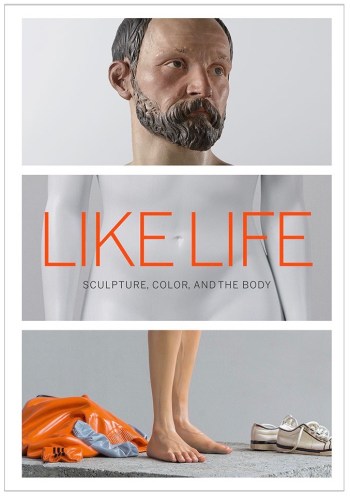 Seven hundred years of sculptural practice—from 14th-century Europe to the global present—will be examined anew in the groundbreaking exhibition Like Life: Sculpture, Color, and the Body (1300–Now). On view at The Met Breuer from March 21 through July 22, 2018, the exhibition will explore expanded narratives of sculpture through works in which artists have sought to replicate the literal, living presence of the human body. A major international loan exhibition of approximately 120 works, Like Life will draw on The Metropolitan Museum of Art’s rich collection of European sculpture and modern and contemporary art, while also featuring a selection of important works from national and international museums and private collections.
Just how perfectly should figurative sculpture resemble the human body? Histories and theories of Western sculpture have typically favored idealized representations, as exemplified by the austere, white marble statuary of the classical tradition. Such works create the fiction of bodies existing outside time, space, and personal or cultural experience. This exhibition, by contrast, will place key sculptures from different eras in conversation with each other in order to examine the age-old problem of realism and the different strategies deployed by artists to blur the distinctions between original and copy, and life and art. Foremost among these is the application of color to imitate skin and flesh. Other tactics include the use of casts taken from real bodies, dressing sculpted figures in clothing, constructing movable limbs and automated bodies, even incorporating human blood, hair, teeth, and bones. Uncanny in their approximation of life, such works have the potential to unsettle and disarm observers, forcing us to consider how we see ourselves and others, and to think deeply about our shared humanity.

Thomas Southwood Smith and Jacques Talrich, ‘Auto-Icon’ of Jeremy Bentham (1748–1832), wax figure built around Bentham’s own skeleton, with human hair, wool, cotton, linen textiles, straw hat, glasses, wood walking stick, table, and chair (London: UCL).
Juxtaposing well-known masterpieces with surprising and little-seen works, the exhibition brings together sculptures by artists from Donatello, El Greco, Jean-Léon Gérôme, Antonio Canova, Auguste Rodin, and Edgar Degas to Louise Bourgeois, Meret Oppenheim, Isa Genzken, Charles Ray, Fred Wilson, Robert Gober, Bharti Kher, Duane Hanson, Jeff Koons, and Yinka Shonibare MBE, as well as wax effigies, reliquaries, mannequins, and anatomical models. Together these works will highlight the continuing anxieties and pleasures attendant upon the three-dimensional simulation of the human body.
Like Life: Sculpture, Color, and the Body (1300–Now) is curated by Luke Syson, Iris and B. Gerald Cantor Chairman of European Sculpture and Decorative Arts, and Sheena Wagstaff, Leonard A. Lauder Chairman of Modern and Contemporary Art, both at The Met, with Brinda Kumar, Assistant Curator of Modern and Contemporary Art, The Met, and Emerson Bowyer, Searle Associate Curator of European Painting and Sculpture at the Art Institute of Chicago, with the assistance of Elyse Nelson, Research Associate, European Sculpture and Decorative Arts, The Met. The catalogue is made possible by the Mary C. and James W. Fosburgh Publications Fund.
Luke Syson and Sheena Wagstaff, with Emerson Bowyer, Brinda Kumar, Barti Kher, Jeff Koons, Schwartz Hillel, Marina Warner, and Fred Wilson, Like Life: Sculpture, Color, and the Body (New York: The Metroplitan Museum of Art, 2018), 312 pages, ISBN: 978 1588396440, $65.
A symposium explores themes raised by the exhibition on Saturday, 14 April 2018, from 10:30am until 6:30pm.
Conference | Artistic Trade between Spain and Its Viceroyalties

Plaza Mayor in Lima, 1680, oil on canvas
(Madrid: Museo de América)
◊ ◊ ◊ ◊ ◊
From the conference flyer:
Artistic Trade between Spain and Its Viceroyalties, 1500–1800
Keynes Hall, King’s College, University of Cambridge, 22 June 2018
This is the first conference in the United Kingdom devoted to artistic trade between Spain and its viceroyalties. Referring to Cambridge’s Spanish and colonial art collections and with the indispensable support of the King’s College Nigel Glendinning studentship, this conference brings together scholars specialized in the art from the Spanish Viceroyalties. The speakers will trace the artworks from their production, their movement with the help of agents and their collection and display at their destination. For further information, please contact Akemi Herráez Vossbrink at alh64@cam.ac.uk, and register for free at Eventbrite.
P R O G R A M M E
9:15 Akemi Herráez Vossbrink (University of Cambridge), Introductory Remarks
9:30 Keynote Speaker | Luisa Elena Alcalá (Universidad Autónoma de Madrid), Passageways of Art in the Atlantic World: Artists, Patrons, and Agents
10:00–11:30 | Workshops and Artists Producing Art for the Spanish Viceroyalties and Transitory Spaces
Chaired by Akemi Herráez Vossbrink (University of Cambridge)
• Holly Trusted (Victoria and Albert Museum), Shipwrecked Ivories: The Confluence of East and West
• Piers Baker Bates (The Open University), Traveling between the Viceroyalties: Artistic Translation in the Sixteenth-Century Hispanic World
• Escardiel González Estevez (Universidad de Sevilla), Alonso Vázquez between Seville, Mexico, and Manila, 1603–1608: The Paradigm of a ‘Global Artist’
13:30-15:00 | The Role of Agents Commercializing Artworks between Spain and Its Viceroyalties
Chaired by José Ramón Marcaida López (University of Saint Andrews)
• Sandra Van Ginhoven (Getty Research Institute, Research Associate), Spanish Transatlantic Agents and the Flemish Guilliam Forchondt in the Overseas Paintings Trade
• Corinna Gramatke (Technical University of Munich Chair of Conservation-Restoration), ‘The Portable Europe’: European Artworks for the Jesuit Province of Paraguay, 1608–1767
• Eduardo Lamas Delgado (Royal Institute for Cultural Heritage, Brussels), Madrilenian Painters and America: Artistic Production for Overseas Trade Networks and Their Possible Agents
16:00–17:30 | Collecting and Display in Private, Civil, and Religious Spaces in the Spanish Viceroyalties
Chaired by Jean Michel Massing (University of Cambridge)
• Kathryn Santner (Leverhulme Trust Fellow, ILAS, London), Conventual Art Collections and Artistic Exchange in the Colonial Viceroyalties
• Isabel Oleas Mogollón (University of Delaware), The Divine and the Self: Uses and Meanings of Mirrors in Quito’s Jesuit Church
• Veronika Winkler (Ludwig-Maximilians-Universität, München), Witnessing the Saint’s Life: Patrons and Hagiographical Painting Cycles of Viceregal Peru










 Enfilade
leave a comment