Lecture | Tracy Ehrlich on Carlo Marchionni and the Art of Conversation
From the flyer:
Tracy Ehrlich, Carlo Marchionni and the Art of Conversation:
Architectural Drawing and Social Space in Eighteenth-Century Rome
Cooper Hewitt, Smithsonian Design Museum, New York, 3 November 2017

Carlo Marchionni, Design for a Doorway in the Villa Albani, Rome, 1755–56; pen and brown ink, brush with brown and grey wash, graphite on cream laid paper, 417 × 289 mm (Cooper Hewitt, Smithsonian Museum; photo by Matt Flynn).
In the 1750s the Roman architect Carlo Marchionni (1702–1786) produced a set of highly finished drawings for the villa of the noted collector Cardinal Alessandro Albani. Marchionni’s renderings feature sophisticated figures in fashionable dress conversing and gesticulating at the thresholds of the grand gallery. The figures yield little if any technical information; yet in these drawings the bodies are as architectonic and expressive as the building itself, perhaps even more so. Marchionni’s work diverged from contemporary conventions for architectural drawings, offering his patron not simply a design for a pleasure casino but a distinctive cultural argument that may be traced to models of civility. An eloquence of the body, a sociable kind of living, in short, the art of civil conversation, marks the drawings of Carlo Marchionni.
Tracy Ehrlich, Faculty member, MA in the History of Design & Curatorial Studies Parsons School of Design, The New School, and Smithsonian Institution, Senior Fellow, 2016–17
3 November 2017 at 1:00pm, Lower Level Lecture Hall, Cooper Hewitt, Smithsonian Design Museum
Call for Papers | Artist Immigrants to the Baltic Sea Area, 1554–1721
From H-ArtHist:
Successful Immigrants: Artist Immigrants
to the Baltic Sea Area in Times of the Nordic Wars, 1554–1721
Leibniz Institut für die Geschichte und Kultur des östlichen Europas, 8–9 February 2018
Proposals due by 31 October 2017
Movement and mobility have always been important engines for innovation and development in the arts. Together with artists, also new ideas, concepts, styles, and techniques traverse boundaries and mix up with traditional and constricted habits at their place of arrival. Long hikes to foreign countries implied a high risk in early modern times since knowledge about far regions was limited and traveling arduous. Nevertheless, a surprisingly high activity of migration can be observed in artistic professions. This workshop seeks to explore the latter phenomenon in the Baltic Sea area.
The Baltic Sea in early modern times wasn’t only a barrier as which it was observed in the further course of history, but also a contact zone. Its neighbouring countries were intertwined in various forms of relations—trade, diplomacy, and also wars gave rise to more exchange and thus encouraged migration movements. This workshop aims to shape a more differentiated picture about the dynamics of artistic transfer processes and labour conditions in the Baltic region. The workshop will focus not only on major cities like Gdansk, which had a special appeal on artists, or Dutch artists and craftsmen, which represented the largest group of immigrants to the Baltic region. Rather, the workshop will target different groups and individuals as well as the entire Baltic Sea area: the Kingdoms of Poland, Denmark and Sweden (including its Baltic provinces), the Duchy of Courland, and cities like Stockholm, Riga, and Reval.
The following questions can serve as opening questions: What reasons motivated the artists to migrate and what goals did they pursue? What made a place attractive for the arrivals? Did the artists stay in their new domains, did they return home or did they continue traveling? How did the artistic development proceeded and how did they integrate in their new home places? Any project that concerns individual artist careers, rewarded with success or failed, will be of interest for the workshop. The workshop also welcomes papers offering an overview, focusing on protagonists, cities, or routes. Furthermore, proposals concerning traveling writers may be included as possible comparison group. Please send your one-page proposal and short CV to Agnieszka Gąsior at agnieszka.gasior@leibniz-gwzo.de by October 31st 2017.
Organized by Agnieszka Gąsior, Leibniz-Instituts für Geschichte und Kultur des östlichen Europa (GWZO)
Erfolgreiche Einwanderer: Künstlerimmigration im Ostseeraum während der Nordischen Kriege, 1554–1721
AAMC Foundation Engagement Program for International Curators
From the Association of Art Museum Curators:
AAMC Foundation Engagement Program for International Curators
Applications due by 20 October 2017
The AAMC Foundation Engagement Program for International Curators, made possible with major support from the Terra Foundation for American Art, is a two-year Program for three non-US based curators and three US Liaisons working on or having worked within exhibitions and projects that explore historic American Art (c. 1500–1980), including painting; sculpture; works on paper, including prints, drawing and photography; decorative arts; and excluding architecture; design; and performance. The Program offers numerous benefits for Awardees, including travel funding.
Through fostering international relationships between curators, the Program aims to not only provide opportunities for professional development and exchange, but also to expand and strengthen the international curatorial community and give primacy to the curatorial voice in the international dialogue between museum professionals.The Program will be an active part of building international partnerships, leading cross-border conversations, and spearheading international representation within AAMC’s membership & AAMC Foundation’s efforts.
Program Goals
• Form new international relationships and partnerships through the interaction of each International Awardee with their US Liaison and the larger AAMC community of members & supporters
• Provide opportunities for International Awardee to engage with US museum networks and professional development opportunities through AAMC membership benefits, including travel funding to the AAMC Annual Conference; Program-specific webinars and access to past AAMC webinars; AAMC Committee or Task Force participation; an Annual Alumni reception; visit to US Liaison’s institution, and more
• Foster awareness of the concerns and needs of curators working outside the US within AAMC’s membership and within the AAMC Foundation programming
• Establish a long lasting relationship between AAMC, AAMC Foundation, the International Awardees, and community of international scholars
• Bring an international voice to AAMC’s leadership through engagement with the organization’s donor groups and involvement on an AAMC Committee
Additional information, including details for International Curators and US Liaisons, is available here»
Exhibition | European Old Masters: 16th–19th Centuries
Press release for the exhibition:
European Old Masters: 16th–19th Centuries
Hazelhurst Regional Gallery and Arts Centre, Gymea (Sydney), 28 September — 3 December 2017

Jean-Marc Nattier, Portrait of Madame de La Porte, 1754; oil on canvas, 82 × 65.5 cm (Art Gallery of New South Wales, gift of William Bowmore, OBE 1992).
New South Wales’s most important European old masters including magnificent works by some of the leading Italian, French, and British artists of the High Renaissance, Baroque, Rococo, and Romantic periods are on loan from the Art Gallery of New South Wales to Hazelhurst Regional Gallery for the exhibition European Old Masters: 16th–19th Century.
Michael Brand, director of the Art Gallery of New South Wales said the exhibition is the first occasion so many of these important European paintings have been shown together outside the Art Gallery of New South Wales. “We are delighted to collaborate with Hazelhurst Regional Gallery to share some of the finest European works in our collection with their audiences in the Sutherland Shire and further afield,” Brand said. “The Gallery’s early ambitions to display paintings by the masters can be seen in the roll-call of European greats inscribed on the building’s façade, and I applaud Hazelhurst Regional Gallery for showing works from this glorious tradition that is still relevant today,” Brand added.
Belinda Hanrahan, director, Hazelhurst Regional Gallery said leading artists in the exhibition include Thomas Gainsborough, William Hogarth, Sir Joshua Reynolds, Bernardo Strozzi, and Frans Snyders. “Hazelhurst Gallery is thrilled that Michael Brand as director of the Art Gallery of New South Wales has given us this opportunity for people to encounter the state’s finest European old masters. Paintings such as these remind us of what is constant in human experience and emotion while offering an insight into ages and cultures so different to our own,” Belinda said.
Sutherland Shire Mayor and Hazelhurst Gallery Board member, Carmelo Pesce said this exhibition is another example of our commitment to a culturally rich community. The Sutherland Shire community is the first to see the collection outside its home and showcases Council’s commitment to strengthen its community connections through shared cultural experiences.
Despite its early ambitions to collect works by the European masters, The Art Gallery of New South Wales did not in fact start collecting old masters until the 1950s. AGNSW curator European prints, drawings and watercolours, Peter Raissis said prior to that time the great masters of the past could be experienced only through copies intended for educational purposes due to the Gallery’s earlier focus on acquiring works by living artists. “Between 1951 and 1976, the Gallery acquired an outstanding group of English 18th-century portraits, including works by three of the leading painters of the age: William Hogarth, Thomas Gainsborough, and Joshua Reynolds. During these years the Gallery also purchased landscapes and subject pictures representative of British Neo-Classicism and Romanticism by artists such as Richard Wilson, John Glover, Richard Westall, William Hamilton, and Francis Danby. “Although accessions of non-British painting were rare, three powerful and imposing figural compositions by the Baroque painters Bernardo Strozzi, Jan van Bijlert, and Matthias Stomer expanded the scope and ambition of the collection,” Raissis said.
The extraordinary donation by James Fairfax AC during the 1990s significantly enriched the Gallery’s holdings of European old masters, particularly in the area of 18th-century French and Italian art such as the works by Nicolas de Largillierre and Canaletto. The collection has continued to develop with the acquisition of major Italian Renaissance and Baroque works such as the work of Giulio Cesare Procaccini, also exhibited in European Old Masters: 16th–19th Century.
Journée d’étude | Jacques-François Blondel
From the conference flyer:
Jacques-François Blondel et l’enseignement de l’architecture:
La dernière leçon de l’architecture « à la française »
Cité de l’architecture et du patrimoine, Paris, 14 December 2017

Gabriel de Saint-Aubin, Blondel démontrant des machines dans l’académie d’architecture, 1770, Recueil de poésies de Sedaine, 1770 (Chantilly, Musée Condé).
Dernier héraut de l’architecture à la française, Jacques-François Blondel (1708/9–1774) a formé dans son école privée et à l’Académie royale d’architecture parmi les architectes les plus renommés de la seconde moi é du XVIIIe siècle et du début du siècle suivant : Claude-Nicolas Ledoux, Étienne-Louis Boullée, Alexandre Brongniart ou William Chambers… La pédagogie révolutionnaire qu’il développa dans l’enseignement de l’architecture tout au long de sa carrière a connu une ample diffusion en France, en Europe et même, outre-Atlantique, jusqu’au Québec. Si certains architectes l’appliquèrent à la lettre, d’autres s’en affranchirent et allèrent au-delà des leçons professées par le maître.
Organisée en partenariat avec la Ville de Metz et l’École na onale supérieure d’architecture de Nancy, cette journée d’étude internationale est centrée sur le rôle de Jacques-François Blondel dans l’enseignement de l’architecture. Elle annonce l’exposition monographique Blondel, architecte des Lumières qui sera présentée à Metz, à l’Arsenal, du 13 avril au 13 juillet 2018 et l’exposition-dossier que la Cité de l’architecture et du patrimoine lui consacrera la même année. Cette rencontre se propose de revenir sur les idées ainsi que les méthodes pédagogiques dispensées par J.-F. Blondel, et de relire, au travers d’un prisme neuf, les fondamentaux de son enseignement. La participation à cette journée est gratuite; inscription en ligne obligatoire. Contact: jean-marc.hofman@citedelarchitecture.fr.
◊ ◊ ◊ ◊ ◊
9.00 Accueil
9.20 Ouverture de la journée d’étude
• Corinne Bélier (Directrice du musée des Monuments français)
• Lorenzo Diez (Directeur de l’École nationale supérieure d’architecture de Nancy)
• Dominique Gros (Maire de Metz)
9.45 Jacques-François Blondel : état de la recherche, Aurélien Davrius (Maître-assistant à l’École nationale supérieure d’architecture de Paris-Malaquais, Laboratoire LIAT)
10.15 Jacques-François Blondel, un professeur innovant à l’Académie royale d’architecture ?, Hélène Rousteau-Chambon (Professeur d’histoire de l’art moderne à l’université de Nantes)
10.45 Blondel et les Mansart : une leçon particulière, Philippe Cachau (Docteur en histoire de l’art)
11.15 Pause-café
11.45 Les savoirs théoriques et techniques transmis par Blondel au travers de l’exemple du matériau plâtre, Christelle Inizan (Chargée d’études et de recherches, Médiathèque de l’architecture et du patrimoine, Centre de recherches sur les Monuments historiques)
12.15 L’influence de J.-F. Blondel sur le cours d’architecture de l’École des Ponts et Chaussées, Théodore Guuinec (Architecte DE-HNOMNP, historien du patrimoine)
12.45 Questions ouvertes aux intervenants
13.00 Pause-déjeune
14.30 L’enseignement de l’expérience architecturale chez Blondel et ses collègues anglais, Sigrid de Jong (Chercheur à l’université de Leyde, Pays-Bas)
15.00 « Como ha hecho el Sieur Blondel, en Francia… » Réflexions sur l’influence de la théorie architecturale française autour de Jacques-François Blondel en Espagne, 1750–1800, Adrián Almoguera (Doctorant contractuel en histoire de l’architecture Université de Paris Sorbonne / Centre André Chastel)
15.30 Le Précis d’architecture (1828) de l’abbé Jérôme Demers et le prolongement de l’enseignement de Blondel au Canada au XIXe siècle, Marc Grignon (Professeur d’Histoire de l’art à l’Université Laval) et Pierre-Édouard Latouche (Professeur au département d’histoire de l’art à l’Université du Québec à Montréal)
16.15 Pause
16.30 L’École des arts de Jacques-François Blondel ou l’invention d’une pédagogie des relations entre architecture, sculpture et peinture, Laure Chabanne (Conservateur du patrimoine, musée et domaine nationaux du palais de Compiègne)
17.00 « Le Grand Blondel », Jean-Marie Pérouse de Montclos (Directeur de recherche honoraire au CNRS)
17.30 Vers une conception « évolutionnaire » de l’architecture : Jacques-François Blondel et la question du jugement professionnel dans la théorie de Peter Collins, Denis Bilodeau (Professeur tulaire à l’École d’architecture de l’Université de Montréal)
18.00 Questions ouvertes aux intervenants
18.20 Conclusion de la journée, Pierre Caye (Directeur de recherche au CNRS)
19.30 Visite de la galerie des moulages
Exhibition | Canova, Hayez, and Cicognara: The Last Glory of Venice
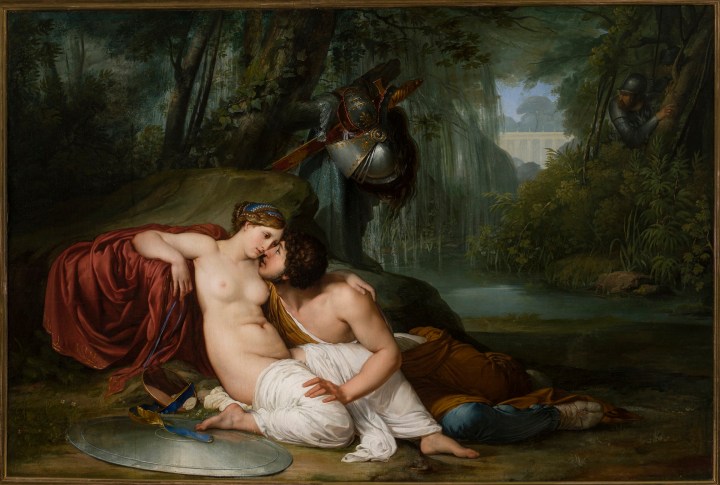
Francesco Hayez, Rinaldo and Armida, 1812–13, oil on canvas
(Venice: Museo Nazionale Gallerie dell’Accademia)
◊ ◊ ◊ ◊ ◊
From Et Electa:
Canova, Hayez, and Cicognara: The Last Glory of Venice
Gallerie dell’Accademia, Venice, 29 September 2017 — 2 April 2018
Curated by Paola Marini, Fernando Mazzocca, and Roberto De Feo
In the year of the bicentennial celebrations of the opening of the Gallerie dell’Accademia—an international institution first founded to compensate for the loss of so many masterpieces removed during the suppression of schools and religious institutions—the exhibition Canova, Hayez, Cicognara: L’ultima gloria di Venezia pays homage to a unique moment in the artistic history of the Serenissima, its cultural revival initiated in 1815 when the Four Horses of Saint Mark, the iconic symbol of the city, were returned from Paris.
The acknowledged leader of this revival was the intellectual Count Leopoldo Cicognara, President of the Accademia di Belle Arti, who together with his friend Antonio Canova, the guiding spirit of the project, and Francesco Hayez, worked to create a museum on an international scale, a worthy setting for Venice’s unrivaled art heritage, yet one also suitable for promoting contemporary art.
The exhibition includes 100 major works, arranged in nine thematic sections, including a series of artefacts known as ‘The Homage of the Venetian Provinces’ sent to the imperial court of Vienna in 1818 to mark the fourth marriage of Emperor Francis I, reunited and returning to their native city for the first time in 200 years.
Highlights of the exhibition also include the opening section dedicated to the return of the Four Horses of St Mark and the cameo depicting Jupiter the Shield Bearer, a masterpiece whose beauty was hymned by Canova, and further on the commemoration of the acquisition of a series of drawings by Leonardo da Vinci and Raphael from Canova and Cicognara’s mutual friend Giuseppe Bossi, a purchase which significantly enriched the Academy’s collection.
Fernando Mazzocca et al., Canova, Hayez, Cicognara: L’ultima Gloria di Venezia (Venice: Marsilio, 2017), 352 pages, ISBN: 9788831728225, $65.
New Book | Messerschmidt’s Character Heads
Now available from Routledge:
Michael Yonan, Messerschmidt’s Character Heads: Maddening Sculpture and the Writing of Art History (New York: Routledge, 2018), 194 pages, ISBN: 978 113821 3432 (hardcover), $150 / ISBN: 978 131544 8404 (ebook), $55.
 This book examines a famous series of sculptures by the German artist Franz Xaver Messerschmidt (1736–1783) known as his ‘Character Heads’. These are busts of human heads, highly unconventional for their time, representing strange, often inexplicable facial expressions. Scholars have struggled to explain these works of art. Some have said that Messerschmidt was insane, while others suggested that he tried to illustrate some sort of intellectual system. Michael Yonan argues that these sculptures are simultaneously explorations of art’s power and also critiques of the aesthetic limits that would be placed on that power.
Michael Yonan is associate professor of art history at the University of Missouri–Columbia. He is a specialist in eighteenth-century European art and material culture.
C O N T E N T S
List of Figures
Acknowledgments
Introduction
I Writing the Artist’s Mind
Introduction to Part I
1 Nicolai’s Dreamer
2 Kris’s Psychotic
II Writing the Artist’s Context
Introduction to Part II
3 Mesmer’s Acolyte
4 Lichtenberg’s Ally
III Writing the Artist’s Project
Introduction to Part III
5 The Game of Making
6 The Envy of the Gods
Conclusion
Bibliography
Index
Workshop | Diderot and 18th-Century Human Simulacra
From H-ArtHist:
Diderot and 18th-Century Human Simulacra
Freie Universität Berlin, 5 October 2017
Registration due by 3 October 2017
The workshop aims to explore the different aesthetical and anthropological dimensions of the ‘mannequin’ metaphor in Diderot’s “Paradoxe sur le comédien,” which Diderot introduces as a model for actors/actresses at the very beginning of his acting theory. Central questions of the workshop include, but are not limited to, the following: Why does Diderot use a tool for visual artists to exemplify his idea of the ideal actor/actress? What is the specificity of the mannequin compared to other types of human simulacra such as the statue, the marionette, and the automat?
In order to analyse this specific metaphor and to explore possible answers to these questions, the workshop will approach the subject from two angles. The first approach consists of a comparative analysis between the mannequin’s function as an art tool for painters or sculptors and Diderot’s conception of the ideal actor/actress. Such an analysis implies a comparison between Diderot’s theoretical works on theatre and his theoretical writings on visual art, as for example his ‘Salons’. The second approach consists of a historical contextualisation of Diderot’s concept of the human body in the broader philosophical and scientific discourse of his time.
The workshop will focus on the mannequin’s specificity while comparing it to other human simulacra of that time, such as Jacques de Vaucanson’s famous automata or the moving statue of Condillac’s “Traité des sensations.” The workshop will also discuss other forms of simulacra present in Diderot’s works, as they appear for instance in the Encyclopédie.
The workshop will be held in French and English. Please register via email by October 3rd: marie.igelmann@fu-berlin.de. Freie Universität Berlin, Institut für Theaterwissenschaft, Grunewaldstr. 35, 12165 Berlin-Steglitz, Room 103. The workshop is organised by Marie-Irène Igelmann (Freie Universität Berlin) in the context of the Dahlem Junior Host Program of the Dahlem Humanities Center.
S C H E D U L E
9.45 Opening and Introduction
10.00 L’automate chez Diderot: le vivant et le mécanique (Aurélia Gaillard, Université Bordeaux Montaigne)
11.00 Coffee break
11.15 L’esthétique de la singularité: abstraction et figuration du personnage chez Condillac et Diderot (Manuel Mühlbacher, LMU München)
12.00 Aesthetic and Scientific Concepts of 18th-Century Mannequins (Marie-Irène Igelmann, Freie Universität Berlin)
12.45 Lunch break
15.00 The Encyclopédie, Similarity, and the Simulacrum (Thari Jungen, Graduate School “Performing Citizenship,” Hamburg)
15.45 The Notion of Genius in Diderot’s ‘Salon de 1767’ (Christian Hartwig Steinau, Freie Universität Berlin/LMU München)
16.30 Coffee break
16.45 Concluding Discussion
Cleveland Acquires Wright’s Portrait of Charles Heathcote
From the museum’s press release (27 September 2017). . .

Joseph Wright of Derby, Portrait of Colonel Charles Heathcote, ca. 1771–72; oil on canvas, 50 × 40 inches (The Cleveland Museum of Art).
The Cleveland Museum of Art’s recent acquisitions include a portrait of Colonel Charles Heathcote by British artist Joseph Wright of Derby; a drawing by German Expressionist Oskar Kokoschka; a 14th-century Japanese hanging scroll featuring the Buddhist deity Aizen Myōō, Wisdom King of Passion; and a monumental oil painting on canvas by contemporary Chinese artist Liu Wei.
Often described as among the artist’s most successful and appealing portraits, Joseph Wright of Derby’s Portrait of Colonel Charles Heathcote is one of a limited group of small-scale likenesses made in the early 1770s, depicting the figures at full length in a landscape setting. The subject, Charles Heathcote, of Derby, joined the army in 1745 at the age of 15 and rose through the ranks. At the time of his retirement in 1772, Heathcote was a Lieutenant-Colonel in the 35th Foot (Royal Sussex).
The figure is painted in a relatively soft and smooth technique: facial features are carefully characterized and minute attention paid to rendering details of costume. However, the landscape is painted in a more energetic, almost impressionistic, technique. Indeed, Wright gave the landscape as much personality and presence as he did Heathcote himself. The group of small-scale portraits to which the Portrait of Colonel Charles Heathcote belongs mark the beginnings of Wright’s interest in landscape painting.
This innovative approach to combining figure and landscape was not particularly well received by critics at the time, who were more accustomed to portraits entirely dominated by a figure alone. When viewed close up, the variance in technique can seem jarring, but when viewed from the intended few steps away, Wright’s radical approach results in a compelling image of an elegant figure in verdant natural surroundings. Wright painted the landscape in bold, broad brushstrokes that call attention to artistic process in a way that seems dazzlingly modern for a painting executed in 1771–72.
Joseph Wright’s Portrait of Colonel Charles Heathcote makes a striking addition to the museum’s display of eighteenth-century British art. It complements and offers a counterpoint to the full-length, life-sized Grand Manner portraits by Thomas Gainsborough, Thomas Lawrence, and Joshua Reynolds in the collection. . .
The full press release is available here»
Exhibition | Chaekgeori: Korean Painted Screens
In terms of objects, it is a nineteenth-century exhibition, but this fascinating genre dates to the late eighteenth century. From SUNY Press:
Chaekgeori: Pleasure of Possessions in Korean Painted Screens
Charles B. Wang Center, Stony Brook University, 29 September — 23 December 2016
Spencer Museum of Art, The University of Kansas, 15 April — 11 June 2017
The Cleveland Museum of Art, 5 August — 5 November 2017
 Chaekgeori explores the genre of Korean still-life painting known as chaekgeori (loosely translated as ‘books and things’). Encouraged and popularized by King Jeongjo (1752–1800, r. 1776–1800) as a political tool to promote societal conservatism against an influx of ideas from abroad, chaekgeori was one of the most enduring and prolific art forms of Korea’s Joseon dynasty (1392–1910). It depicts books and other material commodities as symbolic embodiments of knowledge, power, and social reform.
Chaekgeori has maintained its popularity in Korea for more than two centuries, and remains a force in Korean art to this day. No other genre or medium in the entirety of Korean art, including both court and folk paintings, has so engaged and documented the image of books and collectable commodities and their place in an ever-evolving Korean society. When it transitioned into folk-style painting, unexpected and creative visual elements emerged. Folk versions of chaekgeori from the eighteenth and nineteenth centuries often show an exquisite fusion of Korean and Western composition that feels modern to our contemporary eyes. Not only books but many other commodities are depicted to represent the commoner’s desire for higher social status, wealth, and knowledge.
The first large-scale traveling exhibition of its kind to be published, The Power and Pleasure of Possessions in Korean Painted Screens is made possible by generous grants from the Korea Foundation and the Gallery Hyundai.
Byungmo Chung and Sunglim Kim, eds., Chaekgeori: The Power and Pleasure of Possessions in Korean Painted Screens (Albany: State University of New York Press, 2017), 250 pages, ISBN: 978 14384 68112, $60.
Byungmo Chung is Professor in the Department of Cultural Assets at Gyeongju University, Korea. He was a visiting scholar in the Department of Asian Cultures and Languages at Rutgers University and President of the Korean Folk Painting Society. His scholarship focuses on the genre paintings and Minhwa—the folk painting of Korea. He has organized several Minhwa exhibitions in Korea and written numerous articles and books about Korean folk and genre paintings, including Chaesaekhwa: Polychrome Paintings of Korea.
Sunglim Kim is Assistant Professor of Korean Art History in the Department of Art History and the Asian and Middle Eastern Studies Program, Dartmouth College. Her scholarship focuses on premodern and early twentieth-century Korean art and culture, including the rise of consumer culture and the role of professional nouveau riche in late Joseon Korea, Japanese colonial photographs of Korea, and Korean women artists. She has curated several exhibitions in the United States and written numerous publications on Korean art.










 Enfilade
leave a comment