The Fitzwilliam Acquires Pair of Pietre Dure Roman Cabinets

Pair of ebony and rosewood cabinets, inlaid with pietre dure, and mounted with gilt-bronze; made in Rome, ca. 1625, likely for a member of the powerful Borghese family. The gilt-wood stands were made in England, ca. 1800, probably to the designs of the influential Regency designer, Charles Heathcote Tatham, in order to display the cabinets in the spectacular Long Gallery at Castle Howard, Yorkshire (Cambridge: The Fitzwilliam Museum).
◊ ◊ ◊ ◊ ◊
Press release from The Fitzwilliam:
The Fitzwilliam Museum announced today (Monday, 8 August 2016) its successful bid to raise the £1.2 million needed to save an important pair of pietre dure Roman cabinets for the nation. No other pair of Roman hardstone cabinets exist in a public collection in Britain.
The Fitzwilliam is grateful for the support of The National Heritage Memorial Fund (NHMF) for their generous grant of £700,000 and to the Art Fund for their early adoption of this project with a £200,000 grant. The Fitzwilliam also received generous support from numerous other benefactors, including the Pilgrim Trust, to prevent these treasures from leaving the UK.
These unique and highly prized cabinets have been part of the private collection at Castle Howard, Yorkshire, since their purchase by Henry Howard, the 4th Earl of Carlisle, most likely in Rome during his second ‘Grand Tour’ of Italy (1738–39). They were offered for auction at Sotheby’s London, last summer by the Trustees of Castle Howard and sold to a foreign buyer for £1.2 million.
A member of the Reviewing Committee on the Export of Works of Art, (RCEWA), Christopher Rowell, stated that the cabinets, represent “the high watermark of the British taste for Italian princely furniture” and that “with the exception of the National Trust’s cabinet at Stourhead, made in Rome around 1585 for Pope Sixtus V, these are the most significant cabinets of this type in Britain.”
Their historic and cultural value was such that the then Culture Minister Ed Vaizey placed a temporary export bar on the 400-year-old Italian cabinets to provide an opportunity to save them for the nation.

One of the cabinets as installed at Castle Howard.
The cabinets were made in Rome in the first quarter of the 17th century almost certainly for a member of the papal Borghese dynasty, one of the most powerful and wealthy families of their day, and represent the highest quality of furniture-making in 17th century Italy. Veneered with ebony and rosewood, they have been further embellished with inlays of expensive, exotic and vividly coloured semi-precious hardstones (such as lapis lazuli and jasper) and with gilt-bronze statuettes and escutcheons. They are among the most significant cabinets of this type left in Britain, dating back to 1625.
Each cabinet sits on a Neo-classical stand, probably made ca. 1800 to the designs of the influential Regency designer, Charles Heathcote Tatham, for display in the just-completed spectacular Long Gallery at Castle Howard, Yorkshire. Fashioned from mahogany, they boast gilded caryatid supports and other classical ornaments. Showpiece cabinets, like these, were the most prestigious display furniture in 17th-century Europe and were lavishly decorated to reflect the status and taste of their owners and have been eagerly collected ever since.
Tim Knox, Director of the Fitzwilliam Museum, remarked “Splendid hardstone mounted cabinets such as these were the ultimate trophy of British Grand Tour collectors in the 18th century. With their lavish inlay of electric blue lapis lazuli, and glowing jaspers, and later English stands with gilded caryatids (supports in the form of antique maidens), they are a perfect combination of Italian pomp and English splendour. Nowhere in the UK is it possible to see a pair of Roman cabinets of quite this swagger and splendour. I am thrilled that we have saved these remarkable objects from export and that they can take their place amidst the Fitzwilliam’s world-class collections. They are a fitting acquisition to celebrate the 200th birthday of our founder, Lord Fitzwilliam.”
Sir Peter Luff, Chair of NHMF, said: “Exquisitely beautiful and exceptionally rare, it is when you consider these cabinets in their original context at Castle Howard, one of our finest country house interiors, that they become very important to the UK’s heritage.”
Stephen Deuchar, Art Fund Director, said: “We are very happy to support the Fitzwilliam in acquiring this captivating pair of cabinets, a fantastic addition to the permanent collection in its bicentenary year.”
Sir Mark Jones, Chair, The Pilgrim Trust said “It is great news that these spectacular cabinets, so important for understanding the history of taste in Britain, are to stay in the country.”
The pair of cabinets will go on display at the Museum on Wednesday 10th August, when they will be unveiled as part of the celebrations in honour of the Founder’s Birthday.
Exhibition | An Amateur’s Passion: Lord Fitzwilliam’s Print Collection
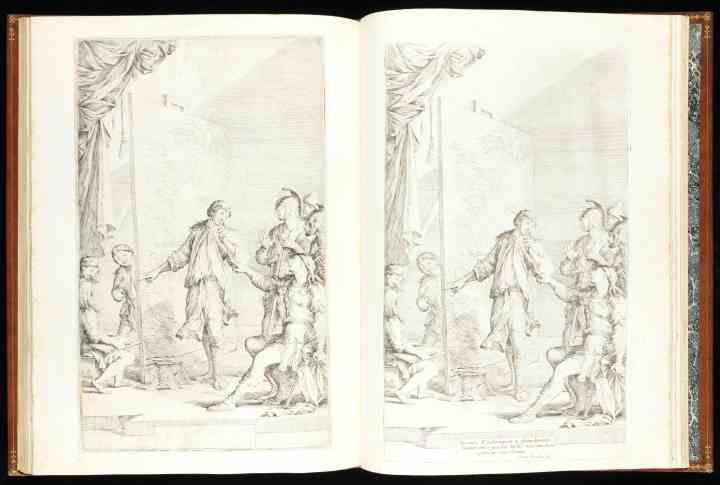
Now on view at The Fitzwilliam:
An Amateur’s Passion: Lord Fitzwilliam’s Print Collection
The Fitzwilliam Museum, Cambridge, 9 August 2016 — 29 January 2017
Curated by Elenor Ling
To mark the bicentenary of the founding of The Fitzwilliam Museum and celebrate its collection, this exhibition looks at one of the passions of its founder, Richard 7th Viscount Fitzwilliam of Merrion (1745–1816). Lord Fitzwilliam embodies both our present idea of the amateur print collector, as a non-professional enthusiast, and in the way the word amateur was understood in his day—a ‘lover of the arts’. The 198 albums that were housed in his library at the time of his death and transferred to the University of Cambridge under the terms of his bequest are testament to his love of prints. Despite his other all-consuming passions—the plight of the French monarchy in exile and the activities for the Concerts of Ancient Music—he managed to find time to boast of his collection to the exiled French court and to the Earl of Sandwich. The fact that some 40,000 prints are contained within the 198 albums gives a sense of the time and effort he expended on his collection. This small exhibition, comprising thirty-one prints and seven albums, gives a sense of the content and scope of Fitzwilliam’s print collection.
The first significant fact about Fitzwilliam’s albums is that they are arranged according to printmaker—that is to the person who made the print, rather than the artist who designed it or the work in another medium it represents. The names on the spines of the albums, therefore, usually correspond to the work of the person, or a family of engravers, regardless of whether a print was designed by the printmaker or someone else. The display begins with a small selection of Fitzwilliam’s Rembrandt prints, known at the time of his death as one of the strengths of his collection and evidently one of his earliest preoccupations. Following Rembrandt is a mixture of old masters, including Ishrael van Meckenem (c.1445–1503) and Albrecht Dürer (1471–1528), as well as work by contemporary artists, such as Jean-Jacques de Boissieu (1736–1810) and Johann Christian Reinhart (1761–1847).
Fitzwilliam’s albums fall into two main categories: those he acquired complete from other sources and those containing mounted, individual prints arranged entirely by Fitzwilliam himself. The latter is the focus of this exhibition, although the first category is represented. In terms of construction, evidence suggests that Fitzwilliam assembled the work of each printmaker in turn. In general Fitzwilliam tried to acquire prints in good condition and of good quality, and paid great attention to the decorative effect of the finished sheets. Neatness, symmetry and elegance are characteristic qualities across all his albums. Large prints were usually folded, rather than cut and pasted on separate sheets (in contrast to some albums acquired from other collections).
The examples of prints from his monographic albums serve to highlight the anomalies in his collection: the outsized albums that housed his mezzotints (the chief strength of his collection of British prints) and two albums arranged by subject, ‘Imitations of Drawings’, which comprises a mixture of sixteenth and seventeenth-century Italian woodcuts and eighteenth-century prints produced as facsimiles of drawings. Most bizarrely of all is the strange large album called simply ‘Jesuites’, a testament to another of his admirations: St Ignatius of Loyola and the Jesuit Order.
The exhibition presents what little can be gleaned about Fitzwilliam’s method of acquisition, including the single-surviving draft letter, written by Fitzwilliam just after the turn of the nineteenth century to someone who was to buy prints for him in Paris, and the names of print sellers and publishers written by Fitzwilliam as notes in a small number of the albums. The lack of documentation concerning the acquisition of prints highlights how importance it is that the majority of his albums has survived intact to this day.
2015 Dissertation Listings from CAA
From caa.news (1 August 2016) . . .
caa.reviews has published the authors and titles of doctoral dissertations in art history and visual studies—both completed and in progress—from American and Canadian institutions for calendar year 2015. You may browse by listing date or by subject matter. Each entry identifies the student’s name, dissertation title, school, and advisor. Once a year, each institution granting the PhD in art history and/or visual studies submits dissertation titles to CAA for publication.
◊ ◊ ◊ ◊ ◊
The index for 2015 lists ten ‘eighteenth-century art’ dissertations completed, including:
• Katherine Arpen, “Pleasure and the Body: The Bath in Eighteenth-Century French Art and Architecture” (UNC Chapel Hill, M. Sheriff)
• Julie Boivin, “Horrid Beauty: Rococo Ornament and Contemporary Visual Culture” (Toronto, M. Cheetham)
• John Cooper, “Imperial Balls: The Arts of Sex, War, and Dancing in India, England, and the Caribbean, 1780–1870” (Yale, T. Barringer; R. Thompson)
• Meredith Gamer, “‘The Sheriff’s Picture Frame’: Art and Execution in Eighteenth-Century Britain” (Yale, T. Barringer)
• Elizabeth Lee Oliver, “Mercantile Aesthetics: Art, Science, and Diplomacy in French India (1664–1761)” (Northwestern, S. H. Clayson)
◊ ◊ ◊ ◊ ◊
and forty-four ‘eighteenth-century art’ dissertations in progress, including:
• Franny Brock, “Drawing the Amateur: Draftsmanship and the Amateur in Eighteenth-Century France” (UNC Chapel Hill, M. Sheriff)
• Ashley Bruckbauer, “Dangerous Liaisons: Ambassadors and Embassies in Eighteenth-Century French Art” (UNC Chapel Hill, M. Sheriff)
• Emily Casey, “Waterscapes: Representing the Sea in the American Imagination, 1760–1815” (Delaware, W. Bellion)
• Bernard Cesarone, “Redeeming Virgins and Heterodox Images in Enlightenment New Spain” (UIUC, O.Vázquez)
• Kathryn Desplanque, “Art, Commerce, and Caricature: Satirical Images of Artistic Life in Paris, 1750–1850” (Duke, N. McWilliam)
• Monica Hahn, “Go-Between Portraits and the Imperial Imagination, circa 1800” (Temple, T. Cooper)
• Joshua Hainy, “John Flaxman: Beyond the Line” (Iowa, D. Johnson)
• Alexandra Morrison, “Copying at the Louvre” (Yale, C. Armstrong)
• Sarah Sylvester Williams, “Dining Scenes by Nicolas Lancret” (Missouri, Columbia, M. Yonan)
Exhibition | Fashion Forward, 3 Siècles de Mode
The exhibition closes this week at the Arts Décoratifs. Writing for Worn Through (10 August 2016), Hayley-Jane Dujardin-Edwards provides a review.
Fashion Forward, 3 Siècles de Mode, 1715–2016
Musée des Arts Décoratifs, Paris, 7 April — 14 August 2016

Dress and Petticoat (robe à la française), ca. 1740, silk damask satin ground silk brocaded and filé (Collections UFAC, Les Arts Décoratifs, Paris / photo by Jean Tholance)
The Musée des Arts Décoratifs is celebrating the thirtieth anniversary of its fashion collection from April 7 to August 14, 2016. In doing so we are responding to our public’s strongly expressed desire to at last be shown an all-embracing panorama of fashion history over several centuries. It will also be an unique opportunity to showcase the jewels and highlight the particularities of a national fashion and textiles collection curated in full dialogue with the other departments of a museum dedicated to all the decorative arts. Fashion Forward, 3 Centuries of Fashion, 1715–2016 brings together 300 items of men’s, women’s and children’s fashion from the 18th century to today, selected from the museum’s collections to provide a novel chronological overview.
The Arts Décoratifs fashion collection now comprises more than 150,000 works, ranging from ancient textiles to haute couture creations and emblematic silhouettes of ready-to-wear fashion, but also including accessories, major collections of drawings and photographs, and the archives of iconic creators such as Elsa Schiaparelli, Madeleine Vionnet and Cristobal Balenciaga. Now France’s foremost national collection, it is the result of the amalgamation of two admirable collections, that of the Musée des Arts Décoratifs since its creation in 1864, and that of the Union Française des Arts du Costume (UFAC), founded in 1948 and currently presided by Pierre Bergé, of which the Musée des Arts Decoratifs is the proud custodian.
To mark the 30th anniversary of the opening of the Musée des Arts de la Mode—founded in 1986 on the initiative of Pierre Bergé and the French textile industry with the support of Jack Lang, then culture minister—the Musée des Arts Décoratifs is paying tribute to this collective adventure and great ‘fashion moment’. Fashion Forward, Three Centuries of Fashion casts a new spotlight on one of the richest collections in the world, freed from its display cases in the Fashion galleries to be shown for the first time in the museum’s Nave.
The three hundred pieces, selected from a collection constantly enriched by donations and acquisitions, take us on a journey through time, highlighting the key moments in fashion history from the very late 17th century to the most contemporary creation. Freeing itself from the dictates of the conservation of works and the stringent conditions of their display, the exhibition is conceived as an ideal museum of fashion, featuring the finest examples of three centuries of creation habitually illustrated in reference books. It also provides a fascinating new insight into fashion’s evolution via its designers, clients and periods, because now more than ever at Les Arts Décoratifs, fashion is treated as an artistic field that has wide-ranging echoes in the museum’s other collections. Fashion is a history of evolving techniques, materials and designs but also a history of changing times and attitudes, a reflection of the art of living. Fashion is even more fascinating when it is not self-generating but dialogues with the arts of its time, as did great figures of Couture such as Charles-Frederick Worth, Jacques Doucet, Paul Poiret, Jeanne Lanvin, Madeleine Vionnet, Gabrielle Chanel, Christian Dior and Yves Saint Laurent.
In a completely novel manner, the exhibition recreates each of these ‘fashion moments’ in its human, artistic and social context, not didactically but via ellipses illustrating fashion’s constant elective affinities with the decorative arts. Eighteenth-century wood paneling, scenic wallpapers by Zuber, Paul Iribe’s drawings for the ‘Robes de Paul Poiret’, and the straw marquetry doors created by Jean-Michel Frank for the writer François Mauriac, provide perfect settings for fashion’s stylistic expressions and the metamorphoses of the body and style from the 18th century. The exhibition culminates in the effervescence and singular eclecticism of the global contemporary fashion scene, in which the names of the most original creators are now associated with the most ancient fashion houses.
Because the entire history of fashion is also a history of the body and style, the exhibition’s artistic direction was entrusted to the British dancer and choreographer Christopher Wheeldon, formerly one of the stars of the New York City Ballet and winner of a Tony award for his stage adaptation of An American in Paris in 2014, based on the film by Vicente Minelli. In collaboration with the scenographer Jérôme Kaplan and assisted by Isabelle Vartan, Christopher Wheeldon has succeeded in giving the collection a sensual, poetic dimension, breathing new life into these illustrious creations by transforming every stage of the exhibition into a world in itself. Each of these moments is enhanced by a unique collaboration with the dancers of the Opéra de Paris, in which a choreography gracefully casts new light on a silhouette, posture or attitude characteristic of this social and artistic evolution of the body.
Exhibition | Highest Heaven: Spanish and Portuguese Colonial Art
Now on view at the San Antonio Museum of Art:
Highest Heaven: Spanish and Portuguese Colonial Art
of the Roberta and Richard Huber Collection
San Antonio Museum of Art, 11 June 2016 — 14 September 2016
Crocker Art Museum, Sacramento, 23 October 2016 — 22 January 2017
Worcester Art Museum, 12 March — 9 July 2017
Chrysler Museum of Art, Norfolk, Virginia, 2 March — 3 Jun 2018
Curated by William Keyse Rudolph and Marion J. Oettinger

Our Lady of Candlemas with Donors, Bolivian, Potosí, 1799, oil on canvas (Roberta and Richard Huber Collection; photograph by Graydon Wood, Philadelphia Museum of Art)
Highest Heaven explores the paintings, sculpture, furniture, ivories, and silverworks of the Altiplano, or high plains, of South America in the 18th century. Through the work of both well-regarded masters and lesser-known artists, Highest Heaven highlights the role of art in the establishment of new city centers in the Spanish Empire and the propagation of the Christian faith among indigenous peoples. Drawn exclusively from the distinguished collection of Roberta and Richard Huber, the exhibition highlights the distinct visual language created by the cultural and creative exchanges that occurred between Spain and Portugal and their South American colonies. The exhibition will remain on view through September 4, 2016, before traveling to the Crocker Art Museum in Sacramento, California in October, and to the Worcester Art Museum in Worcester, Massachusetts the following March.
The exhibition features more than 100 works, including religious paintings, carved and gilded wooden sculptures, intimate ivories, and silverwork, originally housed in ecclesiastical and private collections throughout the former colonial possessions of Spain and Portugal. The majority of these works were created for functional purposes, as articles of faith or symbols of civic order, and were displayed in a manner that enhanced religious understanding, brought social order, and spurred conversion among colonial populations. Highest Heaven examines these uses, focusing in particular on the translation of Christian imagery to the colonies and the ways in which these works and objects worked to establish an ordered society and were integrated into religious life. The exhibition includes approximately 20 recent acquisitions by the Hubers, many of which have never before been seen in a museum exhibition.
“A central component of our mission is to examine and communicate the historic and cultural contexts of artworks, along with the objects themselves. Highest Heaven is an exciting opportunity to not only investigate the aesthetic beauty of this art, but also the significant role that it played in the cultural, religious, and social lives of these peoples,” said Katherine Luber, The Kelso Director of San Antonio Museum of Art. “We are grateful to Roberta and Richard for their collecting vision and the chance to share this incredible collection with our audiences. San Antonio is a city rich in history and diversity, and we look forward to engaging our community with this work, which we think will have a particular meaning here.”

Pax Depicting the Ecce Homo, Peruvian, 18th century, silver (Roberta and Richard Huber Collection; photograph by Graydon Wood, Philadelphia Museum of Art)
The exhibition is co-curated by William Keyse Rudolph, Mellon Chief Curator and Marie and Hugh Halff Curator of American Art, and Marion J. Oettinger Jr, Curator of Latin American Art. Unlike many previous exhibitions of Colonial Art, which have arranged objects by media, Highest Heaven will be organized according to iconography. After an introductory section that explores a group of objects made for secular life, the exhibition considers the art works religiously, from the angels and archangels that foretold the coming of Jesus Christ, through imagery dealing with the life of Christ and spread of the gospel, to the importance of the Virgin Mary and the saints. Each section of the exhibition contains a mixture of works of art in all media, from paintings to sculpture to silverwork and ivories.
The Altiplano stretches from northern Argentina to the flatlands of Peru, and much of the exhibition focuses on works produced by workshops in the major cities of Cuzco and Lima in modern day Peru and Potosi in modern day Bolivia, where both European and native artists practiced. Paintings and sculpture served primarily to disseminate Christian images and faith to the New World, while works in ivory and silver underscored the wealth and prosperity of the growing Empire. Paintings also frequently depicted major colonial cities to both capture their urban fabric and educate those back home on the appearance and existence of the colonies.
With the extensive growth of trade across the Empire, works of art took on a range of styles that represented European traditions and local idioms. In some instances, European aesthetics and subjects were replicated directly. In others, European saints, idols, and figures took on the appearance of native populations, enhancing their relevance and influence. Yet, in other work, Christian symbols were incorporated into scenes of local rural and urban life. Together, these distinct yet interrelated approaches, created a new visual culture that represented the expansiveness of the Empire, and spoke to the integration of a diversity of peoples into a single faith.
“In contrast to other areas of Spanish colonial scholarship, such as New Spain (present-day Southwestern United States, Mexico, and Central America), much less is known about the artists, workshop practices, and even the names of South American artists,” said Luber. “Collectors are often the first to blaze the trail of discovery, and then the scholarship follows. A show like Highest Heaven opens up avenues of investigation. We are producing a catalogue that we hope will spur additional scholarship in the field. That’s part of what is so exciting about this exhibition.”
New York-based collectors Roberta and Richard Huber developed the collection of colonial South American art over the last 40 years. The Hubers continue to discover new artists and works, building on their holdings for personal enjoyment and public education and making their collection a living and evolving one. They first discovered the art and antiquities of the Spanish Empire when Richard Huber was relocated for work to Buenos Aires, Argentina in 1962. His and Roberta’s love for the period grew as they traveled and lived in other areas of South America. Today, they are committed to enhancing understanding of the diversity, depth, and intricacy of art produced by artists across the Altiplano during Spanish rule.
Erin Kathleen Murphy and William Keyse Rudolph with contributions by Thomas B. F. Cummins, Katherine Moore McAllen, and Katherine Crawford Luber, Highest Heaven: Spanish and Portuguese Colonial Art from the Roberta and Richard Huber Collection (San Antonio: San Antonio Museum of Art, 2016), 192 pages, ISBN: 978-1883502225, $40.
Call for Papers | AAH 2017 at Loughborough University
Here are some of the intriguing thematic offerings proposed for the Association of Art Historians 2017 conference that could include eighteenth-century papers. Be sure to consult the conference website for things I’ve overlooked. –CH
43rd Annual AAH Conference and Bookfair
Loughborough University, 6–8 April 2017
Proposals due by 7 November 2016
AAH2017 will celebrate the expansive spectrum of histories, theories and practices that characterize art historical research today. Internationally, the field of art history is eclectic and inclusive, reaching across geopolitical, cultural and disciplinary divides to extend our understanding of the visual and material culture of many diverse periods and places. At Loughborough, we are engaged with art history, contemporary practice and visual culture, linking arts-based research with advances in design, technology, media and communication, centred on the development of more sustainable and equitable global communities.
Please email your paper proposals straight to the session convenor(s). Provide a title and abstract for a 25 minute paper (max 250 words). Include your name, affiliation and email. Your paper title should be concise and accurately reflect what the paper is about (it should ‘say what it does on the tin’) because the title is what appears most first and foremost online, in social media and in the printed programme.
Keynote Speakers
Amelia Jones (Robert A. Day Professor in Art and Design and Vice-Dean of Critical Studies at the Roski School of Art and Design) and Mark Hallett (Director of studies at the Paul Mellon Center for Studies in British Art)
◊ ◊ ◊ ◊ ◊
Session 1 | 50 Years On: Art History in the UK since the 1960s
Geoff Quilley, University of Sussex, g.quilley@sussex.ac.uk
Meaghan Clarke, University of Sussex, m.e.clarke@sussex.ac.uk
Francesco Ventrella, University of Sussex, fv37@sussex.ac.uk
The current decade marks the 50th anniversary of many Art History departments across the UK. It was not until the 1960s that the majority of Art History departments still functioning today were instituted. This was not merely coincidental, but was part of the seismic shift in post-war higher education that saw the wave of building of new universities. The consequent democratisation of the teaching of Art History in 1960s Britain had enormous impact both on the politics of the discipline and also on its place within an overall higher education ‘framework’. This session will seek to revisit that ‘new vision’ for Art History within 1960s culture, by reflecting on the history of Art History over the past 50 years, and focusing on its role within UK higher education, and educational philosophy and policy more generally. This might consider several inter-related sets of issues, including: the mutual impact and influences between the new departments and the old institutions, and how they might have prepared the terrain for the ‘New Art History’; how Art History intersected with the teaching of art and design; the relation of Art History to other disciplines, both established and new. What were the effects of the influx of Art History degrees on related professional environments such as museums? Did public perceptions of the discipline change as an effect of its popularisation through the media? And what has been, and continues to be, the public role of Art History, and how has this changed over the past half-century?
◊ ◊ ◊ ◊ ◊
Session 3 | Art History as Créolité/Creolising Art History
Alpesh Kantilal Patel, Florida International University, Miami, alpesh.patel@fiu.edu
As part of the three-day workshop titled ‘Créolité and Creolisation’, which took place on St Lucia as one of the platforms of Documenta 11 (2002), participants explored the genealogy of terms such as ‘creolization’ and ‘Créolité’, and their potential to describe phenomena beyond their historically and geographically specific origins (however slippery they are). Surprisingly, there has been little engagement with the potential of creolisation as a way of doing or writing art histories differently since that time. This session aims to redress this lacuna.
Stuart Hall, one of the workshop participants, writes that what distinguishes creolisation from hybridity or diaspora is that it refers to a process of cultural mixings that are a result of slavery, plantation culture, and colonialism. Yet, Martinican-born poet and theoretician Édouard Glissant notes that creolisation can refer to a broader set of sociocultural processes not only in the Caribbean but also ‘all the world’ (Tout-monde). Drawing on Hall and Glissant, Irit Rogoff suggests that créolité can more broadly reference the construction of a literary or artistic project out of creolising processes.
What would it mean to re-imagine art history as Créolité? That is, hegemonic Western art history has created in its wake an array of ‘other’ art histories connected to regions such as Latin America, the Caribbean, Eastern Europe, and South Asia to name a few. Of special interest in this session is not only considering such regional art histories as relational to each other, but also exploring how other constructions of identity—such as gender, sexuality, race, and class—are intertwined with them. Papers exploring contemporary and historical periods are both welcome; and those critically examining Glissant’s terms—such as ‘opacity’ and ‘globality’—to bear on the session theme are especially encouraged.
◊ ◊ ◊ ◊ ◊
Session 7 | Catastrophism and the Ecology of Art in Pre- and Early Modern Europe
Joanne W Anderson, The Warburg Institute, Joanne.anderson@sas.ac.uk
Jill Harrison, The Open University, Jill.harrison@open.ac.uk
Floods, fires, earthquakes, famines and plagues were catastrophic events in pre- and early modern Europe. They impacted heavily on environment and society by devastating resources, levelling infrastructure and displacing or destroying communities. The residual presence of such events in the cultural memory could be long term and institutionalised. As Erling Skaug has recently argued (2013) in relation to change in Giotto’s late oeuvre, ‘disasters of a certain magnitude tend to cause breaks and abrupt changes in a historical course—for better or worse.’
Catastrophism is an emerging and productive way of thinking about art’s relationship to climate and environment, and the circumstances of its production and interpretation. But it also has a venerable tradition within the discipline of art history itself. From Winckelmann’s climate theory in relation to the stylistic development of Greek sculpture (1755) to Millard Meiss’s theories about the Black Death and its instigation of an archaising pictorial system (1951), the ecology of visual representation is a persistent framework for critical enquiry. It has the potential to align local events with universal histories, for example a synecdoche for the Apocalypse or the Great Flood.
This panel welcomes papers that explore catastrophes of art in the classical sense. By focusing on pre- and early modern Europe, it aims to push art historians to rethink the role of such events in our understanding of art and its production. It will seek to discuss and offer fresh perspectives on the concept of catastrophism and its relevance for the ecology of art.
◊ ◊ ◊ ◊ ◊
Session 8 | Changing Regimes of Art Education: An International Look at Art History, Pedagogy, and Power Knowledge
Elke Krasny, Academy of Fine Arts Vienna, elke.krasny@gmail.com
Barbara Mahlknecht, Academy of Fine Arts Vienna, b.mahlknecht@akbild.ac.at
Art education is part of the archives of regimes of power knowledge. Despite the important role art education holds for producing and reproducing knowledge of art history and artistic practice, it has so far remained an understudied area in critical art history writing. The session’s focus is on the critical analysis of art history education at university and art academy level internationally. While art and art history are commonly understood as fields of global knowledge production and circulation, art education is still connected to the nation state and the changing regimes of its ideologies, economies, and politics. The session therefore asks to what extent the nation state is still the core structure forming canonical art histories and art education pedagogies? It also raises the question to what extent art history education is transformed via international, transnational, and global exchange. Some of the questions concern how art history education was formed by imperial and colonial regimes, totalitarian and fascist regimes at times of war, and the contemporary neoliberal regime in which both the global South and the global North are implicated.
The session invites papers giving case studies from different places and specific time periods. Of particular interest are transitional periods revealing the change from one regime to another. The focus is on the formation and institutional recognition of art history education in relation to art history’s critical history writing and the analysis of the archives of regimes of power knowledge.
◊ ◊ ◊ ◊ ◊
Session 10 | Damaged Art and the Question of Value
Kathryn Brown, Loughborough University, kathrynjbrown@mac.com
While entropy has often been used by artists as an aesthetic strategy, this session examines the values that attach to artworks that are damaged in the process of their execution, or that have been broken, vandalised, discarded, or otherwise rendered unfit for their original design or purpose. What aesthetic, historical and financial values attach to such works, and are those values divergent or mutually reinforcing? While ancient statuary is exhibited in fragments, what is the display value of more recent works that have not benefitted from restoration? For some collectors, prints pulled from cancelled plates are prized objects, while, for others, such works are considered counterfeit. Artists complain of failures to maintain the condition of public art that no longer meets their original conception and, in some cases, recommend destruction of that work.
Such examples problematise the values that attach to the material qualities of art objects and the ways in which such qualities relate to artistic intention and audience expectations throughout time. This session asks why some works have been considered worthy of restoration while others have been ignored? Might the preservation of damage to an object have evidential value that outweighs the restoration of that object’s material appearance? What types of destruction befall conceptual and performance artworks? From the activities of the Salvage Art Institute to the exhibition of paintings and sculptures marred by war, accident, or neglect, this session uses the concept of damage to investigate values that attach to the production, display, preservation, and financial value of artworks.
◊ ◊ ◊ ◊ ◊
Session 19 | Modern Lives – Modern Legends: Artist Anecdotes since the 18th Century
Hans Christian Hones, The Warburg Institute (Bilderfahrzeuge Project), hoenes@bilderfahrzeuge.org
Anna Frasca-Rath, University of Vienna, anna.sophie.rath@univie.ac.at
In John Nichols’ Biographical Anecdotes of William Hogarth (1785), one reads of how the painter died in the arms of his servant, his demise the result of overindulging in beefsteak. Seventy years later, a biography of John Flaxman tells of how the artist, in his childhood, showed his drawings to a famous painter—who asked if they were meant to represent flounders.
These are just two examples for a little-known tendency in the artistic literature of the 18th and 19th century: the re-adaptation of traditional anecdotes which had been repeated countless times since the trecento. Nichols’ story clearly refers ironically to Vasari’s description of Leonardo’s death in the arms of the French King, and Flaxman’s ‘flounders’ are an equally ironic take on the legend of Giotto’s discovery by Cimabue. Far from simply providing entertainment, they were also an opportunity for succinct commentary on the respective artist’s work—the ‘Englishness’ of Hogarth and the ‘flatness’ of Flaxman.
This panel explores these revisions and re-adaptations of traditional artist anecdotes and their function in the art theoretical debates of their time. What was the purpose of such re-writings? How does this flood of new anecdotes relate and react to the rise of ‘scholarly’ biographical writing? Which art-theoretical subtexts were carried in these ironic deflections from tradition? And how do they intersect with the equally prominent rise of depictions of anecdotal scenes from artists’ lives—Giotto painting sheep being just the most prominent example? Papers examine these and other questions in a broad geographical context between the 18th and 20th century.
◊ ◊ ◊ ◊ ◊
Session 25 | Prints in Books: The Materiality, Art History and Collection of Illustrations
Elizabeth Savage, Cambridge University, leu21@cam.ac.uk
Book illustrations, especially from the hand-press period (1450–1830), are an essential but traditionally overlooked source of art historical information. Although the hierarchies of fine art over popular art are dissolving, and modern disciplinary distinctions between text and image (or art and book) are giving way to cross-disciplinary and holistic approaches to printed material, printed images that happen to be inside books often fall outside the remits of art historical, literary, bibliographical and material research.
One reason is that practical and academic barriers impede access to the art historical information that book illustrations can provide. Due to incompatible cataloguing standards adopted by libraries and art museums, researchers can struggle to identify book illustrations across collections. Cataloguing protocols may reduce hundreds of significant woodcuts in a book to the single word ‘illustrated’; some world-leading graphic art digitisation initiatives exclude book illustrations. As the global digitised corpus expands, will book illustrations be more represented in print scholarship or will they continue to fall into the gap between art and book? As material objects and visual resources, should they be considered bibliographical, art historical or iconographical material? And how do such classifications influence their interpretation?
This interdisciplinary panel seeks to establish a platform for discussion about the position of printed book illustrations in graphic art scholarship. Theoretical and object-based papers related to any aspect of collecting, cataloguing and interpreting printed book illustrations, broadly defined, are welcome, as are papers that explore the materiality, iconography, historiography or art history of printed pictures inside books.
◊ ◊ ◊ ◊ ◊
Session 30 | Sculpture in Motion
Martina Droth, Yale Center for British Art, martina.droth@yale.edu
Sarah Victoria Turner, Paul Mellon Centre for Studies in British Art, svturner@paul-mellon-centre.ac.uk
Sculpture is generally static. It tends to be thought of as solid, inert, and physically grounded. These qualities are deeply associated with some of its most traditional functions—to commemorate, memorialise, and provide permanent public symbols. But throughout its history, sculpture’s immobility has been held in tension with the fantasy of its potential motion and animation. This tension plays out in the dualities of its association with life and death. The potential of the statue coming to life, as in the Pygmalion myth, has been a constant reference point for sculpture and how it is written about.
This interdisciplinary session seeks to examine the various ways in which sculpture has been put in motion, literally or metaphorically, and to consider what drives this desire to animate sculpture. Areas of possible investigation include the devices and artistic strategies that induce motion or an illusion of life—for example, turning statues on rotating pedestals; viewing statues by candlelight; the tinting and colouring of sculpture to create life-like effects; sophisticated technologies and mechanical devices such as animatronics, automata, and kinetics; the ‘living statue’ and the tableau vivant; bringing sculpture to life in text; the suggestion of movement in photographs of sculpture; the appearance of sculpture in film. Proposals may address any period or area of sculpture, and can present case-studies or broader reflections.
◊ ◊ ◊ ◊ ◊
Session 31 | Speculative Libraries
Nick Thurston, University of Leeds, n.thurston@leeds.ac.uk
The symbolic status of ‘the library’—be it in the image of the great libraries of antiquity, the monastic libraries of the Middle Ages or the public libraries of Victorian Britain—has served as both a metaphor and allegory for knowledge, wealth, devotion and permanence. Yet all contemporary libraries are having their rationales, architecture, labour practices and holdings radically changed by the growth of networked computing and information science. What are the many and changing relationships between art practice, art’s discourses and libraries? And where, from the first proto-libraries of Sumer to counter-cultural archives of grey or illegal material, do we see the logic of the library reaching beyond the confines of libraries-as-such?
I invite submissions from historians, theorists and makers who can address these questions directly and who work within or across the fields of architecture studies, art history, art & design and library & information science. Our aim will be to take seriously all aspects of library culture and library-making as they relate to art, including: holdings, collections policies, librarianship, furniture, architecture and the role of libraries within their communities. From Martha Rosler Library (2005–6) to the open-access file-sharing on aaaaarg.fail, a trend can be traced for making libraries as or within contemporary art projects. As such, through this session’s broad discussion I hope we will also foster a sub-focus on the history, theory and techniques of speculative library-making, considered as the practice of constructing real or imaginary libraries as an artistic act.
◊ ◊ ◊ ◊ ◊
Session 32 | Standing Stones and the Origins of Architectural Modernity
Ralph Ghoche, Barnard College, Columbia University, rghoche@barnard.edu
Christina Contandriopoulos, UQAM University
Standing stones (menhirs) have captivated the imagination of architects and archaeologists since their rediscovery in the 17th century. By the 19th century, these primitive monuments were accorded a prominent place in the new narratives of architectural history, generating countless debates over their origin and function. Indeed, they emboldened many architects to challenge the prevailing neoclassical histories of architecture by moving the point of origin from the so-called ‘civilised’ societies of classical Greece and Rome, back to the ritualistic practices of Celts, Druids and Gauls. The interest in indigenous monuments was no less potent for architects in the 20th century. In the writings of Le Corbusier, Sigfried Giedion and Aldo van Eyck, here too these stone were employed as testaments of wholly distinct historical trajectories.
This session focuses on the impact of standing stones and primitive, indigenous monuments on architecture from the 17th to the 20th centuries. The question can be explored from multiple perspectives. From an historiographical standpoint, we are interested in the way that these stones informed new historical narratives in architecture. How was the new awareness of these stones employed to challenge Greco-Roman models? From the perspective of architectural production, how did they impact the primitive sensibilities of modernist architects? To be sure, the mute and enigmatic quality of menhirs provided Modernists powerful precedents for their own experiments in abstract signification. As prehistorical monuments, standing stones would seem to have provided designers with a way of achieving an emancipated architecture, free of the burdens of history.
◊ ◊ ◊ ◊ ◊
Session 35 | Textile, Art & Design: Reciprocity and Development
Alice Kettle, Manchester Metropolitan University, a.kettle@mmu.ac.uk
Uthra Rajgopal, Manchester Metropolitan University, u.rajgopal@mmu.ac.uk
The reciprocity and division of textiles and the fine arts are in continual negotiation. This session examines the nexus between the fine and decorative arts, craft making and commercial production. Many artists of the 20th century such as Abakanowicz, Dali, Delaunay, Matisse, Moore, Parker, Picasso, Paolozzi and Warhol (to name but a few) have been celebrated for their collaborations in sculpture and/or pattern making, but this approach presents one avenue of the artist’s intervention in textiles. This session will consider a wider view, asking how contributions of textile designers and artists working across a spectrum of geographical and historical periods, such as those working in Spitalfields, Lyon, Japan or India for example, or designers such as Dora Batty, Marian Clayden, Marion Dorn, Bernat Klein or John Piper influenced and collaborated with artists, fashion designers and art movements or contributed to the synergy of these practices.
In this session we welcome papers from academics, researchers, textile artists, textile and fashion historians, curators and archivists. The term textile can be interpreted in its widest sense. Suggestions for proposals of papers or panel discussions include but are not limited:
• The evolution and circulation of a particular motif in woven or printed textiles
• Artists/designers and textiles: an exploration of their oeuvre through pattern making
• The influence of textile designers in art/dress/fashion history
• Historical and contemporary collaborations between artists and textile designers
◊ ◊ ◊ ◊ ◊
Session 37 | The Power of Plasticity
Rowan Bailey, University of Huddersfield, r.bailey@hud.ac.uk
Sheila Gaffney, Leeds College of Art, sheila.gaffney@leeds-art.ac.uk
Plasticity is a powerful yet elusive concept of formation in the histories, theories and practices of making. In its traditional sense, it has been synonymised with the noun ‘plastic’—the plastic arts of sculpture and architecture within the modern schema—and the adjective ‘plastic’—the material and aesthetic registrations of a state of being malleable, pliant, ductile and adaptable. More recently, plasticity has gained cultural currency in science as a tool for articulating the brain’s thinking activity. The reception of plasticity within the histories of art, visual and material culture thus covers a broad and diverse spectrum. It not only refers to a condition of aptitude within the mind of the practitioner—derived from the Greek plassein: ‘to mould or form’—it also registers the transformation of materials from the molecular to the microscopic, the psychic to the aesthetic.
Whether operating through different tropes of formation in art historical/art writing, as material transformations in and through the making process, or as environmental states for the production and reception of form, this session seeks to explore the varied use, application and agency of the term ‘plasticity’ in a trans-disciplinary expanded field.
The panel proposes to address three dimensions to plasticity and their potential intra-relations, reflecting on objects of visual and material culture to bring about new configurations of plastic thinking in practice. Contributions that move beyond this framework are also welcome:
• Plasticity as a dynamic condition for the production and reception of form
• Plasticity and the transformation of materials
• Plasticity as a thinking tool in art, visual and material culture
Exhibition | Gardens, Art, and Commerce in Chinese Woodblock Prints
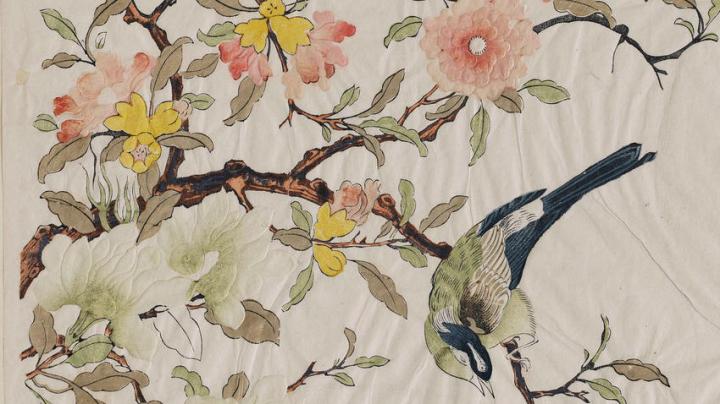
Ding Liangxian, Pomegranate and Magnolia with Bird, (detail), Qing Dynasty, 1700–50; woodblock print with embossing, ink, and colors on paper (multiblock technique with hand-coloring), 11 7/8 × 14 3/4 inches (Boston: Museum of Fine Arts)
◊ ◊ ◊ ◊ ◊
Press release (28 June 2016) from The Huntington:
Gardens, Art, and Commerce in Chinese Woodblock Prints
The Huntington, San Marino, CA, 17 September 2016 — 9 January 2017
Curated by June Li and Suzanne Wright
The Huntington Library, Art Collections, and Botanical Gardens will present a major international loan exhibition exploring the art, craft, and cultural significance of Chinese woodblock prints made during their golden age, with works made from the late 16th century through the 19th century. Gardens, Art, and Commerce in Chinese Woodblock Prints brings together 48 of the finest examples gathered from the National Library of China, Beijing; the Nanjing Library; the Shanghai Museum; and 14 institutional and private collections in the United States. The exhibition presents monumental visual accounts of sprawling, architecturally elaborate ‘scholar’s gardens’, alongside delicate prints with painterly textures and subtle colors depicting plants, birds, and other garden elements so finely wrought they might be mistaken for watercolors. A highlight of the exhibition is The Huntington’s rare edition of the Ten Bamboo Studio Manual of Calligraphy and Painting (ca. 1633–1703), acquired in 2014, and on public view for the first time in this exhibition.
Research informing the exhibition and an accompanying catalog reveals much about the history and significance of Chinese pictorial printing during the period, including its influence on better-known Japanese woodblock artists and collectors. Coveted for their artistic merit and technical virtuosity, Chinese illustrated books and pictorial works were collected by the literati and wealthy merchant classes in both China and Japan. The Ten Bamboo Studio Manual, for example, contains the inscriptions of five renowned Japanese artists, successive owners who treasured the artistically ambitious and visually creative volumes as an important resource.
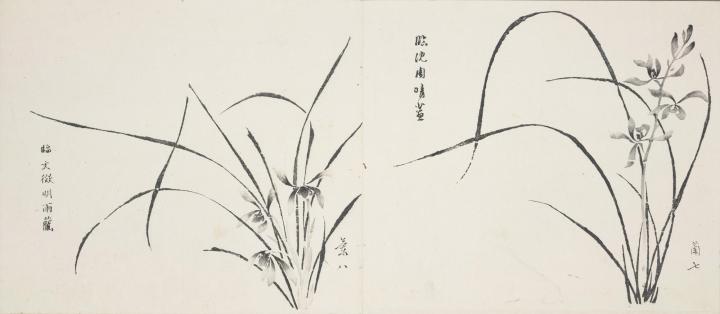
Lotus Leaf, Lotus Root, and Two Jitou Capsules, with calligraphy by Sun Yuwang, Fruit 10, from Ten Bamboo Studio Manual of Calligraphy and Painting, compiled and edited by Hu Zhengyan; woodblock-printed book, ink and colors on paper, each page 9 7/8 × 11 1/4 inches (San Marino: Huntington Library, Art Collections and Botanical Gardens)
◊ ◊ ◊ ◊ ◊
The founding curator of The Huntington’s Chinese Garden, June Li, is co-curator of the exhibition and co-author of the catalog, along with Chinese woodblock print specialist Suzanne Wright, associate professor of art history at the University of Tennessee.
Gardens, Art, and Commerce in Chinese Woodblock Prints unites several interests at The Huntington. It is the home of one of the most extensive collections of early printed books in the nation, various collections of prints by European and American artists, and one of the largest Chinese scholar’s gardens outside of China.
“This exhibition is utterly evocative of The Huntington’s transdisciplinary nature,” said Laura Skandera Trombley, Huntington president. “Woodblock prints were formative communication and aesthetic tools that served a number of purposes over time, from disseminating Buddhist teachings to depicting ideals of beauty. This perfect fusion of art and language, an integration of emotion and intellectual pursuit, is evidenced in The Huntington’s art and library collections, and is embodied in our stunning Suzhou-style Chinese Garden. We are enormously grateful for June Li’s commitment and guiding vision for this extraordinary exhibition.”
During the late Ming (1368–1644) and early Qing (1644–1912) dynasties, an increase in wealth, stemming in part from the salt, rice, and silk industries, led to higher levels of literacy and education. Consumer demand for printed words and images increased as merchants and scholars looked for ways to display their taste in drama, poetry, literature, and art. For these elites, gardens were central to a cultured life, appearing frequently in woodblock prints as subject or setting. By the 1590s, several enterprising publishers were successfully meeting the strong demand for woodblock prints. They hired renowned designers, carvers, and printers to produce sophisticated and exquisite works, raising the standards of printmaking. During the last decades of the Ming dynasty, several centers of printing around the lower Yangzi River delta grew in reputation, ushering in a golden age of Chinese pictorial printing.
“In the realm of Chinese art, pictorial woodblock prints are not as familiar as paintings, calligraphy, or ceramics,” said Li. “The subject of woodblock prints usually brings to mind Buddhist icons, Daoist deities, or folk images, rather than refined and artistic works. But, over the past few years, scholars researching the historical and artistic aspects of these prints have re-introduced a trove of beautiful works that are highly accomplished.”
Building on this story, Gardens, Art, and Commerce in Chinese Woodblock Prints is organized into thematic sections with explanatory panels in both English and Chinese. In the first gallery visitors will find an impressive nine-and-an-half-foot long hand scroll that was commissioned by the Song emperor Taizong (r. 976–97). An unusual Buddhist work that depicts landscape rather than images of deities, it is the earliest and only religious work in the exhibition, showing the lofty achievements of woodblock printers by the 10th century, with enormous clarity of line and painstaking attention to the details of mountains, streams, trees, and tiny figures. The accomplishments of such early printing established the technical foundation from which later Ming and Qing artists grew. Illustrations of the Garden Scenery of the Hall of Encircling Jade, an extraordinary set of 45 prints produced around 1602 to 1605, will be displayed in facsimile (the only evidence that remains of the original). Taken as a whole, the prints illustrate the enormous garden estate of a successful merchant, scholar, and book publisher of the early 17th century. The detailed prints show what seems to be acres of a fashionable garden, with a large, elegant hall framing scholars seated in conversation; a courtyard where figures re-enact a famous poetry game around a table; an enclosure for carefully sculpted penjing (bonsai trees); and more than a hundred names inscribed on buildings, ponds, and rocks. The print has an elevated viewpoint and changing perspectives that allow glimpses into interior spaces, revealing a cultivated life of books and men in scholars’ robes deep in discussion.
The exhibition next focuses exclusively on prints about gardens, both historical and fictional. Historical gardens include famous sites recorded by emperors, such as Suzhou’s Lion Grove, a popular tourist destination to this day. Another imperial work, a scroll more than 25 feet long (six feet of which will be displayed), shows urban gardens and the bustle of daily life in 18th-century Beijing.
The effects of exchanges between European missionaries and the Chinese also are explored in the exhibition. One publisher incorporated biblical illustrations into his ink catalog, produced around 1616. The Qianlong emperor in 1783–86 commissioned a set of large copperplate engravings in a European style that showed details of the European pavilions in his private retreat.
Another section of the exhibition explores the styles of print artists from the late 16th through the 18th centuries in publishing centers such as Hangzhou, Huizhou, Wuxi, and Suzhou. On view are several examples by different publishers illustrating a single popular story, The Story of the Western Chamber, making clear their varying visual and artistic interpretations. In some cases, prints were made to resemble known paintings. Sometimes famous painters, such as Chen Hongshou (1598–1652), designed works expressly for printing. The exhibition includes a rare early edition of Chen’s version of The Story of the Western Chamber, as well as a set of cards he designed for a drinking game.
The exhibition also looks at accomplishments in multi-color and embossed printing, such as beautifully printed guides offering suggestions for cultivating taste. These manuals prescribed appropriate pastimes for a cultivated life, instructed on calligraphy, and advised on chess strategy and drinking games for men, and embroidery patterns for women. They also illustrated musical and dramatic works such as the popular Peony Pavilion. Many of these leisure activities took place in the garden, and prints showing scholar’s rocks, which had become precious items for the discerning collector, will be represented by finely printed editions of well-known works including a rare edition of The Stone Compendium of Plain Garden. Two examples of actual scholar’s rocks from The Huntington’s collection will be on view to complement the book.
Additionally, four iPads in the galleries will allow for a deeper investigation of Illustrations of the Garden Scenery of the Hall of Encircling Jade (a work showing the large garden estate of the successful merchant and publisher Wang Tingna) and allow visitors to see all the leaves of The Huntington’s Ten Bamboo Studio Manual of Calligraphy and Painting, a work that due to its delicate nature can only be viewed a few leaves at a time in the galleries.
Visitors of all ages can view Chinese woodblock printing techniques in a gallery featuring a replica of a printing table, along with carving tools, colored inks, paper, brushes, and burnishers. To better understand the multi-color printing process, a set of woodblocks and step-by-step prints replicating a page of the Ten Bamboo Studio Manual will be on view, a display commissioned from the Shanghai publisher Duo Yun Xuan especially for the exhibition.
T. June Li and Suzanne E. Wright, Gardens, Art, and Commerce in Chinese Woodblock Prints (San Marino: The Huntington Library, Art Collections, and Botanical Gardens, 2016), 176 pages, ISBN 978-0873282673, $50.
June Li details the origins and provenance of The Huntington’s Ten Bamboo Studio Manual of Calligraphy and Painting, a landmark of multi-block color printing, with particular emphasis on its appeal to 18th- and 19th-century Japanese collectors. Suzanne Wright traces the development of three distinct regional styles of woodblock-printed illustrations during the late Ming dynasty, with striking examples of each style drawn from the exhibition. The 176-page volume, published by The Huntington, features more than 150 illustrations, including full-color plates of each work in the exhibition.
◊ ◊ ◊ ◊ ◊
Exhibition Symposium | Word and Image: Chinese Woodblock Prints
The Huntington, San Marino, CA, 12 November 2016
The late Ming period witnessed an unprecedented production of woodblock images printed for many different purposes, including illustrations for drama and games, decorations for stationery paper or ink making, as well as pictorial works for the market. This symposium will explore the relationship and interaction between image and text in woodblock prints during the late Ming and early Qing periods. Register online here.
• Kai-Wing Chow (University of Illinois at Urbana-Champaign), “Nature, Print, and Art: Commerce and Garden Culture in Late Imperial China”
• He Yuming (University of California, Davis), “Illustrating Encyclopedic Knowledge in the Ming”
• Richard Strassberg (University of California, Los Angeles), “The Kangxi Emperor’s Thirty-Six Views: The Making of an Imperial Publication”
• Meng-ching Ma (National Tsing Hua University, Taiwan), “‘Poetic Pictures’ in Late-Ming Illustrated Dramatic Publications”
• Suzanne Wright (University of Tennessee, Knoxville), “The Swallow Messenger: Text and Image”
• Hu Jun (Northwestern University), “A Panoply of Metaphor: Painting and Intermediality in the Late Ming”
Sotheby’s Museum Network to Launch in August
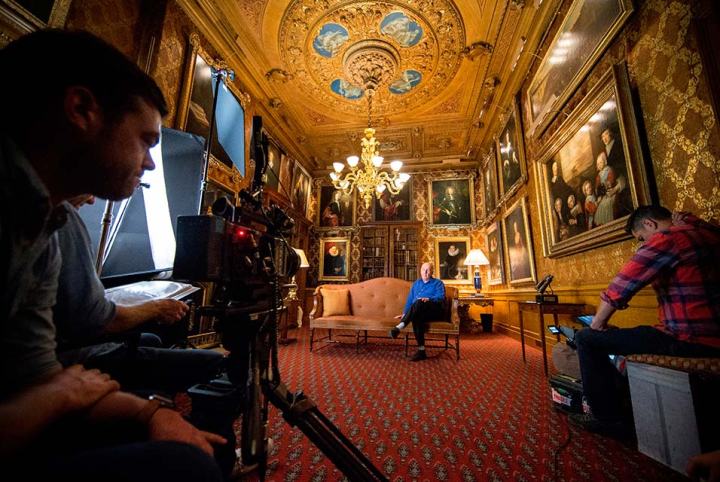
The 13-part series The Treasures of Chatsworth is currently in production and will debut in Autumn 2016
(Photo: Sotheby’s)
◊ ◊ ◊ ◊ ◊
Press release (5 August 2016) from Sotheby’s:
Sotheby’s announces the upcoming launch [scheduled for August 29] of an online destination to discover video content created by and about the world’s leading museums. The digital hub will be called Sotheby’s Museum Network, and it will be featured prominently on Sothebys.com as well as Sotheby’s Apple TV channel. The museums in this network will include internationally-renowned public institutions, such as The Metropolitan Museum of Art, Tate, and the National Palace Museum in Taiwan, as well as well as newer institutions founded by private collectors, including the Garage Museum of Contemporary Art in Moscow.
In addition to syndicating museums’ own content, the Sotheby’s Museum Network will be the home of original programming conceived and produced by Sotheby’s. The Treasures of Chatsworth, a 13-part series on one of Europe’s greatest private houses and most significant art collections, is currently in production and will debut this autumn. Further information will be shared in the coming months.
Recent years have seen the opening of numerous private museums by passionate patrons, as well as record attendance at major exhibitions worldwide, reflecting a seemingly insatiable public interest in great art and collections. Sotheby’s Museum Network will reach a global audience for whom museums and foundations are a new entry point into the world of art, as well as seasoned collectors and connoisseurs who look upon these institutions as the ultimate source of authority on art and culture. It will ultimately encompass thousands of existing museum videos, which have never before been aggregated into one channel, making it easier for people to discover what they love as well as introducing new audiences to the great work that these institutions are creating worldwide.
“We are thrilled to host the extraordinary videos produced by our museum partners around the world,” commented David Goodman, Executive Vice President, Digital Development & Marketing. “The Museum Network is a response to a growing global audience that wants to experience the world of art and collecting. The network is a natural evolution of the existing ties we have with museums through programs like Sotheby’s Preferred, and we can now deepen those relationships with institutions and their benefactors as we expose their outstanding collections to millions of art lovers who engage via digital channels. The Treasures of Chatsworth is the perfect way to launch our drive into original video content creation centered on the arts and will be the first of many original films that will reveal the wonder of art and collecting.”
New Book | Inside Venice
From Rizzoli:
Toto Bergamo Rossi, with a foreword by Diane Von Furstenberg and Peter Marino, an introduction by James Ivory, and photographs by Jean-François Jaussaud, Inside Venice: A Private View of the City’s Most Beautiful Interiors (New York: Rizzoli, 2016), 310 pages, ISBN: 978-0847848164, $60.
 The superb interiors of Venice are revealed in this lavishly photographed book, which is sure to appeal to Venice’s many admirers interested in the elegance and refinement of classical Old World interior design. The book is a luxurious presentation of the hidden architectural and interior design treasures of Venice, ranging from historical ninth-century buildings to contemporary renovations that blend old and new. Seventy-two properties, each photographed exclusively for the book, are profiled—mainly private apartments and palazzos, along with some churches, hotels, and other public spaces. Preservation expert Toto Bergamo Rossi selected each property for inclusion based on his detailed field knowledge gained over many years as director of the Venetian Heritage Foundation, whose mission is to safeguard Venetian cultural heritage as manifested in architecture, music, and fine art.
Exhibition | Art and Stories from Mughal India
Press release for the exhibition now on view at the CMA:
Art and Stories from Mughal India
The Cleveland Museum of Art, 31 July — 23 October 2016
Curated by Sonya Rhie Quintanilla

Women Enjoying the River at the Forest’s Edge, ca. 1765. Mughal, Murshidabad or Lucknow. Opaque watercolor and gold on paper; 33.1 × 24.9 cm (The Cleveland Museum of Art, 2013.351).
Art and Stories from Mughal India presents the story of the Mughals— and stories for the Mughals—in 100 exquisite paintings from the 1500s to 1800s. The exhibition and accompanying Mughal painting collection catalogue celebrate the Cleveland Museum of Art’s centennial with works drawn from the 2013 landmark acquisition of the Catherine Glynn Benkaim and Ralph Benkaim Collection of Deccan and Mughal paintings, many exhibited and published for the first time. Complementing the paintings are 39 objects including costume, textiles, jewelry, arms and armor, architectural elements and decorative arts, some on loan from other prominent institutions, such as the Asian Art Museum, San Francisco, the Brooklyn Museum and the Arthur M. Sackler Museum, Harvard University. These objects resonate with details in the paintings and bring the sumptuous material culture of the Mughal world to life.
“The Cleveland Museum of Art has long boasted a particularly fine holding of Indian art, and with the acquisition of the Benkaim collection of Mughal paintings, we are now fortunate to have an extraordinary representation of one of its most celebrated artistic traditions,” said William M. Griswold, Director. “This exhibition—beautifully curated and magnificently installed—vividly evokes the richness and cosmopolitanism of one of the world’s great empires.”
The Mughal Empire existed for more than 300 years, from 1526 until the advent of British colonial rule in 1858. It encompassed territory that included vast portions of the Indian subcontinent and Afghanistan. The Mughal rulers were Central Asian Muslims who assimilated many religious faiths under their administration. Famed for its distinctive architecture, including the Taj Mahal, the Mughal Empire is also renowned for its colorful and engaging paintings, many taking the form of scenes from narrative tales.
Art and Stories from Mughal India is organized into eight sections based on the Persian idea of the nama. Nama may be translated as any of a number of English words, among them: book, tale, adventure, story, account, life and memoir. Paintings were integral to the production of namas in book form for royal collections in Mughal India. Art and Stories from Mughal India sets the paintings, now long separated from their bound volumes, into their nama contexts. Four of the exhibition’s sections focus on a specific nama: a fable, a sacred biography, an epic, and a mystic romance. Many of the paintings, long celebrated for their vivid color, startling detail and alluring sense of realism, are displayed double-sided to show complete folios from albums and manuscripts, a constant reminder of their original status as part of a larger book or series.
“The paintings are products of a powerful, multiethnic dynasty of rulers who valued art and literature as essential elements of court life,” said Sonya Rhie Quintanilla, the George P. Bickford Curator of Indian and Southeast Asian Art. “They were made to inspire awe and delight, and this exhibition aims to do the same by making them accessible to audiences today.”
Sumptuously designed to evoke the spaces of Mughal palace interiors and verandas where paintings were kept and viewed, the exhibition opens with a 25-foot-long 16th-century floral arabesque carpet, rarely seen because of its scale. The first two galleries are devoted to Mughal paintings made for Akbar, the third Mughal emperor (r. 1556–1605), who saw to it that his copies of fables, adventures and histories were accompanied by ample numbers of paintings. On view are some of the earliest works from Akbar’s reign by celebrated artists, such as Basavana (Basawan) and Dasavanta (Daswanth), from the Tuti-nama (Tales of a Parrot), and the culminating scene from the Hamza-nama (Adventures of Hamza), 70 cm in height, one of the few surviving pages from this massive 1,400-folio project in which the Mughal style became thoroughly synthesized.
The next two galleries explore the relationship between Akbar and his oldest son, Salim, whose birth in 1569 was cause for great celebration. By 1600, Salim was ready to lead the empire and mutinously set up his own court where he brought paintings, artists and manuscripts from Akbar’s palace and commissioned new works, such as the illustrated Mir’at al-quds (Mirror of Holiness), a biography of Jesus written in Persian by a Spanish Jesuit priest at the Mughal court, completed in 1602. Like the Tutinama (Tales of a Parrot), the Mir’at al-quds manuscript is remarkable not only for its historical importance and artistic beauty, but because it survives nearly intact, though unbound, with few missing pages. Both manuscripts, crucial for the study of Mughal painting, are kept in the collection of the Cleveland Museum of Art, and most of their folios have never before been shown.
The story of the Mughals continues with works made for and collected by Emperor Jahangir—the name Prince Salim took after the death of Akbar in 1605—as well as his son Shah Jahan (r. 1627–58) and grandson Alamgir (r. 1658–1707). This period spanning the 17th century saw the production of some of the most exquisite paintings and objects ever made for the Mughals. Textiles, courtly arms, garments, jades, marble architectural elements and porcelains bring to life the painted depictions of the Mughal court’s refined splendor at the height of its wealth.
Concluding the exhibition is a large, dramatic gallery, painted black in keeping with depictions of the interiors of 18th-century Mughal palaces, with paintings framed in gold, hookah bowls, jewels, a vina, lush textiles and a shimmering millefleurs carpet. The assemblage celebrates the joy in Mughal art of the mid-1700s. The scenes predominantly take place in the world of women and the harem, where the emperor Muhammad Shah (r. 1719–48), who was largely responsible for the reinvigoration of imperial Mughal painting, grew up, sheltered by his powerful mother from the murderous intrigues that wracked the court after the death of Alamgir in 1707.
Throughout the exhibition viewers will note the international character of Mughal art and culture. Flourishing during the Age of Expansion between the 1500s and 1700s, Mughal India was the source for goods and natural resources coveted throughout the Western world, and visitors to the exhibition will encounter the origins of familiar aspects of current daily life in the works of art on view.
To complement Art and Stories from Mughal India, the Cleveland Museum of Art has developed a free, innovative CMA Mughal exhibition app, in which the exhibition’s curator, Sonya Rhie Quintanilla, relates stories and describes paintings. The app includes hyperlinks to an audio glossary of names and terms, and 100 tweetable facts illustrated with a related detail image from the 100 paintings on view. CMA Mughal—available now for download from the iTunes Store for Apple devices running iOS9 and above—is the first in a series of exhibition apps that will be available for use after the exhibition ends.
◊ ◊ ◊ ◊ ◊
From D. Giles, Ltd:
Sonya Rhie Quintanilla with Dominique DeLuca and essays by Mohsen Ashtiany, Marcus Fraser, Catherine Glynn, Ruby Lal, and Pedro Moura Carvalho, Mughal Paintings: Art and Stories, The Cleveland Museum of Art (London: Giles, 2016), 368 pages, ISBN: 978-1907804892, £50 / 70.
 The mighty Persian warrior Rustam; the Israelite prophets; the Christian Messiah; the Mughal emperors; and the women of the harem—Mughal paintings tell the stories of these figures from epic poetry, holy texts, and the history of the Mughals, one of the greatest empires of the early modern period. Captured in this unique art form, Mughal paintings blend Persian and Indian themes and styles, along with Central Asian and European elements. The results are works of great beauty: intense and delicate, detailed and luxurious, with a distinctive character of their own.
The Cleveland Museum of Art holds one of the leading collections of Indian art in the United States, illustrated here in stunning detail. The provenance, publication history, and technical information of each manuscript painting is also accompanied by full transcriptions of Persian and Arabic calligraphy. This, the third volume in a series dedicated to the Cleveland Museum’s special conservation collections, casts new light on these stunning paintings.
Sonya Rhie Quintanilla is the George P. Bickford Curator of Indian and Southeast Asian Art at The Cleveland Museum of Art. Mohsen Ashtiany is is currently a research scholar and editor on the Encyclopaedia Iranica at the Center for Iranian Studies of Columbia University. Marcus Fraser is is an independent scholar, cataloguer, curator, and specialist consultant in Islamic and Indian manuscripts and painting. Catherine Glynn served from 1970 to 1980 as assistant and associate curator of Indian and Islamic art at the Los Angeles County Museum of Art. Pedro Moura Carvalho has served as deputy director, Art and Programs, at the Asian Art Museum, San Francisco, before which he was the deputy director and chief curator of the Asian Civilisations Museum and the Peranakan Museum in Singapore. Ruby Lal is professor of South Asian Studies in the Department of Middle Eastern and South Asian Studies at Emory University, Atlanta.










 Enfilade
leave a comment