V&A Named ‘Art Fund Museum of the Year’ for 2016
From The Art Fund:

The southern entrance of the Victoria and Albert Museum in London (Photo by David Iliff, 24 March 2014, Wikimedia Commons)
On Wednesday evening [6 July], the Victoria and Albert Museum was announced as the £100,000 winner of the Art Fund Museum of the Year 2016 by HRH The Duchess of Cambridge at a dinner and ceremony at London’s Natural History Museum.
Stephen Deuchar, Art Fund director and chair of the judges, said: “The V&A experience is an unforgettable one. Its recent exhibitions, from Alexander McQueen to The Fabric of India, and the opening of its new Europe 1600–1815 galleries, were all exceptional accomplishments—at once entertaining and challenging, rooted in contemporary scholarship and designed to reach and affect the lives of a large and diverse national audience. It was already one of the best-loved museums in the country: this year it has indisputably become one of the best museums in the world.”
The winner was chosen from five remarkable finalists, including Arnolfini (Bristol), Bethlem Museum of the Mind (London), Jupiter Artland (West Lothian), and York Art Gallery (Yorkshire). Art Fund awards the Museum of the Year prize annually to one outstanding museum, which, in the opinion of the judges, has shown exceptional imagination, innovation and achievement across the previous twelve months. It is the biggest museum prize in the world and the largest arts award in Britain.
2015 saw a remarkable transformation for the V&A. It attracted nearly 3.9 million visitors to its sites, 14.5 million visitors online and 90,000 V&A members, the highest in the museum’s 164-year history. December 2015 saw the Europe 1600–1815 galleries opening to great acclaim. 2015 also heralded one of their most popular exhibition programmes. Alexander McQueen: Savage Beauty became the V&A’s most-visited exhibition, attracting a record breaking 493,043 visitors from 87 countries, while the India Festival of exhibitions engaged visitors in the rich and varied culture of South Asia. Also, a major fundraising appeal reunited four angels originally created for the tomb of Cardinal Wolsey, one of the most powerful men in Tudor England.
Martin Roth, director of the V&A, said: “We are truly honoured to be awarded the Art Fund Museum of the Year 2016. It is fantastic to be recognised for our many achievements last year, from the Europe 1600–1815 Galleries—the £12.5m project which completed the restoration of the entire front section of the museum—to the cutting edge public programme, headlined of course by the record-breaking Alexander McQueen: Savage Beauty exhibition. Winning this award is a perfect way to thank everyone who has made these successes possible: our staff, visitors, funders, and our many partners and colleagues across organisations around the world. I would like to thank the judges for acknowledging the V&A during this truly exciting period of our growth, and I congratulate all the other shortlisted museums who so ably demonstrate the richness and variety of the UK’s unique arts and culture scene. The V&A is thriving as a world-class museum and centre of excellence for research and expertise. This award not only allows us to celebrate our achievements over the past year, but it will progress our ambitions to continue to transform our building and make our unparalleled collections of art and design accessible to the widest possible audiences in the UK and overseas. With this prize we plan to revive the Museum’s legendary Circulation department, which collected and shared the best of contemporary design with regional museums, galleries and art colleges, but which closed in 1976. We will ‘re-circulate’ our collections, taking them beyond our usual metropolitan partners and engaging in a more intimate way with the communities we reach so that we can continue to deliver on our ambition to be both a national museum for a local audience and a local museum for a national audience.”
Among the 370 guests at the ceremony were artists Antony Gormley, Grayson Perry, Michael Craig-Martin, Cornelia Parker, Mat Collishaw, Gavin Turk and Yinka Shonibare; museum directors Nicholas Cullinan, (National Portrait Gallery), Sir Nicholas Serota (Tate); Martin Roth (V&A); Sir Michael Dixon (Natural History Museum); Charles Saumarez-Smith (Royal Academy of Arts); Axel Rüger (Van Gogh Museum, Amsterdam); and Ed Vaizey, Minister of State for Culture, Communications & Creative Industries.
The judges for Museum of the Year 2016 were Gus Casely-Hayford, curator and art historian; Will Gompertz, BBC Arts editor; Ludmilla Jordanova, professor of History and Visual Culture, Durham University; Cornelia Parker, artist; and Stephen Deuchar (chair of the panel), director, Art Fund.
Call for Papers | ASECS 2017, Minneapolis
2017 American Society for Eighteenth-Century Studies Conference
Hyatt Regency Minneapolis, 30 March — 2 April 2017
Proposals due by 15 September 2016
Proposals for papers at the at the 48th annual meeting of the American Society for Eighteenth-Century Studies, at the Hyatt Regency Minneapolis, are now being accepted. Proposals should be sent directly to the session chairs no later than 15 September 2016. Along with our annual luncheon and business meeting, HECAA will be represented with the Anne Schroder New Scholars’ Session, chaired by Jessica Fripp. A selection of other sessions that might be relevant for HECAA members is also included below. A full list of panels is available as a PDF file here»
◊ ◊ ◊ ◊ ◊
Anne Schroder New Scholars’ Session (HECAA)
Jessica Fripp (Texas Christian University), j.fripp@tcu.edu
Named in honor of Anne Schroder (1954–2010), this open session is intended for advanced graduate students and early career scholars in the art and architectural history of the eighteenth century.
◊ ◊ ◊ ◊ ◊
Strawberry Hill and Other Queer Spaces
George Haggerty (University of California, Riverside), George.haggerty@ucr.edu
This session, in honor of Horace Walpole’s 300th anniversary, will consider Strawberry Hill as the quintessential queer space of the eighteenth-century and will look at other queer spaces too.
◊ ◊ ◊ ◊ ◊
The Eighteenth Century on Film
John H. O’Neill (Hamilton College), joneill@hamilton.edu
This session welcomes and encourages proposals for papers on any aspect of its topic, including—but not limited to—film and television adaptations of eighteenth century narratives (e.g., The Castaway, Tom Jones), films set in the period (e.g., Stage Beauty, Amazing Grace), and film explorations of eighteenth-century history or biography (e.g., Peter Watkins’s Culloden, Sofia Coppola’s Marie Antoinette). Proposals for discussions of adaptation theory as it applies to eighteenth-century works are also welcome.
◊ ◊ ◊ ◊ ◊
Amateurism in the Eighteenth Century
Lindsay Dunn (Texas Christian University) and Franny Brock (University of North Carolina at Chapel Hill), l.m.dunn@tcu.edu and mfbrock@live.unc.edu
Non-professional activity flourished in artistic, literary, and scientific circles of the eighteenth century due, in part, to economic prosperity of the upper classes, new forms of sociability, dissemination of previously privileged information, and an Enlightenment interest in the organization of knowledge. In turn, the amateur significantly impacted this period not only by expanding the contexts in which cultural products were made, circulated, and consumed, but also by challenging the very definitions and boundaries of these contexts. Until recently, amateur practice was considered inferior because amateurs often copied or imitated the work of others and usually did not earn money for their work, freeing them from the constraints of the market economy. This panel seeks papers that modify these views by exploring the contributions and working conditions of amateurs. We invite proposals from a range of fields, including art history, history, literary and music history, and others, to reconsider the position of non-professionals during this period. Possible topics may include the status of the amateur, training the amateur, the amateur’s direct influence as a purveyor of taste, the circulation of ideas through the work of amateurs, and how amateur practice influenced and shaped relationships between professional and non-professional groups.
◊ ◊ ◊ ◊ ◊
Art Markets: Agents, Dealers, Auctions, Collectors
Wendy Wassyng Roworth (University of Rhode Island), wroworth@uri.edu
During the eighteenth and early nineteenth centuries numerous artworks were removed and sold from churches, monasteries, palaces, and private collections. Paintings, sculptures, drawings, and antiquities were purchased by Grand Tourists in Italy, and many were sold, confiscated, or lost as a result of political and social upheavals throughout Europe, especially in the aftermath of the French Revolution and Napoleonic wars. Travel and trade in Asia and America brought new types and styles of art and artifacts to markets in London, Paris, Amsterdam and elsewhere and stimulated taste for the exotic. This session seeks papers on the roles played by art dealers, auction houses, private sales, collectors, the movement of artworks from private to public or public to private collections as well as other aspects of the art market and effects on contemporary artists.
◊ ◊ ◊ ◊ ◊
Illustrating the Ilustración/Iluminismo: Visual Culture and Transnational Enlightenment in Iberia and Ibero-America
Nicholas Wolters (Wake Forest University), naw5fq@virginia.edu
Around 1765, Bohemian artist Anton Raphael Mengs painted a now iconic portrait of King Charles III of Spain. During his tenure as Charles III’s court painter, Mengs was also the author of celebrated frescoes in the Royal Palace in Madrid that eventually would become emblematic of Spanish monarchical splendor in the second half of the eighteenth century, influencing artists from Alcázar y Paret to Goya. Though the so-called Age of Enlightenment is often associated with the consolidation of national borders under the hand of absolute monarchs, transnational art and visual cultures more broadly flourished during this period and reflect evolving patterns of consumption and aesthetic taste that both transcended and shaped national identity. How was the Enlightenment visualized in Iberia and Ibero-America, and what did visual mediums—painting, sculpture, fashion, illustrations—contribute to global and local contours of reason and sensibility? To work towards answering this and related questions, this panel invites papers that engage visual cultures in eighteenth-century Iberia and Ibero-America with a focus on issues related to transnational aesthetics, consumer culture, modernity, modes of production, and dissemination. Papers exploring the intersections of the visual with nationalism, new technologies, advertising and the marketplace, and identity politics are particularly welcome.
◊ ◊ ◊ ◊ ◊
Aesthetics of the Urban
Alison O’Byrne (University of York), alison.obyrne@york.ac.uk
This panel seeks to explore how cities were described and represented in the eighteenth century. What kinds of aesthetic categories were invoked—or reworked—to describe particular cities, or particular occurrences in cities? Did / how did aesthetic categories associated with landscape and natural phenomena (such as the sublime and the picturesque) translate to the urban built environment? Are there new categories and new terminologies to describe the city in the eighteenth century? Topics might include natural disaster in the city, accounts of crowds, descriptions of improvement and decline, and any other topics addressing these questions.
◊ ◊ ◊ ◊ ◊
Empire and the Antique in Art and Design
Jocelyn Anderson (Courtauld Institute of Art) and Holly Shaffer (Dartmouth College), jocelynkristen@hotmail.com and hollyshaffer@gmail.com
In the second half of the eighteenth century, the influence of classical antiquity on European art and design was tremendous, shaping everything from monumental architecture to linear engravings to the collection of decorative objects for the home. Frequently associated with aristocratic connoisseurship and the Grand Tour, this enthusiasm also had an important global dimension: as European powers built their own empires, classical antiquity was a critical reference point, a model, a historical lesson, and a pantheistic comparison. In this panel, we seek to examine the connections between European interest in Ancient Rome and Greece, and the material culture of imperial projects of the long eighteenth century. Possible topics might include the use of the Neoclassical style for colonial building projects, the outline style used in publications, classical antiquity as a frame of reference for the interpretation of indigenous cultures, imperial leaders’ taste for the antique for self-fashioning in the metropole, explicit classical references in images of colonial territories, imperialist approaches to classical sites, or the adoption of the antique-inspired style by artists based in colonial territories.
◊ ◊ ◊ ◊ ◊
1680–1715: A Crisis of the European Mind?
Aaron Wile (Harvard University), awile@fas.harvard.edu
In his seminal work, La crise de la conscience européenne, 1680–1715 (1935), Paul Hazard identified at the end of the seventeenth and beginning of the eighteenth centuries a profound crisis of the European mind. In short order, the foundations of the classical order were destabilized and the modern outlook of the Enlightenment emerged. Revisited by generations of scholars, the ‘Hazard thesis’ has proven remarkably resilient, yet the exact nature of the crisis remains in debate. This panel seeks to reevaluate the sources, effects, and extent of the crisis. Proposal from all disciplines are welcome and interdisciplinary perspectives, especially those that challenge or go beyond the idealism of Hazard’s history of ideas, are particularly encouraged. Topics that engage with Hazard’s thesis but are outside the strict confines of his chronology are also welcome.
◊ ◊ ◊ ◊ ◊
Women of Power and the Power of Women: Rethinking Female Agency in Honor of Maria Theresa
Rita Krueger (Temple University), rita.krueger@temple.edu
This panel invites papers that explore aspects of female power and rulership in households, cities, and courts from a variety of disciplines, as a way to commemorate the 300th year anniversary of Austrian Empress Maria Theresa’s birth in 1717. Maria Theresa was self-consciously and uncomfortably aware of the at times contradictory nature of her place in history. She had one foot in the baroque and the other in reformed governance. She gestured to the intimacy of the bourgeois family and to the splendor of dynastic pretensions. She lauded the submission of wives even as she dominated her family and her state. She was king and empress, mother and powerbroker. This panel honors that complicated legacy by bringing together new research on female power and agency from different disciplinary approaches and within varied social and spatial contexts. Papers that explore women’s negotiation of new social and political terrains; women performing unexpected social or economic roles; women who transcended their apparent inherited places; women who, Janus-like embraced multiple, at times contradictory agendas; women who said one thing and did another would be welcome. Papers are not limited to Central Europe—nor was Maria Theresa.
◊ ◊ ◊ ◊ ◊
Visualizing Weimar
Amelia Rauser (Franklin & Marshall College), arauser@fandm.edu
Weimar’s role as a cultural center and incubator of innovative Classicism has been richly explored by scholars of literature and philosophy who have mined the outstanding contributions of Goethe, Herder, and Schiller, among others. But the visual culture of Weimar has received relatively little scholarly attention, despite the importance these thinkers attached to visual art and the devotion of many famed Classicists to drawing, painting, and collecting. This panel invites papers that investigate the visual culture of eighteenth-century Weimar. Topics might include the patronage of Anna Amalia or Carl August, the collections of Goethe, the aesthetic theories of Herder, the painting of Tischbein or Georg Melchior Kraus, the founding of institutions like the Free Academy of Drawing in 1776, the design of architectural programs or decorations, or the path- breaking Journal des Luxus und der Moden. Much of Weimar’s visual culture was fueled by strong connections to other centers through travel, study, publication, and collecting, so other topics might include the relationship between Weimar and Naples or Rome, or counter-examples of the visual cultures of other princely European centers.
◊ ◊ ◊ ◊ ◊
Material Culture, Then and Now
Beth Fowkes Tobin (University of Georgia) and Chloe Wigston Smith (University of York), btobin@uga.edu and chloe.wigstonsmith@york.ac.uk
We invite papers that expand current approaches to material culture and develop new methods to address the materiality of objects. We are interested in how period treatments of objects and scholarly methods have shaped our understanding of eighteenth-century objects and their meanings. How do we read material culture ‘now’? Are there methodologies that build on object-oriented ontology and new materialisms, but refocus our attention on the materiality of things? Are objects always entangled with the human? How do they function separately from subjectivity? We are interested as well in the historical conditions of collecting and the physical conditions of extant objects. How have the historical treatments of objects (‘then’) affected current methodologies? What roles have museum collections, and the histories of acquisition, played in our methodologies (in relation to class and other concerns)? We welcome papers in particular that offer feminist, queer and/or postcolonial interpretations of material culture, as well as interdisciplinary approaches and submissions from colleagues in literary studies, archeology, art history, dress history and history. Please send abstracts of no more than 500 words and a very brief biography to both organizers.
◊ ◊ ◊ ◊ ◊
Home Subjects: Art and/in the Private House in the Eighteenth Century
Melinda McCurdy (The Huntington Library) and Anne Nellis Richter (American University), mmccurdy@huntington.org and anne.nellis@gmail.com
Eighteenth-century houses and interiors have become the focus of tremendous academic energy during the past five years. This topic has a particular resonance in the British context, as the eighteenth century saw the notion of the house as an iconic symbol of political and moral authority developing into a remarkably persistent cultural ideal; at the same time, this formulation may be unsettled by similar trends in other countries or colonial contexts. This session will explore the development of these ideas by considering the relationships between domesticity, the display of art and other objects in the private interior, and national or personal identity. We welcome proposals that explore such topics as the commissioning, and/or reception of artworks intended for private display, literary or theoretical thinking about the role of art and design in the private interior, the relationship between ‘decorative’ painting and easel painting, the uses and reception of decoration and painting in rooms and interiors, and the relationship between private and public modes of display and decoration. This panel will be convened by Home Subjects, an ongoing research working group focused on the display of art in the private sphere; please visit http://www.homesubjects.org for details.
◊ ◊ ◊ ◊ ◊
Is Improvement a Useful Concept?
Rachael Scarborough King (UC Santa Barbara), rking@english.ucsb.edu
‘Improvement’ was an Enlightenment buzzword, consolidating in the second half of the eighteenth century as a means to describe key cultural concerns from landscape gardening and the conversion of wasteland to new modes of education and the rise of the novel (in the debate over what constituted ‘improving’ literature). But does improvement maintain its intellectual purchase to assist us in understanding the changes in the organization of knowledge, relationship to the environment, and understandings of the self that took place in the eighteenth century? Or is it too vague, triumphalist, and/or progressivist to offer a useful framework? And are ‘material’ improvement, in the natural or built environment, and ‘intellectual’ improvement, in literature or the individual, aspects of the same concept? This panel invites papers that take improvement as both/either a grand organizing narrative and/or a specific set of material and intellectual practices, and that ask whether this term should remain—or return to being—a central rubric in the study of eighteenth-century literature and culture.
◊ ◊ ◊ ◊ ◊
Clothing as Visual Language
Kristin O’Rourke (Dartmouth College), kristin.o’rourke@dartmouth.edu
European clothing styles changed dramatically over the course of the eighteenth century, as did their depiction in the arts of the time. While the nervous draperies of late seventeenth-early eighteenth century portraits lend a dynamism and power to the elite subject, the mid-century emphasis on up-to-the-minute fashion and the meticulous representation of fabric and cuts bring a sense of realism to both the glittering upper-class world and lower domestic sphere. By contrast, the later eighteenth century classical revival meant, on the whole, a more abstracted perception of clothing in art as covering or draping the idealized, timeless body, rather than rendering it contemporary and tactile. Can we read clothing in the arts as an expressive language that offers clues as to the power of dress in conveying messages related to social and economic status, craft, fashion, trade, and so forth? Building upon recent work by social, cultural, and art historians on the construction, utility, appropriation, and circulation of clothing as material object and as artisanal product, I seek interdisciplinary papers that explore the multiple meanings of clothing in the visual arts and the connection to ‘real’ clothing. I welcome papers on all aspects of clothing and in all artistic media.
◊ ◊ ◊ ◊ ◊
Material Girls
Jennifer Germann (Ithaca College), jgermann@ithaca.edu
Women and girls up and down the social ladder bought, sold, made, and used things. What can we say about their lived experience in relation to their property and production? This panel invites papers about women’s relationship to material goods, property ownership, or productive and/or creative labor. How does the relationship between women and girls and their things either support or undermine normative ideas about gender, sexuality, or other facets of identity? Interdisciplinary and global topics welcomed from the broad span of the long eighteenth century.
◊ ◊ ◊ ◊ ◊
‘Home is Where the Start is’: Interrogating Eighteenth-Century Domesticity
Karen Lipsedge (Kingston University), K.Lipsedge@Kingston.ac.uk
For many scholars, the eighteenth century was the time when modern domesticity was invented. Developments in domestic architecture, material culture and concepts of self, contributed to the evolution of a concept of the home that was spatially and ideologically distinct from other architectural spaces. Scholars from Leonore Davidoff and Catherine Hall to Amanda Vickery and Cynthia Wall have explored eighteenth-century domesticity from the perspectives of social class, material culture, the rhetoric of description, and gender. More recently, the role of men and the domestic servant, as well as the concept of domestic patriarchy, have also been placed under scrutiny. As the lens through which we view eighteenth-century domesticity becomes broader, now seems to be an appropriate time to take stock: to interrogate what we do and what we do not mean by eighteenth-century domesticity. I invite papers exploring eighteenth-century domesticity from a range of perspectives, including domestic architecture, parenthood, religion, family life and anthropology, as well as social and political history, popular culture, and landscape and garden design.
◊ ◊ ◊ ◊ ◊
Small Courts
Jennifer Germann (Ithaca College), jgermann@ithaca.edu
Small courts offer an opportunity to consider art, literature, music, as well as the political structures that developed and flourished in circumstances distinct from the better known examples of the Bourbons and Habsburgs. This panel invites papers that consider small courts and their cultural production in a variety forms. Questions that papers might consider: What kinds of novel or conventional representations did small courts produce of themselves for consumption both within and outside of these courts? Did small courts offer novel or distinct gendered configurations? How did artists, musicians, and writers assimilate bourgeoisie culture into court culture? Papers welcome from all disciplines and cultural contexts.
◊ ◊ ◊ ◊ ◊
Cities and Disasters
Cindy Ermus (University of Lethbridge), cindy.ermus@uleth.ca
Today, more than half the global population lives in cities, and as urban centers continue to expand, the dangers posed by disasters and the effects of climate change in highly populated areas will become increasingly acute. It is important then to study the ways in which past societies have managed the prevention and effects of disasters, as well as the short and long-term ramifications of these responses. This panel will explore the ways in which eighteenth-century cities experienced, managed, and were shaped by ‘natural’ or man-made disasters, including earthquakes, famine, fire, disease, hurricanes/typhoons, etc. For example: How did eighteenth-century cities respond to disaster, and how did these responses help shape the urban, political, or cultural landscape of affected areas? How linked or divorced were local responses from the centralizing state? How did a specific catastrophe help shape understandings of disaster causation, and/or of vulnerability and resilience? What can we learn from studying responses to disasters in the past? Papers may address these and/or other questions. My own work looks at responses to the 1720 Plague of Provence in some of Europe’s most active port cities, including Cádiz, Lisbon, and London, but I welcome papers on all geographic regions.
◊ ◊ ◊ ◊ ◊
Strolling in the Garden: Performance and Material Culture in Semi-Natural Spaces
Shawn Watkins (Duquesne University) and Sarah Hancock (Carnegie Mellon University), watkinss@duq.edu and sarahh1@andrew.cmu.edu
This panel seeks presentations that explore the intersection between material culture, performance, and semi- natural spaces, such as parks and gardens. Possible questions for exploration include, but are not limited to: how do semi-natural spaces inform eighteenth-century notions of sociability and performance in terms of race, class, and gender? What plants, architectural features, clothing, and/or accessories characterize semi-natural spaces? How are these objects used, re-used, or misused in these spaces in order to perform, complicate, and/or reinforce notions of national, ethnic, or gendered identity? How is the physical layout of semi-natural spaces influenced, shaped, and implicit in movement and performance within these spaces? What relationships exist between these semi-natural spaces and other spaces, such as the theater or the country estate? We invite papers that consider all genres of eighteenth-century texts—literary or otherwise—and scholarship that addresses eighteenth-century material culture and performance from all disciplines.
◊ ◊ ◊ ◊ ◊
Color in Eighteenth-Century Architecture
Basile Baudez, Université Paris-Sorbonne, Paris IV), basile.baudez@gmail.com
Although associated with baroque exuberance born after the Counter Reformation movement or the nineteenth-century rediscovery of polychromy in Greek architecture, color was far from absent from eighteenth-century architecture—even if critics like Quatremère de Quincy, or draftsmen like Boullée, favored monochromy on built structures and their representation. At a moment when color was invading every aspect of daily life, when artists and printers were developing new ways to diffuse color reproductions, when authors from Roger de Piles to Goethe were revalorizing the evocative and sensualist effectiveness of color, how did architects respond to this pressure, both in their drawings and buildings? The geographic breath of this session is left deliberately open, but proposals should be unified by their close attention to the complex and paradoxical relationship between theory and practical use of color in architecture in the eighteenth-century. Key issues will include comparisons of attitudes towards color in different national traditions, the decision to hide or reveal colored materials, the place of color in architectural definitions of beauty or connotations of color within typologies, spaces or specific periods.
◊ ◊ ◊ ◊ ◊
Textual and Visual Representations of Nature and Landscape Architecture (Roundtable)
Chunjie Zhang and Alessa Johns (University of California Davis), chjzhang@ucdavis.edu and amjohns@ucdavis.edu
This session seeks presentations that deal with the dynamics between textual and visual representations of nature or landscape architecture (gardens and parks) in and outside of Europe in the long eighteenth century. The written description of nature became an important scientific method for the project of Natural History and was practiced diligently by naturalists on European world expeditions. At the same time, visual images imported from non-European cultures (China, Oceania, or India) informed and inspired European and early American writers and artists to textually imagine and visually design different landscapes in novels, treatises, paintings, and actual garden and architectural designs. Nature also became the site where liberal and conservative political visions competed in the garden revolution in England and Germany. The roundtable seeks presentations on, but not limited to, the differences or similarities between textual and visual representations and their mutual influences in British, German, French, Italian, or American contexts.
◊ ◊ ◊ ◊ ◊
Illustrating Nature from the Margins
Craig Ashley Hanson (Calvin College), CraigAshleyHanson@gmail.com
This panel aims to explore marginalized or understudied aspects of scientific illustration, particularly prints and drawings that were important for the study of nature in the eighteenth century but haven’t received their due in the often heroically ‘Whiggish’ accounts of the history of science. Papers might consider practitioners—‘nonprofessionals’, women, provincial or indigenous individuals—whose contributions were given little credit by contemporaries or historians. Talks might also focus on previously overlooked geographic regions or fields of knowledge. Especially welcome are presentations that advance close readings of scientific illustrations in regard to subject matter and the social circumstances of their production. Examination of concerns related to historiography, methodology, the history of scientific collections, and reception histories are also encouraged.
◊ ◊ ◊ ◊ ◊
On the Walls: Painting in Eighteenth-Century Europe
William W. Clark (Queens College and The Graduate Center CUNY), wwclark@comcast.net
In her book, Hanging the Head, Marcia Pointon states “that the ordering of imagery in particular spaces and settings produces meanings specific to those times and places,” and she adds, “it is …the case that objects like paintings which symbolize the ownership of a particular class or institution, enshrine the sense of identity of that group….” Papers for this panel may treat paintings executed for (installed in) royal palaces, aristocratic residences, and other domestic sites as well as public institutions including religious, judicial, civic, and military establishments. They might focus on special iconographic programs for certain sites or on particular rooms such as salons, libraries, drawings rooms, portrait galleries, dining rooms where the display might provide additional levels of meaning. What social identity is described by these paintings? What virtues are valorized by these works? How does the combination of certain paintings add luster to a family or an institution? Interdisciplinary topics are equally welcome.
◊ ◊ ◊ ◊ ◊
The Art of Watercolor
Julia Sienkewicz (Duquesne University), julia.a.sienkewicz@gmail.com
In recent years, the medium of watercolor has garnered new critical attention, particularly for its rise and global dissemination toward the end of the eighteenth-century. Quick and portable, watercolor offered the means to capture the world, whether on picturesque tour of Britain, an expedition in Africa, or in a Philadelphia garden. The facile medium has brought new attention to amateur artistic practice and to scientific subject matter. Significant in multiple national contexts, the medium has also been tied to ideological content—especially in Britain where the rise of translucent watercolor has been closely tied to nationalism. This session seeks to continue the scholarly discussion about the importance of this medium by bringing together new scholarship about watercolor in the eighteenth century. Papers are sought that consider work from all corners of the globe, by professional or ‘amateur’ artists, and with any subject matter. Of special interest will be any work that expands our understanding of the ways in which artists (in the broadest possible understanding of this term) employed the medium in experimental and intellectually-critical ways.
◊ ◊ ◊ ◊ ◊
Anything Goes? From the Sister Arts to Media Studies
Timothy Erwin (University of Nevada, Las Vegas), timothy.erwin@unlv.edu
The last couple of decades have seen a paradigm shift in the way we talk about literature and the visual arts. The field once called literary pictorialism is now more often called media studies or visual culture. Studies of image and text today are often framed in language either borrowed from film criticism ( ‘movement image’ and ‘gaze’) and narratology (‘focalization’ and ‘diegesis’) or else cobbled together from scratch (‘imagetext’ and ‘iconotext’). What makes for a useful lexicon in a time when adaptation tends to collapse the distinction between still and moving images? How can we make old terms more serviceable, and how should we be using the new? How do we describe our interdisciplinary practices, and determine our interartistic values? Even though no hard and fast answers may be found for questions like these, I invite papers alert to the problematics of talking about texts and images.
◊ ◊ ◊ ◊ ◊
Laocoön’s Legacy: Testing Out the Limits of Aesthetic Representation
Anne Pollok (University of South Carolina), apollok@sc.edu
In 1766, Gotthold Ephraim Lessing published Laocoön: On the Limits of Painting and Poetry, which remained at the fulcrum of debate about the unity of the beautiful and the respective differences among the arts (literature, music, sculpture and painting). At different times, different aspects of Lessing’s work were highlighted for debate—all of which engage in fundamental ways with central issues of aesthetics and theories of art. One of these concerns the specific grammars in the different genres of art and how the composition of the artwork evokes admiration or empathetic participation. Another aspect foregrounds the relation between the objective structure of a work of art and the subjective work of the beholder’s imagination, a third engages the thesis of the media-specificity of art and associated formalist calls for aesthetic purity. In this session, I aim to reflect on these three areas as discussed by Lessing’s contemporaries, may those be his friends and adversaries, his inspiration or subject to his scorn. Major figures include (but are not limited to) Mendelssohn, Herder, Goethe, Harris, Diderot, or Dubos. Instead of trying to capture the full breadth of Lessing’s masterpiece, papers with a concentration on either of the aforementioned areas are preferred.
◊ ◊ ◊ ◊ ◊
Rococo Queens
Melissa Hyde (University of Florida), mlhyde@ymail.com
Recognizing that the Rococo is not a stable idea or category, this session invites papers that consider how two ‘constants’ (femininity and women) nonetheless have attended Rococo art since the eighteenth-century and in the discourse on it ever since. Papers might approach the topic from the point of view of ‘Rococo Queens’ (whether literal or figurative) as patrons and collectors, as arbiters of taste for the Rococo. But also welcome are papers that consider (or interrogate) conceptions and definitions of the Rococo itself, or its afterlives in relation to questions of gender, and queenship.
◊ ◊ ◊ ◊ ◊
Innovative Course Design Competition
ASECS@wfu.edu
ASECS invites proposals for a new approach to teaching a unit within a course on the eighteenth century, covering perhaps one to four weeks of instruction, or for an entire new course. For example, participants may offer a new approach to a specific work or theme, a comparison of two related works from different fields (music and history, art and theology), an interdisciplinary approach to a particular social or historical event, new uses of instructional technology (e.g., web sites, internet resources and activities), or a new course that has never been taught or has been taught only very recently for the first time. Participants are encouraged to include why books and topics were selected and how they worked. Applicants should submit 5 copies of a 3- to 5-page proposal (double-spaced) and should focus sharply on the leading ideas distinguishing the unit to be developed. Where relevant, a syllabus draft of the course should also be provided. Only submissions by ASECS members will be accepted. A $500 award will be presented to each of the participants, and they will be invited to submit a twelve-page account of the unit or course, with a syllabus or other supplementary materials, for publication on the website.
◊ ◊ ◊ ◊ ◊
Made Up in the Eighteenth Century: Makeup, Accessories, Fashion, and Hair (Graduate Student Caucus)
Mallory Anne Porch (Auburn University), map0030@auburn.edu
This panel seeks to explore any and all aspects of what it meant to be ‘made up’ in the eighteenth century. Essays on makeup, accessories, fashion, hair, and any other related areas are welcome.
◊ ◊ ◊ ◊ ◊
Getting on a Panel: Tips, Tricks, and Knowing When It’s Already Full (Graduate Student Caucus)
Mallory Anne Porch (Auburn University), map0030@auburn.edu
This roundtable invites all those willing to share and discuss their experiences with conference panels.
◊ ◊ ◊ ◊ ◊
Beauty, Fashion and Taste … According to Women (Italian Studies Caucus)
Catherine Sama (University of Rhode Island), csama@uri.edu
How did women’s participation in the eighteenth-century debate about their place and purpose in society influence contemporary notions of female beauty and fashion? How did it help shape the question of taste, so central to the century’s formulation of aesthetics? Was Beauty as important to women as it appeared to be to men—who tended to consider it a principal female attribute—although they, too, were subject to the dictates of fashion as much as at any time in history? Possible areas of focus:
• The influence of fashion periodicals on notions of performance, gender and class;
• The role of eighteenth-century Italian female writers, artists and scientists in changing the terms by which beauty, fashion, taste, and women themselves were defined;
• The influence of Grand Tourism on questions of fashion, beauty, taste, and views of Italian women.
This session invites contributions that explore and/or address these issues and related questions.
◊ ◊ ◊ ◊ ◊
Gendered Materialities (Women’s Caucus)
Hannah Wirta Kinney (University of Oxford) and Rivka Swenson (Virginia Commonwealth University), Hannah.Kinney@history.ox.ac.uk and rswenson@vcu.edu
This multi-disciplinary session explores the ways objects and their modes of production were or became gendered in the long eighteenth century (geography open). Our definition of materiality embraces multiple disciplinary definitions and approaches, including (but not limited to) art history and literature/book history (process of making, artistic media, and multi-modal sensory engagement). The session goal is not only to identify materialities with gendered associations, but also to scrutinize the process of gendering. What value structures contributed to the formation of those associations? Were they aesthetic, sensory, economic, political, social, scientific? Were they influenced by where the object was made, used, or displayed? How did media or processes of making effect the gendered associations of a finished object? Did the language that gendered these materialities develop in public debates, within texts (either academic or popular), or through their circulation on the market? How did these materialities reinforce gendered boundaries? In what cases could materialities allow makers, owners, and users to transgress gender boundaries? Presenters will give 8- to 10-minute papers. The session will conclude with a group discussion that incorporates the attendees, focused on demarcating how the material worlds of eighteenth-century people intersected with ideas of gender. Send 250-word abstracts to co-chairs.
Exhibition | The White Dress
Press release (25 May) from the NGC:
Masterpiece in Focus: The White Dress
National Gallery of Canada, Ottawa, 27 May — 25 September 2016
Curated by Erika Dolphin
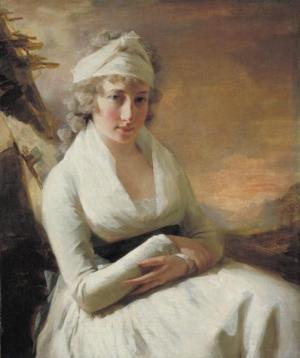
Henry Raeburn, Jacobina Copland, ca. 1794–98, oil on canvas, 76.2 × 63.5 cm. (Ottawa: National Gallery of Canada)
The National Gallery of Canada presents, as part of its Masterpiece in Focus program, The White Dress, an exhibition that highlights the evolution of the chemise dress and the drastic transformation in fashion around the turn of the nineteenth century. Complementing the Gallery’s major summer retrospective of Elisabeth Louise Vigée Le Brun (1755–1842), the portraitist to Marie Antoinette, The White Dress offers a rich exploration of the trends and artistic movements of the time. At the heart of this Masterpiece in Focus presentation are two portraits by Vigée Le Brun’s contemporaries: Scottish artist Henry Raeburn and French artist Anne-Louis Girodet. These magnificent works from the national collection—Jacobina Copland (ca. 1794–98), by Raeburn, and Madame Erneste Bioche de Misery (1807), by Girodet—can be seen alongside insightful drawings and illustrations, as well as stunning period dresses on loan from the Royal Ontario Museum and a private collector.
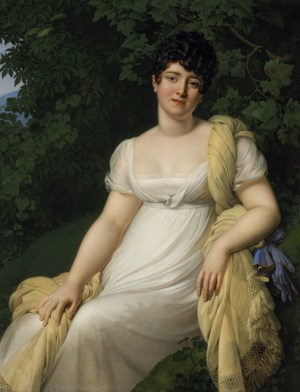
Anne-Louis Girodet, Madame Erneste Bioche de Misery, 1807, oil on canvas, 115.7 × 91.5 cm (Ottawa: National Gallery of Canada)
With the aid of a simple white dress, the exhibition unveils the world that portraitist Elisabeth Louise Vigée Le Brun and her sitters navigated at the turn of the eighteenth century. Although it may seem demure to contemporary eyes, Vigée Le Brun’s portrait of Marie Antoinette in a Chemise Dress caused a scandal when it was exhibited at the Paris salon in 1783. Royal etiquette required elaborate formal dress. The notorious portrait depicting France’s queen in a simple muslin garment was seen as immodest and had to be removed from view. But more than a breach of decorum, nearly a decade before the French Revolution of 1789, the painting can also be seen as announcing the end of formality, luxury and all that was synonymous with the monarchy.
At the time, court gowns, made of ornately embellished heavy brocades, required structural undergarments—panniers, hooped petticoats, and whalebone stays (an early form of the corset)—for support. It was a style designed to inspire respect for the French monarchy. Marie Antoinette’s preference for the chemise dress was deemed not only a breach of decorum, but an act of treason: court dress was largely a product of the French textile industry—especially the silk looms of Lyon, while the white muslin was a foreign import from India and Britain.
The Gallery’s website presents a time-lapse video of Dr. Anne Bissonnette, dress historian at the University of Alberta, preparing one of the eighteenth-century muslin dresses for the exhibition in the Gallery’s conservation lab.
Additional information and images are available from Sheila Singha’s article “A Scandal in Muslin: Marie Antoinette’s Little White Dress,” for NGC Magazine (24 May 2016).
Lecture | Aaron Wile, Watteau: Making as Meaning
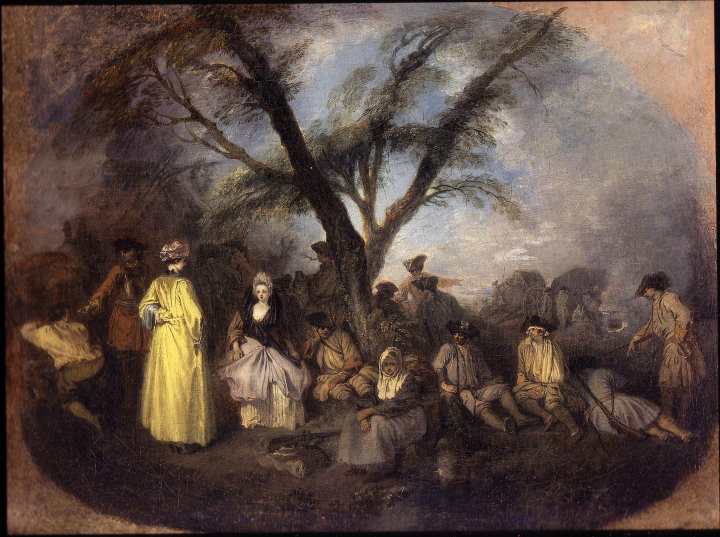
Jean-Antoine Watteau, The Halt (Alte), ca. 1710–11, oil on canvas, 13 × 17 inches
(Madrid: Museo Thyssen-Bornemisza)
◊ ◊ ◊ ◊ ◊
Next week at The Frick:
Aaron Wile, Watteau: Making as Meaning
The Frick Collection, New York, 13 July 2016
Jean-Antoine Watteau’s military works proffer a modern vision of war in which the soldier’s inner life is brought to the fore. This talk, presented by the curator of the special exhibition Watteau’s Soldiers: Scenes of Military Life in Eighteenth-Century France (on view until October 2), examines how the problem of representing interiority informed the artist’s working methods. Wednesday, July 13, 6pm.
Aaron Wile is the Anne L. Poulet Curatorial Fellow at The Frick Collection.
Call for Papers | The Architect as Active Reader
From H-ArtHist:
The Architect as Active Reader
Vicenza, 15–17 June 2017
Proposals due by 15 September 2016
The Centro Internazionale di Studi di Architettura Andrea Palladio (CISA) will organize an international conference on the theme of The Architect as Active Reader, 15–17 June 2017. Printed treatises and texts have been the main vehicle for the communication of architectural ideas. Architects and builders, as owners of these texts, have left records of their thoughts in the form of subsequent annotations, comments, and drawings within the texts or closely connected to them. In developing the notion of the architect as an ‘active reader’ who absorbs new information for future practical application, the conference seeks to bring out examples of architects in dialogue with texts.
Geographic area and time period are open. Scholars may apply individually or propose a theme to be carried through in a single session by a group or team. (Such a theme might address a single architect’s varied reading practices; multiple approaches to a single work; the collecting practices revealed in an architect’s library). Contributions from scholars and librarians are welcome.
Those interested in participating with a contribution (20 minute limit) should send an outline (no more than 250 words) and brief CV (no more than 100 words) to cfp@cisapalladio.org by 15 September 2016. Speakers will be notified by 31 October 2016.
Exhibition | Chinamania: Walter McConnell
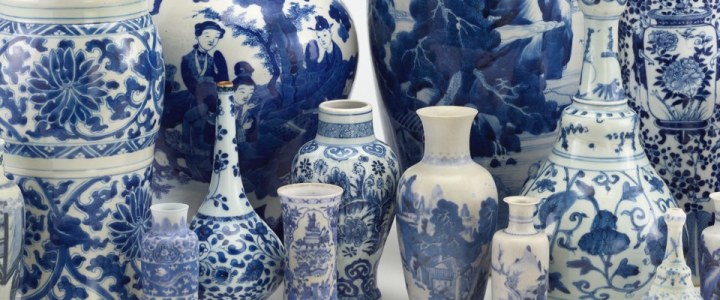
Contemporary art, engaging an iconic nineteenth-century interior, engaging perennially popular early eighteenth-century ceramics—opening next week at the Sackler:
Chinamania: Walter McConnell
Arthur M. Sackler Gallery, Washington, D.C., 9 July 2016 — 4 June 2017
A mania for Chinese blue-and-white porcelain swept through London in the 1870s as a new generation of artists and collectors ‘rediscovered’ imported wares from Asia. Foremost among them was American expatriate artist James McNeill Whistler. For him, porcelain was a source of serious aesthetic inspiration. For British shoppers, however, Chinese ceramics signified status and good taste. Cultural commentators of the time both embraced and poked fun at the porcelain craze. Illustrator George du Maurier parodied the fad in a series of cartoons for Punch magazine that documented what he mockingly called “Chinamania.”
More than a hundred fifty years later, American artist Walter McConnell explores Chinamania in our own time. In this exhibition, he juxtaposes two monumental porcelain sculptures, which he terms stupas, with export wares from China’s Kangxi period (1662–1722). Those blue-and-white ceramics are similar to those that once filled the shelves of Whistler’s Peacock Room in London. These historical porcelains also inspired McConnell to create a new work based on 3D-printed replicas. His interest in replication and in the serialized mass production of ceramic forms began after he visited China more than a decade ago. The large kilns and busy factories at Jingdezhen prompted McConnell to look at China as an enduring resource for ceramic production.
Chinamania complements the exhibition Peacock Room REMIX: Darren Waterston’s Filthy Lucre, a contemporary installation that reimagines the Peacock Room as a resplendent ruin. Inspired by museum founder Charles Lang Freer’s collection of Asian ceramics, Waterston painted scores of vessels and arranged them on the buckling shelves of Filthy Lucre. These oozing, misshapen ceramics convey a sense of unsustainable luxury and excess. They also echo McConnell’s interest in the interplay of creativity, the mass production of aesthetic objects, and the powerful forces of materialism and conspicuous consumption.
◊ ◊ ◊ ◊ ◊
Summer Open House: Chinamania After-Hours Preview
Arthur M. Sackler Gallery, Washington, D.C., 8 July 2016
Free and open to the public
Join us for a special after-hours celebration of the opening of Chinamania, the third and final installation in the Peacock Room REMIX series. Explore the craze for Chinese porcelain that took the West by storm in the nineteenth century and discover the interplay between creativity and mass production. Chinese blue-and-white ceramics from the Freer|Sackler collection join monumental installations by contemporary sculptor Walter McConnell and 3D objects printed especially for this exhibition.
The open house will feature tours led by McConnell and curator Lee Glazer, music, photo booths, and hands-on activities such as customizable screen-printed tote bags and create-your-own stop motion animation, featuring decorative motifs inspired by Chinese blue-and-white porcelain.
Across the street from the Sackler, food will be available through the USDA Farmer’s Market at Night, which hosts over 20 of our city’s most popular local food trucks from 4:00 to 7:00pm. So come get a first look at Chinamania and enjoy a picnic on the National Mall.
Friday, July 8, 5:30pm, Arthur M. Sackler Gallery, 1050 Independence Ave. SW, Washington, D.C.
Exhibition | Kakiemon and 400 Years of Porcelain
Press release for the exhibition now on view at The British Museum:
Made in Japan: Kakiemon and 400 Years of Porcelain
The British Museum, London, 23 June — 21 August 2016
Japanese Porcelain
Founded by Korean potters . . .
Inspired by Chinese styles . . .
Encouraged by Dutch traders . . .
The Kakiemon style has absorbed foreign influence while incorporating distinctive Japanese elements.
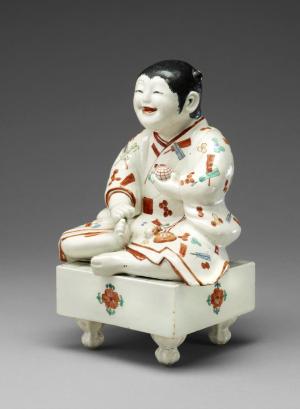
Boy on a Go Board, Kakiemon kiln, Arita, Japan, ca. 1670–80, nigoshide porcelain (London: The British Museum)
This Asahi Shimbun Display Made in Japan: Kakiemon and 400 Years of Porcelain celebrates fifteen generations of porcelain production in Arita by showcasing work by one of the most famous potting dynasties. 2016 is the 400th anniversary of the birth of porcelain in the town of Arita in Saga Prefecture, and the show will feature, among other examples, a new work decorated with acorn branches by Sakaida Kakiemon XV (b. 1968) representing his coming of age as an artist that he created specifically for the British Museum. Featured in the display is an original film made by the British Museum at the Kakiemon kiln, which allows viewers to see and feel through the actions of the potters how Kakiemon porcelain is actually created.
The Kakiemon (pronounced ‘ka-ki-e-mon’) kiln is still modeled on the traditional Japanese early modern workshop system. Succession is based on the principle of iemoto or ‘head of the household’, the oldest son inheriting and sustaining the brand and workshop. The current head of the kiln is Kakiemon XV. He recently received the title following the death of his greatly admired father Kakiemon XIV in 2013.
Historically, the Kakiemon workshop produced some of the most exquisite porcelain for export to Europe and the Middle East, notably in the later 1600s. In 1647 Sakaida Kizaemon was credited with introducing the overglaze enameling technique to the Arita porcelain kilns, making advanced porcelain production possible and starting the potting dynasty. He was thought to have learnt the secrets to overglaze enameling on porcelain from a Chinese specialist in adjacent Nagasaki. This success earned him the name Sakaida Kakiemon I—which derived from kaki or ‘persimmon’ after the orangey-red colour of the most important overglaze enamel. Japan was a late starter to porcelain production compared to China and Korea, but it quickly made up for lost time. Japan benefitted from domestic turbulence in China and was able to start exporting to Europe and elsewhere through the Dutch East India Company.
The classic Kakiemon style, lasting from 1670 to 1700, is defined by its refined yet sparse decoration executed with bright overglaze enamels in a palette of orange-red, green, blue and yellow. Some of the most exquisite porcelain is on view in this display such as Boy on a Go Board, ca. 1670–80. This figurine was specifically created with a distinctive creamy-white porcelain body called nigoshide, the formula for which was developed by the Kakiemon kiln. The contrast in colours and tones emphasises the brightly coloured enamels. A 3D model of this figurine can be viewed online.
Kakiemon grew in international popularity in the late 17th century, and became particularly valued in England during the reign of Queen Mary II (1686–1694), who was passionate about the Kakiemon style. Classic Kakiemon style in Japan ceased production in the 18th century; but its popularity continued, and the style was reproduced in China and in Europe, examples of which can be seen in this display. There was a revival in the mid-20th century of traditional Kakiemon style due to the ingenuity of Kakiemon XII and Kakiemon XIII. They rediscovered the forgotten techniques and created a renaissance for the nigoshide creamy white porcelain used earlier with Boy Sitting on a Go Board. Kakiemon XIII was awarded the high honour from the Japanese government as a ‘Living National Treasure’ for his revitalisation of classic Kakiemon style. His son, Kakiemon XIV continued the legacy of his father while also developing the Kakiemon brand through inspired naturalistic designs. Kakiemon XV is now poised to take the revitalised Kakiemon legacy forward.
The Asahi Shimbun Displays are a series of regularly changing displays which look at objects in new or different ways. Sometimes the display highlights a well-known item; sometimes it surprises the audience with extraordinary items from times and cultures that may not be very familiar. This is also an opportunity for the Museum to learn how it can improve its larger exhibitions and permanent gallery displays. These displays have been made possible by the generous sponsorship of The Asahi Shimbun Company, who are long-standing supporters of the British Museum. With a circulation of about 7 million for the morning edition alone, The Asahi Shimbun is the most prestigious newspaper in Japan. The company also publishes magazines and books, and provides a substantial information service on the internet. The Asahi Shimbun Company has a century-long tradition of staging exhibitions in Japan of art, culture, and history from around the world.
Call for Papers | Art in the British Country House: Collecting and Display
From the Paul Mellon Centre for Studies in British Art:
Art in the British Country House: Collecting and Display
Paul Mellon Centre for Studies in British Art, London, 7 October 2016
Proposals due by 8 July 2016
The Paul Mellon Centre’s research project Art in the British Country House: Collecting and Display investigates the collection and display of works of art in the country house in Britain from the sixteenth century to the present day. Focusing on specific case studies, the project addresses two closely related issues:
• The formation, character and function of country-house art collections
• The conventions, development and dynamics of pictorial and sculptural display within the country house
The crucial importance of the country house to understanding the history of art-collection and display in Britain is indisputable and of long-standing interest to historians of British art. This project, in turning a fresh eye on the collections of art associated with the country house, builds on exciting new developments within this area of scholarship, which shed new light on the wide range of motivations and circumstances that have shaped such collections. The project extends to the country house a growing scholarly interest in modes of pictorial display, which has hitherto tended to focus on the display of paintings, sculpture, and prints within more urban and public environments, and on the exhibition space in particular.
The project will concentrate attention on the ways in which country house art collections were formed and on the reasons why they took the form they did. It will address the impact upon collecting practices of such factors as the growth of continental travel, the development of a sophisticated art market, fluctuations in taste, and dynastic ambitions and familial alliances. It will also address the conditions, facilities, and habits of display in the country house, investigating such issues as the shifting modes of the picture hang, the introduction of dedicated gallery spaces within the country house, the relationship between the country house and the town house as sites of collection and display, the development of cataloguing, and the growth of professional curatorship.
As an integral part of this project, the Centre is organizing the first of a series of conferences designed to showcase new research in this area. We invite proposals for 30-minute papers which discuss some aspect of the collecting and/ or display of art in a single country house from any point over the past five hundred years. We welcome proposals from academics, museum curators, independent scholars, those working in the heritage sector, and those actively involved in postgraduate studies. While the Call for Papers has a purposefully broad and open brief, it is essential that submissions offer fresh, methodologically ambitious perspectives on the topic.
Possible themes for exploration might include, but are not limited to:
• The impact of commerce and travel on collecting
• The creation and presentation of spaces for display
• The commissioning and display of portraiture in the country house
• The collecting and display of historic and/or contemporary art
• The relationship between country- and town-house modes of collection and display
• The interaction of works of art within the country-house interior
• The relationship between the fine and decorative arts in country-house display
• Patterns of display across the different rooms of a single country house
Proposals, of no more than 250 words, together with a short CV, for 30-minute papers, should be submitted to Ella Fleming at efleming@paul-mellon-centre.ac.uk by 8th July 2016.
Call for Papers | Romanticism and the Peripheries
From the conference website:
Romanticism and the Peripheries
Calouste Gulbenkian Foundation, Lisbon, 5–7 December 2016
Proposals due by 30 July 2016
“The Romantic phenomenon seems to defy analysis, not only because its exuberant diversity resists any attempt to reduce it to a common denominator but also and especially because of its fabulously contradictory character” (Michael Löwy and Robert Sayre, Romanticism against the Tide of Modernity, trans. by Catherine Porter, Durham: Duke University Press, 2001). In an attempt to accommodate both its diversity and contradictory character, Löwy and Sayre defined Romanticism as “a worldview constituted as a specific form of criticism of ‘modernity’” and expanded the term beyond artistic and literary phenomena to encompass a wide range of fields such as religion, political theory, philosophy, etc. Even though Löwy and Sayre may offer a guiding principle outside the interpretative confusion often generated by the term, their analysis is still mostly, if not exclusively, concerned with the definition of the phenomenon as it manifested in the principal centers of Europe (namely England, France, and Germany).
This three-day conference, organized on the occasion of the bicentenary of Fernando II’s birth, the Portuguese king responsible for the edification of what is widely considered the hallmark of Romantic Portuguese architecture, seeks to focus on Romanticism in the peripheries, both European and non-European, and explore the validity of the concept for the analysis of artistic and cultural forms that, for the most part, originated outside the centers of bourgeois industrial civilization. Taking as its starting point the definition proposed by Lowy and Sayre, the conference invites participation on a number of issues including, but not limited to:
1 When Was Romanticism? Attempts at Periodization and Definition
2 Sublime matters: Romanticism and Material Culture
3 Transfers and Cross-Sections: Literature, Theater and the Visual Arts
4 The Romantic Traveler: Drawings, Prints and Souvenirs
5 Artistic Education. Academy versus Nature?
6 Romantic Landscape, Gardens and Architecture
7 Romantic Nationalism – Romantic Imperialism? The Politics of Style
Abstracts (of no more than 300 words), accompanied by a short bio (approximately two paragraphs) should be sent to the members of the organizing committee, at iha.romanticism2016@gmail.com by July 30, 2016. Participants will be notified by the end of August, and the conference program will be published in mid-September. The languages of the conference are English and Portuguese.
A selection of papers from the conference will be published as a special number of the Revista de História da Arte, an annual peer-reviewed journal, and a second publication, in the form of a book, is also being contemplated by the organizers. For all questions regarding administration and practical matters, as well as the payment of the conference inscription, please contact Mariana Gonçalves and Inês Cristóvão (iha.romanticism2016@gmail.com). Conference inscription rates: speakers 50€, participants 40€, students 20€.
Exhibition | Stubbs and the Wild

George Stubbs, Horse Frightened by a Lion, 1770
(National Museums Liverpool, Walker Art Gallery)
◊ ◊ ◊ ◊ ◊
Press release (via Art Daily) for the exhibition on view at The Holburne Museum:
Stubbs and the Wild
The Holburne Museum, Bath, 25 June — 2 October 2016
Curated by Amina Wright
The Holburne Museum presents Stubbs and the Wild, an exhibition of animal portraits, grand fantasies, and exquisite prints and drawings by renowned British wildlife painter George Stubbs (1724–1806), on show from 25 June to 2 October 2016. Stubbs and the Wild delves into the many-sided eighteenth-century world of George Stubbs through his realistic animal studies and sublime fantasy pieces, focusing on the artist’s famous depictions of wild animals in paint and print that encapsulated the uneasy relationship between the domestic and the exotic in polite Georgian society.
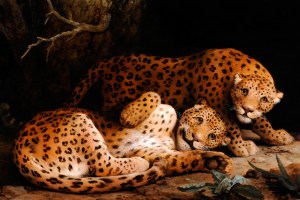
George Stubbs, Two Leopards, ca. 1776, oil on oak panel, 90.5 × 137.4 cm (Private Collection)
Throughout his life George Stubbs was fascinated by how animals are built and studied their anatomy tirelessly. It was this interest that led him beyond horses and dogs to other animals at a time when exotic new wildlife was arriving in London from Britain’s expanding colonies. Moose, leopards, lemurs, antelope and even the remains of a kangaroo were brought home as valuable curiosities and their owners encouraged Stubbs to study the animals and record them for posterity. Although many of them were intended primarily as zoological studies, Stubbs’s paintings of wild creatures are also portraits that capture the behaviour and character of living beings. His most successful essays in the sublime explore the wild, not as a source of curiosity but as a distant, untamed land where nature is merciless and well-fed predators rule. His images of a horse attacked and then devoured by a lion—with variations in different media and reproductions in print—became Stubbs’s signature work.
Alongside paintings, the exhibition will present some of the astonishing works that Stubbs made in other media, using wild animals as his subject. As a printmaker, he was one of the most outstanding etchers of his day, despite being apparently self-taught. He also developed the art of painting in enamels on ceramic, producing jewel-like works of extraordinary clarity and durability.

George Stubbs, The Rev. Robert Carter Thelwall and his Family (Bath: The Holburne Museum)
“The starting point for this exhibition,” explained Amina Wright, Senior Curator at the Holburne Museum and curator of the exhibition, “is the Holburne’s own Stubbs portrait, The Rev. Robert Carter Thelwall and his Family, a polite Georgian conversation piece of a family on a country estate with their horses. This elegant type of portraiture is typical of Stubbs, but this exhibition will explore another side of the artist. By bringing together Stubbs’s anatomical studies and extraordinary images of wild animals, Stubbs and the Wild will present the artist as an indefatigable explorer of the natural world and a bold technical innovator. It will also introduce some of the animal celebrities of eighteenth-century England, from the sweet and fluffy to the majestically terrifying.”
The exhibition will be accompanied by a free audio guide featuring responses to Stubbs’s work by animal experts and artists. Visitors will be able to hear a horse whisperer explaining what’s going on in the minds of Stubbs’s horses and an equine vet explaining the artist’s importance to anatomy. Artist Daphne Wright will explain why monkeys are so fascinating, while wildlife photographer and presenter Simon King will share his many years’ experience of observing big cats. Biographer Wendy Moore introduces the lonely moose who made friends with London’s leading scientists, and a deer manager discusses the life cycle of these beautiful native mammals. Stubbs and the Wild is part of a series of special events and exhibitions to celebrate 100 years since the re-establishment of the Holburne Museum in Sydney Gardens.
◊ ◊ ◊ ◊ ◊
Stubbs and the Wild Study Afternoon
The Holburne Museum, Bath, 29 July 2016, 1:00–4:30
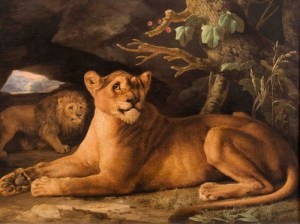
George Stubbs, A Lion and Lioness, 1778, enamel on Wedgwood ceramic 43.1 × 61.6 cm (London: The Daniel Katz Gallery)
Amina Wright, ‘Introduction’
An introduction to the artist and his animals.
Gaye Blake-Roberts, ‘Wedgwood and Stubbs’
In 1775, George Stubbs contacted Josiah Wedgwood to see if he could produce large ceramic tablets on which to paint animals. Over the next few years a fruitful working relationship grew up between these two extraordinary innovators and indefatigable experimenters. Gaye Blake-Roberts, curator at the Wedgwood Museum, explores his unique alliance between potter and painter.
Tim Clayton, ‘George Stubbs and the Print’
George Stubbs was acutely conscious of the importance of prints in communicating his ideas, as the permanent record of his painted images and as the vehicle for his international reputation. Tim Clayton describes why Stubbs taught himself printmaking and traces his subsequent fascination with the medium. He is the author of George Stubbs: The Complete Engraved Works and The English Print, 1688–1802.
The cost of the study afternoon (£30/£12 students) includes admission to the exhibition Stubbs and the Wild.










 Enfilade
leave a comment