Exhibition | In the Library: Growth and Development of the Salon Livret

Explication des peintures, sculptures, et autres ouvrages, de messieurs de l’Académie royale (Paris, 1767). Washington, D.C.: National Gallery of Art Library, David K. E. Bruce Fund.
◊ ◊ ◊ ◊ ◊
Press release (31 May 2016) from the NGA:
In the Library: Growth and Development of the Salon Livret
National Gallery of Art, Washington D.C., 20 June — 16 September 2016
Curated by Yuri Long
Documenting the history of the Paris Salon from its emergence in the late 17th century through its decline during the early 20th century, In the Library: Growth and Development of the Salon Livret presents over 60 examples of literature related to the Paris Salon drawn from nearly 250 years of exhibitions. On view in the East Building Study Center, the exhibition includes a variety of publications that document the rise and fall of the Académie Royale de Peinture et de Sculpture and its exhibition, which came to be known as the Salon.
Beginning as a checklist for the works on view, the livret (‘little book’ or catalog) was first published for the Salon of 1673. Appearing then as little more than a pamphlet in decorative wrappers, the livret developed over time into a full catalog. During the latter half of the 19th century livrets included not only additional entries but also supplemental information about the juries, the artists, and the rules of the organization. And throughout the 19th century, new printing technologies—from lithography to photography—allowed for the inclusion of increasingly more faithful reproductions of exhibited works in the livrets.
Developments beyond the academy can also be seen in the growing amount of literature surrounding Salon exhibitions. Art criticism, a new type of writing in the 18th century, evolved alongside the official exhibition livrets as authors began writing commentaries about the Salon. Later, the political upheavals of and following the French Revolution affected the administration of the Salon, whose own controversies, such as the dissatisfaction of member artists, persisted through the 19th century. By the early 20th century, independent exhibitions, each with its own published catalog, had become more frequent and contributed to the declining influence and importance of the official Salon.
Coinciding with the exhibition, the National Gallery of Art Library will publish Documenting the Salon: Paris Salon Catalogs, 1673–1945, compiled and edited by librarian John Hagood. As a bibliography, it lists the publications in the library by and about the organizations that hosted Salons in Paris. Two essays analyze the form and function of Paris Salons and Salon publishing in the ancien régime and in the 19th century. Written by Yuriko Jackall, assistant curator, department of French paintings, and Kimberly A. Jones, associate curator, department of French paintings, they reveal the history and taste of collecting as well as how the Paris Salon grew from a forum for elite, privileged artists and viewers into a more inclusive event. Documenting the Salon is made possible by a grant from The Florence Gould Foundation and will be distributed to museums, libraries, and art research organizations in the US around the world.
Organized by the National Gallery of Art and curated by Yuri Long, rare book librarian, the exhibition is open from 10:00 a.m. to 5:00 p.m., Monday through Friday.
The National Gallery of Art Library contains more than 400,000 books and periodicals, including more than 15,000 volumes in the rare book collection, with an emphasis on Western art from the Middle Ages to the present. The National Gallery of Art Library was founded in 1941, the year the Gallery opened to the public. In 1979, with the move to a seven-story facility in the Gallery’s new East Building and the establishment of the Center for Advanced Study in the Visual Arts (CASVA), the library broadened its purpose and the scope of its collection. Its goal has been to establish a major national art research center, serving the Gallery’s curatorial, educational, and conservation staff, CASVA members, interns, visiting scholars, and researchers in the Washington art community.
New Book | The Grid and the River: Philadelphia’s Green Places
From Penn State UP:
Elizabeth Milroy, The Grid and the River: Philadelphia’s Green Places, 1682–1876 (University Park: The Pennsylvania State University Press, 2016), 464 pages, ISBN: 978-0271066769, $65.
 Philadelphians are fond of quoting a letter in which William Penn described his vision of a “greene country towne, which will never be burnt & always wholesome.” Today, Philadelphia’s public parks cover more than ten thousand acres—roughly 11 percent of the city’s area. They encompass extensive woodlands and waterways as well as the largest collection of historic properties in the state of Pennsylvania, including the Fairmount Water Works, the Philadelphia Zoo (the oldest zoo in the United States), and the Philadelphia Museum of Art.
The Grid and the River is the product of Elizabeth Milroy’s quest to understand the history of public green spaces in William Penn’s city. In this monumental work of urban history, Milroy traces efforts to keep Philadelphia ‘green’ from the time of its founding to the late nineteenth century. She chronicles how patterns of use and representations of green spaces informed notions of community and identity in the city. In particular, Milroy examines the history of how and why the district along the Schuylkill River came to be developed both in opposition to and in concert with William Penn’s original designations of parks in his city plan. Focusing on both the history and representation of Philadelphia’s green spaces, and making use of a wealth of primary source materials, Milroy offers new insights into the city’s political and cultural development and documents how changing attitudes toward the natural environment affected the physical appearance of Philadelphia’s landscape and the lives of its inhabitants.
Elizabeth Milroy is Professor and Department Head of Art and Art History in the Antoinette Westphal College of Media Arts & Design at Drexel University.
◊ ◊ ◊ ◊ ◊
C O N T E N T S
List of Illustrations
Acknowledgments
Introduction
City
1 The Origins of Penn’s Squares
2 Patterns of Growth and Governance in the Centre City
Suburb
3 The Liberty Lands
4 Suburban Villas in the Schuylkill Valley
5 Nurseries of National Virtue: Private Estates and Public Culture
6 Agriculture, Horticulture, and the Origins of the American Picturesque
Consolidation
7 Reviving Penn’s Plan
8 The Fairmount Water Works: Picturing Civic Virtue
9 Rural Cemeteries, River Parks, and the Search for Rational Recreation
10 Greening the Consolidated City
11 The Fairmount Park Commission: Park Building for Preservation and Conservation
12 Spatial Politics and the Centennial Exhibition
13 A Work Unfinished
Notes
Bibliography
Index
New Book | Endeavouring Banks
News emerged in May that the wreckage of the Endeavour has been located off the coast of Rhode Island—as reported, for instance, in The Guardian (2 May 2016). After Cook’s voyage, the ship was renamed the Lord Sandwich and used in the revolutionary war blockade, sinking in 1778. This volume appears with an eye toward the 250th anniversary of the first voyage (the Endeavour sailed from Plymouth in August 1768). From Paul Holberton:
Neil Chambers, ed., with with a foreword by Sir David Attenborough and contributions by Anna Agnarsdóttir, Jeremy Coote, Philip J. Hatfield and John Gascoigne, Endeavouring Banks: Exploring the Collections from the Endeavour Voyage, 1768–1771 (London: Paul Holberton Publishing, 2016), 304 pages, ISBN: 978-1907372902, £40 / $50.
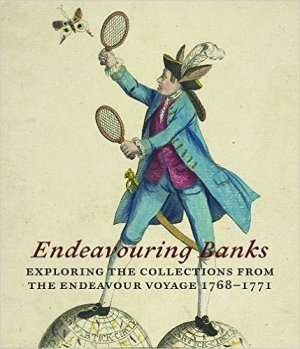 When English naturalist Joseph Banks (1743–1820) accompanied Captain James Cook (1728–1779) on his historic mission into the Pacific, the Endeavour voyage of 1768–1771, he took with him a team of collectors and illustrators. They returned with unprecedented collections of artefacts and specimens of stunning birds, fish, and other animals as well as thousands of plants, most seen for the first time in Europe. They produced, too, remarkable landscape and figure drawings of the peoples encountered on the voyage along with detailed journals and descriptions of the places visited, which, with the first detailed maps of these lands (Tahiti, New Zealand, and the East Coast of Australia), were afterwards used to create lavishly illustrated accounts of the mission. These caused a storm of interest in Europe, where plays, poems, and satirical caricatures were also produced to celebrate and examine the voyage, its personnel, and many ‘new’ discoveries.
Along with specimens and artefacts, contemporary portraits of key personalities aboard the ship, scale models and plans of Endeavour itself, scientific instruments taken on the voyage, commemorative medals and sketches, the objects (over 140) featured in this new book tell the story of the Endeavour voyage and its impact ahead of the 250th anniversary in 2018 of the launch of this seminal mission. Items separated in some cases for more than two centuries are brought together to reveal their fascinating history not only during but since that mission. Original voyage specimens will feature together with illustrations and descriptions of them, showing a rich diversity of newly discovered species and how Banks organized this material, planning but ultimately failing to publish it. Drawings of people and places visited during the mission are reproduced. And by comparing these voyage originals with the often stylized engravings later produced in London for the official account, this book investigates how knowledge gained on the mission was gathered, later revised and then printed in Europe.
The book focuses on the contribution of Banks’s often neglected artists—Sydney Parkinson, Herman Diedrich Spöring, Alexander Buchan as well as the priest Tupaia, who joined Endeavour in the Society Islands—none of whom survived the mission. These men illustrated island scenes of bays, dwellings, canoes as well as the dress, faces, possessions, and ceremonies of Pacific peoples. Of particular interest, and only recently recognised as by him, are the original artworks of Tupaia, who produced as part of this mission the first charts and illustrations on paper by any Polynesian. The surviving Endeavour voyage illustrations and maps were the most important body of images produced since Europeans entered this region, matching the truly historic value of the plant specimens and artefacts seen alongside them in this handsome book.
Call for Papers | Collecting and Display Seminar Group
From H-ArtHist:
Collecting and Display Seminar Group
Institute of Historical Research, London, 3 October 2016 — 22 June 2017
Proposals due by 6 July 2016
Our monthly seminars cover a wide range of topics from the study of individual collectors and the art market to the many different types of collections acquired over the centuries. Although the main emphasis is on art and artefacts, collections of memorabilia, scientific or ethnographic collections have also been covered. Papers have considered every type of collection, from royal and aristocratic collections to those of private citizens.
Papers are invited for the next academic year October 2016–July 2017. We encourage research that opens the field of collecting to new debates on motives of collectors, methods and networks of collecting, the market for works of art and the roles of dealers and auction houses, different types of collections and display. We are able to offer some limited support for travel from abroad where necessary.
Please submit your proposal of 300 words with a short biography to schbracken@btopenworld.com by 6 July. Our proposed dates are 3 October, 14 November, 12 December, 9 January, 6 February, 6 March, 15 May and 20 June. Please indicate if you have a preference for one of these dates.
Exhibition | Divine Pleasures: Painting from India’s Rajput Courts
Press release (14 June 2016) from The Met:
Divine Pleasures: Painting from India’s Rajput Courts—The Kronos Collections
The Metropolitan Museum of Art, Fifth Avenue, New York, 14 June — 12 September 2016
Curated by Navina Haidar and Courtney Stewart

Detail of The Village Beauty. Probably painted by the artist Fattu (active ca. 1770–1820). Illustrated folio from the dispersed ‘Kangra Bihari’ Sat Sai (Seven Hundred Verses). Punjab Hills, kingdom of Kangra, ca. 1785. Opaque watercolor, ink, and gold on paper; narrow yellow and white borders with black inner rules; dark blue spandrels decorated with gold arabesque; painting 18.7 x 13.2 cm, page 20.6 x 14.9 cm. Promised Gift of the Kronos Collections, 2015 (SK.082).
Compelling episodes from the epic and poetic literature of the Indian subcontinent dominate the nearly 100 masterful paintings—most a 2015 promised gift by Steven M. Kossak from his family’s Kronos Collections—on display at The Metropolitan Museum of Art. Created mainly between the 16th and the early 19th century for the royal courts of Rajasthan and the Punjab Hills in northern India, the works on view in the exhibition Divine Pleasures: Painting from India’s Rajput Courts—The Kronos Collections are meant to move the soul and delight the eye. Suffused with the powerful imagery of the myths of the past, Indian painting expressed a new way of seeking the divine through bhakti, or personal devotion. The collection was assembled over nearly four decades by Mr. Kossak, formerly a curator in The Met’s Department of Asian Art.
“We are delighted to present this exhibition of Steve Kossak’s generous promised gift,” said Thomas P. Campbell, Director and CEO of The Met. “These distinguished paintings constitute one of the premier collections of this material in private hands, and their eventual addition to The Met collection will transform the Museum’s holdings of Rajput painting. It is a significant addition to Steve’s legacy at The Met after serving for two decades as a curator.”
The exhibition is organized into three major sections: Early Rajput and Rajasthan, early Pahari (Punjab Hills), and later Pahari. Within each room, the paintings will be shown in relation to the literary traditions of Indian Hinduism. Rajput court painting was mainly intended for royal delectation, to amplify through the artistic fantasy manifest in the pictures, well-known religious, quasi-religious, and secular texts and subjects. The power and magic of the images transcends the subjects they portray.
Under the patronage of their Rajput rulers, many of the principalities of north India developed and nurtured a distinctive painting style. This galaxy of stylistic expression is amply demonstrated in the exhibition through compelling examples of the Early Rajput Style; the later schools of Bikaner, Bundi, Kishangarh, Kota, and Mewar; as well as many of the small courts of the Punjab Hills: Bahu, Bahsoli, Bislalpur, Chamba, Guler, Kangra, Mandi, Mankot, and Nurpur.
Painted on paper in opaque watercolor and ink, they are often heightened with gold and silver. Whites are often raised to simulate pearls and reflective beetle-wing casings stand in for emeralds. Many of the paintings have never before been exhibited publicly.
Concurrent with the exhibition is a small, thematically related display, Poetry and Devotion in Indian Painting: Two Decades of Collecting (June 15–December 4, 2016) in the Florence and Herbert Irving Galleries for the Arts of South and Southeast Asia, Indian Painting Gallery, Gallery #251. Recognizing the contributions of Mr. Kossak to the Department of Asian Art, where he was a curator from 1986 to 2006, it features 22 of the dozens of Rajput and Pahari paintings that were acquired during his tenure, including a large intricately painted and printed cloth pichwai (temple hanging).
The exhibition was organized by Navina Haidar, Curator, and Courtney Stewart, Senior Research Assistant, of The Met’s Department of Islamic Art. Exhibition design is by Daniel Kershaw, Exhibition Design Manager; graphics are by Constance Norkin, Graphic Design Manager; and lighting is by Clint Ross Coller and Richard Lichte, Lighting Design Managers, all of the Museum’s Design Department.
◊ ◊ ◊ ◊ ◊
The catalogue is distributed by Yale UP:
Terence McInerney, with essays by Steven Kossak and Navina Najat Haidar, Divine Pleasures: Painting from India’s Rajput Courts—The Kronos Collections (New York: The Metropolitan Museum of Art, 2016), 272 pages, ISBN: 978-1588395900, $50.
 This splendidly illustrated publication features over 90 important paintings from the predominantly Hindu Rajput tradition of Indian painting, and are highlights from the Kronos Collection, one of the finest holdings of Indian art. These remarkable works—most of them published and illustrated here for the first time—were painted between the 16th and 18th centuries for the Indian royal courts in Rajastan and the Punjab Hills. Many of the paintings are characterized by their brilliant colors and vivid depictions of scenes from Hindu epics, mystical legends, and courtly life. Along with an informative entry for every work and a personal essay by expert and collector Steven M. Kossak, the book contains an extensive essay by Terence McInerney that outlines the history of Indian painting, with a special emphasis on the Rajput courts, and provides an overview of the subject with fresh insights and interpretations.
Terence McInerney is an independent scholar, dealer, and author of numerous articles on Indian painting. Steven M. Kossak is a former curator in the Department of Asian Art at The Metropolitan Museum of Art and a distinguished collector.
Call for Papers | Objects and Possessions
From the conference website:
Objects and Possessions: Material Goods in a Changing World, 1200–1800
Southampton, 3–6 April 2017
Proposals due by 12 September 2016
This interdisciplinary conference looks at material culture across a long timeframe in order to explore the worlds of goods and objects across Europe and its overseas colonies, the connections and relationships facilitated by the exchange of goods, the importance and interpretation of the inheritance of goods and objects, and the ways in which goods brokered relationships between Europe and the wider world in the period.
The aim is to deepen our understanding of how goods ‘worked’ in a variety of social, economic and cultural contexts. We know a great deal about real property and the possession of land, but comparatively little about goods and chattels and their connections, and how these developed across a long timeframe. Over the period 1200‒1800 there were great changes in the type, range and availability of goods, from the finest items of the elite, the work of craftsmen on an individual basis, to the manufacture and widespread availability of cheap and utilitarian goods and equipment.
Customs of ‘possession’ need to be exposed, to show what ownership might mean, what property might be held by women or children, and what might be considered inalienable within families. The conference will look to identify the cultural connections—and how goods and attitudes to them change culture. It will also consider how goods were transferred, exchanged and collected, as well as the ways in which objects could be used to mediate connections and broker relationships between different people and places.
Proposals are invited for single papers and for whole sessions (three papers). Papers should not exceed 30 minutes. Themes might include:
• The ownership of goods; the law and objects
• Patterns of inheritance for different categories
• The connections of different groups in society to goods, for example, domestic equipment, jewellery, textiles
• The introduction of new goods, fashions and colours
• The increasing quantities and diversity of goods
• Furnishings for household interiors
• Consumer revolutions (e.g. sugar, colour, fur)
• Vocabularies for describing goods
• Trades and markets for goods
• Processes of collecting and accumulation
• The politics of possession and display
Please send short abstracts (no more than 200 words per paper) by 12 September 2016 to Chris Woolgar (C.M.Woolgar@southampton.ac.uk).
Call for Essays | Adapting the Eighteenth Century
Adapting the Eighteenth Century: Pedagogies and Practices
Edited by Sharon Harrow (Professor of English, Shippensburg University) and Kirsten Saxton (Professor of English, Mills College)
Proposals due by 15 August 2016; final essays due by 15 January 2017
The eighteenth century has quite a bit of popular currency these days; we see adaptations of eighteenth-century literature and culture on tumblr, fan fiction, web series, scent lines, cult mashups, Facebook accounts, you-tube videos, fashion, graphic novels, literary fiction, theater stagings, greeting cards, and in mainstream films. Adaptation is currently a lively intellectual topic, generating both theoretical and applied research. Theories of adaptation—including Linda Hutcheon’s A Theory of Adaptation, Julie Sanders’s Adaptation and Appropriation, and Dan Hassler-Forest’s and Pascal Nicklas’s The Politics of Adaptation: Media Convergence and Ideology—undergird recent inquiries into adaptation, including interpretations of contemporary adaptations of eighteenth-century texts, such as Pride and Prejudice and Zombies, Longbourn, The Scandal of the Season, Foe, The Cattle Killing, Inkle and Yariko, Mother Clap’s Molly House, and Zong! In addition, new work argues for the adaptive nature of the century itself; Citizens of the World: Adapting in the Eighteenth Century, edited by Samara Anne Cahill and Kevin Cope, explores adaptations—transnational and transactional—within the century.
Our collection will build on this rich scholarly foundation to focus on adaptation and pedagogy. Adaptations of material or ideas from the long eighteenth century are often seen as middlebrow simplifications, capitalist exploitations, or, in teaching, simply as gateway texts. Rather than viewing adaptations as the spoonful of sugar, we invite essays to combine current adaptations of eighteenth-century texts or concepts with texts from the eighteenth-century in ways that provocatively and thoughtfully open up and out our own reading and teaching.
Essays might focus on the literary (novels, plays, poems), or on philosophical or scientific treatises, paintings, historical records, or musical notations. We are interested in both direct adaptations as well as in appropriations, re-mixes, or traces. We are particularly interested in essays that move beyond description of a film adaptation of a book to address new forms of media convergence and participatory culture in which reading, watching, and listening are key elements in the process of adaptation.
Adapting the Eighteenth Century: Pedagogies and Practices hopes to be broadly representative in the philosophies, methodologies, and critical orientations presented; and in the types of schools, students, and courses considered. We want the book to be relevant for non-specialists as well as specialists, for graduate student teachers as well as senior professors. We welcome essays across a range of disciplines, geographies, and levels of focus. Since this volume is dedicated to teaching, abstracts and essays should center on pedagogical issues. Whatever its topic—practical teaching or more theoretical or topical—essays should explicitly address how they will apply to the needs of teachers in preparing and teaching classes and the needs of students in learning.
Please send a 500 word proposal/abstract and a CV to ktsaxton@mills.edu and srharr@ship.edu by August 15, 2016. We will respond with decisions by September 15, 2016. Completed essays of no more than 25 pages will be due by January 15, 2017.
Exhibition | The Recovery of Antiquity
Press release for the exhibition closing this weekend at the MMFA:
The Recovery of Antiquity: From the Renaissance to Neoclassicism in France and Italy
Le retour à l’antique: de la Renaissance au néoclassicisme, en France et en Italie
Musée des beaux-arts de Montréal, 12 January — 26 June 2016

Jean‑Baptiste Lallemand (1716–1803), Classical Ruins, gouache on paper mounted on cardboard. 61.1 × 44.6 cm (MMFA, Lady Davis Bequest)
In connection with the exhibition Pompeii (on view until September 5), the Montreal Museum of Fine Arts presents The Recovery of Antiquity, revealing the keen interest of artists from the sixteenth to the early nineteenth century for antiquities. This selection of graphic works from the Museum’s collection features over fifty prints and drawings, including several new acquisitions. It features works by French masters like François Boucher, Jean-Baptiste Greuze, and Anne-Louis Girodet, as well as several Italian artists. Some of these works are being exhibited for the first time.
The discoveries in Rome at the turn of the sixteenth century of the Apollo Belvedere and the Laocoön—the latter praised as a masterpiece by Pliny the Elder in the first century—occurred precisely when that city was emerging from its medieval conditions and becoming once again the international centre of art, culture, and political influence in Europe, with artists like Bramante, Raphael and Michelangelo transforming and re-envisioning Rome at the forefront of a Christian humanism deeply rooted in its Imperial Roman artistic heritage. The rediscovery at this same period of Nero’s great villa at the heart of the city, the Domus Aurea, with some of its frescoed interior spaces intact, seemed to confirm this mission.

Charles Michel-Ange Challe (1718–1778), Interior View of an Ancient Temple with the Figure of a Goddess, ca. 1742–49 (MMFA, gift of Dr. Sean B. Murphy)
A distinct aesthetic appreciation of Greek art dates back to the latter fifteenth century, when the Venetian Empire encompassed the Greek peninsula and islands, as well as Crete and Cyprus. Collectors, especially Venetians, prized the more generalized and less veristic character of classical and Hellenistic Greek art. It reached an apogee in the mid-eighteenth century in Rome, when Johann Joachim Winckelmann, the celebrated aesthete and historian in Rome, elevated the artistic accomplishments of the Greeks above those of the Romans, creating animated controversy among other aestheticians and the artistic community. In counterpoint, Piranesi’s prints recorded in dramatic and inspiring terms the legacy of Roman Antiquity. It was precisely at this same moment, in 1748, that excavations were revealing to an enthralled public the ancient cities of Pompeii and Herculaneum, buried in the cataclysm of the eruption of Mount Vesuvius in 79 A.D. Two generations later, influenced by these archaeological discoveries, Napoleon adopted Roman imperial emblemata and styles to advance his own political and imperial ambitions.
From the engravings of Marcantonio Raimondi after designs by Raphael to the spectacular eighteenth-century etchings of Giovanni Battista Piranesi exalting the still-visible remains of ancient Rome to the early nineteenth-century illustrations after designs by Anne- Louis Girodet for works written by ancient authors, we can see the constant reinterpretation and changing visions of different generations regarding their own interface with Antiquity.
Exhibition | Bountiful Invention: Drawings by Oppenord and Meissonnier
Press release (27 May 2016) for the exhibition now on view at Waddesdon:
Bountiful Invention: Drawings by Gilles-Marie Oppenord (1672–1742) )
and Juste-Aurèle Meissonnier (1695–1750)
Waddesdon Manor, Buckinghamshire, 8 June — 23 October 2016
Curated by Juliet Carey

Gilles-Marie Oppenord, Design for a headpiece or title-page, with the Arms of the Marquis de Torcy, ca. 1725 (Waddesdon: Rothschild Collection / National Trust; photo: Mike Fear)
An exhibition exploring the work of two of the most innovative draughtsmen and designers of the 18th century, including spectacular presentation sheets, as well as drawings for workshop use; designs for interiors, fountains and grottoes, both real and fantastical; and an important group of designs for churches and ritual objects.
Born during the reign of Louis XIV, at a time of unprecedented interest in drawing and extraordinary artistic innovation, Oppenord and Meissonnier are two of the greatest names associated the development of the distinctively French style that reached its peak in the reign of Louis XV, now known as Rococo.
This exhibition of 45 drawings, mostly from Waddesdon’s own collections acquired in Paris in the 19th century by Baron Edmond de Rothschild (1845–34), is complemented by two loans: a spectacular Meissonnier design for a projected church for the Order of the Holy Ghost from the V&A and a red chalk Oppenord from the Courtauld Gallery. The majority of these drawings have never previously been shown.

Gilles-Marie Oppenord, Design for a Garden Fountain, ca. 1720–30; black ink on paper; 439 x 291mm (Waddesdon: Rothschild Collection / National Trust; photo: Mike Fear)
The drawings on display include experimental studies and highly finished presentation sheets, drawings for workshop use, others for student instruction, and copies made as part of the process of translating a design into print. There are designs for personal accessories such as gold boxes, furniture and interiors, for real and fantastical palaces, fountains and grottoes as well as an important group of ecclesiastical works. Many would go on to be realised in a variety of materials by builders, masons, carpenters, plasterers, goldsmiths, instrument makers, and other craftsmen; others exist only on paper. This exhibition demonstrates the breadth and variety of Oppenord’s and Meissonnier’s creativity and skill, both valued by collectors and connoisseurs even during the artists’ lifetimes. Prints of their drawings spread their ideas throughout Europe and further afield and were copied by other artists and designers long after their designs went out of fashion in France.
New Book | Condition: The Ageing of Art
From Paul Holberton:
Paul Taylor, Condition: The Ageing of Art (London: Paul Holberton Publishing, 2015), 264 pages, ISBN: 978-1907372797, £30 / $45.
 The paintings we see today in museums, galleries, churches, and temples are often much altered by the centuries. Pictures can split, rot, be eaten by woodworm, warp, blister, crack, cup, flake, darken, blanch, discolour, become too translucent, and disappear under a centuries-old varnish; and they can also suffer from the efforts of their owners to rectify these situations: they might be transferred, relined, ironed, abraded or repainted.
Anyone considering a work of art needs to establish at the outset how much it has changed since it was first made. This act of understanding is far from easy. We need to develop a knowledge of the physical and chemical processes which have brought paintings to their current state, in the hope that we can imagine their reversal. And we have to look as much as we can at a wide variety of paintings, so we can learn to distinguish those in a worse or better state of preservation; we have to try to understand what it is about a picture that differentiates good and bad condition. Theories of art history have been built on works whose appearance is made up of little more than repaint and decay, and the beginner needs to be warned about the many pitfalls dug by time for the unwary. This book is meant both for that beginner and for the qualified practitioner who might have missed a step along the way.
While there are many books on conservation and restoration, there is nothing which focuses specifically on condition. The plan here is to provide a hands-on introductory text, which can be used as a first orientation in the study of condition, and can remain as a basic reference work when the reader’s studies have progressed further. It should appeal to anyone with an interest in art.
Far too complex for their own good, European ‘Old Master’ pictures—by the likes of Cranach the Elder, Raphael, Leonardo, Poussin, Vermeer, Rembrandt, Canaletto, Gainsborough, Turner, and Van Gogh—rely for their delicate effects on layers of fragile materials, all of which are subject to change and decay. No-one can enjoy them to the full without an understanding of how and what they may have survived, suffered, or lost in the journey through the years.
Paul Taylor is curator of the photographic collection at the Warburg Institute, University of London, and editor of the Journal of the Warburg and Courtauld Institutes. He has written numerous articles and contributed to many books; he is the author of Dutch Flower Painting 1600–1720 (1995) and the editor of Pictorial Composition from Medieval to Modern Art (2000), The Iconography of Cylinder Seals (2006); Iconography without Texts (2008); and, most recently, Meditations on a Heritage: Papers on the Work and Legacy of Sir Ernst Gombrich (2014), also published by Paul Holberton publishing.










 Enfilade
leave a comment