Display | Persuading the King: A MS Petition by Gabriel de Saint-Aubin
Now on view at Waddesdon:
Persuading the King: A Manuscript Petition by Gabriel de Saint-Aubin (1724–1780)
Waddesdon Manor, Buckinghamshire, 23 March — 23 October 2016
Curated by Rachel Jacobs
 This display highlights a new addition to the collection at Waddesdon: Gabriel de Saint-Aubin’s volume, Placets de l’officier Desbans (1775). This elaborate manuscript petition (placet) was submitted to Louis XVI and Marie-Antoinette by a soldier, Edme Louis Desbans, asking for a long-promised promotion. Gabriel de Saint-Aubin was one of the greatest draughtsman of 18th-century France, and the drawings with which he brought this document to life were designed to glorify the royal couple while appealing to their artistic tastes and sensibilities. This unique work offers a glimpse into the politics of promotion and favour at the French court near the end of the Old Regime—in which the fortune of an individual depended upon the arts of persuasion. It has all sorts of resonances today, from patronage to the mysterious world of the political lobbyist.
A pdf file of the text panels is available at the Waddesdon website.
Study Session | Persuading the King
Study day opportunity at Waddeson Manor in connection with the exhibition:
Study Session Persuading the King: Gabriel de Saint-Aubin’s Placets
de l’officier Desbans and Other Books by the Saint-Aubin Brothers
Waddesdon Manor, Buckinghamshire, 24 June 2016
A rare opportunity to study Waddesdon’s newly acquired royal petition by Gabriel de Saint-Aubin, alongside other manuscript volumes, drawings, and prints by the artist and his brothers Charles-Germain and Augustin. Senior Curator Dr Juliet Carey and Curator Rachel Jacobs will offer a glimpse into the politics of promotion and favour near the end of the Old Regime. Works will include Gabriel de Saint-Aubin’s Memoire sur la reformation de la police de France (1749) and a special copy of Du Perron’s Discours sur la peinture et sur l’architecture (1757), made for the book’s dedicatee Madame de Pompadour. Charles-Germain de Aubin’s famous Livre de caricatures will provide a subversive counterpoint to the arts of flattery and persuasion that lay at the heart of court culture. £25 (includes grounds admission), £15 National Trust/Art Fund members, £10 students. Friday, 24 June 2016. Coffee on arrival at 10.15; study session 10.45–12.15. Book early to avoid disappointment.
Study Session | Books and Bindings at Waddesdon Manor
From Waddesdon:
Study Session: Books and Bindings
Waddesdon Manor, Buckinghamshire, 12 May and 15 September 2016
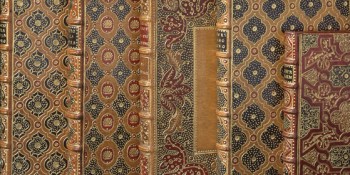 Come and explore the treasures of the Waddesdon collection of 17th- and 18th-century books and bindings. These include unique manuscripts and luxuriously illustrated printed volumes. Many of the books in the collection have illustrious provenances including great bibliophiles and members of the French Royal Family. The session will provide an opportunity to view some of the treasures of the Waddesdon Collection and to learn about book history through some of its finest examples. £25 (includes grounds admission), £15 National Trust/Art Fund members, £10 students. Thursday 12 May and 15 September 2016. Coffee on arrival at 10.15; study session 10.45–12.15.
Paul Mellon Centre Rome Fellowship, 2017

From the Paul Mellon Centre for Studies in British Art:
Paul Mellon Centre Rome Fellowship
The British School at Rome, April — June 2017
Applications due by 23 May 2016
One Rome Fellowship is offered annually to allow a Senior or Mid-Career scholar three months at the British School at Rome to work on an Anglo-Italian art-historical topic of any period from the medieval era onwards.
The Paul Mellon Centre for Studies in British Art offers a variety of Fellowships (for individuals) and Grants (for institutions and individuals) twice a year in a strictly timetabled schedule. The programme supports scholarship, academic research and the dissemination of knowledge in the field of British art and architectural history from the medieval period to the present, although all supported topics must have an historical perspective. We do not offer fellowships and grants in the fields of archaeology, the current practice of architecture or the performing arts. We have no discretionary funds outside our stated programme.
The Rome Fellowship is for the three months April to June 2017. The Fellowship cannot be deferred to a later academic year nor can it run concurrently with a Fellowship awarded by another institution.
This three-month full-time Rome Fellowship will be awarded by the Paul Mellon Centre for Studies in British Art, in conjunction with the British School at Rome. The Fellowship is for an individual employed at a University, Institution of Higher Education, Museum, Gallery or Archive, or for an independent scholar. The award is intended for individuals who have already published a significant body of scholarly work and/or are internationally recognised in their field of expertise. The Paul Mellon Centre will make allowance for applicants who have had a career break or who are established scholars without doctorates.
This award allows a senior or mid-career scholar three months at the British School at Rome to work on an Anglo-Italian artistic or architectural topic. Applicants are expected to provide details of the proposed outcomes of their research in Rome in their application.
The Rome Fellowship is offered for the period April to June 2017.
More information is available from the Paul Mellon Centre.
Call for Papers | Warburg Postgraduate Symposium: Cultural Encounters
From the conference website:
Warburg Institute Postgraduate Symposium
Cultural Encounters: Tensions and Polarities of Transmission
from the Late Middle Ages to the Enlightenment
The Warburg Institute, London, 17 November 2016
Proposals due by 31 May 2016
The Warburg Institute will host its first postgraduate symposium on 17 November 2016. It will explore the concept of cultural encounters and focus particularly on their productive outcomes. We are interested, above all, in the dynamics of cultural change across time and space. The symposium will be multidisciplinary and will cover topics that fall into the unique classification system of the Warburg Library: Image, Word, Orientation and Action.
The aim of the symposium will be to map the diverse and intricate forces which have driven cultural encounters in the past and which also help define contemporary societies. Amongst the questions that we hope to address are: the degree to which productive outcomes can be seen as a conscious reception and reformulation of external ideas and models; resistances to exchange and in what form; the long-term implications of such encounters and their outcomes.
The symposium is intended for postgraduate students and early career researchers. It will bring together speakers from different backgrounds in the humanities and draw on a variety of disciplinary tools and methodologies. Submissions are invited across a wide range of topics represented by the global cultural interests of the Warburg Institute, including but not limited to:
• Artistic creations: forms, models, styles
• Literary productions and transmission of texts: translations, adaptations, copies
• Philosophy, rhetoric and transmission of ideas
• Personal encounters: Academies, universities and epistolary exchanges
• Encounters with the ancient past: reception, interpretation, visualisation
• Religious encounters, propaganda and politics
• Geographical discoveries: new continents, new cultures and animal species, etc.
• Scientific innovation: findings, theories, inner contradictions, etc.
Proposals for papers should be sent to warburg.postgrad@gmail.com by 31 May 2016:
• Maximum 300-word abstract, in English, for a 20-minute paper, in PDF or Word format
• One-page CV, including full name, affiliation, contact information
All candidates will be notified by 31 July 2016. Limited funding to help cover travel expenses is available. Attendance is free of charge.
Organized by Desirée Cappa, Maria Teresa Chicote Pompanin, James Christie, Lorenza Gay, Hanna Gentili, Federica Gigante, and Finn Schulze-Feldmann
New Book | Ideas of Chinese Gardens: Western Accounts, 1300–1860
From Penn Press:
Bianca Maria Rinaldi, ed, Ideas of Chinese Gardens: Western Accounts, 1300–1860 (Philadelphia: University of Pennsylvania Press, 2015), 400 pages, ISBN: 978-0812247633 (cloth), ISBN: 978-0812292084 (ebook), $90 / £58.50.
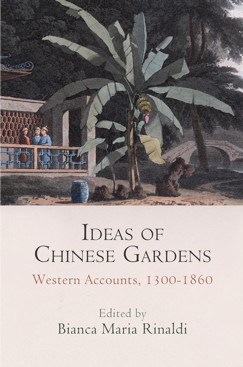 Europeans may be said to have first encountered the Chinese garden in Marco Polo’s narrative of his travels through the Mongol Empire and his years at the court of Kublai Khan. His account of a man-made lake abundant with fish, a verdant green hill lush with trees, raised walkways, and a plethora of beasts and birds took root in the European imagination as the description of a kind of Eden. Beginning in the sixteenth century, permanent interaction between Europe and China took form, and Jesuit missionaries and travelers recorded in letters and memoirs their admiration of Chinese gardens for their seeming naturalness. In the eighteenth century, European taste for chinoiserie reached its height, and informed observers of the Far East discovered that sophisticated and codified design principles lay behind the apparent simplicity of the Chinese garden. The widespread appreciation of the eighteenth century gave way to rejection in the nineteenth, a result of tensions over practical concerns such as trade imbalances and symbolized by the destruction of the imperial park of Yuanming yuan by a joint Anglo-French military expedition.
In Ideas of Chinese Gardens, Bianca Maria Rinaldi has gathered an unparalleled collection of westerners’ accounts, many freshly translated and all expertly annotated, as well as images that would have accompanied the texts as they circulated in Europe. Representing a great diversity of materials and literary genres, Rinaldi’s book includes more than thirty-five sources that span centuries, countries, languages, occupational biases, and political aims. By providing unmediated firsthand accounts of the testimony of these travelers and expatriates, Rinaldi illustrates how the Chinese garden was progressively lifted out of the realm of fantasy into something that could be compared with, and have an impact on, European traditions.
Bianca Maria Rinaldi is Associate Professor of landscape architecture at the Polytechnic University of Turin.
New Book | Thomas Whately’s Observations on Modern Gardening
From Boydell & Brewer:
Michael Symes, Observations on Modern Gardening by Thomas Whately: An Eighteenth-Century Study of the English Landscape Garden (Martlesham, Suffolk: Boydell Press, 2016), 261 pages, ISBN: 978-1783271023, $56.
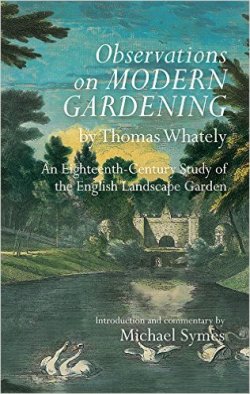 Thomas Whately’s Observations on Modern Gardening (1770) is the first and most comprehensive study of what has come to be known as the English landscape garden, often claimed to be this country’s greatest original contribution to the fine arts. It became the standard text on the subject; its authority was accepted at home and abroad, and the book was read widely across Europe, mainly in a French translation. It influenced taste and design; taught visitors how to respond to gardens; analysed natural and built elements of the garden; suggested principles of design; and provided descriptions of major gardens of the day, such as those at Blenheim and Piercefield (Monmouthshire), together with the author’s responses, aesthetic, mental and emotional. It indicates a taste for the natural and the ‘picturesque’, foreshadowing romanticism. This first modern edition of the text is accompanied by an introduction and full commentary, covering both general considerations and specific points and topics. Contemporary illustrations have been chosen to illuminate further the gardens and places discussed.
Michael Symes is an author, lecturer and garden historian. He founded the MA in Garden History at Birkbeck, University of London, and specialises in eighteenth-century gardens in Britain and on the continent.
C O N T E N T S
1 Introduction
2 Observations on Modern Gardening by Thomas Whately
3 Latapie and Whately
4 Commentary
Further Reading
Index of Place Names
At Sotheby’s | Musical Automaton ‘Bird Cage’ Clock
The clock dates to around 1825, but it is an eighteenth-century kind of object—a kind of object that’s not yet appeared here at Enfilade. Try a keyword search for ‘bird cage automaton’ (to the right) and now something turns up. Press release from Sotheby’s:
Important Watches (Sale #GE1601)
Sotheby’s, Geneva, 14 May 2016

Attributed to Jean-David Maillardet with clavier by Charles-Frédéric Nardin, musical automaton bird cage clock, ca. 1825–30 (Sotheby’s Sale #GE1601; estimate: $411,000–825,000).
Sotheby’s upcoming sale of Important Watches, to be held on Saturday, 14 May, will be led by an exceptional and rare musical automaton clock, shaped as a bird cage. This stunning object proudly showcases the very finest of Swiss craftsmanship: its external appearance combines exquisite design and detail, while its inner mechanics represent the most advanced horological complications of the age. The bird cage features two charming singing birds as well as a captivating butterfly. Thanks to three automaton mechanisms, the elements combine to form a delightful scene filled with movement and music. This exceptional piece will be offered with an estimate of CHF 400,000–800,000 ($411,000–825,000).
Speaking ahead of the sale, Pedro Reiser, Department Manager of Sotheby’s Watch Division in Geneva, commented: “It is truly an honour to have been entrusted with such an extraordinary timepiece for our upcoming auction of important watches. This wonderful automaton is a rare find—all the more exceptional because it features an automated butterfly. Records suggest that only one other double-bird cage clock with an automaton butterfly is currently known. We are delighted to be able to present this exquisite creation, which would be equally at home in the collection of a connoisseur or in a museum.”
The ornate cage, of chiselled golden bronze, sits on four lion paw-shaped feet atop a pedestal. The whole structure is finished in shiny piqué-mat. Inside the rectangular cage are two singing birds, which jump from one perch to another, opening and closing their beaks alongside an animated fountain. The fountain is topped by a beautiful butterfly, whose hand-painted wings move as it turns within the cage. The mechanism articulating these delicate movements, built in brass and steel, are ingeniously concealed inside the lower section of the cage. The birdsong, mimicking canaries and nightingales, is reproduced by a combination of bellows, whistles and cams, enabled by an intricate fusee-and-chain mechanism. This feat of horological complexity can be attributed to a highly accomplished craftsman, Jean-David Maillardet (1748–1834) from La Chaux-de-Fonds.
Birdcage clocks were primarily made between 1780 and 1840. In the late 18th century, singing birds were produced in extremely small quantities, and they were considered the ultimate in luxury. The number of privately held pieces has diminished greatly, and their appearance at auction generates tremendous interest.
The music box, which is concealed inside the base of this striking piece, plays three melodies which are triggered on the passing of each hour or on demand. The mechanism triggers brass cylinders, which in turn vibrate the 93 blades of the clavier, or the ‘comb’. The clavier is signed ‘C. F. Nardin’ for Charles-Frédéric Nardin from La Chaux-de-Fonds. The three charming melodies which can be selected include Der Jägerchor (The Huntsmen’s Chorus) by Carl Maria von Weber (1786–1826), written in 1820.
This masterpiece combines the exceptional skills of Swiss craftsmen, including horologists from Neuchatel, la Vallée de Joux and Geneva, who specialised in singing birds. Among the best known makers were Jaquet-Droz, Frédéric Leschot, Jacob Frisard, Jean-David Maillardet, the Rochat family and the Bruguiers. Their popularity can be seen to rise in parallel with the expanding commercial relationship with the Chinese, Ottoman and Russian markets, which blossomed towards the end of the eighteenth century.
Call for Papers | SAH 2017, Glasgow
From SAH:
2017 Society of Architectural Historians Conference
Glasgow, 7–11 June 2017
Proposals due by 6 June 2016
The Society of Architectural Historians is now accepting abstracts for its 70th Annual International Conference in Glasgow, Scotland, June 7–11. Please submit an abstract no later than June 6, 2016, to one of the 32 thematic sessions, the Graduate Student Lightning Talks, or the open sessions. The thematic sessions have been selected to cover topics across all time periods and architectural styles. SAH encourages submissions from architectural, landscape, and urban historians; museum curators; preservationists; independent scholars; architects; and members of SAH chapters and partner organizations.
Please note that those submitting papers for the Graduate Student Lightning Talks must be graduate students at the time the talk is being delivered (June 7–11, 2017). Open sessions are available for those whose research does not match any of the themed sessions. Instructions and deadlines for submitting to themed sessions and open sessions are the same.
Submission Guidelines
1 Abstracts must be under 300 words.
2 The title cannot exceed 65 characters, including spaces and punctuation.
3 Abstracts and titles must follow the Chicago Manual of Style.
4 Only one abstract per conference by author or co-author may be submitted.
5 A maximum of two authors per abstract will be accepted.
Abstracts are to be submitted online at the SAH website.
A selection of sessions of particular relevance for scholars working on the eighteenth century are included below. See the call for papers for the full list.
◊ ◊ ◊ ◊ ◊
‘A Narrow Place’: Architecture and the Scottish Diaspora
Session Chair: Neil Jackson, University of Liverpool
This session, which is hosted by the Society of Architectural Historians of Great Britain, invites papers on Scottish architects who have made their mark outside their native country. Despite the Acts of Union of 1707, south of the border was, and still is, a separate country, and it has been in England that many Scottish architects, from James Gibbs to Norman Shaw and Basil Spence have built their best work. The colonies, and later the British Empire, attracted a disproportionate number of Scots: to America went Robert Smith who built Nassau Hall at Princeton University and who sat on the First Continental Congress of 1774, while to Canada, South Africa, Australia and New Zealand went others, either to official positions or simply to make a living. Most recently, in 2015, Kirsteen MacKay was appointed Government Architect in South Australia. “Scotland,” Robert Adam wrote in 1755, “is but a narrow place.” Was it just the opportunities offered elsewhere which, for so long, drew Scottish architects abroad, or something deeper—a need to atone for the supposed barrenness of their own country? Is there something in the Scottish architects’ character and education that allows them to be so peripatetic? What made Colen Campbell, Robert Adam and James Stuart, all resident in England, such propagandists of foreign architectures? Was it no more than informed patronage which brought Charles Cameron to the Moscow of Catherine the Great or encouraged James Stirling to design university buildings at Rice, Harvard, Cornell and UC Irvine—but only once in Scotland, at St Andrews? And could Kathryn Findlay ever have achieved in Scotland what she did in Japan? Papers which investigate any architectural aspect of the Scottish diaspora will be welcome.
◊ ◊ ◊ ◊ ◊
Architectural Ghosts
Session Chairs: Karen Koehler, Hampshire College, and Ayla Lepine, University of Essex
This session explores the concept of the ghostly in architecture. While the ‘ghost’ in architecture might refer to actual haunted places, it also refers to the unfinished, the remnant, the referenced, the remembered, and the ruined. How, when, and where do we find and interpret the ghostly in architecture? Whether it be the flicker of spatial remembrance like a passing sense of cold, the palimpsest of a former window on a solid brick wall, or a crumbling foundation overgrown in the woods—spirits, souls, traces, and the spaces in between abound in our experience of, and critical approaches to, architecture and its histories. The ghostly can complicate ideas about originality, temporality, authenticity, and the sacred. It may imply a process of design that could linger in uncanny twilight between the conscious and the unconscious. Moreover, might architectural ghostliness lure us towards nostalgia, utopia, and imagined histories? Architects haunted by various histories may be caught up in the ghostly too: the spectres of lost opportunities or ruined spaces, and, significantly, the persistent power of the past. The concept of the architectural phantom could equally imply spaces of the ephemeral—opening up possibilities of the architectural image in visual culture or performative practices. What can writers—from ancient dramas to gothic tales to modern critical theory—offer to the study of the ghostly in design? We are interested in papers that explore any aspect of the architectural ghost: the unfinished project, the troubled biography, the voices of the memorialized in monuments or crypts, the fragment and its imagined completion, or any case study or theoretical paradigm in which architectural apparitions, residues, shadows or wraiths might be found.
◊ ◊ ◊ ◊ ◊
Architecture and Carbon
Session Chairs: Jason Nguyen, Harvard University, and Marrikka Trotter, Harvard University
In the eighteenth century, the scientist René-Antoine Ferchault de Réaumur set about differentiating steel from cast iron. What separated them, he discovered, was their carbon content, and he praised the lower levels in steel for its artistic and industrial benefits. Later, John Ruskin lectured his Victorian audience that limestone was nothing but carbon, air, and lime: “the breath of the earth joining with the cold metals produced a thing that was a blessing to man.” Today, the element evokes images of damaging excess rather than the promise of a limitless resource. Creating a ‘carbon-neutral economy’ was the goal of the COP21 conference, which proposed leveraging taxes against greenhouse emissions. As these examples suggest, architecture’s entanglements with carbon range from materials science to ethical claims and cultural taboos. Yet even casual borrowings like the expression ‘the building block of life’ underscore carbon’s fundamental role in human existence. On the one hand, it is an essential component of all living assemblies, from DNA to the plants and animals making human life possible. On the other, as we plunder the carbon-rich remains of previous mass-extinctions, we risk precipitating our own. This panel seeks to probe architecture’s relationships with carbon in its multiple guises, across any period or region. We ask that papers attend to architecture’s engagement with nature in its elemental forms, preferring case studies to trans-historical speculation. How has the study, manufacturing, or use of carboniferous resources influenced architecture and its discourses? What are the stakes where the ‘organic’ or ‘sustainable’ are concerned? What avenues have been opened by non-carbon-based products like glass and silicon? How might these inquiries relate to larger discussions on nature and man’s place within it?
◊ ◊ ◊ ◊ ◊
Chinese Architecture and Gardens in a Global Context
Session Chair: Tracy Miller, Vanderbilt University
Although known as one of the world’s most distinctive cultural traditions, the architecture of China did not develop in isolation. Ongoing research in the field continues to break new ground regarding the complexity of the ‘architectures’ of traditional China and the ways in which they influenced, and were influenced by, the artistic and philosophical traditions of other regions. The goal of this panel is to provide a forum to discuss the influence of global networks of exchange on the development of the architecture China, broadly construed. Possible topics would include: the impact of non-native religious traditions, such as Buddhism and Islam, on the development of temple architecture; how conceptions of paradise and the exotic from South and West Asia inspired innovations in landscape garden design in the Chinese context; the influence of Chinese garden design and horticulture elsewhere in Eurasia and the US; and how concerns for sovereignty impacted the choice of architectural style in East Asia during periods of aggressive imperialism in the recent, and more distant, past. In an effort to foster lively discussion and introduce creative approaches to the examination of the role of China within global architectural history, the final panel will be composed of papers emerging from a variety of theoretical and methodological perspectives.
◊ ◊ ◊ ◊ ◊
Colour and Light in Venetian Architecture
Session Chairs: Andrew Hopkins, University of L’Aquila, and Deborah Howard, University of Cambridge
The session explores the ways in which architects in Venice manipulated colour and light. How did light reflected upward from water surfaces influence design decisions on canal facades? How was lighting adapted to the respective needs of coloured or whitewashed interiors? Shadows and darkness also deserve attention. That the facades of both major plague churches, the Redentore and the Salute, are almost permanently in shadow might have a symbolic meaning. The use of Murano glass chandeliers seen through large windows changed the city’s appearance at night, making Venetian palaces glow like lanterns. How were streets and campi lit after dark: did moonlight and starlight prove adequate in a less lightpolluted environment than today? In what ways were lighting and colour controlled or modified to create a particular religious effect? How were existing churches modified in the post-Tridentine era? How did the hanging of carpets and tapestries transform church interiors and palace facades on special occasions? How did the use of coloured materials change over time? Did the availability of marbles and glass mosaic condition the local demand for polychromy? Did the colours used in Venetian painting, and the flourishing trade in pigments, influence architectural patronage and practice? Did colour symbolism confer specific meanings on different marbles? What effect did the burgeoning phenomenon of architectural treatises—all printed in black and white— have on the perception of architectural colour from the sixteenth century onwards? How were changes to material colour perceived, such as the rebuilding in stone of the Rialto bridge rather than in wood? Can different colour choices be defined for different patronage groups? This session invites proposals on any dimension of the use of light and colour in the Venetian townscape, whether in terms of design, construction or meaning.
◊ ◊ ◊ ◊ ◊
Evidence and Narrative in Architectural History
Session Chairs: Michael Osman, University of California, Los Angeles, and Daniel M. Abramson, Tufts University
To write histories of architecture necessarily employs tools of rhetorical persuasion: what facts to select in support of an argument, and how to sequence events to tell a convincing story. Architectural historians, however, have generally not been self-conscious about these devices. What kinds of facts are deployed as evidence in architectural history? What kinds of stories do we tell to make sense of events? How have strategies for evidence and narrative evolved over time in architectural history? Nor have architectural historians usually explored the methods of evidence and narrative they share with other disciplines, and what may be particular to architectural history. Like other historians, for example, architectural historians take much of their evidence from textual archives. But photographs, drawings, buildings, and other material objects also support our arguments and stories. How are these materials selected and deployed as evidence in architectural history? How do they relate to techniques for developing evidentiary claims in other fields, such as science or law? This session, on the uses of evidence and narrative in the historiography of architecture, welcomes papers from all periods and all geographies. The aim is to focus on methodological questions in historical scholarship. Papers may focus on a particular text or work of an architectural historian; or within a group of texts and/or figures within a period in architectural history. Papers may also treat narrative and/or evidence in architectural history from a theoretical perspective, and in comparison with other disciplines. We are particularly interested in papers that point to specific problems of using evidence and narrative to position buildings, cities, and architectural techniques, in a broader account of historical change.
◊ ◊ ◊ ◊ ◊
Piranesi at 300
Session Chairs: Heather Hyde Minor, University of Notre Dame, and John Pinto, Princeton University
Giovanni Battista Piranesi (1720–1778), one of the most outstanding graphic artists of any age, made enduring contributions to both the representation of architecture and the narrative of its history. Through the alchemy of his etching needle, he gave expression to the mute poetry of Roman ruins. Piranesi also published a series of artfully structured volumes in which he orchestrated textual erudition and visual pyrotechnics to advance his polemical views on the history of architecture. Always a passionate advocate of the virtues of creativity and innovation over blind adherence to rules, Piranesi became a touchstone in the roiling Quarrel of the Ancients and Moderns. Piranesi’s polemical publications and extensive corpus of over one thousand prints extended his reach and exerted a powerful influence on architectural discourse that persists into our own day. Much new information relating to Piranesi has emerged in recent years, such as numerous drawings, archival documents, and the eloquent testimony of his surviving copper plates, which have recently been conserved. In the run-up to the three-hundredth anniversary of Piranesi’s birth in 2020, we propose a session that will provide a fresh view of Piranesi and his place in the history of architecture. We invite papers that address such themes as Piranesi’s representational strategies, his polemical vision of architectural history, his audience and reception, as well as how his ideas and his art have been taken up in more recent years.
◊ ◊ ◊ ◊ ◊
Graduate Student Lightning Talks
Session Chair: R. Scott Gill, University of Texas at Austin
The Graduate Student Lightning Talks provide graduate students with an invaluable opportunity to test their ideas, refine their thoughts, and enhance their presentation skills among a circle of empathetic and supportive peers. This session is composed of approximately 12 five-minute talks that allow graduate students to introduce their current research. We are seeking work in various forms, including a focused summation, concentrated case study, and methodological exegesis. The individual talks are divided into thematic groups with a short question and discussion period following each set of presentations. Graduate students are invited to submit a concise abstract (under 300 words). Authors/co-authors must be graduate students at the time the talk is being delivered (June 7–11, 2017). Preference will be given to doctoral students, but all graduate students are encouraged to apply, and the Lightning Talks co-chairs welcome geographic and institutional diversity.
New Book | Jacobites: A New History of the ’45 Rebellion
From Bloomsbury:
Jacqueline Riding, Jacobites: A New History of the ’45 Rebellion (London: Bloomsbury, 2016), 608 pages, ISBN: 978-1608198047, £25.
 The Jacobite Rebellion of 1745–46 is one of the most important turning points in British history–in terms of national crisis every bit the equal of 1066 and 1940. The tale of Charles Edward Stuart, ‘Bonnie Prince Charlie’, and his heroic attempt to regain his grandfather’s (James II) crown remains the stuff of legend: the hunted fugitive, Flora MacDonald, and the dramatic escape over the sea to the Isle of Skye. But the full story—the real history—is even more dramatic, captivating, and revelatory.
Much more than a single rebellion, the events of 1745 were part of an ongoing civil war that threatened to destabilize the British nation and its empire. The Bonnie Prince and his army alone, which included a large contingent of Scottish highlanders, could not have posed a great threat. But with the involvement of Britain’s perennial enemy, Catholic France, it was a far more dangerous and potentially catastrophic situation for the British crown. With encouragement and support from Louis XV, Charles’s triumphant Jacobite army advanced all the way to Derby, a mere 120 miles from London, before a series of missteps ultimately doomed the rebellion to crushing defeat and annihilation at Culloden in April 1746—the last battle ever fought on British soil. Jacqueline Riding conveys the full weight of these monumental years of English and Scottish history as the future course of Great Britain as a united nation was irreversibly altered.
Dr Jacqueline Riding specialises in eighteenth- and early nineteenth-century British history and art. She read History and Art History at the universities of Leicester, London and York, and has over twenty-five years’ experience working as a curator and consultant within a broad range of museums, galleries and historic buildings, including the Guards Museum, Tate Britain and Historic Royal Palaces. From 1993 to 1999 she was Assistant Curator at the Palace of Westminster and later founding Director of the Handel House Museum, London. Her publications include Houses of Parliament: History, Art, Architecture (2000). She was the consultant historian and art historian on Mike Leigh’s award-winning Mr. Turner (2014) and is the consultant historian on his next feature film, Peterloo. Jacqueline Riding is an Associate Research Fellow in the School of Arts, Birkbeck College, University of London and lives in South London.










 Enfilade
leave a comment