Display | American Made

John Singleton Copley (1738–1815), The Western Brothers, 1783, oil on canvas, 50 × 62 inches (The Huntington Library, Art Collections, and Botanical Gardens)
◊ ◊ ◊ ◊ ◊
From The Huntington:
American Made: Selections from The Huntington’s Early American Art Collections
The Huntington Library, Art Collections and Gardens, San Marino, CA, 5 September 2015 — 4 January 2016
While a portion of the Virginia Steele Scott Galleries of American Art is closed for expansion and reinstallation, 25 selections from among the earliest works in the collection are spotlighted in a temporary installation, focusing on masterworks in various media that were made between 1700 and 1868. Paintings by the most influential American artists of the period, such as Benjamin West, John Singleton Copley, Gilbert Stuart, and Frederick Edwin Church, are joined by representative furniture, silver, and sculpture from the colonial, Federal, and Civil War periods.
Exhibition | Canaletto’s Vedute Prints

Canaletto (Giovanni Antonio Canal), La Libreria. V. (The Library,
Venice), ca. 1740–44. Etching on laid paper (Hood Museum of Art,
Dartmouth College: Gift of Jean Weil in memory of Adolph Weil Jr.,
Class of 1935, PR.997.5.37)
◊ ◊ ◊ ◊ ◊
Press release (13 July 2015) for the exhibition now on view at the Hood Museum of Art:
Canaletto’s Vedute Prints
Montgomery Museum of Fine Arts, Montgomery, Alabama, 10 January — 8 March 2015
Hood Museum of Art, Dartmouth College, Hanover, New Hampshire, 1 August — 6 December 2015
Beginning August 1, 2015, the Hood Museum of Art, Dartmouth College, will present an exhibition of thirty etchings from the museum’s collection that represent a nearly complete set of Venice-inspired prints by Giovanni Antonio Canal (1697–1768). Known as Canaletto, the artist is famous for his luminous, sweeping views of the Grand Canal and Piazza San Marco. The Vedute, a series of prints he made in the early 1740s, reveal another, often more modest, side of Venice. These scenes are intimate in scale and depict an extraordinary variety of subject matter, encompassing both real and imaginary views, from urban portraits to bucolic landscapes. This exhibition presents the full range of Canaletto’s Vedute project while celebrating the legacy of Adolph J. ‘Bucks’ Weil, Dartmouth Class of 1935, an astute and generous collector who assembled this remarkable suite of etchings and over his lifetime amassed one of the most impressive collections of Old Master prints in the country.
Mr. Weil’s many extraordinary gifts to the Hood include exceptional prints by such artists as Albrecht Dürer, Lucas van Leyden, Rembrandt van Rijn, Jacques Callot, and Francisco Goya. The Vedute etchings were donated to the museum by Jean K. Weil, following the wish of her late husband. Through this exhibition devoted to Canaletto, the Hood is honored to highlight an important facet of Mr. Weil’s distinguished collection in recognition of the one hundredth anniversary of his birth.
It is difficult to imagine an artist more intimately associated with a city than Canaletto. For centuries, his name has been synonymous with topographical cityscapes of Venice known as vedute (views). His meticulously detailed paintings of such familiar vistas as the Grand Canal and Piazza S. Marco celebrate the city’s stunning beauty and became coveted mementoes for English gentlemen to bring home from the Grand Tour. Given his fame as a landscape painter and the demand for his trademark Venetian scenes, it is remarkable that he turned, albeit very briefly, to a new medium and format for his art.
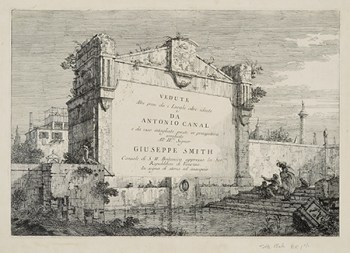
Canaletto (Giovanni Antonio Canal), Title Plate, Vedute Series, ca. 1744, etching on laid paper (Hood Museum of Art, Dartmouth College: Gift of Jean Weil in memory of Adolph Weil Jr., Class of 1935; PR.997.5.22)
In the early 1740s, Canaletto embarked on a project to create a series of etchings dedicated to (and most likely financed by) Joseph Smith, the British consul to the Venetian Republic, who acted as his agent on behalf of foreign collectors. Unlike his painted views of Venice, the Vedute prints present an unexpected side of the artist and offer an alternate window into eighteenth-century Venetian life. Creative and at times whimsical, the scenes are often pastiches of real places and imaginary views. With few exceptions, they are not of the expected landmarks but show the more humble, everyday aspects of the city, such as modest dwellings and little byways; others are fantasies, ranging from elaborate caprices to intimate backyard scenes and wild landscapes. The Vedute prints thus reveal an unknown artist and a hidden city and its environs, beyond the vision packaged for tourists and outsiders.
Canaletto, after years of precisely transcribing the glory of Venetian tourist sites, clearly delighted in the creative freedom of this project, combining disparate elements to create a romantic portrait of the Venice he knew so well. With unfamiliar etching tools in hand, he flourished with newfound spontaneity and economy of line. Even in the few recognizable Venetian scenes included in the series—La Libreria, for example—Canaletto downplays the soaring architecture to focus on the activities of everyday Venetian life, such as children playing, nuns promenading, and merchants haggling.
Offering creative combinations of fantasy and reality, inventive conflations of the romantic past with a precarious present, and a peek at the domestic side of Venice, the Vedute represent a significant departure from Canaletto’s previous work. Equally, they reveal an unexpected virtuosity in a medium that was entirely new to the artist. The reason for Canaletto’s shift to printmaking at the peak of his fame as a landscape painter remains unclear. In part, the Vedute prints may have been an answer to the artist’s critics and detractors, who favored a more imaginative, rather than topographical, approach. For all of their inventiveness and skillful yet spontaneous execution, they are now considered some of the finest examples of etching of the eighteenth century.
The Canaletto exhibition is complemented by an installation of eight late nineteenth- and early twentieth-century American etchings of Venice by James McNeill Whistler and his circle, all of them drawn from the Hood’s collection. Whistler, who greatly admired Canaletto, was a major influence in the development of the late nineteenth-century American etching revival.
Canaletto’s Vedute Prints will be on view at the Hood from August 1 through December 6, 2015. It is accompanied by a twenty-page booklet with essays by former Hood Assistant Curator for Special Projects Sarah G. Powers and Montgomery Museum of Fine Arts Curator of Collections Margaret Lynne Ausfeld. The booklet was co-published with the Montgomery Museum of Fine Arts, located in Mr. Weil’s hometown of Montgomery, Alabama, where a version of the exhibition was on view in the spring of 2015. The MMFA also benefited from donations from Mr. Weil’s outstanding collection of prints, including several impressions of Canaletto’s Vedute etchings.
To celebrate the exhibition, Frederick Ilchman, Chair, Art of Europe, Museum of Fine Arts, Boston, will deliver a lecture titled “Viewing Eighteenth-Century Venice with Canaletto and Casanova” in the Hood Museum of Art Auditorium on Friday, October 23, at 5:00pm. A reception will follow in Kim Gallery. Dartmouth College Studio Art Professor Louise Hamlin will also give a lunchtime gallery talk titled “Canaletto from an Artist’s Perspective” in the exhibition gallery on Tuesday, October 6, at 12:30pm.
This exhibition was organized by the Hood Museum of Art and the Montgomery Museum of Fine Arts, Montgomery, Alabama, and generously supported by the William Chase Grant 1919 Memorial Fund.
Art Fair | Ceramics and Arts du Feu

◊ ◊ ◊ ◊ ◊
Next month in Paris:
8ème Parcours de la Céramique et des Arts du Feu
Paris, 22–27 September 2015
This year, participants will gather in the heart of the French capital, mainly within the Carré Rive Gauche, 75007 Paris. This event will last six days, from Tuesday 22 September until Sunday 27 September 2015, from 11am to 8pm, with an evening opening on the first day and closing at 6pm on the Sunday. The twenty-four participating French and European specialist antique dealers and gallery owners come from Paris, London, Rome, Brussels, etc. and are all members of the Association des Spécialistes de la Céramique de Collection. They will be offering quality pieces from all civilisations and all periods, within a wide price range, and specially set aside for this event. Encouraged by the participating dealers and with the warm support of museum curators, the Association des Spécialistes de la Céramique de Collection, whose aim is to promote ceramics and Arts du Feu, will be organising two days of lectures.
The cultural project of the 8th circuit will be celebrating the Adda Collection on the fiftieth anniversary of its sale by auction at Palais Galliéra, Paris, in 1965. This historic event lasted a whole week and saw the dispersal of exceptional pieces of Italian Majolica, items of Hispano-Mauresque origin, Chinese and Middle-Eastern ceramics, glass and enamels.
Lectures will be given on Wednesday 23 September 2015 on the following subjects: the transformation of the market for Italian Majolica over the last 50 years and the evolution in prices, and the scientific advances in attributions over the same period. Vincennes and Sèvres sculpture of the 18th century will be honoured with two lectures on this theme on Thursday 24 September, coinciding with the exhibition at Sèvres, Cité de la Céramique.
The 8th circuit of Ceramics and Arts du Feu is open to all: enthusiasts, art lovers, curators, historians and anyone tempted by this ceramic feast. You will discover not only rare and magnificent Italian majolica, faience, Chinese terracotta and porcelain, Iznik and Middle-Eastern ceramics, Meissen and Sèvres porcelain, but also enamels and antique and modern glass, not forgetting contemporary ceramics.
We are particularly grateful to our participating colleagues who run galleries specialising in the 20th and 21st centuries. They are numerous this year: Galerie Jean d’Albis, Galerie Arcanes, Galerie France de Forceville, Galerie Michèle Hayem, Lefebvre & Fils, Galerie Dumonteil, Gendras Regnier.

Earliest Topographical View of Niagara Falls

Thomas Davies, An East View of the
Great Cataract of Niagara, 1762
◊ ◊ ◊ ◊ ◊
From Art Daily (21 August 2015). . .
The very first eyewitness representation of Niagara Falls, a 1762 topographical watercolour by Thomas Davies, is at risk of being exported from the UK unless a buyer can be found to match the £151,800 asking price. In order to provide a last chance to keep it in the UK, Culture Minister Ed Vaizey has placed a temporary export bar on the watercolour by Captain Thomas Davies, An East View of the Great Cataract of Niagara.
The topographical watercolour of Niagara Falls by Captain Thomas Davies provides the very first accurate portrait of this iconic landscape, which has become one of the most recognisable views in the world. It was also the earliest inclusion of Niagara’s ever-present rainbow. Captain Thomas Davies was highly regarded as a military artist and collector, and this watercolour and Davies’ career was testament to Britain’s global role in the eighteenth century.
Culture Minister Ed Vaizey said, “This watercolour painting not only provides us with the first glimpse of Niagara Falls, but it also sheds light on Britain’s achievements in eighteenth-century exploration, military and topographical art. I hope that the temporary export bar I have put in place will result in a UK buyer coming forward and that the watercolour will be available for all to better understand Britain’s global role in the eighteenth century.”
While there are many examples of military artwork in the eighteenth century, military artist drawings of North America during this century are rare. Davies was the first military artists to record Niagara falls, and this particular watercolour is important in the study of the history of British military, topographical art and exploration. The watercolour previously belonged to Peter Winkworth, who had built an extensive collection of artwork of Canadian scenes.
Vaizey took the decision to defer granting an export licence for the watercolour following a recommendation by the Reviewing Committee on the Export of Works of Art and Objects of Cultural Interest (RCEWA), administered by Arts Council England. The RCEWA made their recommendation on the grounds of it’s close association with our history and national life, and its significance for the study of Britain’s history in the fields of eighteenth-century exploration, scientific and military endeavour.
RCEWA Member Christopher Wright said, “The significance of the work of the draughtsmen produced by the Military Academy at Woolwich has only come to be fully appreciated by a nonspecialist audience in the last few decades. That Captain Thomas Davies should have produced the first scientifically and topographically accurate portrayal of the greatest natural wonder of North America at the very moment that Wolfe’s victory at Quebec had brought the whole of the continent’s eastern landmass under British control at once gives him a pre-eminent place in the Woolwich tradition. However, most of his work has already left these shores. Davies produced three views of Niagara. An East View of the Falls, arguably the most important of the three, is the only one now remaining in this country.”
The decision on the export licence application for the watercolour will be deferred for a period ending on 18 November 2015 inclusive. This period may be extended until 18 February 2016 inclusive if a serious intention to raise funds to purchase the watercolour is made at the recommended price of £151,800 (inclusive of VAT).
Exhibition | Murat, King of Naples
Now on view in Naples:
Murat re di Napoli: A passo di carica
Il Palazzo Reale, Naples, 19 May — 29 September 2015
Dal 19 maggio al 29 settembre 2015 nel Salone d’Ercole del Palazzo Reale di Napoli si terrà un’interessante mostra sul decennio francese a Napoli ed in particolare sul periodo di regno di Gioacchino Murat (1767–1815).
 La mostra è organizzata dalla Soprintendenza Beni ai Architettonici di Napoli, assieme con l’Ambasciata di Francia in Italia ed il Consolato francese a Napoli in occasione del bicentenario della morte di Gioacchino Murat e sarà uno degli appuntamenti più importanti a Napoli tra la primavera e l’estate del 2015.
Murat re di Napoli. A passo di carica, propone in mostra oltre 150 pezzi molti dei quali provengono da collezioni di musei francesi e vengono esposti per la prima volta in Italia: tra questi due famose spade quella a lama ricurva che Murat impugna nella campagna d’Egitto e la spada cerimoniale da “Maresciallo dell’Impero.”
Tante le opere interessanti tra dipinti, incisioni, porcellane, miniature che consentono di ricostruire il “Decennio francese” quando dal 1806 due re francesi si succedettero sul trono del Regno di Napoli. Il primo fu Giuseppe Bonaparte, fratello di Napoleone che regno fino al 1808 quando poi andò in Spagna: gli seguì suo cognato Gioacchino Murat, che regnò fino al 1815. In quel periodo Ferdinando IV di Borbone fuggiva in Sicilia per poi riorganizzare la riconquista del suo regno. Il 13 ottobre 1815 Murat fu catturato e fucilato dai reparti borbonici a Pizzo Calabro ed il Regno di Napoli ritornò in possesso di Ferdinando IV di Borbone, che l’8 dicembre 1816 cambiò nome e prese il titolo di Ferdinando I, re del nuovo Regno delle Due Sicilie.
La mostra, che non a caso si chiama Murat re di Napoli. A passo di carica celebra, attraverso interventi multimediali e pannelli esplicativi, l’intenso cambiamento che si ebbe a Napoli in quel periodo. La città subì infatti una grande modernizzazione e fu ridisegnata dai progetti e dalle trasformazioni urbanistiche volute dal giovane sovrano. Nel decennio tra l’altro ci fu l’abolizione della feudalità, l’introduzione dello Stato moderno e del Codice civile, la creazione di un’organizzazione moderna dello stato con nuove intendenze, tribunali, uffici provinciali e la riforma dell’Università in cui, attraverso la Scuola di Ponti e strade, fu creata anche l’attuale Facoltà di Ingegneria.
Exhibition | Fragonard in Love: Suitor and Libertine
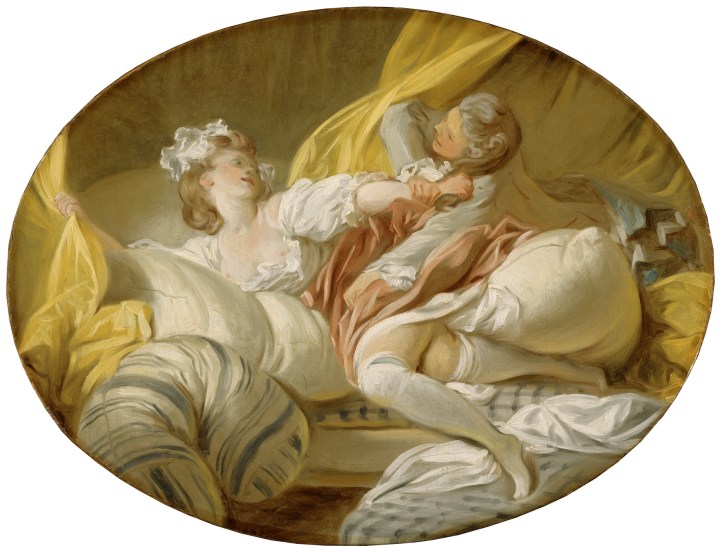
Jean-Honoré Fragonard, Useless Resistance, 1770–73,
18 × 24 inches, 45 × 60 cm (Stockholm: Nationalmuseum)
◊ ◊ ◊ ◊ ◊
Opening next month at the Musée du Luxembourg:
Fragonard Amoureux: Galant et Libertin
Fragonard in Love: Suitor and Libertine
Musée du Luxembourg, Paris, 6 September 2015 — 24 January 2016
Curated by Guillaume Faroult
According to the Goncourt brothers, the eighteenth century was an era of seduction, love and intrigue, and Jean-Honoré Fragonard (1732–1806) might have been its main illustrator, if not its main agent. Indeed, the inspiration of love runs through Divine Frago’s protean and generous work, from his early bucolic compositions to the love allegories found in his later works. In turn gallant, libertine, daringly lustful or conversely concerned with new love ethics, his art spans half a century of artistic creativity with ardour and elegance, endlessly reinventing itself to better capture the subtle variations of emotion and love impulse.
Presenting Fragonard’s work for the first time through this love prism, this exhibition at the Musée du Luxembourg focuses on the mid-eighteenth century, a time when the spirit of Enlightenment was deeply influenced by English sensualism. The topic of how to delicately express sensuality and emotion was then at the heart of philosophical, literary and artistic concerns. Strongly imbued with these questions as he emerged from François Boucher’s studio, the young Fragonard already brings to fashionable pastoral and mythological compositions a fresh sensitivity, unquestionably marked by sensuality, yet more profound than the strict libertine strategy.

Jean Honoré Fragonard, The Stolen Kiss, ca. 1760, 19 x 25 inches, 48.3 x 63.5 cm (New York: Metropolitan Museum of Art)
At the same time, his study of Flemish masters encourages him to transition from sophisticated eroticism to rustic scenes that take on an unequivocal carnal dimension, such as The Stolen Kiss from The Metropolitan Museum of Art. Talented illustrator of La Fontaine’s least restrained Tales, Fragonard, like his colleague, miniaturist and libertine Pierre-Antoine Baudoin, displays an audacity that often matches that of many progressive writers and intellectuals of his time, such as Diderot in The Indiscreet Jewels. Indeed, forceful yet allusive ‘secret’ works for licentious amateurs, created at the beginning of the 1760, contributed to portraying Fragonard as a libertine and painter of ladies’ salons and other intimate scenes. This impish inspiration transpires through a great variety of expressions, from the naughty Useless Resistance in the Nationalmuseum in Stockholm to the sensual yet delicate Kiss (private collection).
In parallel with this independence of mind—or free licence—Fragonard strove to renew with great poetry the theme of fête galante, inherited from Watteau, as the timeless Île d’amour (on loan from the Fondation Calouste Gulbenkian) testifies. Later, in the 1770 and 1780s, following in the steps of the famous The Lock from the Louvre and as de Laclos’s Liaisons Dangereuses knelled the end of literature’s libertine inspiration, his art reached a decisive turning point as he began to explore the true feeling of love through allegories swept by a most delicate lyricism. With infinite subtlety, Fragonard dealt with the mystical dimension of profane love, at the root of what was to become ‘romantic love’.
 S E C T I O N S
Introduction
The Gallant Shepherd
The Loves of the Gods
Rustic and Popular Eros
Fragonard, Illustrator of Libertine Tales
Pierre-Antoine Baudouin, A Libertinist Master
Fragonard and Licentious Imagery
Dangerous Reading
The Revival of the Fête Galante
Love Moralised
Heroic Passion
Romantic Allegory
Curators: Guillaume Faroult, Head of Conservation, Paintings Department, Musée du Louvre, 18th-century French paintings Manager.
Scenography: Jean-Julien Simonot
This exhibition is produced by the Réunion des Musées Nationaux-Grand Palais.
The catalogue is available from Artbooks.com:
Guillaume Faroult, ed., Fragonard Amoureux: Galant et Libertin (Paris: Musées Nationaux, 2015), 288 pages, ISBN: 978-2711862344, 45€ / $75.
Exhibition | Élisabeth Louise Vigée Le Brun (1755–1842)
Opening next month in Paris at the Grand Palais:
Élisabeth Louise Vigée Le Brun (1755–1842)
Grand Palais, Paris, 23 September 2015 — 11 January 2016
The Metropolitan Museum of Art, New York, 9 February — 15 May 2016
National Gallery of Canada, Ottawa, 10 June — 12 September 2016
Curated by Joseph Baillio and Xavier Salmon
This first retrospective devoted to the works of Elisabeth Louise Vigée Le Brun presents an artist whose life stretched from the reign of Louis XV to that of Louis-Philippe—one of the most eventful and turbulent periods in European and above all French history of modern times.
 Self-portraits by Vigée Le Brun abound: paintings, pastels and drawings that elegantly associate feminine grace and pride. With the Ancien Régime and its School of Fine Arts coming to an end, she supplanted most of her rival portrait artists. Vigee Le Brun used self-portraits to assert her status, circulate her image and show people the mother she had become despite the constraints of a career.
She made her greatest coup de force at the 1787 Exhibition where she presented two paintings that cannot be dissociated. First, a Portrait of Queen Marie-Antoinette posing for a portrait surrounded by her children in an attempt to rectify the image of an extravagant libertine; secondly, the portrait of a female artist hugging her daughter Julie to her chest in an effusive Raphael-like manner. The latter is one of the finest and most popular of the many works by this painter owned by the Louvre and has remained the emblem of «maternal tenderness» since it was first exhibited to the public. The culture of the Enlightenment and the influence of Rousseau obliged the artist to take on this role, which she did happily and with resounding success. As a counterpoint, she painted the Portrait of Hubert Robert. These paintings are absolute icons illustrating the joy of life and creative genius, complementing and communicating with each other.
What is even more remarkable was her determination to overcome obstacles hindering her career. Born in Paris in 1755, she came from a relatively modest background, her mother a hairdresser and her father a talented portrait artist. Her father died when she was a young adolescent. Drawing inspiration from his example, the brilliant young artist was accepted as a master painter at the Academy of Saint-Luc. In 1776, she married the most important art dealer of her generation, Jean Baptiste Pierre Le Brun (1748–1813), but this prevented her from being accepted at the Royal Academy of Painting and Sculpture because its regulations formally forbid any contact with mercantile professions. However, this union had a beneficial effect on her career. When the price of Flemish paintings soared, she learnt how to master the magic of colours and the fine craftsmanship of Rubens and Van Dyck. Her clientèle had mainly been the bourgeoisie but in 1777, she started working for the aristocracy, descendants of royal blood and finally Queen Marie-Antoinette. However, it was not until 1783 and the intervention of the Queen’s husband, Louis XVI, that the portrait artist was able to join the Royal Academy of Painting after much polemic.
Organized by the Réunion des musées nationaux/Grand Palais in Paris, The Metropolitan Museum of Art in New York, and the National Gallery of Canada in Ottawa.
The exhibition booklet is available here»
Details on the catalogue to follow later.
New Book | Then and Now: Collecting and Classicism
From McGill-Queen’s University Press:
Jean Coutu, Then and Now: Collecting and Classicism in Eighteenth-Century England (Montreal: McGill-Queen’s University Press, 2015), 340 pages, ISBN: 978-0773545434, $100.
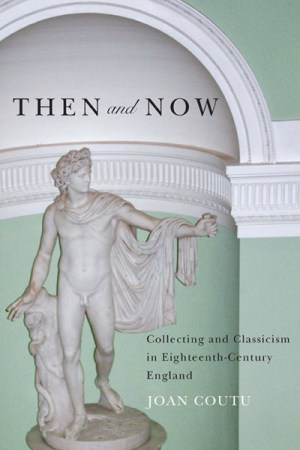 In the mid-eighteenth century, English gentlemen filled their houses with copies and casts of classical statuary while the following generation preferred authentic antique originals. By charting this changing preference within a broader study of material culture, Joan Coutu examines the evolving articulation of the English gentleman.
Then and Now consists of four case studies of mid-century collections. Three were amassed by young aristocrats—the Marquis of Rockingham, the Duke of Richmond, and the Earl of Huntingdon—who, consistent with their social standing, were touted as natural political leaders. Their collections evoke the concept of gentlemanly virtue through example, offering archetypes to encourage men toward acts of public virtue. As the aristocrats matured in the politically fractious realm of the 1760s, such virtue could become politicized. A fourth study focuses on Thomas Hollis, who used his collection to proselytize his own unique political ideology.
Framed by studies of collecting practices earlier and later in the century, Coutu also explores the fluid temporal relationship with the classical past as the century progressed, firmly situating the discussion within the contemporaneous emerging field of aesthetics. Broadening the focus beyond published texts to include aesthetic conversations among the artists and the aristocracy in Italy and England, Then and Now shows how an aesthetic canon emerged—embodied in the Apollo Belvedere, the Venus de’ Medici, and the like—which shaped the Grand Manner of art.
Joan Coutu is associate professor of art history and visual culture at the University of Waterloo, and author of Persuasion and Propaganda: Monuments and the Eighteenth-Century British Empire.
◊ ◊ ◊ ◊ ◊
C O N T E N T S
Figures
Acknowledgments
Introduction
1 Temporal Elision and Sculpture Collections in the First Half of the Eighteenth Century
2 An “Old Whig”: The 2nd Marquis of Rockingham and His Collections
3 The 3rd Duke of Richmond and His Sculpture Gallery in Whitehall: Munificence Worthy of a Prince
4 The 10th Earl of Huntingdon and the Arcadian Plains of Leicestershire
5 Thomas Hollis and His Life Plan
6 Conclusion: The Nuances of the Classical Archetype
Notes
Bibliography
Index
Lecture | Fit for a King: Louis XIV and the Art of Fashion
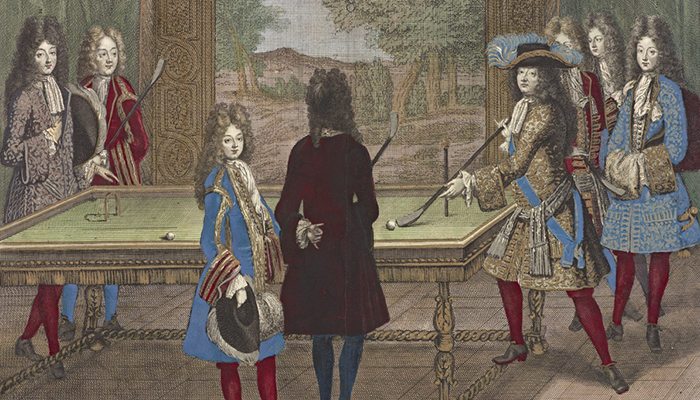
Antoine Trouvain, Third Apartment (detail), 1694. Hand-colored engraving and etching. From Appartements ou amusements de la famille royale à Versailles, a suite of 6 plates (The Getty Research Institute, 2011.PR.20)
◊ ◊ ◊ ◊ ◊
From The Getty:
Kimberly Chrisman-Campbell | Fit for a King: Louis XIV and the Art of Fashion
The Getty Center, Los Angeles, 23 August 2015
Louis XIV recognized fashion’s propaganda value as well as its economic importance, and he was deeply invested in establishing the technical and aesthetic superiority of France’s clothing and textile industries. Through prints, fashion plates, and his own oft-reproduced image, he set the standard of elegant dress and deportment throughout Europe. Art historian Kimberly Chrisman-Campbell examines the Sun King’s lasting contributions to French fashion as well as his own exquisite (and extravagant) taste. Sunday, August 23, 2:00pm.
This lecture complements the exhibition A Kingdom of Images: French Prints in the Age of Louis XIV, 1660–1715, organized in special collaboration with the Bibliothèque nationale de France and on view in the Getty Research Institute from June 16, 2015, to September 6, 2015.
Kimberly Chrisman-Campbell is an independent art historian specializing in fashion and textiles. She has worked as a curator, consultant, and educator for museums and universities around the world. Following the lecture, she will sign copies of her book, Fashion Victims: Dress at the Court of Louis XVI and Marie-Antoinette (Yale University Press, 2015), which will be available for purchase.
New Book | From Invention to Perfection
Published by Arnoldsche and available from Artbooks.com:
Sarah-Katharina Andres-Acevedo and Hans Ottomeyer, eds., From Invention to Perfection: Masterpieces of Eighteenth-Century Decorative Art (Stuttgart: Arnoldsche, 2015), 352 pages, ISBN: 978-3897904422, 78€.
 One hundred masterpieces of European art and arts and crafts of the eighteenth century form a panorama of innovation, design and expert realisation. In their sumptuous design, the porcelain, furniture, bronzes and silver objects are all miracles of the luxury craftsmanship found in court art. Such sophisticated design was the driving force behind the quickly successive styles of classicism, naturalism and the exotic design of the Rococo period. André-Charles Boulle, Jakob Philipp Hackert, Johann Joachim Kaendler, Alexandre-Jean Oppenordt und Jean-Baptiste François Pater are just some of the renowned artists featured in this catalogue. The artworks are opulently presented, interpreted in detail and arranged according to context. Thus the colourful image of a great era in art emerges, one that relied on creative energy and the power of the imagination.
With contributions by Sarah-K. Andres-Acevedo, Christine Cornet, Melitta Kunze-Köllensperger, Georg Lechner, Claudia Lehner-Jobst, Claudia Nordhoff, Hans Ottomeyer, Ulrich Pietsch, Christina Pucher, David Ranftl, Michael Röbbig-Reyes, Max Tillmann and Alfred Ziffer.










 Enfilade
leave a comment