Lecture | Pannill Camp on Masonic Ritual as Philosophy
From The Newberry:
Pannill Camp, Masonic Ritual as Philosophy in Early Eighteenth-Century France
The Newberry Library, Chicago, 25 April 2015
The story of Freemasonry’s introduction into France in the early decades of the eighteenth century is also in part the story of Enlightenment philosophy’s reliance on performance activity. Radical philosophy and freethinking did not subsist only in the circulation of printed texts. Natural philosophy was demonstrated in proliferating spaces of experimental proof, and esoteric thinkers devised ceremonies meant to serve as the basis of a new moral and intellectual reality. Figures credited with promoting French interest in Freemasonry, including J. T. Desaguliers, were also intimately involved in disseminating new knowledge about the natural world.
As part of a project that examines multiple categories of performance behavior that Freemasonry instituted and inspired in France, Professor Camp will propose that Masonic ritual activity represents a broader category of philosophical performance, encompassing works like John Toland’s 1720 Pantheisticon, which Margaret C. Jacob has provocatively called a Masonic ritual text. Examining this text alongside artifacts of proper Masonic rituals, Professor Camp will also argue that treating eighteenth-century French Freemasonry as an embodied philosophical pursuit may allow us to reconcile two disjointed themes that have so far characterized historians’ approaches to the topic. In other words, the ideals that motivated early Masonic activity, when viewed through the lens of performance, may also be seen as integral to the synthetic emotional bonds and sensitive masculine solidarity cultivated in lodge activity.
Eighteenth-Century Seminar, Saturday, April 25, 2015, 2pm.
Please register by 10am Friday, April 24.
Pannill Camp is Assistant Professor of Drama at Washington University, St Louis. His research examines points of intersection between theater history and the history of philosophy, especially in eighteenth-century France. He is the author of The First Frame: Theatre Space in Enlightenment France, (Cambridge University Press, 2015).
Mellon Lectures | Thomas Crow on Restoration as Event and Idea
Press release (20 February 2015) from NGA in Washington (after the fact, audio and video recordings are available here) . . .
Thomas Crow, Restoration as Event and Idea: Art in Europe, 1814–1820
64th Annual A. W. Mellon Lectures in the Fine Arts
National Gallery of Art, Washington, D.C., 15 March — 26 April 2015
 Thomas Crow, Rosalie Solow Professor of Modern Art at the Institute of Fine Arts, New York University, will give the 64th annual A. W. Mellon Lectures in the Fine Arts in a series entitled Restoration as Event and Idea: Art in Europe, 1814–1820. Crow will consider the period 1814–1820, following the fall of Napoleon. During this time, artists throughout Europe were left uncertain and adrift, with old certainties and boundaries dissolved. How did they then set new courses for themselves? Crow’s lectures will answer that question by offering both a wide view of art centers across the continent—Rome, Paris, London, Madrid, Brussels—and a close-up focus on individual actors—Francisco Goya (1746–1828), Jacques-Louis David (1748–1825), Antonio Canova (1757–1822), Sir Thomas Lawrence (1769–1830), Jean-Auguste-Dominique Ingres (1780–1867), and Théodore Géricault (1791–1824). Whether directly or indirectly, these artists were linked in a new international network with changed artistic priorities and new creative possibilities emerging from the wreckage of the old.
March 15: Moscow Burns/The Pope Comes Home, 1812–1814: David, Gros, and Ingres Test Empire’s Facade
March 22: At the Service of Kings, Madrid and Paris, 1814: Aging Goya and Upstart Géricault Face Their Restorations
March 29: Cut Loose, 1815–1817: Napoleon Returns, David Crosses Borders, and Géricault Wanders Outcast Rome
April 12: The Religion of Ancient Art from London to Paris to Rome, 1815–1819: Canova and Lawrence Replenish Papal Splendor
April 19: The Laboratory of Brussels, 1816–1819: The Apprentice Navez and the Master David Redraw the Language of Art
April 26: Redemption in Rome and Paris, 1818–1820: Ingres Revives the Chivalric while Géricault Recovers the Dispossessed
All lectures will take place on Sunday afternoons at 2:00pm and are free and open to the public. Because of the East Building renovation, the lectures will be presented in the West Building Lecture Hall, which has limited capacity. Entry passes (one per person) will be required for admission and will be distributed starting at 1:00pm on a first-come, first-served basis on the day of each lecture in the East Building Concourse. The lectures will be streamed live. At the Gallery, the live stream will be shown in the West Building Project Room and the East Building Reception Room. The live stream will also be available at the NGA website. On the Wednesday following each lecture, a video screening will be shown in the West Building Lecture Hall at noon. Audio recordings will be available each Tuesday, and video recordings with closed captioning will be available each Friday following the lecture here.
Thomas Crow is the Rosalie Solow Professor of Modern Art at the Institute of Fine Arts, New York University. He holds an MA and a PhD in art history from the University of California, Los Angeles, and a BA from Pomona College. His interests center on the entwined aesthetic and social dynamics in the production of art and the role of art in modern society.
Crow’s most recent book, The Long March of Pop: Art, Design, and Music, 1930–1995, was published by Yale University Press in January 2015. He is also the author of Emulation: Making Artists for Revolutionary France (1995, 2006); The Rise of the Sixties: American and European Art in the Era of Dissent (1996, 2005); The Intelligence of Art (1999); Modern Art in the Common Culture (1996); Painters and Public Life in Eighteenth-Century Paris (1985); and articles including “The Practice of Art History in America,” Daedalus 135 (Spring 2006) and “Marx to Sharks: The Art-Historical ’80s,” Artforum 41 (2003). He is a contributing editor of Artforum.
Crow has received numerous honors throughout his career, including the Eric Mitchell Prize for the best first book in the history of art (1986), the Charles Rufus Morey Prize of the College Art Association (1987), and a National Endowment for the Humanities Fellowship (1988–1989). He is a member of the American Academy of Arts and Sciences. He is currently the recipient of a John Simon Guggenheim Memorial Foundation fellowship (2014–2015) and spent the fall of 2014 as a Michael Holly Fellow at the Sterling and Francine Clark Art Institute.
Before his appointment at the Institute of Fine Arts, Crow was director of the Getty Research Institute, professor of art history at the University of Southern California, the Robert Lehman Professor of the History of Art at Yale University, and professor and chair in the history of art at the University of Sussex.
Call for Session Proposals | ASECS 2016, Pittsburgh
2016 American Society for Eighteenth-Century Studies Conference
Pittsburgh, 31 March — 3 April 2016
Session Proposals due by 1 June 2015
Proposals for panels at the at the 47th annual meeting of the American Society for Eighteenth-Century Studies, to take place in Pittsburgh, are now being accepted. Please complete the form (available as a Word document) and email it to asecs@wfu.edu.
ASECS Awards, 2014–15
A selection of this year’s ASECS awards that particularly relate to landscapes, images, objects, and material culture:
2014–15 Louis Gottschalk Prize
 Vittoria Di Palma, Wasteland: A History (New Haven: Yale University Press, 2014).
The American Society for Eighteenth-Century Studies awards annually the Louis Gottschalk prize to the best scholarly book on an eighteenth-century subject. The 2015 Gottschalk prize has been awarded to Vittoria Di Palma for Wasteland: A History (Yale University Press, 2014), an elegant, probing, and timely account of how the emerging discourse of modern aesthetics in Britain was inseparably intertwined with interest in certain ‘unimproved’ types of land. Di Palma’s work, which conjoins the resources of art history, landscape and garden studies, the history of science, and more disciplines still, is a scholarly tour-de-force that synthesizes disparate studies of subjects ranging from land enclosure to the sublime in order to shed new light on the prehistory of our current ecological challenges.
2014–15 James L. Clifford Prize
Paola Bertucci, “Enlightened Secrets: Silk Intelligent Travel, and Industrial Espionage in Eighteenth-Century France” published in Technology and Culture 54 (October 2013): 820–52.
Bertucci offers a critical examination of the relationship between the openness of academic knowledge and the secrecy of state affairs in the age of Enlightenment. Using the silk manufacturing industry of France and Piedmont as an example, she explores the ways in which technical intelligence was gathered under the guise of academic exchange and demonstrates that the seeming openness of academic culture was one of the resources that intelligent travelers mobilized to serve the state in secret.
2014–15 Women’s Caucus Editing and Translation Fellowship
There were five very fine submissions this year for the Women’s Caucus Editing and Translation Prize. The selection committee—which consisted of Katherine Binhammer, Katharine Kittredge, and Mary Trouille (Chair)—was especially impressed by the proposals submitted by Aileen Douglas and Catherine Sama. Since no prize was given last year, the Women’s Caucus kindly agreed to allow our committee to award a $1,000 prize to both Professors Douglas and Sama. Catherine Sama is Professor of Italian at the University of Rhode Island in Providence. She has published widely on eighteenth-century Italian women writers and artists. The title of her project is “Rosalba Carriera (1673–1757): Correspondence of a Venetian Artist.”
2014–15 Innovative Course Design Competition
Michael Gavin, “Modeling Literary History: Quantitative Approaches to the Enlightenment”
Estelle Joubert, “Music in the Global Eighteenth Century: A New Course Proposal”
Sean Silver, “The Novel and the Museum”
Symposium | The 2015 Newport Symposium
From The Preservation Society of Newport County:
North and South: Crosscurrents in American Material Culture
23rd Annual Newport Symposium, Newport, Rhode Island, 26–29 April 2015
Despite the sometimes irreconcilable differences that culminated in the Civil War (1861–65), Newport and other Northern cities maintained close social, economic, cultural, and artistic ties with the South from the Colonial period through the Gilded Age. The 2015 Newport Symposium, North and South: Crosscurrents in American Material Culture, invites a fresh look at regional differences in American furnishings, silver, textiles, painting, architecture, and interiors to reveal the complex exchange of ideas and enduring influences.
◊ ◊ ◊ ◊ ◊
S U N D A Y , 2 6 A P R I L 2 0 1 5
4:00 Opening Lecture
“Historic House Museums, North and South: Preserving Our Past, Enhancing Our Future,” George McDaniel (Executive Director, Drayton Hall, Charleston, SC)
In both the North and South, historic house museums are too often seen as staid institutions, stuck on giving only boring ‘velvet ropes’ tours and suffering from declining revenues and morale. While such examples do exist, there are also many house museums that are using their collections, their site, and their staff in innovative and strategic ways to reach out and make a difference in their communities and beyond, and to thereby play significant roles in preserving our past and enhancing our future.
5:00 Opening Reception at Rosecliff (1902)
M O N D A Y , 2 7 A P R I L 2 0 1 5
8:00 Registration and coffee
9:00 Welcome, Donald O. Ross (Chairman of the Board, The Preservation Society of Newport County)
9:30 “Pride & Prejudice: Understanding North and South,” Tom Savage (Director of Museum Affairs, Winterthur Museum)
At the first Williamsburg Antiques Forum in 1949, Joseph Downs, then curator of the American Wing at the Metropolitan Museum of Art, announced that “little furniture of artistic merit was ever produced south of Baltimore.” A southern matron asked politely but pointedly if Mr. Downs had spoken “out of prejudice or ignorance?” The battle cry that went out from that conference spawned the landmark 1952 exhibition Furniture of the Old South, 1640–1820 at the Virginia Museum and a special issue of The Magazine Antiques dedicated to southern furniture. In 1965, The Museum of Early Southern Decorative Arts (MESDA) opened in Winston-Salem, North Carolina. This lecture will examine the historiography of southern decorative arts research and the mythological perceptions that have pervaded our understanding of American material culture, both North and South.
10:30 Break
11:00 “He Went to War a Virginian But Came Home an American: General Washington’s Revolutionary Transformation of Mount Vernon,” Susan Schoelwer (Robert H. Smith Senior Curator, George Washington’s Mount Vernon)
George Washington’s wartime travels took him to countless communities in New England and the Middle States, giving him rich opportunities to compare country estates and city houses in these regions with more familiar examples in Virginia and Maryland. After the Revolution, he drew on these experiences to purposefully redesign Mount Vernon, his beloved home and estate on the Potomac River, to suit what he called his ‘Republican stile of living’. The resulting innovations—most notably the picturesque landscape surrounding the Mansion and the grand neoclassical interior that Washington called his ‘New Room’—vividly expressed his prescient vision for the future of the new American nation.
12:00 Lunch
1:30 Concurrent lectures and tours
“Beyond the Summer Colony: Exchange Between Charleston and Newport,” Brandy Culp (Curator Historic Charleston Foundation)
Because of its favorable climate and intellectual charm, Newport was a fashionable summer destination for many Charlestonians in the eighteenth and nineteenth centuries. In addition to being what some have called “the Bath of America,” Newport was an important partner in the coastal trade, and the two cities were economically linked. We will discuss the exchange of goods between Newport and Charleston facilitated by merchants such as Rhode Island native Nathaniel Russell, as well as the cultural connections that gave rise to Newport’s popularity among the southern colony.
“Elegant Boston Interiors 1789–1830,” Jane Nylander (President Emerita) and Richard Nylander, (Curator Emeritus, Historic New England, Boston, MA)
In two consecutive afternoon sessions, the Nylanders will discuss furnishings and interiors in the homes of Boston’s elite during the New Republic. Early nineteenth-century Boston witnessed changing styles of architecture and furniture, new technologies, increasing prosperity, and an expanded circle of world trade. Interiors featured both locally made and imported goods such as textiles and wallpaper, ceramics and glass, window curtains and carpets as well as paintings and sculpture, reflecting an increased interest in the fine arts.
3:00 Concurrent lectures and tours
“Finding the Sacred in the Secular: Eighteenth-Century Synagogue Architecture in Newport and Charleston,” Daniel Kurt Ackermann (Associate Curator, Museum of Early Southern Decorative Arts, Winston-Salem, NC)
Touro Synagogue in Newport, which opened in 1763, has long been held up as a symbol of religious tolerance in America. Indeed, both Touro and KKBE’s Synagogue in Charleston, South Carolina, were important buildings in their cityscapes. These two sacred buildings constructed in secular styles reflected the status and acceptance that Jews found in early America. They also reflected the webs of kinship, commerce, and faith that linked the Jews of Newport and Charleston to each other and to the rest of the Jewish Atlantic world.
“Elegant Boston Interiors 1789–1830,” Jane Nylander (President Emerita) and Richard Nylander, (Curator Emeritus, Historic New England)
In two consecutive afternoon sessions, the Nylanders will discuss furnishings and interiors in the homes of Boston’s elite during the New Republic. Early nineteenth-century Boston witnessed changing styles of architecture and furniture, new technologies, increasing prosperity, and an expanded circle of world trade. Interiors featured both locally made and imported goods such as textiles and wallpaper, ceramics and glass, window curtains and carpets as well as paintings and sculpture, reflecting an increased interest in the fine arts.
4:00 “Elegant Taking and Talking Tea: Gentility, Patriotism and Shared Conversations in Early America,” Martha Willoughby (Senior Specialist, Christie’s, London)
This lecture will look at the American tea party and its central role in social and cultural discourse during the eighteenth century. Throughout the colonies, the ritual of tea drinking and its symbolism of British tyranny during the Revolution provided a means for establishing and affirming bonds with neighbors, visitors and compatriots. A close look at the tea party’s guest of honor—the tilt-top tea table—will illustrate the lively and fruitful conversation of ideas between North and South.
5:00 Tea and refreshments
T U E S D A Y , 2 8 A P R I L 2 0 1 5
8:00 Registration and coffee
9:00 “North and South: Town & Country,” Trudy Coxe (CEO & Executive Director) and Laurie Ossman (Director of Museum Affairs, The Preservation Society of Newport County)
9:30 “‘Send None but the Finest Quality’: Art and Patronage in Early Maryland–The Edward Lloyd Family and Beyond,” Alexandra Kirtley (The Montgomery-Garvan Associate Curator of American Decorative Arts, Philadelphia Museum of Art)
Edward Lloyd settled on Maryland’s Eastern Shore in 1659. There he established a dynasty of gentleman farmers, whose lands eventually stretched the entire length of the Delmarva peninsula. The Lloyds patronized artists of the first order, from the finest silversmiths and furniture makers to British marine painter Dominic Serres and American portraitist Charles Willson Peale. The family crafted an extraordinary landscape and built exceptional manor houses to reflect the most current architectural styles of the day. The story of the Lloyd family art patronage typifies the social experience in Early Maryland and the Upper South.
10:30 Break
11:00 “Five Desks for Virginia: New England Furniture in the South and the Caribbean during the Eighteenth Century,” Brock Jobe (Professor of American Decorative Arts, Winterthur Museum)
Throughout the 1700s, many New England woodworkers built furniture for export to distant ports in the South, the Caribbean, and beyond. Craftsmen often entered into contracts with ship captains, who carried the furniture from port to port in search of a market; when the pieces were finally sold, the proceeds were used to purchase timber, coffee, and molasses. The first provided the raw material for the furniture-making; the latter two offered a source of cash for craftsmen. We will trace the furniture export trade in four New England communities: Portsmouth, Salem, Boston, and Newport.
12:00 Lunch
1:30 Concurrent lectures and tours
“The Cosmopolitan Middletons: A Family’s History as Told Through Their Collections,” George McNeely (Vice President for Strategic and International Affairs, World Monuments Fund, New York)
The Middleton family established themselves in South Carolina in the early 18th century and have been prominent in politics, international affairs, commerce and culture ever since. Their remarkably grand Jacobean-style seat was completed in 1741 and the unusual ‘butterfly’ lakes and extensive gardens in the following decades. Trace the family through triumphs and despair, from Charleston to Philadelphia to Newport to London and back, through a wonderful selection of paintings, furniture and decorative arts in the family collections.
“In Search of Respite: Natchezians at the Northern Resorts,” Jeff Mansell, Historian, Natchez National Historical Park
In an attempt to escape the blistering Southern summers, wealthy Natchez, Mississippi planters sought refuge at popular watering holes and fashionable Northern resorts. From June to October, in a seemingly steady progression, Natchezians moved from Niagara Falls and Seneca Lake to Saratoga and Cape May. In August, they descended on Newport and by 1860, one planter’s wife observed, “it seems to me all of Natchez is here.” While most Natchezians spent only a few weeks of the season in Newport, others built cottages and became fixtures in the social and cultural life of the town.
3:00 Concurrent lectures and tours
“Victoria Mansion: The 1860 Maine Summer Home of a New Orleans Hotelier,” Arlene Palmer Schwind (Curator, Victoria Mansion, Portland, ME)
Maine native Ruggles Sylvester Morse began his hotel career in Boston and New York, but by 1843 he settled in New Orleans where he quickly made a sizable fortune. Between 1858 and 1860 he constructed a magnificent summer home in Portland, Maine. This Italian villa style mansion is largely intact, with interiors that are exceptional for their brilliant wall and ceiling paintings, marble fireplaces, and stained glass. Over ninety percent of the original furnishings remain from 1860, including an important collection of furniture by Gustave Herter, who also supervised the design of the mansion’s sumptuous interiors. Learn how Morse’s background as a hotelier and a New Orleans resident influenced the design and furnishing of this unique example of pre-Civil War grandeur, a National Historic Landmark that has been a historic house museum since 1941.
“The North in the South: Furnishings in Antebellum Natchez,” Caryne Eskridge (Project Manager and Research Curator, The Classical Institute of the South, New Orleans)
In the mid-nineteenth century, the elite ‘Natchez Nabobs’ possessed the wealth, taste, and connections that allowed them to order the most fashionable furnishings from Philadelphia, New York, and Massachusetts. As a result, many of the parlors, dining rooms, and bedrooms in Natchez resembled what was found in elite households in the Mid-Atlantic and New England. These objects challenge the distinction of ‘northern’ versus ‘southern’ and reveal significant paths within the dynamic movement of goods and people. The presentation will highlight objects that remain extant in Natchez, in some cases in a nearly complete context.
7:00 Dinner at The Breakers (1895)
W E D N E S D A Y , 2 9 A P R I L 2 0 1 5
8:30 Registration and coffee
9:30 “‘The Largest Assortment Constantly on Hand’: Furniture in New Orleans, 1840–1900,” Stephen Harrison (Curator of Decorative Art and Design, The Cleveland Museum of Art)
Recent research suggests that the story of household furnishings in the South’s most prosperous port city is far richer in its associations with Europe and the American style centers of the North both before and after the Civil War than ever imagined before. This fully illustrated lecture will discuss the many furniture emporiums that lined Royal Street and the bounty they displayed. Familiar purveyors such as Barjon, Mallard, and Siebrecht will come to life again along with the storied plantations and fashionable city residences they furnished and adorned with furniture of ‘fancy and fashion’ they kept ‘constantly on hand’.
10:30 Break
11:00 “Painting in the American South, 1730–1790,” Carolyn Weekley (Juli Grainger Curator Emerita, Colonial Williamsburg)
Portraiture dominated the activity of painters who worked in the early South. Most artists were trained in trades techniques such as signboard and coach painting. Both resident and traveling painters were the chief providers of portraits, although Southerners occasionally commissioned pictures from artists elsewhere in America and abroad, chiefly in London. Most of the painters engaged by Southerners had contact with others in the trade. Some were directly trained by fellow painters while others imitated the idiosyncratic styles of other artists.
12:00 Lunch
1:00 Optional independent touring
Symposium attendees will be admitted free of charge by presenting their symposium badges at the following properties: Redwood Library and Athenaeum (1748), Newport Art Museum, J.N.A. Griswold House (1864), The International Tennis Hall of Fame, Newport Casino (1881), The Museum of Newport History at Brick Market. Preservation Society Properties: Chateau-sur-Mer (1852), Marble House (1892), The Breakers (1895), The Elms (1901), Rosecliff (1902)
Georeferencing the British Library’s Map Collection
◊ ◊ ◊ ◊ ◊
A recent posting at at the British Library’s Maps and Views blog (25 March 2015) describes the latest phase of the project to georeference the BL’s map collection. As a crowdsourcing project, it’s fascinating. And even if you’re not interested in contributing your time, there are lots of resources already available (to search for maps previously georeferenced, use the map portal Old Maps Online, which searches across numerous online map collections, including the British Library). The video below provides an effective introduction to the basic concept of georeferencing. –CH
◊ ◊ ◊ ◊ ◊
From the BL’s Georeference Home:
Help! British Library needs 50,000+ maps georeferenced
 You can join the latest phase of our project, which features over 50,000 more maps from the British Library collections. Help us identify accurate locations for these historic maps! Bear in mind that some places have changed significantly or disappeared completely, creating a puzzle that reveals an exciting contrast.
Your name will be credited, and your efforts will significantly improve public access to these collections. Contributors can see the results of their work, as well as the progress of the pilot and other participants, and the top contributor will be publicly announced.
Sotheby’s Institute of Art | European Decorative Arts, 1600–1900

◊ ◊ ◊ ◊ ◊
From Sotheby’s Institute of Art:
Summer Study in London | European Decorative Arts: From Baroque to Art Nouveau
Sotheby’s Institute of Art, London, 26 May — 19 June 2015
Sotheby’s Institute of Art’s Summer Study programme offers intensive short courses in areas of art business, art history and finance. The programme is designed for undergraduates, career changers, study abroad participants and those interested in art and cultural history. This summer the Institute is offering a four-week intensive and immersive European Decorative Art course.
Beginning in the seventeenth century with the rise of the Baroque and culminating in Art Nouveau at the end of the nineteenth, this varied and exciting course provides a comprehensive understanding of key stylistic developments in Western European design and the decorative arts. The course focuses on furniture, ceramics, glass and metalwork, explored within the context of architecture and interiors and the broader historical and cultural forces that have influenced the production and consumption of decorative art objects. It seeks also to provide students with a basic knowledge of materials and techniques.
A diverse programme of lectures is complemented by visits to leading museums, galleries and historic houses. Students will make a private visit to Sotheby’s Warehouse, to see art objects consigned for sale and learn about the auction process, and will also have the opportunity to visit the Olympia International Art and Antiques Fair. The teaching approach is object-based and enables students to gain confidence in analyzing and identifying a wide range of art objects. Students are taught by a range of in-house tutors and visiting experts from the art world; the course is led by Jane Gardiner and Helena Pickup. For a single course, the fee is £2,650.
Suggested Reading
Gere, C. and M. Whiteway. Nineteenth-Century Design from Pugin to Mackintosh. 1993.
Riley, N. (ed.). The Elements of Design. 2003.
Snodin, M. and J. Styles (eds.). Design and the Decorative Arts: Georgian Britain, 1714–1837. 2004.
Thornton, Peter. Seventeenth-Century Interior Decoration in England, France and Holland. 1981.
Display | The Curious Neoclassical Vision of Ennemond-Alexandre Petitot
Now on at the V&A:
The Curious Neoclassical Vision of Ennemond-Alexandre Petitot
Victoria and Albert Museum, London, 25 March — 6 December 2015
Curated by Sarah Grant
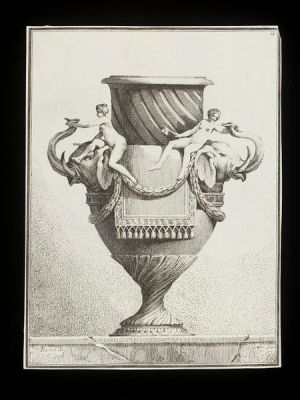
Ennemond-Alexandre Petitot, Suite de Vases (1 of 30 designs), etching by Benigno Bossi, 1770s (London: V&A)
This display showcases 24 prints and drawings by French-born architect and designer, Ennemond-Alexandre Petitot (1727–1801) who was responsible for some of the most captivating and eccentric neoclassical ornamental designs ever produced.
Petitot received a classical training in Lyons, Paris and Rome and won the prestigious post of court architect to the Duke of Parma in 1753. He executed a diverse range of commissions for the ducal palace and other important interiors, bringing a distinctly French aesthetic to the architecture and gardens of Parma. In two famous suites of ornament prints published in the 1770s Petitot gave full reign to his imagination and ensured his legacy as one of the most original exponents of Neoclassicism. These prints and a number of Petitot’s drawings and works by other influential architects and designers form the focus of this display.
Display | Blue and White: British Printed Ceramics
Now on at the V&A:
Blue and White: British Printed Ceramics
Victoria and Albert Museum, London, 31 January 2015 — 3 January 2016
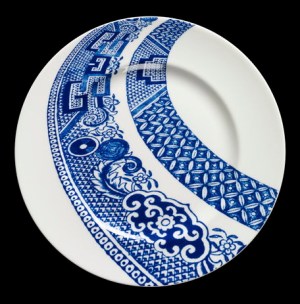
Plate, transfer-printed in enamel, ‘Border’ designed by Robert Dawson. Made by Josiah Wedgwood & Sons, Stoke-on-Trent, 2005 © Victoria and Albert Museum/WWRD United Kingdom Ltd/Robert Dawson
Blue-and-white printed ceramics are a pronounced British phenomenon with continued appeal for potters, artists and consumers. At its very best ceramic printing in blue results in a high-quality, technically precise and aesthetically pleasing decoration, enabling a rapid design response to society and culture.
This display features the wide variety of designs and decoration used in blue-and-white printed ceramics in Britain from the 1750s to present day, in both industrial and art production, demonstrating how these objects reflect British society, culture and interpret the wider world.
The display has been generously supported by The Headley Trust and includes loans from The Potteries Museum and Art Gallery, The Spode Museum Trust, The Wedgwood Museum and private collections.
Display | The Lost Art of Writing
The last weeks for this display at the V&A:
The Lost Art of Writing
Victoria and Albert Museum, London, 6 September 2013 — 4 May 2015

Inkstand, Sheffield plate, ca. 1810 (London: V&A)
“Beautiful Writing pleases everyone, it makes one sought after,” explained the French writer Père Gregoire Martin in 1761.
Having a fine writing hand was not only a useful skill but the sign of an educated and genteel person
This small display in the Metalware gallery explores some of the objects used in writing, from a medieval penner to an ingenious 18th-century globe inkstand and a pen rest designed by the architect Alfred Waterhouse. These objects, made to serve the art of writing, have been displaced by the new virtual world of icons and toolbars.










 Enfilade
leave a comment