Exhibition | The Declaration’s Journey

Looking to this fall, from the March 11 press release for the exhibition:
The Declaration’s Journey
Museum of the American Revolution, Philadelphia, 18 October 2025 — 3 January 2027
The Museum of the American Revolution today announces new details of its loan acquisitions for The Declaration’s Journey—a special exhibition commemorating the 250th anniversary of the adoption of the Declaration of Independence—related to female activists and suffragists in the 18th and 19th centuries who both touted the Declaration’s progressive ideals and pushed the United States to apply the its promise of equality to women.
On the night of July 4,1776, the first copies of the Declaration of Independence were published at John Dunlap’s printing office, near Second and Market Streets in Philadelphia. The news of independence spread quickly and widely both in the United States and abroad. Though women were not mentioned in the declaration issued by the Continental Congress, they contributed to its proliferation and success. Beginning with Dunlap, printers created broadsides of the Declaration, and they published the text in their newspapers. In July 1776, Mary Katharine Goddard of Baltimore was the only woman running a newspaper under her own name in the newly declared United States. She first published the Declaration in her newspaper, the Maryland Journal, and later also printed broadside copies of the Declaration, the first version to bear the names of the men who signed the revolutionary document. The Declaration’s Journey will feature a rare surviving broadside of the Declaration of Independence printed by Goddard in January 1777, on loan from Brian and Barbara Hendelson.
Throughout the 19th and early 20th centuries, activists fought for women’s rights and cited the words of the Declaration of Independence to advocate for education, temperance, abolition, and especially suffrage. In Seneca Falls, New York, in 1848, 100 men and women signed a Declaration of Sentiments that looked very similar to the Declaration of Independence, with a key difference—it affirmed that “all men and women are created equal.” At the time, women in the United States had few legal, social, and political rights compared to men. Women were not allowed to vote. Only a few state laws allowed them to own property if they got married. They had limited rights in the court system and could not serve in government positions.
Elizabeth Cady Stanton, a skilled writer and orator for the suffrage movement, wrote the Declaration of Sentiments, borrowing its title from the American Anti-Slavery Society while retaining the structure and much of the language from the United States’ Declaration. Of the 68 women who signed the Declaration of Sentiments, only one, Rhoda Palmer, lived long enough to legally vote after nationwide women’s suffrage was achieved in 1918.
The Declaration’s Journey will feature Elizabeth Cady Stanton’s desk used in her house in Tenafly, New Jersey, where she lived from 1868 until 1887. Alongside coauthors Matilda Joslyn Gage, Ida Husted Harper, and Susan B. Anthony, Stanton likely used this desk during the writing process for their History of Woman Suffrage book, which they began working on following the suffragists’ appearance at the Centennial International Exhibition in Philadelphia in 1876. At that appearance, a small group of suffragists including Stanton famously interrupted the proceedings of the Fourth of July celebration at Independence Hall to present their Declaration of Rights of the Women of the United States to Vice President Thomas Ferry. History of Woman Suffrage was later published in 1881.
Coline Jenkins, the great-great-granddaughter of Stanton, will lend the desk to the Museum for the full run of The Declaration’s Journey. Just as Stanton and her fellow activists took advantage of the attention surrounding the Centennial celebration to travel to Philadelphia and champion their cause, Jenkins said she is thrilled to have her ancestor represented through the Museum’s special exhibition celebrating the Semiquincentennial.
“The Declaration’s Journey will be the focus of the nation in 2026,” Jenkins said. “It means a lot to me and to my family to contribute this artifact at such a key time to such a key institution. It was never my family’s interest to have it stored away from the American people. Now, by its inclusion in this special exhibition, the desk can be a tool for Americans to understand where they came from and how to move forward.”
Displayed near Stanton’s desk in The Declaration’s Journey will be the earliest known printing of the Declaration of Sentiments, on loan from the Historical Society of Pennsylvania. The exhibition will also include a ballot box made from blueberry crates that was used in 1868 in a protest organized by Vineland, New Jersey, resident Portia Gage. One hundred and seventy-two local white and Black women cast illegal votes in the ballot box, which will be on loan from the Vineland Historical and Antiquarian Society.
“American women have helped to shape the legacy of the Declaration of Independence over the past 250 years,” said Matthew Skic, Senior Curator at the Museum of the American Revolution. “Stories of revolutionary women such as Mary Katherine Goddard, Elizabeth Cady Stanton, and Portia Gage remind us of the long-standing and continuing struggle to strengthen the American nation’s commitment to equality stated back in 1776.”
Structure of the exhibition:
First Travels, 1776–1783
The exhibition begins with the story of Jonas Phillips, a Jewish merchant in Philadelphia who sent a letter, written in Judeo-German to keep its contents secret, and a Dunlap broadside of the Declaration of Independence to Amsterdam in July 1776. That copy never arrived, as the ship carrying it was captured by a British warship. The letter and Dunlap broadside will be on view along with Phillips’ notes referencing the Declaration’s promise of freedom of conscience—an early example of the emerging meanings credited to the Declaration. Other objects and documents in this introductory section convey how a July 1776 reading of the Declaration led the Mi’kmac and Maliseet communities of New Brunswick and Maine to enter into the first treaty to recognize the U.S. as an independent nation; how the French celebrated the Declaration and helped to announce the U.S. as a nation of the world, available for diplomacy and alliance; and how a small minority, all abolitionists, pioneered the use of the Declaration as an egalitarian document.
A Worldwide Journey, 1780–1830
The story moves abroad to examine how international interpretations of the Declaration of Independence pressured Americans to clarify their own understanding of the founding document, especially its language about equality. The Marquis de Lafayette borrowed language of the Declaration in his “Declaration of the Rights of Man and Citizen” (1789) but clarified language about equality. The Haitian Declaration of 1804, as well as the declarations adopted in Mexico and Chile, pushed and pressured Americans into conversation and conflict over the tensions within their own Declaration’s promise.
A Divided Declaration, 1831–1898
The narrative returns to the United States, exploring the Declaration’s appropriation by abolitionists, suffragists, and Confederate secessionists. Items may include Frederick Douglass’s typescript oration from 1852, best known for the line “What to the American Slave, is your Fourth of July?” and a printing of the Seneca Falls Convention’s Declaration of Sentiments, which launched the modern women’s suffrage movement with the addition of the phrase “and women” to the Declaration’s statement that “all men” are created equal.
Examples of Native American Declarations of Sovereignty and Independence, including Mashpee and Cherokee, show ways that the Declaration’s language was re-fashioned in the 1800s by people described in the original document as “savage.”
The Declaration’s Journey, 1898–Present
In this final section, visitors will see more and more people claim the legacy of the Declaration. At the end of WWI, Czechoslovakia, Korea and six other nations adopted their versions of a declaration of independence and by the mid-1900s, the Declaration was increasingly understood as a fundamental statement of human rights and equality. Martin Luther King Jr.’s 1963 “I Have a Dream,” speech is perhaps the best-known example of this understanding of the Declaration as a far-reaching promise. Visitors will leave the exhibition with an understanding of our Declaration as part of an ongoing revolution, a continuing effort to secure fair government and individual rights for people in the United States and around the world.
The Museum is poised to play a leadership role in the upcoming 250th anniversary of the nation’s founding in 2026. As we continue to transform the nation’s relationship with its Revolutionary past by increasing awareness of the many ordinary, diverse, and little-known people who created the American nation. Through this special exhibit, digital initiatives, and educational programs, we aim to facilitate widespread conversation about the meaning of the American Declaration of Independence and its ongoing legacy.
Turner 250

.
J.M.W. Turner, The Battle of Trafalgar, 21 October 1805, 1822–24, about 10 × 14 feet framed
(Greenwich: National Maritime Museum, BHC0565)
◊ ◊ ◊ ◊ ◊
Press release (21 January 2025) from Tate:
This morning, cultural institutions across Britain announced Turner 250, a year-long festival of special exhibitions and events. Taking place throughout 2025, the programme celebrates 250 years since the birth of renowned painter JMW Turner. Whether visiting museums and galleries or tuning in on TV and online, everyone will have the chance to enjoy Turner’s greatest works, learn about his incredible life and career, and discover the many ways he continues to inspire creativity today.
Born on 23 April 1775, Joseph Mallord William Turner is widely considered to be the greatest and most influential British artist of all time. From humble beginnings, he travelled the length and breadth of the country to capture its dramatic scenery, redefining landscape painting in the process. Today he remains a touchstone of British cultural life—the face on the £20 note—and the painter behind some of the most iconic images of the natural world ever created.

J.M.W. Turner, Self-Portrait, ca.1799, oil on canvas, 74 × 58 cm (London: Tate, Turner Bequest 1856, N00458).
This announcement includes over 30 projects taking place this year, organised by venues large and small as well as by national organisations such as Tate, the BBC, and Art UK. Turner exhibitions will be held in London, Edinburgh, Leeds, Manchester, Liverpool, Norwich, Bath, and Sussex, highlighting key themes in his life and work and exploring his connections to other renowned historic figures like Jane Austen and John Constable. Turner’s legacy in modern and contemporary art will be celebrated with displays, commissions, and events in London and Margate, while the Turner Prize will be staged in Bradford as a highlight of the UK City of Culture programme. Books, films, and digital content will be released through the year, including a complete catalogue of Turner’s 37,500 sketches and watercolours on Tate’s website, a major new BBC documentary bringing the man and his art to life, and a screening of Mike Leigh’s award-winning film Mr. Turner at BFI Southbank. Talks and workshops will showcase new scholarship and ideas inspired by Turner, including an international conference at Tate Britain, a summit exploring art’s connection to the natural world at Turner Contemporary, and the Turner Society’s annual Kurt Pantzer memorial lecture. A keen international traveller, Turner will also have his 250th anniversary commemorated far beyond the UK, with celebratory shows being staged in Connecticut, Cincinnati, and Shanghai, as well as a special exhibition closer to home in Dublin.
Turner’s birthday on 23 April 2025 will be a particular highlight: the artists shortlisted for the Turner Prize will be announced that morning ahead of their show in Bradford in the autumn, an exhibition of Turner’s rarely-seen images of wildlife will open at Turner’s House in Twickenham, and a newly refreshed room will open in Tate Britain’s Clore Gallery, home to a permanent free display of 100 works by the artist.
Arts Minister Sir Chris Bryant said: “Turner was one of this country’s greatest artists. An innovator who created some of our best known canvasses, he reshaped British art. A talent of Turner’s stature requires a year of celebration, from the prize in his name to the back of the £20 note, his immense legacy continues to permeate through the arts and public life in Britain. The 250th anniversary of his birth will be an opportunity for the public to immerse themselves in our outstanding artistic heritage. I encourage everyone to take the time to find an event from the upcoming year to enjoy some of Britain’s finest artists from the past and present.”
Maria Balshaw, Director of Tate, said: “Turner is a standout figure in the story of British creativity. It is Tate’s privilege to care for the world’s biggest collection of his art and showcase it to the widest possible public. Over the course of this year, I’m delighted that we will be showing over 150 of his stunning works at Tate Britain as well as lending over 100 more to venues right across this country and beyond.”
Suzy Klein, Head of BBC Arts & Classical Music TV, said: “We’re thrilled to be working with Tate to celebrate Britain’s most celebrated artist and be granted unprecedented access to Turner’s vast collection of rarely seen sketches. I can’t wait to share this treasure trove with audiences, not only illuminating the workings of Turner’s unique creative mind but also offering an unprecedented view into the extraordinary era of change during his lifetime.”
Exhibition | A Lively Mind: Jane Austen at 250
There’s no shortage of stimulating events marking this year’s 250th anniversary of Jane Austen’s birth, and readers will know this terrain much better than I. But for anyone tring to keep up, the following sites offer a useful starting place. –CH
• Ben Jureidini, “Is 2025 the Year of Jane Austen? From Society Balls to Blockbuster TV Shows, the 250th Anniversary of ‘Britain’s Greatest Author’ Is Set to Break Records,” The Tatler (6 January 2025). Miss Austen and The Other Bennet Sister on the BBC, a Dolly Alderton adaptation of Pride and Prejudice heading for Netflix, and a tourism boom for real-life regency balls, there’s something truly Austentatious about 2025. Link»
• “Worldwide Guide to Jane Austen 250th Events,” from the Jane Austen Centre in Bath, which focuses on the life and works of Jane Austen, as well as the Regency period in which she lived. Link»
• The Jane Austen Society, founded in 1940 by Dorothy Darnell with the purpose of raising funds to preserve the Cottage in the village of Chawton, Hampshire, where Jane Austen lived with her mother and sister Cassandra from 1809 to 1817. Link»
• The Jane Austen Society of North America, a non-profit organization staffed by volunteers and dedicated to the enjoyment and appreciation of Jane Austen and her writing. Link»
◊ ◊ ◊ ◊ ◊
Opening at The Morgan in June:
A Lively Mind: Jane Austen at 250
The Morgan Library and Museum, New York, 6 June — 14 September 2025
Organized by Dale Stinchcomb and Juliette Wells
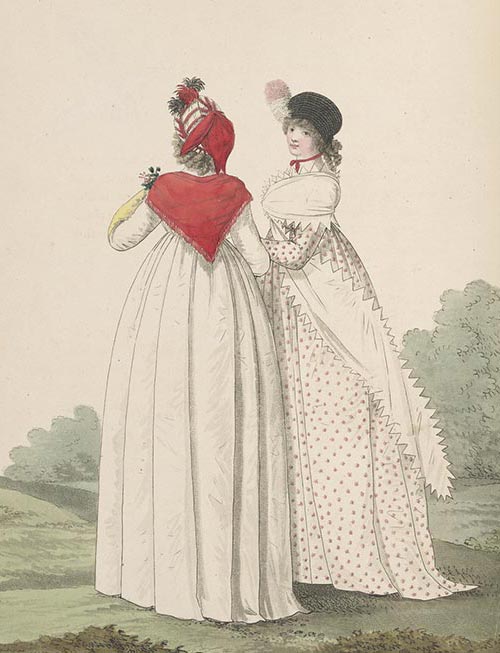
Morning Dresses from Gallery of Fashion (London: N. Heideloff, 1798), figs. 198, 199 (New York: The Morgan Library & Museum; PML 5680).
A Lively Mind immerses viewers in the inspiring story of Jane Austen’s authorship and her gradual rise to international fame. Iconic artifacts from Jane Austen’s House in Chawton, England join manuscripts, books, and artworks from the Morgan, as well as from a dozen institutional and private collections, to present compelling new perspectives on Austen’s literary achievement, her personal style, and her global legacy.
Beginning as a teenager, Austen cultivated her imaginative powers and her ambition to publish. Encouraged by her family, especially her father and her sister Cassandra, she persevered through years of uncertainty. Her creativity found expression in a range of artistic pursuits, from music-making to a delight in fashion. The story of how Americans first encountered and responded to Austen’s novels, unbeknownst to her, emerges from four surviving copies of an unauthorized edition of Emma published during her lifetime. Following Austen’s death, family members preserved their memories of her, while carefully guarding what was publicly revealed. Austen’s audience continued to grow as those who loved her novels helped new generations of readers to appreciate them. In addition to celebrating Austen, A Lively Mind commemorates the landmark gift of Austen manuscripts to the Morgan in 1975 by Alberta H. Burke and draws extensively on the extraordinary collection she bequeathed to Goucher College in Baltimore.
A Lively Mind: Jane Austen at 250 is organized by Dale Stinchcomb, Drue Heinz Curator of Literary and Historical Manuscripts, and Juliette Wells, Professor of Literary Studies at Goucher College. It is made possible by generous support from the Drue Heinz Exhibitions and Programs Fund, Cynthia H. Polsky, Martha J. Fleischman, the Caroline Morgan Macomber Fund, the Lucy Ricciardi Family Exhibition Fund, and Alyce Williams Toonk.
Byron 200 Years after His Death
George Gordon Byron (1788–1824) died 200 years ago on Friday (19 April). Writing this week for The Washington Post, Michael Dirda reviews two new books about the poet (noted below), while Benjamin Markovits, in a New York Times essay, grapples with how (and whether) people still read him. A Byron Festival is being held at Trinity College, Cambridge (yesterday and today) while the Keats-Shelley House presents the exhibition, Byron’s Italy: An Anglo-Italian Romance, along with a series of talks and other events throughout the year. Finally (for now), Liverpool UP has discounted some of its Byron books.
The Byron Festival at Trinity
Trinity College Cambridge 19–20 April 2024
 Trinity College Cambridge will host a two-day festival to coincide with the 200th anniversary of Lord Byron’s death on 19 April 1824, in Missolonghi, Greece. Byron was a student at Trinity College and is one of its most celebrated alumni. While enrolled as an undergraduate, Byron published his collection of poetry, Hours of Idleness, and began the satirical poem that would become English Bards and Scotch Reviewers, a scathing provocation of the literary establishment.
Described by the College’s Senior Tutor of the time as a “young man of tumultuous passions,” Byron became one of the most controversial, celebrated, and influential poets of his age. When Westminster Abbey declined to accept the magnificent statue of Byron, created after his death by the Danish sculptor Thorvaldsen, Trinity gave it a home in the Wren Library, where the poet still stands—an impressive presence for students, scholars, and visitors.
But what kinds of presence does Byron have now? This question is the focus of an exciting programme of talks, readings, music, and exhibited work, which will address, and mediate, the legacy and status of Byron now, within the contexts of today’s culture and scholarship. The Byron Festival Conference programme includes talks about Byron, by academics and writers including Bernard Beatty, Drummond Bone, Clare Bucknell, Will Bowers, Christine Kenyon Jones, Mathelinda Nabugodi, Seamus Perry, Diego Saglia, Dan Sperrin, Jane Stabler, Fiona Stafford, A.E. Stallings, Andrew Stauffer, Corin Throsby, Clara Tuite, Ross Wilson.
◊ ◊ ◊ ◊ ◊
Fiona Stafford, ed., Byron’s Travels: Poems, Letters, and Journals (New York: Everyman’s Library, 2024), 728 pages, ISBN: 978-1101908426, $35.
 George Gordon, Lord Byron, was one of the leading figures of British Romanticism. The Byronic hero he gave his name to—the charming, dashing, rebellious outsider—remains a powerful literary archetype. Byron was known for his unconventional character and his extravagant and flamboyant lifestyle: he had numerous scandalous love affairs, including with his half-sister Augusta Leigh. Lady Caroline Lamb, one of his lovers, famously described him as “mad, bad and dangerous to know.”
His letters and journals were originally published in two volumes; this new one-volume selection includes poems and provides a vivid overview of his dramatic life arranged to reflect his travels through Scotland, Italy, Spain, Turkey, Albania, Switzerland, and of course Greece, where he died. It contains a new introduction by scholar Fiona Stafford highlighting Byron’s enduring significance and the ways in which he was ahead of his time.
Fiona Stafford is a professor of English literature at Oxford University. The author of many books, including a biography of Jane Austen, she also wrote and presented the highly acclaimed The Meaning of Trees for BBC Radio 3’s The Essay. Her book The Long, Long Life of Trees, published in 2017, was a Sunday Times Nature Book of the Year.
◊ ◊ ◊ ◊ ◊
Andrew Stauffer, Byron: A Life in Ten Letters (Cambridge: Cambridge University Press, 2024), 300 pages, ISBN: 978-1009200165, $30.
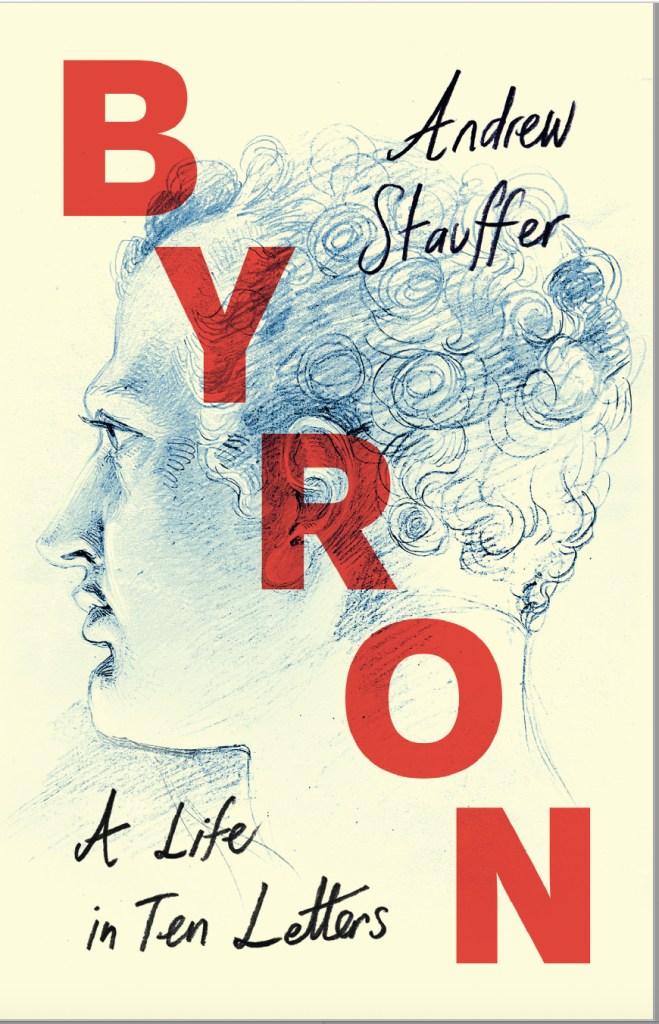
Lord Byron was the most celebrated of all the Romantic poets. Troubled, handsome, sexually fluid, disabled, and transgressive, he wrote his way to international fame—and scandal—before finding a kind of redemption in the Greek Revolution. He also left behind the vast trove of thrilling letters (to friends, relatives, lovers, and more) that form the core of this remarkable biography. Published to coincide with the 200th anniversary of Byron’s death, and adopting a fresh approach, it explores his life and work through some of his best, most resonant correspondence. Each chapter opens with Byron’s own voice—as if we have opened a letter from the poet himself—followed by a vivid account of the emotions and experiences that missive touches. This gripping life traces the meteoric trajectory of a poet whose brilliance shook the world and whose legacy continues to shape art and culture to this day.
Andrew M. Stauffer is a professor in the English Department at the University of Virginia, where he specializes in nineteenth-century literature, especially poetry.
Exhibition | 1923 —The Domaine de Sceaux: Origins of a Renaissance
From Silvana Editoriale:
1923 — The Domaine de Sceaux: Origins of a Renaissance
Musée du Domaine départemental de Sceaux, 10 March — 9 July 2023
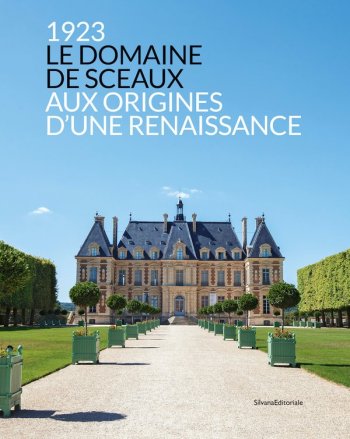 The Domaine de Sceaux was acquired in 1923 by the Hauts-de-Seine department, leading to the estate’s restoration and its opening to the public. This exhibition (installed in the former stables) brings together archival documents, posters, photographs, drawings, and paintings to tell the story of the place during this last eventful century. The exhibition traces the history of the estate from its first major transformation to the 1950s.
L’histoire du Domaine de Sceaux entre 1850 et 1950 reste peu connue du grand public. Après la Révolution, la propriété traversa plusieurs phases de déclin et de renouveau. Les aménagements d’aujourd’hui s’inspirent donc à la fois du parc ancien et des ouvrages classés du XVIIe s., et ils intègrent aussi le décor du XIXe s., introduit par les ducs de Trévise. Si vous êtes familier des lieux ou en quête d’histoire sur le Grand Paris, vous ressentirez d’autant plus cette métamorphose : celle d’un somptueux château à la campagne devenu un site muséal préservé et ouvert à tous.
Site historique et patrimonial majeur de la région parisienne, le Domaine départemental de Sceaux fut créé en 1670 par Jean-Baptiste Colbert, qui y appela les plus grands artistes de son temps, d’André Le Nôtre à Charles Le Brun, de Jules Hardouin-Mansart à Antoine Coysevox. Passé entre les mains du marquis de Seignelay, fils du ministre de Louis XIV, puis entre celles du duc et de la duchesse du Maine, du duc de Penthièvre et enfin du duc et de la duchesse de Trévise, cet ensemble remarquable, bientôt menacé par l’extension galopante de la banlieue, était appelé à une disparition quasi certaine lorsqu’en 1923, à la suggestion du maire de Sceaux, il fut acquis in extremis par le département de la Seine à la princesse de Cystria, née Trévise, dernière propriétaire. 2023 marque ainsi le centenaire du passage de ce domaine exceptionnel du statut de propriété privée à celui de bien public, devenu en 1970 l’un des fleurons du département des Hauts-de-Seine qui en assure depuis l’entretien et la valorisation. L’exposition revient sur le contexte, sur les raisons et sur les conditions de cette acquisition qui permit l’heureuse renaissance du domaine de Sceaux.
David Baurain and Céline Barbin, eds., 1923 — Le Domaine de Sceaux: Aux origines d’une renaissance (Milan: Silvana Editoriale, 2023), 208 pages, ISBN: 978-8836654239, €30.
Exhibition | Reframing Reynolds
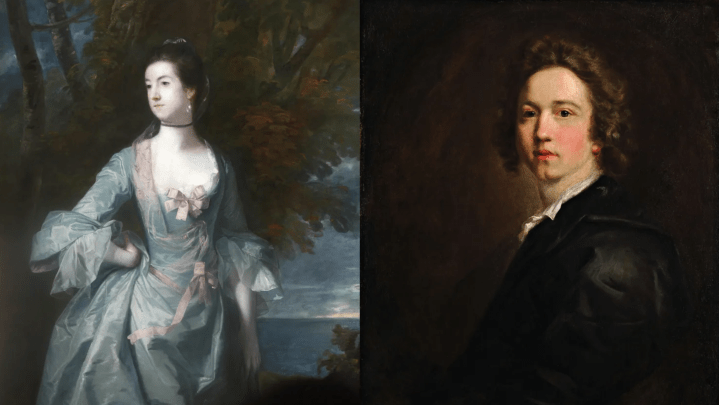
Left: Joshua Reynolds, Portrait of Lady Anne Bonfoy, née Eliot (1729–1810), oil on canvas, 125 × 100 cm (Acquired from the Trustees of Port Eliot Estate through the acceptance in lieu scheme, 2007). Right: Joshua Reynolds, Self Portrait, 1746, oil on canvas, 104 × 90 cm (Plymouth: The Box, 2014.71, purchased with the assistance of the Heritage Lottery Fund, V&A Purchase Grant Fund, and the Art Fund, with a contribution from the Wolfson Foundation).
◊ ◊ ◊ ◊ ◊
Opening this month at The Box:
Reframing Reynolds: A Celebration
The Box, Plymouth, 24 June 2023 — 29 October 2023
This major new exhibition celebrates the 300th anniversary of the birth of famous portrait painter, Sir Joshua Reynolds, who was born in nearby Plympton St Maurice.
Joshua Reynolds (1723–1794) was known for capturing his clients’ personalities, being one of the founding members and first president of the prestigious Royal Academy in London, as well as one of the most influential painters of the 1700s. Reframing Reynolds: A Celebration explores the career of this famous 18th-century portrait artist within a global context, highlighting themes such as image, identity, his studio practice, his early career in Plymouth Dock (now Devonport), and his use of pigment, colour, and light.
Important works from The Box’s permanent collection are shown alongside loans from national and private collections including Tate, The Woburn Abbey Collection, National Trust, National Maritime Museum, and The Barber Institute of Fine Arts. The loans are supported by the Weston Loan Programme with Art Fund. Created by the Garfield Weston Foundation and Art Fund, the programme is the first ever UK-wide funding scheme to enable smaller and local authority museums to borrow works of art and artefacts from national collections.
Reynolds’ enduring legacy and his ongoing relevance for artists today are highlighted through an exciting collaboration with Royal Academician Rana Begum, who has created new works inspired by three of his portraits. Begum’s internationally touring Dappled Light exhibition will also be on display at The Box this summer.
Keen to discover more about Sir Joshua Reynolds?
• Learn about the National Trust’s Reynolds 300 programme.
• Find out more about what’s happening at Saltram House.
• Book for one of the Royal Academy’s Artists on Art talks, which have been programmed to coincide with the 300th anniversary of Reynolds’ birth.
• Book a ticket for a special Sir Joshua Reynolds at 300 talk and panel discussion at Plympton St Maurice Guildhall on 14 July.
New Book | A Treatise on Civil Architecture
From Rizzoli:
William Chambers, with a preface by Frank Salmon, A Treatise on Civil Architecture (Stockholm: Bokförlaget Stolpe, 2023), ISBN: 978-9189696358, $80.
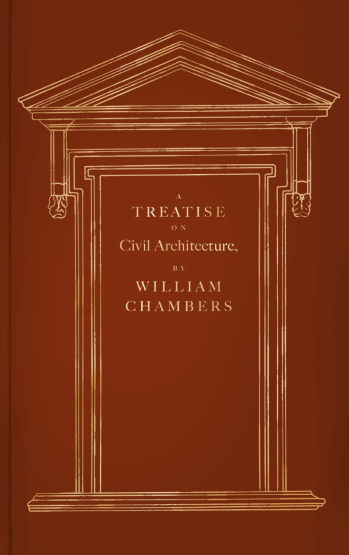 A gorgeous, oversize, clothbound facsimile of the classic 18th-century guide to the vocabulary of Western architecture
Sir William Chambers (1723–1796) was a Swedish British architect who designed imaginative castle buildings and luxurious interiors as well as simple and rational utilitarian architecture: some of his most famous works include the Roehampton Villa, Great Pagoda, and Somerset House (all located in London). Originally published in 1756, A Treatise on Civil Architecture is an architecture handbook in which Chambers explains the basics of the art of building, aiming “to collect into one volume what is now dispersed in a great many, and to select, from mountains of promiscuous Materials, a Series of Sound Precepts and good Designs.” The guidebook is supplemented by concise texts and beautiful illustrations of classical building types and their functions. Received with considerable acclaim upon its release, A Treatise on Civil Architecture quickly became the most popular practical work on architecture in the English language and has since been republished several times. This handsome clothbound edition is published in conjunction with the 300th anniversary of Chambers’ birth.
William Chambers (1723–1796) was an architect mainly active in and around London. Chambers was a founder member of the Royal Academy of Arts in 1768 and he published a number of both practical and theoretical books on architecture, gardening, and interior design.
Frank Salmon is Associate Professor (Senior Lecturer) in History of Art, University of Cambridge and a Fellow at St John’s College, Cambridge. Since 2021 Dr. Salmon has served as the director at the Cambridge based The Ax:son Johnson Centre for the Study of Classical Architecture.
Adam Smith 300 in 2023
From the press release (23 November 2022) for Adam Smith 300 . . .
The University of Glasgow is marking the 300th anniversary of pioneering Scot Adam Smith (1723–1790) with a year-long celebration of his life, work, and influence.
The tercentenary commemoration of the ‘father of economics’ includes a host of events in Scotland and around the world, designed to inspire renewed discussion about Smith’s ideas. Smith’s work has had a lasting impact on the way the world considers economics, politics, and society more broadly. The planned programme of events aims to consider how his ideas from 300 years ago can help answer some of the biggest challenges we face today.
Throughout 2023 the University of Glasgow has a raft of programmes and events that will give academics, students, and the public new insights into his life and work. Highlights include:
• Tercentenary Week (5–10 June 2023)—a week-long series of activities, including talks and exhibitions at the University of Glasgow featuring scholars from the London School of Economics, the universities of Princeton and Harvard, and the University of Cambridge.
• An on-campus and virtual exhibition of significant and rare Smith-related artifacts—including letters, first edition books, and material from the University of Glasgow’s archives.
• The Adam Smith Tercentenary Global Lecture Series, featuring internationally renowned speakers from academia, business, and public policy.
• New research into Smith’s life and writings.
• The Royal Economic Society and Scottish Economic Society Joint Conference in April, featuring global academics reflecting upon Smith’s legacy.
Other activities involve a national student competition to re-design the front cover of The Wealth of Nations, online courses for adult learners, and new programmes to introduce high school to Adam Smith and his ideas. Universities from across the world, in North and South America, Asia, Africa, Europe, and Australia will be joining in the commemorations with their own events to mark the tercentenary.
Professor Sir Anton Muscatelli, Principal and Vice Chancellor of the University of Glasgow, said: “Adam Smith is one of our most famous alumni, and he left an indelible impact on the University of Glasgow, on the fields of economics and moral philosophy, and on the wider world. His studies and writings introduced new ideas, insights, and concepts that shaped our understanding of economics today but were revolutionary in their day. To mark the tercentenary of his birth we will see academics, students, and the public discuss his continued relevance at a series of events taking place in Glasgow and across the world. I look forward to taking part in the University’s commemoration of Adam Smith as we evaluate his legacy and consider how his thoughts and ideas from 300 years ago can still help us answer the greatest challenges of today.”
Adam Smith—born in Kirkcaldy, Fife, in June 1723—started his studies at the University of Glasgow aged 14. In 1740, he was awarded the Snell Scholarship, which is still in existence today, and left to study at Oxford. In 1751, Smith returned to Glasgow as a Professor of Logic, later becoming Professor of Moral Philosophy. While at Glasgow, Smith published the first edition of The Theory of Moral Sentiments in 1759, developing upon the principles and concepts explored in his lectures. Smith’s final connection with the University came in 1787 when he assumed the prominent position of Rector. He published arguably his most famous work The Wealth of Nations in 1776 and died in 1790.
Marking the Tercentenary of Wren’s Death in 2023
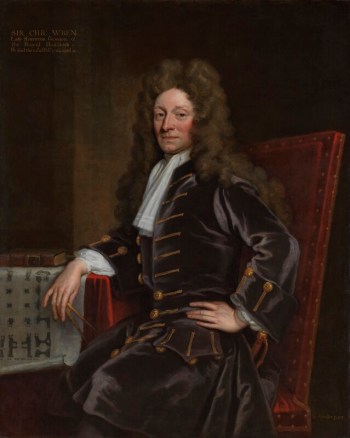
Sir Godfrey Kneller, Portrait of Sir Christopher Wren, 1711, oil on canvas (London: NPG, 113).
2023 marks three hundred years since the death of Sir Christopher Wren (1632–1723)—mathematician, astronomer, physicist, anatomist, and one of the United Kingdom’s greatest architects.
Wren was given responsibility for rebuilding 51 churches in the City of London after the Great Fire in 1666, including what is regarded as his masterpiece, St Paul’s Cathedral, where today he is buried under a gravestone with the Latin inscription which in part translates: “If you seek his memorial, look about you.” From centres of learning in Greenwich, Oxford, and Cambridge, churches, and palaces fit for a king, Wren’s influence spans the centuries.
His tercentenary will be marked in the Square Mile Churches by a year-long education and conservation programme for children and adults which has been awarded a £241,000 grant by The National Lottery Heritage Fund. Throughout 2023, Wren’s remaining churches in The City will host a variety of school and community initiatives, marking the enduring legacy of one of Britain’s most acclaimed polymaths.
With projects including school pupils building a replica of the dome of St Paul’s, and a ‘Wrenathon’ of choirs across The City of London, the Wren300 Square Mile Churches programme offers a range of opportunities to explore the work of Sir Christopher Wren through conservation, heritage, and musical activities.
The Wren300 projects include:
• The Schools’ Programme: Working with the London Diocesan Board of Schools, Temple Bar Trust and the London Fire Brigade Museum, primary school children will have the opportunity to visit Wren churches throughout 2023. The programme will be open to all state schools, with almost 5,000 pupils expected to take part in these trips, focused on London’s most under-privileged areas.
• Conservation Workshop: A series of workshops, talks and events on new construction techniques and sustainable construction materials, inspired by Wren’s work, run by Cliveden Conservation Workshop.
• The ‘Dastardly’ Triple Dome: Taking place during School Science Week in March 2023 and led by Chris Wise, Senior Director of Expedition Engineering, this project will involve 100 secondary school pupils coming together to build a mini dome using foam blocks and bamboo, representing the triple dome of St Paul’s Cathedral.
• A City Full of People: Led by historians, Dr Rebecca Preston and Dr Susan Skedd, this programme will engage and recruit volunteers from diverse communities in researching and understanding the lives of people engaged with Wren’s churches over the centuries, who might previously have been overlooked.
• The Wrenathon: Working with Music in Offices, work-based, community, and intergenerational choirs, drawn from diverse communities, including The Samaritans Choir and Ukrainian Refugees Choir, will come together in Wren churches. to sing music ranging from baroque and classical to contemporary and jazz.
• Exhibitions of fire artists: From September 2023, a number of churches will be hosting exhibitions of fire artists, depicting the destruction and rebuilding of Wren churches.
Alongside a grant from the National Lottery Heritage Fund, Wren300 has also received grants from the Royal Academy of Engineering, The Linbury Trust and the London Fire Brigade Museum.
Commenting on Wren300, the Bishop of London, the Rt Revd and Rt Hon Dame Sarah Mullally, said: “We are very grateful for the funding the Wren300 project has received from the National Lottery Heritage Fund. This will go a long way to helping those from all backgrounds to experience Wren’s churches in The City, encouraging new audiences to feel inspired by the architecture, heritage, arts and music of his time.”
Stuart McLeod, Director England – London & South at The National Lottery Heritage Fund, added: “We are delighted to support this project, which, thanks to money raised by National Lottery players, will enable more people to learn about the fantastic legacy of Sir Christopher Wren. His work is so integrated into the community and bringing this to life through a year-long programme will be a fitting legacy. Heritage has a huge role to play in instilling pride in our communities and through Wren300 more people will be able to get involved with, protect, and learn about the exciting heritage right on their doorstep.”
Annie Hampson, Chair of the Wren300-Square Mile Churches, said: “Wren300 is a celebration of an extraordinary and prolific career that occurred at a changing point in British history and transformed our architecture. The Great Fire of London decimated the City and Wren brought his pragmatism and skill to the rebuilding of the City Churches, providing him with the expertise and knowledge to achieve his greatest masterpiece in the rebuilding of St Paul’s. The Wren300 project provides a range of activities that will ensure these Churches are better known and appreciated, that they are an enriching experience to all who come to them, a learning resource for young people living in and around the City of London and a lasting legacy that will ensure their survival for generations to come.”
Wren300 Square Mile Churches, Honorary Patron, Lord Norman Foster of Thames Bank added “Sir Christopher Wren was one of our greatest ever citizens. I admire him not only as a great architect but also as a surveyor and manager who remarkably came up with a plan for rebuilding the City only days after the Great Fire. What is even more extraordinary is that he succeeded in carrying it out, supervising the rebuilding of 51 churches, including St Paul’s Cathedral, where he used a completely new architectural language not previously seen in England. His influence continues to this day.”
Exhibition | Canova: Sketching in Clay
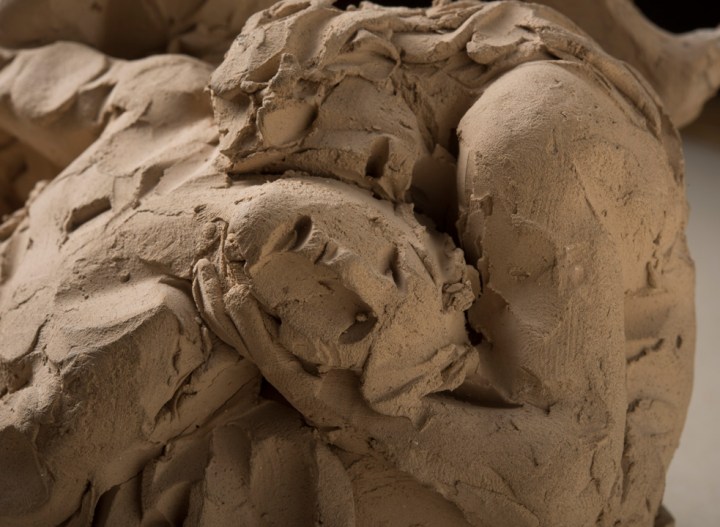
Antonio Canova, Adam and Eve Mourning the Dead Abel, detail of Eve and Abel, ca. 1818–22, terracotta
(Possagno: Museo Gypsotheca Antonio Canova; photograph by Tony Sigel)
◊ ◊ ◊ ◊ ◊
Antonio Canova, at age 64, died on this day (13 October) 200 years ago; his clay models are the subject of a major exhibition opening in June. From the NGA:
Canova: Sketching in Clay
National Gallery of Art, Washington, DC, 11 June — 9 October 2023
Art Institute of Chicago, 19 November 2023 — 18 March 2024
Curated by C. D. Dickerson and Emerson Bowyer
How does a sculptor turn an initial idea into a finished work of marble? For Antonio Canova (1757–1822), the most famous artist of Europe’s revolutionary period, the answer was with clay. Working with his hands and small tools, Canova produced dazzling sketch models in clay, which helped him plan his designs for his large statues in marble. Imprinted with the fire of his imagination, these sketches were boldly executed in mere minutes. Canova also made more finished models, sensuous in their details, that he showed to patrons or used as guides for carving. Approximately 40 of the some 60 of his surviving models reveal the artist’s extraordinary working process—a process that led to the creation of some of the most iconic works in the history of sculpture.
Canova: Sketching in Clay is organized by the National Gallery of Art, Washington and The Art Institute of Chicago. The exhibition is curated by C. D. Dickerson, curator and head of sculpture and decorative arts, National Gallery of Art, and Emerson Bowyer, Searle Curator, Painting and Sculpture of Europe, The Art Institute of Chicago.
C. D. Dickerson and Emerson Bowyer, with contributions by Anthony Sigel and Elyse Nelson, Canova: Sketching in Clay (New Haven: Yale University Press, 2023), 280 pages, ISBN: 978-0300269758, $65.
◊ ◊ ◊ ◊ ◊
Note (added 12 June 2023) — The original posting was updated to include information on the catalogue, which was published 6 June 2023.










 Enfilade
leave a comment