Searching for Shelley’s Ghost on Shelley’s Birthday
The storied poet, Percy Bysshe Shelley, was born on this day in 1792. This exhibition helps explain how some of those stories were framed by his grieving wife in the wake of his death. From Dove Cottage and the Wordsworth Museum:
Shelley’s Ghost: Reshaping the Image of a Literary Family
Wordsworth Museum and Art Gallery, Grasmere, Cumbria, 7 July — 30 October 2011
Curated by Stephen Hebron
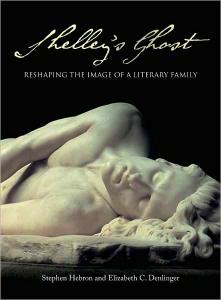
ISBN: 9781851243396, $35
Few families have such a remarkable reputation for their contribution to the literary and intellectual life of Britain as the Godwins and the Shelleys. In the course of their lives, each of the important writers in these families accumulated an archive of letters, notebooks and literary papers. After their death, surviving family members pored over this material, publishing some records and withholding others in an attempt to control that reputation.
Now, parts of this archive material are being brought together for display from two great Shelley collections – the Bodleian Libraries in Oxford and the New York Public Library, home of the Carl H. Pforzheimer Collection of Shelley and his Circle. Shelley’s Ghost will open in the Wordsworth Museum on 7 July 2011, and show until 31 October. The exhibition provides a fascinating insight into the real lives of three generations of a family that was blessed with genius, marred by tragedy, and often surrounded by scandal. It begins with the relationship between Wordsworth’s radical friend William Godwin and the feminist campaigner Mary Wollstonecraft; it goes on to cover their daughter Mary’s elopement and subsequent relationship with the poet Percy Bysshe Shelley, whose expulsion from Oxford for the publication of The Necessity of Atheism and elopement four months later with the 16-year-old Harriet Westbrook had already caused notoriety; and it concludes with the roles played by the Shelleys’ only surviving child, Sir Percy Florence Shelley, and his wife Jane, Lady Shelley, as the guardians of the family papers.
A central theme of the exhibition is the effort made by the grieving Mary Shelley in 1822, immediately after Shelley drowned aged 29 in the Bay of Lerici, to collect and edit his work and create a compelling image of his character. Shelley expected posterity to judge him as a poet: the court, he said, was ‘a very severe one’, and he feared the verdict would be ‘guilty death’. Sir Percy and Lady Shelley went on to house the family manuscripts in a special ‘Shelley Sanctum’ alongside treasured family relics such as portraits, personal possessions and locks of hair. For years they guarded them closely, seeking to protect the images of Shelley and Mary that we see in the portraits: smiling, ethereal, other worldly. Much of this archive remained intact when it was gifted to the Bodleian in 1893, as a collection which now enables us to see the dramas of these years preserved in private letters and journals, written in times of great stress and recording the most painful emotions. The exhibition will therefore show how the deliberately selective release of the manuscripts on display, which have been the basis of many biographies, has shaped public knowledge of this great literary family. The exhibition will also include rare books and family possessions, the first draft of Mary Shelley’s Frankenstein, and the best-known portrait of Shelley, painted in Rome by the amateur artist Amelia Curran in 1819.
The exhibition’s interactive website is available here»
◊ ◊ ◊ ◊ ◊
About Dove Cottage:
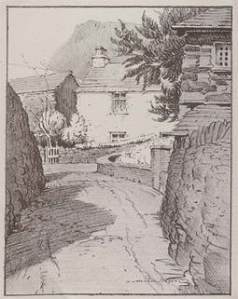 Dove Cottage was the home of William Wordsworth from December 1799 to May 1808, the years of his supreme work as a poet. As with many old buildings, the early history of Dove Cottage is difficult to trace accurately; although the date of its construction is not recorded, this is likely to have been during the early 17th century. Its original use is also unknown, but during the second half of the 18th century it became an inn called the Dove and Olive. Many of the building’s distinctive features date from this time; its white-washed walls, flagstone floors and dark, wood panelling. However, in the early 1790s, the Dove Cottage was closed down. It seems likely that the building remained empty for the next few years, until William and Dorothy Wordsworth arrived as tenants on 20th December 1799.
In the building’s time as a pub, the downstairs bedroom would have been used as a drinking room, but for the Wordsworths, it was always used as a bedroom. Initially this is where Dorothy slept and it would have been here that she wrote much of her ‘Grasmere Journals’. In the summer of 1802 this became William’s bedroom in preparation for his marriage to Mary Hutchinson in October. The washstand displayed in this room belonged to William and Mary and is a rare example of a double washstand. (more…)
The Royal Society Turns 350 in November!
On now at the National Portrait Gallery:
Science, Religion and Politics: The Royal Society
National Portrait Gallery, London, 11 September — 5 December 2010
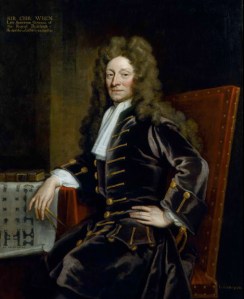
Sir Godfrey Kneller, "Portrait of Sir Christopher Wren," 1711 © National Portrait Gallery, London.
Marking the 350th anniversary of the foundation of the Royal Society, this display celebrates a key moment in the development of modern science. The Society was founded on 28 November 1660 when a dozen men gathered to hear the young Christopher Wren give a lecture on astronomy. In the discussion that followed they decided to form ‘a Colledge for the Promoting of Physico-Mathematicall Experimentall Learning’. They rejected the classical ideal that knowledge could be acquired through contemplation alone. Instead, they drew on the ‘new philosophy’ devised by Sir Francis Bacon to pursue knowledge through first hand observation, data collection and experimentation. This revolutionary approach to investigating the world laid the foundations for three and a half centuries of scientific discovery and innovation. The display features key figures in the early history of the Royal Society including Sir Christopher Wren, Robert Boyle, Samuel Pepys and Sir Isaac Newton. The Royal Society has generously loaned two important early portraits from its collection.
Thomas Arne and The Newberry Consort
Rule Britannia! Celebrating the Tercentenary of Thomas Arne
The Newberry Consort, Chicago, 1-3 October 2010
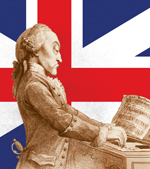 The Newberry Consort, Chicago’s premier early music ensemble, kicks off its new season with a tribute to one of eighteenth-century England’s most popular and successful composers. Thomas Arne’s works run the gamut from pleasure garden songs for Vauxhall to the first Italian-style opera seria written in English. Plumbing the Newberry Library collections, we’ve recreated his colorful orchestrations for strings, baroque flute, and continuo to perform our selection of Shakespeare songs, opera arias, and chamber pieces. You’ll be invited to join in singing the evening’s finale!
Friday, October 1, 2010, 8:00 pm, Sanctuary, Fourth Presbyterian Church of Chicago
Saturday, October 2, 2010, 8:00 pm, Rockefeller Memorial Chapel, Hyde Park
Sunday, October 3, 2010, 3:00 pm, Lutkin Hall, Northwestern University
Pre-concert lectures begin one hour before the concerts. Student tickets: $5 at the door, cash only. General admission: $28 in advance, $30 at the door. Purchase tickets online at http://www.newberryconsort.org or call 312.255.3610
Happy Birthday, Enfilade!
From the Editor

Keven Law, Wikimedia Commons
As I’ve said in the past, I’m extremely grateful to all of you for visiting the site and especially to Enfilade’s regular readers — all the more so on this one-year anniversary! What I envisioned as a convenient forum for sharing the occasional news item for HECAA members has surpassed my wildest expectations. To be sure, Enfilade is still a work in progress, and based on feedback from others, I’m optimistic about the future of this experiment.
I’m especially happy to welcome aboard Jennifer Ferng as our first Correspondent staff member. A former practicing architect, Jennifer is a Ph.D. candidate in the History, Theory, & Criticism of Architecture and Art program at MIT. Her dissertation focuses on the intersections between architecture, the decorative arts, and geology during the eighteenth and nineteenth centuries in Britain and France. From 2009 until 2011 she is based in Paris at the INHA as a Kress Fellow. Particularly in light of how many of you think of France as the geographical, intellectual, and artistic center of your work, I’m thrilled about the addition.
As I’ve also emphasized in the past, Enfilade readers are genuinely interested in what HECAA members are doing. So please continue to send reports regarding your own publications and research activities along with general notices of news items that relate to the art and visual culture of the long eighteenth century.
Finally, let me put in a plea for your financial support. The cost of an annual HECAA membership is just $20 (only $5 for students). If you’re not a member or if your membership has expired, please consider joining or renewing now (additional financial support is also most welcome). HECAA is affiliated with two scholarly organizations (the College Art Association and the American Society for Eighteenth-Century Studies), but anyone interested in the eighteenth century is most welcome here. Your payment will help fund the work of graduate students and junior scholars. Moreover, in being counted as a HECAA member, you help make the case that the eighteenth century really does matter for how we think about art history, visual culture, and the history of the built environment in general (in our world where keeping count becomes increasingly important, membership size is itself an indication of support).
Thanks again, and I leave with you an assortment of statistics:
- 396: number of postings published in the first year
- 44,600: total number of views Enfilade received in the first year
- 12,512: number of individual visitors to Enfilade during the second quarter of 2010
- 1516: number of views from returning visitors during the second quarter of 2010
- 2804: total number of views from returning visitors
Craig Hanson
Happy (Belated) Birthday, Dr. Sloane!
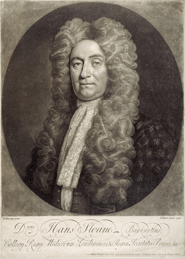 In the midst of the disruptions from the volcanic ash cloud, I failed to note the birthday of Sir Hans Sloane (1660-1753), who would have turned 350 years this past Friday (April 16). The physician was an important naturalist, bibliophile, and collector. As outlined in his will, the bequest of his vast collections to the nation provided the foundation of the British Museum. To mark the anniversary, a series of events have been organized at the British Museum, London’s Natural History Museum, and the Old Operating Theatre Museum, as well as in the Northern Ireland village of Killyleagh, where Sloane was born. Although most events took place last week, in June a major conference will be held at the British Library (see below for the schedule). For whatever it’s worth, I have a hunch that Sloane would have been thrilled to have his birthday marked by the eruption of Iceland’s Eyjafjallajokull -C.H.
◊ ◊ ◊ ◊ ◊
In addition, the Sloane Printed Books Catalogue, is an outstanding new online resource. As noted on the BL’s website:
Sloane’s library of approximately 40,000 volumes, now dispersed within the collections of the British Library and other research libraries, is being identified. Bibliographical descriptions are enhanced with information about pre-Sloane provenance, annotations and other copy-specific information. The information accumulated is being made available through a web-accessible database, the Sloane Printed Books Catalogue, maintained by the British Library. The work of this project will form a significant research resource for medical, scientific and intellectual historians of the period.
◊ ◊ ◊ ◊ ◊
From Books to Bezoars: An International Conference Celebrating the 350th Anniversary of the Birth of Sir Hans Sloane, Physician, Naturalist and Collector
British Library, London, 7-8 June 2010
MONDAY, JUNE 7
9:30 Registration
10:00 Plenary Session
- James Delbourgo (Rutgers University), Collecting Sir Hans Sloane
10:45 Coffee
11:05 Sloane’s Origins, Life and Work
- Mark Purcell (National Trust), “Settled in the north of Ireland”, or Where did Sloane come from?
- Pratik Chakrabarti (University of Kent), The Voyages of Hans Sloane: A colonial history of gentlemanly science
- Lisa Smith (University of Saskatchewan), Sir Hans Sloane: Physician of the family
12:15 Lunch
1:10 Specimens and Classification
- Charlie Jarvis, Mark Spencer, and Rob Huxley (Natural History Museum), Sloane’s plant specimens at the Natural History Museum
- Savithri Preetha Nair (Independent Scholar), Botanising on the Coromandel coast in the seventeenth century
- Jill Cook (British Museum), Sloane, elephants and climate change
3:00 Tea
3:20 Sloane and the West Indies
- James Robertson (University of the West Indies), Knowledgeable readers- Jamaican critiques of Hans Sloane’s botany
- Julie Chun Kim (Fordham University), The African and Amerindian sources of Atlantic medicine
- Wendy Churchill (University of New Brunswick), Hans Sloane’s perspectives on the medical knowledge and health practices of non-Europeans
- Tracy-Ann Smith and Katherine Hann (Natural History Museum), Sloane, slavery and the natural world: New perspectives from community programming
6:30 Reception in the Enlightenment Gallery of the British Museum
TUESDAY, JUNE 8
10:00 Plenary Session
- Kim Sloan (British Museum), Sir Hans Sloane’s ‘Paper Museum’
10:45 Coffee
11:05 The Culture of Collecting
- Kathryn James (Beinecke Library, Yale), Hans Sloane and the public performance of natural history
- Barbara Benedict (Trinity College, Hartford), Sloane’s Ranges: Shifts in Sir Hans Sloane’s literary representation in the eighteenth century
- Eric Jorink (Huygens Instituut), Sloane and the Dutch connection
12:15 Lunch
1:15 Catalogues, Books, and Manuscripts
- Alison Walker, The Sloane Printed Books Project
- Marjorie Caygill (British Museum), Sloane’s catalogues in the British Museum
- Arnold Hunt, Sloane as a manuscript collector
2:20 Tea
2:50 Sloane’s Book Collections
- John Goldfinch (British Library), A rediscovered volume of printed and mss fragments from Sloane’s library
- Julianne Simpson (Wellcome Library), The dispersal of Sir Hans Sloane’s library: A case study from the Medical Society of London collection
- Stephen Parkin (British Library), Sloane’s Italian books
- Will Poole (New College, Oxford), Sloane’s books at the Bodleian Library
4:20 Concluding Remarks
Happy Birthday, Angelica Kauffman!
Angelica Kauffman turns 268 today. The following comes from Meredith Martin’s 2007 review of Angela Rosenthal’s book on the artist. From caa.reviews:
Angela Rosenthal, Angelica Kauffman: Art and Sensibility (New Haven: Yale University Press in association with Paul Mellon Centre for Studies in British Art, 2005) 352 pages, $65.
Reviewed by Meredith Martin, Assistant Professor, Wellesley College; posted 1 May 2007.
Cover Image: Angelica Kauffman, "Self-Portrait," detail, 1784 (Munich: Bayerische Staatgemäldesammlung Neue Pinakothek)
Rosenthal’s monograph restores Kauffman’s own work to center stage. Her project is not simply one of “historical recovery,” for as the author notes, “unlike some other female artists, [Kauffman] never fully lost her position within the art-historical canon” (2). Generally speaking, Kauffman’s story is not one of isolation or exclusion, but rather of strong support, widespread influence, and international renown. One need only glance at her voluminous, multilingual correspondence with the leading cultural figures of eighteenth-century Europe—Goethe, Johann Caspar Lavater, and Izabella Czartoryska among them—to get a sense of the professionally rewarding and breathlessly glamorous life that Kauffman led. Zoffany’s painting notwithstanding, Angelica Kauffman was nobody’s wallflower. . .

Member News
Angela Rosenthal is associate professor at Dartmouth. She specializes in early modern European visual culture (especially British art within a global perspective), with an emphasis on cultural history, gender studies, feminist and post-colonial theory, and the history of art criticism. She studied art history, psychology and social anthropology at Trier University, Germany and in the UK (The Courtauld Institute of Art, University College London, and Westfield College). Before joining the faculty at Dartmouth College in 1997, she was curator of contemporary art at the Stadtgalerie in Saarbrücken (1994-95), and Andrew W. Mellon Assistant Professor of Art History at Northwestern University (1995-97). Rosenthal’s most recent research project emerged from her past work on the visual formulation of subjectivity, as well as from her engagement with contemporary post-colonial art theory. In this new book project, entitled The White of Enlightenment: Racializing Bodies in 18th-Century British Visual Culture, Rosenthal seek to complement the growing field of research on concepts of “race” and “ethnicity” in the visual arts.
Meredith Martin joined the Wellesley faculty in 2008. She received a BA in Art History from Princeton University in 1997 and a PhD in the History of Art and Architecture from Harvard University in 2006. Her research interests include: eighteenth- and nineteenth-century French visual and material culture, architectural theory and landscape design; gender, space, and the domestic interior; early neo-classicism; art and colonialism; and the historiography of the Rococo. She is the co-author, with Scott Rothkopf, of Period Eye: Karen Kilimnik’s Fancy Pictures (Serpentine Gallery/Koenig Books, 2007). Her book, Dairy Queens: Pastoral Architecture and Political Theater from Catherine de’ Medici to Marie-Antoinette, is forthcoming from Harvard University Press, and she is also co-editing a volume with Denise Baxter entitled Architecture Space in Eighteenth-Century Europe: Constructing Identities and Interiors to be published by Ashgate next spring. Her current research addresses diplomatic and material exchanges between France and India in the late eighteenth century.
Birthday Surprises — Watteau Turns 325 Today
On this, the 325th birthday of Jean-Antoine Watteau (1684-1721), it’s worth recalling the circumstances surrounding the recent discovery and sale of La Surprise, which is, incidentally, included in the Watteau, Music, and Theater exhibition now on at the Metropolitan Museum of Art in New York. From ArtDaily.org, 9 July 2008:

Jean-Antoine Watteau, “La Surprise,” oil on panel, 14.1/2 x 11.1/2 inches, ca. 1718
LONDON — A recently rediscovered masterpiece by Jean-Antoine Watteau (1684-1721) sold at Christie’s auction of Important Old Master and British Pictures this evening for £12,361,250 / $24,376,385 / €15,513,369, a world record price for any French Old Master painting sold at auction. La Surprise had been missing for almost 200 years, presumed to have been destroyed, and was previously known only by a copy in the Royal Collection at Buckingham Palace and through a contemporary engraving. It was found in the corner of a drawing room in a British country house during a Christie’s valuation last year.
Richard Knight, International Director of Christie’s Old Master Department and Paul Raison, Director and Head of Old Master Pictures at Christie’s, London: “We are thrilled to have realised a record price for La Surprise by Jean-Antoine Watteau, who is recognised as one of the most influential artists in the history of European art. It was extremely exciting to have rediscovered the painting last year, its whereabouts having been a mystery for almost 200 years, and it has been a great honour to have shown the picture to the public for the first time in over two centuries during pre-sale exhibitions in London, Paris, New York and St Petersburg. This is not only one of the most extraordinary rediscoveries of recent years, but also the most expensive French Old Master painting ever sold at auction, and we are pleased to have welcomed international interest from a number of collectors and institutions at this evening’s sale” . . .
La Surprise by Jean-Antoine Watteau (1684-1721) was painted circa 1718 and was first owned by Nicolas Henin (1691-1724), an Advisor to the French King who was one of Watteau’s best and most constant friends. It is likely that the work was painted for Henin together with its pendant L’Accord Parfait, now in the Los Angeles Museum of Art. The legendary connoisseur and collector Pierre-Jean Mariette (1694-1774) noted in his Abecedario of 1746 that La Surprise is “one of [Watteau’s] most beautiful paintings.” On Nicolas Henin’s death in 1724, the two paintings went to the artist’s friend and biographer Jean de Jullienne (1686–1766) who had them engraved and published in the Recueil Jullienne, and who seems to have split the pair and sold them before 1756. La Surprise next appears in the celebrated collection of Ange-Laurent de La Live de Jully (1725-1779), who is recognised as assembling the first serious art collection dedicated to the encyclopedic display of French painting. The catalogue of his collection was published in 1764 and describes La Surprise as executed “with a piquant touch and richly tinted with the color of Rubens.” The picture had left the collection by 1770 and amidst the turmoil of the French Revolution, it is not recorded until it appears in a Lady Murray’s probate valuation of 1848, by whom it was bequeathed to the family of the vendors at this evening’s auction. The painting’s attribution and significance had remained lost until its rediscovery last year. . .
Jean-Antoine Watteau (1684-1721) was born in the Flemish town of Valenciennes, which had passed to France from Spanish rule just six years earlier, and left for Paris in about 1702. He was to be influenced by Flemish art throughout his career, and was often considered a Flemish painter by his contemporaries. In Paris, he worked with Claude Gillot (1673-1722) and became fascinated by theatre costume and stage design, before moving to the workshop of Claude Audran III, curator of the Palais du Luxembourg where Watteau was introduced to Rubens’s magnificent and inspirational canvases painted for Queen Marie de Medici. The work of Rubens was to influence Watteau throughout his career as he revitalised the Baroque style and became a pioneer of Rococo art. Watteau was frail and subject to ill health throughout his life and in 1720, he travelled to London to visit Dr. Richard Mead, a celebrated physician, in the hope of medical relief. Unfortunately, the climate and air quality in the city hindered any progress and he returned to France where he died in 1721 at the age of 37.
Happy Birthday, Dr. Johnson
Though he was actually born on 7 September 1709, Samuel Johnson himself came to think of September 18 as his birthday after England accepted the Gregorian calendar reforms in 1752. The tercentenary has been widely celebrated throughout the year with a spate of conferences and exhibitions.
◊ ◊ ◊ ◊ ◊
Samuel Johnson: Literary Giant of the Eighteenth Century
Huntington Library, San Marino, CA, 23 May — 21 September 2009
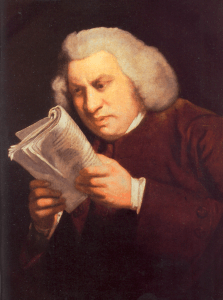
Joshua Reynolds, "Portrait of Samuel Johnson" (Huntington Library)
Samuel Johnson (1709-1784)—one of the greatest moralists, poets, biographers, critics, essayists, and correspondents of all time—so dominated literary and intellectual life in the last half of the 18th century that the era is frequently referred to as the “Age of Johnson.” As a conversationalist and writer he was so insightful and adept in the use of language that only Shakespeare and the Bible are quoted more often.
Samuel Johnson: Literary Giant of the 18th Century, tells the story of Johnson’s life and achievements through a display of rare books, manuscripts, and portraits drawn from The Huntington’s holdings and from the Loren and Frances Rothschild Collection. The exhibition is curated by noted Johnson scholar O. M. “Skip” Brack, professor emeritus of English at Arizona State University.
One of the earliest English authors to make his living solely by his writings, Johnson spent his early years, after arriving in London in 1737, writing mostly for the Grub Street booksellers. Needing a large project that would produce a steady income, he accepted a commission to write an English dictionary. On April 15, 1755, after Johnson had labored over it for nine years, a consortium of London booksellers published, in two large volumes, A Dictionary of the English Language: In which the Words are Deduced from their Originals, and Illustrated in their Different Significations by Examples from the Best Writers. This colossal achievement brought Johnson fame not only in England but across Europe.
A first edition of the Dictionary in its original binding will be one of the highlights of the exhibition. Other treasures to be displayed are the famous “Blinking Sam” portrait of Johnson by his friend Sir Joshua Reynolds, a portion of one of Johnson’s diaries, and a number of personal letters.
Johnson’s prolific output as a writer included his famous poem The Vanity of Human Wishes (1749), more than 200 essays for his twice-weekly publication, The Rambler (1750–52), and the allegorical fable Rasselas: The Prince of Abyssinia (1759). His edition of Shakespeare (1765) and the Lives of the Poets (1779–81) secured his fame as a literary critic and biographer.
◊ ◊ ◊ ◊ ◊
An Immortal Friend: Dr. Johnson and the Royal Academy
Royal Academy of Arts (Library Print Room), London, 28 April — 2 October 2009
This display explores both private and public aspects of Samuel Johnson’s close friendship with the first president of the Royal Academy of Arts, Sir Joshua Reynolds. It includes not only rarely seen memorabilia, evoking in particular their shared addiction to tea, but also illustrates, through a selection of prints, books and documents from the RA Library and Archive, the crucial contribution that Johnson and his literary circle made to raising the intellectual status of the newly fledged institution.
◊ ◊ ◊ ◊ ◊
 People tend to have their favorite entries from The Dictionary. My latest encounter with the edition compiled by Jack Lynch impressed me with the following:
abecedarian — n.s. [from the names of a, b, c, the three first letters of the alphabet.] He that teaches or learns the alphabet, or first rudiments of literature.
centuriator — n.s. [from century.] A name given to historians, who distinguish times by centuries; which is generally the method of ecclesiastical history.
fancysick — adj. [fancy and sick.] One whose imagination is unsound; one whose distemper is in his own mind.
tonguepad — n.s. [tongue and pad.] A great talker.
In addition to the wide array of terms to express derision of one sort or the other, it’s also intriguing to see the fluidity of meanings within the same word as a term moves between praise and scorn.
wiseacre — n.s. [It was antiently written wiseegger, as the Dutch wiseggher, a soothsayer.] 1. A wise, or sententious man. Obsolete. 2. A fool; a dunce.
connoisseur — n.s. [French.] A judge; a critick: it is often used of a pretended critick.
◊ ◊ ◊ ◊ ◊
For additional information, see the websites of the Samuel Johnson Birthplace Museum in Lichfield and Dr. Johnson’s House in London. Pat Rogers’s entry on Johnson for the Oxford Dictionary of National Biography is available here.
-Craig Hanson
Thomas Wright’s Menagerie & Gervase Jackson-Stops
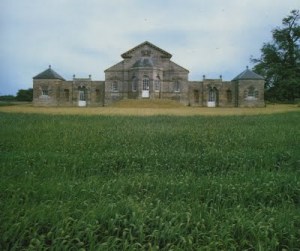
Thomas Wright, The Menagerie, Horton Park, Northamptonshire, 1750s (Photo: Bruno de Hamel, "Architectural Digest: Chateaux and Villas," 1982)
Earlier in the week, An Aesthete’s Lament included a posting on The Menagerie, the Grade II listed building acquired by Gervase Jackson-Stops (1947-95) in the 1970s. After a three-year studentship at the Victoria and Albert Museum, Jackson-Stops joined the National Trust, first as a research assistant and then (starting in 1975) as an architectural advisor. It’s difficult to overstate his importance for the organization. As noted in numerous obituaries — including those from the Society of Antiquaries of London, The Independent, and Architectural History (available through JStor) — he played important roles in the Trust’s acquisition of Canons Ashby House, Kedleston Hall, and Fountains Abbey. His commitments to restoration were evinced not only at Stowe but also at his personal labor of love, The Menagerie.
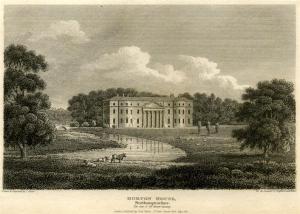
Horton Hall, destroyed 1936
This mid-eighteenth-century banqueting house, by Thomas Wright (1711-86), at Horton Park, Northamptonshire is actually just one of just thirteen listed buildings attached to the property (the main house, Horton Hall, was destroyed in the 1930s). The Horton Park Conservation Group (HPCG) was founded in 2008 to campaign for the ongoing conservation of the park and these structures. The park is likely to receive increased attention over the next two years as Wright’s three-hundredth birthday approaches.
The Menagerie appears in Paige Rense, Architectural Digest: Chateaux and Villas (Knapp, 1982); Timothy Mowl and Claire Hickman, Historic Gardens of England: Northamptonshire (History Press, 2008), and Chippy Irvine, The English Room (Bullfinch Press, 2001). For details regarding visits, see The Menagerie website.
 Finally, no evocation of Jackson-Stops is complete without mention of his role in organizing the seminal Treasure Houses of Britain exhibition at the National Gallery of Art in Washington (1985-86). For his work on the show, he received the Presidential Award for Design in 1986 and was made an Officer of the British Empire (O.B.E.) — all before turning 40! A full list of publications, including dozens of contributions for Country Life, can be found at the end of the obituary compiled by Oliver Garnett and Tim Knox for Architectural History 39 (1996): 222-35.
[The photograph of The Menagerie comes from An Aesthete’s Lament; the print of Horton Hall comes from the website of the Horton Park Conservation Group. Thanks to both.]
Joyeux anniversaire
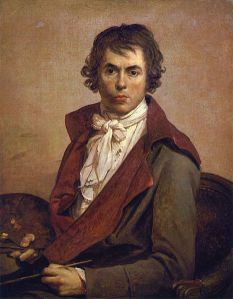
Jacques-Louis David, "Self-Portrait," oil on canvas, 32 x 26 inches, 1794 (Paris: Louvre)
Jacques-Louis David turns 261 today. Born in Paris on 30 August 1748, he died in Brussels in 1825 at age 77. Of the artist’s Self-Portrait from 1794, Philippe Bordes notes that
the only source of information concerning this painting is a recollection by David’s pupil Pierre-Maximilien Delafontaine, who accompanied him to prison on 2 August 1794: ‘It was in the Hôtel des Fermes [the prison] that he made a portrait of himself from the mirror I brought to him. This portrait was given by him a few years later to Isabey, the miniature painter and his pupil. He is represented dressed in a greatcoat, the costume of the period’. . . Worth noting is that David did not want to keep this work associated with his close call with the guillotine and his year in prison and that never again would he execute a self-portrait.
See Bordes, Jacques-Louis David: Empire to Exile (New Haven: Yale University Press, 2005), p. 16. For the quotation, see Daniel Wildenstein and Guy Wildenstein, Documents complémentaires au catalogue de l’oeuvre de Louis David (Paris, 1973), p. 114; Bordes also also points the reader to Ewa Lajer-Burcharth, “Les oeuvres de David en prison: art engagé après Thermidor,” La Revue du Louvre et des Musées de France 39 (1989): 310-21.










 Enfilade
leave a comment