Sotheby’s Museum Network to Launch in August
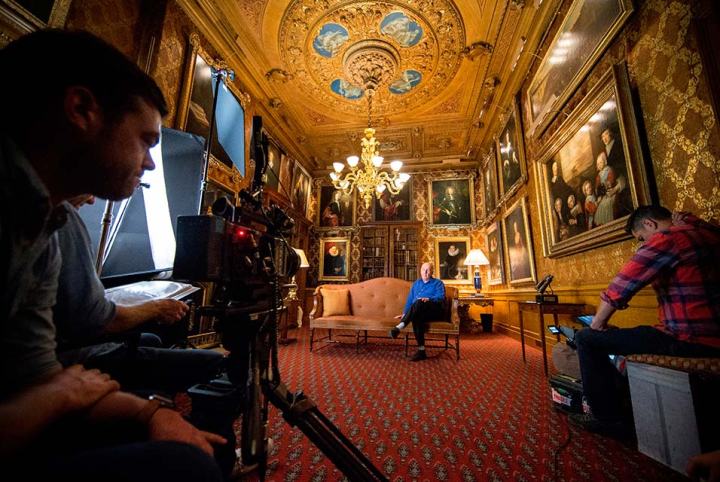
The 13-part series The Treasures of Chatsworth is currently in production and will debut in Autumn 2016
(Photo: Sotheby’s)
◊ ◊ ◊ ◊ ◊
Press release (5 August 2016) from Sotheby’s:
Sotheby’s announces the upcoming launch [scheduled for August 29] of an online destination to discover video content created by and about the world’s leading museums. The digital hub will be called Sotheby’s Museum Network, and it will be featured prominently on Sothebys.com as well as Sotheby’s Apple TV channel. The museums in this network will include internationally-renowned public institutions, such as The Metropolitan Museum of Art, Tate, and the National Palace Museum in Taiwan, as well as well as newer institutions founded by private collectors, including the Garage Museum of Contemporary Art in Moscow.
In addition to syndicating museums’ own content, the Sotheby’s Museum Network will be the home of original programming conceived and produced by Sotheby’s. The Treasures of Chatsworth, a 13-part series on one of Europe’s greatest private houses and most significant art collections, is currently in production and will debut this autumn. Further information will be shared in the coming months.
Recent years have seen the opening of numerous private museums by passionate patrons, as well as record attendance at major exhibitions worldwide, reflecting a seemingly insatiable public interest in great art and collections. Sotheby’s Museum Network will reach a global audience for whom museums and foundations are a new entry point into the world of art, as well as seasoned collectors and connoisseurs who look upon these institutions as the ultimate source of authority on art and culture. It will ultimately encompass thousands of existing museum videos, which have never before been aggregated into one channel, making it easier for people to discover what they love as well as introducing new audiences to the great work that these institutions are creating worldwide.
“We are thrilled to host the extraordinary videos produced by our museum partners around the world,” commented David Goodman, Executive Vice President, Digital Development & Marketing. “The Museum Network is a response to a growing global audience that wants to experience the world of art and collecting. The network is a natural evolution of the existing ties we have with museums through programs like Sotheby’s Preferred, and we can now deepen those relationships with institutions and their benefactors as we expose their outstanding collections to millions of art lovers who engage via digital channels. The Treasures of Chatsworth is the perfect way to launch our drive into original video content creation centered on the arts and will be the first of many original films that will reveal the wonder of art and collecting.”
At Sotheby’s | English Watches
Press release (8 July 2016) from Sotheby’s, via Art Daily:
Celebration of the English Watch, Part II
John Harrison’s Enduring Discovery, Sale #L16055
Sotheby’s London, 7 July 2016

John Arnold, silver consular cased pocket chronometer, 1781.
At Sotheby’s London, auction records for watches made by two of England’s most important watchmakers were set when a silver pocket chronometer by John Arnold (Lot 38) sold for £557,000 ($722,318) and a gold pocket chronometer by Thomas Earnshow (Lot 39) fetched £305,000 ($395,524).
Made in 1781 and estimated at £130,000–150,000, the large silver consular cased pocket chronometer by John Arnold is remarkable in that it has survived in its completely original state. Arnold introduced the ‘double S’ balance in 1780. The ‘S’ sections of the balance were shaped bi-metallic bars that were designed to overcome the changing elasticity of the balance spring and expansion of the balance’s rim. The watch sold yesterday is the only example of a watch by Arnold which survives without restoration and with its original case, dial, pivoted detent and ‘double S’ balance.
Thomas Earnshaw invented the spring detent escapement and Thomas Wright, watchmaker to King George III, agreed to pay for the patent in his name. Dating from 1784, the gold pair cased pocket chronometer in yesterday’s sale was the only surviving example of a watch made strictly to Wright’s patent details (est. £250,000–300,000).
The sale included some of the finest precision timekeepers of the English horological Golden Age. It was the second part in a series of sales entitled Celebration of the English Watch, featuring the most important collection of English watches in private hands.
Fake Furniture at Versailles?
When I first started thinking about what a reformatted newsletter for the Historians of Eighteenth-Century Art & Architecture might include, I began asking other HECAA members. An esteemed colleague answered immediately, “More gossip!”As much as I liked the response, I’m afraid there’s been very little gossip published here at Enfilade over the past seven years. Yet nothing seems to drive whisperings in the art world like a forgery scandal; and Paris is in the midst of one, with allegations that fake eighteenth-century furniture was sold to Versailles. That the story is receiving widespread coverage in the press and has become a proper legal matter, complete with press releases, probably suggests it’s moved on from the mere gossip stage. Sarah Cascone reported on the story for ArtNet News (10 June 2016), and here’s weekend coverage by Georgina Adam for the Financial Times (19 June 2016) . . . . –CH

Louis Delanois, Chair made for Madame du Barry, the mistress of Louis XV, ca. 1769 (Versailles)
A scandal over faked 18th-century French furniture has erupted in Paris, with a couple of eminent specialists under investigation for the alleged making and sale of counterfeit chairs, some of which were bought by Versailles.
One of those under investigation is Bill Pallot, who works for the venerable antique dealer Didier Aaron, which has spaces in Paris, London and New York. Pallot is an art historian, collector, lecturer at the Sorbonne and the author of numerous books on antique furniture, including the reference volume on 18th-century chairs. He is a sworn expert for law courts and a member of both the French antique dealers’ association the Syndicat National des Antiquaires and the Syndicat Français des Experts Professionnels. Both professional bodies have vowed to “take the necessary measures” if the accusations are proved.
The other suspect is Laurent Kraemer, co-director of Kraemer Gallery, a prominent 141-year-old family firm of antique dealers. A master craftsman in the Faubourg St Antoine, a district famed for making furniture of all sorts, supposedly produced the pieces in question.
At issue are six pieces now in Versailles, along with two others that were sold by Kraemer. These two chairs were apparently copied from genuine ones already in Versailles; in 2013 they were listed as national treasures by the authorities and export barred, but were ultimately not bought by the palace because of their hefty price: €1m each.
In a laconic press release, the French Ministry of Culture admitted that Versailles had spent €2.7m, between 2008 and 2012, on furniture that is “implicated” in an investigation by the French cultural police unit (OCBC). . .
The full article from the Financial Times is available here»
Lecture Programme for Art Antiques London, 2016
Art Antiques London
Albert Memorial West Lawn, Kesington Gardens, 24–30 June 2016
Albert Memorial and Kensington Gardens once again provide the stunning backdrop to one of London’s most exciting and glamorous art and antique fairs. Held in a beautiful bespoke pavilion opposite the Royal Albert Hall and close to the site of the Great Exhibition of 1851, Art Antiques London brings together leading international dealers and discerning visitors from all over the world, who can buy with confidence at this strictly vetted sumptuous summer showcase for the arts. The fair is complemented with a full lecture programme.
◊ ◊ ◊ ◊ ◊
Saturday, 25 June 2016, 11.30–12.30
Elisabetta Dal Carlo (Curator, The Fondazione Querini Stampalia, Venice), “Geminiano Cozzi, His Manufactory, and Its Porcelain”
During the eighteenth century, the Serenissima Repubblica was the only State which boasted no less than four porcelain factories, and it is remarkable that none of them had been founded by public decree, but by private initiative. The manufactory founded by Geminiano Cozzi in 1763 achieved a great success in Venice and was active until 1812. The factory was located in San Giobbe, Canaregio and followed a strict trade policy in order to exclude foreign imports in the Venetian market. The lecture will present the story of the manufactory, its huge production of high quality porcelain decorated with rich and brilliant colours, and will focus on the finest pieces featuring all the Venetian charm.
Almost 250 years later, Venice has dedicated a fascinating exhibition to this extraordinary entrepreneur which explores the long activity of the factory and recognizes its rightful place among other European manufactures. The exhibition is the first retrospective on the Cozzi manufactory and offers the public more than 600 items on view, an important collection from national and international museums, enriched by rare pieces from private collections that have never been displayed before. It takes place in Venice, Ca’Rezzonico, Museo del Settecento veneziano from March 18th to July 12th 2016.
Elisabetta Dal Carlo is an art historian, a scholar of decorative arts between baroque and neoclassical styles and a specialist in eighteenth-century ceramics. Curator, Fondazione Querini Stampalia, Venice. She graduated in History of Art at Ca’Foscari University in Venice, and she obtained her Ph.D. in History of Art at Siena University. She lectured in Italy and abroad (London and Paris) on the art of porcelain and she edited some catalogues of decorative arts collections and various publications on Venetian and Veneto art history.
◊ ◊ ◊ ◊ ◊
Saturday, 25 June 2016, 3.00–4.00
Suzanne Findlen Hood (Curator of Ceramics and Glass, Colonial Williamsburg Foundation), “Ceramic Treasures from the Colonial Williamsburg Collection”
Colonial Williamsburg’s collections illuminate our understanding of colonial Virginia and the larger Anglo-American world. In addition to objects of everyday life, Williamsburg has also collected the finest British and American arts. Explore the treasures of Colonial Williamsburg’s ceramics collection from porcelain produced by Chelsea, Bow, and Worcester to exceptional English delft. From a first edition Portland vase, to seventeenth-century German stoneware, Williamsburg’s collection is full of masterpieces that illustrate that teapots and plates are more than just dishes. This lecture will reacquaint you with some old friends and introduce you to some of Colonial Williamsburg’s lesser known strengths. With two museums and more than eighty eighteenth-century buildings, ‘collecting colonial’ in the twenty-first century offers a world of variety.
Suzanne Findlen Hood is the curator of ceramics and glass at Colonial Williamsburg. She has had the privilege of working at Colonial Williamsburg since 2002. Ms. Hood holds a B.A. in history from Wheaton College in Massachusetts and an M.A. from the Winterthur Program in Early American Culture and the University of Delaware. Prior to coming to Colonial Williamsburg, Ms. Hood was employed at The Chipstone Foundation in Milwaukee, Wisconsin. Her research has focused on ceramics owned and used in seventeenth- and eighteenth-century America with a particular emphasis on archaeological ceramics, Chinese export porcelain, salt-glazed stoneware, and British pottery. Ms. Hood is co-author with Janine Skerry of Salt-glazed Stoneware in Early America, winner of the American Ceramic Circle Book Award for 2009. Her most recent exhibition, China of the Most Fashionable Sort: Chinese Export Porcelain in Colonial America, is currently on view at the DeWitt Wallace Decorative Arts Museum, one of the Art Museums of Colonial Williamsburg.
◊ ◊ ◊ ◊ ◊
Monday, 27 June 2016, 11.30–12.30
Rosalind Sword (BA Cantab, Author and Lecturer), “Coloured Worcester Porcelain of The First Period: The H.R. Marshall Collection at The Ashmolean Museum”
To celebrate the publication of the new Worcester catalogue of the H.R. Marshall Collection at the Ashmolean Museum in August, Rosalind Sword will talk about the highlights of the Marshall collection. Drawing on Marshall’s own papers, the speaker will give further insights into how this amazing, academic, and encyclopaedic collection was formed. Highlights to be discussed will include a rare garniture of five vases decorated by James Giles with naturalistic birds, the ‘Grubbe’ tea jar also by Giles (its partner is in the Museum of Royal Worcester), O’Neale Vases and dishes, a Duvivier signed and decorated teapot, a teapot from the Theatrical Service, and an amazing pair of candlesticks in under-glaze blue. Particular attention will be paid to rare items from the first ten years of the factory such as a Wigornia type cream boat, a large jug decorated with the Stag Hunt pattern, a cylindrical vase with European Figures possibly decorated by O’Neale, tall vases, and many covetable small bottles and dishes of different shapes and decoration. Examples of other items of great interest to Marshall will also be discussed such as comparative or prototype pieces from other factories and armorial porcelain not featured in depth in his own book. This unparalleled 20th-century collection, now re-displayed for the 21st century viewer in the Ashmolean, is an amazing insight into this extraordinary Worcester collection.
◊ ◊ ◊ ◊ ◊
Monday, 27 June 2016, 5.15–6.30
“Face to Face: Dame Rosalind Savill in Conversation with Richard, 10th Duke of Buccleuch and 12th Duke of Queensberry”
In this conversation Dame Rosalind and the 10th Duke of Buccleuch will discuss the extraordinary task of preserving and presenting four most wonderful houses and their sumptuous art treasures in the United Kingdom: Boughton House (The English Versailles), Drumlanrig Castle, Bowhill and Dalkeith Palace in Scotland. His legacy will not simply be one of stewardship and scholarship but also creating innovative exciting landscape projects.
Dame Rosalind Savill DBE, FBA, FSA, Curator Emeritus, The Wallace Collection, London, became a Museum Assistant in the Ceramics Department of the Victoria and Albert Museum in 1973, moving to the Wallace Collection in 1974. There she worked for thirty-seven years, becoming an Assistant Director in 1979 and Director in 1992, and retired in 2011. Her major publication is The Wallace Collection: Catalogue of Sèvres Porcelain, 3 vols, 1988, which won her the National Art-Collection Fund prize for Scholarship in 1990; she has written numerous articles and papers, chiefly on Sèvres porcelain. In 1990 she became a Fellow of the Society of Antiquaries, in 2000 she was awarded a CBE for Services to the Study of Ceramics, in 2006 she became a Fellow of the British Academy, and in 2009 she was awarded a DBE for Services to the Arts. She has Visiting Professorships from the University of Buckingham and the University of the Arts London, won the European Woman of Achievement Award (Arts and Media) 2005 and was a Member of the Conseil d’Administration at Sèvres Cité de la Céramique. Currently her Trusteeships include: the Royal Collection Trust, the Buccleuch Living Heritage Trust and The Wallace Collection Foundation. Dame Rosalind is also President of the French Porcelain Society and of the Academic Committee at Waddesdon Manor.
◊ ◊ ◊ ◊ ◊
Tuesday, 28 June 2016, 11.00–5.00
“The English Ceramics Circle: Study Day | A Taste for the Antique, The Neo-classical Style, and Ceramics in England, ca. 1770–1800″
• Matthew Martin (Curator, NG Victoria), Introduction
• Oliver Fairclough (Hon. Research Fellow, N M Wales), ‘A Very Masterly Stile’: The British Taste for Sèvres Porcelain, 1760–1790
• James Lomax (F.S.A., Emeritus Curator of Collections at Temple Newsam House), The Neo-classical Style and Ceramics at Temple Newsam
• Diana Edwards (porcelain researcher and author), Dry-bodied Pottery
• Leslie Grigsby (Senior Curator of Ceramics and Glass, Winterthur), Some Neo-classical Sources
• Roger Massey (porcelain researcher and author), Derby Bisque Figures
• Patricia Ferguson (ceramics advisor to the National Trust), Vases and Garnitures
• Nicholas Panes (porcelain researcher and author), Bristol Porcelain
Tickets (including a three-course dinner) £110 ECC members. £135 non-ECC members; lectures only £70 ECC members, £85 non-ECC members. For further information please visit the English Ceramics Circle website. Booking information is available here.
◊ ◊ ◊ ◊ ◊
Wednesday, 29 June 2016, 11.30–12.30
Sally Kevill-Davies (Independent writer and researcher), “Chelsea ‘Hans Sloane’ Botanical Porcelain: Visions of Arcadia and America in the English Landscape Garden”
Marking the 300th anniversary of the birth of Lancelot (‘Capability’) Brown (1716–1783), this lecture examines the influx of unknown American trees and shrubs into England during the first decades of the eighteenth century. This was initiated largely by Peter Collinson (1694–1768), a London cloth merchant with a passion for botany, in response to the Enlightenment interest in the natural world, and the desire by English aristocrats to find trees and shrubs with which to adorn their estates in the new fashion for landscape gardening. Through his American contacts Collinson was put in touch with John Bartram (1699–1777), a Pennsylvania farmer, whom he paid to go on hazardous expeditions into virgin territory in search of new plants. These were shipped across the Atlantic, and were eagerly cultivated by London nurserymen, Philip Miller at the Chelsea Physic Garden, and Collinson himself, for distribution to the aristocracy for their fashionable landscape gardens. Many of the plants were painted by Georg Dionysius Ehret (1708–1770) and later engraved, and these images were copied onto porcelain at Nicholas Sprimont’s Chelsea porcelain factory during the 1750s. Thus, the sensational new plants of the American wilderness and of the landscape garden were, for a few years, pictured at the tables of elite Society.”
Sally Kevill-Davies started her ceramic career as a specialist at Sotheby’s, where she worked for nine years. She also worked on re-cataloguing the English porcelain at the Fitzwilliam Museum in Cambridge and organised an exhibition of Chelsea porcelain for the Chelsea Festival, 1999. She wrote the catalogue, Sir Hans Sloane’s Plants on Chelsea Porcelain for an exhibition in June 2015.
◊ ◊ ◊ ◊ ◊
Wednesday, 29 June 2016, 3.00–4.00
Katharina Hantschmann (Curator for Ceramics at the Bavarian National Museum, Munich and The Ernst Schneider Collection of Meissen Porcelain, Lustheim Castle), “Chinese and Meissen Porcelain of the Bavarian Elector Karl Albrecht: An Exercise in Propaganda”
When in 1740 the German Emperor Karl VI died without a male heir, it was the only time in modern history that a member of the Habsburg family was not elected emperor but one of the other German electors, the Bavarian ruler Karl Albrecht (1697–1745). He substantiated his claim to the title of emperor by detailing familial relationships dating back to the sixteenth century. His dynastic ambitions are reflected in the prestigious and magnificent developments he made to the Munich court decades before, such as commissioning the building of the Reiche Zimmer (‘rich apartment’) in 1730. Also his acquisitions and presentations of exceptional Chinese and Meissen porcelain services bear witness to the elector’s aspirations. A unique service magnificently etched with Augsburg gold decoration on Chinese and Meissen porcelain was probably displayed on a buffet on festive occasions. The Bavarian electors were also early owners of Meissen porcelain, such as four early tea services with Chinese scenes, two presently displayed in the Munich Residenz on tiered silver stands. Was all this an exercise in propaganda? The speaker will explore these aspirations.
Katharina Hantschmann MA, PhD: Curator of Ceramics at the Bavarian National Museum, Munich and The Ernst Schneider Collection of Meissen Porcelain, Lustheim Castle from 1984.
At Auction | Chinese Export ‘Lady Washington States China’ Plate

◊ ◊ ◊ ◊ ◊
Martha Washington’s Birthday was last Monday (13 June 1731). A plate from her tea service sold earlier in the month at Grogan and Company:
A rare Chinese export ‘Lady Washington States China’ plate led the Grogan & Company’s June 5 auction in Boston. Capturing the attention of public institutions and private collectors alike, the ‘Lady Washington States China’ plate soared above its $25,000–50,000 pre-sale estimate when it fetched $244,000 in The June Auction (Sale 154, Lot 37). The plate is an example from Martha Washington’s porcelain tea service of approximately 40 pieces, presented to her in April 1796 by the Dutch trader Andreas van Braam Houckgeest. Designed for Mrs. Washington by van Braam himself, the service celebrated the nascent United States of America through the decorative motif repeated on each piece. Today, fewer than 20 pieces of the remarkable service remain.
At Auction | The Marquis de Sade’s Chair
This week, the Agence France-Presse (AFP) reported that
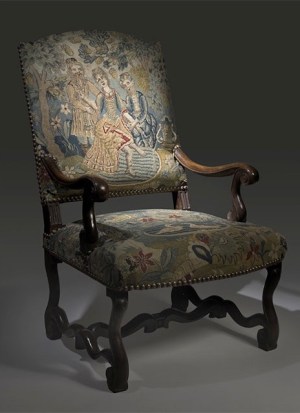
Louis XIII armchair owned by the Marquis de Sade; for auction at Drouot in Paris, 15 June 2016.
The chair on which France’s most notorious writer, the Marquis de Sade, wrote his most shocking work went under the hammer [at Drouot] in Paris Wednesday [15 June 2016] with nearly 100 of his rare surviving manuscripts. The aristocratic author of The 120 Days of Sodom and Philosophy in the Bedroom brought the Louis XIII armchair with him through a series of prisons after he was repeatedly locked up for his outrageous sexual antics. And it was on it that he wrote some of his most erotic and blasphemous works including his masterpiece Justine in 1791.
The chair and drafts of plays and letters belonging to the marquis were part of a secret cache found by his descendants sealed in a chest behind the shelves of the library of the family’s chateau at Conde-en-Brie in the northern Champagne region. . . .
The full article is available at Art Daily.
The piece weirdly fails to mention that the narrative depicted is that of Susanna and the Elders, and I’ve had no luck tracking down further details (including whether it actually sold). . . I just keeping thinking of Steve Martin’s brilliant performance in the 1979 film The Jerk. –CH
. . . And that’s it, and that’s the only thing I need, is this. I don’t need this or this. Just this ashtray. And this paddle game, the ashtray and the paddle game, and that’s all I need. And this remote control. The ashtray, the paddle game, and the remote control, and that’s all I need. And these matches. The ashtray, and these matches, and the remote control, and the paddle ball. And this lamp. The ashtray, this paddle game, and the remote control, and the lamp, and that’s all I need. And that’s all I need, too. I don’t need one other thing, not one—I need this. The paddle game, and the chair, and the remote control, and the matches, for sure. What are you looking at? What do you think I am? Some kind of jerk or something? And this. That’s all I need. The ashtray, the remote control, the paddle game, this magazine, and the chair.
At Sotheby’s | Four Paintings of the British Siege and Capture of Havana

Dominic Serres, The Cathedral at Havana, August–September 1762: View of the Church of San Francisco de Asís, oil on canvas, 83.5 × 122.3 cm (estimate: £300,000–400,000)
◊ ◊ ◊ ◊ ◊
Press release (6 June 2016) from Sotheby’s:
This summer, Sotheby’s will present for sale some of the earliest views of Havana, Cuba (Evening Sale of Old Master and British Paintings, London, 6 July 2016, Sale L16033). Painted by Dominic Serres between 1770 and 1775, the four spectacular pictures depict specific stages of the British siege and capture of Havana in 1762. There were made either for General George Keppel, 3rd Earl of Albemarle (1724–1772) or for his brother, Admiral Augustus Keppel, 1st Viscount Keppel (1725–1786), both of whom played a decisive role in the British victory. Unseen on the market for almost 250 years, the works boast exceptional provenance, having remained in the possession of the Keppel family ever since they were painted.
Talking about the sale of the paintings, Julian Gascoigne, Specialist, British Paintings at Sotheby’s, commented: “These four views are not only of great historical significance; they are also remarkable works of art and some of the greatest British marine pictures ever painted, demonstrating the influence on Serres’s work of both Canaletto and Vernet, two masters of eighteenth-century Europe.”
Based on drawings made on the spot as events unfolded, the works belong to a group of eleven paintings depicting the siege and capture of Havana, all of which were—from 1948 onwards—on loan to the National Maritime Museum in Greenwich, London, and six of which now remain in the permanent collection there. The Albermale Havana Views demonstrate how Serres was intimately acquainted with the topography of the city and its surrounding environs. The French-born painter went to the West Indies as a young man and spent several years in Havana working as a ship’s captain on Spanish galleons, before being captured by the British and taken to London. In 1752 he returned to Havana once again, this time as master of an English merchantman.
The British capture of Havana in 1762 was the last major engagement of the Seven Years’ War and the decisive military action that finally brought to an end a conflict that ravaged the globe between 1756 and 1763. A contest for global supremacy, the war involved most of the major European powers of the day, as well as their colonies, divided into two giant coalitions led by Britain and France respectively. In 1761 Spain joined the conflict as an ally of France, and between March and August 1762 British naval and ground forces—under the joint command of General George Keppel, 3rd Earl of Albemarle and Admiral Sir George Pocock—besieged and captured the city of Havana, the capital of Spanish Cuba and Spain’s principal naval base in the West Indies. Also serving among the British forces were two of Albemarle’s younger brothers: Admiral Augustus Keppel, later 1st Viscount Keppel, who was second-in-command of the fleet, and Colonel William Keppel, who was one of his eldest brother’s two divisional commanders and later succeeded him as British Governor of Cuba.
Dominic Serres, View of the Morro Castle and Boom Defence before the Attack, 1770, oil on canvas, 85.5 × 176.5 cm (estimate: £400,000–600,000)
This painting shows the Spanish preparations before the siege. The port of Havana was a vitally important strategic target as both the capital of Spanish Cuba and Spain’s principal naval base in the Caribbean. On 6th June 1762, the British fleet was spotted approaching the city from the North. The Spanish garrison at Havana had expected an attack from the West, and the unexpected sighting of the fleet in the North created panic among the city’s defenders. A council of war was held by the Spanish governor, Juan de Prado Mayera Portocarrero y Luna (1716–1770), at which it was decided to sink three large ships across the narrow mouth of the harbour to block the British from entering but also trapping the Spanish fleet inside. To the left of the painting can be seen the Castillo de los Tres Reyes de Morro, known to the British as the Morro Castle, guarding the mouth of the harbour. On the right is the narrow channel that gave entrance to the harbour itself, blocked by the sunken ships and a floating boom defence strung across its mouth, whilst men and supplies are loaded into the fort. The large cloud of smoke rising from behind the fort indicates that the British bombardment from the landward side has begun.
Dominic Serres, The English Battery before the Morro Castle, 1770, oil on canvas, 84 × 122 cm (estimate: £200,000–300,000)
The British forces under General Albemarle had the benefit of a fairly detailed report on the defences at Havana. He knew that the weakest point in the Spanish defences was the rocky ridge of the Cabana hills, known to the Spanish as Los Cavannos. On high ground to the South-East of the city, the Cabana heights overlooked the Morro Castle, which commanded both the entrance to the harbour and the town on the west side of the bay. Whilst the castle itself was virtually impregnable, the Spanish defences on the ridge were relatively light. The British landed troops on 7th June, and on the 11th a successful assault was made on the heights. This painting shows the inside of the British battery. Beyond can be seen the fortress of El Morro, with its formidable ramparts. On the left is the bell tower of Havana cathedral silhouetted against the hills beyond.
Dominic Serres, The Taking of the Havana by British Forces under the Command of the Earl of Albemarle, 14 August 1762, oil on canvas, 125.7 × 187.9 cm (estimate: £800,000–1,200,000)
On 22nd June 1762, four British batteries of 12 heavy cannon and 38 mortars opened fire from their newly captured Cabana heights on the Morro Castle. By the end of the month, British gunners were scoring 500 direct hits a day, inflicting heavy casualties and exhausting Spanish efforts to repair the Castle walls. Finally on 29th July the British stormed El Morro, mortally wounding the Spanish commander during the fierce hand to hand fighting that ensued. With the fort captured, the British began their domination of the city. On the 11th August, following Spanish refusals to surrender, Albemarle opened fire on Havana. By 2pm, the Spanish governor was forced to surrender. This painting shows British land forces sailing to take possession of the Castle and the north gates of the city following conclusion of Spain’s capitulation terms on 13th August. On the left, the Union Jack fly from the flagpole atop the Morro Castle, whilst to the right is a magnificently detailed panoramic view of the walled city of Old Havana, arguably the finest and most important of its kind.
Dominic Serres, The Cathedral at Havana, August–September 1762: View of the Church of San Francisco de Asís, oil on canvas, 83.5 × 122.3 cm (estimate: £300,000–400,000)
This is one of two scenes painted by Serres depicting Havana after its capture by the British, the other being part of the National Maritime Museum’s collection. The central building is the monastic church of San Francisco de Asís, dating from the 1730s. In this picture, Serres is at pains to show British troops and Spanish civilians in harmony, reflecting the contemporary concern to grant the defeated Spanish magnanimous terms. The composition is taken from one of six prints produced by Elias Durnford, an engineer stationed in Havana under General Albemarle. The composition shows a debt to the work of the artist’s close friend Paul Sandby, as well as to Canaletto.
The works will be on view in London, 2–6 July 2016.
Odes on a Cat Drowned in a Goldfish Bowl
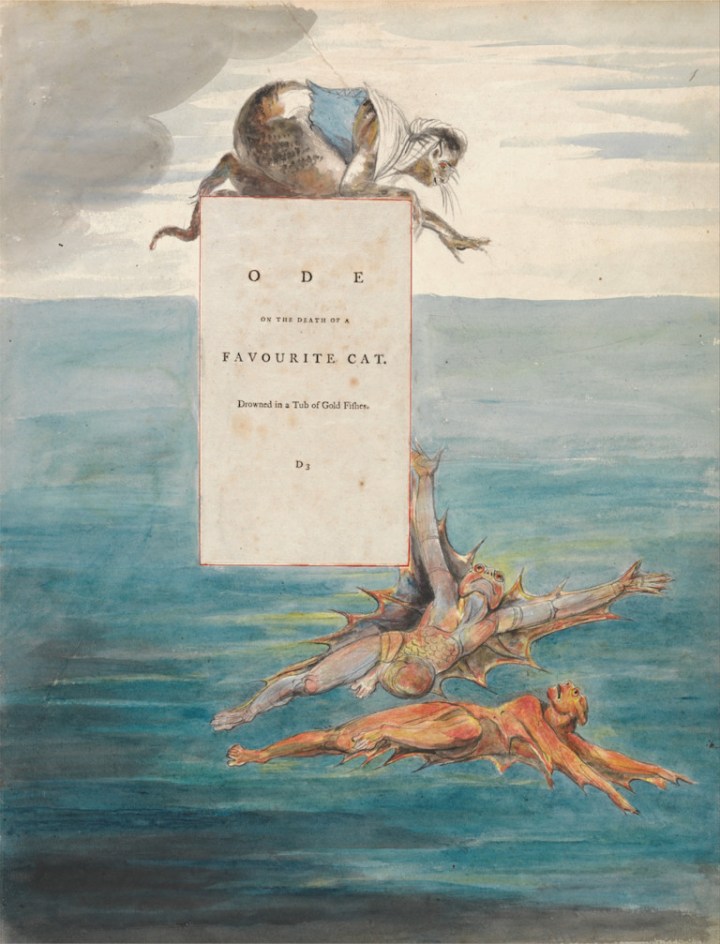 William Blake, illustration for “Ode on the Death of a Favourite Cat,” in ‘The Poems of Thomas Gray (1797-98), watercolor with pen and black ink and graphite on paper with inlaid letterpress page (New Haven: Yale Center for British Art, Paul Mellon Collection)
◊ ◊ ◊ ◊ ◊
Taking as a point of departure a painting at auction this week at Bonhams, Allison Meier highlights for Hyperallergic readers some of the artistic responses to Horace Walpole’s cat, which drowned in 1747, including William Blake’s extraordinary watercolors.

Attributed to Martin Ferdinand Quadal (Nietschitz 1736–1811 St. Petersburg), Ode on the Death of a Favourite Cat Drowned in a Tub of Goldfishes (Estimate: £1000–1500 / US$1400–2200)
Allison Meier, “18th-Century Odes to a Cat that Drowned in a Goldfish Bowl,” Hyperallergic (8 April 2016).
A cat that fell into a goldfish bowl in 1747 and subsequently drowned from her pyrrhic hunt inspired an unlikely series of artworks in the 18th century. Selima, as the unfortunate feline was called, was the companion of art historian and author Horace Walpole, and like any eccentric aristocrat worth his earldom, he asked friend and poet Thomas Gray to pen a tribute. Gray went beyond a simple epitaph and scribed a whole mock elegy for the cat, called “Ode on the Death of a Favourite Cat Drowned in a Tub of Goldfishes.” . . .
The painting is included in Bonhams Old Master Sale this Wednesday (27 April 2016, Auction 23252, Lot 200).
At Sotheby’s | Musical Automaton ‘Bird Cage’ Clock
The clock dates to around 1825, but it is an eighteenth-century kind of object—a kind of object that’s not yet appeared here at Enfilade. Try a keyword search for ‘bird cage automaton’ (to the right) and now something turns up. Press release from Sotheby’s:
Important Watches (Sale #GE1601)
Sotheby’s, Geneva, 14 May 2016

Attributed to Jean-David Maillardet with clavier by Charles-Frédéric Nardin, musical automaton bird cage clock, ca. 1825–30 (Sotheby’s Sale #GE1601; estimate: $411,000–825,000).
Sotheby’s upcoming sale of Important Watches, to be held on Saturday, 14 May, will be led by an exceptional and rare musical automaton clock, shaped as a bird cage. This stunning object proudly showcases the very finest of Swiss craftsmanship: its external appearance combines exquisite design and detail, while its inner mechanics represent the most advanced horological complications of the age. The bird cage features two charming singing birds as well as a captivating butterfly. Thanks to three automaton mechanisms, the elements combine to form a delightful scene filled with movement and music. This exceptional piece will be offered with an estimate of CHF 400,000–800,000 ($411,000–825,000).
Speaking ahead of the sale, Pedro Reiser, Department Manager of Sotheby’s Watch Division in Geneva, commented: “It is truly an honour to have been entrusted with such an extraordinary timepiece for our upcoming auction of important watches. This wonderful automaton is a rare find—all the more exceptional because it features an automated butterfly. Records suggest that only one other double-bird cage clock with an automaton butterfly is currently known. We are delighted to be able to present this exquisite creation, which would be equally at home in the collection of a connoisseur or in a museum.”
The ornate cage, of chiselled golden bronze, sits on four lion paw-shaped feet atop a pedestal. The whole structure is finished in shiny piqué-mat. Inside the rectangular cage are two singing birds, which jump from one perch to another, opening and closing their beaks alongside an animated fountain. The fountain is topped by a beautiful butterfly, whose hand-painted wings move as it turns within the cage. The mechanism articulating these delicate movements, built in brass and steel, are ingeniously concealed inside the lower section of the cage. The birdsong, mimicking canaries and nightingales, is reproduced by a combination of bellows, whistles and cams, enabled by an intricate fusee-and-chain mechanism. This feat of horological complexity can be attributed to a highly accomplished craftsman, Jean-David Maillardet (1748–1834) from La Chaux-de-Fonds.
Birdcage clocks were primarily made between 1780 and 1840. In the late 18th century, singing birds were produced in extremely small quantities, and they were considered the ultimate in luxury. The number of privately held pieces has diminished greatly, and their appearance at auction generates tremendous interest.
The music box, which is concealed inside the base of this striking piece, plays three melodies which are triggered on the passing of each hour or on demand. The mechanism triggers brass cylinders, which in turn vibrate the 93 blades of the clavier, or the ‘comb’. The clavier is signed ‘C. F. Nardin’ for Charles-Frédéric Nardin from La Chaux-de-Fonds. The three charming melodies which can be selected include Der Jägerchor (The Huntsmen’s Chorus) by Carl Maria von Weber (1786–1826), written in 1820.
This masterpiece combines the exceptional skills of Swiss craftsmen, including horologists from Neuchatel, la Vallée de Joux and Geneva, who specialised in singing birds. Among the best known makers were Jaquet-Droz, Frédéric Leschot, Jacob Frisard, Jean-David Maillardet, the Rochat family and the Bruguiers. Their popularity can be seen to rise in parallel with the expanding commercial relationship with the Chinese, Ottoman and Russian markets, which blossomed towards the end of the eighteenth century.
At Sotheby’s | Voyage to Rome, A Distinguished Italian Collection, Part II
Next month at Sotheby’s Paris:
Voyage à Rome: Collection particulière italienne, IIème partie (Sale #PF1640)
Sotheby’s, Paris 4 May 2016
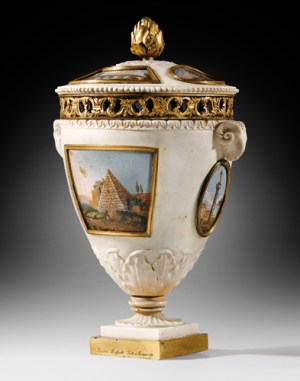
A gilt-bronze mounted white marble micromosaic vase with cover signed by Giacomo Raffaelli and dated 1777.
Following Sotheby’s New York’s 28 January auction The Road to Rome, the first installment in an artistic journey to the Eternal City seen through the eyes and paintbrushes of the great Italian painters of the late 18th century such as Vanvitelli, Anesi, Caffi and Van Lint, Voyage à Rome marks the second chapter in this recollection of the Grand Tour. This second catalogue continues the well-deserved tribute to an important Italian private collection, the spirit and taste of which was inspired by the classical revival. The sale, which will take place at Sotheby’s in Paris on 4 May, will bear witness to the tradition and continuity of the artistic and cultural quest that flourished in Rome at the end of the Enlightenment. It will also bring together a wonderful group of neo-classical objects created by the most famous artisans of the period, such as Valadier, Righetti, Raffaelli and Aguatti. The decorative arts have been collected with the same fervour and passion as the fine arts, just as they may well have been centuries earlier by the aesthetes and enthusiasts who roamed the provinces of Italy.
The light of the natural landscapes and beauty of the architectural decoration were taken up by the expertise and creativity of these artisans, who knew how to blend fine materials, precious stones, bronze and micro-mosaic while striving for perfection and driven by the quest for beauty. Among the most emblematic pieces in this collection of around 240 lots is a vase signed by the famous Italian micro-mosaicist, Giacomo Raffaelli (1753–1836), illustrating Rome’s most famous ancient sites; this valuable and refined object could not have failed to captivate enthusiasts on the Grand Tour. Also featured in this sale is a bust of the Spanish ambassador to Rome, José Nicolàs de Azara, sculpted in 1790 by Francesco Righetti (1738–1819). A pendant to that of Mengs, a leading exponent of neo-classicism and a friend of Azara, the work summarises what Rome promoted in the way of intellectual exchange, virtuosity and artistic effervescence.
The section dedicated to Old Master Paintings marvellously illustrates the poetry of the Roman campagna and the gentle quality of the Italian light when painted by vedutisti such as Paolo Anesi, Jacob de Heusch, and Hendrick Franz van Lint. Beautifully crafted and in excellent condition, this collection has clearly been assembled by someone passionate about painting.










 Enfilade
leave a comment