Private Goes Public, Private Art Dealers Association Exhibition
Press release (22 July 2013) from PADA (a CAA affiliate society, incidentally). . .
Private Goes Public (Private Art Dealers Association)
13 East 69th Street, New York, 1–16 November 2013
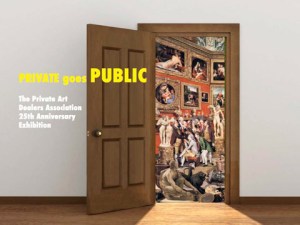 The Private Art Dealers Association (PADA), the first trade association to represent private art dealers, is celebrating its 25th anniversary with its first-ever public exhibition, Private Goes Public, 1–16 November 2013. Over thirty members of the 50-member strong PADA organization will exhibit a full range of fine art from the 17th to the 21st centuries at 13 East 69th Street, where galleries of three PADA members are located. European and American paintings, drawings, prints, photographs, and sculpture will be offered, all available for sale. An illustrated catalog will provide details on each of the dealers exhibiting at this show. (more…)
At Auction | One of Fragonard’s ‘Fantasy’ Portraits
Up for auction on December 5 in London (#21413), Fragonard’s Portrait of François-Henri d’Harcourt will be on public view in Geneva at the newly opened Bonhams office (10 rue Etienne-Dumont,) September 24–26. From Bonhams:
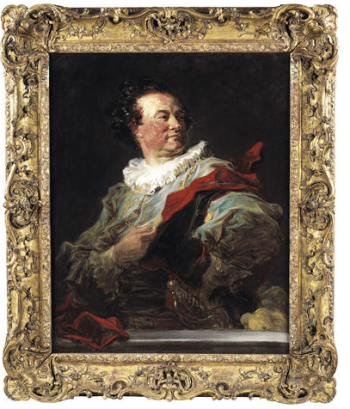 A major work by the eighteenth-century French artist Jean-Honoré Fragonard, Portrait of François-Henri d’Harcourt, will lead Bonhams sale of works from the renowned collection of the German philanthropist, the late Dr Gustav Rau. The proceeds will be used to benefit the Foundation of the German Committee for UNICEF – for the children of the world. The sale will take place at Bonhams New Bond Street on 5 December [auction #21413].
It will be one of the most important sales in the inaugural season of auctions to be held in Bonhams new saleroom which is being built at a cost of £30m and is due to open in October.
One of Fragonard’s famous 15 fantasy portraits, the Portrait of François-Henri d’Harcourt is the most significant of the artist’s works to appear on the market for many years. Only two other fantasy portraits remain in private hands making this painting rarer than portraits by Frans Hals, Joshua Reynolds or even Rembrandt. With a multimillion-pound estimate, it has only changed hands once in its 250 year history when Dr Rau acquired the picture from the Harcourt family in 1971. (more…)
Art Market | The Age of Elegance at Ely House
From Mallett:
The Age of Elegance: Treasures from the Eighteenth-Century Town House
Mallett, Ely House, London, 18 June — 20 July 2013
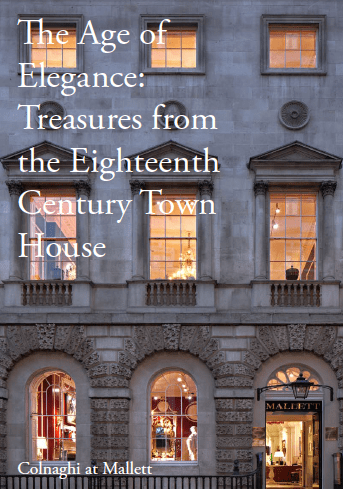 We are delighted to announce a special collaboration between Mallett and the world-renowned Old Masters dealer, Colnaghi. The exhibition will show the importance of the 18th-century town house as a site of display for the finest paintings and furniture. Set in the London showrooms of Mallett, the magnificent former palace of the Bishop of Ely built in 1770 to the designs of Sir Robert Taylor, this special event will show a series of rooms hung and decorated to recreate the splendours of a bygone era.
In the 18th century, the first in the hierarchy of rooms would have been the Saloon, containing the finest gilt furniture and hung with what Lord Chesterfield termed “capital pictures.” Among the works to be displayed in the Saloon of Ely House are Giovanni Antonio Pellegrini’s Sophinsba and Susannah and the Elders, which relate to an important series painted for nearby Burlington House. Still lifes will be featured in the dining room, while the Cabinet will be hung with smaller-scale pictures from the Northern Schools. The entrance hall will be dominated by an equestrian portrait by Louis Rolland Trinquesse, painted for presentation by the sitter Charles Grant to his
kinsman Sir James Grant.

Attributed to Sefferin Nelson (1739-97), after designs by Henry Holland, Giltwood Trophy, ca. 1795
Mallett will present a number of important pieces, including a pair of magnificent commodes, made by Mayhew and Ince for the home of Robert Birch in Donabate, Co. Dublin, and impaled with his coat of arms. Amongst other highlights will be a magnificent pair of giltwood settees in the manner of Thomas Chippendale, a set of twelve armchairs made by François Hervé and supplied to George John 2nd Earl Spencer in 1791, and a giltwood wall trophy attributed to Sefferin Nelson (1739-97) after designs by Henry Holland. This trophy was one of a series made for Carlton House, the former residence of George IV when Prince of Wales.
Carlton House will also be the subject of a special lecture given to accompany the exhibition by Desmond Shawe-Taylor, Surveyor of the Queen’s Pictures, on Sunday 30th June (please contact us for details).
The exhibition brochure is available here»
At Auction | Liberty or Death: Relics from the American Revolution
While I generally refrain from editorializing, it seems to me that there’s something dreadful linguistically and maybe conceptually about the phrase “selling exhibition.” On the other hand, the objects included in the sale and the exhibition look interesting enough, and this is the first I’ve heard of the Museum of the American Revolution (further proof of just how much slips past me!). Robert A. M. Stern’s design plans were unveiled last June, and the museum plans to open in 2016. -CH
◊ ◊ ◊ ◊ ◊
From a Sotheby’s press release (6 June 2013) . . .
Liberty or Death: Relics from the American Revolution
Sotheby’s, New York, 1–28 June 2013

Robert A. M. Stern, Architectural Rendering for the Museum of the American Revolution in Philadelphia
Sotheby’s presents Liberty or Death: Relics from the American Revolution, an exciting cross-platform initiative in collaboration with Philadelphia’s Museum of the American Revolution. The selling exhibition features items for sale by Sotheby’s as well as objects on loan from the museum’s extraordinary collection, creating a fresh, multi-dimensional dialogue on America’s struggle for independence. The exhibition will be open to the public through 28 June 2013.
The Museum of the American Revolution will be a national institution that will chronicle the full sweep of the American Revolution – the deadly struggle between British and American forces as well as the growth of the idea of independence. Located in Philadelphia, Pennsylvania, the museum will be built steps away from where the Declaration of Independence was drafted, debated and adopted. Funds are currently being raised to build the institution. “We are delighted to collaborate with Sotheby’s to display these great treasures from our collection. Through this exhibition, people now have a rare opportunity to view these relics as they await display in the new Museum of the American Revolution,” said Michael C. Quinn, President and CEO of the Museum of the American Revolution.
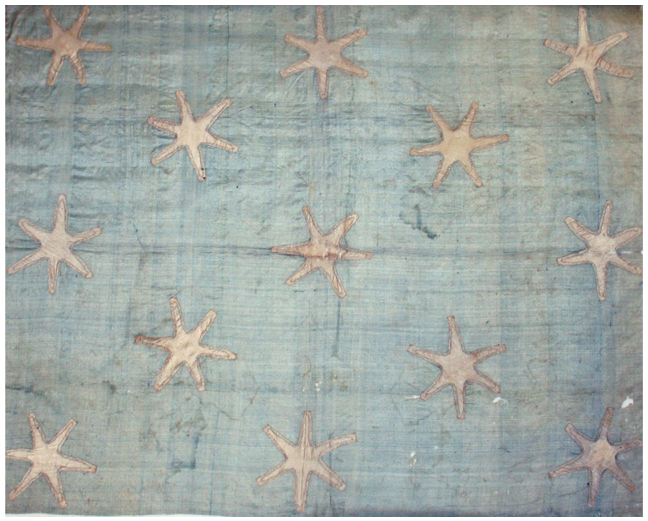
Commander in Chief’s Standard, ca. 1777-83 (Philadelphia: Museum of the American Revolution)
The distinctive thirteen-star blue silk standard circa 1777–83 that marked the presence of the Commander-in-chief on the battlefield and in headquarters is on loan from the museum and currently on view. This rectangular standard has been known for more than a century as George Washington’s Headquarters flag. It descended in the family of Washington’s sister, Betty Washington Lewis, whose son George served as an officer in the Commander-in-Chief’s guard. Also on loan from the museum are ten original silver camp cups from George Washington’s military field equipment with commemorative inscriptions. The original set of twelve cups, used to serve wine to aides and guests at the General’s table, were made in the shop of Philadelphia silversmith Edmund Milne in August 1777.
Sotheby’s selling exhibition will include a rare contemporary printing of the Declaration of Independence, the official printing for Massachusetts Bay, and a fine and rare engraved powder horn from March 22, 1770, owned by Jonathan Leonard Jr. (February 17, 1763 – January 25, 1849), a soldier in the American Revolution. The unique phrase, “Britain to Washington Shall Yield, Freedom Shall Triumph in the Field,” is engraved on the horn, paraphrased from the last verse of the highly popular song of the time, Great News from the Jerseys. Also included in the sale is the William Schuyler American horseman saber with figured maple grip, eagle pommel and original leather scabbard circa 1778–90. Opening hours are Monday – Saturday 10 am – 5pm and Sunday 1 pm – 5pm through 28 June 2013.
The Museum of the American Revolution will tell the complete story of the American Revolution. To be built in historic Philadelphia, just steps from Independence Hall and the Liberty Bell, the museum will feature a distinguished collection of objects, artifacts, artwork, and manuscripts from the period of the American Revolution that will bring to life the original “greatest generation” and engage people in the history and continuing relevance of the American Revolution.
At Christie’s | The Exceptional Sale
Press release (22 May 2013) from Christie’s:
The Exceptional Sale (#1140)
Christie’s, London, 4 July 2013

George II Silver Coffee-Pot, Mark of Paul de Lamerie, 1738. 10 3/4 in. (27.3 cm.) high. The arms are those of Lequesne impaling Knight, for Sir John Lequesne (1687-1741) and his wife Mary, née Knight, whom he married in 1738. Estimate: £3.5 million – 4.5 million. Photo: Christie’s Images Ltd 2013.
With an estimated 1.6 billion cups of coffee being consumed worldwide each day, Christie’s London presents the most important coffee-pot ever to come to the market in The Exceptional Sale (#1140) on 4 July 2013 (estimate: £3.5 million – 4.5 million). This Rococo masterpiece by Paul de Lamerie (1688–1751) – the greatest silversmith working in Britain in the eighteenth century – is expected to become the most valuable piece of English silver ever to be sold at auction. The George II silver coffee-pot was created in 1738, for a successful merchant. This exceptional piece of craftsmanship has recently been the centerpiece of the British Silver exhibition at The Metropolitan Museum in New York.
Lamerie’s works have been prized above all others for the last two hundred and fifty years. He was apprenticed to his fellow Huguenot Pierre Platel in 1703, becoming free of his master in 1711. Within six years he was described as the King’s Silversmith. This coffee-pot is the masterpiece of de Lamerie’s highly developed Rococo period and is a tour-de-force of design and execution.
The coffee pot was commissioned by London based trader and fellow Huguenot Sir John Lequesne. As a child, Lequesne came to Britain as a refugee with his younger brother, fleeing Rouen like so many of his fellow Protestants. It was arranged by their father that they would lodge with a Spanish merchant in London; the brothers would never see their father again, he died tragically from an illness after having been imprisoned for his beliefs. The Lequesne brothers prospered; John became free of the Grocers’ Company and David the Salters’ Company. They later set up business together trading with the West Indies. John not only became an Alderman of the City but was also a director of the Bank of England, and was knighted by King George II in 1737. A successful marriage, bringing a dowry of £20,000, and an equally successful career enabled him to commission this most magnificent of coffee-pots from the greatest silversmith of the day. The coffee-pot, inspired by French forms and conceived in the new French Rococo style, speaks of his ancestry. Its presence in the ownership of a successful merchant epitomises the vibrancy of eighteenth-century trade in London.
The first London coffee house was opened in 1652 by a member the English Levant company which traded with Turkey. Pasqua Roseé had served in Smyrna (now Izmir) and had acquired a taste for the dark stimulant drink. Coffee’s many virtues, both real and imagined, were extolled by printed handbills; they also warned of a sleepless night if consumed too late. Each coffee house had its own particular clientele, some were literary, some political, others concerned with shipping and others finance. From the coffee house came the Gentleman’s Clubs and City institutions such as the insurance market Lloyds of London. These unofficial meeting places were disapproved of by the establishment; King Charles II tried to censure them in 1675 to no avail.
By the eighteenth century the practice had acquired polite acceptance and coffee was being consumed at home from silver and porcelain pots. It was usually served black and from long spouted vessels. There was also a fashion for taking it in the Turkish manner, with large quantities of sugar syrup used in the preparation. Contemporary accounts survive for ‘Turky Coffee Pots’ with short spouts, as used by Lamerie for the present coffee pot; the short spout meant viscous liquid flowed freely.
At Mallett | Great English Furniture
As noted at ArtDaily (the brochure from Mallett is available as a PDF here) . . .
Great English Furniture
Mallett, London, 21 May — 1 June 2013
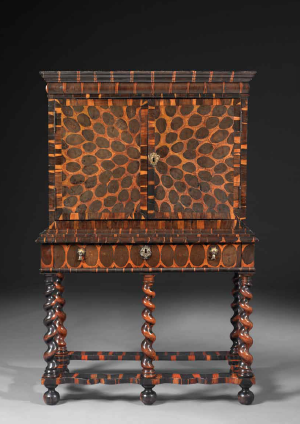 A major exhibition of English furniture which has been in important American private collections for many years is to be held by Mallett, one of the world’s leading antique dealers, at Ely House, 37 Dover Street, London W1 from 21 May to 1 June 2013. Great English Furniture will celebrate the skills of some of the best furniture makers in history and also provide an opportunity for collectors to buy pieces which have not been on the market for at least a quarter of a century.
Highlights of the exhibition will include a magnificent Master’s Chair, probably made for an anti-French society in the 18th century and one of only two known examples, an exceptional giltwood trophy attributed to Sefferin Nelson and made for the Prince Regent’s opulent home at Carlton House in London, a rare William and Mary cocus wood cabinet and an elaborately carved Chippendale period carved giltwood mirror. The majority of the pieces in the exhibition are 18th century and have been sourced by Mallett from private collections in the United States.
 One of the most fascinating pieces in the exhibition is a rare George II Master’s Chair, almost certainly made for the Anti-Gallican Society, founded in 1745 when Britain and France were at war. “For our Country,” the motto of the Society, is inlaid on the imposing walnut armchair, which is almost six feet high. It would have been made ca. 1750 for use in a dining club of the Anti-Gallican Society, which aimed to deter what it called “the insidious arts of the French nation.” Like many 18th-century clubs, its members combined the pursuit of convivial pleasure with promoting a cause – in this case opposing French influence and Anglo-French trade. The chair has broad sloping shoulders ornamented with carved and gilt acanthus and scroll-shaped terminals. The arms end in finely carved lions’ masks. The only other such chair known is in the collection of Temple Newsam, the great country house near Leeds. The price of this rare and historic chair will be in the region of £125,000.
Another highlight of the Mallett exhibition with a fascinating history is an exceptional giltwood trophy, representing the victory of peace over war, attributed to Sefferin Nelson ca. 1795. Nelson worked at Carlton House, the London residence of the Prince Regent, later George IV, as a carver gilder and frame maker. Henry Holland, the architect who turned the house into a palatial home for the heir to the throne, designed a set of giltwood trophies for the throne room at Carlton House. He commissioned them from the famous marchand-mercier Dominique Daguerre, who had the order completed by Nelson. Four of these trophies are now in the throne room at Buckingham Palace, where most of the contents of Carlton House were taken after the latter’s demolition in 1825. These are of the same dimensions and decorated with similar carvings and motifs to the one in the exhibition at Mallett. It will be priced in excess of £100,000.
Great English Furniture will also include a very rare William and Mary cocus wood cabinet on a stand, made in England ca. 1700. This oyster-veneered cabinet has a rectangular top above a moulded cornice and a pair of doors enclosing a fitted interior. Inside are two drawers around a central door with a row of pigeonholes on top. The whole piece stands on barley-twist turned legs joined by a waved stretcher and ending in bun feet. The cabinet will be on sale for more than £100,000.
A fine Chippendale period carved giltwood mirror will be another highlight of the exhibition. The elaborately carved mirror of Rococo design, made in England ca. 1765, has a central cartouche with foliate C-scrolls and bell flowers, elaborately pierced with an unusual double-layered cresting, flanked by hoho birds. This will also be priced in excess of £100,000. A fine Queen Anne double back walnut settee of rich colour and patination made in England ca. 1720 and a rare late 17th-century William and Mary desk decorated with ‘seaweed’ marquetry inlay, primarily in holly, are among the many other magnificent examples of furnituremakers’ art in the exhibition. Both will be on sale for a price in the region of £50,000.
Note (added 13 July 2013): The Master’s Chair sold at Masterpiece London (27 June — 3 July 2013) , as reported here»
Peale’s Portrait of Washington Sells for Record Price
With this posting on auction results, I would remind readers that we’re keeping up with past and upcoming auctions on HECAA’s Pinterest boards. -CH
◊ ◊ ◊ ◊ ◊
Press release from Heritage Auctions:

Rembrandt Peale, Portrait of George Washington, ca. 1856, oil on canvas, 36 x 29 inches
Rembrandt Peale’s iconic portrait of U.S. President George Washington — created in the artist’s lifelong quest to paint the most recognizable image of the ‘Father of the United States’ — realized a new world record for a porthole portrait by the artist when it sold for $662,500 to lead Heritage Auctions’ two-day, $4.5+ million American art events in Dallas. The May 10-11 events spanned American Indian art, Texas, Western and California Art and masterpieces of fine American art. The auction sold 88 percent by lot and 93 percent by value and pushed three artists’ records past $500,000.
Peale’s portrait of Washington was presented with his equally iconic portrait of Martha Washington, which reached $158,500. . . .
The full press release is available here»
Christie’s Object Lessons: Flower Holders of the 18th Century
As we transition from still to moving images, it’s interesting to see people (and institutions) exploring possibilities — in this case for educational and marketing purposes. Note the inclusion of music behind the narration of Jody Wilkie, a ceramics specialist at Christie’s and a regular appraiser on Antiques Roadshow. Does the music enhance or detract? I can report, from first-hand experience, that art historians working on similar projects are debating precisely this question. Do your lectures and articles come with soundtracks — either real or imagined? -CH
◊ ◊ ◊ ◊ ◊
From Christie’s Object Lessons series:
London Art Week 2013
Press release (January 2013) . . .
London Art Week
London, 28 June — 5 July 2013
 London Art Week is an exciting joint venture that unites Master Paintings Week and Master Drawings and Sculpture Week (formerly Master Drawings London). The new collaboration will provide a coherent platform, sharing advertising and creating a new online portal through which the individual websites can be accessed. London Art Week will also produce a map with the locations of all the participants making it easier for collectors to navigate the week. More than 50 specialist dealers across the fine art disciplines and the major London auction houses will take part in this new initiative.
“We welcome this initiative which strongly underlines the unique and unrivalled connoisseurship and expertise to be found in the art trade in London,” comments Johnny Van Haeften, co-founder of Master Paintings Week. “The old cliché of the fusty gallery is totally out of date and we want people to discover just how accessible we are and what treasures we hold.”
The strength of the format of London Art Week lies in its simplicity. By joining together to hold a series of coordinated exhibitions in galleries throughout the West End at the same time that the auction houses hold their major sales, specialist dealers in these disciplines are giving collectors, both private and institutional, the opportunity to view the full range of works available on the market. During the first weekend, all the participants’ doors will be open giving visitors the opportunity to look at works of art at their leisure.
London Art Week will serve to promote specialist dealers and their works in all three disciplines, while encouraging collectors and enthusiasts to visit exhibitions in the galleries. By displaying the objects in intimate gallery settings located in Mayfair and St James’s, the event will encourage the building of relationships between clients and dealers.
The Met Acquires Work by William Theed
As noted at Art Daily (14 March 2013) . . .
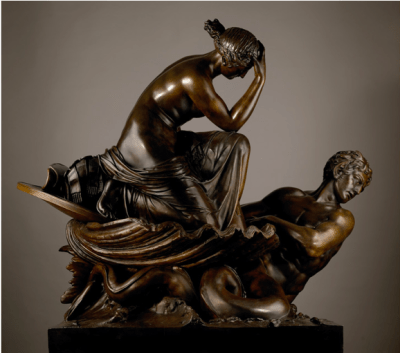
William Theed the Elder (1764-1817), Thetis Returning from Vulcan with the Armour of Achilles. Bronze, cast, chased and patinated, on an integral rectangular plinth. Height: 128 cm; width: 120 cm; length: 143 cm.
For over a year, Tomasso Brothers, the internationally renowned dealers in European sculpture, paintings, furniture and the decorative arts, has been searching for an elegant space in London. Dino and Raffaello are now delighted to announce that from 1 May 2013 they can be found at their new gallery at 12 Duke Street , St James’s. Established in 1993 and based at Bardon Hall, Leeds, Tomasso Brothers is pleased to also have a presence in the heart of London ’s traditional art market where they will showcase exciting pieces from their extensive portfolio.
The two Tomasso brothers are especially renowned for their expertise in European sculpture and boast a number of the world’s greatest museums amongst their clients. Recent sales include a major bronze to the Metropolitan Museum of Art, New York, Thetis Returning from Vulcan with the Armour of Achilles by William Theed the Elder (1764-1817), which was unveiled at the inaugural Frieze Masters in October 2012. This remarkable, almost life-size, bronze depicts the ‘divine Thetis of the silver feet’, most famous of the Nereids in Homer’s Iliad, kneeling by the shield of her son Achilles with the hero’s armour in a giant cockle shell. This spectacular sculpture, described by Sir Timothy Clifford as ‘undoubtedly Theed’s most ambitious work’, was almost certainly originally supplied to the author, philosopher, interior designer and art collector, Thomas Hope (1769-1831) for Duchess Street, London, or his country house Deepdene in Surrey. William Theed was born in London and entered the Royal Academy Schools in 1786. He went to Italy in 1790, returning in 1796. He began his artistic career as a painter but was befriended by the sculptor John Flaxman whilst in Rome and took up sculpture. Flaxman’s designs for Homer’s Iliad clearly made a powerful and lasting impression on the young Theed. Dino Tomasso said: ‘It is hugely gratifying when such a superb sculpture ends up in one of the world’s leading museums’. Dino and Raffaello Tomasso take great pride and pleasure in helping connoisseurs and museums in Europe and America to enhance their collections. In addition the company has promoted and supported through loans and exhibitions major international institutions such as the Fitzwilliam Museum, Cambridge, the Centro Internazionale, Carrara, the National Gallery, Prague, and the Kunsthistorisches Museum, Vienna. Most recently they were one of the sponsors of the landmark show Bronze at the Royal Academy of Arts, London , in 2012.
Tomasso Brothers will be exhibiting at TEFAF, 15 to 24 March 2013, Stand 165, Masterpiece London, 27 June to 3 July 2013, Stand C2, and also joining Master Drawings and Sculpture Week from 28 June to 5 July 2013.










leave a comment