Reynolds at Auction?
On 11 December 2011 (Sale 131), Grogan and Company Fine Art Auctioneers and Appraisers sold a portrait of Captain Benjamin Davies by Joshua Reynolds, along with an unattributed portrait of the captain’s wife, Elisabeth Viscount Davies, for $8470 (surpassing the estimate of $3000-5000). With the paintings having been handed down within the family from generation to generation, this was the first time they were offered on the open market. The following description comes from ArtDaily:

Sir Joshua Reynolds, Portrait of Captain Benjamin Davies
with unattributed Portrait of Elisabeth Viscount Davies, 1761-72
◊ ◊ ◊ ◊ ◊
Benjamin Davies was born in 1728 in Bristol, England and immigrated to New York in 1750. His seafaring career began with a voyage to China, as an apprentice to Captain William Sedgwick, Commander of the London East India Company Service. He also accompanied Captain George Jackson to India before taking passage to New York in 1850 aboard the Neptune. In 1753 he married Elizabeth Viscount, a recent widow of Dutch descent. The next 13 years was spent in the seafaring trade with many partners, much of which is documented in his Diaries, currently located in the Colgate papers at Yale University Library.
In 1765, when the Stamp Act was to be established in the Colonies, Davies took command of the ship Hope and sailed to England with his wife Elisabeth to secure items for his mercantile business. While there, he had a pendant portrait made of his wife with the ship Hope in the background to match the earlier portrait he commissioned from Sir Joshua Reynolds. The Beekman Mercantile Papers at the New York Historical Society contains references to Benjamin Davies making multiple voyages as Captain of the ship Hope between England and American between 1765-1771. . . .
The full article at ArtDaily is available here»
At Sotheby’s: Zoffany and Joseph Wright
Press release from Sotheby’s:
Old Master & British Paintings Evening Sale, L11036
Sotheby’s, London, 7 December 2011

Johann Zoffany, The Garden at Hampton House
with Mr. and Mrs. David Garrick Taking Tea, 1762.
◊ ◊ ◊ ◊ ◊
Sotheby’s London Old Master & British Paintings Evening Sale realised a total of £20,074,500/ $31,364,399/ €23,437,051, comfortably within the pre-sale estimate of £17.6 – 24.2 million. The top lot of the sale was a pair of paintings by Johann Zoffany – the most important works by the artist to appear on the market in recent years – The Garden at Hampton House, with Mr and Mrs David Garrick Taking Tea and The Shakespeare Temple at Hampton House, which fetched £6,761,250/$10,563,777/ €7,893,784 (pre-sale estimate of £6-8 million). . . .
◊ ◊ ◊ ◊ ◊
Characterizing the auction as “a little subdued,” Bendor Grosvenor reports at Art History News that the two paintings were acquired by the Garrick Club:
The buyer was the Garrick Club, and the pictures will hang alongside their pre-eminent collection of theatrical portraits, including numerous Zoffanys. This is splendid news for the preservation of English heritage, for there was a risk the pictures could have been sold overseas. . . .
◊ ◊ ◊ ◊ ◊
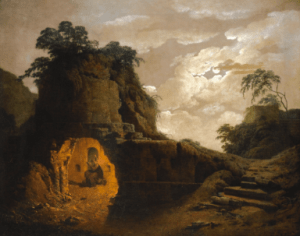 Also up for sale was Joseph Wright’s 1779 painting Virgil’s Tomb by Moonlight (Lot 37). Estimated to sell for £600,000-800,000, it roughly doubled that, fetching just under £1.5 million.
To be sure, along with these British highlights, the evening belonged to Jan Steen, whose Interior with Figures Playing Cards at a Table established a new auction record for the artist. At £4.8 million, it was a strong price, though still toward the low end of the estimate (£4.5-6million).
More information on the painting is available at Art Daily.org.
◊ ◊ ◊ ◊ ◊
For more information on the pair of paintings by Zoffany, see the original announcement from Sotheby’s (5 September 2011). From the press release:
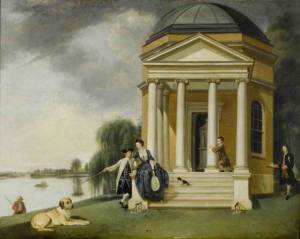 Sotheby’s announced the sale of the two most important works by Johann Zoffany to appear on the market in recent years. Both commissioned by David Garrick, Britain’s greatest actor, they depict him with his family and friends in the garden of his house on the banks of the river Thames at Hampton. Painted in 1762 they have only appeared once on the open market, when they were sold in 1823 from Garrick’s estate, and have descended in the family of a distinguished private collection ever since. From 2007 until 2010 the paintings hung together on loan at Tate Britain, in London, and have been requested as highlights for the forthcoming retrospective of Zoffany’s work at the Royal Academy later this year. They will be offered together as part of Sotheby’s Old Master & British Paintings Evening Sale on 7th December 2011 with an estimate of £6-8 million. (more…)
Holiday Gift Guide, Part 4: Gift Shop Finds
By Courtney Barnes
 Certain scents and sights instantly remind me of my grandparents and the holidays: bourbon mingling with chocolate; a tin of Virginia peanuts; and brass trivets and Duke of Gloucester Fifer ornaments from a Colonial Williamsburg gift shop. In terms of style, the iconic trivets are certainly versatile and very eye-appealing, but other historically connected gift options abound. More than ever, museums and historic foundations are going beyond the tote bags, mugs, and ubiquitous replicas by expanding their gift shop offerings to include locally crafted wares that speak to their roots.
Take, for example, some of the glass sold at Monticello. There are small cobalt blue vials ($18 each) based on Jefferson-era medicinal bottles and currently handmade in Virginia at the
Jamestown Glasshouse, as well as sculptural double-lipped water
pitchers made by West Virginia artisans ($55).
 At first mention, a magnolia paperweight might sound like the ultimate tourist purchase, but South Carolina’s Drayton Hall (the oldest surviving example of Georgian Palladian architecture in the U.S. and an important repository of African American heritage) offers an object with an interesting backstory: handcrafted by students from the American College of the Building Arts in Charleston—they visit Drayton to perfect their own craft through hands-on interaction with rare examples of intact eighteenth-century craftsmanship—the paperweight is modeled after a detail of the plaster ceiling in the house’s great hall ($20).
◊ ◊ ◊ ◊ ◊
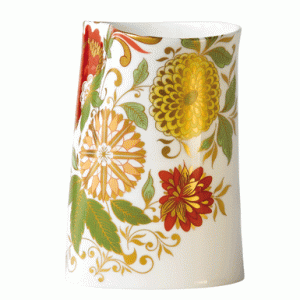 In the UK, contemporary ceramicist Ken Eastman has been working in collaboration with Royal Crown Derby Porcelain Company and adapting pattern manuscripts from the Derby factory archives to decorate new forms of bone china. The pieces impressed the V&A so much that the Museum added select items to its permanent collection and sells the wares in its shop. Limited but gorgeous V&A options are available online; a wider array can be found at Derby online.
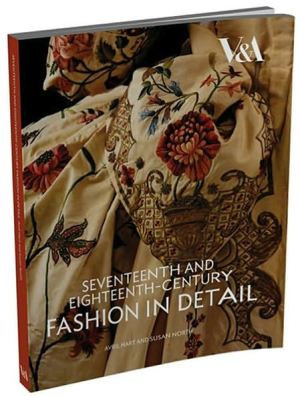
For the budding fashion student—maybe a teen intrigued with the craftsmanship of Catherine Middleton’s wedding dress—there is the V&A’s Fashion in Detail series. One example, Seventeenth and Eighteenth-Century Fashion in Detail, explores minute details that are not always visible to museum visitors: decorative
seams, refined stitching, slashing, stamping, and corseting.
◊ ◊ ◊ ◊ ◊
And finally something for the renovation junkie: Mount Vernon’s large scale paint fan deck, a collaboration between the Estate and Fine Paints of Europe. At $50, it’s a portable little luxury. The cost is refundable with future paint purchase. Although the name leads to some confusion, Fine Paints of Europe is a privately owned American company specializing in Dutch paint.
◊ ◊ ◊ ◊ ◊
Courtney Barnes writes the blog Style Court, which has been praised by editors at various national publications including Time, Elle Decor, Domino, Lonny, and The Washington Post. With a B.A. in art history and a Master’s in education, Courtney provides smart, stimulating coverage of the decorative arts, textiles, books, art exhibitions, and interior design.
At Bonhams: A Large Doccia Figure of the Farnese Hercules
Press release from Bonhams:
Bonhams: Fine European Ceramics
New Bond Street, London, 7 December 2011
 A very rare and important 82cm high porcelain figure of Hercules created at the Doccia factory in Tuscany in 1753-55 is to be sold at Bonhams, New Bond Street, London in the Fine European Ceramics sale on 7th December 2011. This is the first time that a Doccia figure of this size has come to auction and the piece is estimated to sell for £300,000-500,000. Nette Megens, Bonhams European Ceramics Specialist, comments, “It is an unprecedented event that a Doccia figure of this size and importance comes to the market by public sale. It is truly a once in a lifetime chance for an auctioneer to handle an object of this beauty and museum quality.”
The Doccia factory was founded in the middle of the 18th century by Carlo Ginori, and is still operating in Sesto Fiorentino, just outside of Florence. The factory started making large-scale porcelain figures, a hugely ambitions task, in the late 1740s. The stunning work on offer in this sale is based on the famous Antique sculpture of the Farnese Hercules, now in the Archaeological Museum in Naples. The gesso model used in its creation has not moved since the 18th century, and is still kept in the Doccia factory museum. The factory often used bronze models from well-known sculptors to translate into porcelain and even bought the waxes from the workshops of Massimiliano Soldani Benzi and Foggini. For this Hercules, artists were sent to Rome to take casts of one of the many smaller marble versions of the monumental Farnese Hercules, which was one of the most famous Antique sculptures in the 18th century. These moulds were brought back to the Doccia factory to be re-worked into porcelain by the most famous sculptor-modeller at the factory, Gasparo Bruschi. Models of this size were generally kept at the factory, while smaller examples, often with their titles on the base, were sold as expensive souvenirs to travellers on the Grand Tour.
Porcelain sculptures of this size are very rare; Most of the known examples are now in museum collections. Dr. Rita Balleri, guest-curator at the Doccia Factory and author of ‘Omaggio a Venere’ has added an article on the Doccia Hercules, which has been published in the printed catalogue.
◊ ◊ ◊ ◊ ◊
From the Bonhams online catalogue:
Bonhams: Fine European Ceramics, 7 December 2011 (Sale 19110)
Lot #30 — An important unrecorded large Doccia figure of the ‘Farnese Hercules’, ca. 1745-55
Estimate: £300,000 – 500,000 / € 350,000 – 580,000
Comparative Literature:
Klaus Lankheit, Die Modellsammlung der Porzellanmanufaktur Doccia (1982);
John Winter (ed.), Le Statue del Marchese Ginori (2003);
John Winter, “Die Skulpturen der Porzellanmanufaktur Docia,” in J. Kräftner (ed.), Barocker Luxus Porzellan, exhibition catalogue, Liechtenstein Museum (2005), pp. 179-189;
Alessandro Biancalana, Porcellane e Maioliche a Doccia (2009)
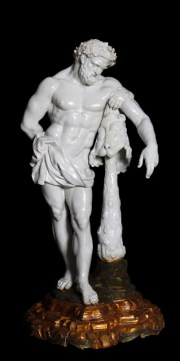 From the important series of large-scale figures and groups produced at the instigation of the founder of the Doccia manufactory, Marchese Carlo Ginori, between 1744 and Ginori’s death in 1757. No other example of this figure is recorded in the literature. The Inventario de’Modelli, the list of plaster, wax and terracotta models that were exhibited as a Galleria, or kind of museum, throughout six rooms of the Doccia manufactory, which was probably compiled by Gaspero Bruschi sometime between 1765 and 1780, includes two mentions of the Farnese Hercules:
- (Busti e statue posate sul banco della seconda stanza, nale è in Campidoglio) — No. 16 Una statua rappresentate Ercole di Farnese. L’originale è dei Signori Marchesi Verospi, senza forma (pagina 14) (published by Lankheit, p.115).
- (Sesta Stanza, Quinto palchetto) — No. 1. Vi è 14 statuette parti di Galleria di Firenze e parte di altri luoghi che sono Mercurio. Ganimede la seconda. Le terza la Baccante. La quarta la Pomona. La quinta la Venere de Medici. La sesta il Fauno. La settima 2 Venere delle belle chiappe. L’ottava Ercole del Farnese. La nona Apollo di Belvedere. La decimal una Diana. L’undecima 2 Venere una vestita e l’altra nuda. La duodecima un Giove, e tutto colle forme. (pagina 76) (published by Lankheit, p. 153).
In 1753, Carolo Ginori appointed a Florentine living in Rome, Guido Bottari, as his agent in the search for Antique statues to copy for his porcelain manufactory. It is clear from the correspondence between the two men that Ginori regarded copies of Antique statues as being of great interest. The same year, he despatched one of the modellers in the manufactory, Francesco Lici, to Rome to produce copies of desirable models. The correspondence between Bottai and Ginori reveals the difficulties the former encountered in securing permission to copy Antique statues in the Capitoline Museum. Although permission to copy six statues was eventually granted in September 1753, Bottari had in the meantime obtained permission to make copies from more easily accessible collections, such as the Villa Medici and the Palazzo Verospi. (more…)
Eighteenth-Century Glass at Bonhams
Press release from Bonham’s (as noted at ArtDaily.com) . . .
Important English and Dutch Glass: The Collection of A. C. Hubbard, Jr.
Bonhams, London, 30 November 2011
 Bonhams will be auctioning the internationally renowned glass collection of A C Hubbard Jr. on 30th November 2011 at Bonhams, 101 New Bond Street, London. The important and magnificent Prince William V of Orange Goblet, circa 1766, is the major highlight not only of the sale but of all English glass offered at auction in recent years, and is estimated to sell for £100,000-150,000.
This goblet is signed by William Beilby. The Beilby workshop in Newcastle was renowned for its enamel decoration of glass and produced around 90 recorded heraldic decanters, goblets and wine glasses, mainly with English armorials of which a significant handful depict Royal coats of arms. Simon Cottle, Head of Bonhams Glass Department, comments, “The majority of their fine goblets with Royal armorials now reside in public institutions worldwide. The Prince William V of Orange Goblet in this auction offers a rare opportunity to possess an example, it is one of only four left in private hands. It is also one of only 16 glasses to be signed, and at an imposing 30.2cm in height it is by far the largest of all Beilby goblets. I believe its production may have led William Beilby’s entry to a contemporary valuable Dutch glass market. Its large size and colourful enamel decoration would have been particularly impressive to the Dutch at a time when their craftsmen were producing smaller, engraved pieces.”
Assembled by a discerning Baltimore collector with a passion for fine wines, A C Hubbard Jr.’s collection includes examples of the best of English and Dutch glass from the seventeenth and eighteenth centuries, many previously published in the literature on glass. From majestic early heavy baluster goblets of both large and small size to the attractive colour-twist wine glasses of the later period, this private collection is one of the finest to be offered at auction in recent years.
Iconic eighteenth-century drinking glasses, such as those painted by the Beilby family in Newcastle, also include several further important colourful heraldic goblets and a range of their exquisite wine glasses painted with a variety of subjects in white enamel. Of the colour-twist glasses in the sale several examples feature rare combinations of threads, three of which have highly uncommon canary-yellow stems. Notable English engraved political wine glasses sit happily alongside their Dutch counterparts of which there are numerous light-baluster examples decorated with Royal armorials, VOC ships and political themes such as the patriotic glass by Jacob Sang, dated 1758. Dutch stipple-engraved glass from the hands of David Wolff, Alius and other contemporary eighteenth-century artists represents further classic highlights of this magnificent collection of over 270 lots.
Simon Cottle, comments, “There are few collections of English and Dutch eighteenth-century glass of this quality still in private hands. The Hubbard sale therefore presents a wonderful and rare opportunity to acquire examples from what is now considered to be the Golden Age of lead crystal.”
At Auction: Elizabeth Taylor’s Jewels
Press release from Christie’s (7 September 2011) . . .

Edith Head Necklace, gold necklace with ivory opera passes, ca. 18th and 19th centuries
Christie’s is proud to announce details of the first in a four-day series of landmark sales devoted to the iconic collection of Elizabeth Taylor, the celebrated film star, fashion icon, and humanitarian. On December 13, 2011, Christie’s New York will present 80 of Ms. Taylor’s most iconic jewels in a special Evening Sale, followed by 189 additional jewels in two Day Sale sessions on December 14. Widely celebrated as one of the greatest private collections ever assembled, this dazzling array of jewels includes Elizabeth Taylor’s most iconic diamonds, gemstones, historic jewels, and one-of-a-kind creations, as well as a treasure trove of personal mementos and beloved gifts. The total selection of 269 magnificent jewels from this storied collection is estimated to achieve well in excess of $30 million. . . .
The Edith Head Necklace, a gold necklace with ivory opera passes, circa 18th and 19th centuries, gift from the Estate of Edith Head Estimate: $1,500 – 2,000. Fashioned from ivory theatre tokens, this one-of-a-kind necklace was owned by the Hollywood costume designer Edith Head – a dear friend of Elizabeth Taylor whom she often described as being like a second mother to her. As Ms. Taylor later recounted, she had always admired the necklace on Edith, who in turn promised to leave it to Elizabeth in her will. True to her word, the necklace was the one thing Miss Head left to her, and it became a beloved reminder of her dear friend and one of her most cherished possessions. . . .
An especially nice AP photo by Richard Drew is available here»
Early Editorial Cartoon by Franklin at Auction
Press release from Heritage Auctions:
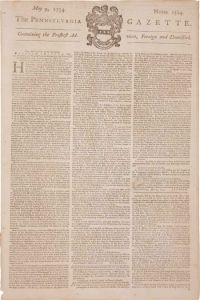 One of only a handful of known existing original copies of Benjamin Franklin’s celebrated “Join, or Die” editorial cartoon, from the May 9, 1754 edition of The Pennsylvania Gazette – the single most famous and important American editorial cartoon in existence, and one of the most famous ever printed – will be offered for the first time at auction and is expected to bring well in excess of $100,000+ when it crosses the block as part of Heritage Auctions’ September 13 Signature Historical Manuscripts Auction.
“There’s no way to overstate just what this cartoon means to American history, Pop Culture history and comics history,” said Ed Jaster, Senior Vice President of Heritage Auctions. “It’s important on so many levels, to collectors of all kinds, across many genres, that there’s no telling where the bidding for this could go.”
Benjamin Franklin’s woodcut illustration of a snake severed into eight sections, each one representing one of the colonies, is the stuff of legend, burned into the collective American consciousness from the time most citizens were in grade school.
The appearance of this copy at auction – the only other known
copy is in the Library of Congress –constitutes a major event in
the annals of American auction history.
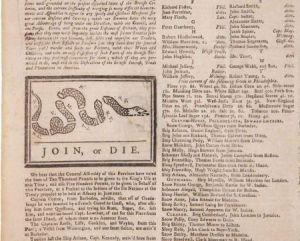 “Franklin used the illustration, along with his accompanying editorial, to vividly explain the importance of colonial unity in 1754 shortly before the French and Indian War,” said Jaster. “Its prescient call for American unity may not have worked the way Franklin planned it in 1754, but it plainly sowed the seeds of the need for unity in the face of the looming American Revolution, some 22 years in the future.”
This very rare and historic newspaper was published in response to the French military expansion west of the Allegheny Mountains in Virginia, itself a response to the growing influx of British traders and colonists in that same region. The French
sought to build several forts along the Ohio River to discourage the British colonists from their westward migration. In April 1754, a young Major George Washington was given command of a small detachment and sent across the Allegheny Mountains to protect Virginian settlers who had built a fort at the confluence of the Allegheny and Monongahela Rivers, the beginning of the Ohio River. When Washington arrived, however, he found that a much larger French force had already arrived and taken control of the fort. (more…)
Motion Pictures in the Eighteenth Century
Earlier this summer, Sotheby’s offered a rare set of five landscape transparencies by Carmontelle (many of you will remember the 2006 exhibition at The Getty of related materials). Estimated to fetch £350,000-500,000, the paintings, in fact, did not sell. Press release from 1 July 2011:
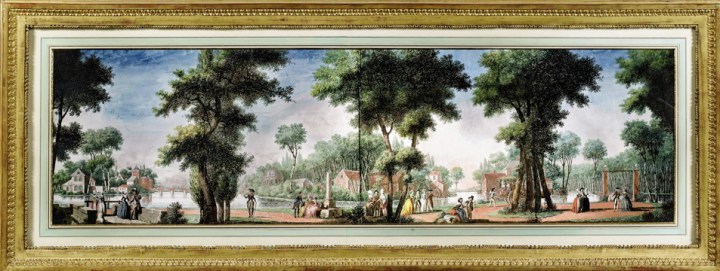
Louis Carrogis called Carmontelle, Set of five landscape transparencies, from the "Campagnes de France," gouache and watercolour; one on six joined sheets of paper, and two others on four joined sheets, all with various minor additional strips at the edges (Photo: Sotheby's)
◊ ◊ ◊ ◊ ◊
Sotheby’s London Sale of Old Master and British Drawings [Sale L11040] on July 7th and 8th 2011 will present for sale a range of important drawings from the 16th to the 19th centuries. In addition to works by artists Hans Bol, Jacopo Ligozzi, Joseph Mallord William Turner and John Constable, a remarkable highlight of the sale is a set of five astonishingly original landscape transparencies From The ‘Campagnes de France’ by Louis Carrogis called Carmontelle (1717-1806), estimated at £350,000-500,000 [Lot 111]. Commenting on the forthcoming sale, Gregory Rubinstein, Worldwide Head of Sotheby’s Old Master Drawings Department said, “We are extremely pleased to be offering these remarkably rare transparencies which not only offer a contemporary account of the French aristocracy during the final years of the ancien régime, but also represent an important step in the journey towards the emergence of perhaps the most influential art form of the 20th century – the motion picture.”
These five landscape transparencies are extremely rare examples of a highly original, but today almost unknown, art form that Carmontelle himself invented, and with which he utterly captivated the French aristocracy during the final years of the ancien régime. Originally, these landscapes, painted on translucent paper, would have formed part of a single, hugely long panoramic landscape, which would have been rolled up, to be viewed by being wound through
a backlit viewing box, as a proto-cinematic theatrical event. As the scene unfolded, frame by frame, Carmontelle would provide an entertaining commentary, complete with a description of the events depicted and much imagined dialogue between the protagonists, as well as music and a variety of other sound effects. These panoramic transparencies were conceived as a continuous narrative of a single trip through the landscapes, parks and gardens of the areas on the outskirts of Paris where the artist’s aristocratic audience had their country retreats. Between 1783 and 1790, Carmontelle made nine such enormous transparencies, which he collectively titled Campagnes de France ornées de ses jardins pittoresques appelés jardins anglais. Of the initial series of nine transparencies dating from 1783 and 1792, it appears that none survive complete, and indeed relatively little survives at all. The largest surviving section, in a private collection, measures 20m in length, while the Musée Condé, Chantilly, has a section measuring 12.6m in length, and the Getty Museum, Los Angeles has another measuring 3.77m in length. The five sections now offered for sale are the only other recorded survivals from these crucial works.
Both in their technical originality and in their remarkable blurring of the boundaries between art, theatre and spectacle, these remarkable landscapes embody the essence of the spirit of the Enlightenment. They are also very moving documents of the last days of the French ancien régime, as they owe not only their subject matter but their very existence to the extraordinary privilege and leisure of the aristocracy in the years leading up to the Revolution. But their significance is not only in relation to their own time. The fact that so few examples of this remarkable precursor of the cinematic film have survived make the present works all the more significant. Over a period of twenty years Carmontelle made 12 rolls, of which only 1 or 2 remain. . . .
Art Market: Buyers Lose Their Taste for 18th-Century Art and Furniture?
This interesting article by Souren Melikian on the state of the art market appeared a couple of week ago in The New York Times (22 July 2011). Whether the vogue for the eighteenth century is in fact waning, it makes for a compelling read. The article also includes some lovely examples of decorative arts from the period (a full list of images from the Lyons Demesne auction, with sale prices, is available here) -FG
◊ ◊ ◊ ◊ ◊

Lyons Demesne House, County Kildare, Ireland, 1785-1797, acquired by Tony Ryan in 1996
Last week, 450 works ranging from furniture to paintings and sculpture that had adorned Lyons Demesne, the Irish Georgian house restored at vast expense by the late Tony Ryan, who founded Ryanair, were dispersed at Christie’s to great fanfare [Sale 8012].
The fine catalog did justice to the mansion in County Kildare designed in 1797 by Oliver Grace for the wealthy businessman Nicholas Lawless. The son of a rich Dublin draper, Lawless further expanded his financial position by marrying the heiress of a brewer, Margaret Browne, and was made a peer. As the 1st Baron Cloncurry, Lawless acknowledged this costly promotion by writing to the Viceroy: “If I have obtained any honours, they have cost me their full value.”
His son Valentine was more pugnacious. He joined the Society of United Irishmen set up in 1791 to fight against the Act of Union with Great Britain and was incarcerated in the Tower of London following the 1798 uprising but was released in 1801, the year of the Act of Union. Whereupon, the 2nd Baron Cloncurry redirected his energy toward the embellishment of Lyons Demesne and embarked on a wild art-buying spree in Italy. Among his purchases were the granite columns from the Golden House of Nero, which had been re-employed in the Palazzo Farnese and now support the portico at Lyons.
Past history fired up Mr. Ryan. Having saved the grand mansion from ruin in the most ambitious program of restoration ever undertaken privately in Irish history, according to Hugh Montgomery-Massingberd, who tells the story in “Great Houses of Ireland,” the businessman proceeded to furnish it at top speed. Christie’s made the most of the Lyons Demesne motif — house sales traditionally gave furniture and other objects a halo that substantially enhanced their commercial value.
While the July 14 sale went remarkably well, with 90 percent of the lots finding takers, it also underlined the decline of the traditional furniture and decorations beloved by members of the Western upper class until the late 20th century. Good 18th-century furniture that does not belong in the superlative museum category did not fare well. . . .
Read the rest of the article here»
Happy Bastille Day
One exquisite indication of just how complicated time could be in the French Republic (and perhaps how emphatically phallic the Empire style could be). . .
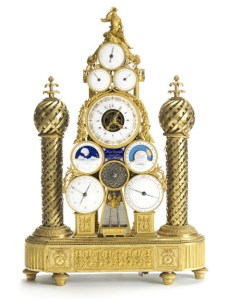
Estimated to fetch between £200,000 and 300,000, this remarkable clock sold for £322,400
An exceptional and historically important early 19th century French ormolu automata clock with eight enamel dials by Joseph Coteau including full Republican and Gregorian calendars, age- and phase- of the moon, time of sunrise and sunset, equation of time, world time and signs of the Zodiac. Almost certainly made for the ‘Seconde exposition publique des produits de l’industrie francaise’ held in the courtyard of the Louvre from the 19th to the 25th September 1801.
Press release from Bonham’s:
An historic and rare clock believed to have been designed for Napoleon’s ‘Exposition publique des produits de l’industrie Francaise’ in 1801 and which has lain undiscovered in Europe for two centuries, is to be sold at Bonhams, New Bond Street, as part of its sale of Fine Clocks and Watches on 28 June 2011. Estimated at £200,000 – 300,000, the clock was designed by French clock maker, Hartmann, and uses the Republican calendar, the decimal time system put into effect in 1793.
Napoleon established the ‘exposition’ in 1798 to showcase France’s burgeoning industry. In 1801, the exposition was held in the courtyard of the Louvre and it is recorded that, in this exhibition, a clock maker named Hartmann of 9 rue de Vannes gained an honourable mention for a clock with eight dials which showed the rising and setting of the sun and the moon phase. It is almost certain that this clock, the clock shown to the Emperor, is the very clock that Bonhams will be selling on 28 June.
The clock is signed Hartmann, Paris, invenit et fecit, and the eight enamel dials were made by the foremost dial maker of the day, Joseph Coteau. One of the dials features the months, which were named according to the prevailing conditions, such as ‘grape harvest’, ‘foggy’, ‘snowy’ and ‘frosty’, a system that was introduced after the French Revolution and was mocked in Britain with people referring to the months as wheezy, sneezy, breezy; slippy, drippy and nippy; showery, flowery and bowery; and wheaty, heaty and sweety… Indeed the time system did not prove popular in France either and by 1806 it was dropped, having lasted 13 years.
◊ ◊ ◊ ◊ ◊
Sales results, from a Bonham’s press release:
 The highly anticipated sale of an historic and rare clock believed to have been designed for Napoleon’s ‘Exposition publique des produits de l’industrie Francaise’ in 1801, did not disappoint. Having lain undiscovered in Europe for two centuries, it had been estimated at £200,000–300,000 and sold for an excellent £322,400.
In some ways, however, the real star was this seventeenth-century clock:
A highly important, recently discovered, English ebony bracket clock attributed to Ahasuerus Fromanteel sold for a remarkable £692,000 on 28 June at Bonhams, New Bond Street, as part of its sale of Fine Clocks and Watches. The clock, which was found in a private European collection in mid-May this year, and had been in the same family since the 1950s, had attracted a pre-sale estimate of £200,000 – 300,000.










 Enfilade
leave a comment