Snuff Boxes at Bonham’s — New Record
Press release from Bonham’s:

Meissen gold-mounted Royal snuff box made for Augustus III, Elector of Saxony and King of Poland, ca 1755. Estimate: £100,000 - 150,000
The most important collection of porcelain snuff boxes ever assembled is to be sold at Bonhams, New Bond Street, London on 5th July 2011 (Sale 19483). Comprising 80 boxes, the Helmut Joseph Collection gives a comprehensive overview of the history of European ceramics in snuff boxes, with examples from all major factories including Capodimonte, Meissen, Fulda, and Sevres. These exceptional and exquisite objects were considered the pinnacle of refined eighteenth-century court culture at its most luxurious and the collection has been exhibited in the world-renowned institutions of the Rijksmuseum, Amsterdam (1972-2000), alongside the Gilbert Collection in Somerset House (2003-2008) and most recently at the Bowes Museum, Co. Durham. The entire collection is estimated to fetch £800,000-1,000,000.
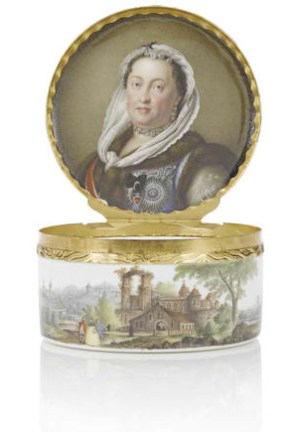
Gold-mounted circular snuff box with a portrait of Maria Josepha, Electress of Saxony and Queen of Poland, ca 1755. Estimate: £40,000 – 60,000.
Prolonged exposure to air causes snuff to dry out and lose its quality, so pocket snuff boxes were designed to be airtight containers with strong hinges, generally with enough space for a days worth of snuff only. The jewel-like objects are immensely tactile and widely varied in design and style. The most expensive in the collection has an intricately detailed depiction of a Dresden landscape on the inside lid, which is after an engraving by Bernardo Bellotto (estimate £100,000-150,000). There are also more affordable boxes, such as a small St Cloud example dating to the 1730s in the shape of a horse with diamond eyes (estimate £3,000-5,000). The collection has a large variety of boxes made as diplomatic gifts between nobility, as well as intimate family gifts, such as a magnificent Meissen box with the portrait of Maria Josepha, mother-in-law of Louis XVI. This extremely rare box painted by Heinrici was most likely a gift to one of her daughters.
Rich in detail and made from precious materials these gem-like pieces were among the most precious and intimate gifts bestowed by princes and monarchs. Many of them feature in the standard reference on the subject by Barbara Beaucamp-Markowsky, who writes: “Superbly decorated boxes in gold, enamel, mother-of-pearl or precious stones, and above all in porcelain, were adored by the ‘beau mode’ of the eighteenth century, indeed, such was their passion that it has been described as the ‘box culture period’ of the siècle gallant. Snuff-boxes were then the ‘musts’ of the world of elegance. They bore gracious witness to one’s good taste and refinement. Porcelain boxes from the colourful European factories possess such exquisite elegance and attractiveness, the delightful paintings on the inside of the lids so fascinating, that they are comparable in their fineness with that of the most exacting miniature paintings.”
The examples for sale at Bonhams come from what is without doubt the greatest collection of snuff boxes in the twentieth century, formed by Helmut Joseph. Joseph began collecting boxes following the example of his father, who already has a substantial collection before WWII. A real connoisseur of early Meissen porcelain, he had a profound and intimate relationship with his subject, and a deep knowledge of the field. Helmut Joseph generously made his collection available to the public; he always showed an interest in sharing information, and indeed supporting the development of knowledge on ceramics, be it by funding museums, or publishing his own collection.
◊ ◊ ◊ ◊ ◊
Sale results (updated 7 July 2011), from a Bonham’s press release:
Snuff Box with Dresden Landscape Sells for £860,000
 The most important collection of porcelain snuff boxes assembled in the 20th century sold for a fantastic £1,700,000 at Bonhams, New Bond Street, London on 5th July 2011. The top lot was a magnificent made for Augustus III, Elector of Saxony and King of Poland. With an intricately detailed depiction of a Dresden landscape on the inside of the cover, painted after an engraving by Bernardo Bellotto, the box had attracted a pre-sale estimate of £100,000-150,000. After a protracted bidding battle on the telephones the hammer finally came down on the staggering price of £860,000. This is a world record price for a porcelain snuff box at auction. . . .
The Grand Canal on a Grand Scale: Guardi at Sotheby’s on July 6
Press release from Sotheby’s:

Francesco Guardi, "Venice, a View of the Rialto Bridge, Looking North, from the Fondamenta del Carbon," oil on canvas, 45¼ by 78½ inches.
Guardi’s Venice, a View of the Rialto Bridge, Looking North, from the Fondamenta del Carbon, estimated at £15-25 million, is the centrepiece of the sale. This dramatic, atmospheric evocation of 18th-century Venice measures an impressive 115 by 199.5cm (45¼ by 78½ in) and is one of four works that Guardi painted on this grand scale, all executed in the late 1760s, which together constitute the pinnacle of his output as a painter of vedute. Generally considered to be Guardi’s greatest works, they are the first and fullest expression of the artist’s mature style. The oil on canvas has an exceptional provenance, having been sold just once since it was first acquired in Venice in 1768 by the English Grand Tourist, Chaloner Arcedeckne and then passed by inheritance from Arcedeckne until 1891. Throughout its existence, the painting has almost always hung in private. It has been on loan for a short period recently to the Iveagh Bequest at Kenwood House in London, but before that, has only been on show twice in its long history. . . .
◊ ◊ ◊ ◊ ◊
In addition to several impressive seventeenth-century paintings, there’s this pair of peculiar pictures attributed to Giandomenico Tiepolo:

Attributed to Giandomenico Tiepolo are two highly distinctive, majestic depictions of polar bears – possibly the first individual depictions of the animals in Italian art. Believed to be designed as overdoors, the spectacular pair – oils on canvas with gold ground – is estimated at £400,000-600,000.
◊ ◊ ◊ ◊ ◊
Sales results (updated 7 July 2011), from a Sotheby’s press release:
Guardi’s Monumental Veduta Beats Estimates to Top $42.8 Million

Tonight Sotheby’s London Old Master & British Paintings Evening Sale was led by Francesco Guardi’s monumental masterpiece Venice, a View of the Rialto Bridge, Looking North, from the Fondamenta del Carbon, which established the highest price of the week of London Old Master Sales when it sold for an astonishing £26,697,250/$42,865,105/ €29,834,146 (est. £15-25 million). Achieving a record as the second highest price for any Old Master Painting sold at auction, a record for any Venetian view painting at auction, as well as a record for the artist’s work, the painting was sought after by two determined bidders and finally sold to an anonymous telephone bidder. Overall the sale achieved a total of £47,640,900/$76,492,229/ €53,238,651 (pre-sale est. £31,110,000-48,120,000), with an average lot value for the works sold of £952,818 million. The sale was 68.5% sold by lot and 91.6% sold by value. . . .
And in case you were wondering, the bears attributed to Giandomenico Tiepolo fell comfortably in their estimate range, selling for £469,250.
Stubbs at Christie’s on July 5
Press release from Christie’s:

George Stubbs, "Gimcrack on Newmarket Heath, with a Trainer, a Stable-Lad, and a Jockey," 1765 (Photo: Christie's Images Ltd 2011)
Christie’s announce that they will offer for sale one of George Stubbs’ most important works at the Old Master and British Paintings Evening Sale on 5 July 2011 in London. Gimcrack on Newmarket Heath, with a Trainer, a Stable-Lad, and a Jockey by George Stubbs (1724-1806) is a true masterpiece of both British art and sporting painting, portraying Gimcrack, one of the most popular and admired of all eighteenth-century racehorses. It is offered from the Woolavington Collection, one of the finest private collections of Sporting Art, and is expected to realise in excess of £20 million.
John Stainton, Senior Director of British Pictures, Christie’s: “This is a truly exceptional example of eighteenth-century painting which holds immense importance on many levels — as an Old Master picture, as a great masterpiece of British Art, and as one of the finest sporting pictures ever painted. It is a great privilege for us to be able to work with this painting and to offer it at auction. Stubbs is an artist admired and collected by individuals and institutions from all around the world, and we look forward to presenting the opportunity for clients to acquire one of his greatest works at Christie’s on 5 July.”
Richard Knight, International co-head of Old Master and Nineteenth-Century Art at Christie’s: “Painted the year before James Christie oversaw our company’s first auction, the sale of this masterpiece will be a cornerstone moment in the history of Christie’s. It is telling that as a result of the global nature of the twenty-first-century art market, Stubbs, a very British artist, is set to join a small and select group who represent the most valuable old master artists ever sold, placing him alongside Raphael, Rubens, Rembrandt, and Turner.”
George Stubbs (1724-1806) is often celebrated as the greatest artist-scientist since Leonardo. His early career was spent working as a portrait painter, first in his native Liverpool, and subsequently in York. Having briefly visited Rome in 1754, Stubbs spent 18 months in a farmhouse in Lincolnshire dissecting and drawing horses in preparation for the publication of his famous book The Anatomy of the Horse. His striking depictions of animals are true to science and he held an ability to portray the magnificence of beasts in paint with complete accuracy and with no compromise to sentimentality. His exceptional talent earned the artist the patronage of many important aristocrats, particularly those involved in horseracing, the ‘sport of Kings’.
Gimcrack on Newmarket Heath, with a Trainer, a Stable-Lad, and a Jockey (40 x 76¼ in. / 101.6 x 193.6 cm.) was executed in 1765 having been commissioned by the horse’s owner, Frederick St. John, 2nd Viscount Bolingbroke, who led an extravagant lifestyle pursuing his main interests of racing and gambling. Gimcrack was one of the most popular and admired of all eighteenth-century racehorses. Although he was small, he had great stamina and won an impressive 28 of his 36 races, finishing unplaced only once. The painting shows Gimcrack twice: in the background he is seen winning a ‘trial’ by some distance, and in the foreground he is depicted with his trainer and jockey, a stable-lad rubbing him down. Gimcrack is portrayed with the full magnificence of the artist’s talent; anatomical perfection with even his veins shown pulsing through his skin. A secondary, autograph version of the painting was owned by Lord Grosvenor (a subsequent owner of Gimcrack) and is now in the collection of the Jockey Club, Newmarket.
The painting is making its third appearance at Christie’s. Sold by the Bolingbroke family in 1943, it was bought by Walter Hutchinson, founder of the National Gallery of British Sports and Pastimes, before being sold again at Christie’s in 1951 when it made £12,600 and entered the Woolavington Collection. One of the greatest collections of Sporting Art in the world, the core of the Woolavington Collection was formed at the end of the nineteenth and the early twentieth century by Lord Woolavington, a whisky magnate, philanthropist, and successful racehorse owner. The collection also includes other paintings by Stubbs, as well as exceptional works by Marshall, Ferneley, Herring and Munnings.
◊ ◊ ◊ ◊ ◊
Sale Results (updated 7 July 2011), from a Christie’s press release:
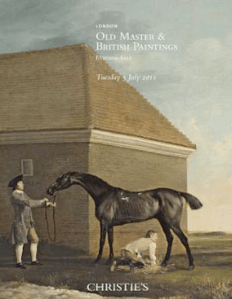 Stubbs’s Gimcrack on Newmarket Heath Fetches $35.9Million
The Evening Sale of Old Master & British Paintings realised £49,766,050 / $79,625,680 / €54,991,485, selling 67% by lot and 83% by value. The evening’s top price was paid for Gimcrack on Newmarket Heath, with a Trainer, a Stable-Lad, and a Jockey by George Stubbs (1724-1806) which sold for £22,441,250 / $35,906,000 / €24,797,581, becoming the third most valuable Old Master painting ever sold at auction. A masterpiece of both British art and sporting painting, it portrays Gimcrack, one of the most popular and admired of all eighteenth-century racehorses. It was last sold at auction in 1951 when it realized £12,600. . . .
Bernheimer-Colnaghi at Masterpiece London
Press release from Colnaghi:
Masterpiece London
The Royal Hospital Chelsea, London, 30 June — 5 July 2011
 Bernheimer-Colnaghi will show the unusual combination of Old Master paintings and contemporary photographs at the second staging of Masterpiece London, the luxury fair that was launched to great acclaim last summer and will take place in the South Grounds of The Royal Hospital Chelsea, London SW3, from 30 June to 5 July 2011. The stand will be divided into two parts, the large photographic masterpiece by Candida Höfer from her Louvre series forming a bridge between the two disciplines.
Amongst the Old Master paintings will be a selection of works inspired by artistic life in Rome in the 18th century. One of the highlights is the Architectural Capriccio with Figures Discoursing among Roman Ruins by Giovanni Paolo Panini (1691-1765), the leading 18th-century painter of vedute in Rome. He worked exclusively in the Eternal City, where his patrons included Pope Innocent XIII, and his capricci of the ruined monuments of ancient Rome appealed greatly to Grand Tourists. In this example, signed and dated 1730, the artist has invented a grand, monumental setting with architectural elements inspired by the Basilica of Constantine and the Temple of Castor and Pollux while the statues of Athena and the crouching lion may be based on real sculptures from the antique.

Giovanni Paolo Panini, "Architectural Capriccio with Figures Discoursing among Roman Ruins," 1730
Bernheimer-Colnaghi will also be exhibiting the only known portrait of Panini (apart from the small-scale depictions in some of his own paintings). This extremely rare portrait of the vedutista was painted by Louis-Gabriel Blanchet (1705-1772), one of the leading French painters in 18th-century Rome, and presents the sitter as a relaxed and elegant gentleman-painter amidst the tools of his trade, standing before his easel and leaning on a portfolio, brush in hand. That Panini would have been formally portrayed by a French artist should not be surprising as he was closely associated with the French community in Rome from the outset of his career and counted many important French collectors among his patrons.
The international aspect of the Roman art world in the 18th century is also shown by another fine portrait being exhibited by Bernheimer-Colnaghi. The picture depicts the Scottish architect, art dealer and antiquary James Byres (1733-1817) and was executed by the Austrian artist Anton Von Maron (1733-1808), who settled in Rome in 1755. It was probably painted around the time of Byres’ election to the Accademia di San Luca in 1768, where he had won 3rd prize for architectural design in 1762, and features one of his drawings prominently in the foreground.
Hubert Robert (1733-1808) was one of a number of French artists who visited Italy as a young man. His River Landscape with an Artist Sketching beneath a Ruined Temple, possibly the Temple of the Sibyl at Tivoli, probably painted in the late 1770s, draws upon that visit. The temple with its Corinthian columns is undoubtedly inspired by the famous Temple of the Sibyl at Tivoli outside Rome, although the artist has taken considerable liberties with the surrounding landscape which is depicted as much gentler and more low-lying than the actual rugged terrain. (more…)
Eighteenth-Century Maps: A Fair, a Lecture, and a New Reference Book
Press release from The London Map Fair:
2011 London Antique Map Fair
Royal Geographic Society, London, 11-12 June 2011

Johann Baptist Homann. "Sphærarum Artificialium Typica..." Nuremberg, ca.1730.
The 2011 London Map Fair, taking place in the historic surroundings of the Royal Geographical Society, is the most established and largest antiquarian map fair in Europe: over forty of the leading national and international specialist map dealers will be exhibiting in June. Visitors to the fair will discover a vast selection of original antique maps covering the whole world and printed between the 15th and 19th centuries. Highlights include a map of the universe by seventeenth-century Venetian cartographer Coronelli, revealing the Nine Circles of Hell as described in Dante’s Divine Comedy, as well as a 19th-century curiosity map of Europe depicting each country in the form of a caricature: the United Kingdom
figures as an old crone.
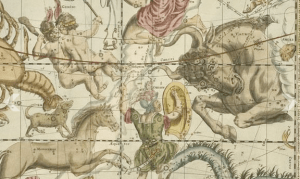
Johann Gabriel Doppelmayr, "Globi Coelestis," 1 of 6 Celestial Charts, Nuremberg, Homann, 1742
Other fine maps offered this year will include: an example of Ogilby’s innovative and incredibly detailed, 17th-century road map, marking all inns, churches and other landmarks on the road from London to Portsmouth – the course of the modern A3; an impression of Braun and Hogenberg’s bird’s-eye view of London; the earliest surviving printed plan of the city, dated 1574; and Christoph Vetter’s rare and beautiful 17th-century depiction of Bohemia stylised as a rose, with Prague at its centre and Vienna, the seat of the Hapsburg Dynasty, at its root. Exhibitors will offer atlases, travel books, globes, sea charts, town plans, celestial maps, topographical prints and
reference books; there are prices to suit all pockets ranging
from a very affordable £10 to over £100,000 for exceptional
pieces.
◊ ◊ ◊ ◊ ◊
2011 London Map Fair Lecture: Laurence Worms and Ashley Baynton-Williams
Royal Geographic Society, London, 11 June 2011
On Saturday, 11 June 2011, at 2:30pm, Laurence Worms and Ashley Baynton-Williams will launch their long-awaited Dictionary of British Map Engravers at the Fair. The product of over twenty years of research, it offers a wealth of fresh material on the map trade and a new insight into the lives of its most important figures, revealing some surprising links and relationships in the process.
◊ ◊ ◊ ◊ ◊
From the International League of Antiquarian Booksellers:
Laurence Worms and Ashley Baynton-Williams, British Map Engravers: A Dictionary of Engravers, Lithographers and Their Principal Employers to 1850 (London: Rare Book Society, 2011), approximately 750 pages, £125.
 The ultimate guide to the identification of British antique maps and their makers: An illustrated dictionary of over 1,500 members of the map trade in England, Ireland, Scotland and Wales, of British-born engravers working overseas and foreign engravers working in the British Isles, from the beginnings until the mid 19th century. Included are all the known engravers and lithographers, globemakers and retailers, the principal map sellers and publishers, key cartographers, makers of map-based games and puzzles, but also the remarkable lives of many artists, dealers and publishers, whose fates have been unknown so far. (more…)
Putting a Price on a Chinese Vase
 Arts writer and CultureGrrl blogger, Lee Rosenbaum, does an extraordinary job covering the intersection of the visual arts, museum culture, the art market, and politics. As a journalist, she’s not afraid of asking tough questions, challenging flimsy responses, and occasionally taking stances on controversial issues. In a recent posting (23 March 2011), she reports on the results of the New York Sotheby’s sale, Informing the Eye of the Collector: Chinese Ceramics and Works of Art from J.T. Tai & Co, in which a vase valued at $1000 sold for $18 million. The auction house presented the vase as “probably Republican” (early twentieth century) while seven bidders believed it to be something else altogether more important: a vase with the seal marks of the eighteenth-century emperor Qianlong.
It’s a potent example of what’s at stake in identifying an object. All seven bidders could certainly be mistaken, but regardless of who’s right, the discrepancies between their conception of the object and that of Sotheby’s is startling.
The posting is available here»
At Sotheby’s in Paris: Furniture, Porcelain, & Sculpture
Press release from Sotheby’s (as noted art ArtDaily, 12 March 2011). . .
Important Furniture, Sculpture & Objets d’Art (Sale PF1101)
Sotheby’s, Paris, 6 April 2011 (viewing 2-5 April)
 The sale of Important Furniture, Sculpture & Objets d’Art at Sotheby’s Paris on 6 April comprises an exceptional ensemble of 230 precious items from a variety of European collections, including a rare Italian Renaissance bronze and a group of French 18th- and early 19th-century terracottas.
Highlight of the sale is sure to be an extremely rare Louis XV Secrétaire en Cabinet in citronnier, sycamore and amaranth veneer, adorned with ormolu mounts and Sèvres porcelain plaques, stamped four times A. Weisweiler, from the former Collection of Baron Gustave de Rothschild (estimate €1.5-2.5m*). Furniture incrusted with Sèvres porcelain plaques has always been popular among aficionados of the French 18th-century decorative arts and considered the epitome of refined cabinet-making. The greatest 18th-century cabinet-makers, such as BVRB, RVLC, Carlin, Riesener or Weisweiler, were commissioned to make sophisticated furniture by marchands-merciers, notably Poirier and Daguerre (who enjoyed a monopoly on the purchase of Sèvres porcelain plaques). Our secrétaire, probably made around 1778-80 at the time when Adam Weisweiler was qualifying, reflects the stylistic demands of Dominique Daguerre. An extensive array of furniture with porcelain plaques entered the Rothschild Collections in the 19th century, like the extraordinary ensemble from the Baron Edmond de Rothschild Collection acquired by the Louvre in 1990. (more…)
TEFAF Opens in Maastricht March 18
The European Fine Art Fair (TEFAF)
Maastricht, 18-27 March 2011
 TEFAF Maastricht has built its reputation as the world’s most influential art and antiques fair on the unique quality of its exhibits. The 24th edition at the MECC (Maastricht Exhibition and Congress Centre) in the southern Netherlands from 18 to 27 March 2011 will include great rarities and recent rediscoveries among more than 30,000 works of art, all rigorously vetted by committees of international experts. Among them will be the last fragment of an Egyptian water clock still in private hands, a painting containing one of the few self-portraits of Bernardo Bellotto, and a bronze by Gustave Courbet rediscovered after being lost for more than a century.
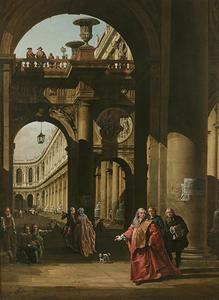 Bernardo Bellotto, Architectural Capriccio with a Self-Portrait of Bellotto in the Costume of a Venetian Nobleman, oil on canvas, 155 x 112 cm, 1760s — This painting contains one of the few self-portraits of Bellotto. He is depicted here lavishly clad in the traditional costume of Venetian nobility. The artist extends his arm in pride, inviting the viewer to admire the magnificent palatial setting, a testament of his exemplary artistic talent and innovation. Dating from the artist’s second Dresden sojourn between 1761 and 1767, the present work is the first of three known versions of the composition by Bellotto. Exhibited by Otto Naumann Ltd. Price: $11.5 million USD
English Needlework at Auction — What Lovely Shoes!
As noted at ArtDaily:

Lot No: 26, A pair of lady's shoes English, circa 1740 Embroidered yellow silk worked in chain stitch in coloured silks with carnations, tulips and other flowers, having a broad silk lined tongue, waisted heel and slightly pointed toe.
A pair of embroidered lady’s shoes, dating back to 1740, is to be sold at Bonhams, New Bond Street, as part of its Fine English Furniture Sale on 2 March 2011. The shoes are part of a remarkable collection of early English needlework comprising 63 pieces with estimates totalling £210,000 – 315,000, which was owned by the former Chairman of Debenhams and Harvey Nichols, Sir Frederick Richmond (1873-1953). Made from embroidered yellow silk worked in chain stitch, depicting carnations, tulips and other flowers, and with a broad silk lined tongue and a pointed toe, the shoes have attracted a pre-sale estimate of £1,000 – 2,000. . . .
The full article is available here»
At Sotheby’s: Record Price for Vernet
Charlotte Burns reports in The Art Newspaper (28 January 2011) on Sotheby’s sale of Important Old Master Paintings & Sculpture (No8712), which took in a total of over $90million. . .

Claude-Joseph Vernet, "A Grand View of the Sea Shore Enriched with Buildings, Shipping and Figures," 1776
Sotheby’s strode ahead of rival Christie’s after a bullish 98-lot sale of old master paintings . . . “It was outstanding. I haven’t seen an auction like this for many years,” said Colnaghi director Konrad Bernheimer. The energetic sale set new records for several artists . . . The packed salesroom started to swivel in its seats when a bidding war broke out for Claude-Joseph Vernet’s A Grand View of the Sea Shore . . . , 1776, which tripled its $2m high-estimate to hammer at a record $6.2m (est $1.5m-$2m. Total $7m, with premium). The painting once belonged to the Beaverbrook Art Gallery in Fredericton, Canada and was consigned by the UK-based Beaverbrook Foundation, which gained title to the work in September along with over 40 others in an out-of-court settlement after a lengthy legal battle. It went to New York based art advisor Carol Strone, who said she was buying on behalf of a private US collector. . . .
The full article is available here» Additional coverage is available at ArtInfo.










 Enfilade
leave a comment