London Art Week, Summer 2023
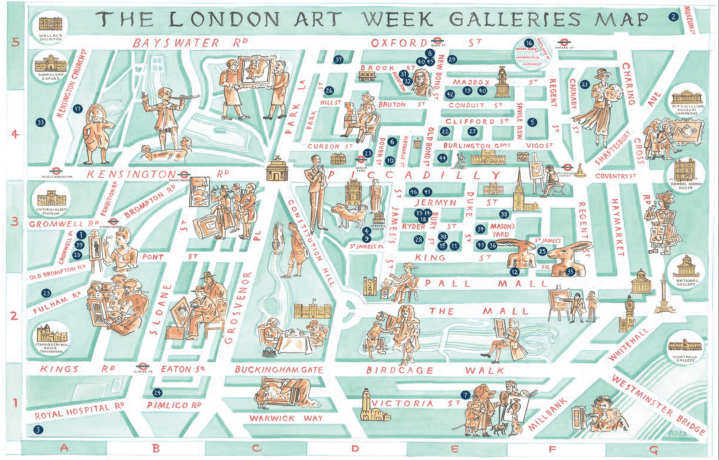
The London Art Week Galleries Map, drawn by Adam Gant; the map with a key to exhibitors is available here.
◊ ◊ ◊ ◊ ◊
From the art fair’s website:
London Art Week, Summer 2023
30 June — 7 July 2023
The UK’s leading fine arts selling event is held both in galleries around central London and as exhibitions online. This summer it features 53 participants, all internationally-acknowledged specialists in their chosen fields. Expert dealers offer museum-quality examples of decorative arts, paintings, sculpture, and works on paper of all periods from antiquity to contemporary, as well as—for the first time this year—rare books, maps, and manuscripts. The week coincides with the summer series of Old Master and Classic auctions held by Christie’s, Bonhams, and Sotheby’s. LAW provides a happy art-filled opportunity to explore the city’s major gallery areas such as St. James’s, Mayfair, and South Kensington, whilst browsing, admiring, and learning about works from antiquity to the present day. All works on show are for sale. Soak up the unique flavour of each locality and individual gallery, whilst enjoying unparalelled access to works of museum calibre as well as entry-level examples and rediscovered masters.
◊ ◊ ◊ ◊ ◊
A selection of gallery offerings:
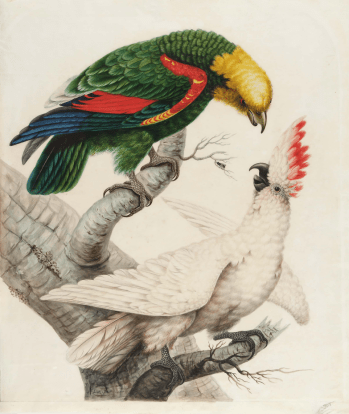
Sarah Stone, Yellow-Headed Amazon Parrot (Amazona ochrocephala oratrix) with Hybrid Cockatoo, 1801, 45 × 37 cm.
Sarah Stone’s Unseen World: A Rare Collection of 18th-Century Ornithological Watercolours
Finch & Co
The exhibition presents 23 watercolours by the trailblazing 18th-century artist Sarah Stone, accompanied by a new book on the artist. Written by Errol Fuller and Craig Finch, the publication will be the first major work on Stone since Christine Jackson’s 1999 book Sarah Stone: Natural Curiosities from the New Worlds. Although long highly acclaimed for their historical and artistic importance, Sarah Stone’s paintings in private hands are rare, and this important collection has only recently come to light. Stone might be compared to her contemporary Mary Anning, the woman from Lyme Regis who kick-started the science of palaeontology. Like the activities of Anning, Sarah Stone’s work proved to be of enormous historical and scientific value.
European and British Paintings, Watercolours, and Drawings, 1780–1860
James Mackinnon
Works include portrait drawings made in Italy by Jean-Baptiste Wicar, whose remarkable career encompassed fame as a neo-classical painter, collector, and dealer in Italian master paintings and drawings by Michelangelo and Raphael among others. After 1896, Wicar served as Napoleon’s Commissioner for Science and Arts in Italy.
Travel, 1600–1900
Nonesuch Gallery
We are pleased to present this second iteration of our catalogues on the theme of travel, accompanied by an exhibition coinciding with London Art Week. The Nonesuch Gallery was set up by Tom Mendel in 2020 to provide high-quality, fully researched and above all interesting pictures to established collectors, institutional collections, and first-time buyers. The gallery specialises in works on paper from the 16th to 19th centuries; with a focus on landscape and topographical subjects, particularly as related to the Grand Tour.
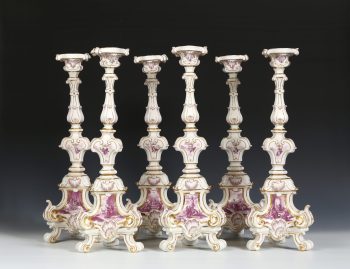
Giovanni Caselli and Gaetano Fumo, Set of Six Altar Candlesticks 1745–52, soft-paste porcelain, each about 50 cm high, fleur-de-lys marks in blue, £85,000.
A Survey of European Ceramics, 1500–1800
E&H Manners
Established in 1986 when Errol and Henriette left Christie’s after working in the Chinese and European ceramic departments. Henry joined in 2015. We deal in ceramics, glass and enamels of the world from the Middle Ages to the 20th century. We focus on European pottery and porcelain of the 17th and 18th century and East Asian, Middle-Eastern and Mexican colonial period wares and ceramics of the Arts and Crafts and Modern Movement. We take pride in the quality and rarity of the pieces that we offer, many of which are now in the great museums and collections of the world.
The Chinese Export Interior
Thomas Coulborn & Sons (digital participant)
Thomas Coulborn & Sons has a reputation for producing eclectic collections of exceptional furniture and works of art. The stock is centred by superb examples of English furniture and works of art ranging from the Tudor period through to Regency, interwoven with stellar items from the Continent. Jonathan Coulborn has a particular interest in objects which reflect the historic intersection of cultures and design. In recent years we have become one of the world’s leading dealers in Chinese export furniture.
Face to Face: Portraits Spanning Five Centuries
Moretti Fine Art
The Galleria Moretti was founded in 1999 in Florence by Fabrizio Moretti. It opened to the public and private collectors with the inaugural exhibition From Bernardo Daddi to Giorgio Vasari and immediately distinguished itself with its specialization in Italian old masters paintings. Moretti Fine Art opened in London in 2005 and it became a point of reference for collectors who seek a confidential and discreet approach. In 2022, the gallery moved in the new building in Duke Street, St. James’s.
◊ ◊ ◊ ◊ ◊
A sampling of particular works on offer:

Attributed to Jacques Antoine Marie Lemoine, Portrait of the Violinist Jacques Pierre J. Rode, ca. 1810, oil on canvas, 92 × 72 cm.
• Antonio Gionima, Mucius Scaevola before Lars Porsenna, ca. 1720–25, oil on canvas, 156 × 198 cm. Offered by Fondantica di Tiziana Sassoli (digital participant) as part of a selection of Emilian Old Master paintings.
• Thomas Bardwell, Portrait of Henry Herbert, 10th Earl of Pembroke, 1757, oil on canvas, 137 × 168 cm. Offered by Lowell Libson & Jonny Yarker Ltd.
• Paul Sandby, Capriccio Landscape, 1792, pencil and watercolour. Offered by Abbott & Holder, the drawing once belonged to King Willam IV (and then to his illegitimate son, Lord Frederick Fitzclarence).
• Attributed to Jacques Antoine Marie Lemoine, Portrait of the Violinist Jacques Pierre J. Rode, ca. 1810, oil on canvas, 92 × 72 cm. Offered by Maurizio Nobile Fine Art (digital participant).
At Bonhams | Old Master Paintings

Lot 80: J.M.W. Turner, East Cliff Lodge, Ramsgate, the Seat of Lord Keith, 1796–97, pencil and watercolour. 31 × 41 cm.
Estimate: £30,000–50,000.
◊ ◊ ◊ ◊ ◊
Press release, via Art Daily, for Turner’s View of East Cliff Lodge, included in the July 5 sale at Bonhams:
Old Master Paintings
Bonhams, London, 5 July 2023
An early architectural watercolour, East Cliff Lodge, Ramsgate, the Seat of Lord Keith, by J.M.W. Turner (1775–1851) is to be offered at Bonhams Old Master Paintings sale in London on Wednesday 5 July 2023 (Lot 80). It is estimated at £30,000–50,000.
Bonhams Director of Old Master Paintings, Caroline Oliphant, said: “East Cliffe Lodge dates from 1796–97 when the artist was in his early 20s and is one of several architectural watercolours Turner executed around this time. Topographical commissions were a good and dependable way of earning a living for young aspiring painters but, this being Turner, the results are, of course, rather special.”
East Cliff Lodge was designed in the gothic revival style by Charles Boncey and completed by 1794. Early owners included George Elphinstone, 1st Viscount Keith (1764–1823), a Scottish-born naval officer who served in the American Revolutionary and Napoleonic Wars. He was Commander in Chief of the North Sea Squadron while living at Cliff Lodge; the house gave him an excellent view of the Downs anchorage.
In 1831, East Cliff was acquired by Moses Haim Montefiore (1784–1885), a British financier, banker, activist, and philanthropist. Sheriff of London, Fellow of the Royal Society, President of the Board of Deputies of British Jews, and a key figure in British Jewish history. He was knighted in 1837. Moses and his wife Judith spent their honeymoon in Ramsgate, fell in love with the area, and rented East Cliff Lodge for some years before buying it. Montefiore built a private synagogue in the grounds of East Cliff and, following his wife’s death in 1862, commissioned a mausoleum where they both now lie. On nearby land he founded the Judith Montefiore College. Most of the house was demolished in 1954, but the synagogue, mausoleum, and college remain.
At Auction | ‘Charles Monro’s House at Finchley’ by Turner

Lot 2143: J.M.W. Turner, Charles Monro’s House at Finchley, 1793–94, 22 × 29 cm
(Estimate: £30,000–50,000)
◊ ◊ ◊ ◊ ◊
From the press release (via Art Daily) for the sale:
Fine Art and Silver
Ewbank’s, Surrey, 22 June 2023
An early watercolour by J.M.W. Turner, consigned by the descendants of the patron for whom it was painted, comes to auction at Ewbank’s in Surrey on 22 June 2023 (Lot 2143: estimated at £30,000–50,000). Charles Monro’s House at Finchley (1793–94) is a signed corner view of an imposing mansion set among trees. It depicts the home of the brother of Turner’s patron Dr. Thomas Monro (1759–1833), a serious collector who also supported Peter De Wint, Thomas Girtin, and John Sell Cotman, among others, and established an academy and what became known as ‘The Monro Circle’ of artists. Dr. Monro rose to prominence, not just as a patron and art collector, but also as one-time consulting physician to King George III.
The painting, whose subject was the home of Dr. Monro’s elder brother Charles, passed to Charles’s son and namesake, before descending through the family to the current day. It was exhibited at the Royal Academy in 1887 and in the Monro Academy Exhibition at the Victoria & Albert Museum in 1976. The house is identified by a signed inscription to the reverse of the artwork by his son, the younger Charles, reading: “Original drawing of my father’s House Nether Street Finchley made for him about the year 1793 or 4. Charles Monro.” The reverse of the frame bears an inscription by Robert W. Monro, nephew of the younger Charles Monro and the son of Thomas Monro, dated 23rd July 1874 and alluding to the main inscription by Charles Monro to the reverse.
Partner Andrew Ewbank said: “This is a delightful painting packed with detail and character, as well as demonstrating considerable draughtsmanship. Turner would have been about 18 when he painted it, and his assured hand in its composition makes this an important historical document in the story of the artist, as its inclusion in distinguished public exhibitions has shown.”
At Auction | Significant Colonial Notes
From the press release (via Art Daily) for the sale:
Significant Colonial Notes from the John J. Ford Collection
Live Online Sale, Kagin’s Auctions, Tiburon, California, 20 May and 23 September 2023
 Historic, colonial-era paper money printed by Benjamin Franklin and Paul Revere with provenance from a famous collection formed starting in the 1940s is coming to market. The first of two auctions of the rare, early American money will be conducted online by Kagin’s Auctions of Tiburon, California on 20 May 2023, with the second sale scheduled for 23 September.
“These important notes were previously in the collection of John J. Ford, a prominent New York City collector and influential dealer who passed away at the age of 81 in 2005. Some of the notes are unique with no other examples known, and many others are the finest surviving 18th-century notes of their kind,” explained Dr. Donald Kagin, president of the auction company.
Notes from all 13 original colonies and Georgia are represented in the auctions, including a dozen notes produced by Franklin and 34 made by Revere. Writer, inventor and statesman Benjamin Franklin printed money for Delaware, New Jersey, and Pennsylvania. Those notes’ designs include the words, “Printed by B. Franklin,” or, “Printed by B. Franklin and D. Hall.” David Hall emigrated to Philadelphia from Scotland and was an early American printer, publisher, and business partner with Franklin. Boston silversmith, engraver, and patriot Paul Revere printed money for Massachusetts and New Hampshire without placing his name or initials on the money. One of the notes has the authorization signature of a signer of the Declaration of Independence, William Ellery of Rhode Island.
Kagin states: “John J. Ford began assembling his collection of early American money in the 1940s. There are 375 of Ford’s Colonial and Revolutionary War era notes that will be offered in the two auctions, and 58 of them were used as illustrations in the standard reference book on the topic, The Early Paper Money of America, [by Eric Newman, the first edition of which appeared in 1967]. These are examples of the types of money printed in the colonies in the mid-1700s and used by the public for daily commerce or to pay soldiers fighting in the Revolutionary War. All of these notes are early American history you can hold in your hands.”
Nearly four dozen notes in the May 20 auction were printed with the unmistakable warning, “To Counterfeit is DEATH.” Denominations of some notes are in English Pence, Shillings, or Pounds; others are in dollar denominations depending on when and where the notes were printed. A few notes are even denominated in both Pounds and Dollars. Some carry patriotic messages or symbolism, such as the “sword in hand” design on some notes printed by Revere. Those depict a Colonial era man holding a sword in one hand and a copy of the Magna Carta in the other. The motto above him reads “IN DEFENSE OF AMERICAN LIBERTY” and below in Latin is a phrase translated as “By arms he seeks tranquility under freedom.”
At Bonhams | Watches and Wristwatches

Lot 55: Joseph Martineau, Senr, London, gold and ruby-set key wind triple case pocket watch with shagreen outer case (441 individually set rubies), ca. 1760 (estimate: £20,000–30,000). Note (added 16 May 2023) — it sold for £48,180, as noted by the post-sale press release via Art Daily.
◊ ◊ ◊ ◊ ◊
From the press release for the sale:
Watches and Wristwatches
Bonhams, London, 11 May 2023
Bonhams Watches and Wristwatches sale on 11 May will offer staple designs from names including Rolex, Patek Philippe, Audemars Piguet, and IWC, along with a significant single-owner collection of exquisite 17th- and 18th-century pocket watches. The 14 pocket watches, come from the collection of T. P. Camerer Cuss, renowned for his discerning eye for special timepieces. Included are designs by the father of English clockmaking Thomas Tompion (1639–1713), alongside works by George Graham and Joan Dellavos.
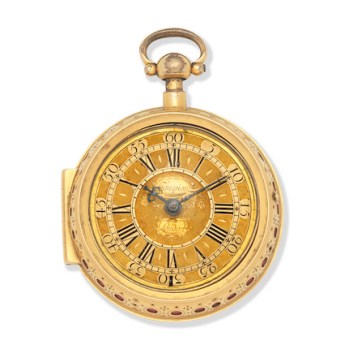
Lot 58: Thomas Tompion, 18K gold and gilt metal key wind quarter repeating pair case pocket watch, London Hallmark for 1709–10. It appears to have been made for Mary Montagu, Duchess of Montagu (1689–1751), daughter of the 1st Duke of Marlborough (estimate: £20,000–30,000).
Penelope Andrews, Bonhams Head of Watches in London, said: “It’s a privilege to offer such a significant collection of early pocket watches from the esteemed Camerer Cuss Collection in the Knightsbridge sale. The timepieces represent some of the leading names of watchmaking including Tompion and Graham. The watches are truly works of art; they transcend from being simply a watch into exceptional decorative pieces. We look forward to presenting the outstanding horological selection to our clients.”
Leading the sale is a fine and rare 18K gold and gilt metal key wind quarter repeating pair case pocket watch by esteemed maker Thomas Tompion (Lot 58, estimate: £20,000–30,000). Tompion was known for his exceptional designs and high society patrons, creating arguably some of the world’s greatest clocks. The watch on offer, from around 1709, represents an important quarter repeating watch of the highest quality; it is one of the earliest surviving with jewelled bearings and diamond end stones for the balance, complete with a beautiful watch dial featuring a central cherub and garland cartouche design. The timepiece was made for Mary, Duchess of Montagu (1689–1751), as indicated by the cypher ‘MM’ on the outer case below the coronet; it is believed to be one of only three watches that Tompion made for a female.

Lot 59: George Graham. 18K gold key wind repeating pair case pocket watch with repousse decoration. London Hallmark for 1718–19. Pierced and engraved outer case with repousse depicting Hercules being led, possibly by Hermes, to Cerberus with four embossed shells to the quarters depicting busts of classical figures (estimate: £15,000–20,000).
A fine and rare 18K gold key wind repeating pair case pocket watch with repousse decoration by George Graham, ca. 1718, is also included in the sale (Lot 59: estimate: £15,000–20,000). Featuring a finely produced repousse outer case depicting Hercules being led by a figure in classical armour, the watch is an exquisite example of the art of watchmaking and the art of the goldsmith from an esteemed maker rarely seen on the market. Also on offer is a Joan Dellavos fine and rare gold key wind open face pocket watch, ca. 1765, with a striking enamel scene depicting Venus blindfolding Cupid set within a decorative cartouche surround (estimate: £15,000–20,000).
Outside of the Camerer Cuss Collection, another important lot is a Joseph Martineau, fine and rare gold and ruby-set key wind triple case pocket watch with a shagreen outer case made in about 1760. It includes 441 individually set rubies forming a radiating circle to the back and bezel of the middle case and further decoration to the white enamel dial (Lot 55: estimate: £20,000–30,000).
Other Highlights from the T. P. Camerer Cuss Collection
• A William Snow fine and rare silver and leather key wind pair case pocket watch with pin decoration. The watch, ca. 1670, has a silver dial with a central engraved rosette, and the decorative pin work on the back of the leather covered outer case features exuberant floral designs. Offered with an estimate of £12,000–18,000.
• A John Snow silver key wind pair case ‘puritan’ pocket watch, ca. 1640. The early design was fashionable between 1630 and 1660 and features a silver dial along with an early method of fitting the crystal ‘glass’ held in place by tags around the underside of the bezel. Offered with an estimate of £12,000–15,000.
Additional Sale Highlights
• Rolex Cosmograph Daytona, reference 16523, ca. 1999. The stainless steel and 18K gold automatic chronograph bracelet watch has a sunburst champagne and diamond set dial. Offered with an estimate of £12,000–18,000.
• Rolex Submariner ‘Kermit’, stainless steel automatic calendar bracelet watch, reference 16610, ca. 2004. The special edition submariner with a green and black dial is offered with an estimate of £10,000–15,000.
• IWC limited edition 18K rose gold automatic calendar wristwatch, ca. 2015. The big pilots watch ‘Le Petit Prince’ with sunburst blue dial is offered with an estimate of £8,000–12,000.
Exhibition | Rear View
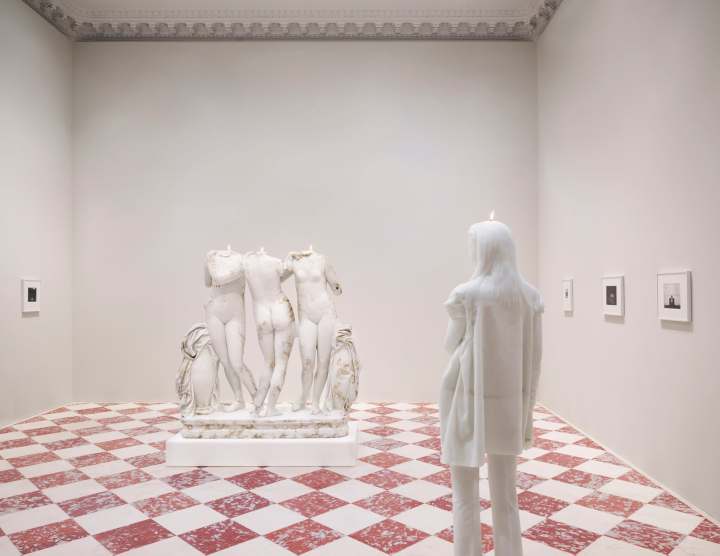
Urs Fischer, Divine Interventions, 2023, wax, based on the Metropolitan Museum of Art’s Roman sculpture The Three Graces (second century CE), with a wax portrait in the foreground of Pauline Karpidas, the contemporary art patron who once owned the ancient work. Installation view of a gallery at LGDR, 2023.
◊ ◊ ◊ ◊ ◊
It’s not an eighteenth-century show, but I’m left wishing that it were: an exploration of where classicism(s) and Romanticism meet, with Rococo impulses in-between. The emotional tenor of works varies widely; Carrie Mae Weems’s photographs strike me as especially powerful. See Jason Farago’s review for The New York Times (20 April 2023). –CH. From the press release for the exhibition:
Rear View
LGDR, New York, 18 April — 1 June 2023
Spanning two floors of LGDR’s landmark Beaux-Arts-style townhouse, Rear View presents a transhistorical selection of over sixty paintings, sculptures, works on paper, and photographs that explore representation of the human figure as seen from behind—an enduring, wide-ranging paradigm that has exerted potent influence upon modern and contemporary artists. In addition to rare twentieth-century masterworks by Félix Vallotton, Edgar Degas, René Magritte, Francis Bacon, Egon Schiele, Paul Cadmus, Aristide Maillol, and others, Rear View brings together seminal works by a diverse group of living artists spanning generations.
Long before the term Rückenfigur was popularized in the nineteenth century by Caspar David Friedrich, painters and sculptors from as far back as antiquity deployed the human figure seen from behind as a conceptual and formal device. Rear View provides a lens onto this specific genre as it pertains to artists’ desire to capture a range of human states and emotions—contemplation, longing, voyeurism, refusal, fetishism, and defiance—while drawing our attention to the act of looking itself and to the viewer’s role in constructing meaning and identity.
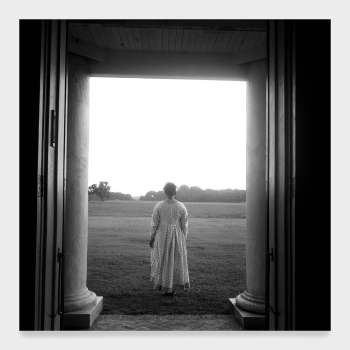
Carrie Mae Weems, Passageway II, 2003 (Jack Shainman Gallery, New York and LGDR).
Many contemporary artists have engaged the Rückenfigur trope, deliberately harnessing its critical potential. In one of the most compelling examples, Carrie Mae Weems has photographed herself in canonical landscapes and charged historical sites over many years, as a means of addressing complex issues around race, gender, and class, while also subjecting the signature paradigm of Romanticism to radical, politicized revision.
From the idealized bodies celebrated in Hellenistic sculpture to the bathers glimpsed in snapshot-like paintings and drawings by Impressionists and early modernists, images of nude bodies portrayed from behind have been integral to the unfolding story of figuration in the West. Urs Fischer directly quotes the Classical origins of this art historical paradigm in a monumental new candle sculpture made specifically for Rear View. Divine Interventions (2023) reprises one of the Metropolitan Museum of Art’s Roman marble Three Graces (second century CE), turning the trio of iconic feminine paragons, Aglaia (Beauty), Euphrosyne (Mirth), and Thalia (Abundance), into ephemeral forms cast in wax. Admiring this sculptural group—and in essence joining the Graces—is a wax effigy of Pauline Karpidas, the legendary contemporary art patron who once owned the ancient work that the Met would come to acquire.
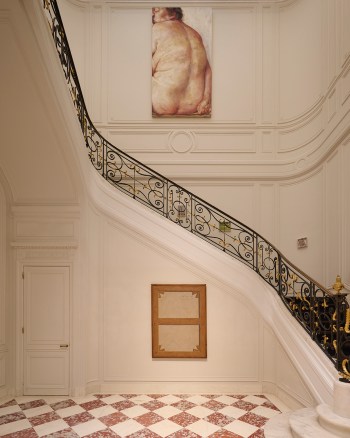
Installation view of Rear View at LGDR with work by Jenny Saville, Juncture (1994), top, and Domenico Gnoli, Back View (1968), below (Photo by Jason Schmidt).
The eroticism of ‘rear view’ images emerges not only from the frisson of nudity—the iconography of the human derrière emerges as a whole transhistorical subject onto itself—but from the narrative implication of intimacy between the depicted subject and the artist, the viewer’s fantasizing gaze and the sensuousness of the image on canvas. The trope of the mirror, the ritual of bathing, and the lounging or sleeping body are typical rear view scenarios taken up by artists across the centuries—from Edgar Degas to René Magritte, from Félix Vallotton to Barkley L. Hendricks, through to our present day. Fernando Botero’s painting The Bathroom (1989) features a woman, at once monumental and delicate, gazing at herself in the mirror, wearing only heels and a headband. The figure’s unselfconscious posture suggests she is unaware of the artist, invested only in herself.
By contrast, John Currin’s Nude in a Convex Mirror (2015) looks over her shoulder, presumably at the painter who is depicting the curves of her accentuated buttocks—but also at the viewer observing the action. The subject of Paul Cadmus’s ca. 1965 crayon drawing Standing Male Nude (NM 48) likewise peeks over his shoulder at the artist and the viewer, but with a loaded glance and flirtatious pose—one foot ever so slightly lifted to reveal its sole—that encode a sexual charge of mutual male gazes into an otherwise classical image. Jared French, who was part of the homosocial circle of artists around Cadmus, are represented in the exhibition by emblematic, dreamlike paintings populated uniquely by idealized male figures. The performative signifiers of masculinity emerge as an important subtheme of Rear View, evident in Giorgio de Chirico’s hyper-stylized Gladiatori (1928), Francis Bacon’s tormented figure in Study for Portrait of John Edwards (1986), and Andy Warhol’s abstracted depiction of a butch man’s hind quarters.

John Currin, Nude in a Convex Mirror, 2015, oil on canvas, 42 inches.
In their foreclosure of a complete picture, turned figures such as Currin’s nude also signal fetishism, another theme explored in Rear View. A number of works in the exhibition illuminate ways in which contemporary painting has absorbed the cinematic motif of the rear view, translating the camerawork of film noir and Hitchcockian thrillers like Rear Window (1954) into paint on canvas or rich black-and-white photographic images. Eric Fischl and Danielle Mckinney, for example, draw upon our collective cinematic imagination in composing their deeply narrative scenes, often populated by mysterious figures shown from the back and seemingly unaware of being observed. By contrast, but with no less enigmatic intensity, Harry Callahan’s mid-century rear-view photographs of his beloved wife, Eleanor, testify to the impact of cinematic vision when personalized to a single, deceptively simple subject.
In this context, another thematic trope of Rear View manifests in the work of Edgar Degas. Second only to his images of ballet dances, Degas’s voyeuristic bathing scenes dominate his vast oeuvre. On view in the exhibition, the artist’s delicate 1889–92 pastel Femme se peignant depicts a young nude female, seen from behind, combing her raven-colored tresses over her head. Degas’s scopophilic gaze focuses on the model’s flowing mane—a visual and psychological effect echoed by Domenico Gnoli’s sumptuous large-scale canvas Curly Red Hair (1969), which lingers over the texture of auburn curls cascading down a woman’s back. Tightly cropped to the subject at hand and denying the identifying details of the figure, this painting reveals Gnoli’s seeming uninterest in the body, except as a support for signifying ornament.

Félix Vallotton, Étude de fesses / Study of Buttocks, ca. 1884, oil on canvas, 38 × 46 cm (Private Collection).
The fragmented, fetishized human body emerged as a loaded trope in art history, according to esteemed feminist scholar Linda Nochlin in her study The Body in Pieces: The Fragment as a Metaphor of Modernity (1994). Spurred by the violence and social upheaval of the French Revolution, Nochlin notes, artists began to systematically deploy radical spatial cropping as well as isolating specific body parts, in order to explore the specific conditions of modern urban life—alienation, desire, suffering, obsession, ambiguous anonymous experiences. Nochlin’s observations find a contemporary echo in Issy Wood’s intimate canvas on view in the exhibition: Health and Hotness (2018) shows only the muscular back and bottom of a swimmer framed by her purple bathing suit. Wood’s enigmatic image is also a meditation on the impact of compressed and splitting planes and shapes—a study of the body as an abstraction.
Political refusal and personal irreverence also figure into art historical manifestations of the rear view. Six photographs from Anselm Kiefer’s polemical 1969 series Occupations (Besetzungen) take up this political mantle. In this series, the young artist photographed himself—often shown from behind, mimicking the heroic stance of Friedrich’s Rückenfigur—performing the Nazi salute in front of European monuments and natural sites. Of the series, controversial then as now, art historian Benjamin Buchloh remarked that it is “a real working through of German history. You have to inhabit it to overcome it.”
“String bottoms together in place of signatures for petition of peace.” This is how Yoko Ono described her infamous Film No. 4 (Bottoms) (1966–67)—an 80-minute montage of 365 human bottoms, featuring different genders, races, and body types. Marshaling her conceptual Fluxus rigor and sly humor into a powerful political protest against the Vietnam War, Ono’s provocative film retains its antiwar bite as well as its universalizing humanism today.
In the diptych that Francesco Clemente created for Rear View, Gold on Green, Green on Gold (2023), the artist slyly questions the front/back logic that underpins the exhibition as well as the binary thinking that governs so much of Western culture. Using gold leaf and a radically reduced palette, Clemente portrays ambiguous, gender-indeterminate figures that appear to be engaged in oral sex. The artist muses, “Maybe our mistaken ideas—based on duality, based on ‘us against them’—begin with the fact that we can only see half of what there is. We can only face one direction. We feel incomplete because we can never see completely ourselves. Painting may repair that, offering a vision of totality.”
As a pendant presentation to Rear View, Full Frontal (exhibited on the gallery’s second floor) explores the opposite art historical trope: frontal nudity. As the idiom of the title suggests, debates around moral propriety and censorship in art and popular culture often ascribe a confrontational value to front-facing nudes. While the naked body has always been present in visual culture, shifting social values have influenced representational approaches to the subject. Featured in Full Frontal are works by Miriam Cahn, Jenna Gribbon, and Barkley L. Hendricks, among others.
At Sotheby’s | From the Collection of Jacques Garcia

Salon-Tapisseries in the Château du Champ de Bataille
(Photo from Sotheby’s)
◊ ◊ ◊ ◊ ◊
Auction puffery is always interesting. The press release (via Art Daily) for the sale explains that Garcia’s “perfect knowledge of history is treasured by some of the greatest museums and institutions . . . [including] Versailles” and declares that the sale will “present the most important group of Sèvres ever to appear on the market.” We’re likely to hear a lot about it between now and May. [Note (added 22 May 2023) — Sale results are summarized in this press release, via Art Daily.] –CH
At Auction: Jacques Garcia, Intemporel, Sale PF2361
Sotheby’s, Paris, 16 May 2023 (works on view in Paris, 11–15 May 2023)
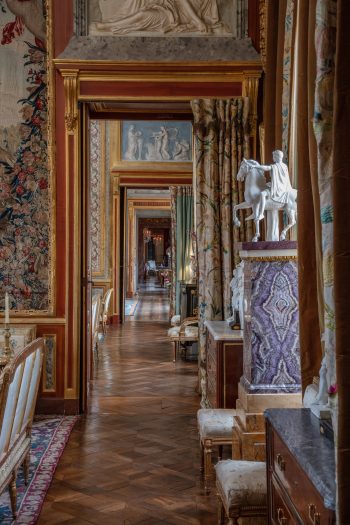
Enfilade at Château du Champ-de-Bataille (Photo from Sotheby’s).
“The power of exceptional residences lies in the unforgettable feeling that stays with those who have visited them. As with all of Jacques Garcia’s creations, Champ de Bataille is one such memorable place. This setting leaves an indelible mark from the first visit, from the initial shock of its beauty to the awe when you realise the mammoth effort that has gone into its construction and renovation. Nowhere is Garcia’s mastery of atmosphere more evident.” –Mario Tavella, Président of Sotheby’s France, Chairman of Sotheby’s Europe
On 16 May, 75 prestigious works of art—handpicked by French interior designer and collector Jacques Garcia from the project of a lifetime—will be offered at Sotheby’s in Paris. The proceeds will benefit Champ de Bataille, preserving its legacy for future generations. Garcia is the creative force behind many of the most lavish and opulent settings in the world—from the La Mamounia Hotel in Marrakech and Hotel Costes in Paris, to painstakingly decorated rooms in the Louvre and Versailles. Most recently in the limelight has been his Villa Elena in Noto, a magnificent Sicilian villa featured in the US series The White Lotus, a labour of love for Garcia who painstakingly restored the baroque interiors, which were destroyed by an earthquake in 1693.
In 1992, Garcia acquired the Château du Champ de Bataille, one of the most charming and inventive buildings of its kind, designed by Louis le Vau (the architect behind Versailles) and boasting the grandest private garden in Europe. By the late twentieth century, only two of the rooms were in usable condition; and so, began a titanic project of renovating the site spanning the next three decades and then opening its doors to the public.
The collection assembled by Jacques Garcia for the Champ de Bataille is a tribute to the finest decorative arts of the 17th, 18th and 19th centuries, bringing together exceptional furniture, porcelain, and sculpture. Among the many masterworks are items that belonged to royalty and nobility—including Kings Louis XV and Louis XVI, Queens Marie Leszczynska and Marie-Antoinette, King William III and Queen Mary II, the Count of Provence, and the Dukes of Penthièvre and Lorraine. The selection continues into the 19th century with provenances including the Emperor Napoleon and dynastic collectors such as the Rothschilds.
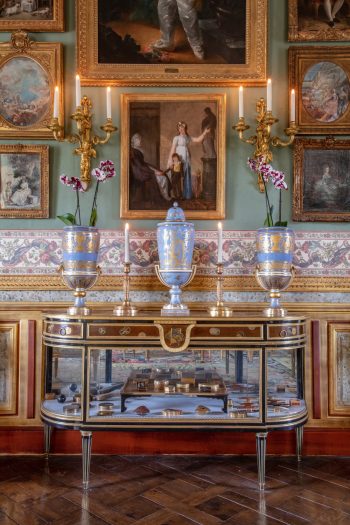
The sale’s 75 lots will mark Garcia’s 75th birthday. Many pieces within the collection have a royal provenance, with Kings Louis XV and Louis XVI and Queens Marie Leszczynska and Marie-Antoinette among the previous owners (Photo from Sotheby’s).
The sale will offer several pieces of Neoclassical furniture crafted by prominent Parisian maker Georges Jacob and delivered for Queen Marie-Antoinette. These include two pairs of armchairs and a canapé thought to have been ordered for Marie-Antoinette’s Turkish Boudoir at Fontainebleau (each estimated at €400,000–600,000).
Among the most remarkable pieces is a console table by Parisian marchand-mercier and ébéniste Adam Weisweiler (estimated €1–2 million). The magnificent piece of furniture bears the hallmarks of the innovations towards the end of Louis XVI’s reign, bringing together precious materials such as Japanese lacquer and porcelain plates. The use of painted sheet metal, juxtaposed with the marble top, is unique in Weisweiler’s corpus, whilst paying homage to the work of his predecessor Martin Carlin.
A floral marquetry commode from the Louis XV period, attributed to Antoine-Robert Gaudreau (the principal supplier of furniture for the royal châteaux early in the reign of Louis XV), bears the mark of Louis XIV’s grandson, the Duke of Penthièvre (estimated at €400,000–700,000). Penthièvre was one of the wealthiest men of his day, living in the Château de Bizy in Normandy, which he partly decorated with furniture from the Marquise de Pompadour.
The sale also offers a daybed likely made for the wedding of Napoleon Bonaparte to Empress Marie-Louise in 1810 (estimated €100,000–200,000). Attributed to Jacob Desmalter, it follows the design from a drawing by French architects Percier and Fontaine and decorated with a medallion by Bertrand Andrieu (created to commemorate the marriage and associated Napoleon with a centuries-old dynasty).
A pair of cabinets, decorated with remarkable finesse with Japanese laquer and silver mounts from the Edo period (ca. 1640–80), hail from the collection of King William III and Queen Mary II of England (estimated €800,000–1,200,000). The decor reflects the strong Flemish and Dutch influences during their reign, as well as a penchant for East Asian elements.

The table service featured in the sale is decorated with images of 400 different birds after drawings by Buffon (Photo from Sotheby’s).
The sale will present the most important group of Sèvres ever to appear on the market. Among them is a pair of vases with Turkish-inspired decor from 1773, the compositions inspired by painter Jean-Baptiste Le Prince (estimated €200,000–300,000)—reflecting the contemporary craze of transposing fashionable artworks onto vases intended for the royal court. The collection also includes part of a table service with the Suddell family coat of arms, decorated with more than 400 different birds after the natural history drawings by Georges-Louis Le Clerc de Buffon, keeper of the Royal Garden in Paris (estimated €600,000– 1,000,000). Among the most spectacular of all is a pair of large ‘Lagrenée’ vases, with a vibrant purple background, dated 1797 (estimated €800,000– 1,200,000). Over its long history, this pair has belonged to a number of the most prestigious European collections: purchased at the Sèvres factory in December 1799 before being presented to King Charles IV of Spain in about 1800, acquired by Alexander Hamilton (the 10th Duke of Hamilton) in 1807–08, and passed on by descent to the 12th Duke of Hamilton, William Alexander Louis Stephen Douglas-Hamilton.
Recognised the world-over, Jacques Garcia has long been one of the most sought-after interior designers, reinventing himself with each project and dedicated to innovation through the bringing together of the classic and the modern. His influence is multi-faceted, spanning interior design, patronage of the arts, and technical and artistic advisor. Garcia was awarded the Legion of Honour in 1997, before being made a Commander of the Order of Arts and Letters in 2002, as well as the Knight of the Order of Agricultural Merit.
From the 1990s, Garcia has worked for major international hoteliers, from Barrière-Desseigne to Costes; his standout achievements include La Réserve in Paris (a 5-star palace voted as the best hotel in the world in 2017) and the mythic La Mamounia in Marrakech. His innate talent for matching styles and his perfect knowledge of history is treasured by some of the greatest museums and institutions, many of which have entrusted him with their spaces. These include the Musée de la Vie Romantique in Paris, the grand apartments of Versailles, and the rooms of François I at the Château de Chambord. He has also played the rôle of scenographer for several exhibitions, the most spectacular of which was a recreation of the throne room in Versailles’ Hall of Mirrors in 2007.

Château du Champ-de-Bataille, built 1653-65 (Photo from Sotheby’s).
An art lover from his childhood, Garcia is also an eminent collector, buying his first works at the age of 25. His erudition, curiosity, and encyclopedic knowledge of inventories, as well as an overriding quest for excellence, has enabled him to assemble the finest examples of art and antiques. In 1992, Garcia acquired the Château de Champ de Bataille and set about on the project of a lifetime, renovating the residence in the image of the Grand Siècle. Inspired by the Universal Exhibitions, he also populated the garden with multiple follies, bringing together influences from China and India.
Built in the 17th century, the Château du Champ de Bataille is one of the most beautiful estates in France. Its first proprietor, Count Alexandre de Créqui, was exiled from court and placed under house arrest by Cardinal Mazarin during the Fronde (a series of civil wars in France between 1648 and 1653). De Créqui set upon building this home on his land in Normandy to remind himself of the splendour of the French court.
The castle then passed through the hands of a number of different families, including several cousins of the noble Harcourt family, each of whom made profound changes. In the 19th century, the almost derelict castle even became a hospital and then a prison.
At the time that Jacques Garcia acquired the property, only two of the rooms had retained their original decor. Remaining true to the grand spirit of the 17th and 18th centuries, Garcia redesigned and restored all of the other rooms, acquiring a wealth of furniture, paintings, and works of art from great collections to furnish and bring the space to life.
Alongside the interiors, Garcia also completely recreated the gardens, with the assistance of master landscaper Patrick Pottier. The result is a marriage of a historic garden and a contemporary vision, drawing inspiration from ancient and philosophical themes. The garden presents several architectural follies, including the ‘Temple of Leda’ and the ancient theatre or ‘Pavillion of Dreams’ (inspired by Mughal India and furnished with original pieces from Indian palaces). Today, the Champ de Bataille estate—covering an area of 45 hectares—is the largest private park in Europe, its gardens recognised for their wonder by the French government.
◊ ◊ ◊ ◊ ◊
For more information on the house, see Jacques Garcia and Alain Stella, with photographs by Eric Sander, Jacques Garcia: Twenty Years of Passion: Chateau du Champ de Bataille (Paris: Flammarion, 2014), 400 pages, ISBN: 978-2080201690.
At Christie’s | Interracial Double Portrait Purchased by Philip Mould
Press release via Art Daily (22 January 2023) . . .
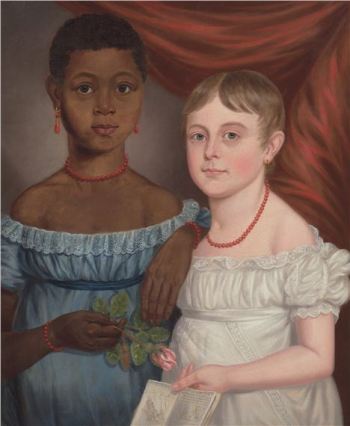
American School, A Portrait of Two Girls, ca. 1820, oil on canvas, 24 × 20 inches (Philip Mould & Co). Estimated to sell for $50–100K, the portrait sold at auction for nearly $1million.
An extraordinarily rare image of two children—one
White, one African American—was purchased by London art dealers Philip Mould & Company this evening (Friday, 20 January 2023) at Christie’s in New York for just under one million dollars.
Painted by an unknown artist in America in about 1820, and estimated at $50–100k, the double portrait attracted heated competition from collectors and museums on both sides of the Atlantic, eventually making ten times its top estimate with premium included.
Mould, who is also known as the art expert on BBC1’s Fake or Fortune, believes it to be unprecedented for this date in American portrait painting. “We are very excited to have bought it. I know of no painting of this date or earlier quite like it. The unselfconscious depiction of two racially distinct girls, who were clearly deeply attached, is extraordinarily rare for this period, as well as very affecting. The constraints and social protocol in painted portraiture of the period make such palpable depiction of interracial attachment almost without precedent.”
In their description of the painting Christie’s acknowledged its rarity, stating: “This double portrait presents its subjects as equals at a time of pervasive racial inequality. If anything, the pose and props cast the African American girl as the superior figure.” [Sale 21026, Lot 460]
The only painting that Mould knows which could be described as comparable is the portrait of Dido Belle and her cousin Elizabeth Murray painted around 1770 in England (on display as part of the collection at Scone Palace, Perth, Scotland)—a work that was the focus of an episode of Fake or Fortune in 2018. Dido was the daughter of a Black slave and White father. Mould identified the artist, after considerable research, as the Scottish portraitist, David Martin. “This however goes considerably further. Although, as yet, we don’t know the artist, nor the identity of the subjects, the relationship of equality is emphatically expressed” says Mould “The normal objectifications in the depiction of racial distinction have been set aside.”
A most unusual and revealing aspect of the painting is the book of the story of Cinderella held by the younger child. As the Christie’s cataloguer pointed out: “The inclusion of a reference to a well-known story with stepsister characters raises the possibility that in the absence of blood ties, the artist was nonetheless deliberately conveying sisterhood.” Mould muses “Or perhaps the reference to Cinderella is more obvious. As a female heroine who overcame the prejudices of her oppressors, Cinderella may well turn out to have more in common with the eldest child than initially thought.”
Future plans for the painting involve a period of research, after which Mould will be looking to place the work in a museum where its qualities and significance can be appreciated within a fuller context, and it can be enjoyed by the public.
◊ ◊ ◊ ◊ ◊
The painting was included in the Important Americana sale at Christie’s New York on 20 January 2023, Sale 21026, Lot 460. Also relevant is this early nineteenth-century miniature portrait of two girls with arms around each other.
At Bonhams | New Auction Record for Pair of Meissen Vases

Lot 89: An extremely rare pair of Meissen red-ground bottle vases, from around 1735, sold at Bonhams for £831,900, more than four times their high estimate, and a new world record for a pair of Meissen vases.
◊ ◊ ◊ ◊ ◊
Press release from Bonhams, announcing the results of the sale:
500 Years of European Ceramics
Bonhams, London, 7 December 2022
On Wednesday, 7 December 2022, at Bonhams 500 Years of European Ceramics sale in London an extremely rare pair of Meissen red-ground vases from around 1735 achieved £831,900, a new world record for a pair of Meissen vases. The vases more than quadrupled their pre-sale estimate of £120,000–180,000. The 219-lot sale made a total £1,625,280.
Nette Megens, Bonhams Director, Decorative Arts, U.K. and Europe, said: “This is an exceptional result for an important and hitherto unrecorded pair of vases. Bottle vases of this kind were made by the Meissen factory exclusively for the Dresden court, and these are the largest size and only known examples with this rare ground colour. These qualities, and the fact that these vases were fresh to the market, led to fierce competition in the saleroom. The price they achieved is also a testament to the taste of one of the greatest collectors of the 20th century, Catalina von Pannwitz (1876–1959), to whom they once belonged.”
Another top lot was the very rare pair of Nymphenburg large circular dishes from the ‘Hofservice’, ca. 1760–1735, which sold for £164,000, soaring past an estimate of £20,000–30,000.
Other sale highlights included:
• A pair of Meissen models of hares, ca. 1750, sold for £36,840 (estimate: £8,000–12,000).
• A rare Meissen footed stand from the Sulkowski service sold for £35,580 (estimate: £15,000–20,000).
• A Meissen basket centrepiece from Podewils service, ca. 1741–42, sold for £25,500 (estimate: £6,000–8,000).
• A large Vincennes/Sèvres oval green-ground dish (plat à groseilles) from the Frederick V of Denmark service, dated 1735–38, sold for £25,500 (estimate: £20,000–30,000).
• A Sèvres plate from the ‘service de dessert marly rouge’ for Emperor Napoleon I, dated 1809, sold for £20,400 (estimate: £8,000–12,000).
• A Meissen waste bowl from the Sulkowski service, ca. 1735–38, sold for £16,575 (estimate: £6,000–8,000).
• A rare Meissen large dish from the Sulkowski service, ca. 1735–38, sold for £14,025 (estimate: £12,000–18,000).
Exhibition | Beyond Boundaries
From the introduction of the catalogue, available online, for the show now on view at Robert Simon Fine Art:
Beyond Boundaries: Historical Art by and of People of Color
Robert Simon Fine Art, New York, 27 October — 16 December 2022
 Diversity is a crucial issue in the contemporary art world today. But what of the art of the past? Beyond Boundaries brings to light an array of paintings, sculpture, and other works of art from the 17th to 19th centuries, from Europe and the Americas, that explore subjects and makers often overlooked in traditional art history. But unlike many thematic exhibitions, there is no underlying social or political philosophy. Rather we have attempted to explore diversity simply by exhibiting diverse works of art—each chosen as it in some ways illustrates an aspect of the historical past, some surprising and empowering, others uncomfortable or disturbing.










 Enfilade
leave a comment