Exhibition | Giovan Battista Foggini (1652–1725)
Closing soon at the Palazzo Medici Riccardi:
Giovan Battista Foggini: Grand Ducal Architect and Sculptor
Palazzo Medici Riccardi, Florence, 10 April — 9 September 2025
Curated by Riccardo Spinelli
 Florence celebrates the artistic genius of Giovan Battista Foggini (1652–1725) with a monographic exhibition, promoted by the Metropolitan City of Florence and organised by the Fondazione MUS.E. Curated by Riccardo Spinelli, it marks the third centenary of the artist’s death, presenting the extraordinary figure of a man who, through his ‘interdisciplinary’ work, shaped the artistic language of late-Medicean Florence. This unique opportunity will showcase the design, stylistic, and technical prowess of Foggini, highlighting the breadth of his interventions and the distinctive signature that set a standard in Florence. His grand and eloquent style quickly gained recognition, earning the admiration of the Medici and his contemporaries, while also inspiring younger artists, who saw in him a brilliant master with an almost inexhaustible creative imagination.
Through a selection of sculptures, drawings, and artefacts, the exhibition traces Foggini’s career, from his training in Rome at the Medici Academy, founded by Cosimo III de’ Medici, to his return to Florence, where he became the Grand Ducal sculptor, court architect, and director of the Galleria Manufactories. These workshops, commissioned by the prince, were dedicated to the production of marvellous inlaid works in hard stones and precious metals. Foggini’s style, characterised by a late-Baroque language influenced by Roman art yet distinctly original, defined the image of late 17th-century Florence, paving the way for future generations.
Riccardo Spinelli, ed., Giovan Battista Foggini: Architetto e scultore granducale (Florence: Edifir Edizioni, 2025), 336 pages, ISBN: 978-8892802964, €40.
New Book | Coffee Nation
From Penn Press:
Michelle Craig McDonald, Coffee Nation: How One Commodity Transformed the Early United States (Philadelphia: University of Pennsylvania Press, 2025), 280 pages, ISBN: 978-1512827552, $45.
 Coffee is among the most common goods traded and consumed worldwide, and so omnipresent its popularity is often taken for granted. But even everyday habits have a history. When and why coffee become part of North American daily life is at the center of Coffee Nation. Using a wide range of archival, quantitative, and material evidence, Michelle Craig McDonald follows coffee from the slavery-based plantations of the Caribbean and South America, through the balance sheets of Atlantic world merchants, into the coffeehouses, stores, and homes of colonial North Americans, and ultimately to the growing import/export businesses of the early nineteenth-century United States that rebranded this exotic good as an American staple. The result is a sweeping history that explores how coffee shaped the lives of enslaved laborers and farmers, merchants and retailers, consumers and advertisers.
Coffee Nation also challenges traditional interpretations of the American Revolution, as coffee’s spectacular profitability in US markets and popularity on the new nation’s tables by the mid-nineteenth century was the antithesis of independence. From its beginnings as a colonial commodity in the early eighteenth century, coffee’s popularity soared to become a leading global economy by the 1830s. The United States dominated this growth, by importing ever-increasing amounts of the commodity for drinkers at home and developing a lucrative re-export trade to buyers overseas. But while income generated from coffee sales made up an expanding portion of US trade revenue, the market always depended on reliable access to a commodity that the nation could not grow for itself. By any measure, the coffee industry was a financial success story, but one that runs counter to the dominant narrative of national autonomy. Distribution, not production, lay at the heart of North America’s coffee business, and its profitability and expansion relied on securing and maintaining ties first with the Caribbean and then Latin America.
Michelle Craig McDonald is the Librarian/Director of the Library and Museum at the American Philosophical Society.
New Book | The Invention of Rum
Coming in October from Penn Press:
Jordan B. Smith, The Invention of Rum: Creating the Quintessential Atlantic Commodity (Philadelphia: University of Pennsylvania Press, 2025), 320 pages, ISBN: 978-1512828184, $40.
 Making and consuming rum created a new means of profit that transformed the Atlantic world.
It was strong. It was cheap. It was ubiquitous. Fermented and distilled from the refuse of sugar production, rum emerged in the seventeenth-century Caribbean as a new commodity. To conjure something desirable from waste, the makers, movers, and drinkers of rum arrived at its essential qualities through cross-cultural experimentation and exchange. Those profiting most from the sale of rum also relied on plantation slavery, devoured natural resources, and overlooked the physiological effects of overconsumption in their pursuit of profit. Focusing on the lived experiences of British colonists, Indigenous people, and enslaved Africans, The Invention of Rum shows how people engaged in making and consuming this commodity created a new means of profit that transformed the Atlantic world.
Jordan B. Smith guides readers from the fledgling sugar plantations and urban distilleries where new types of alcohol sprung forth to the ships, garrisons, trading posts, and refined tables where denizens of the Atlantic world devoured it. He depicts the enslaved laborers in the Caribbean as they experimented with fermentation, the Londoners caught up in the Gin Craze, the colonial distillers in North America, and the imperial officials and sailors connecting these places. This was a world flooded by rum. Based on extensive archival research in the Caribbean, North America, and Britain, The Invention of Rum narrates the seventeenth- and eighteenth-century history of one of the Atlantic world’s most ubiquitous products. Smith casts this everyday item as both a crucial example of negotiation between Europeans, Africans, and Americans and a harbinger of modernity, connecting rum’s early history to the current global market. The book reveals how individuals throughout the Atlantic world encountered—and helped to build—rapidly shifting societies and economies.
Jordan B. Smith is Associate Professor of History at Widener University.
The Magazine of the Decorative Arts Trust, Summer 2025
The Decorative Arts Trust has shared select articles from the summer issue of their member magazine as online articles for all to enjoy. The following articles are related to the 18th century:
The Magazine of the Decorative Arts Trust, Summer 2025
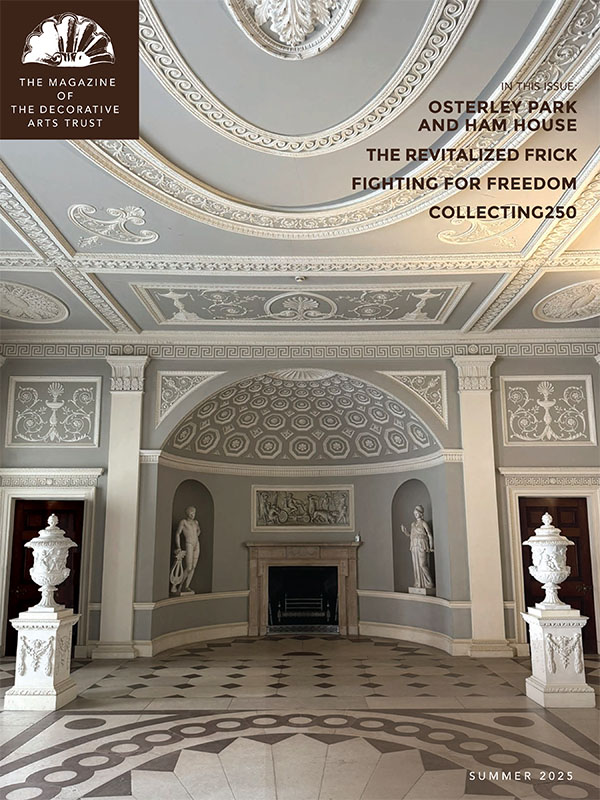 • “Time Travel in the Thames Valley: Ham House and Osterley Park” by Megan Wheeler Link»
• “Whose Revolution at the Concord Museum” by Reed Gochberg Link»
• “Fighting for Freedom: Black Craftspeople and the Pursuit of Independence” by William A. Strollo Link»
• “Decorative Arts Shine at the Reopened Frick” by Marie-Laure Buku Pongo Link»
• “A Room of Her Own: New Book Explores the Estrado” by Alexandra Frantischek Rodriguez-Jack Link»
• “Luster, Shimmer, and Polish: Transpacific Materialities in the Arts of Colonial Latin America” by Juliana Fagua Arias Link»
The printed Magazine of the Decorative Arts Trust is mailed to Trust members twice per year. Additional membership information is available here.
Pictured: The magazine cover depicts the Entrance Hall at Osterley Park showcasing Robert Adam’s signature Neoclassical style. The apsidal end features plasterwork by Joseph Rose and contains statues of Apollo and Minerva. The marble urns are attributed to Joseph Wilton. Decorative Arts Trust members visited the house during the Thames Valley Study Trip Abroad tours in May and June 2025.
Exhibition | Fighting for Freedom
Now on view at the DAR:
Fighting for Freedom: Black Craftspeople and the Pursuit of Independence
Daughters of the American Revolution Museum, Washington, DC, 25 March — 31 December 2025
Gibbes Museum of Art, Charleston, Summer 2026 — Spring 2027
Historic New Orleans Collection, Summer — Fall 2027
Tennessee State Museum, Nashville, Winter — Spring 2028
Museum of the Shenandoah Valley, Winchester, Summer — Fall 2028
 The Daughters of the American Revolution (DAR) Museum is proud to present the exhibition Fighting for Freedom: Black Craftspeople and the Pursuit of Independence, in collaboration with the Black Craftspeople Digital Archive. This exhibition seeks to embrace the stories of all those who pursued independence by centering on the lives and experiences of Black craftspeople and artisans from the 18th and 19th centuries. It highlights the creations, contributions, and legacies of African Americans as they fought for freedom from the earliest calls for American independence and beyond. Fighting for Freedom spans the war years of the Revolution through the present, as African Americans have sought to pursue agency and liberty through craft. The underpinning idea of African American craft as a catalyst for freedom-seeking displays itself in a host of ways in this exhibition, encompassing furniture, metals, ceramics, textiles, art, tools, and personal accessories.
The Founders’ cries for liberty from tyranny and oppression resonated with African Americans and were embraced by Black craftspeople, both free and enslaved. “The Founding Fathers, while enslaving tens of thousands of people, unintentionally created a ripple effect,” states exhibition co-curator and founder of the Black Craftspeople Digital Archive Dr. Tiffany Momon, “and we hope that visitors will see just how important those cries for liberty were to Black craftspeople and how they pursued it despite being marginalized.”
Fighting for Freedom features more than 50 objects from public and private lenders and includes objects made by both free and enslaved craftspeople. With artifacts from the 18th, 19th, and 21st centuries, this exhibition tells the stories of countless known and unnamed figures whose skills and commitment created not only objects but independence in many forms.
◊ ◊ ◊ ◊ ◊
From UNC Press:
Torren L. Gatson, Tiffany N. Momon, and William A. Strollo, eds., Fighting for Freedom: Black Craftspeople and the Pursuit of Independence (Chapel Hill: The University of North Carolina Press, 2025), 176 pages, ISBN: 978-1469686257, $35. Contributors include Lauren Applebaum, Robell Awake, Lydia Blackmore, Aleia M. Brown, R. Ruthie Dibble, Philippe L. B. Halbert, Jennifer Van Horn, Alexandra Alevizatos Kirtley, and Susan J. Rawles.
Delving into diverse narratives of creativity, resilience, and triumph in the quest for freedom, this book underscores the evolution of freedom through the lens of material culture—by exploring how the very concept of freedom was shaped and redefined by enslaved and free craftspeople who relentlessly fought for their rights and the recognition of their humanity. Featuring ten essays by leading historians, museum curators, and material culture scholars and more than seventy color photographs of Black artistry, including paintings, metalwork, woodwork, pottery, and furniture, this book vividly illustrates how Black men and women persistently sought tangible expressions of liberty which have endured as symbols of their creators’ legacies in the ongoing struggle for freedom.
New Book | The Painter’s Fire
From Harvard UP:
Zara Anishanslin, The Painter’s Fire: A Forgotten History of the Artists Who Championed the American Revolution (Cambridge: Harvard University Press, 2025), 400 pages, ISBN 978-0674290235, $33.
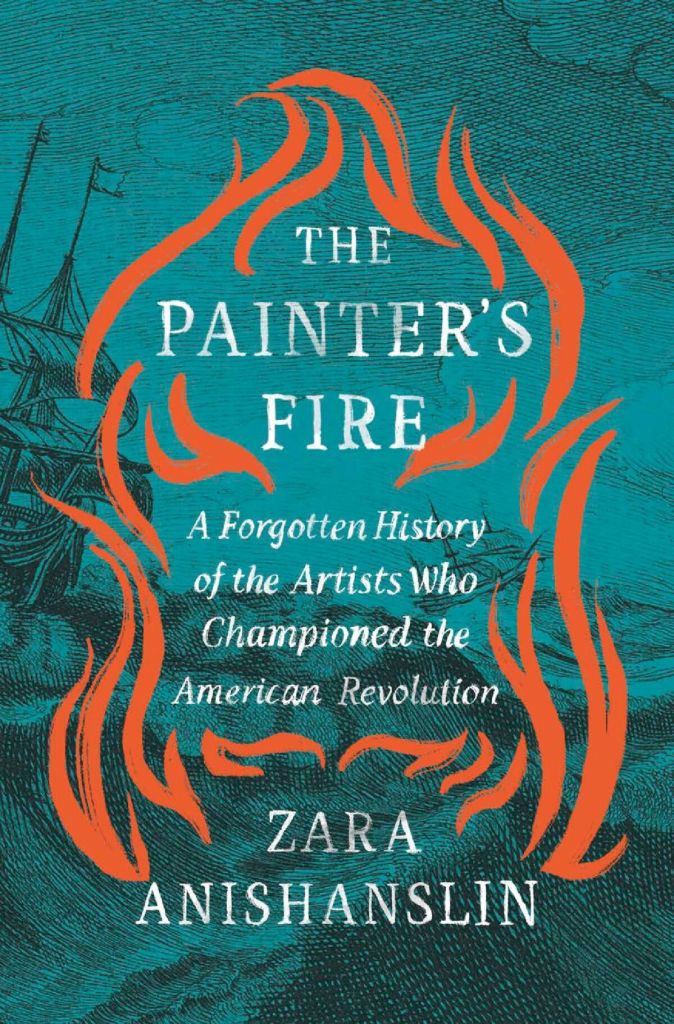 Told through the lives of three remarkable artists devoted to the pursuit of liberty, an illuminating new history of the ideals that fired the American Revolution.
The war that we now call the American Revolution was not only fought in the colonies with muskets and bayonets. On both sides of the Atlantic, artists armed with paint, canvas, and wax played an integral role in forging revolutionary ideals. Zara Anishanslin charts the intertwined lives of three such figures who dared to defy the British monarchy: Robert Edge Pine, Prince Demah, and Patience Wright. From London to Boston, from Jamaica to Paris, from Bath to Philadelphia, these largely forgotten patriots boldly risked their reputations and their lives to declare independence.
Mostly excluded from formal political or military power, these artists and their circles fired salvos against the king on the walls of the Royal Academy as well as on the battlefields of North America. They used their talents to inspire rebellion, define American patriotism, and fashion a new political culture, often alongside more familiar revolutionary figures such as Benjamin Franklin and Phillis Wheatley. Pine, an award-winning British artist rumored to be of African descent, infused massive history paintings with politics and eventually emigrated to the young United States. Demah, the first identifiable enslaved portrait painter in America, was Pine’s pupil in London before self-emancipating and enlisting to fight for the Patriot cause. And Wright, a Long Island–born wax sculptor who became a sensation in London, loudly advocated for revolution while acting as an informal patriot spy.
Illuminating a transatlantic and cosmopolitan world of revolutionary fervor, The Painter’s Fire reveals an extraordinary cohort whose experiences testify to both the promise and the limits of liberty in the founding era.
Zara Anishanslin is Associate Professor of History and Art History at the University of Delaware. She is the author of the award-winning Portrait of a Woman in Silk: Hidden Histories of the British Atlantic World and has served as a historical consultant for the Philadelphia Museum of Art as well as Hamilton: The Exhibition.
The Burlington Magazine, July 2025
The long 18th century in the July issue of The Burlington:
The Burlington Magazine 167 (July 2025)
e d i t o r i a l

Maria van Oosterwijck, Vanitas stilleven, ca. 1675, oil on canvas (Amsterdam: Rijksmuseum).
• “The Gallery of Honour,” p. 635. The gallery of honour in the heart of the Rijksmuseum, Amsterdam, has recently welcomed an impressive painting to its walls: Vanitas still life by Maria van Oosterwijck (1630–93). In a compelling sense the artist has long had a place in galleries of honour, as works by her were acquired by Emperor Leopold I, Louis XIV of France, and Cosimo III de’ Medici of Tuscany.
r e v i e w s
• Christian Scholl, “Germany’s Celebration of Caspar David Friedrich’s 250th Anniversary,” pp. 694–701.
In Germany, the 250th anniversary of Caspar David Friedrich’s birth was celebrated with a series of exhibitions. Key among them were those organised by the three museums with the most extensive holdings of the artist’s work: the Hamburger Kunsthalle, the Alte Nationalgalerie, Berlin, and the Staatliche Kunstsammlungen, Dresden. All three focused on stylistic, iconographic and technical aspects of the artist’s work rather than on Friedrich’s life, and each in its own way has thrown fresh light on his complex and enigmatic art.
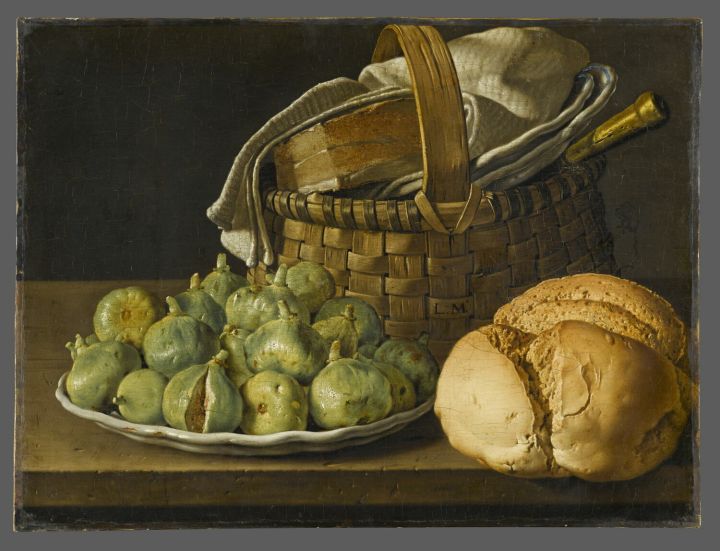
Luis Egidio Meléndez, Still Life with Figs, ca. 1760, oil on canvas (Paris: Musée du Louvre, on view at the Musée Goya, Castres).
• Robert Wenley, Review of the exhibition Wellington’s Dutch Masterpieces (Apsley House, London, 2025), pp. 713–15.
• Christoph Martin Vogtherr, Review of the exhibition Corot to Watteau? On the Trail of French Drawings (Kunsthalle Bremen, 2025), pp. 715–18.
• Elsa Espin, Review of the exhibition Le Louvre s’invite chez Goya (Musée Goya, Castres, 2025), pp. 718–20.
• John Marciari, Review of the exhibition Picturing Nature: The Stuart Collection of 18th- and 19th-Century British Landscapes and Beyond (Museum of Fine Arts, Houston, 2025), pp. 720–22.
• Kee Il Choi Jr., Review of the exhibition Monstrous Beauty: A Feminist Revision of Chinoiserie (The Metropolitan Museum of Art, New York, pp. 722–25.
• Deborah Howard, Review of Mario Piana, Costruire a Venezia: I mutamenti delle tecniche edificatorie lagunari tra Medioevo e Età moderna (Marsilio, 2024), pp. 732–33.
• Isabelle Mayer-Michalon, Review of Christophe Huchet de Quénetain and Moana Weil-Curiel, Étienne Barthélemy Garnier (1765–1849): De l’Académie royale à l’Institut de France (Éditions Faton, 2023), pp. 737–39.
Exhibition | The Grand Tour: Destination Italy

Pompeo Batoni, Portrait of Thomas William Coke, 1774, installed at Holkham Hall.
◊ ◊ ◊ ◊ ◊
From the press release (3 July) for the exhibition:
The Grand Tour: Destination Italy
Mauritshuis, The Hague, 18 September 2025 — 4 January 2026
The Grand Tour: Destination Italy features masterpieces from three of the UK’s most esteemed stately homes: Burghley House, Holkham Hall, and Woburn Abbey. The art in this exhibition was collected on tours in the 17th and 18th centuries, when young British aristocrats finished their education by spending several years travelling in continental Europe. The highlights will include an impressive portrait of Thomas William Coke by Pompeo Batoni (Holkham Hall), work by Angelica Kauffman (Burghley House), and two grand Venetian cityscapes by Canaletto (Woburn Abbey), all of them on display in the Netherlands for the first time.
Burghley House: Great Collectors
Visitors will encounter two extraordinary travellers from the Cecil family: John Cecil, the 5th Earl of Exeter, and Brownlow Cecil, the 9th Earl. In the 17th century John and his wife made four tours of Europe, collecting pieces for their stately home, Burghley House. They purchased all kinds of things, including furniture and tapestries, but above all they purchased lots of paintings for their grand house. Their trips were far from easy. The couple travelled with their children, servants, and dozens of horses. Grand Tours were not without their challenges. Sick servants would have to be left behind, horses died in the heat, and carriages broke down.

Nathaniel Dance, Portrait of Angelica Kauffman, 1764 (Burghley House).
Angelica Kauffman: Beloved, Talented, and in Demand
In the 18th century their great grandson Brownlow left for Italy after the death of his wife. He had a particular favourite, Angelica Kauffman, a Swiss-Austrian painter who worked in Italy for many years and was the star of her age beloved, talented, and in demand. The exhibition will include a magnificent portrait of her by Nathaniel Dance that shows her looking straight at the viewer. For many, meeting Kauffman was the highlight of their Grand Tour. Vesuvius can be seen in the background of her portrait of Brownlow. No visit to Naples was complete without a climb to the top of this volcano, which was a popular destination in the 18th century—the earliest example of ‘disaster tourism’. Pietro Fabris painted a detailed image of the eruption of Vesuvius in 1767, with a crowd in the foreground watching the awesome power of nature.
Holkham Hall: Home of Art
Thomas Coke, the 1st Earl of Leicester, was just fifteen when he embarked on his six-year Grand Tour (1712–1718). He travelled with a clear goal in mind: to collect art for the future Holkham Hall, which he had built after his return, in Palladian style, with Roman columns, façades resembling temples and strict symmetry. His artworks were displayed to their best advantage in his palatial country home. During his travels, he collected paintings, drawings, sculptures, books, and manuscripts. Coke was regarded as one of the most important 18th-century collectors of the work of Claude Lorrain, the French master of Italian landscapes, including the fabulous View of a Seaport and Amphitheatre. The top item in the exhibition is an impressive portrait of his great nephew Thomas William Coke, painted by Pompeo Batoni, a typical Grand Tour portrait with a Roman statue from the Vatican in the background.
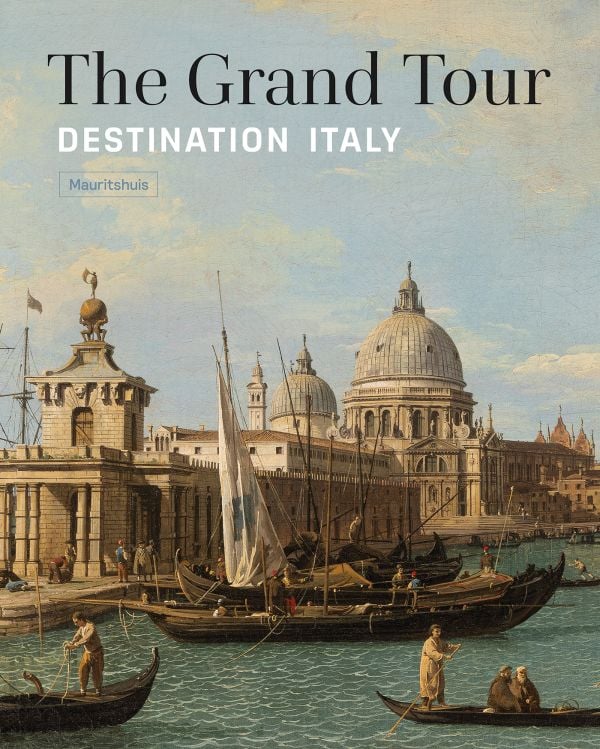
The cover of the catalogue includes a detail of Canaletto’s View of the Grand Canal in Venice, Looking West, with the Dogana di Mare and the Santa Maria della Salute, ca.1730–40 (Woburn Abbey).
Woburn Abbey: Obsession with Venice
The Grand Tour is synonymous not only with Rome, but also with Venice. John Russell, who became the 4th Duke of Bedford in 1735, visited the city on his Grand Tour (1730–31). Like many young aristocrats, he wanted a permanent memento to take home with him, and what could be more appropriate than a cityscape by Canaletto, the leading painter of 18th-century Venice? Eventually, John Russell commissioned an entire series comprising more than 24 paintings, the largest series of Canalettos still in existence. The paintings normally hang in the dining room at Woburn Abbey, the ancient family seat of the Russells.
The Grand Tour
These days many youngsters take a ‘gap year’ after high school, but a Grand Tour could easily last several years. Italy was the ultimate destination, with Rome, Florence, Naples, and Venice as the absolute highlights. En route, travellers would learn about art, architecture and culture, and collect artworks for their stately homes in England, just as we take back souvenirs nowadays. Yet these trips were not always innocent and high-minded. They are also known for their less salubrious distractions, including gambling and lustful pleasures. To keep the young men on the straight and narrow, they would be accompanied by chaperones. Such a ‘private tutor’ would mockingly be known as a ‘bear leader’. From the 18th century onwards, women also increasingly did the Grand Tour, sometimes with their entire family. The Napoleonic Wars (1803–15) brought the tradition of the Grand Tour to an end. In the 19th century, the advent of the steam train changed travel for good.
The catalogue is distributed by ACC Art Books:
Ariane van Suchtelen, The Grand Tour: Destination Italy (Waanders & de Kunst Publishers, 2025), 112 pages, ISBN: 978-9462626461, $45.
New Book | Travel Stories and the Eastern Adriatic
From The Institute of Art History at Zagreb:
Katrina O’Loughlin, Ana Šverko, and Elke Katharina Wittich, eds., Travel Stories and the Eastern Adriatic with a Section about the Travels of Thomas Graham Jackson (Zagreb: The Institute of Art History, 2025), 296 pages, ISBN: 978-9537875466, €20.
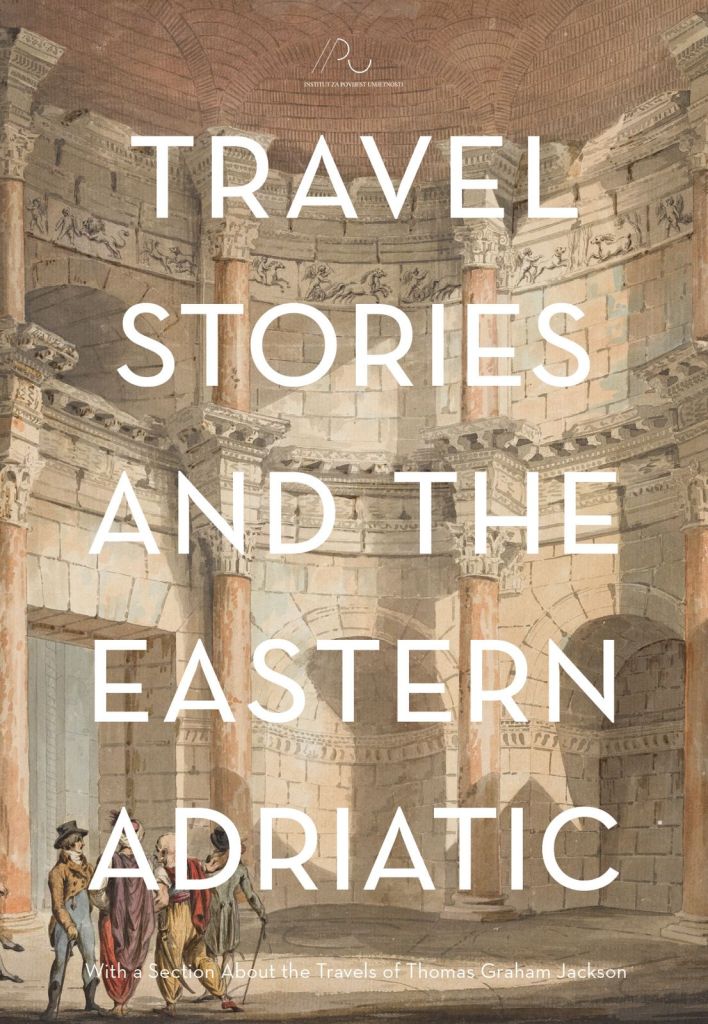 Travel Stories is the fourth collection of selected papers from a series of annual academic conferences held at the Institute of Art History – Cvito Fisković Centre in Split, which began in 2014. The current volume is a direct continuation of the book Discovering Dalmatia: Dalmatia in Travelogues, Images, and Photographs, published in 2019. The same editorial team and volume reviewers have this time grouped the selected papers from the Split conferences into two sections.
The first section, “Travellers and Travel Narratives,” brings together five papers related to travel narratives and the Eastern Adriatic over a broad timeline. These papers are authored by individuals from various backgrounds and discuss sources that include a variety of different media (lectures, drawings, books, photographs, diaries, letters), contributing to the exploration of the range of media used in travel narratives within this multimedia genre. The second section follows the Victorian architect Thomas Graham Jackson (1835–1924) on his journey along the eastern Adriatic coast, focusing on selected episodes from this trip, as described in his renowned three-volume work Dalmatia, the Quarnero, and Istria with Cettigne in Montenegro and the Island of Grado (Oxford, 1887), which is dedicated to the architectural and artistic heritage of this region.
The editorial process and publication of this book coincides with the first year of a new project funded by the Croatian Science Foundation, dedicated to Dalmatia and travel writing, ‘Where East Meets West’: Travel Narratives and the Fashioning of a Dalmatian Artistic Heritage in Modern Europe (c. 1675–1941), (Travelogues Dalmatia 2024–27).
c o n t e n t s
Acknowledgments
Ana Sverko — Preface: Exploring Genre, Place, and Travellers within the Travel Narrative
Section 1 | Travellers and Travel Narratives
• Frances Sands — Sir John Soane’s Lecture Drawings: A Virtual Grand Tour
• David McCallam — Carlo Bobba, Souvenirs d’un voyage en Dalmatie (1810): Travel, Empire, and Hospitality in the Early Nineteenth-Century Adriatic
• Ante Orlović — A Photographic Album with a Description of His Majesty the Emperor and King Franz Joseph I’s Tour through Dalmatia in 1875
• Boris Dundović and Eszter Baldavári — The Balkan Letters by Ernő Foerk: A Travelogue Mapping the Architectural Trajectories of Ottoman and Orthodox Heritage
• Dalibor Prančević and Barbara Vujanović — Ivan Meštrović’s Reflections from His Travels to the Middle East
Section 2 | Thomas Graham Jackson and the Eastern Adriatic
• Mateo Bratanić — Travellers, Historians, and Antiquaries: How Thomas Graham Jackson Wrote History in Dalmatia, the Quarnero, and Istria
• Krasanka Majer Jurišić and Petar Puhmajer — Thomas Graham Jackson and the Island of Rab
• Ana Torlak — Thomas Graham Jackson and Salona
• Sanja Žaja Vrbica — The Portrait of Dubrovnik by Thomas Graham Jackson
• Mateja Jerman — The Church Treasuries of Dalmatia and the Bay of Kotor through the Eyes of Thomas Graham Jackson
List of Illustrations
List of Contributors
Cover image: Soane office hand: Detail of a Royal Academy Lecture Drawing Showing an Interior View of the Temple of Jupiter at Diocletian’s Palace, Spalatro (Split), after Robert Adam, Ruins of the Palace of the Emperor Diocletian at Spalatro in Dalmatia (London 1764, plate 33), 1806–19 (London: Sir John Soane’s Museum, SM 19/11/1; Ardon Bar-Hama).
New Book | London: A History of 300 Years in 25 Buildings
Published last year by Yale UP, with a paperback edition due in September:
Paul Knox, London: A History of 300 Years in 25 Buildings (New Haven: Yale University Press, 2024), 448 pages, ISBN: 978-0300269208, $35.

A lively new history of London told through twenty-five buildings, from iconic Georgian townhouses to the Shard
A walk along any London street takes you past a wealth of seemingly ordinary buildings: an Edwardian church, modernist postwar council housing, stuccoed Italianate terraces, a Bauhaus-inspired library. But these buildings are not just functional. They are evidence of London’s rich and diverse history and have shaped people’s experiences, identities, and relationships. Paul L. Knox traces the history of London from the Georgian era to the present day through twenty-five surviving buildings. He explores where people lived and worked, from grand Regency squares to Victorian workshops, and highlights the impact of migration, gentrification, and inequality. We see famous buildings, like Harrods and Abbey Road Studios, and everyday places like Rochelle Street School and Thamesmead. Each historical period has introduced new buildings, and old ones have been repurposed. As Knox shows, it is the living history of these buildings that makes up the vibrant, but exceptionally unequal, city of today.
Paul Knox is an expert in the social and architectural history of London. Originally from the UK, he is now University Distinguished Professor at Virginia Tech. He is the author of Metroburbia: The Anatomy of Greater London; London: Architecture, Building, and Social Change; and Cities and Design.










 Enfilade
leave a comment