Exhibition | Tiepolo in Milan
Press release from The Frick:
Tiepolo in Milan: The Lost Frescoes of Palazzo Archinto
The Frick Collection, New York, 16 April — 14 July 2019
Curated by Xavier Salomon, with Andrea Tomezzoli and Denis Ton
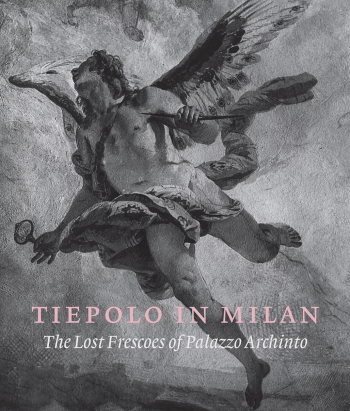 This spring and summer, The Frick Collection presents paintings, drawings, prints, and photographs related to Giambattista Tiepolo’s (1696–1770) first significant project outside of Venice, a series of ceiling frescoes painted in 1730–31 for Palazzo Archinto in Milan. Commissioned by Count Carlo Archinto, one of the city’s most influential patrons and intellectuals, the frescoes were tragically destroyed when the palazzo was bombed by the Allies during World War II. Tiepolo in Milan: The Lost Frescoes of Palazzo Archinto brings together more than fifty works from collections in the United States and Europe to tell the story of this important commission. Five preparatory paintings and drawings are featured, among them the oil sketch Perseus and Andromeda, acquired by Henry Clay Frick in 1916. As the Frick does not loan objects purchased by the institution’s founder, the New York museum is the only place where these works can be displayed together. Several complementary drawings and books illustrated by Tiepolo are included, alongside documentary photographs, taken between 1897 and the early 1940s, which are the only surviving records of the finished frescoes. The exhibition is organized by The Frick Collection in collaboration with the Azienda di Servizi alla Persona Golgi-Redaelli, Milan, and curated by Xavier F. Salomon, the Frick’s Peter Jay Sharp Chief Curator, with Andrea Tomezzoli, Professor at the University of Padua, and Denis Ton, Curator of the Musei Civici in Belluno.
Comments Salomon, “At a moment in history when wars are destroying art and culture in many parts of the world, it is worth pausing to consider, through an exhibition like this, the tragic, irreparable effects caused by violence throughout the centuries on great works of human creativity.”
Tiepolo and the Archinto Family
Palazzo Archinto belonged to one of Milan’s most prominent aristocratic families, documented in the city since at least the twelfth century. In the eighteenth century, the Archinto were described as one of those Milanese families who had always owned “highly admired treasures.” In addition to Tiepolo’s frescoes, the palazzo contained extensive collections of artworks and a renowned library. Carlo Archinto (1670–1732), Tiepolo’s patron, was at the center of Milan’s intellectual circles and was especially recognized for his interest in philosophy, mathematics, and science. During the mid-eighteenth century, he lived in the family palazzo, located on Via Olmetto, near Porta Ticinese, in one of the oldest parts of the city.
The palazzo’s library, overseen by librarian Filippo Argelati, filled five rooms and was open to scholars. Together with Carlo Archinto and other patrons, Argelati founded the Società Palatina, a publishing enterprise. Between 1723 and 1751, the Società published Ludovico Antonio Muratori’s Rerum Italicarum Scriptores. Archinto financed the project and contributed notes to one of the volumes. Tiepolo provided a number of designs for books published by the Società Palatina (five are included in the exhibition) and thus became acquainted with the aristocratic family. About 1730, when Archinto decided to redecorate his palazzo, he commissioned eight frescoed ceilings: five from Tiepolo and three from the Bolognese painter Vittorio Maria Bigari (1692–1776).
The Commission
The substantial commission was Tiepolo’s first outside the Veneto, and it marked the beginning of his international career. According to the Tiepolo scholar, Michael Levey, the frescoes at Palazzo Archinto “must have been sumptuously rich and impressive. Tiepolo never received a commission for a private palace of comparable extent and rarely of such splendour.” The ceilings, in part to celebrate the wedding of Carlo’s son Filippo to Giulia Borromeo, were meant to underscore the status of the Archinto family and were Carlo’s spiritual and visual testament, blending allegorical and mythological scenes.
Of the preparatory works that survive from the commission, three painted sketches on canvas provide the most important visual record of the lost frescoes: Triumph of Arts and Sciences (Museu Nacional de Arte Antiga, Lisbon), Perseus and Andromeda (The Frick Collection), and Apollo and Phaëton (Los Angeles County Museum of Art).
The largest and most elaborate fresco at Palazzo Archinto was the Triumph of the Arts and Sciences, which decorated one of the main rooms on the palace’s principal floor, or piano nobile. In it, Tiepolo depicted a resplendent sky with an assembly of allegorical figures, including Architecture, Painting, Sculpture, Music, and Mathematics, under the aegis of Apollo and Minerva. The ceiling’s decoration surely related to Carlo’s intellectual pursuits and to his library. When Tiepolo created the sketch (modello) for the ceiling, the fictive architectural scheme (quadratura) that was to frame the fresco had not yet be finalized; he therefore depicted his figures hovering in a cloudy sky, surrounded only by an area of brown ocher. In preparation for his fresco cycles, Tiepolo executed numerous drawings. Two surviving drawings related to Triumph of the Arts and Sciences are included in the exhibition, together with the related Lisbon modello and black-and-white photographs of the finished fresco in situ.

Giambattista Tiepolo, Perseus and Andromeda, ca. 1730–31, oil on canvas (New York: The Frick Collection).
The fresco of Perseus and Andromeda was likely envisioned as a celebration of the wedding of Filippo Archinto and Giulia Borromeo. Book IV of Ovid’s Metamorphoses recounts the tale of the young and beautiful Andromeda, daughter of the Aethiopian king Cepheus and Cassiopeia. Boasting that Andromeda is more beautiful than the Nereids, Cassiopeia angers Neptune, who, in revenge, sends a monster to ravage the cost of Aethiopia. Told that the only way to save their country is to sacrifice their daughter to the monster, Andromeda’s parents chain her to a rock by the sea. The hero Perseus, son of Jupiter and Danaë, sees Andromeda while flying over Aethiopia and falls in love with her. He asks her parents for permission to marry her if he is able to save her; he subsequently kills the sea monster and rescues Andromeda. Tiepolo took liberties with Ovid’s Metamorphoses in showing Perseus riding the winged horse Pegasus instead of flying by way of a pair of winged sandals. As evidenced in the archival photographs, the overall configuration of the Perseus and Andromeda fresco in Palazzo Archinto was almost identical to the one visible in the oil sketch (page one), which was likely presented to Carlo Archinto for approval.
Tiepolo faithfully followed another passage from Ovid’s Metamorphoses in the fresco depicting Phaëton, the son of Apollo and Clymene. Uncertain about his divine origins, the youth questions Clymene about the identity of his father, and Clymene encourages him to visit Apollo in his heavenly palace. To prove his paternity, Apollo grants Phaëton a single wish, which is to drive the sun god’s chariot for a day. Apollo provides the exact course he should take across the sky and warns his son about the dangers of such a trip, particularly from specific constellations such as Scorpio. Once guiding the chariot, however, Phaëton is terrified by Scorpio and quickly loses control. Despite Apollo’s instructions and warnings, Phaëton flies too close to earth and scorches it. Incensed, Jupiter hits him with a thunderbolt, hurling him out of the chariot and to his death in the river Po. In the modello for the fresco, the artist set the scene in the dwelling of the Sun, described by Ovid as decorated with columns and bathed in golden light. Carlo’s choice of this father-son myth as the fresco’s subject may have been meant to serve as a warning to his children—Filippo especially—about life’s dangers. The exhibition provides a unique opportunity to compare the Los Angeles modello and related archival photographs of the original fresco with three other works previously associated with Palazzo Archinto: two paintings by Tiepolo (now at the Akademie in Vienna and the Bowes Museum) and a drawing from the British Museum, all of which depict Apollo and Phaëton.
Tiepolo’s other two ceilings in the palazzo represented Juno, Venus, and Fortune, probably painted for Giulia Borromeo’s private apartments, and an allegory of Nobility, which most likely decorated the ceiling of a relatively small room. Unfortunately, no related preparatory drawings or modelli have been identified. The two frescoes are represented in the exhibition by archival photographs.
The Fate of Palazzo Archinto
The palazzo belonged to the Archinto family for more than a century, until 1825, when the family sold it. In 1853, it was purchased by the current owner, Luoghi Pii Elemosinieri, a charitable institution (now called the Azienda di Servizi alla Persona Golgi-Redaelli). On the night of August 13, 1943, Allied bombs hit Palazzo Archinto, destroying its interior, including Tiepolo’s frescoes. (The interior was rebuilt between 1955 and 1967, following the general structure of its previous architectural form.) During World War II, sixty-five percent of Milan’s historic monuments were damaged or destroyed. Tiepolo’s frescoes at Palazzo Archinto were among the most tragic losses.
Fortunately, a number of black-and-white photographs were taken in Palazzo Archinto at different points before 1943. In 1897, Attilio Centelli and Gerardo Molfese published a large volume dedicated to Tiepolo’s frescoes in Lombardy. The book includes a series of fifty photographs of frescoes by—or attributed at the time to—Tiepolo. These photographs are the oldest surviving images of the Palazzo Archinto frescoes and remain vital documents of their original appearance. Only three copies of the book survive (one in Milan, one in Rome, and one in Venice). The Milan copy is preserved, unbound, in the archive of the Azienda di Servizi alla Persona Golgi-Redaelli. The exhibition includes ten plates from this copy, as well as twenty photographs documenting the palace before the war, Tiepolo’s finished frescoes, and the ruins of the palace after 1943.
Major support for the exhibition is provided by an anonymous gift in memory of Melvin R. Seiden and by Margot and Jerry Bogert. Additional funding is generously provided by the David L. Klein, Jr. Foundation, Julie and David Tobey, an anonymous gift in memory of Charles Ryskamp, Dr. Tai-Heng Cheng and Cole Harrell, Mr. and Mrs. Hubert L. Goldschmidt, and The Krugman Family Foundation.
Xavier Salomon, Andrea Tomezzoli, and Denis Ton with Alessandra Kluzer, Tiepolo in Milan: The Lost Frescoes of Palazzo Archinto (London: Paul Holberton, 2019), 224 pages, ISBN: 978-1911300526, £45 / $50.
The Frick Collection, in association with Paul Holberton Publishing, has produced a fully illustrated catalogue to accompany the exhibition. Included are essays about Tiepolo’s work in Palazzo Archinto (Xavier F. Salomon), the architectural history of the palace (Alessandra Kluzer), the role of the Archinto frescoes in Tiepolo’s career (Andrea Tomezzoli), and the intellectual world of the Archinto family (Denis Ton).
Lecture | Robin Myers on Andrew and James Ducarel
From Eventbrite:
Robin Myers, Dr Andrew Ducarel, Lambeth Librarian 1757–85, Seen through His Brother’s Eyes
Lambeth Palace, London, 8 May 2019
 Andrew Ducarel (1713–1785), the eldest of three Huguenot brothers, was a successful ecclesiastical lawyer, Librarian at Lambeth, historian of the palaces of Lambeth and Croydon and of the architecture of Normandy. In Robin Myers’s new book The Two Brothers, it is Andrew’s younger brother James who takes centre stage, writing letters to Andrew in London about his life in France. Wednesday, 8 May 2019, 6pm (admittance not before 5.30pm). Guests should arrive via the main Gatehouse of Lambeth Palace. For any queries, please email melissa.harrison@churchofengland.org.
Robin Myers is a Past President of the Bibliographical Society and Archivist Emeritus of the Worshipful Company of Stationers. Her principal research interests are the history of the Company and its archive, on which she has published widely. She has also worked on Andrew Ducarel for more than twenty years. Her edition, with Gerard de Lisle, of Two Huguenot Brothers: Letters of Andrew and James Coltee Ducarel (1732–1773) has recently been published by Bernard Quaritch.
Exhibition | The Tale of Genji

Press release (26 February 2019) from The Met:
The Tale of Genji: A Japanese Classic Illuminated
The Metropolitan Museum of Art, New York, 5 March — 16 June 2019
Curated by John Carpenter and Melissa McCormick with Monika Bincsik and Kyoko Kinoshita
A major international loan exhibition focusing on the artistic tradition inspired by Japan’s most celebrated work of literature will go on view at The Metropolitan Museum of Art beginning March 5, 2019. Bringing together more than 120 works of art from 32 public and private collections in Japan and the United States—including National Treasures and Important Cultural Properties, most of which have never left Japan—The Tale of Genji: A Japanese Classic Illuminated explores the tale’s continuing influence on Japanese art since it was written around the year 1000 by the noblewoman Murasaki Shikibu (ca. 978–ca. 1014). Often referred to as the world’s first novel, The Tale of Genji has captivated readers for centuries through its sophisticated narrative style, humor and wit, and unforgettable characters, beginning with the ‘radiant prince’ Genji, whose life and loves are the focus of the story.

Tosa Mitsunari (Japanese, 1646–1710), ‘Murasaki Shikibu’, late 17th–early 18th century, one of a triptych of hanging scrolls, ink and color on silk (Ishiyamadera Temple).
“The Tale of Genji has inspired generations of artists over centuries, and ours is the first exhibition to explore this phenomenon in such a comprehensive way,” said Max Hollein, Director of The Met. “The magnificent works of art in the show will also offer a view into the development of Japanese art, a testament to the prevalence and impact of the renowned story.”
The exhibition is organized by The Metropolitan Museum of Art and The Japan Foundation, with the cooperation of the Tokyo National Museum and Ishiyamadera Temple. It is made possible by the Mary Livingston Griggs and Mary Griggs Burke Foundation Fund, 2015; the Estate of Brooke Astor; the E. Rhodes and Leona B. Carpenter Foundation; and Ann M. Spruill and Daniel H. Cantwell.
The exhibition presents the most extensive introduction to the visual world of Genji ever shown outside Japan. It features nearly one thousand years of Genji-related art—an astonishing range of works including paintings, calligraphy, silk robes, lacquerware, a palanquin for a shogun’s bride, and popular art such as ukiyo-e prints and contemporary manga—and provide viewers with a window into the alluring world of the Heian imperial court (794–1185) that was created by the legendary authoress.
Comprising 54 chapters, The Tale of Genji describes the life of the prince, from the amorous escapades of his youth to his death, as well as the lives of his descendants, introducing along the way some of the most iconic female characters in the history of Japanese literature. Organized thematically in eight sections, the exhibition pays special attention to the Buddhist reception of the tale, while also giving prominence to Genji’s female readership and important works by female artists.
Among the works on view, highlights include two of Japan’s National Treasures. The first, on loan from Seikado Bunko Art Museum, is a pair of screens by the Rinpa master Tawaraya Sotatsu (ca. 1570-ca. 1640)—Channel Markers and The Barrier Gate—depicting two chance encounters between Genji and a former lover. The second is the breathtaking Heian-period Lotus Sutra with Each Character on a Lotus, from the Museum Yamato Bunkakan. These works will be on view for six weeks and then rotated with other masterpieces over the course of the exhibition. A number of works recognized as Important Cultural Properties will be on view throughout the exhibition, including beautifully preserved album leaves by Tosa Mitsuyoshi (1539–1613), from the Kuboso Memorial Museum of Arts, Izumi, which will be shown together with rare Tosa School album paintings from the Harvard Art Museums and The Met’s own collection.
The exhibition also includes a section featuring important works of art from Ishiyamadera Temple whose hall contains a ‘Genji Room’ that commemorates the legend that Murasaki started writing the novel within the temple precincts. And the final section of the exhibition features a series of original manga drawings by Yamato Waki that were inspired by The Tale of Genji. She translated Genji into the comic book idiom, making Murasaki’s tale accessible to a whole new generation of readers.
A site-specific opera entitled Murasaki’s Moon—commissioned by MetLiveArts, On Site Opera, and American Lyric Theater in conjunction with the exhibition—will be presented in The Met’s Astor Court on May 17, 18, and 19.
This exhibition will be the opening highlight of Japan 2019, a series of events organized by The Japan Foundation to introduce Japanese arts and culture in the United States throughout 2019.
The Tale of Genji: A Japanese Classic Illuminated will be accompanied by a fully illustrated catalogue, made possible by The Andrew W. Mellon Foundation; the Florence and Herbert Irving Fund for Asian Art Publications; the Charles A. Greenfield Fund; The Miriam and Ira D. Wallach Foundation; the Mary Livingston Griggs and Mary Griggs Burke Foundation Fund, 2015; the Parnassus Foundation; and Richard and Geneva Hofheimer Memorial Fund.
The exhibition is curated by John T. Carpenter, Mary Griggs Burke Curator of Japanese Art in the Department of Asian Art at The Met; and guest curator Melissa McCormick, Professor of Japanese Art and Culture at Harvard University; with Monika Bincsik, Diane and Arthur Abbey Assistant Curator for Japanese Decorative Arts at The Met; and Kyoko Kinoshita, Professor of Japanese Art History at Tama Art University.
John Carpenter and Melissa McCormick, The Tale of Genji: A Japanese Classic Illuminated (New York: The Metropolitan Museum of Art, 2019), 368 pages, ISBN: 978-1588396655, $65.
Exhibition | Making Time: The Art of the Kentucky Tall Case Clock
Now on view at the Speed Art Museum:
Making Time: The Art of the Kentucky Tall Case Clock, 1790–1850
Speed Art Museum, Louisville, 2 February — 16 June 2019
Curated by Scott Erbes

Case attributed to Daniel Spencer (American, about 1741–1796), Lexington, Fayette County, Kentucky, Tall Case Clock, 1793–96; cherry, poplar, chestnut, walnut; eight-day brass and steel movement, 98 inches high (Cox Collection).
Making Time: The Art of the Kentucky Tall Case Clock, 1790–1850 is a first-of-its-kind exhibition devoted to early Kentucky tall case, ‘grandfather’ clocks. The exhibition showcases twenty-seven clocks made across a wide swath of Kentucky from the 1790s through the 1840s. The majority of the clocks come from family and private collections and have rarely, if ever, been shared with the public. The exhibition is accompanied by a fully illustrated scholarly catalog that presents significant new research on early Kentucky cabinetmaking and the state’s watch and clock trade.
When shown side-by-side, the clocks reveal the expert hands of many Kentucky artisans; illustrate the hidden world of gears, bells, weights, and pendulums that kept the clocks running and chiming; and record the complex webs of craft, taste, trade, and technology needed to make these practical works of art. Throughout the exhibition, the clock cases illustrate the talents of early Kentucky cabinetmakers, both native-born and those who came to the state in search of success. These artisans transformed local woods like cherry and walnut into towering cases that frequently incorporate flourishes like inlaid decoration, carved ornament, and richly figured veneers. The results range from urbane, Federal-style creations to more idiosyncratic, often boldly inlaid forms. Numerous Kentucky silversmiths are associated with the intricate movements housed within the various clocks.
Just in Time: Exploring Kentucky Tall Case Clocks
Speed Art Museum, Louisville, 18 May, 9:00–3:00
Come join us for a study day exploring the backstories behind early Kentucky tall case clocks with the experts who created the exhibition Making Time: The Art of the Kentucky Tall Case Clock, 1790–1850. Enjoy a morning of presentations focused on the art, history, and technology of these Kentucky treasures; an opportunity to purchase signed copies of the exhibition’s accompanying catalog; and an afternoon tour of the exhibition with its creators. $75.
Scott Erbes (Curator of Decorative Arts and Design, Speed Art Museum), From the Beginning: An Introduction to Kentucky Tall Case Clocks
Early Kentucky tall case clocks tell many stories: of the talented artisans who created them, of local and regional practices, of fashionable taste, of international trade, of the nature of time and timekeeping in Federal America, and of family memory. This overview will touch on these themes and others, setting the stage for the day’s conversations.
Mack Cox (independent researcher and collector), Making the Case for the Art in Kentucky Tall Case Clocks
Kentucky tall case clocks consist of locally made cases mated with clock movements, dials, and other components often made elsewhere. While the latter are often well documented, the Kentucky-made portions and artistic expressions of early Kentucky craftsmen are nearly unknown. Based on over a decade of serious study of Kentucky furniture, this lecture will shed light on the art and Kentucky parts of the Kentucky tall case clock.
Bob Burton (independent researcher and collector), What Makes It Tick: Inside Kentucky Tall Case Clocks
The movements and related parts in Kentucky tall case clocks vary widely in type, materials, and origins. This discussion will reveal these secrets, exploring the time-keeping mechanisms, painted dials, and other components that marked the time in early Kentucky clocks.
Greg Black (independent researcher and collector), Will the Real Elijah Warner Please Stand Up?
Over the past decades, much has been written about Elijah Warner of Lexington, Kentucky, especially that he was a cabinetmaker and clockmaker. The recent discovery of nineteenth-century documents and advertisements cast new light on Warner’s training and occupation and the goods he produced and sold. This presentation will review this information to bring the real Elijah Warner into better focus.
New Book | Art Crossing Borders
From Brill:
Jan Dirk Baetens and Dries Lyna, eds., Art Crossing Borders: The Internationalisation of the Art Market in the Age of Nation States, 1750–1914, Series: Studies in the History of Collecting & Art Markets, Volume 6 (Leiden: Brill, 2019), 351 pages, ISBN: 978-9004291980, €127 / $153.
 Art Crossing Borders offers a thought-provoking analysis of the internationalisation of the art market during the long nineteenth century. Twelve experts, dealing with a wide variety of geographical, temporal, and commercial contexts, explore how the gradual integration of art markets structurally depended on the simultaneous rise of nationalist modes of thinking, in unexpected and ambiguous ways.
Jan Dirk Baetens (PhD, University of Leuven, 2011), is Assistant Professor at Radboud University Nijmegen. He has published widely on the nineteenth-century art market and on nineteenth-century historicism. He is preparing a book-length study on the Belgian history and historical genre painter Henri Leys.
Dries Lyna (PhD, University of Antwerp, 2010), is Assistant Professor at Radboud University Nijmegen. He has published on the art markets and material culture of eighteenth-century cities in the Low Countries, co-editing Concepts of Value in European Material Culture, 1500–1900 (2015). He is currently preparing a book on the rise of art auctions in the Austrian Netherlands.
C O N T E N T S
Acknowledgements
Figures
Contributors
• Jan Dirk Baetens and Dries Lyna, Towards an International History of the Nineteenth-Century Art Trade
• Jan Dirk Baetens and Dries Lyna, The Education of the Art Market: National Schools and International Trade in the ‘Long’ Nineteenth Century
• Bénédicte Miyamoto, ‘Directions to Know a Good Picture’: Marketing National School Categories to the British Public in the ‘Long’ Eighteenth Century
• Leanne Zalewski, Creating Cultural and Commercial Value in Late Nineteenth-Century New York Art Catalogues
• Barbara Pezzini, (Inter)national Art: The London Old Masters Market and Modern British Painting (1900–14)
• Camilla Murgia, The Artistic Trade and Networks of the Italian Community in London around 1800
• Lukas Fuchsgruber, Berlin – Paris: Transnational Aspects of French Art Auctions in the Middle of the Nineteenth Century
• Adriana Turpin, Appropriation as a Form of Nationalism? Collecting French Furniture in the Nineteenth Century
• Sharon Hecker, The Modern Italian Sculptor as International Entrepreneur: The Case of Medardo Rosso (1858–1928)
• Robert Verhoogt, Art Reproduction, and the Nation: National Perspectives in an International Art Market
• Pamela Fletcher and Anne Helmreich, Reframing the ‘International Art Market’
Index
Call for Manuscripts | Brill Series, History of Collecting & Art Market
History of Collecting & Art Market
Brill Book Series, Edited by Christian Huemer
Brill‘s ‘Studies in the History of Collecting & Art Markets’ is a peer-reviewed book series dedicated to original scholarship on the social, cultural, and economic mechanisms underlying the circulation of art. Over the last two decades interest in the formation, display, and dissolution of art collections increased tremendously; art markets, trade routes, and dealer networks became a rich field of interdisciplinary inquiry. Scholarship brought forth a lot of information about the flamboyant personalities to whom the possession of art was a lifestyle; regarding the ‘social life of things’, i.e. the provenance of individual artworks, many research gaps could be closed.
This shift in scholarly attention from the production side to the consumption side of the art world is also reflected in the emergence of specialized post-graduate courses offered by a number of institutions internationally, as well as an ever-increasing stream of exhibitions, conferences, and publications devoted to the subject. Brill‘s book series accommodates scholarly monographs, collections of essays, conference proceedings, and works of reference that engage in the broadly defined topic of art markets and collecting practices throughout history.
We invite scholars to submit their English language manuscript proposal for the book series to Liesbeth Hugenholtz, acquisitions editor at Brill (hugenholtz@brill.com) or to the series editor Christian Huemer (C.Huemer@belvedere.at).
Editor-in-Chief
Christian Huemer (Belvedere Research Center, Vienna)
Editorial Board
Malcolm Baker (University of California, Riverside), Ursula Frohne (Westfälische Wilhelms-Universität Münster), Daniela Gallo (Université de Lorraine, Nancy), Hans van Miegroet (Duke University, Durham), Inge Reist (The Frick Collection, New York – retired), Adriana Turpin (Institut d’Etudes Supérieures des Arts, London), Filip Vermeylen (Erasmus University, Rotterdam)
More information about the series is available here»
New Book | Itch, Clap, Pox
From Yale UP:
Noelle Gallagher, Itch, Clap, Pox: Venereal Disease in the Eighteenth-Century Imagination (New Haven: Yale University Press, 2019), 288 pages, ISBN: 978-0300217056, $65.
 A lively interdisciplinary study of how venereal disease was represented in eighteenth-century British literature and art
In eighteenth-century Britain, venereal disease was everywhere and nowhere: while physicians and commentators believed the condition to be widespread, it remained shrouded in secrecy, and was often represented using slang, symbolism, and wordplay. In this book, literary critic Noelle Gallagher explores the cultural significance of the ‘clap’ (gonorrhea), the ‘pox’ (syphilis), and the ‘itch’ (genital scabies) for the development of eighteenth-century British literature and art. As a condition both represented through metaphors and used as a metaphor, venereal disease provided a vehicle for the discussion of cultural anxieties about gender, race, commerce, and immigration. Gallagher highlights four key concepts associated with venereal disease, demonstrating how infection’s symbolic potency was enhanced by its links to elite masculinity, prostitution, foreignness, and facial deformities. Casting light where the sun rarely shines, this study will fascinate anyone interested in the history of literature, art, medicine, and sexuality.
Noelle Gallagher is Senior Lecturer in Eighteenth-Century Literature and Culture at the University of Manchester. She is the author of Historical Literatures: Writing about the Past in England, 1600–1740.
New Book | Martin Lister and his Remarkable Daughters
Distributed in North America by The University of Chicago Press:
Anna Marie Roos, Martin Lister and his Remarkable Daughters: The Art of Science in the Seventeenth Century (Oxford: Bodleian Library, 2019), 224 pages, ISBN: 978-1851244898, $40.
 A royal physician and fellow of the Royal Society, Martin Lister was an extraordinarily prolific natural historian with an expertise in shells and mollusks. Disappointed with the work of established artists, Lister decided to teach his daughters, Susanna and Anna, how to illustrate images of the specimens he studied. The sisters became so skilled that Lister entrusted them with his great work, Historiæ Conchyliorum, assembled between 1685 and 1692. This first comprehensive study of conchology consisted of more than one thousand copperplates of shells and mollusks collected from around the world. Martin Lister and his Remarkable Daughters reconstructs the creation of this masterwork, presenting original drawings, engraved copperplates, draft prints, and photographs of the finished books.
Susanna and Anna portrayed the shells of this collection not only as curious and beautiful objects, but also as specimens of natural history, rendering them with sensitivity and keen scientific empiricism. Beautiful in their own right, their illustrations and engravings reveal the early techniques behind scientific illustration and offer fascinating insight into the often hidden role of women in the scientific revolution.
Anna Marie Roos is a reader in the history of science and medicine at the University of Lincoln.
New Book | Jefferson on Display
From the University of Virginia Press:
G. S. Wilson, Jefferson on Display: Attire, Etiquette, and the Art of Presentation (Charlottesville: University of Virginia Press, 2018), 308 pages, ISBN: 978-0813941295, $30.
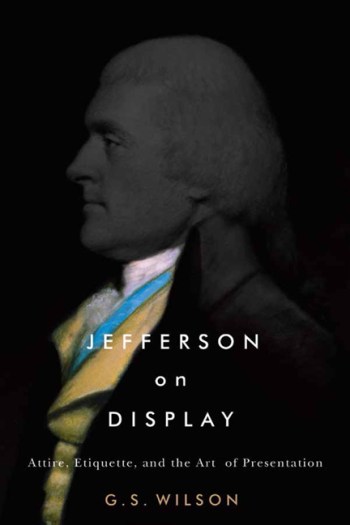 When we think of Thomas Jefferson, a certain picture comes to mind for some of us, combining his physical appearance with our perception of his character. During Jefferson’s lifetime this image was already taking shape, helped along by his own assiduous cultivation. In Jefferson on Display, G. S. Wilson draws on a broad array of sources to show how Jefferson fashioned his public persona to promote his political agenda. During his long career, his image shifted from cosmopolitan intellectual to man of the people. As president he kept friends and foes guessing: he might appear unpredictably in old, worn, and out-of-date clothing with hair unkempt, yet he could as easily play the polished gentleman in a black suit, as he hosted small dinners in the President’s House that were noted for their French-inspired food and fine European wines. Even in retirement his image continued to evolve, as guests at Monticello reported being met by the Sage clothed in rough fabrics that he proudly claimed were created from his own merino sheep, leading Americans by example to manufacture their own clothing, free of Europe.
By paying close attention to Jefferson’s controversial clothing choices and physical appearance—as well as his use of portraiture, architecture, and the polite refinements of dining, grooming, and conversation—Wilson provides invaluable new insight into this perplexing founder.
G. S. Wilson is Shannon Senior Historian at the Robert H. Smith International Center for Jefferson Studies, Monticello.
C O N T E N T S
List of Illustrations
Acknowledgments
Introduction
The European Experience
1 At the French Court and among the Literati
2 Remembering the Revolution
The Politics of the 1790s
3 Returning to a New America
4 Campaigning for Change
The Presidency
5 A New Presidential Profile
6 But Always the Cosmopolitan Gentleman
Retirement at Monticello
7 Contemplating Legacy
8 A Final Image
Epilogue
Notes
Bibliography
Illustration Credits
Index
New Book | Grammars of Approach
From The University of Chicago Press:
Cynthia Wall, Grammars of Approach: Landscape, Narrative, and the Linguistic Picturesque (Chicago: The University of Chicago Press, 2019), 352 pages, ISBN: 978-0226467665 (cloth), $105 / ISBN: 978-0226467832 (paper), $35.
 In Grammars of Approach, Cynthia Wall offers a close look at changes in perspective in spatial design, language, and narrative across the late eighteenth and early nineteenth centuries that involve, literally and psychologically, the concept of ‘approach’. In architecture, the term ‘approach’ changed in that period from a verb to a noun, coming to denote the drive from the lodge at the entrance of an estate “through the most interesting part of the grounds,” as landscape designer Humphrey Repton put it. The shift from the long straight avenue to the winding approach, Wall shows, swung the perceptual balance away from the great house onto the personal experience of the visitor. At the same time, the grammatical and typographical landscape was shifting in tandem, away from objects and Things (and capitalized common Nouns) to the spaces in between, like punctuation and the ‘lesser parts of speech’. The implications for narrative included new patterns of syntactical architecture and the phenomenon of free indirect discourse. Wall examines the work of landscape theorists such as Repton, John Claudius Loudon, and Thomas Whately alongside travel narratives, topographical views, printers’ manuals, dictionaries, encyclopedias, grammars, and the novels of Defoe, Richardson, Burney, Radcliffe, and Austen to reveal a new landscaping across disciplines—new grammars of approach in ways of perceiving and representing the world in both word and image.
Cynthia Wall is professor of English at the University of Virginia. She is an editor of works by Bunyan, Defoe, and Pope, and the author of The Literary and Cultural Spaces of Restoration London and The Prose of Things: Transformations of Description in the Eighteenth Century, the latter also published by the University of Chicago Press.
C O N T E N T S
List of Illustrations
A Note on My Text
Acknowledgments
Introduction
1 The Architectural Approach
The etymology of ‘approach’ (n.s.)
The concept of approach (n.s. and v.): the ‘ancient’ and the ‘modern’ lines
The language of approach (v.): architectural and syntactical design
The traveler’s approach
The novelists approach
2 The Prepositional Building
The park gate lodge
The topographical view: angles and staffage
A Bridge to the next part: ‘A Village on, or across, the Thames‘
3 The Topographical Page
The typographical landscape
The letters on the page:
i. fonts
ii. capitals and italics
iii. catchwords
iv. pointing
4 The Grammar in Between
The rise of grammar
The rise of the preposition
Clarissa and the little words: the avenue and the approach
i. Richardson as printer
ii. Clarissa and prepositions
iii. Clarissa as prepostion
5 The Narrative Picturesque
Syntactical architecture in textual landscapes
i. Bunyan: “thinges . . included in one word”
ii. Defoe: “in a Word”
iii. Haywood: “In fine, she was undone”
The narrative picturesque
i. Radcliffe and the prepositional phrase
ii. Burney and the psychological interior
iii. Austen and the approach to the interior
Coda: A Topographical Page
Notes
Bibliography
Index










 Enfilade
leave a comment