Exhibition | Duplessis (1725–1802): The Art of Painting Life

From the press release for the exhibition:
Duplessis (1725–1802): The Art of Painting Life / L’art de peindre la vie
Inguimbertine, Hôtel-Dieu, Carpentras, 14 June — 28 September 2025
Curated by Xavier Salmon
From June 14 to September 28, 2025, the Inguimbertine at the Hôtel-Dieu of Carpentras hosts an exhibition dedicated to Joseph Siffred Duplessis (1725–1802), one of the most remarkable portraitists of the 18th century, in celebration of the 300th anniversary of his birth. The Hôtel-Dieu of Carpentras, magnificently restored, provides the perfect setting. Inaugurated in April 2024, this heritage site is now home to the Bibliothèque-Musée Inguimbertine. With nearly 43,000 visitors since its opening, it has established itself as a major cultural venue in the Provence-Alpes-Côte d’Azur region, immersing visitors in the history of Carpentras and the Comtat Venaissin, as well as in the world of an 18th-century library-museum and a grand fine arts gallery.

Joseph Siffred Duplessis, Portrait of Benjamin Franklin, oil on canvas, 72 × 58 cm (New York: The Metropolitan Museum of Art, The Friedsam Collection, 32.100.100).
In 2025, the Inguimbertine has the honor of celebrating a native of Carpentras, Joseph Siffred Duplessis, born 300 years ago and recognized as a master of portrait painting at the court of King Louis XVI. His works, now housed in the world’s greatest museums, attest to Duplessis’s artistic genius. The exhibition brings together around sixty paintings from the 200 he created, sourced from prestigious collections such as the Metropolitan Museum of Art in New York, the Nelson-Atkins Museum of Art in Kansas City, the National Gallery of Canada in Ottawa, the Palace of Versailles, and the Louvre Museum. The exhibition also provides the Inguimbertine with an opportunity to highlight the richness of its own collection, which includes the largest public holding of the artist’s works—22 paintings and drawings, among them the only two religious paintings he ever produced. These masterpieces allow visitors to discover or rediscover Duplessis’s remarkable skill, particularly in his role as the official portraitist of Louis XVI. This first retrospective of the master portraitist is accompanied by a catalog of his works, listing nearly two hundred paintings, published by Lienart Editions.
Duplessis had an extraordinary ability to capture the essence of his subjects with mastery and sensitivity that transcend time. Visitors will be particularly impressed by his virtuosity in rendering the complexions of faces and the textures of fabrics. Acknowledged by his contemporaries as “the greatest portrait painter in the kingdom,” his talent for portraying character and presence is being showcased through a carefully curated selection of works. For a portraitist, painting and exhibiting well-known figures was essential to gaining public recognition. In this pursuit, Duplessis worked within three spheres: men of letters, scholars, and artists. Among his most famous works are the full-length portrait of Louis XVI and two portraits that have left a lasting mark on art history: that of Austrian composer Gluck and that of the American statesman Benjamin Franklin, whose long stay in France embodied the ideals of the Enlightenment and the birth of a new world.
Curated by Xavier Salmon, curator at the Louvre Museum and a specialist in 18th-century portraiture, this exhibition promises to be a major cultural event of 2025. It offers a unique opportunity to understand why Duplessis was considered one of the greatest portraitists of his time. Visitors are able to explore his official commissions for the royal court and the ministers of Louis XVI, his clientele in both Provence and Paris, as well as his rare religious paintings, all within the stunning setting of the Hôtel-Dieu of Carpentras.
Xavier Salmon, Joseph Siffred Duplessis (1725–1802): Le Van Dyck de la France (Paris: Lienart éditions, 2025), 224 pages, ISBN: 978-2359064650, €35.
New Book | Giovanni Battista Piranesi: Etchings from the BSR
From De Luca Editori d’Arte:
Clare Hornsby and Caroline Barron, Giovanni Battista Piranesi: Etchings from the Research Collections of the British School at Rome (Rome: De Luca Editori d’Arte, 2025), 272 pages, ISBN: 978-8865576403, €60.
 This book presents some of the most significant objects in the Research Collections of the British School at Rome (BSR), gathered by the School’s first student and third Director, the archaeologist Thomas Ashby (1874–1931). Ashby bought a large number of early books and prints that now make up the basis of the Special Collections, including a substantial number—around 150—loose etched prints and several complete printed books made by the multi-talented artist, architect, and printmaker Giovanni Battista Piranesi (Venice 1720–Rome 1778).
The etchings come from all stages of Piranesi’s career and reflect many aspects of his vast output. They have been the subject of exhibitions organised by the British School, in Rome and elsewhere, and they feature in online catalogues, but this book is the first produced by BSR to offer an analysis of a selection of the loose prints, 104 in total. The focus of the catalogue is the archaeological and topographical subject matter of the prints, as well as an examination of the text that accompanies them in the form of detailed labels and captions. Piranesi’s print output has become widely known in the last century or so and his name has come to be associated with drama, exaggeration, fantasy and even mystery. This book takes a close look at the prints and reveals a partial corrective to that view: Piranesi the antiquarian and archaeologist emerges as protagonist here, highlighting just one of the rich variety of responses to the ancient past that formed the cultural environment of Grand Tour Rome.
Clare Hornsby is an art and architectural historian and a Research Fellow at BSR. She has published on the Grand Tour, the antiquities market between Rome and London, and on eighteenth-century architecture. She is a Fellow of the Society of Antiquaries of London, a member of the Centro di Studi sulla Cultura e l’Immagine di Roma, and of the Scientific Committee of the Edizione Nazionale delle Opere di Giovanni Battista Piranesi.
Caroline Barron is an ancient historian who works on the cultural and historical significance of Latin epigraphy, from antiquity to the present day. A monograph on the collecting of Latin inscriptions in the eighteenth-century is forthcoming, and her current research project is on the history of epigraphic forgery. She is Assistant Professor in Classics (Roman History) in the Department of Classics and Ancient History at Durham University, a Fellow of the Society of Antiquaries of London, and a Research Fellow at BSR.
New Book | Glama Ströberle tra Roma e Lisbona
This brief publication (in Italian) is available as a free PDF from De Luca Editori d’Arte; the English abstract is included below:
Sabina d’Inzillo Carranza de Cavi, Glama Ströberle tra Roma e Lisbona: Vieira, Benefial, Masucci e la pietra rossa (Rome: De Luca Editori d’Arte, 2025), 31 pages, ISBN: 978-8865576502 (PDF file), free.
 This essay, which thoroughly analyzes three notebooks now in the special collections of the Getty Research Institute in Los Angeles, focuses on the graphic style of João Glama Ströberle, a Portuguese painter of German descent, a pupil of Vieira Lusitano, and a master of Vieira Portuense. His training in Rome from 1734 to 1741 with talented artists such as the non-conformist Marco Benefial and the Marattesque Agostino Masucci made him an important trait d’union between Italy and Portugal, where he contributed to the transfer of the principles of life drawing and academic draughtsmanship. The essay discusses the graphic techniques learned in Rome, paying particular attention to the use of red chalk in the 18th century, between Rome and Lisbon.
Exhibition | So Far, So Close: Guadalupe of Mexico in Spain
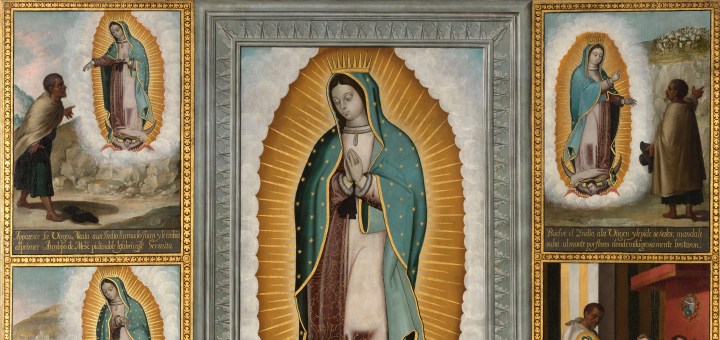
José Juárez, The Virgin of Guadalupe with Four Apparitions, detail, 1656, oil on canvas, 251 × 293 cm
(Ágreda, Soria: Monasterio de Concepcionistas Franciscanas)
◊ ◊ ◊ ◊ ◊
From the press release for the exhibition:
So Far, So Close: Guadalupe of Mexico in Spain
Museo Nacional del Prado, 10 June — 14 September 2025
Curated by Jaime Cuadriello and Paula Mues Orts
So Far, So Close: Guadalupe of Mexico in Spain casts an unprecedented gaze on the artistic dialogue between Latin America and Europe in the 17th and 18th centuries, showing how the Virgin of Guadalupe was reinterpreted, reproduced, and venerated on both continents, emerging as a transatlantic devotional and political icon. The exhibition offers a new perspective on the role of the Virgin of Guadalupe as a miraculously created image, an object of worship, and symbol of identity in the Hispanic world. Through nearly 70 works, including paintings, prints, sculptures and books, the exhibition shows how this manifestation of the Virgin, which first appeared on the Cerro del Tepeyac or Tepeyac Hill in 1531, transcended the borders of New Spain to become a powerful presence in the Spanish collective imagination. The project, curated by the Mexican professors Jaime Cuadriello (UNAM) and Paula Mues Orts (INAH), is the result of years of research and collaboration between institutions. The exhibition is structured into eleven thematic sections, combining small and large-format works that range from the earliest depictions of apparitions of the Virgin to the sophisticated vera effigies reproduced for devotional or political purposes.

Attributed to Joaquín Villegas (act. ca. 1713–53), The Eternal Father Painting the Virgin of Guadalupe, ca. 1740–50, oil on canvas (México City, INBAL/Museo Nacional de Arte, Donación FONCA, 1991).
The exhibition begins with a visual cartography that charts the surprising density of the presence of images of the Virgin of Guadalupe across all of Spain. This dissemination reflects economic, social and political factors such as trade with the Indies, mining and the movement of viceregal officials. These works reflect both devotion and the concerns of communities, artists, merchants, the nobility, and the clergy, who together made the Virgin a shared devotional cult. Themes covered in the exhibition’s different sections include the transmission of the Guadalupe story through standardised narrative and visual models; the formal genealogy of the image and its connection with European Marian icons such as the Immaculate Conception and the Tota pulchra; its status as a ‘painting not made by human hand’, which relates to the concept of the Deus pictor; and the sacredness of the Virgin’s mantle, conceived as a living relic and object of veneration. A comparison is also made with Iberian painting of the same period, revealing stylistic affinities and differences with schools such as Madrid and Andalusia.
Of particular interest are the sections dedicated to the vera effigies, which are exact copies or modified versions of the original, reproduced using specialised artistic techniques. Also notable is the presence of exotic materials, such as mother-of-pearl, ivory and brass, which arrived on the Manila Galleon, demonstrating the global reach of the cult of Guadalupe and its integration into transoceanic networks of cultural exchange. The exhibition includes masterpieces by artists from New Spain and the Iberian Peninsula, including José Juárez, Juan Correa, Manuel de Arellano, Miguel Cabrera, Velázquez, Zurbarán, and Francisco Antonio Vallejo. Together they trace an artistic and symbolic map of the cult of the Virgin of Guadalupe which lasted from the 17th to the early 19th century.
In conjunction with the exhibition, the Fundación Casa de México in Spain is collaborating on an extensive cultural programme that focuses on the symbolic and artistic dimension of the Virgin of Guadalupe. The programme includes lectures by the curators, a cycle of historical and contemporary films, informational capsules and workshops on traditional Mexican crafts taught by masters from Michoacán and Chiapas. These activities, taking place at the Museo del Prado and at the Fundación’s venue in Madrid, will offer participants a wide-ranging experience that interweaves history, art, and living tradition.
Jaime Cuadriello and Paula Mues Orts, eds., Tan lejos, tan cerca: Guadalupe de México en España (Madrid: Prado, 2025), 304 pages, ISBN: 978-8484806325, €32.
New Book | Beyond Adornment: Jewelry and Identity in Art
From The Getty:
Yvonne Markowitz and Susanne Gänsicke, with contributions by Emily Stoehrer, Beyond Adornment: Jewelry and Identity in Art (Los Angeles: J. Paul Getty Museum, 2025), 184 pages, ISBN: 978-1606069622, $40.
 Why do people wear jewelry? What meaning does it hold for the wearer? And what does the wearer hope it will convey to those they encounter—or to someone viewing their image decades, even centuries, later?
Artistic renderings of the human figure—in portraiture, sculpture, and other media—in a range of allegorical, historical, and religious images often showcase jewelry. The ornaments depicted in such designs offer an abundance of information that not only heightens our understanding of the subject but also provides insights into the imagination of the artist. Jewelry enhances our enjoyment of works of art because it is visually compelling, sensuous, and laden with an array of associations and symbolic meanings. Bringing together spectacular and significant art objects depicting figures wearing sumptuous personal adornments that define who they are within the specific milieus in which they lived, this richly illustrated and accessible volume represents a novel, interdisciplinary approach to the ways in which jewelry can be studied and understood.
Susanne Gänsicke is senior conservator of antiquities at the J. Paul Getty Museum.
Yvonne J. Markowitz is the Rita J. Kaplan and Susan B. Kaplan Curator Emerita of Jewelry at the Museum of Fine Arts, Boston.
c o n t e n t s
Timothy Potts — Foreword
Introduction — Yvonne Markowitz and Susanne Gänsicke
1 Susanne Gänsicke — Projecting a Powerful Presence
2 Susanne Gänsicke — In Search of the Spiritual
3 Yvonne Markowitz — For Those We Love and Mourn
4 Susanne Gänsicke — An Illustrious Past Serving the Present
5 Yvonne Markowitz — Fantasizing the Present
Emily Stoehrer — The Theater of Everyday Life: Dressing the Part
About the Authors
Acknowledgments
Illustration Credits
Index
The Burlington Magazine, May 2025
The long 18th century in the May issue of The Burlington:
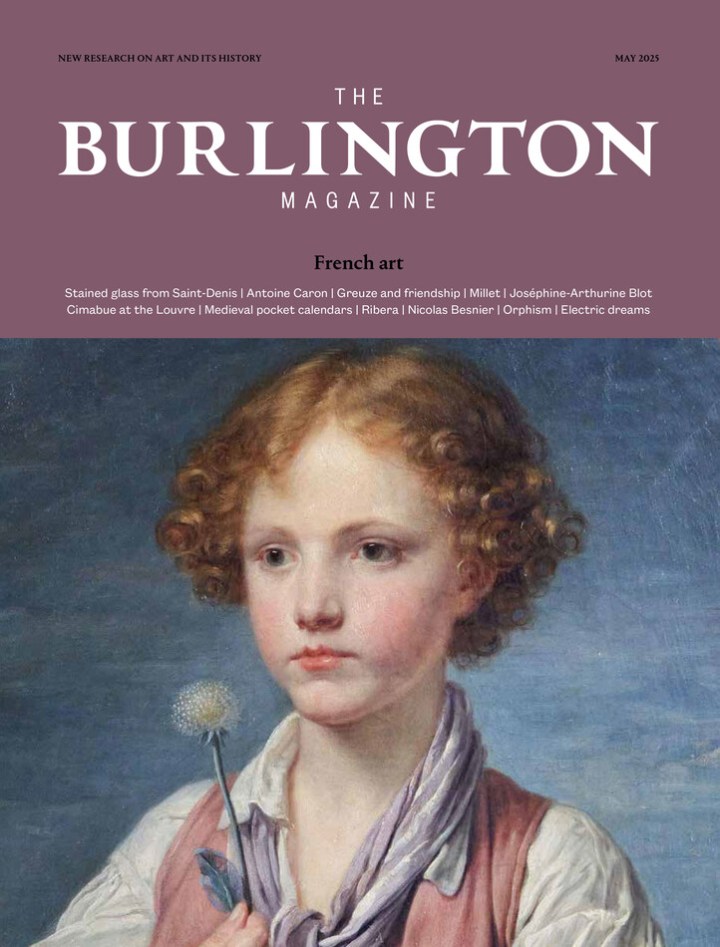
The Burlington Magazine 167 (May 2025) | French Art
 e d i t o r i a l
• “Fashionistas,” p. 427.
The costume institute and its annual gala in May at the Metropolitan Museum of Art, New York (the Met), have become fixtures on the museum world’s map and calendar. Whether you delight in them or are bemused by the spectacle they provide, or indeed try and take no notice at all, they are hard to ignore. The alignment they represent between fashion history, contemporary celebrity and the gravitas of a major museum is immensely beneficial in terms of fundraising and profile.
l e t t e r
• “A Sleeping Apostolado at Wentworth Woodhouse,” pp. 428–29.
We are launching an appeal for the conservation, reframing, and rehanging of an important set of seventeenth-century paintings. We are making this appeal in honour of the art historian Alastair Laing, who died aged seventy-nine in 2024. It was he who identified the artist of this series as the Flemish painter Gérard Seghers (1591–1651). . . . By 1870 the thirteen paintings were framed in groups and fixed against the walls, as they are now, probably to give a more church-like feel to the simple prayer-book chapel of 1736, with its panelling and gallery of craved, unstained oak.
a r t i c l e s
• Yuriko Jackall, John Delaney, and Michael Swicklik, “Friendship Tokens: Jean-Baptiste Greuze’s Paintings for Madame de Pompadour,” pp. 438–49.
Greuze’s paintings, known for their sentimentality and charm, were lauded by the artist’s contemporaries. Two early compositions, Simplicity and Young Shepherd Holding a Flower, were part of the collection of Madame de Pompadour; stylistic and technical analysis of them, in conjunction with another version of Simplicity, expands their early provenance.
• Humphrey Wine, “Napoleon Crossing the Alps: British Press Reaction to the London Exhibitions of David, Lefèvre, Wicar, and Lethière,” pp. 450–59.
Paintings by notable French artists were exhibited in Britain during the first third of the nineteenth century. Reactions to these works published in British newspapers and journals between 1814 and 1830 were often negative in tone and politically motivated. Despite this criticism, these accounts provide a valuable perspective on the art of the period that was shipped across the Channel.
• Daniëlle Kisluk-Grosheide, “Bravery, Ingenuity, and Aerial Post: An Enamelled Bowl by Joséphine-Arthurine Blot,” pp. 470–77.
During the height of the Franco-Prussian War, Gaston Tissandier made a perilous balloon journey from Paris to deliver correspondence from the besieged city. The flight is commemorated in a small bowl by Joséphine-Arthurine Blot, a technically accomplished yet little-known enamellist. Her bold design celebrates Tissandier’s bravery as well as French resistance and resourcefulness.
r e v i e w s
• Alice Minter, Review of Christophe Huchet de Quénetain, Nicolas Besnier (1686–1754): Architecte, orfèvre du roi et échevin de la Ville de Paris (Presses universitaires de Rennes, 2024), pp. 516–17.
• Céline Cachaud, Review of La Tabatière Choiseul: Un monument du XVIIIe siècle, edited by Michèle Bimbenet-Privat (Éditions Faton, 2025), pp. 519–20.
• Mark Evans, Review of Ulrike Müller, Private Collectors in Brussels, Antwerp, and Ghent, ca.1780–1914: Between Public Relevance and Personal Pleasure (Brepols, 2024), pp. 521–22.
o b i t u a r y
• Christopher Baker and Stephen Duffy, Obituary for Rosalind Joy Savill (1951–2024), pp. 526–28.
An immensely successful director of the Wallace Collection, London, and a pre-eminent scholar of eighteenth-century Sèvres porcelain, Rosalind (‘Ros’) Savill had a profound and enduring impact both on the museum and the research she cared passionately about.
New Book | The Writer’s Lot
From Harvard UP:
Robert Darnton, The Writer’s Lot: Culture and Revolution in Eighteenth-Century France (Cambridge: Belknap Press, 2025), 240 pages, ISBN: 978-0674299887, $27.
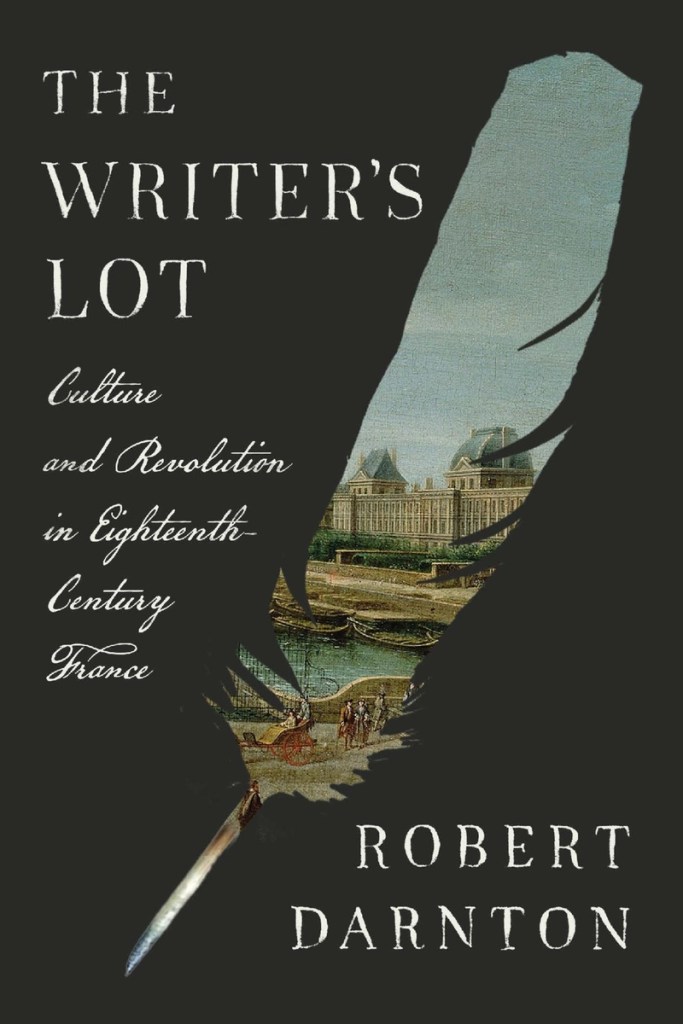 A pioneering social history of French writers during the Age of Revolution, from a world-renowned scholar and National Book Critics Circle Award winner.
In eighteenth-century France, writers emerged as a new kind of power. They stirred passions, shaped public opinion, and helped topple the Bourbon monarchy. Whether scribbling in dreary garrets or philosophizing in salons, they exerted so much influence that the state kept them under constant surveillance. A few became celebrities, but most were hacks, and none could survive without patrons or second jobs.
The Writer’s Lot is the first book to move beyond individual biography to take the measure of ‘literary France’ as a whole. Historian Robert Darnton parses forgotten letters, manuscripts, police reports, private diaries, and newspapers to show how writers made careers and how they fit into the social order—or didn’t. Reassessing long-standing narratives of the French Revolution, Darnton shows that to be a reject was not necessarily to be a Jacobin: the toilers of the Parisian Grub Street sold their words to revolutionary publishers and government ministers alike. And while literary France contributed to the downfall of the ancien régime, it did so through its example more than its ideals: the contradiction inherent in the Republic of Letters—in theory, open to all; in practice, dominated by a well-connected clique—dramatized the oppressiveness of the French social system.
Darnton brings his trademark rigor and investigative eye to the character of literary France, from the culture war that pitted the ‘decadent’ Voltaire against the ‘radical’ Rousseau to struggling scribblers, booksellers, censors, printers, and royal spies. Their lives, little understood until now, afford rare insight into the ferment of French society during the Age of Revolution.
Robert Darnton is the author of numerous award-winning books on French cultural history, including The Revolutionary Temper. A MacArthur Fellow, chevalier in the Légion d’honneur, and winner of the National Humanities Medal and the National Book Critics Circle Award, Darnton is the Carl H. Pforzheimer University Professor and Director of the University Library, Emeritus, at Harvard University.
c o n t e n t s
Introduction: Paths to Grub Street
1 Careers: The Ancien Régime
2 The Facts of Literary Life
3 Contemporary Views
4 Careers: Revolutionary Denouements
Conclusion
Notes
Acknowledgments
Index
New Book | Women Artists & Designers at the National Trust

From the National Trust:
Rachel Conroy, with an introduction by Sandi Toksvig, Women Artists & Designers at the National Trust (National Trust, 2025), 272 pages, ISBN: 978-0707804699, £15.
From the magnificent gardens created by Vita Sackville-West at Sissinghurst to a striking self-portrait by Angelica Kauffman, the elegant, mass-produced ceramics of Susie Cooper and a model of a Palmyran temple by lady’s maid Elizabeth Ratcliffe, this beautifully illustrated book explores the lives and work of women whose creativity has shaped the National Trust’s collections and, often, the experience of visitors to its places. Spanning six centuries, this book takes a closer look at some of the many women artists and designers whose lives are connected to National Trust places or whose work is represented in its vast collections. The selection features both talented amateur artists and professionals who have shaped the art-historical canon—such as Eileen Agar, Elisabeth Vigee Le Brun, Rosalba Carriera, and Barbara Hepworth—focusing on their unique contributions and achievements across a range of disciplines, including garden and interior design, photography, illustration, enamelling, fine art, studio pottery, and textiles.
Rachel Conroy is a Senior National Curator at the National Trust and loves telling stories through objects. She has worked as a curator specialising in British decorative arts since 2004, curating many exhibitions and displays. Having contributed articles to numerous specialist journals, Rachel recently co-authored a book on historic Welsh ceramics.
Sandi Toksvig OBE is a comedian, broadcaster, campaigner, and author. Her broadcasting career has included QI, The Great British Bake Off, The News Quiz, and Call My Bluff. An activist for gender equality, Sandi co-founded the Women’s Equality Party in 2015. She is a Bye-Fellow of Christ’s College, Cambridge, where she has delivered lectures on women in art.
New Book | Neighbours and Rivals
Published by Pallas Athene and distributed by Simon & Schuster:
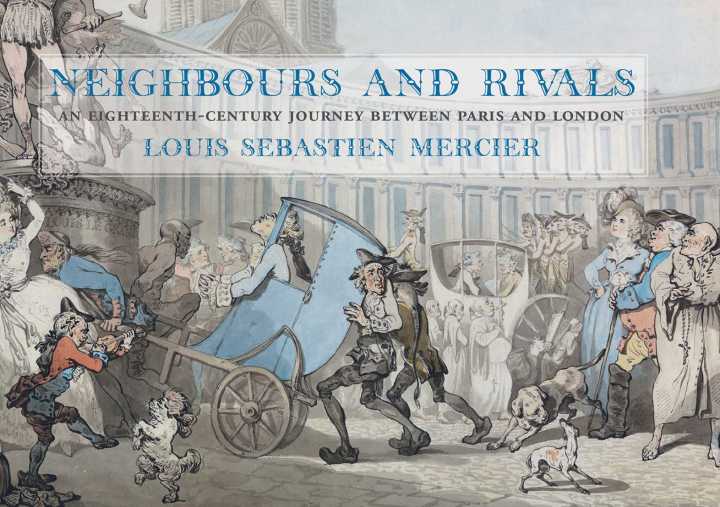
Louis-Sébastian Mercier, Neighbours and Rivals: An Eighteenth-Century Journey between Paris and London, translated by Laurent Turcot and Jonathan Conlin (London: Pallas Athene, 2025), 284 pages, ISBN: 978-1843682707, £25 / $33.
The great French journalist Louis-Sébastien Mercier’s descriptions of an optimistic, utopian 18th-century London, translated by Laurent Turcot and Jonathan Conlin.
Louis-Sébastien Mercier (1740–1814) first traveled to London and began recording his impressions in 1780. An exemplar of a new form of journalistic, reflective literature, his account presents emotive representations of the city as collections of experiences, habits, and personalities. And differently from Dickens’s London or Baudelaire’s Paris, with their contrasts of opulence and misery, Mercier describes a less familiar urban environment—more optimistic, perhaps even utopian. His version of London is, in fact, a projection of his philosophical imagination—not simply a rounded portrait but also a reflection of what he hoped Paris could become. For this first publication in English, Laurent Turcot and Jonathan Conlin’s translation preserves the life and humor of Mercier’s text. It is illustrated with contemporary images, with an emphasis on Thomas Rowlandson and Gabriel-Jacques de Saint-Aubin, the first Parisian flâneur-artist.
Jonathan Conlin, a senior lecturer at the University of Southampton, specializes in modern British cultural history from the 18th century to the present, with a focus on urban history. His previous books include The Nation’s Mantelpiece, Evolution and the Victorians, and Civilisation. Laurent Turcot is a professor of history at l’Université du Québec à Trois-Rivières, specializing in the 16th to the 19th century, particularly urban culture and leisure.
Exhibition | Picturing Nature: British Landscapes
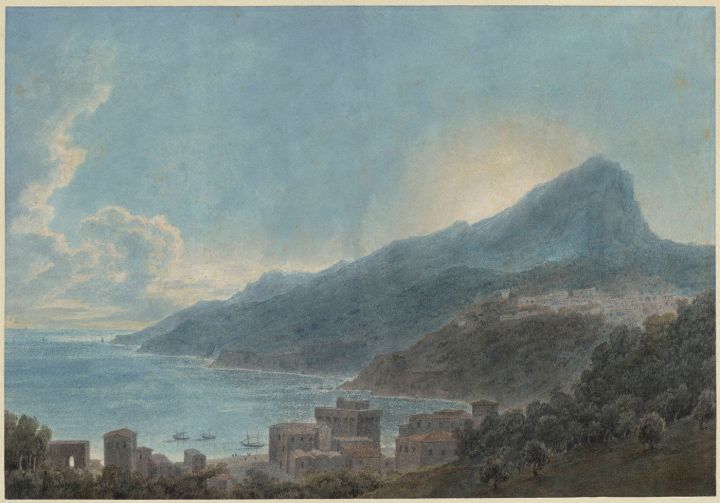
John Robert Cozens, View of Vietri and Raito, Italy, ca. 1783, watercolor over graphite on cream laid paper (The Museum of Fine Arts, Houston, The Stuart Collection, museum purchase funded by Francita Stuart Koelsch Ulmer in honor of Dena M. Woodall).
◊ ◊ ◊ ◊ ◊
Now on view at the MFAH:
Picturing Nature: The Stuart Collection
of 18th- and 19th-Century British Landscapes and Beyond
The Museum of Fine Arts Houston, 12 January — 6 July 2025
Featuring more than 70 works of art in a variety of media, Picturing Nature: The Stuart Collection of 18th- and 19th-Century British Landscapes and Beyond explores how the genre of landscape evolved during an era of immense transformation in Britain. This diverse collection of watercolors, drawings, prints, and oil sketches traces the shift from topographical and picturesque depictions of the natural world to intensely personal ones that align with Romantic poetry of the period. The exhibition spotlights the Stuart Collection, built over the past decade in collaboration with Houstonian Francita Stuart Koelsch Ulmer. This exceptional collection includes standout works by notable artists such as John Constable, John Robert Cozens, Thomas Gainsborough, J.M.W. Turner, and Richard Wilson, whose innovative approaches to watercolor raised its status as an art form and heralded a golden age for the medium.
Through the work of these luminaries and their contemporaries, Picturing Nature reveals how landscape emerged as a distinct artistic genre in England in the late 1700s, then reached its greatest heights the following century, attracting international response and inspiring both artists and collectors at home and abroad. Period publications and artist’s supplies, including drawing manuals and a mid-19th-century Winsor & Newton watercolor box, further illustrate the flowering of the landscape tradition.
Dena M. Woodall, Picturing Nature: The Stuart Collection of 18th- and 19th-Century British Landscapes and Beyond, $35. The online catalogue of the Stuart Collection is available here.










 Enfilade
leave a comment