Exhibition | Music and the Republic
Now on view at the Musée des Archives Nationales:
Music and the Republic: From the French Revolution to the Popular Front
Hôtel de Soubise, Paris, 26 March — 14 July 2025
Curated by Marie Ranquet, Sophie Lévy, and Christophe Barret
 L’exposition Musique et République, de la Révolution au Front populaire—organisée avec le concours du Conservatoire national supérieur de musique et de danse de Paris—souhaite mettre en lumière les liens entre la musique et la construction de la République. De la Révolution, qui organise de nouvelles institutions et utilise la musique pour fonder un sentiment patriotique, au Front populaire de 1936, qui fait le pari de l’émancipation sociale du citoyen par l’accès aux loisirs et à la culture, la formation et la pratique musicale permettent à la fois le partage d’un patrimoine sonore commun et l’expression personnelle, parfois subversive.
Les Archives nationales retracent l’histoire de cette rencontre entre le citoyen et la musique. Des partitions inédites retrouvées dans les fonds des Archives nationales, des instruments de musique étonnants ou oubliés, des correspondances politiques, des commandes passées à des compositeurs prestigieux et de nombreux autres documents, racontent une histoire mouvementée : celle d’un siècle et demi de production, d’éducation et de pratique musicales, envisagées en regard de l’idée républicaine.
Commissariat scientifique
• Marie Ranquet, conservatrice en chef du patrimoine aux Archives nationales
• Sophie Lévy, responsable des archives au Conservatoire national supérieur de musique et de danse de Paris
Commissariat technique
• Christophe Barret, chargé d’expositions au département de l’Action culturelle et éducative des Archives nationales
Musique et République: De la Révolution au Front populaire (Paris: Éditions Snoeck, 2025), 168 pages, ISBN: 978-9461619464, €30. With contributions by Adrián Almoguera, Mathias Auclair, Rémy Campos, Myriam Chimènes, Peter Hicks, Sophie Lévy, Marie Ranquet, Émeline Rotolo, and Charles-Éloi Vial.
New Historical Fiction | Allegro
From Other Press, where one can also find a playlist for the book:
Ariel Dorfman, Allegro: A Novel (New York: Other Press, 2025), 272 pages, ISBN: 978-1635424485, $18.
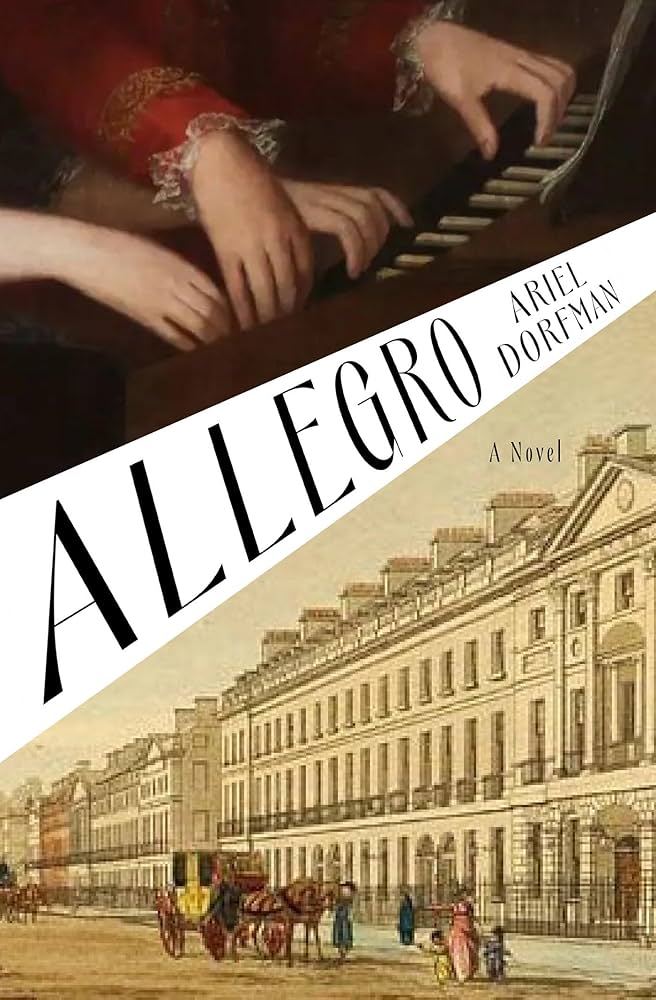 This thrilling historical mystery starring Mozart tells of friendship and betrayal, and how music allows us to defy death—from the acclaimed author of Death and the Maiden and The Suicide Museum.
In 1789 Wolfgang Amadeus Mozart visits the grave of Johann Sebastian Bach in Leipzig, looking for a sign, a signal, an answer to an enigma that has haunted him since childhood: Was Bach murdered by a famous oculist? And years later, was Handel a victim of the same doctor? Allegro follows his investigation, from the salons of London to the streets of Paris, recreating an enthralling and turbulent time, full of rogues and brilliant composers, charlatans and presumptuous nobles. Running parallel to this search is the rise of Mozart, his knowledge and fame, his trials and losses.
Ariel Dorfman is a Chilean-American author, born in Argentina, whose award-winning books in many genres have been published in more than fifty languages and his plays performed in more than one hundred countries. Among his works are the plays Death and the Maiden and Purgatorio, the novels The Suicide Museum (Other Press, 2023), Widows, and Konfidenz, and the memoirs Heading South, Looking North and Feeding on Dreams. He lives with his wife Angélica in Santiago, Chile, and Durham, North Carolina, where he is the Walter Hines Page Emeritus Professor of Literature at Duke University.
New Book | On the Calculation of Volume
The shortlist for this year’s International Booker Prize was announced on Tuesday. Included is the first installation Solvej Balle’s seven-part novel On the Calculation of Volume. As noted by Hilary Leichter in her review for The New York Times (25 January 2025), the central character is an antiquarian bookseller “specializing in illustrated works from the 18th century.” I’ve not yet read the book, but that feels just about perfect to me. –CH
From New Directions:
Solvej Balle, On the Calculation of Volume, Part I, translated from the Danish by Barbara Haveland (New Directions, 2024), 160 pages, ISBN: 978-0811237253, $16.
 Tara Selter, the heroine of On the Calculation of Volume, has involuntarily stepped off the train of time: in her world, November eighteenth repeats itself endlessly. We meet Tara on her 122nd November 18th: she no longer experiences the changes of days, weeks, months, or seasons. She finds herself in a lonely new reality without being able to explain why: how is it that she wakes every morning into the same day, knowing to the exact second when the blackbird will burst into song and when the rain will begin? Will she ever be able to share her new life with her beloved and now chronically befuddled husband? And on top of her profound isolation and confusion, Tara takes in with pain how slight a difference she makes in the world. (As she puts it: “That’s how little the activities of one person matter on the eighteenth of November.”)
Balle is hypnotic and masterful in her remixing of the endless recursive day, creating curious little folds of time and foreshadowings: her flashbacks light up inside the text like old flash bulbs. The first volume’s gravitational pull―a force inverse to its constriction―has the effect of a strong tranquilizer, but a drug under which your powers of observation only grow sharper and more acute. Give in to the book’s logic (its minute movements, its thrilling shifts, its slant wit, its slowing of time) and its spell is utterly intoxicating. Solvej Balle’s seven-volume novel wrings enthralling and magical new dimensions from time and its hapless, mortal subjects. As one Danish reviewer beautifully put it, Balle’s fiction consists of writing that listens. “Reading her is like being caressed by language itself.”
Solvej Balle was born in 1962, made her debut in 1986 with Lyrefugl, and she went on to write one of the 1990s’ most acclaimed works of Danish literature, According to the Law: Four Accounts of Mankind (praised by Publishers Weekly for its blend of “sly humor, bleak vision, and terrified sense of the absurd with a tacit intuition that the world has a meaning not yet fathomed”). Since then, she’s published a book on art theory, Det umuliges kunst, 2005, a political memoir Frydendal og andre gidsler, 2008, and two books of short prose Hvis and Så, published simultaneously in 2013. On the Calculation of Volume is Solvej Balle’s major comeback, not just to Danish or Nordic fiction, but―expanding the possibilities of the novel―to all of world literature.
Barbara J. Haveland (born 1951) is a Scottish literary translator, resident in Copenhagen. She translates fiction, poetry, and drama from Danish and Norwegian to English. She has translated works by many leading Danish and Norwegian writers, both classic and contemporary, including Henrik Ibsen, Peter Høeg, Linn Ullmann, and Carl Frode Tiller.
New Book | Oxford Libraries: Architecture
Coming soon, with distribution by The University of Chicago Press:
Geoffrey Tyack, with photographs by Dan Paton, Oxford Libraries: Architecture (Oxford: Bodleian Library Publishing, 2025), 336 pages, ISBN: 978-1851246052, £50 / $80.
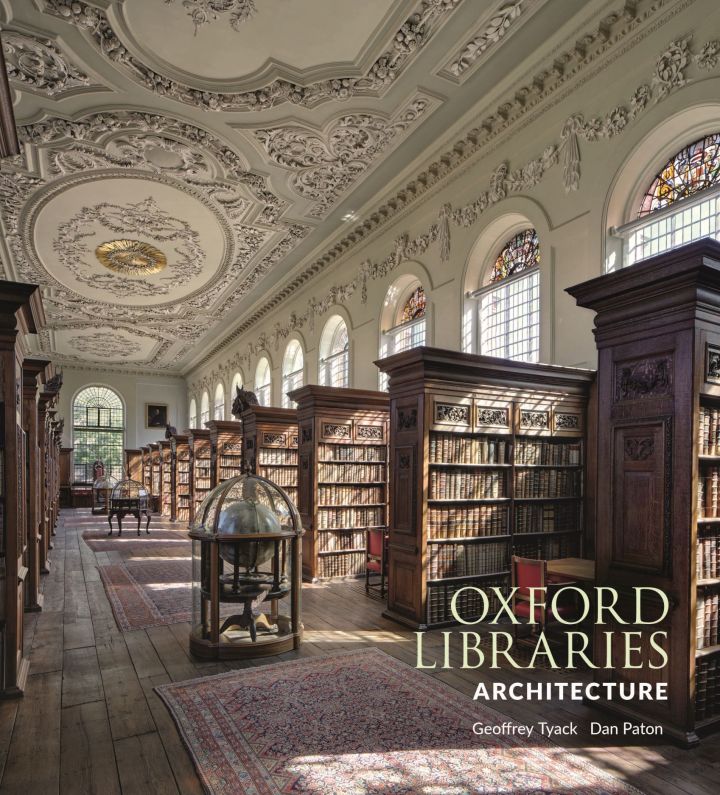 Curated illustrations of the architectural design and history of the most beautiful libraries in Oxford and a close look at the artistic prowess of the architects responsible.
The libraries of the colleges and the University of Oxford are among the finest, but also among the least-known, buildings in the city. Ranging in date from the thirteenth to the twenty-first centuries, they embody successive changes in internal design and architectural taste. Libraries were originally established as repositories of knowledge in the form of manuscripts and printed books, and until fairly recently, they were used only by scholars. Over time, the University’s libraries, and those of the constituent colleges, attracted wealthy donors, some of whom, like John Radcliffe, gave generously to the provision of impressive and architecturally innovative buildings in which to house the books. These buildings are still among the most impressive features of Oxford’s architectural landscape, helping to define its visual identity. Architectural styles range from medieval wooden stalls to the concrete and glass of twentieth-century Brutalism, and notable architects include Sir Christopher Wren, Nicholas Hawksmoor, Sir Giles Gilbert Scott, James Gibbs, Sir Edwin Lutyens, and Arne Jacobsen. With specially commissioned photography, this profusely illustrated book invites readers through the doors of over fifty beautiful and iconic libraries, revealing how they are steeped in history, learning, and cultural change.
Geoffrey Tyack is an emeritus Fellow of Kellogg College, University of Oxford, and the Director of Stanford University Centre in Oxford.
Dan Paton is a commercial photographer specialising in architecture, lighting, interiors, and the built environment, as well as portrait, PR, and event photography.
Book | Jewish Treasures from Oxford Libraries
This is a book that I should have noted years ago; David Stern’s review for Mosaic usefully introduces the collectors, many of whom lived in the 18th century. –CH
Distributed by The University of Chicago Press . . .
Rebecca Abrams and César Merchán-Hamann, eds., Jewish Treasures from Oxford Libraries (Oxford: Bodleian Library Publishing, 2020), 304 pages, ISBN: 978-1851245024, $55.
 Representing four centuries of collecting and a thousand years of Jewish history, this book brings together Hebrew manuscripts and rare books from the Bodleian Library and Oxford colleges. Highlights of the extraordinary collections include a fragment of Maimonides’ autograph draft of the Mishneh Torah, the earliest dated fragment of the Talmud, exquisitely illuminated manuscripts of the Hebrew Bible, stunning festival prayer books, and one of the oldest surviving Jewish seals in England. Lavishly illustrated essays by experts in the field bring these outstanding works to life, exploring the personalities and diverse motivations of their original collectors. Saved for posterity by religious scholarship, intellectual rivalry, and political ambition, these extraordinary collections also detail the consumption and circulation of knowledge across the centuries, forming a social and cultural history of objects moved across borders from person to person. Together, they offer a fascinating journey through Jewish intellectual and social history.
Rebecca Abrams is Royal Literary Fund Fellow at Brasenose College, Oxford and author of The Jewish Journey: 4000 Years in 22 Objects.
César Merchán-Hamann is the Victor Blank Hebraica and Judaica curator in the Bodleian Library and director of the Leopold Muller Memorial Library at the University of Oxford.
c o n t e n t s
Librarian’s Foreword — Richard Ovenden
Preface — Martin J. Gross
Introduction to the Bodleian Library and College Collections — César Merchán-Hamann
1 The Laud Collection — Giles Mandelbrote
2 The Pococke Collection — Benjamin Williams
3 The Huntington Collection — Simon Mills and César Merchán-Hamann
4 The Kennicott Collection — Theo Dunkelgrün
5 The Canonici Collection — Dorit Raines
6 The Oppenheim Collection — Joshua Teplitsky
7 The Michael Collection — Saverio Campanini
8 The Genizah Collection — Nadio Vidro
9 The College Library Collections — Rahel Fronda
From Collectors to Readers — Piet van Boxel
Notes
Further Reading
Contributors
Picture Credits
Index
New Book | Global Germany Circa 1800
From PSU Press (and for now, 30% off with discount code NR25) . . .
Todd Kontje, Global Germany Circa 1800: A Revisionist Literary History (University Park: Penn State University Press, 2025), 266 pages, ISBN: 978-0271099668, $60.
 Global Germany Circa 1800 asks two interrelated questions: How did Germans participate in the European conquest of the world, and how were they different from other imperial powers? In other words, what is the relation between the German form of empire, the old Reich, and the modern European empires that emerged in the global age? Todd Kontje presents a revisionist literary and intellectual history, inviting readers to consider how we might understand ‘Germany’ at the turn of the nineteenth century if we remove the nation-state as the inevitable goal of cultural and political development. Focusing on the pivotal years around 1800, when many of the concepts that define the modern era first came into being, Kontje investigates how thinkers in and around Weimar―from Goethe, Schiller, and Kant to Georg Forster, Heinrich von Kleist, and Alexander von Humboldt―worked within existing political structures to make sense of the region’s place in the world. Ultimately, he reveals how Weimar, a remote artist hub long thought to exemplify the insularity of a soon-to-be-unified nation, was in fact utterly worldly, and in a manner very different from the political capitals of imperial nation-states like London and Paris. Accessible and entertaining, this literary history is essential reading for German studies students and scholars, and it will appeal to audiences in world history, empire studies, intellectual history, and comparative literature.
Todd Kontje is Distinguished Professor of German and Comparative Literature at the University of California, San Diego. He is the author of four books, including Georg Forster: German Cosmopolitan, winner of the 2023 DAAD/GSA Prize for the Best Book in Literature and Cultural Studies.
c o n t e n t s
Preface
Acknowledgments
Introduction
1 The World in Letters
2 The World in Motion
3 Goethe’s Journey to the Center of the Earth
4 Schiller and the Drama of Empire
5 Kleist and the Revolution
6 Alexander von Humboldt and the Anthropocene
Conclusion
Notes
Bibliography
Index
Art History 48 (February 2025)
The 18th century in the latest issue of Art History:
Art History 48 (February 2025)
a r t i c l e s
 • Oliver Wunsch, “The Aesthetic Redemption of the Black Body in Eighteenth-Century France,” pp. 14–44.
Audiences in eighteenth-century France felt little compunction about admiring African people in art while denigrating them in life. They reconciled this apparent contradiction through a belief in the ameliorative effects of art, yielding what is described here as a theory of aesthetic redemption. This essay argues that the theory of aesthetic redemption that developed in eighteenth-century France gave art a unique position in the construction of race. Because those who believed in the possibility of aesthetic redemption distinguished between art’s content and its manner of representation, they created the conditions for artists to depict people of colour using materials, techniques, and formal structures whose qualities would otherwise be considered at odds with the subject. The resulting art often strikes audiences today as progressive, yet it did little to challenge the biases of the original viewers, who admired aesthetic departures from stereotypes precisely because they took those stereotypes for granted.
• Diarmuid Costello, “Die Schönheit des Mittelmenschen: Stephan Balkenhol’s ‘Everyday Beauty’,” pp. 132–61.
This essay considers Stephan Balkenhol’s ‘everyman and woman’ sculptures through the optic of Kant’s ‘ideal of beauty’ (§17, Critique of Aesthetic Judgement, 1790). I take a pair of miniature figures as my test case. Despite minor variations, all these sculptures depict the same generic man and woman, a man or woman who average or middling in every way. What could make depictions of average everydayness so compelling? For a clue, I turn to Kant’s ‘ideal of beauty’. This comprises a ‘standard aesthetic idea’ and an ‘idea of reason’: the former is a (culturally specific) ‘model image’ of the human being; the latter implicates Kant’s (universal) conception of ‘humanity in the person’, where the latter manifests itself through the former. I ask whether this illuminates Balkenhol’s work, suggesting that although the relevance of the former is clear, and the latter less so, there is reason not to rule it out.
• Viccy Coltman, “Travelling Knick-Knacks and Picturesque Points of View: Reverend James Plumptre’s Narrative of a Pedestrian Journey … to the Highlands of Scotland … in the Summer of the Year 1799,” pp. 162–84.
This essay revisits later eighteenth-century picturesque aesthetics in Britain as they were articulated in theory, applied in practice, and reproduced in travel literature and art. It considers the sometimes congruent, at other times contested, relationship between the natural landscape, written descriptions of that landscape, and its pictorial representation. Focusing on unpublished extracts from Reverend James Plumptre’s manuscript travel journal, Narrative of a Pedestrian Journey […] to the Highlands of Scotland […] in the Summer of the Year 1799, it argues for an original interpretation of the pedestrian picturesque as a suite of practices which entailed travelling by foot, viewing the landscape with a range of hand-held implements or ‘knick-knacks’, and representing nature ‘as seen’ without remedial artistic correction or improvement. According to this account, ‘people, places, and things’ becomes a useful rubric for conceptualising Plumptre’s 1799 pedestrian tour of Scotland which included visits to the Edinburgh studios of artists Alexander Nasmyth, Henry Raeburn, and Hugh William Williams.
r e v i e w s
• Brigid von Preussen, “A Woman’s Work,” Review of Paris Spies-Gans, A Revolution on Canvas: The Rise of Women Artists in Britain and France, 1760–1830 (Yale UP, 2022) and Rosalind Blakesley, Women Artists in the Reign of Catherine the Great (Lund Humphries, 2023), pp. 186–92.
The Burlington Magazine, March 2025
The long 18th century in the March issue of The Burlington:
The Burlington Magazine 167 (March 2025)
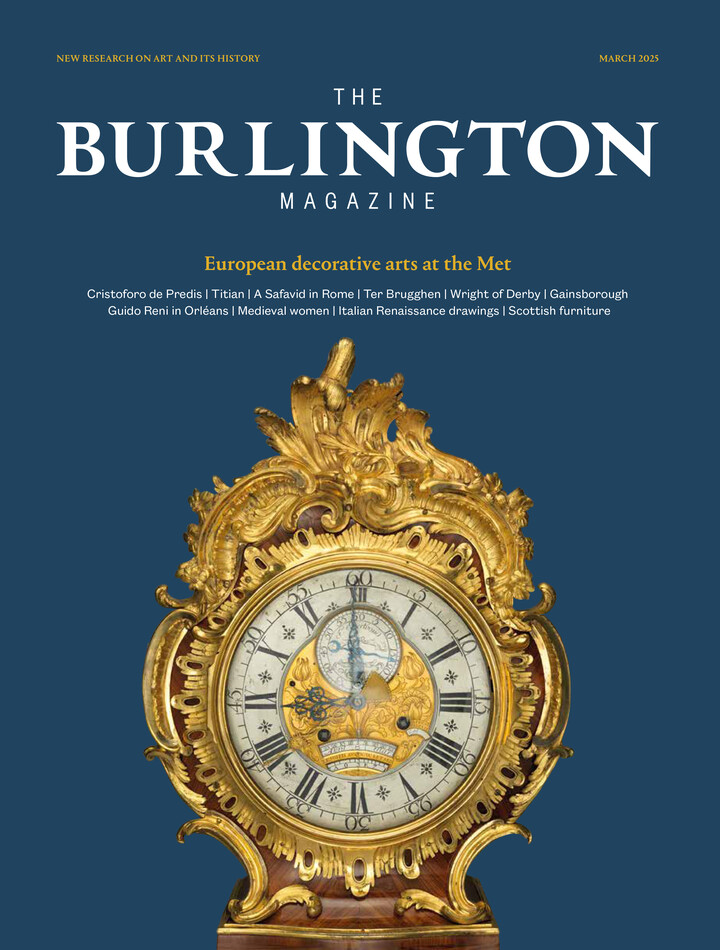
Cover of The Burlington Magazine with a recent acquisition at The Met: Longcase equation regulator, clockmaker: Ferdinand Berthoud, case maker: Balthazar Lieutaud, ca. 1752 (New York: The Metropolitan Museum of Art, 2016.28a–e).
e d i t o r i a l
• “A Frick Renaissance,” p. 203–05.
On 17th April 2025 the Frick Collection on Fifth Avenue re-opens after a long period of redevelopment. When an old friend has a face lift, the results can be disconcerting. Happily, the impact here is, however, reassuringly subtle—as the splendid Gilded-age character of one of New York’s iconic cultural institutions has been retained, while elegant new facilities have been deftly integrated.
a r t i c l e s
• Julia Seimon, “Two Boys with a Bladder in the J. Paul Getty Museum and Joseph Wright of Derby’s Early Candlelights,” pp. 242–57.
A careful re-assessment of Joseph Wright of Derby’s painting of Two Boys with a Bladder in the Getty’s collection, supported by documentary discoveries, clarifies the circumstances of the painting’s creation and first exhibition and has significant implications for dating several of the artist’s other painted and drawn works.
s h o r t e r n o t i c e s
• Oliver Fairclough, “Paul Sandby and Sir Watkin Williams-Wynn Revisited,” pp. 258–61.
• Christina Milton O’Connell, “Observations about the Abandoned Portrait beneath Gainsborough’s Blue Boy,” pp. 26–65.
r e v i e w s
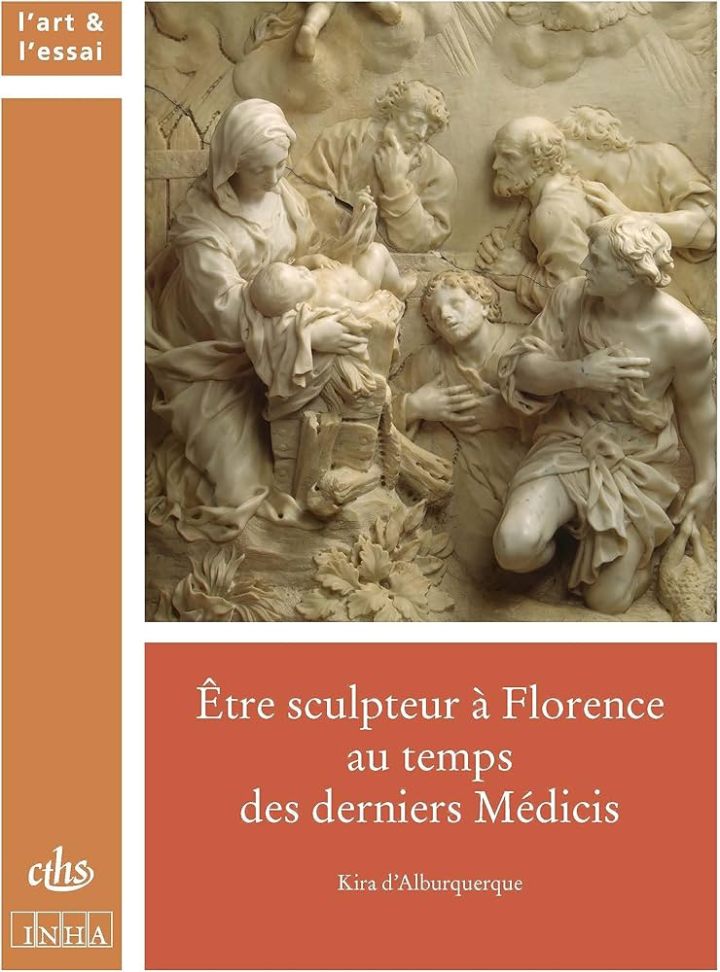
Cover of Être sculpteur à Florence au temps des derniers Médicis, featuring a photograph of Giovanni Battista Foggini’s Adoration of the Shepherds, ca. 1675, marble (Saint Petersburg: Hermitage).
• Nicola Ciarlo, Review of Kira d’Alburquerque, Être sculpteur à Florence au temps des derniers Médicis (CTHS, 2023), pp. 292–94.
• Adam Bowett, Review of Stephen Jackson, Scottish Furniture 1500–1914 (NMS Publishing, 2024), pp. 296–98.
• Penelope Curtis, Review of the exhibition catalogue Souvenirs de jeunesse: Entrer aux Beaux-Arts de Paris 1780–1980, edited by Alice Thomine-Berrada (Beaux-Arts de Paris, 2024), pp. 298–99.
• Alan Powers, Review of Edward McParland, The Language of Architectural Classicism: From Looking to Seeing (Lund Humphries Publishers, 2025), pp. 299–300.
• Max Marmor, Review of Julius von Schlosser, The Literature of Art: A Manual for Source Work in the History of Early Modern European Art Theory, translated by Karl Johns (Ariadne Press, 2023), p. 303.
s u p p l e m e n t
• Sarah Lawrence, “Recent Acquisitions (2014–24) of European Decorative Arts at The Metropolitan Museum of Art,” pp. 305–24.
New Book | Giovanni Battista Maini (1690–1752)
Distributed by Yale UP:
Jennifer Montagu, Giovanni Battista Maini (1690–1752) and Roman Sculpture of His Time (London: Burlington Press, 2025), 302 pages, ISBN: 978-1916237858, $125.
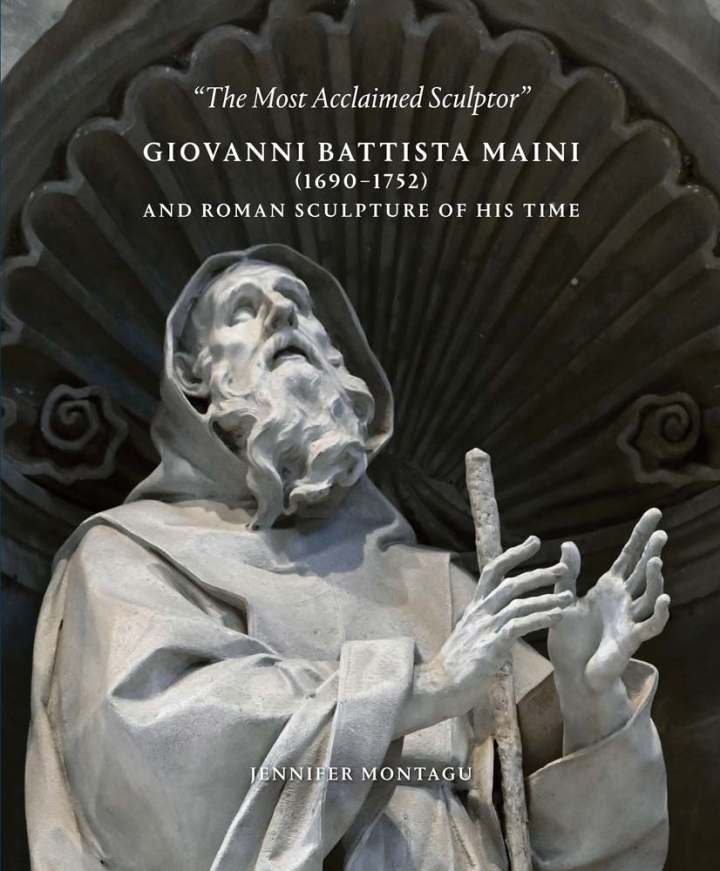 Giovanni Battista Maini is one of the most important and accomplished—although least known and appreciated—of late Baroque sculptors. This new monograph provides an authoritative, scholarly, and beautifully illustrated survey of all his principal commissions. Maini was born in Lombardy and had moved to Rome by 1710. His prestigious projects in the city included the funerary monument for Pope Innocent X in Sant’Agnese in Agone and the two majestic tombs in the family chapel of Pope Clement XII in San Giovanni in Laterano. Maini also worked in Santa Maria Maggiore and was involved in the design for the iconic Fontana di Trevi. These works are set in the context of the Roman art scene: the struggle for commissions, payment, and reputation.
Jennifer Montagu is a distinguished art historian who specialises in Roman Baroque sculpture. Her monograph on Alessandro Algardi was published in 1985 to great acclaim. Montagu worked as Curator of the Photographic Collection of the Warburg Institute, London, and has been both the Slade Professor of Fine Art at Oxford and the Andrew W. Mellon Lecturer at the National Gallery of Art, Washington. She has also served as a Trustee of the Wallace Collection and British Museum, London, and is an Officer of the Order of Merit of the Italian Republic.
New Book | The Language of Architectural Classicism
From Lund Humphries:
Edward McParland, The Language of Architectural Classicism: From Looking to Seeing (London: Lund Humphries Publishers, 2025), 288 pages, ISBN: 978-1848226593, £35 / $70.
 Classicism is ubiquitous, from the facade of Selfridges to the letterhead of The Times, to the pedimented porches of neo-Georgian housing estates. This book invites readers to discover in their surroundings a rich language of form which is there to be revealed. It discusses the pleasures and problems of post-medieval architectural classicism, both its rigour and flexibility, its perfections and incompleteness, its continuities and innovations, and its expressiveness—from the camp to the sublime, and from originality to plagiarism. Abandoning conventional chronological, biographical, or stylistic arrangements, the book makes connections between familiar art historical periods, focusing on looking closely at the buildings and their details, from which useful generalisations emerge.
The book discusses how Renaissance architects, when faced with the bewildering variety of classical antiquity, produced canonical versions of the orders and thus a systematic method of designing in the antique manner. It asks how the highly regulated language of classicism can sustain the originality of a Michelangelo, a Soane or a John Simpson and looks at the human body in relation to classical architecture. It examines the various treatments of the wall and of lettering on classical buildings, before concluding with a chapter on architectural backgrounds in Quattrocento art, revealing how this can lead to a different kind of looking at painting and sculpture.
Edward McParland is an Irish architectural historian and author of several books, including James Gandon (1985) and Public Art in Ireland, 1680–1760 (2001). He was elected as Pro-Chancellor of University of Dublin, Trinity College in 2013. McParland is the co-founder of the Irish Architectural Archive which was established in 1976, and he has contributed extensively to architectural conservation in Ireland.
c o n t e n t s
Introduction
1 The Canon
2 Imitation
3 Body and Building
4 The Wall
5 Discord
6 Lettering
7 Architectural Backgrounds, Mostly Quattrocento
Conclusion
Select Bibliography
Index










 Enfilade
leave a comment