Exhibition | Lafayette and the Antislavery Movement
Now on view at The Grolier Club:
‘A True Friend of the Cause’: Lafayette and the Antislavery Movement
The Grolier Club, New York, 7 December 2016 — 4 February 2017
Curated by Olga Anna Duhl and Diane Windham Shaw
 Although the Marquis de Lafayette is popularly known as ‘America’s Favorite Fighting Frenchman’ in the current Broadway musical Hamilton, his role as an ardent abolitionist has not received the same kind of attention as his contributions to the American Revolution. The groundbreaking exhibition A True Friend of the Cause: Lafayette and the Antislavery Movement, on view at the Grolier Club from December 7, 2016 to February 4, 2017, is designed to offer a more comprehensive look at the man who was a ‘hero of two worlds’. While Lafayette’s contributions in the areas of politics, diplomacy, and the military have received renewed scholarly and public recognition, his abolitionist activities are not widely known, nor have they been adequately explored in any major exhibition or publication in the last twenty-five years. This exhibition brings into focus Lafayette’s sustained efforts in France, the United States, and South America on behalf of the abolition of slavery.
Co-curators Olga Anna Duhl, Oliver Edwin Williams Professor of Languages, and Diane Windham Shaw, Director of Special Collections and College Archivist, Skillman Library, Lafayette College, offer a comprehensive view of Lafayette’s activities. Drawn from Lafayette College’s rich collections of 18th- and 19th-century rare books, manuscripts, paintings, prints, and objects—some of which are on public view for the first time—the approximately 130 works in the exhibition also include loans from Cornell University and the New-York Historical Society.
The Marquis de Lafayette (1757–1834) fought in the American War of Independence; was a friend to the Native Americans; defended the rights of French Protestants and Jews during the French Revolution; supported the national emancipation movements of the people of Poland, Ireland, Italy, Greece, and South America; and promoted the ideas and causes of women. Most significantly, he remained throughout his life a fervent advocate of the abolition of slavery and the African slave trade, earning the recognition of prominent British abolitionist, Thomas Clarkson, as “a true friend of the cause.” Early on, Lafayette learned that the ideals of liberty and equality during the revolutionary era hardly benefited all members of society. In fact, one of the most daunting paradoxes of that era, which became a source of reflection and action for him, was the incompatibility between the national independence of the newly formed United States and the practice of slavery and slave trade.
The exhibition traces Lafayette’s first encounters with slaves on the South Carolina coast upon his arrival in America in 1777. Highlights of his role in service with the Continental Army are revealed in his letters to his mentor, George Washington, written from Valley Forge, Newport, and Virginia during the Yorktown Campaign, where Lafayette writes of the intelligence gathered by one of his spies, James, an enslaved African American. On view is a highly significant letter written by Lafayette to Washington requesting his partnership in a venture to free slaves. Stunning French prints of the American Revolution are included, as is an influential portrait, Lafayette at Yorktown, by Jean-Baptiste Le Paon.
The impact of abolitionist ideas on Lafayette is represented by the Marquis de Condorcet’s seminal work of 1781, Réflexions sur l’esclavage des nègres, and writings of British abolitionists Thomas Clarkson and Granville Sharp. Lafayette’s decision to move forward on his own by purchasing property in French Guiana to carry out his experiment in gradual emancipation is documented by an extraordinary group of documents on loan from the Cornell University Library. Included among them is a list of the enslaved who were selected to work on the property. Maps, prints, and early travel volumes recreate the image of this South American colony.
Lafayette’s complicated story during the French Revolution includes his membership in the French Society of the Friends of Blacks. Publications of the Society are on view, as are printed versions of landmark French documents— the Declaration of the Rights of Man (1789), the French Constitution (1791), and the decree abolishing slavery in the French colonies (1794). Lafayette’s hasty departure from France in 1792 to avoid the guillotine is documented by the beautiful sword that was taken from him when he was arrested and imprisoned by the Austrians, which stands as a symbol of his personal experience with captivity. Lafayette’s return to a quiet life in France in 1800 found him still passionately committed to the antislavery movement, rejoicing when England outlawed the slave trade in 1807. Commemorative volumes and prints celebrate that milestone.
Lafayette’s last visit to America in 1824–25 was an extravagant moment in the nation’s history. The exhibition includes some of the spectacular souvenirs that were made to commemorate his visit—china, textiles, and even a clothes brush with the bristles dyed to spell “Lafayette 1825.” Lafayette’s emphasis on greeting all Americans is highlighted, including his visit to the African Free School in New York City, where he received a welcome address by an eleven-year-old student. Calligraphed and delivered by the student himself, James McCune Smith, who went on to become one of America’s first black physicians and a noted abolitionist, this text is a loan from the New-York Historical Society Library. The Farewell Tour section also documents Lafayette’s friendship with fellow antislavery advocate, Frances Wright, and his support of her gradual emancipation project “Nashoba” near Memphis, Tennessee.
Also included are letters from James Madison, Thomas Jefferson, and John Marshall, and letters from Lafayette to Albert Gallatin, William H. Crawford, Joel Poincett, and others. Even after his death in 1834, his influence continued, particularly in America, where abolitionists, both black and white, continued to cite his example. Finally, the exhibit includes special items chosen to remind us of the human face of slavery—manumission papers of a woman and a man freed by their Quaker owners; the pension records of an African American Revolutionary soldier from Connecticut; and the first American printing of the Brooks engraving of slaves tightly packed on board a slave ship. Despite the changing fortunes and conflicting reviews of his career, Lafayette has remained a compelling figure in world history, and the interest in his contributions shows no sign of diminishing.
Lunchtime Guided Tours with the Curators
December 7 and 14, January 11 and 18, and February 1, 1–2pm
Roundtable Discussion: Lafayette and the Antislavery Movement
24 January 2017, 2–3:30pm
With co-curators and moderators Olga Anna Duhl and Diane Windham Shaw and featuring panelists Laura Auricchio (The New School), François Furstenberg (Johns Hopkins University), and John Stauffer (Harvard University). Reception to follow.
◊ ◊ ◊ ◊ ◊
The catalogue is available from Oak Knoll Press:
Olga Ann Duhl and Diane Windham Shaw, ‘A True Friend of the Cause’: Lafayette and the Antislavery Movement (New York: The Grolier Club and Lafayette College, 2016), 76 pages, ISBN: 978 160583 0650, $40.
New Book | Venice and Drawing, 1500–1800
From Yale UP:
Catherine Whistler, Venice and Drawing, 1500–1800: Theory, Practice, and Collecting (New Haven: Yale University Press, 2016), 380 pages, ISBN: 978 0300 187731, $65.
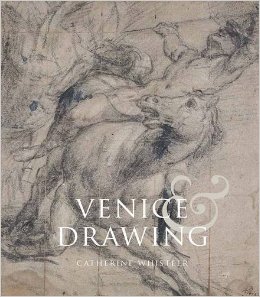 From the time of Titian and Tintoretto to that of Canaletto and Tiepolo, drawing was an important part of artistic practice and was highly valued in Venice. This exciting new study overturns traditional views on the significance of drawing in Venice, as an art and an act, from the Renaissance to the age of the Grand Tour. Gathering together the separate strands of theory, artistic practice, and collecting, Catherine Whistler highlights the interactions and tensions between a developing literary discourse and the practices of making and collecting graphic art. Her analysis challenges the conventional definition of Venetian art purely in terms of color, demonstrating that 16th-century Venetian artists and writers had a highly developed sense of the role and importance of disegno and drawing in art. The book’s generous illustrations support these striking arguments, as well as conveying the great variety, interest, and beauty of the drawings themselves.
Catherine Whistler is senior curator of European art, Ashmolean Museum, and a fellow of St. John’s College, Oxford.
Continent Allegories in the Baroque Age: A Research Database

An introduction to the Erdteilallegorien im Barockzeitalter project and database:
Continent Allegories in the Baroque Age: A Research Database
By Marion Romberg, of the Austrian Research Project Erdteilallegorien im
Barockzeitalter in the University of Vienna’s Department of History
During the late Renaissance—around 1570—humanists developed a new ‘shorthand’ way of representing the world at a single glance: personifications of the four continents Europe, Asia, Africa and America. While the continent allegory as an iconic type had already been invented in antiquity, humanists and their artists adapted the concept by creating the four- continent scheme and standardized the attributes characterizing the continents. During the next 230 years until ca. 1800, this iconic scheme became a huge success story. All known media were employed to bring the four continent allegories into the public and into people’s homes. Within this prolonged history of personifications of the continents, the peak was reached in the Late Baroque, and especially the 18th century. As a pictorial language they were interwoven with texts, dogmas, narratives and stereotypes. Thus the project team find himself asking: What did continent allegories actually mean to people living in the Baroque age?
Notably—though not exclusively—this question is the topic of a research project on continent allegories carried out between 2012 and 2016. The project team approached the subject in a new and systematic fashion. First, a clearly defined geographic area consisting of the greater part of Southern Holy Roman Empire from Freiburg in the Breisgau to the eastern frontier of Lower Austria including Vienna was chosen; the northern limit of the study area is constituted by the Main River, the southern one by South Tyrol. Secondly, the project studied continent allegories in immovable media like fresco, stucco and sculptures within abbeys, palaces, parks and gardens, townhouses and—most importantly—in churches. The systematic survey conducted by the project team identified 407 instances of continent allegories in the south of the Holy Roman Empire. To facilitate the systematic and detailed analysis of all identified instances of continent allegories, a database was developed and is now open access: continentallegories.univie.ac.at. This database allows the use of the collection of sources for various research interests: iconography and iconology, reception of aesthetics, cultural history, social history, history of identity, history of science, etc.
Further results of this research project can be found in the in English published anthology The Language of Continent Allegories in Baroque Central Europe (Stuttgart, 2016) and in the doctoral thesis by Marion Romberg “Die Welt im Dienst der Konfession. Erdteilallegorien in Dorfkirchen auf dem Gebiet des Fürstbistums Augsburg im 18. Jahrhundert“ (Stuttgart, 2017).
Project Team, 2012–16
Prof. Dr. Wolfgang Schmale, University of Vienna, www.wolfgangschmale.eu
Dr. Marion Romberg, University of Vienna, www.marionromberg.eu
Dr. Josef Köstlbauer, University of Bremen, josef.koestlbauer@univie.ac.at
◊ ◊ ◊ ◊ ◊
Wolfgang Schmale, Marion Romberg, and Josef Kostlbauer, eds., The Language of Continent Allegories in Baroque Central Europe (Stuttgart, Franz Steiner Verlag, 2016), 240 pages, ISBN 978 3515 114578, 52€ / $78.
 The iconography of the four continents dates back to 16th and early 17th centuries, at a time when Europe’s vision of the world was changed dramatically by discovery and conquest of the New World. Its peak of dissemination was reached in the 18th century. The late Baroque claims a special role for two reasons: first is the large number of reproductions and applications during this period, and the second is the multifaceted significance these allegories enjoyed. They could be inserted into religious and liturgical settings as well as into political language or that of the history of civilization and mankind. ‘Language’ in this sense means that the continent allegories were less the object of an art historical interpretation than being considered a formative part of religious, liturgical, political, historical, and other discourses. As pictorial language they were interwoven with text, dogmas, narratives, and stereotypes. Thus the authors of this volume inquire what the allegories of the four continents actually meant to people living in the Baroque age.
Cover image: Continent Allegories by Johann Baptist Enderle in the parish church St. Martin in Schwabmühlhausen (Germany) of 1759 (detail).
New Book | Bibliothèques, décors, XVIIe–XIXe siècle
From Éditions des Cendres and available from ArtBooks.com:
Frédéric Barbier, Andrea De Pasquale, István Monok, eds., Bibliothèques, décors, XVIIe–XIXe siècle (Paris, Éditions des Cendres, 2016), 306 pages, ISBN 978 2867 422546, $63.
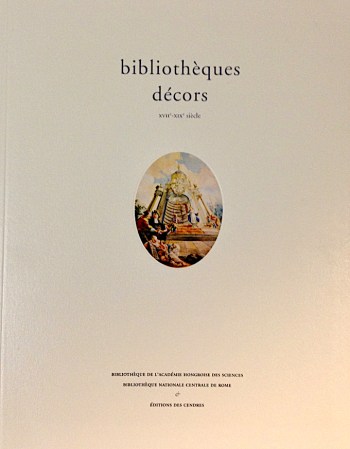 La chronologie est spécifique au domaine : dans la seconde moitié du xvie et au début du xviie siècle, la bibliothèque abandonne le mobilier traditionnel des pupitres pour prendre la forme moderne d’une grande salle de travail dont les murs sont tapissés de livres. Ce modèle deviendra à son tour de moins en moins adapté, jusqu’à ce que, face à l’accroissement de la production imprimée qui se produit au xixe siècle, le principe des magasins de stockage des livres se développe et l’organisation interne de la bibliothèque se modifie. Au fil de cet espace de temps des xviie–xixe siècles, les grands courants artistiques se succèdent, du baroque au classicisme puis au néo-classique, et jusqu’à l’émergence de l’architecture industrielle.
Parallèlement, l’institution de la bibliothèque garde une charge symbolique élevée, mise en scène par le biais du décor. On connaît les somptueuses bibliothèques baroques du monde catholique, de la péninsule Ibérique à l’Allemagne méridionale, à l’Europe centrale, ou encore à l’Italie. Pourtant, d’autres modèles de décor se rencontrent, qu’il s’agisse de la France (à la Bibliothèque Mazarine) ou encore de la géographie de la Réforme protestante. À côté des exemples les plus célèbres, y compris celui de la Hofbibliothek de Vienne, les contributions présentent un certain nombre de bibliothèques historiques largement méconnues jusqu’à aujourd’hui, notamment en Europe centrale et orientale (Alba Iulia), mais aussi en Italie (avec le Palais Borromini à Rome).
Ce travail transdisciplinaire réunit les meilleurs spécialistes européens, confrontant les leçons de l’histoire générale avec celles de l’histoire de l’art, de l’histoire des idées et de l’histoire du livre et des bibliothèques. Un ouvrage placé sous la direction de Frédéric Barbier, István Monok & Andrea De Pasquale qui ont réuni à leurs côtés une équipe internationale de spécialistes de l’histoire des bibliothèques et du livre / Ample iconographie, bibliographie et index.
T A B L E D E M A T I È R E S
• Frédéric Barbier, Bibliothèques, décors, XVIIe–XXIe siècle
• Frédéric Barbier, Illustrer, persuader, servir: le décor des bibliothèques, 1627–1851
• Elmar Mittler, Kunst oder Propaganda? Bibliothekarische Ausstattungsprogramme als Spiegel kultureller Entwicklungen und Kontroversen in Renaissance, Gegenreformation, Aufklärung und Klassizismus
• Hans Petschar, Der Pruncksaal der Österreichichen Nationalbibliothek : zur Semiotik eines barocken Denkraumes
• Andreas Gamerith, Klosterbibliotheken des Wiener Umlandes: alte und neue Motive
• Michaela Seferisová Loudová, Ikonographie der Klosterbibliotheken in Tschechien, 1770–1790
• Szabolcs Serfözö, Barocke Deckenmalereien in klosterbibliotheken des Paulinerordens in Mitteleuropa
• Anna Jávor, Bücher und Fresken: die künstlerische Ausstattung von Barockbibliothecken in Ungarn
• János Jernyei-Kiss, Die Welt der Bücher auf einem Deckenbild: Franz Sigrists Darstellung der Wissenschaften im Festsaal des Lyzeums in Erlau
• Doina Hendre Biró, Le décor de la Bibliothèque et de l’Observatoire astronomique fondés par le comte Ignác Batthyány, évêque de Transylvanie, à la fin du XVIIIe siècle
• Yann Sordet, D’un palais (1643) l’autre (1648): les bibliothèque(s) Mazarine(s) et leur décor
• Fiammetta Sabba, I Saloni librari Borrominiani fra architettura e decoro
• Andrea De Pasquale, L’histoire du livre dans le décor des bibliothèques d’Italie au XIXe siècle
• Jean-Michel Leniaud, L’invention du programme d’une bibliothèque, 1780–1930
• Alfredo Serrai, I vasi o saloni librari. Ermeneutica della iconografia bibliotecaria
New Book | Artefacts of Encounter: Cook’s Voyages
From the University of Hawaii Press:
Thomas, Nicholas Thomas, Julie Adams, Billie Lythberg, Maia Nuku, and Amiria Salmond, Artefacts of Encounter: Cook’s Voyages, Colonial Collecting and Museum Histories (Honolulu: University of Hawai’i Press, 2016), 364 pages, ISBN: 978 0824 859350, $68.
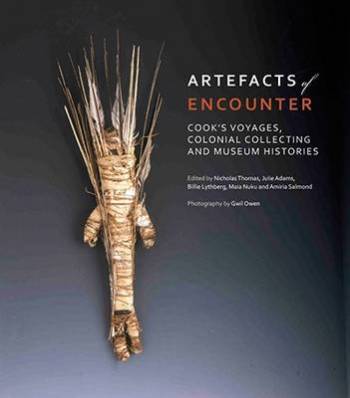 The Pacific artefacts and works of art collected during the three voyages of Captain James Cook and the navigators, traders, and missionaries who followed him are of foundational importance for the study of art and culture in Oceania. These collections are representative not only of technologies or belief systems but of indigenous cultures at the formative stages of their modern histories, and exemplify Islanders’ institutions, cosmologies, and social relationships.
Recently, scholars from the Pacific and further afield, working with Pacific artefacts at the Museum of Archaeology and Anthropology in Cambridge (MAA), have set out to challenge and rethink some longstanding assumptions on their significance. The Cook voyage collection at the MAA is among the four or five most important in the world, containing over 200 of the 2000-odd objects with Cook voyage provenance that are dispersed throughout the world. The collection includes some 100 artefacts dating from Cook’s first voyage. This stunning book catalogues this collection, and its cutting-edge scholarship sheds new light on the significance of many artefacts of encounter. Published in association with Otago University Press.
New Book | Clothing Art
From Yale UP:
Aileen Ribeiro, Clothing Art: The Visual Culture of Fashion, 1600–1914 (New Haven: Yale University Press, 2017), 582 pages, ISBN: 978-0300119077, $60.
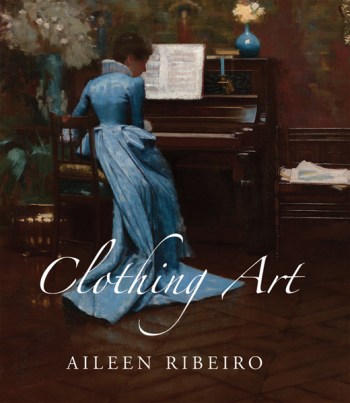 There have always been important links between art and clothing. Artists have documented the ever-evolving trends in fashion, popularized certain styles of dress, and at times even designed fashions. This is the first book to explore in depth the fascinating points of contact between art and clothing, and in doing so it constructs a new and innovative history of dress in which the artist plays a central role.
Aileen Ribeiro provides an illuminating account of the relationship between artists and clothing from the 17th century, when a more complex and sophisticated attitude to dress first appeared, to the early 20th century, when the boundaries between art and fashion became more fluid: haute couture could be seen as art, and art used textiles and clothes in highly imaginative ways. Ribeiro’s narrative encompasses such themes as the ways in which clothing has helped to define the nation state; how masquerade and dressing up were key subjects in art and life; and how, while many artists found increasing inspiration in high fashion, others became involved in designing ‘artistic’ and reform dress. Sumptuously illustrated, Clothing Art also delves into the ways in which artists represent the clothes they depict in their work, approaches which range from photographic detail, through varying degrees of imaginative reality, to generalized drapery.
Aileen Ribeiro is professor emeritus in the history of art at the Courtauld Institute of Art, London.
Netherlands Yearbook for History of Art, November 2016
Latest issue of NKJ:
Thijs Weststeijn, Eric Jorink and Frits Scholten, eds., Netherlandish Art in its Global Context (Leiden: Brill, 2016), 296 pages, ISBN: 978-9004334977, €105 / $123. [Netherlands Yearbook for History of Art / Nederlands Kunsthistorisch Jaarboek 66 (November 2016)].
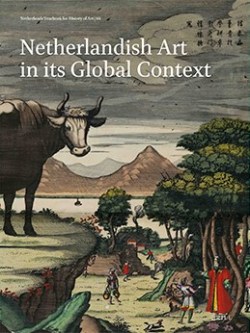 Netherlandish art testifies to the interconnectedness of the Early Modern world. New trade routes, the international Catholic mission, and a thriving publishing industry turned Antwerp and Amsterdam into capitals of global exchange. Netherlandish prints found a worldwide public. At home, everyday lives changed as foreign luxuries, and local copies, became widely available. Eventually, Dutch imitations of Chinese porcelain found their way to colonists in Surinam. This volume of the Netherlands Yearbook for History of Art breaks new ground in applying the aims and approaches of global art history to the Low Countries, with essays ranging from Greenland to South Africa and Mexico to Sri Lanka. The Netherlands, as a fringe area of the Habsburg Empire marked by internal fault lines, demonstrated remarkable artistic flexibility and productivity in the first period of intensive exchange between Europe and the rest of the world.
Thijs Weststeijn, PhD (2005), University of Amsterdam, is professor of art history before 1850 at Utrecht University. He chairs the research project The Chinese Impact: Images and Ideas of China in the Dutch Golden Age (2014–19).
Eric Jorink, PhD (2004), University of Groningen, is Teylers professor at Leiden University and researcher at the Huygens Institute (KNAW). He is the author of Reading the Book of Nature in the Dutch Golden Age, 1575–1715.
Frits Scholten, PhD (2003), University of Amsterdam, is senior curator of sculpture at the Rijksmuseum and holds the chair in the History of Western Sculpture before 1800 at the Universiteit van Amsterdam. He has published widely on Western sculpture and decorative arts. His most recent publication is Small Wonders: Late-Gothic Boxwood Micro-carvings from the Low Countries (Amsterdam 2016).
C O N T E N T S
• Thijs Weststeijn, Introduction: Global Art History and the Netherlands
• Nicole Blackwood, Meta Incognita: Some Hypotheses on Cornelis Ketel’s Lost English and Inuit Portraits
• Stephanie Porras, Going Viral? Maerten de Vos’s St Michael the Archangel
• Christine Göttler, ‘Indian Daggers with Idols’ in the Early Modern Constcamer: Collecting, Picturing and Imagining ‘Exotic’ Weaponry in the Netherlands and Beyond
• Barbara Uppenkamp, ‘Indian’ Motifs in Peter Paul Rubens’s The Martyrdom of Saint Thomas and The Miracles of Saint Francis Xavier
• Thijs Weststeijn and Lennert Gesterkamp, A New Identity for Rubens’s ‘Korean Man’: Portrait of the Chinese Merchant Yppong
• Ebeltje Hartkamp-Jonxis, Sri Lankan Ivory Caskets and Cabinets on Dutch Commission, 1640–1710
• Julie Berger Hochstrasser, A South African Mystery: Remarkable Studies of the Khoikhoi
• Ching-Ling Wang, A Dutch Model for a Chinese Woodcut: On Han Huaide’s Herding a Bull in a Forest
• Annemarie Klootwijk, Curious Japanese Black: Shaping the Identity of Dutch Imitation Lacquer
• Thomas DaCosta Kaufmann, The ‘Netherlandish model’? Netherlandish Art History as/and Global Art History
New Book | American Silver in the Art Institute of Chicago
Due for a February release from Yale UP:
Elizabeth McGoey, ed., American Silver in the Art Institute of Chicago (New Haven: Yale University Press, 2017), 266 pages, ISBN: 978 0300 222364, $50.
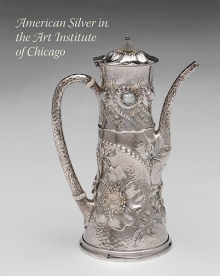 The history of American silver offers invaluable insights into the economic and cultural history of the nation itself. Published here for the first time, the Art Institute of Chicago’s superb collection embodies innovation and beauty from the colonial era to the present. In the 17th century, silversmiths brought the fashions of their homelands to the colonies, and in the early 18th, new forms arose as technology diversified production. Demand increased in the 19th century as the Industrial Revolution took hold. In the 20th, modernism changed the shape of silver inside and outside the home. This beautifully illustrated volume presents highlights from the collection with stunning photography and entries from leading specialists. In-depth essays relate a fascinating story about eating, drinking, and entertaining that spans the history of the Republic and trace the development of the Art Institute’s holdings of American silver over nearly a century. Contributors include Debra Schmidt Bach, David Barquist, Jennifer Goldsborough, Judith Barter, Medill Higgins Harvey, Patricia Kane, Barbara Schnitzer, Janine Skerry, Ann Wagner, Gerald W. R. Ward, Deborah Dependahl Waters, Beth Carver Wees, and Elizabeth Williams.
Elizabeth McGoey is Ann S. and Samuel M. Mencoff Assistant Curator of American Decorative Arts at the Art Institute of Chicago.
Exhibition | Making Nature: How We See Animals
Press release (23 September 2016) from the Wellcome Collection:
Making Nature: How We See Animals
Wellcome Collection, London, 1 December 2016 — 21 May 2017
Curated by Honor Beddard
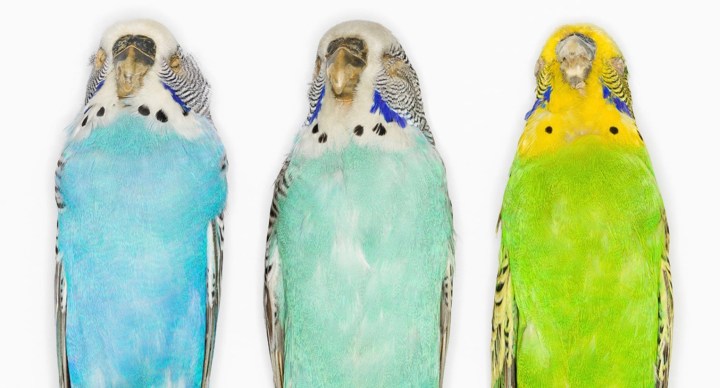
The question of how humans relate to other animals has captivated philosophers, anthropologists, scientists, ethicists and artists for centuries. Making Nature brings together over 100 objects from literature, film, taxidermy, and photography to examine what we think, feel, and value about other species and the consequences this has for the world around us. It will include works by contemporary artists including Allora and Calzadilla and Phillip Warnell and asks how and why we look at animals and what we see when we do.
From the formalisation of natural history as a science, through the establishment of museums and zoos, to lavish contemporary wildlife documentaries, Making Nature reveals the hierarchies in our view of the natural world and considers how these influence our actions, or inactions, towards the planet. The exhibition—organised around four themes: ordering, displaying, observing, and making—opens with Marcus Coates’s Degreecoordinates, Shared Traits of the Hominini (Humans, Bonobos and Chimpanzees), 2015. This recent work questions the definitions of difference between species and establishes this as an idea that runs throughout the exhibition.
Attempts to categorise the natural world in the 18th century will be introduced through the work of Carl Linnaeus and the publication of Systema Naturae in 1735. His efforts to record, describe, and classify the animal kingdom solved the practical problem of identifying species but introduced a manmade ranking system. Similarly, Charles Bonnet’s Scale of Natural Beings 1783 provided a ladder of the animal kingdom with humans placed at the top. Such views are challenged by the depictions of animals—and human-like animals—in Jonathan Swift’s satire of man, Gulliver’s Travels.
Making Nature questions the approach of ‘learning through looking’, including artists such as herman de vries, a trained botanist interested in the challenge of objectivity, and Edwina Ashton who explores the politics of representation. The importance of listening is also examined by artists Allora and Calzadilla in The Great Silence (2014). This film installation is a depiction of endangered parrots paired against footage of the Arecibo Observatory, the world’s largest telescope, in Puerto Rica.
The exhibition also charts changing fashions of museum displays alongside society’s changing attitudes to nature, from overstuffed cabinets in Victorian institutions to elaborately staged dioramas from natural history museums in the 20th century. Contemporary photographers Richard Ross and Hiroshi Sugimoto expose the complexities of successive attempts to give visitors an authentic representation of the animal in a museum setting, revealing works of art as yet another form of mediation. Roger Fenton’s 1855 image of an unnaturally upright gorilla skeleton next to a human one, taken during his time as the British Museum’s documentary photographer, interrogates the idea that natural history displays may not necessarily represent an objective truth.
The search for an authentic encounter with nature will be further examined through our ever more ambitious attempts to get closer to animals—in zoos, national parks, and on screen—while simultaneously hoping to preserve their wildness. The New Architecture and The London Zoo (1936), a film by László Moholy-Nagy, and Casson Condor’s architectural photographs from the 1970s provide examples of how the designs of zoo enclosures are used to frame animals. The phenomena of the ‘zoo-pet’, or mascot, is explored through cases like Jumbo the elephant, adored by Victorian audiences and subject of a public outcry when he was sold to P. T. Barnum’s Circus in 1882. Souvenirs and toys will show how zoo animals have frequently been anthropomorphised in popular culture.
Depictions of animals on film include, Woodpeckers 1954, the first documentary to use new camera technologies to film a family of woodpeckers from within their nest. When broadcast on the BBC, it was second in popularity only to the Queen’s coronation that year and set the precedent for natural history documentaries that remain popular today. The exhibition also features an extract from Seal Island (1948), part of Walt Disney’s True-Life Adventures series of nature films promoted as entertainment.
Phillip Warnell’s film installation Ming of Harlem: Twenty One Storeys in the Air (2016) explores the true story of Antoine Yates, who lived in a high-rise New York apartment with a tiger called Ming and a large alligator. Combining documentary with recreated scenes, Warnell offers new insights on the human/animal relationship and the question of representation.
The final section of the exhibition is curated in collaboration with the Center for PostNatural History, Pittsburgh, USA, the only organisation to solely collect organisms that have been intentionally altered by humans. Specimens, paintings, literature, and scientific models—many on loan from the Center’s museum—will chart a relationship to animals that is bound up with the history, and future, of human civilisation. This includes the breeding of domesticated pigeons by Charles Darwin that helped to inform his theories of natural selection and the genetic modification of mosquitos in the fight against disease spread. Further case studies comprise dog breeding, the origins of laboratory mice and rats, and a history of songbirds as told by musicologist Ian Nagoski. Unlike traditional natural history collections, the significance of postnatural organisms lies in the role they play in human culture.
Making Nature is the first part of a year-long exploration of our relationship with the natural world in the past, present, and future. The exhibition is curated by Honor Beddard, and the exhibition design is by AOC.
◊ ◊ ◊ ◊ ◊
Tim Dee and Anna Faherty, Animal, Vegetable, Mineral: Organising Nature: A Picture Album (London: Wellcome Collection, 2016), 112 pages, ISBN: 978 095 7028593, £13.
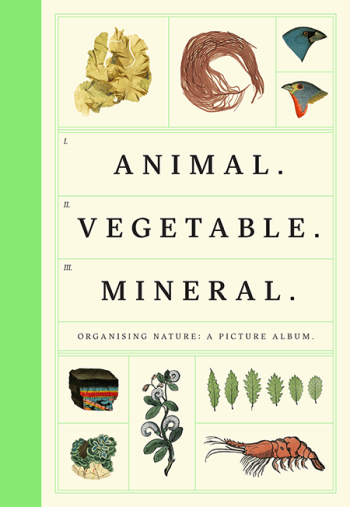 Animal, Vegetable, Mineral celebrates the beauty and strangeness of the very early ‘infographics’, charts, and ordering systems devised in an age that transformed how we see and understand nature. These are the tools created by pioneering European naturalists, artists, scientists, housewives, and explorers in the 18th and 19th centuries in an attempt to better understand (and control) a teeming and shifting natural world: the original big data challenge. In a collision of science, art, and imagination, these images and objects range from intricate specimen illustrations, taxonomy charts, and animal distribution maps, to lavish colour dictionaries, and more. Together, they attest to the deeply human desire to order and identify the world around us—and a restless quest to find our own place in it.
New Book | William Hogarth: A Complete Catalogue of the Paintings
From Yale UP:
Elizabeth Einberg, William Hogarth: A Complete Catalogue of the Paintings (London: The Paul Mellon Centre for Studies in British Art, 2016), 432 pages, ISBN: 978 030 0221749, £95 / $150.
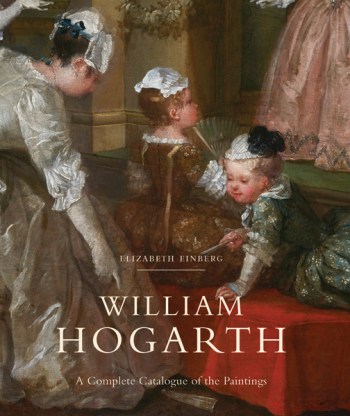 William Hogarth (1697–1764) was among the first British-born artists to rise to international recognition and acclaim and to this day he is considered one of the country’s most celebrated and innovative masters. His output encompassed engravings, paintings, prints, and editorial cartoons that presaged western sequential art.
This comprehensive catalogue of his paintings brings together over twenty years of scholarly research and expertise on the artist and serves to highlight the remarkable diversity of his accomplishments in this medium. Portraits, history paintings, theater pictures, and genre pieces are lavishly reproduced alongside detailed entries on each painting, including much previously unpublished material relating to his oeuvre. This deeply informed publication affirms Hogarth’s legacy and testifies to the artist’s enduring reputation.
Elizabeth Einberg is a senior research fellow at the Paul Mellon Centre for Studies in British Art and former curator at Tate Britain.










 Enfilade
leave a comment