New Book | Materializing Gender in Eighteenth-Century Europe
From Routledge:
Jennifer Germann and Heidi Strobel, eds., Materializing Gender in Eighteenth-Century Europe (New York: Routledge, 2016), 240 pages, ISBN: 978-1472456311, $150.
 Art history has enriched the study of material culture as a scholarly field. This interdisciplinary volume enhances this literature through the contributors’ engagement with gender as the conceptual locus of analysis in terms of femininity, masculinity, and the spaces in between. Collectively, these essays by art historians and museum professionals argue for a more complex understanding of the relationship between objects and subjects in gendered terms. The objects under consideration range from the quotidian to the exotic, including beds, guns, fans, needle paintings, prints, drawings, mantillas, almanacs, reticules, silver punch bowls, and collage. These material goods may have been intended to enforce and affirm gendered norms, however as the essays demonstrate, their use by subjects frequently put normative formations of gender into question, revealing the impossibility of permanently fixing gender in relation to material goods, concepts, or bodies. This book will appeal to art historians, museum professionals, women’s and gender studies specialists, students, and all those interested in the history of objects in everyday life.
Jennifer G. Germann is Assistant Professor of Art History, Ithaca College.
Heidi A. Strobel is Associate Professor of Art History, University of Evansville.
◊ ◊ ◊ ◊ ◊
C O N T E N T S
List of Illustrations
Notes on Contributors
Acknowledgements
Introduction: Material Culture and the Gendered Subject, Jennifer G. Germann and Heidi A. Strobel
I. Transgressive Objects
1 Men and Hunting Guns in Eighteenth-Century France, Amy Freund
2 Taste a-la-mode: Consuming Foreignness, Picturing Gender, Freya Gowrley
3 Gendered Souvenirs: Anna Amalia’s Grand Tourist Vedute Fans, Christina K. Lindeman
4 Majas, Mantillas, and Marcialidad: Fashioning Identity in Late Eighteenth-Century Spain, Tara Zanardi
II. Gender and Domesticity
5 Place and Possession: Emma Hamilton at Merton, 1801–05, Amber Ludwig
6 A Gentlemen’s Pursuit: Eighteenth-Century Chinoiserie Silver in Britain, Elizabeth A. Williams
7 Sexing Sovereignty: The Material Culture and Sexual Politics of Queen Marie Leszczinska’s Bed, Jennifer G. Germann
III. High Art in Low Places
8 ‘Idleness Never Grew in My Soil’: Mary Delany’s Flower Collages, Gender, and the Moral Authority of ‘Nature’ in Eighteenth-Century England, Felicity Roberts
9 Pocket Museums: The Display of Art in Women’s Almanacs during the First French Empire, Ryan Whyte
10 Stitching the Stage: Mary Linwood, Thomas Gainsborough, and the Art of Installation Embroidery, Heidi A. Strobel
Selected Bibliography
Index
Exhibition | Giambattista and Domenico Tiepolo: Master Drawings

Domenico Tiepolo, A Centaur Playing with Punchinellos, ca. 1770 (Bloominton Indiana: The Anthony Moravec Collection of Old Master Drawings, Eskenazi Museum of Art)
◊ ◊ ◊ ◊ ◊
From the Eskenazi Museum of Art at Indiana University:
Giambattista and Domenico Tiepolo: Master Drawings from the Anthony J. Moravec Collection
Eskenazi Museum of Art, Indiana University, Bloomington, 1 October 2016 — 5 February 2017
Crocker Art Museum, Sacramento, California, 29 October 2017 — 4 February 2018
Curated by Adeheld Gealt
This fall, the Eskenazi Museum of Art at Indiana University will showcase a series of Italian master drawings, in an exhibition that highlights a major gift of art in the museum’s 75-year history. Giambattista and Domenico Tiepolo: Master Drawings from the Anthony J. Moravec Collection will present a collection of works on paper by the Venetian masters Giambattista and Domenico Tiepolo—a father and son who are widely considered two of the most notable Italian draftsmen of their era—along with works by contemporaries Ubaldo Gandolfi and Giuseppe Bernardino Bison, as well as their predecessor Jacopo Palma il Giovane. Giambattista and Domenico Tiepolo marks the first time that the Eskenazi Museum has comprehensively exhibited the collection of Anthony J. Moravec, an Indiana philanthropist and civic leader who spent five years building the collection in concert with Dr. Adelheid Gealt, the museum’s director emeritus, before donating his holdings to the Eskenazi Museum in 2010.

Domenico Tiepolo, Jesus in the Garden of Gethsemane: The Second Prayer, ca. 1785, pen and brown ink wash over black chalk on paper (The Anthony Moravec Collection of Old Master Drawings, Eskenazi Museum of Art, 2010.118).
On view from October 1, 2016 through February 5, 2017, the exhibition and its accompanying catalogue will provide new scholarship and curatorial insight on Giambattista and Domenico Tiepolo, two of the most important artists in the Old Masters canon. The exhibition will center on a set of 12 New Testament drawings by Domenico Tiepolo, part of a now-scattered cycle of 320 drawings that is regarded as the most exhaustive and sustained visual exploration of the subject by any artist in history. Domenico’s large pen, brush, and ink drawings were dispersed after his death in 1804, and entered many public and private collections where they were prized as outstanding drawings. However, the actual series to which these individual drawings belonged was not known until two scholars— Adelheid Gealt and George Knox, professor emeritus of the University of British Columbia, Vancouver—spent 10 years piecing the series back together and publishing it as a newly discovered New Testament cycle in 2006. Following Moravec’s 2010 gift, which was the largest private collection of New Testament drawings to enter a public collection in recent history, the Eskenazi Museum has become the world’s third-largest repository of works from Tiepolo’s New Testament series, after the Museé du Louvre and the Morgan Library and Museum.
In addition to works from Domenico’s New Testament series, the Moravec collection also includes important works on paper by his father, Giambattista Tiepolo, who is widely regarded as one of the greatest draftsmen of the 18th century. Works by Ubaldo Gandolfi and Giuseppe Bernardino Bison round out the collection, along with a drawing by Jacopo Palma il Giovane—a previously unidentified study for his painting St. John the Baptist Preaching, which was acquired by the museum in 1964. In total, 24 works on paper will be displayed in Giambattista and Domenico Tiepolo, which will be a major highlight of the Eskenazi Museum’s 75th-anniversary season.
◊ ◊ ◊ ◊ ◊
The catalogue will be available in October from Indiana University Press:
Adeheld Gealt, with George Knox, Giambattista and Domenico Tiepolo (Bloomington: Indiana University Press, 2016), 136 pages, ISBN: 978-0253022905, $50.
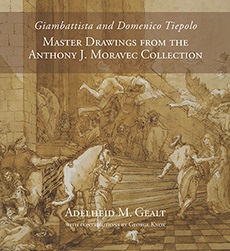 Giambattista and Domenico Tiepolo documents an important collection of master drawings donated by an individual to the Sidney and Lois Eskenazi Museum of Art at Indiana University, including five drawings by the celebrated Venetian genius Giambattista Tiepolo and sixteen drawings by his most famous son, Domenico Tiepolo. Twelve of the sixteen form part of Domenico’s most important drawing series—his exhaustive visual exploration of the New Testament. Also included are two drawings discovered after the 2006 publication of Domenico Tiepolo: A New Testament and seen here for the first time. Gealt and Knox are world-renowned experts on the Tiepolos and this book will serve as a useful reference to understanding their work as draftsmen. This beautiful illustrated volume will appeal to art lovers, biblical scholars, and those who value the unique work of the Tiepolos.
Adeheld M. Gealt is Director Emerita of the Eskenazi Museum of Art. Her research has concentrated on reconstructing the lost serial narratives of the Venetian draftsman Domenico Tiepolo (1727–1804). She is editor (with George Knox) of Domenico Tiepolo: Master Draftsman (1997) and Domenico Tiepolo: A New Testament (2006).
◊ ◊ ◊ ◊ ◊
C O N T E N T S
Foreword, David Brenneman
Preface and Acknowledgments
Structure of the Catalogue
An Interview with the Collector, Anthony J. Moravec and Adelheid M. Gealt
A Brief History of Venetian Drawing
Giambattista Tiepolo, a Brief Biography
Development as a Draftsman
Flight into Egypt
Holy Family
Caricatures
Domenico Tiepolo, a Brief Biography
St. Anthony of Padua
Satyrs and Centaurs
Punchinello
New Testament
Palma Giovane
Ubaldo Gandolfi
Giuseppe Bernardino Bison
Notes
Bibliography
Index
◊ ◊ ◊ ◊ ◊
Note (added 29 October 2017) — The posting was updated to include the Crocker Art Museum as a venue.
New Book | The Rise and Fall of the Fine Art Print
From the University of Toronto Press:
W. McAllister Johnson, The Rise and Fall of the Fine Art Print in Eighteenth-Century France (Toronto: University of Toronto Press, 2016), 472 pages, ISBN: 978-1442637122 , $85.
 Sanctioned by France’s Royal Academy of Painting and Sculpture and struck primarily in order to disseminate the works of the Academy’s members, the eighteenth-century fine art print flourished only briefly. Yet it set into motion the interdependence of graphic and pictorial media. Here, W. McAllister Johnson distills a lifetime of research into an essential study of this seminal phenomenon and chronicles the issues, decisions, and practicalities inherent in making copperplate engravings as articles of art and commerce. His exceptional erudition makes this an unparalleled resource for the study of visual culture and of all aspects of printmaking before the French Revolution.
W. McAllister Johnson is a professor emeritus in the Department of Art at the University of Toronto. His most recent book is Versified Prints: A Literary and Cultural Phenomenon.
◊ ◊ ◊ ◊ ◊
C O N T E N T S
Preface
1 The Full Statement of the Question
2 Orienting Concepts
3 Prints as Information
4 The Fine Art Print Defined
5 Pendant Prints
6 The Académie as Catalyst and Regulator
7 The Académie and the Artist
8 Creative Issues
9 Response Time
10 Career Calculus
11 Reputation and Reflected Glory
12 Commercial Ploys and the Art of the Annonce
13 Prints and Paintings on Exhibition
14 Engraved, Not Engraved
15 Criticism, Controversy and Censure
16 Greuze Prints, including the Salon
17 The Clash of Genres
18 Conclusion
Appendix A: The Mercure’s Editorial Policy regarding Prints (1728)
Appendix B: Problems of Engraving and Collecting Prints (1754)
Appendix C: Wille’s Appreciation of Jean Daullé (1763)
Appendix D: An Oudry Portrait for the Book Trade (1767)
Appendix E: A Greuze ‘Lost to France’ multiplied by a Print (1767)
Appendix F: The Art Market : Paintings, Pendants and Petits Sujets (1780)
New Book | The Piranesi Effect
From New South Books:
Kerrianne Stone and Gerard Vaughan, eds., The Piranesi Effect (Sydney: University of New South Wales Press, 2015), 336 pages, ISBN: 978-1742234267, $60.
 This book publishes a conference convened in February 2014 on the global impact of Piranesi: Piranesi and the Impact of the Late Baroque, presented in collaboration with the State Library and the Baillieu Library.
The work of Italian printmaker Giovanni Battista Piranesi (1720–1778) has captivated artists, architects and designers for centuries. Although contemporary Australia is a long way from eighteenth-century Rome, it is home to substantial collections of his works, the largest being at the State Library of Victoria and the University of Melbourne.
The Piranesi Effect is a collection of exquisitely illustrated essays on the impact of Piranesi’s work throughout the years. The book brings together Australian and international experts who investigate Piranesi’s world and its connections to the study of art and the practice of artists today. From curators and art historians, to contemporary artists like Bill Henson and Ron McBurnie, the contributors each bring their own passion and insight into the work of Piranesi, illuminating what it is about his work that still inspires such wonder.
Kerrianne Stone is the Curator, Prints, at the Baillieu Library, University of Melbourne repository of the first Paris edition of Piranesi’s work. She has worked with several collections across museums and galleries in Melbourne. Gerard Vaughan is Director of the National Gallery of Australia. For 13 years he was director of the National Gallery of Victoria, before retiring to take up a research professorship in The Australian Institute of Art History at Melbourne University. He has a special interest in the rise of neoclassicism in late eighteenth-century Europe.
New Book | Republic of Taste: Art, Politics, and Everyday Life
From the University of Pennsylvania Press:
Catherine Kelly, Republic of Taste: Art, Politics, and Everyday Life in Early America (Philadelphia: University of Pennsylvania Press, 2016), 352 pages, ISBN: 978-0812248234, $50.
 Since the early decades of the eighteenth century, European, and especially British, thinkers were preoccupied with questions of taste. Whether Americans believed that taste was innate—and therefore a marker of breeding and station—or acquired—and thus the product of application and study—all could appreciate that taste was grounded in, demonstrated through, and confirmed by reading, writing, and looking. It was widely believed that shared aesthetic sensibilities connected like-minded individuals and that shared affinities advanced the public good and held great promise for the American republic.
Exploring the intersection of the early republic’s material, visual, literary, and political cultures, Catherine Kelly demonstrates how American thinkers acknowledged the similarities between aesthetics and politics in order to wrestle with questions about power and authority. Judgments about art, architecture, literature, poetry, and the theater became an arena for considering political issues ranging from government structures and legislative representation to qualifications for citizenship and the meaning of liberty itself. Additionally, if taste prompted political debate, it also encouraged affinity grounded in a shared national identity. In the years following independence, ordinary women and men reassured themselves that taste revealed larger truths about an individual’s character and potential for republican citizenship.
Did an early national vocabulary of taste, then, with its privileged visuality, register beyond the debates over the ratification of the Constitution? Did it truly extend beyond political and politicized discourse to inform the imaginative structures and material forms of everyday life? Republic of Taste affirms that it did, although not in ways that anyone could have predicted at the conclusion of the American Revolution.
Catherine E. Kelly is Associate Professor and L. R. Brammer Jr. Presidential Professor of History at the University of Oklahoma. She is author of In the New England Fashion: Reshaping Women’s Lives in the Nineteenth Century.
◊ ◊ ◊ ◊ ◊
C O N T E N T S
Introduction: The American Republic of Taste
1 Learning Taste
2 Aesthetic Entrepreneurs
3 Picturing Race
4 Looking Past Loyalism
5 Waxing Political
6 Political Personae
Epilogue: The Nation’s Guest in the Republic of Taste
Notes
Index
Acknowledgments
Exhibition | Highest Heaven: Spanish and Portuguese Colonial Art
Now on view at the San Antonio Museum of Art:
Highest Heaven: Spanish and Portuguese Colonial Art
of the Roberta and Richard Huber Collection
San Antonio Museum of Art, 11 June 2016 — 14 September 2016
Crocker Art Museum, Sacramento, 23 October 2016 — 22 January 2017
Worcester Art Museum, 12 March — 9 July 2017
Chrysler Museum of Art, Norfolk, Virginia, 2 March — 3 Jun 2018
Curated by William Keyse Rudolph and Marion J. Oettinger

Our Lady of Candlemas with Donors, Bolivian, Potosí, 1799, oil on canvas (Roberta and Richard Huber Collection; photograph by Graydon Wood, Philadelphia Museum of Art)
Highest Heaven explores the paintings, sculpture, furniture, ivories, and silverworks of the Altiplano, or high plains, of South America in the 18th century. Through the work of both well-regarded masters and lesser-known artists, Highest Heaven highlights the role of art in the establishment of new city centers in the Spanish Empire and the propagation of the Christian faith among indigenous peoples. Drawn exclusively from the distinguished collection of Roberta and Richard Huber, the exhibition highlights the distinct visual language created by the cultural and creative exchanges that occurred between Spain and Portugal and their South American colonies. The exhibition will remain on view through September 4, 2016, before traveling to the Crocker Art Museum in Sacramento, California in October, and to the Worcester Art Museum in Worcester, Massachusetts the following March.
The exhibition features more than 100 works, including religious paintings, carved and gilded wooden sculptures, intimate ivories, and silverwork, originally housed in ecclesiastical and private collections throughout the former colonial possessions of Spain and Portugal. The majority of these works were created for functional purposes, as articles of faith or symbols of civic order, and were displayed in a manner that enhanced religious understanding, brought social order, and spurred conversion among colonial populations. Highest Heaven examines these uses, focusing in particular on the translation of Christian imagery to the colonies and the ways in which these works and objects worked to establish an ordered society and were integrated into religious life. The exhibition includes approximately 20 recent acquisitions by the Hubers, many of which have never before been seen in a museum exhibition.
“A central component of our mission is to examine and communicate the historic and cultural contexts of artworks, along with the objects themselves. Highest Heaven is an exciting opportunity to not only investigate the aesthetic beauty of this art, but also the significant role that it played in the cultural, religious, and social lives of these peoples,” said Katherine Luber, The Kelso Director of San Antonio Museum of Art. “We are grateful to Roberta and Richard for their collecting vision and the chance to share this incredible collection with our audiences. San Antonio is a city rich in history and diversity, and we look forward to engaging our community with this work, which we think will have a particular meaning here.”

Pax Depicting the Ecce Homo, Peruvian, 18th century, silver (Roberta and Richard Huber Collection; photograph by Graydon Wood, Philadelphia Museum of Art)
The exhibition is co-curated by William Keyse Rudolph, Mellon Chief Curator and Marie and Hugh Halff Curator of American Art, and Marion J. Oettinger Jr, Curator of Latin American Art. Unlike many previous exhibitions of Colonial Art, which have arranged objects by media, Highest Heaven will be organized according to iconography. After an introductory section that explores a group of objects made for secular life, the exhibition considers the art works religiously, from the angels and archangels that foretold the coming of Jesus Christ, through imagery dealing with the life of Christ and spread of the gospel, to the importance of the Virgin Mary and the saints. Each section of the exhibition contains a mixture of works of art in all media, from paintings to sculpture to silverwork and ivories.
The Altiplano stretches from northern Argentina to the flatlands of Peru, and much of the exhibition focuses on works produced by workshops in the major cities of Cuzco and Lima in modern day Peru and Potosi in modern day Bolivia, where both European and native artists practiced. Paintings and sculpture served primarily to disseminate Christian images and faith to the New World, while works in ivory and silver underscored the wealth and prosperity of the growing Empire. Paintings also frequently depicted major colonial cities to both capture their urban fabric and educate those back home on the appearance and existence of the colonies.
With the extensive growth of trade across the Empire, works of art took on a range of styles that represented European traditions and local idioms. In some instances, European aesthetics and subjects were replicated directly. In others, European saints, idols, and figures took on the appearance of native populations, enhancing their relevance and influence. Yet, in other work, Christian symbols were incorporated into scenes of local rural and urban life. Together, these distinct yet interrelated approaches, created a new visual culture that represented the expansiveness of the Empire, and spoke to the integration of a diversity of peoples into a single faith.
“In contrast to other areas of Spanish colonial scholarship, such as New Spain (present-day Southwestern United States, Mexico, and Central America), much less is known about the artists, workshop practices, and even the names of South American artists,” said Luber. “Collectors are often the first to blaze the trail of discovery, and then the scholarship follows. A show like Highest Heaven opens up avenues of investigation. We are producing a catalogue that we hope will spur additional scholarship in the field. That’s part of what is so exciting about this exhibition.”
New York-based collectors Roberta and Richard Huber developed the collection of colonial South American art over the last 40 years. The Hubers continue to discover new artists and works, building on their holdings for personal enjoyment and public education and making their collection a living and evolving one. They first discovered the art and antiquities of the Spanish Empire when Richard Huber was relocated for work to Buenos Aires, Argentina in 1962. His and Roberta’s love for the period grew as they traveled and lived in other areas of South America. Today, they are committed to enhancing understanding of the diversity, depth, and intricacy of art produced by artists across the Altiplano during Spanish rule.
Erin Kathleen Murphy and William Keyse Rudolph with contributions by Thomas B. F. Cummins, Katherine Moore McAllen, and Katherine Crawford Luber, Highest Heaven: Spanish and Portuguese Colonial Art from the Roberta and Richard Huber Collection (San Antonio: San Antonio Museum of Art, 2016), 192 pages, ISBN: 978-1883502225, $40.
Exhibition | Gardens, Art, and Commerce in Chinese Woodblock Prints
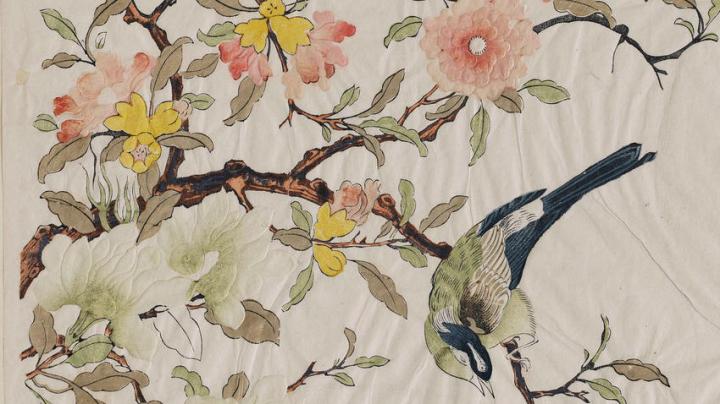
Ding Liangxian, Pomegranate and Magnolia with Bird, (detail), Qing Dynasty, 1700–50; woodblock print with embossing, ink, and colors on paper (multiblock technique with hand-coloring), 11 7/8 × 14 3/4 inches (Boston: Museum of Fine Arts)
◊ ◊ ◊ ◊ ◊
Press release (28 June 2016) from The Huntington:
Gardens, Art, and Commerce in Chinese Woodblock Prints
The Huntington, San Marino, CA, 17 September 2016 — 9 January 2017
Curated by June Li and Suzanne Wright
The Huntington Library, Art Collections, and Botanical Gardens will present a major international loan exhibition exploring the art, craft, and cultural significance of Chinese woodblock prints made during their golden age, with works made from the late 16th century through the 19th century. Gardens, Art, and Commerce in Chinese Woodblock Prints brings together 48 of the finest examples gathered from the National Library of China, Beijing; the Nanjing Library; the Shanghai Museum; and 14 institutional and private collections in the United States. The exhibition presents monumental visual accounts of sprawling, architecturally elaborate ‘scholar’s gardens’, alongside delicate prints with painterly textures and subtle colors depicting plants, birds, and other garden elements so finely wrought they might be mistaken for watercolors. A highlight of the exhibition is The Huntington’s rare edition of the Ten Bamboo Studio Manual of Calligraphy and Painting (ca. 1633–1703), acquired in 2014, and on public view for the first time in this exhibition.
Research informing the exhibition and an accompanying catalog reveals much about the history and significance of Chinese pictorial printing during the period, including its influence on better-known Japanese woodblock artists and collectors. Coveted for their artistic merit and technical virtuosity, Chinese illustrated books and pictorial works were collected by the literati and wealthy merchant classes in both China and Japan. The Ten Bamboo Studio Manual, for example, contains the inscriptions of five renowned Japanese artists, successive owners who treasured the artistically ambitious and visually creative volumes as an important resource.
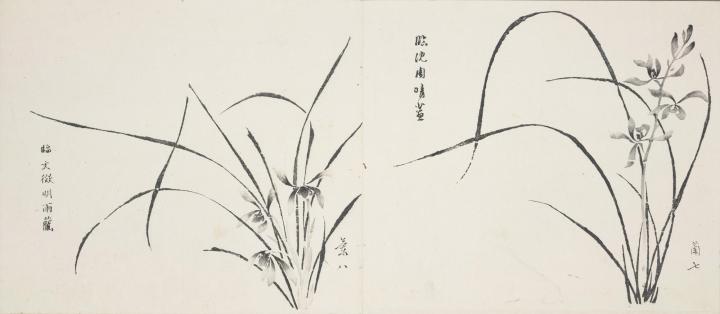
Lotus Leaf, Lotus Root, and Two Jitou Capsules, with calligraphy by Sun Yuwang, Fruit 10, from Ten Bamboo Studio Manual of Calligraphy and Painting, compiled and edited by Hu Zhengyan; woodblock-printed book, ink and colors on paper, each page 9 7/8 × 11 1/4 inches (San Marino: Huntington Library, Art Collections and Botanical Gardens)
◊ ◊ ◊ ◊ ◊
The founding curator of The Huntington’s Chinese Garden, June Li, is co-curator of the exhibition and co-author of the catalog, along with Chinese woodblock print specialist Suzanne Wright, associate professor of art history at the University of Tennessee.
Gardens, Art, and Commerce in Chinese Woodblock Prints unites several interests at The Huntington. It is the home of one of the most extensive collections of early printed books in the nation, various collections of prints by European and American artists, and one of the largest Chinese scholar’s gardens outside of China.
“This exhibition is utterly evocative of The Huntington’s transdisciplinary nature,” said Laura Skandera Trombley, Huntington president. “Woodblock prints were formative communication and aesthetic tools that served a number of purposes over time, from disseminating Buddhist teachings to depicting ideals of beauty. This perfect fusion of art and language, an integration of emotion and intellectual pursuit, is evidenced in The Huntington’s art and library collections, and is embodied in our stunning Suzhou-style Chinese Garden. We are enormously grateful for June Li’s commitment and guiding vision for this extraordinary exhibition.”
During the late Ming (1368–1644) and early Qing (1644–1912) dynasties, an increase in wealth, stemming in part from the salt, rice, and silk industries, led to higher levels of literacy and education. Consumer demand for printed words and images increased as merchants and scholars looked for ways to display their taste in drama, poetry, literature, and art. For these elites, gardens were central to a cultured life, appearing frequently in woodblock prints as subject or setting. By the 1590s, several enterprising publishers were successfully meeting the strong demand for woodblock prints. They hired renowned designers, carvers, and printers to produce sophisticated and exquisite works, raising the standards of printmaking. During the last decades of the Ming dynasty, several centers of printing around the lower Yangzi River delta grew in reputation, ushering in a golden age of Chinese pictorial printing.
“In the realm of Chinese art, pictorial woodblock prints are not as familiar as paintings, calligraphy, or ceramics,” said Li. “The subject of woodblock prints usually brings to mind Buddhist icons, Daoist deities, or folk images, rather than refined and artistic works. But, over the past few years, scholars researching the historical and artistic aspects of these prints have re-introduced a trove of beautiful works that are highly accomplished.”
Building on this story, Gardens, Art, and Commerce in Chinese Woodblock Prints is organized into thematic sections with explanatory panels in both English and Chinese. In the first gallery visitors will find an impressive nine-and-an-half-foot long hand scroll that was commissioned by the Song emperor Taizong (r. 976–97). An unusual Buddhist work that depicts landscape rather than images of deities, it is the earliest and only religious work in the exhibition, showing the lofty achievements of woodblock printers by the 10th century, with enormous clarity of line and painstaking attention to the details of mountains, streams, trees, and tiny figures. The accomplishments of such early printing established the technical foundation from which later Ming and Qing artists grew. Illustrations of the Garden Scenery of the Hall of Encircling Jade, an extraordinary set of 45 prints produced around 1602 to 1605, will be displayed in facsimile (the only evidence that remains of the original). Taken as a whole, the prints illustrate the enormous garden estate of a successful merchant, scholar, and book publisher of the early 17th century. The detailed prints show what seems to be acres of a fashionable garden, with a large, elegant hall framing scholars seated in conversation; a courtyard where figures re-enact a famous poetry game around a table; an enclosure for carefully sculpted penjing (bonsai trees); and more than a hundred names inscribed on buildings, ponds, and rocks. The print has an elevated viewpoint and changing perspectives that allow glimpses into interior spaces, revealing a cultivated life of books and men in scholars’ robes deep in discussion.
The exhibition next focuses exclusively on prints about gardens, both historical and fictional. Historical gardens include famous sites recorded by emperors, such as Suzhou’s Lion Grove, a popular tourist destination to this day. Another imperial work, a scroll more than 25 feet long (six feet of which will be displayed), shows urban gardens and the bustle of daily life in 18th-century Beijing.
The effects of exchanges between European missionaries and the Chinese also are explored in the exhibition. One publisher incorporated biblical illustrations into his ink catalog, produced around 1616. The Qianlong emperor in 1783–86 commissioned a set of large copperplate engravings in a European style that showed details of the European pavilions in his private retreat.
Another section of the exhibition explores the styles of print artists from the late 16th through the 18th centuries in publishing centers such as Hangzhou, Huizhou, Wuxi, and Suzhou. On view are several examples by different publishers illustrating a single popular story, The Story of the Western Chamber, making clear their varying visual and artistic interpretations. In some cases, prints were made to resemble known paintings. Sometimes famous painters, such as Chen Hongshou (1598–1652), designed works expressly for printing. The exhibition includes a rare early edition of Chen’s version of The Story of the Western Chamber, as well as a set of cards he designed for a drinking game.
The exhibition also looks at accomplishments in multi-color and embossed printing, such as beautifully printed guides offering suggestions for cultivating taste. These manuals prescribed appropriate pastimes for a cultivated life, instructed on calligraphy, and advised on chess strategy and drinking games for men, and embroidery patterns for women. They also illustrated musical and dramatic works such as the popular Peony Pavilion. Many of these leisure activities took place in the garden, and prints showing scholar’s rocks, which had become precious items for the discerning collector, will be represented by finely printed editions of well-known works including a rare edition of The Stone Compendium of Plain Garden. Two examples of actual scholar’s rocks from The Huntington’s collection will be on view to complement the book.
Additionally, four iPads in the galleries will allow for a deeper investigation of Illustrations of the Garden Scenery of the Hall of Encircling Jade (a work showing the large garden estate of the successful merchant and publisher Wang Tingna) and allow visitors to see all the leaves of The Huntington’s Ten Bamboo Studio Manual of Calligraphy and Painting, a work that due to its delicate nature can only be viewed a few leaves at a time in the galleries.
Visitors of all ages can view Chinese woodblock printing techniques in a gallery featuring a replica of a printing table, along with carving tools, colored inks, paper, brushes, and burnishers. To better understand the multi-color printing process, a set of woodblocks and step-by-step prints replicating a page of the Ten Bamboo Studio Manual will be on view, a display commissioned from the Shanghai publisher Duo Yun Xuan especially for the exhibition.
T. June Li and Suzanne E. Wright, Gardens, Art, and Commerce in Chinese Woodblock Prints (San Marino: The Huntington Library, Art Collections, and Botanical Gardens, 2016), 176 pages, ISBN 978-0873282673, $50.
June Li details the origins and provenance of The Huntington’s Ten Bamboo Studio Manual of Calligraphy and Painting, a landmark of multi-block color printing, with particular emphasis on its appeal to 18th- and 19th-century Japanese collectors. Suzanne Wright traces the development of three distinct regional styles of woodblock-printed illustrations during the late Ming dynasty, with striking examples of each style drawn from the exhibition. The 176-page volume, published by The Huntington, features more than 150 illustrations, including full-color plates of each work in the exhibition.
◊ ◊ ◊ ◊ ◊
Exhibition Symposium | Word and Image: Chinese Woodblock Prints
The Huntington, San Marino, CA, 12 November 2016
The late Ming period witnessed an unprecedented production of woodblock images printed for many different purposes, including illustrations for drama and games, decorations for stationery paper or ink making, as well as pictorial works for the market. This symposium will explore the relationship and interaction between image and text in woodblock prints during the late Ming and early Qing periods. Register online here.
• Kai-Wing Chow (University of Illinois at Urbana-Champaign), “Nature, Print, and Art: Commerce and Garden Culture in Late Imperial China”
• He Yuming (University of California, Davis), “Illustrating Encyclopedic Knowledge in the Ming”
• Richard Strassberg (University of California, Los Angeles), “The Kangxi Emperor’s Thirty-Six Views: The Making of an Imperial Publication”
• Meng-ching Ma (National Tsing Hua University, Taiwan), “‘Poetic Pictures’ in Late-Ming Illustrated Dramatic Publications”
• Suzanne Wright (University of Tennessee, Knoxville), “The Swallow Messenger: Text and Image”
• Hu Jun (Northwestern University), “A Panoply of Metaphor: Painting and Intermediality in the Late Ming”
New Book | Inside Venice
From Rizzoli:
Toto Bergamo Rossi, with a foreword by Diane Von Furstenberg and Peter Marino, an introduction by James Ivory, and photographs by Jean-François Jaussaud, Inside Venice: A Private View of the City’s Most Beautiful Interiors (New York: Rizzoli, 2016), 310 pages, ISBN: 978-0847848164, $60.
 The superb interiors of Venice are revealed in this lavishly photographed book, which is sure to appeal to Venice’s many admirers interested in the elegance and refinement of classical Old World interior design. The book is a luxurious presentation of the hidden architectural and interior design treasures of Venice, ranging from historical ninth-century buildings to contemporary renovations that blend old and new. Seventy-two properties, each photographed exclusively for the book, are profiled—mainly private apartments and palazzos, along with some churches, hotels, and other public spaces. Preservation expert Toto Bergamo Rossi selected each property for inclusion based on his detailed field knowledge gained over many years as director of the Venetian Heritage Foundation, whose mission is to safeguard Venetian cultural heritage as manifested in architecture, music, and fine art.
Exhibition | Rooms Hidden by the Water: Photographs from Venice

◊ ◊ ◊ ◊ ◊
From Kansallis Museo Finland:
Rooms Hidden by the Water: Photographs from Venice by Jaakko Heikkilä
National Museum of Finland, Helsinki, 29 April — 28 August 2016
The exhibition features approximately 50 photographs by Jaakko Heikkilä, taken between 2005 and 2015 in the palaces of Venetian nobility along with Venetian furniture from the late 1800s from the National Museum’s collections.
Jaakko Heikkilä (b. 1956) is an observer, renowned for photographing people and groups of people around the world. Heikkila photographs people in their own environment: at home, working, at museums, or as flickering shadows on walls. Heikkilä started photographing the Venetian nobility through a friend who opened the doors of the first palace for him. The photographs offer a unique opportunity to peek inside the palaces of the decreasing Venetian nobility and meet the residents and their life stories.
The Venetian nobility live a somewhat isolated life that is bound and protected by their history. The nobility consists of merchants from La Serenissima, the golden age of the Republic of Venice, which existed from the 500s to 1797. They represent Old Europe, the lost world, which is disappearing under the waves just like Venice is due to climate change.
Jaakko Heikkilä, Barone Alberto Franchetti, Alex Snellman, and Minerva Keltanen, Rooms Hidden by the Water: Photographs from Venice by Jaakko Heikkilä (Helsinki: Maahenki, 2016), 131 pages, ISBN: 978-9516162723, €43.
Exhibition | Antoine Watteau: The Draughtsman
Opening in October at the Städel Museum:
Antoine Watteau: The Draughtsman / Der Zeichner
Städel Museum, Frankfurt am Main, 19 October 2016 — 15 January 2017
Teylers Museum, Haarlem, 2 February — 14 May 2017
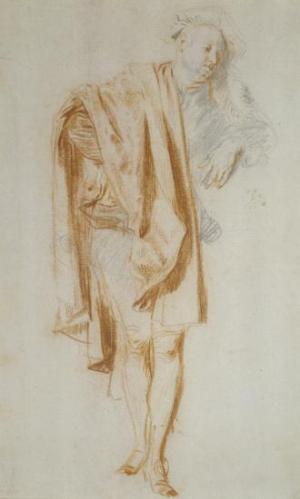
Jean Antoine Watteau, Standing Male Figure (Nicolas Vleughels?), ca. 1718–19 (Frankfurt: Städel Museum)
The French painter Antoine Watteau (1684–1721) is among the great masters of draughtsmanship. His sensitive studies in red, black and white chalk capture female and male models, observations of details and spontaneous ideas, and develop that world of cheerful companies and mutually attentive conviviality that would come to be called fêtes galantes (‘courtship parties’).
In cooperation with the Teylers Museum in Haarlem, the Städel Museum is planning an exhibition of drawings by Antoine Watteau for the autumn of 2016. Both institutions have in their possession substantial holdings of works by the artist, who can be considered one of the most outstanding draughtsmen in the history of French art. His innovative style—characterized by a combination of spontaneity, ease and intimacy on the one hand and observation of the utmost precision on the other—contrasts starkly with the formal tradition of the academically oriented artists of his time. With its psychological sensitivity, the new, virtuoso art reflects the spirit of the dawning Enlightenment.
Watteau is relatively little known in Germany, despite the fact that in the eighteenth century he was one of the Frederick the Great’s favourite artists. The last exhibition to be devoted here to Watteau took place in 1984. Among the works in the Stadel Museum’s painting collection is the earliest version of the Embarkation for Cythera, which—owing in part to the two further versions in the Louvre and Charlottenburg Palace—represents what is presumably the artist’s most famous pictorial invention. Enhanced by a small selection of further paintings, the Städel Museum’s Embarkation for Cythera will form the core of the presentation of approximately fifty choice drawings from the holdings of the participating institutions as well as a number of other prominent German, Dutch, and French collections. Approximately twenty drawings by such artists as François Boucher, Nicolas Lancret, or Jean-Honoré Fragonard will supplement this selection, bearing testimony to Watteau’s impact on later generations of artists.
Martin Sonnabend and Michiel Plomp, Antoine Watteau: Der Zeichner (Munich: Hirmer Verlag, 2016), 260 pages, ISBN: 978-3777426549, 35€.
◊ ◊ ◊ ◊ ◊
Note (added 19 October 2016) — The original posting listed the title of the exhibition as Antoine Watteau: Drawings / Zeichnungen and did not include the exhibition catalogue.










 Enfilade
leave a comment