Exhibition | Classical Splendor: Painted Furniture
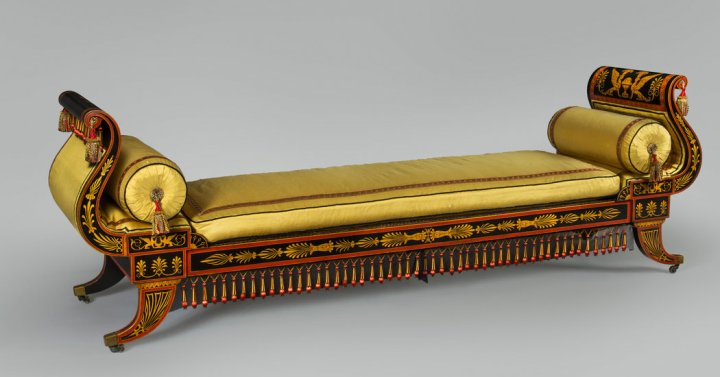
Sofa, designed by Benjamin Henry Latrobe, decorated by George Bridport
(Philadelphia Museum of Art, 1986-126-2a-c).
◊ ◊ ◊ ◊ ◊
Writing for The Magazine Antiques, Alexandra Kirtley previews the exhibition Classical Splendor: Painted Furniture for a Grand Philadelphia House, which opens this fall in Philadelphia.
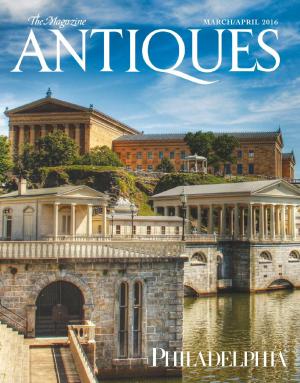
Alexandra Alevizatos Kirtley, “Superfluity & Excess: Quaker Philadelphia Falls for Classical Splendor,” The Magazine Antiques (March/April 2016).
The fruits of extensive research on Benjamin Henry Latrobe’s 1808 house and furniture for William and Mary Waln begin with their impact on the aesthetic of the city itself.
 By the middle of the eighteenth century the “greene Country Towne” founded by William Penn in 1682 was bustling with commercial and social activity. Colonists from Europe and the British Isles who spoke a variety of languages and practiced a number of religions filled the city. Although the aura of the British and European Quakers who had followed Penn to Philadelphia was still palpable, ambitious merchants had begun to create New World versions of aristocratic styles and customs quite at odds with Quaker comportment . . .
Despite this atmosphere of admonishment against hierarchical social customs and “Superfluity & Excess in Buildings and Furniture,” many Philadelphia Quaker and non-Quaker artisans and their patrons did embrace the luxury of contemporary European and Asian styles. . . . The taste for aristocratic style persisted in the city’s public and private spheres even after the Revolution. . . .
By 1805 the city was no longer the nation’s capital, but it was about to witness the creation of its most innovative, resplendent, and potent interior—the work of a team of artisans commissioned by a Quaker merchant and his socially adept Episcopalian wife. British-born architect Benjamin Henry Latrobe—known as Henry—had arrived in the city in early spring 1798 and had already completed several commissions: the Bank of Pennsylvania in the plain Greek revival style; the domed Pump House for the Centre Square Water Works (completed in 1801, demolished in 1829);4 and a Gothic-style country house in Fairmount Park for the merchant William Cramond called Sedgeley (completed in 1802, demolished around 1857). Latrobe had also established himself in Philadelphia society by marrying Mary Elizabeth Hazlehurst (1771–1841), the daughter of Isaac and Johanna Purviance Hazlehurst—a prominent couple with family, commercial, and political ties in Philadelphia, Baltimore, and Salem, New Jersey.
Philadelphia merchant William Waln, the son of the Quaker preacher Nicholas Waln (1742–1813), had made a bold departure from his faith when he was married by Episcopal Bishop William White to Mary Wilcocks on March 14, 1805, at Christ Church, Philadelphia. But what the couple did next in commissioning Henry Latrobe to design and oversee the building of their magnificent house and its furnishings was even bolder: they unleashed Latrobe to design for them furniture that directly imitated ancient furniture, moving once and for all beyond the restrained bounds of mere references to classical art, and transforming Philadelphia’s—and indeed America’s—interpretation of classical art . . . .
The full article is available here»
◊ ◊ ◊ ◊ ◊
Press Release from the Philadelphia Museum of Art:
Classical Splendor: Painted Furniture for a Grand Philadelphia House
Philadelphia Museum of Art, 3 September 2016 — 1 January 2017
Curated by Alexandra Alevizatos Kirtley and Peggy Olley

Card Table, designed by Benjamin Henry Latrobe, decorated by George Bridport (Philadelphia Museum of Art, photograph by Gavin Ashworth)
This exhibition will showcase a set of furniture designed by architect Benjamin Henry Latrobe (1764–1820) and made in Philadelphia in 1808 for William and Mary Wilcocks Waln. The Museum’s ten surviving pieces of furniture from the Walns’ original set will be shown in a new light, reimagined after a comprehensive five-year curatorial study and conservation treatment.The exhibition will highlight the team of makers—the designer (Latrobe), the maker (John Aitken, d. 1839), the painter (George Bridport, 1783–1819), and the upholsterer (John Rea, 1774–1871)—and the fashion for classical art that the furniture ushered into American interiors. The Walns’ drawing rooms and their furniture provided a setting imitating the art and culture of ancient Greece. The exhibition will consider Latrobe’s groundbreaking ‘Klismos’ chair design, and reveal the London-trained Bridport as the visionary artist who translated Latrobe’s design for the walls into classical designs for the painted furniture and whose work is represented today only by the surviving Waln furniture. The Walns’ extraordinary house, which stood at the southeast corner of Seventh and Chestnut Streets in Philadelphia, was torn down in 1847. Through the use of large-scale computer renderings and various other interactive technologies, visitors will be able to explore the way the two drawing rooms were furnished how they interacted with the rest of the house and the gardens, which were also designed by Latrobe.
◊ ◊ ◊ ◊ ◊
From Yale UP:
Alexandra Alevizatos Kirtley and Peggy Olley, with an essay by Jeffrey Cohen, Classical Splendor: Painted Furniture for a Grand Philadelphia House (New Haven: Yale University Press, 2016), 160 pages, ISBN: 978-0300221718, $35.
 This handsome book explores in depth a group of stunning painted and gilded furniture designed by the architect Benjamin Henry Latrobe (1764–1820), best known for originating the plans for the United States Capitol. The furniture was made in Philadelphia for one of the city’s finest houses—the home of William and Mary Wilcocks Waln, which Latrobe also designed. Drawing on a multiyear conservation and research project, Classical Splendor reveals new insights into the patrons, makers, and history behind these extraordinary pieces. In addition to extensively documenting each item, the book attests to Latrobe’s significant contributions to American furniture design—his pieces for the Waln house introduced, and served as exemplars of, a classical style rooted in ancient Greek and Roman design.
Alexandra Alevizatos Kirtley is the Montgomery-Garvan Curator of American Decorative Arts and Peggy A. Olley is the associate conservator of furniture and woodwork, both at the Philadelphia Museum of Art. Jeffrey A. Cohen is senior lecturer and chair of the Growth and Structure of Cities Program at Bryn Mawr College.
Exhibition | Global by Design: Chinese Ceramics
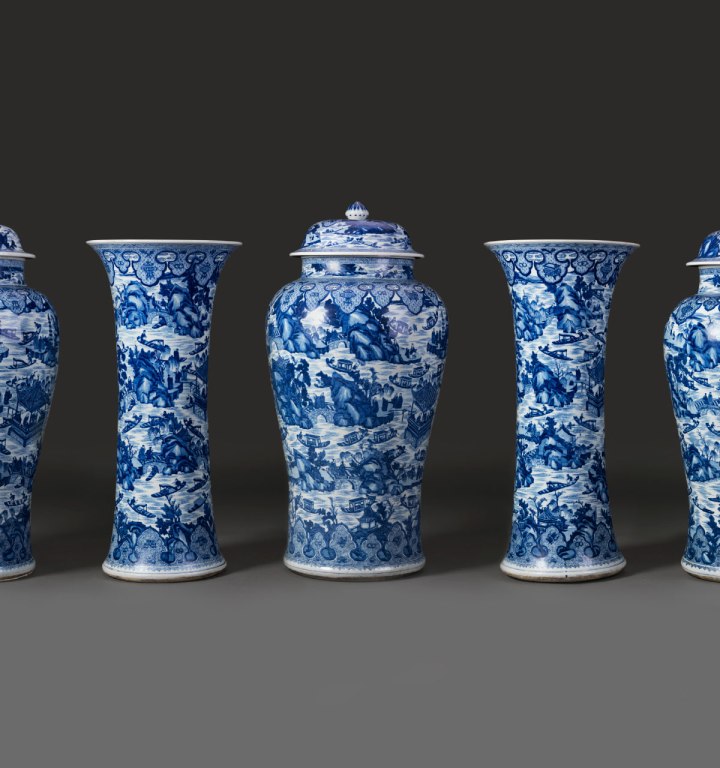
Garniture with Scenes of West Lake, ca. 1700. China, Qing dynasty (1644–1911). Porcelain painted with cobalt blue under a transparent glaze; Jars, H. 40 3/4 in., Vases, H. 35 5/8 in. (R. Albuquerque Collection)
◊ ◊ ◊ ◊ ◊
Press release (25 April 2016) for the exhibition now on view at The Met:
Global by Design: Chinese Ceramics from the R. Albuquerque Collection
The Metropolitan Museum of Art, New York, 25 April — 7 August 2016
Curated by Jeffrey Munger and Denise Patry Leidy
An international loan exhibition of 60 exquisite and unusual Chinese ceramics drawn from a Brazilian private collection—never before exhibited publicly—is now on view at The Metropolitan Museum of Art through August 7. Global by Design: Chinese Ceramics from the R. Albuquerque Collection focuses on the period—from the late 16th to the 18th century—when Chinese porcelain became a global luxury, transforming both the European ceramic industry and styles of dining and drinking.
The introduction of porcelain to Europe can be traced to the period between the late 15th and early 16th centuries known as the ‘Age of Exploration’. This period includes both the discovery by Vasco da Gama (1460–1524) in 1498 of a maritime route around the Cape of Good Hope in Africa to South and East Asia, and the slightly earlier travels of Christopher Columbus (1451–1506) that led to the discovery of the Americas. Supported by Portuguese and Spanish courts, both explorers were searching for a sea route that would provide quicker access to coveted Asian luxuries, including tea, spices, silk, and porcelain.
When the Portuguese first reached China in the 16th century, the extensive kiln complex at Jingdezhen in Jiangxi Province in the southeast dominated porcelain production. (China and, to a lesser extent, Korea were the only places in the world making porcelain at that time.) Portuguese rulers were the first Europeans to commission works from China, and these early-commissioned objects are among the rarest works on view in the exhibition. They include pieces with royal designs, such as a flattened bottle with a coat of arms, and Catholic imagery, such as a delicate bowl with the opening lines of the Hail Mary.
By this time, porcelain had long been treasured in inner-Asian trade, particularly with the Islamic world, and shapes and designs from the Middle East, which had been incorporated into the porcelain industry, were also transmitted to Europe. In the exhibition, a rare example of a kraak dish (ca. 1628–1642) depicting two Persian figures and made for either the Islamic world or Europe provides one example of these complicated interchanges. (The term kraak derives from the Portuguese word for ‘ship’ and is often used in Western sources to define Chinese porcelains made specifically for export in the late 16th and early 17th centuries.) In addition, an unusual bowl with pierced decoration and the Islamic profession of faith has European gilt mounts, indicating its fascinating journey from China to the Islamic world and, ultimately, Europe.
In the early 17th century, after the Dutch auctioned porcelain from two captured Portuguese ships and overtook the Portuguese and Spanish maritime routes, porcelain became widespread throughout northern Europe. By the late 17th and 18th centuries, with the ongoing exchange of shapes and designs, a global artistic language in porcelain making was fully developed. One of the most compelling examples in the exhibition is a monumental set of five vessels; produced for display in a European home, it depicts scenes from West Lake in southern China. In addition, tureens—including a delightful piece in the form of a crab with movable eyes, another in the shape of the historical Chinese Buddhist monk Budai, and a third, based on European silver, with lush patterns incorporating Western and Eastern imagery—exemplify the innovation and experimentation that characterized the Chinese porcelain industry in the 18th century.
The exhibition includes three generous gifts to the Museum from the R. Albuquerque Collection. The exhibition is organized by Jeffrey Munger, Curator, Department of European Sculpture and Decorative Arts, and Denise Patry Leidy, Brooke Russell Astor Curator of Chinese Art, Department of Asian Art. In conjunction with the exhibition, the Museum will offer education programs, including gallery talks and, on June 5, a Sunday at The Met program focusing on trade in Chinese ceramics and their continuous and complicated impact on global traditions.
◊ ◊ ◊ ◊ ◊
Published by Jorge Welsh, the catalogue is available from The Met:
Denise Patry Leidy with catalogue entries by Maria Antónia Pinto de Matos, Global by Design: Chinese Ceramics from the R. Albuquerque Collection (London: Jorge Welsh Research & Publishing, 2016), 240 pages, ISBN: 978-0993506802 (hardcover), £40 / ISBN: 978-0993506819 (softcover), £30 / $40.
 The companion catalogue to The Met exhibition, this beautifully illustrated volume explores the period from the late sixteenth to the eighteenth century when Chinese porcelain became a global luxury, and in doing so, transformed both the European ceramic industry and fashionable styles of dining and drinking. Featuring exquisite and unusual pieces from an important Brazilian private collection, it challenges the long-standing tradition of cataloguing Chinese ceramics as domestic or trade items.
In addition to exploring the trade in Chinese ceramics within Asia, this new book looks at the development of ceramic shapes and designs that reflect the long history of exchange between China and the Islamic world, as well as the period in the late sixteenth century when works reflecting both Chinese and Islamic decorative traditions were introduced and incorporated into Europe and the Americas.
Denise Patry Leidy is the Brooke Russel Astor Curator of Chinese Art at The Metropolitan Museum of Art. Maria Antónia Pinto de Matos is director of the Tile Museum in Lisbon.
Exhibition | Unfinished: Thoughts Left Visible

Benjamin West, American Commissioners of the Preliminary Peace Negotiations with Great Britain, begun in 1783, oil on canvas, 72.3 × 92.7 cm. (Winterthur 1957.856)
◊ ◊ ◊ ◊ ◊
With nearly 200 objects, The Met Breuer’s inaugural exhibition includes a handful of striking eighteenth-century paintings and prints. From the press release:
Unfinished: Thoughts Left Visible
The Met Breuer, New York, 18 March — 4 September 2016
Curated by Andrea Bayer, Kelly Baum, Nicholas Cullinan, and Sheena Wagstaff
Unfinished: Thoughts Left Visible examines a subject that is critical to artistic practice: the question of when a work of art is finished. Opening March 18, 2016, this landmark exhibition inaugurates The Met Breuer, ushering in a new phase for The Met’s expanded engagement with modern and contemporary art, presented in Marcel Breuer’s iconic building on Madison Avenue. With over 190 works dating from the Renaissance to the present—nearly forty percent of which are drawn from The Met’s collection, supplemented with major national and international loans—the exhibition demonstrates the type of groundbreaking show that can result when the Museum mines its vast collection and curatorial resources to present modern and contemporary art within a deep historical context.
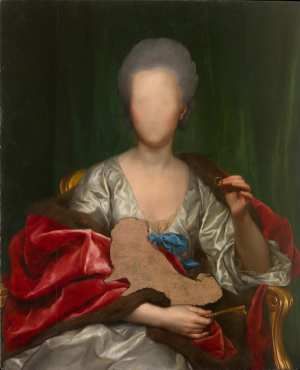
Anton Raphael Mengs, Portrait of Mariana de Silva y Sarmiento, duquesa de Huescar, 1775 (Mr. and Mrs. Otto Naumann, New York)
The exhibition examines the term ‘unfinished’ across the visual arts in the broadest possible way; it includes works left incomplete by their makers, a result that often provides insight into the artists’ creative process, as well as works that engage a non finito—intentionally unfinished—aesthetic that embraces the unresolved and open-ended. Featured artists who explored such an aesthetic include some of history’s greatest practitioners, among them Titian, Rembrandt, Turner, and Cézanne, as well as modern and contemporary artists, including Janine Antoni, Lygia Clark, Jackson Pollock, and Robert Rauschenberg, who have taken the unfinished in entirely new directions, alternately blurring the distinction between making and un-making, extending the boundaries of art into both space and time, and recruiting viewers to complete the objects they had begun.
The accompanying catalogue expands the subject to include the unfinished in literature and film as well as the role of the conservator in elucidating a deeper understanding of artistic thought on the subject of the unfinished.
“Unfinished is a cornerstone of The Met Breuer’s inaugural program and a great example of The Met’s approach to presenting the art of today,” said Thomas P. Campbell, Director and CEO of The Met. “Stretching across history and geography, the exhibition is the result of a cross-departmental collaboration, drawing on the expertise of The Met’s outstanding faculty of curators. We hope the exhibition inspires audiences to reconsider the artistic process as they connect to experiences shared by artists over centuries.”
Sheena Wagstaff, Leonard A. Lauder Chairman of Modern and Contemporary Art, added: “It is rare that an exhibition covering such a broad time span can trace a theme as intimate and essential to the creative process. This sweep of art history throws into sharp focus the ongoing concern of artists about the ‘finishedness’ of their work—which, in the 20th century, they co-opt as a radical tool that changes our understanding of Modernism.”
Using works of art as well as the words of artists and critics as a guide, Unfinished: Thoughts Left Visible strives to answer four questions: When is a work of art finished? To what extent does an artist have latitude in making this decision? During which periods in the history of art since the Renaissance have artists experimented most boldly with the idea of the unfinished or non finito? What impact has this long trajectory had on modern and contemporary art?
The exhibition features works that fall into two categories. The first includes works of art that are literally unfinished—those whose completion was interrupted, usually because of an accident, such as the artist’s death. In some instances, notably Jan van Eyck’s Saint Barbara (1437), there is still debate about whether the artist meant the work to be a finished drawing, which would have been considered unusual at the time, or if it was meant to be a preparation for a painting. Because such works often leave visible the underlying skeleton and many changes normally effaced in the act of completion, they are prized for providing access to the artist’s thoughts, as well as to his or her working process.
The second category includes works that appear unfinished—open-ended, unresolved, imperfect—at the volition of the artist, such as Janine Antoni’s Lick and Lather (1993–1994). Antoni used a mold to create a series of self-portrait busts, half from chocolate and half from soap, fragile materials that tend to age quickly. After finishing the busts, she set to work unfinishing them, licking those in chocolate and bathing with those in soap, stopping once she had arrived at her distinctive physiognomy. The unfinishedness of objects in this second category has been debated and appreciated at definite times, in definite places. Unlike the historical art presented in the exhibition, which includes a significant number of truly unfinished objects, art from the mid-to-late 20th and 21st centuries is represented almost entirely through the lens of non finito.
The exhibition is organized chronologically, spanning the third and fourth floors of The Met Breuer. The works are subdivided thematically, with each group representing a specific case-study in unfinishedness—corresponding to specific times (such as the Renaissance, Baroque, and Modern periods), media (prints and sculpture), artists (including Turner, Cézanne, and Picasso), and genres (most importantly portraiture).
A new, light-based installation by Tatsuo Miyajima, created especially for Unfinished, will be on view in the Tony and Amie James Gallery in the lobby of The Met Breuer (late April through mid-October).
Unfinished: Thoughts Left Visible is curated by Andrea Bayer, Jayne Wrightsman Curator in the Department of European Paintings; Kelly Baum, Curator of Postwar and Contemporary Art in the Department of Modern and Contemporary Art, both at The Metropolitan Museum of Art; and Nicholas Cullinan, former curator in The Met’s Department of Modern and Contemporary Art and current Director of the National Portrait Gallery in London, all working under the direction of Sheena Wagstaff, Leonard A. Lauder Chairman of Modern and Contemporary Art at The Metropolitan Museum of Art. Many curators, conservators, fellows, and research assistants at The Met contributed to this exhibition and its accompanying catalogue, including experts from the Museum’s departments of American Paintings and Sculpture, Drawings and Prints, European Paintings, European Sculpture and Decorative Arts, Paintings Conservation, and Modern and Contemporary Art.
A series of experimental films made by many of the 20th and 21st century’s most innovative filmmakers are being shown in conjunction with the exhibition. Organized by Thomas Beard, founder and director of Light Industry, a venue for film and electronic art in Brooklyn, these screenings, which take place on The Met Breuer’s second floor, address the unfinished in cinematic terms. Details on screening times will be available at a later date.
In collaboration with The Met, The Orchestra Now (TŌN) will present The Unfinished, a performance at Carnegie Hall of two unfinished works: Schoenberg’s Chamber Symphony No. 2 and Mozart’s Great Mass in C minor. The concert will include a panel discussion with the Museum’s Sheena Wagstaff and Andrea Bayer; TŌN’s music director Leon Botstein; Columbia University’s Elaine Sisman, Anne Parsons Bender Professor of Music; and others. Friday, May 13, 2016, 7:30–9:45 pm; tickets start at $25.
Related programs include a Sunday at The Met on May 8 that considers the idea of the unfinished in relation to works across times and cultures and a lecture series on June 20 presenting new scholarship on the subject.
Kelly Baum, Andrea Bayer, and Sheena Wagstaff, Unfinished: Thoughts Left Visible (New York: The Metropolitan Museum of Art, 2016), 336 pages, ISBN: 978-1588395863, $65.
The exhibition is accompanied by a 336-page fully illustrated catalogue that constitutes the most exploratory, yet also comprehensive, introduction to date of the long history of the unfinished in the visual arts, film, and literature. The book is divided into two main sections that roughly correspond to the periods 1435–1900 and 1900–2015. It contains essays by 13 curators, scholars, and a conservator on a range of artists and subjects related to the theme of the unfinished. The catalogue also features interviews with five contemporary artists—Vija Celmins, Marlene Dumas, Brice Marden, Luc Tuymans, and Rebecca Warren—whose work is represented in the exhibition; and a section of brief catalogue entries on each of the objects featured in the exhibition that explores the significance of the work, with an emphasis on its place in the broader narrative and, frequently, an account of its reception. The catalogue is published by The Met and distributed by Yale University Press. The catalogue is made possible by the Samuel I. Newhouse Foundation, Inc. and the Roswell L. Gilpatric Publications Fund.
New Book | Prinny’s Taylor: The Life and Times of Louis Bazalgette
Available from Wordery:
Charles Bazalgette, Prinny’s Taylor: The Life and Times of Louis Bazalgette (Tara Books, 2015), 380 pages, ISBN: 978-0987969200, $25.
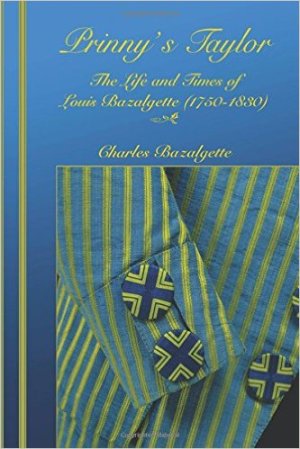 The excesses of George IV, his debts, and the huge sums that he expended on his wardrobe are legendary. It is, therefore, strange that the man who was the Prince’s tailor for over thirty-two years, and his principal tailor for over half of that time, should have been named, and then only in passing, in just two other books. Louis Bazalgette (1750–1830) has been a shadowy figure until now; the relationship between the two men was discreet and almost clandestine. This biography presents a detailed picture of an extraordinary man, of humble origins, whose influence on tailoring, and upon the Prince himself, must have been far-reaching. This fascinating story presents a new angle on Georgian and Regency life, as seen through the eyes of a little French tailor who by his own efforts became a wealthy propertied merchant. There is also a great deal of information on tailoring of the period. Some of Louis Bazalgette’s descendants also enter the story. His eldest son Joseph William Bazalgette, R.N, served with distinction during the Napoleonic Wars, and his grandson of the same name was a noted civil engineer. The author is Louis’s great-great-great-great-grandson.
Charles Bazalgette has worked in the IT industry in a variety of roles for over forty years. He lives near Salmo, a village in British Columbia, with his wife Trish. His interests are mainly in the past: research into family and social history as well as the restoration of old buildings, furniture, and clocks.
New Book | Commemorating the Seafarer
From Boydell & Brewer:
Barbara Tomlinson, Commemorating the Seafarer: Monuments, Memorials and Memory (Martlesham, Suffolk: Boydell Press, 2015), 273 pages, ISBN: 978-1843839705, $50.
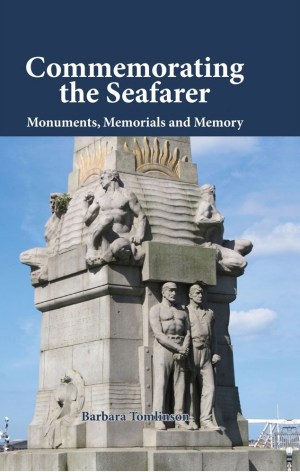 This book discusses memorials—stained glass windows, church, cemetery and public monuments—commemorating British seafarers, shipbuilders and victims of shipwreck from the sixteenth century to the present. Examples have been chosen mainly from Great Britain and Ireland with a few from wider afield. They include important works by major British artists as well as more modest productions by anonymous carvers. The book retells the dramatic stories behind them, illustrating significant social and cultural changes in Britain’s relationship to the sea. Memorials vividly illustrate the hazards of seagoing life and the impact these had both upon the family of the deceased and the general public. The book has a cultural historical focus. Each chapter includes case studies of both high status and popular memorials, showing how iconography such as the depiction of the wrecked ship was widely transmitted. The book covers both naval and commercial aspects of seafaring and includes memorials to naval officers, merchants, explorers, fishermen, leisure sailors, victims of shipwrecks and lifesavers, with around 100 illustrations of memorials. Published in association with the National Maritime Museum, Greenwich.
Barbara Tomlinson was Curator of Antiquities at Royal Museums Greenwich (part of which is the National Maritime Museum) for over thirty-five years and is Hon. Secretary of the Church Monuments Society.
C O N T E N T S
1 Introduction
2 Shifting Loyalties: Naval Memorials, 1628–1763
3 The Age of Heroes: Naval Memorials, 1783–1815
4 Pax Britannica: Naval Memorials, 1815–1914
5 Stormy Weather: Conflict and Sacrifice in the Twentieth Century
6 Commerce and Philanthropy: Mercantile Commemoration
7 Lost at Sea: Maritime Accidents
8 Maritime Explorers: Drake to Shackleton
9 Inshore: Fishermen, Lifesavers and Leisure
10 Conclusion
Exhibition | Netherlandish Drawings, 15th to 18th Centuries

Now on view at the GNM in Nuremberg:
Netherlandish Drawings: Newly Discovered Works from the Germanisches Nationalmuseum
Niederländische Zeichnungen: Neu entdeckte Werke aus dem Germanischen Nationalmuseum
Germanisches Nationalmuseum, Nuremberg, 18 February — 22 May 2016
Since the Renaissance, drawing has been particularly valued—not just because of its relevance to the creative process in all the arts, but also as an insight into an artist’s inspiration. In his Schilder-Boeck (Book of Painters) of 1604, the Dutch biographer Carel van Mander also describes it admiringly as the “father of painting.”
The prominent role of graphic art is also reflected in the GNM’s holdings of Netherlandish drawings of the 15th to 18th century, which are now being shown for the first time in a special exhibition. Featuring around 90 selected works, the exhibition traces an arc from pieces from the workshop of Jan van Eyck through to the decorative designs of Jacob de Wit. The diversity of techniques and themes so typical of the Flemish and Dutch masters is revealed in depictions of landscapes, figure studies, genre scenes, allegories or religious subjects. The exhibition also looks at the various functions of draughtsmanship: from the first sketched idea through to independent works produced for the art market.
The GNM’s Department of Prints and Drawings includes around 150 drawings by Netherlandish artists from the 15th to the 18th century. The geographical term ‘Netherlandish’ refers to both the northern provinces of Holland and the Flemish areas in present-day Belgium. With a few exceptions, these drawings, from the hand of both prominent and not so prominent masters, have remained unpublished and therefore unknown to art historical research.
The museum’s founder, Freiherr Hans von und zu Aufseß, owned Netherlandish drawings, e.g. a sheet signed and dated by Bartholomeus Spranger. However, most of the holdings were acquired through individual purchases between 1866 and 1939. The Netherlandish collection also grew in 1940 and 1982 as a result of bequests from two private collectors.
In addition to a couple of early works, the holdings contain many 17th-century drawings from the Dutch Golden Age. The pictorial genres include landscapes, figures, genre scenes, allegories and religious and mythological subjects. A few 18th-century technical drawings of Netherlandic origin from the ‘Historical Sheets’ are worthy of note as items specific to the collection. The functional relationships between the drawings are diverse, and not always obvious—studies, sketched ideas, drafts for specific paintings, printed graphics etc. can be found alongside independent works produced for the art market.
The goal is to created a printed catalogue describing and depicting the Department of Prints and Drawings’ Netherlandish drawings in accordance with scientific standards and thus open them up for further research. This work is focusing on collecting and evaluating the technical findings, stylistic peculiarities and possible functions of the drawings, particularly in view of the discussion about issues of dating and attribution. The results of the research project are presented in this special exhibition, from February 18 to May 22, 2016.
◊ ◊ ◊ ◊ ◊
Claudia Valter, with contributions by Frank Matthias Kammel and Thomas Ketelsen, Die Niederländischen Zeichnungen 1400–1800 im Germanischen Nationalmuseum (Nuremberg, 2016), 280 pages, ISBN: 978-3936688979, 60€.
 Die Graphische Sammlung des Germanischen Nationalmuseums bewahrt rund 130 niederländische Zeichnungen des 15. bis einschließlich 18. Jahrhunderts, die durch Ankäufe, Schenkungen und Vermächtnisse in den Jahren 1858 bis 1982 erworben wurden. Hierzu zählen Werke von Jan Breughel d.J., Philips Koninck oder Bartholomeus Spranger, aber auch Arbeiten von weniger bekannten und anonymen Meistern. In dem vorliegenden Bestandskatalog sind die niederländischen Zeichnungen nun erstmals in ihrer Gesamtheit wissenschaftlich bearbeitet, mit Provenienzangaben sowie den technischen und bibliographischen Daten dokumentiert und farbig abgebildet. Den Katalog ergänzen Textbeiträge zur Sammlungsgeschichte niederländischer Kunst am Germanischen Nationalmuseum sowie zu den Funktionen niederländischer Zeichnungen.
New Book | Poetical Dust: Poets’ Corner and the Making of Britain
Happy Bard Day!—on the 400th anniversary of the death of William Shakespeare (died on 23 April 1616). Global programming details are available at Shakespeare400. From Penn Press:
Thomas A. Prendergast, Poetical Dust: Poets’ Corner and the Making of Britain (Philadelphia: University of Pennsylvania Press, 2015), 256 pages, ISBN: 978-0812247503 (cloth), ISBN: 978-0812291902 (ebook), $60 / £39.
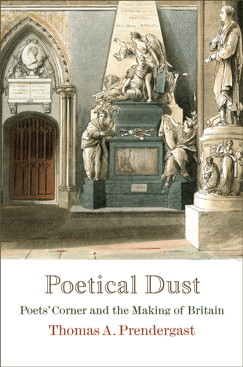 In the South Transept of Westminster Abbey in London, the bodies of more than seventy men and women, primarily writers, poets, and playwrights, are interred, with many more memorialized. From the time of the reburial of Geoffrey Chaucer in 1556, the space has become a sanctuary where some of the most revered figures of English letters are celebrated and remembered. Poets’ Corner is now an attraction visited by thousands of tourists each year, but for much of its history it was also the staging ground for an ongoing debate on the nature of British cultural identity and the place of poetry in the larger political landscape.
Thomas Prendergast’s Poetical Dust offers a provocative, far-reaching, and witty analysis of Poets’ Corner. Covering nearly a thousand years of political and literary history, the book examines the chaotic, sometimes fitful process through which Britain has consecrated its poetry and poets. Whether exploring the several burials of Chaucer, the politicking of Alexander Pope, or the absence of William Shakespeare, Prendergast asks us to consider how these relics attest to the vexed, melancholy ties between the literary corpse and corpus. His thoughtful, sophisticated discussion reveals Poets’ Corner to be not simply a centuries-old destination for pilgrims and tourists alike but a monument to literary fame and the inevitable decay of the bodies it has both rejected and celebrated.
Thomas Prendergast is Professor of English at The College of Wooster and author of Chaucer’s Dead Body: From Corpse to Corpus.
C O N T E N T S
Preface
Introduction
1 Westminster Abbey and the Incorporation of Poets’ Corner
2 Melancholia, Monumental Resistance, and the Invention of Poets’ Corner
3 Love, Literary Publicity, and the Naming of Poets’ Corner
4 Absence and the Public Poetics of Regret
5 Poetic Exhumation and the Anxiety of Absence
Coda: Necromancy and the American Poets’ Corner
Poets’ Corner Graveplan
Poets’ Corner Alphabetical Burial and Monument List
Chronological List of Stones and Monuments in the South Transept
Notes
Bibliography
Index
Acknowledgments
New Book | Ideas of Chinese Gardens: Western Accounts, 1300–1860
From Penn Press:
Bianca Maria Rinaldi, ed, Ideas of Chinese Gardens: Western Accounts, 1300–1860 (Philadelphia: University of Pennsylvania Press, 2015), 400 pages, ISBN: 978-0812247633 (cloth), ISBN: 978-0812292084 (ebook), $90 / £58.50.
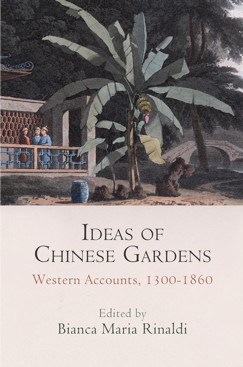 Europeans may be said to have first encountered the Chinese garden in Marco Polo’s narrative of his travels through the Mongol Empire and his years at the court of Kublai Khan. His account of a man-made lake abundant with fish, a verdant green hill lush with trees, raised walkways, and a plethora of beasts and birds took root in the European imagination as the description of a kind of Eden. Beginning in the sixteenth century, permanent interaction between Europe and China took form, and Jesuit missionaries and travelers recorded in letters and memoirs their admiration of Chinese gardens for their seeming naturalness. In the eighteenth century, European taste for chinoiserie reached its height, and informed observers of the Far East discovered that sophisticated and codified design principles lay behind the apparent simplicity of the Chinese garden. The widespread appreciation of the eighteenth century gave way to rejection in the nineteenth, a result of tensions over practical concerns such as trade imbalances and symbolized by the destruction of the imperial park of Yuanming yuan by a joint Anglo-French military expedition.
In Ideas of Chinese Gardens, Bianca Maria Rinaldi has gathered an unparalleled collection of westerners’ accounts, many freshly translated and all expertly annotated, as well as images that would have accompanied the texts as they circulated in Europe. Representing a great diversity of materials and literary genres, Rinaldi’s book includes more than thirty-five sources that span centuries, countries, languages, occupational biases, and political aims. By providing unmediated firsthand accounts of the testimony of these travelers and expatriates, Rinaldi illustrates how the Chinese garden was progressively lifted out of the realm of fantasy into something that could be compared with, and have an impact on, European traditions.
Bianca Maria Rinaldi is Associate Professor of landscape architecture at the Polytechnic University of Turin.
New Book | Thomas Whately’s Observations on Modern Gardening
From Boydell & Brewer:
Michael Symes, Observations on Modern Gardening by Thomas Whately: An Eighteenth-Century Study of the English Landscape Garden (Martlesham, Suffolk: Boydell Press, 2016), 261 pages, ISBN: 978-1783271023, $56.
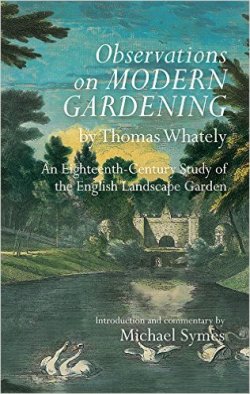 Thomas Whately’s Observations on Modern Gardening (1770) is the first and most comprehensive study of what has come to be known as the English landscape garden, often claimed to be this country’s greatest original contribution to the fine arts. It became the standard text on the subject; its authority was accepted at home and abroad, and the book was read widely across Europe, mainly in a French translation. It influenced taste and design; taught visitors how to respond to gardens; analysed natural and built elements of the garden; suggested principles of design; and provided descriptions of major gardens of the day, such as those at Blenheim and Piercefield (Monmouthshire), together with the author’s responses, aesthetic, mental and emotional. It indicates a taste for the natural and the ‘picturesque’, foreshadowing romanticism. This first modern edition of the text is accompanied by an introduction and full commentary, covering both general considerations and specific points and topics. Contemporary illustrations have been chosen to illuminate further the gardens and places discussed.
Michael Symes is an author, lecturer and garden historian. He founded the MA in Garden History at Birkbeck, University of London, and specialises in eighteenth-century gardens in Britain and on the continent.
C O N T E N T S
1 Introduction
2 Observations on Modern Gardening by Thomas Whately
3 Latapie and Whately
4 Commentary
Further Reading
Index of Place Names
New Book | Jacobites: A New History of the ’45 Rebellion
From Bloomsbury:
Jacqueline Riding, Jacobites: A New History of the ’45 Rebellion (London: Bloomsbury, 2016), 608 pages, ISBN: 978-1608198047, £25.
 The Jacobite Rebellion of 1745–46 is one of the most important turning points in British history–in terms of national crisis every bit the equal of 1066 and 1940. The tale of Charles Edward Stuart, ‘Bonnie Prince Charlie’, and his heroic attempt to regain his grandfather’s (James II) crown remains the stuff of legend: the hunted fugitive, Flora MacDonald, and the dramatic escape over the sea to the Isle of Skye. But the full story—the real history—is even more dramatic, captivating, and revelatory.
Much more than a single rebellion, the events of 1745 were part of an ongoing civil war that threatened to destabilize the British nation and its empire. The Bonnie Prince and his army alone, which included a large contingent of Scottish highlanders, could not have posed a great threat. But with the involvement of Britain’s perennial enemy, Catholic France, it was a far more dangerous and potentially catastrophic situation for the British crown. With encouragement and support from Louis XV, Charles’s triumphant Jacobite army advanced all the way to Derby, a mere 120 miles from London, before a series of missteps ultimately doomed the rebellion to crushing defeat and annihilation at Culloden in April 1746—the last battle ever fought on British soil. Jacqueline Riding conveys the full weight of these monumental years of English and Scottish history as the future course of Great Britain as a united nation was irreversibly altered.
Dr Jacqueline Riding specialises in eighteenth- and early nineteenth-century British history and art. She read History and Art History at the universities of Leicester, London and York, and has over twenty-five years’ experience working as a curator and consultant within a broad range of museums, galleries and historic buildings, including the Guards Museum, Tate Britain and Historic Royal Palaces. From 1993 to 1999 she was Assistant Curator at the Palace of Westminster and later founding Director of the Handel House Museum, London. Her publications include Houses of Parliament: History, Art, Architecture (2000). She was the consultant historian and art historian on Mike Leigh’s award-winning Mr. Turner (2014) and is the consultant historian on his next feature film, Peterloo. Jacqueline Riding is an Associate Research Fellow in the School of Arts, Birkbeck College, University of London and lives in South London.










 Enfilade
leave a comment