Exhibition | Turner in January
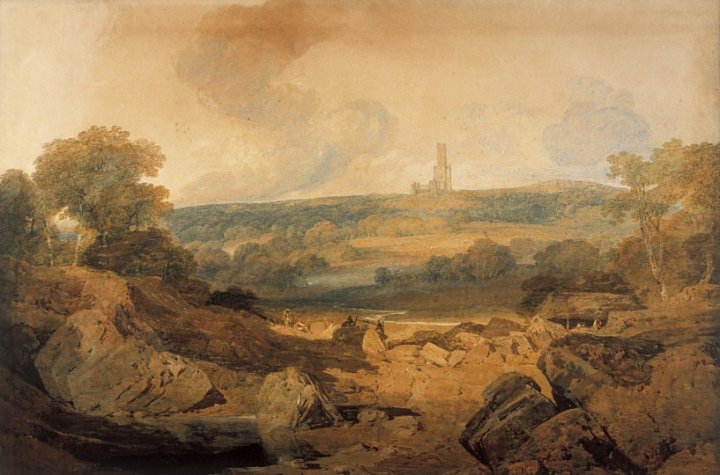
Joseph Mallord William Turner, East View of Fonthill Abbey, Noon, 1800, watercolour on paper
(Edinburgh: Scottish National Gallery)
◊ ◊ ◊ ◊ ◊
Press release for the exhibition:
Turner in January
Scottish National Gallery, Edinburgh, 1–31 January 2016
In keeping with a long-standing tradition now stretching over a century, New Year’s Day at the Scottish National Gallery will be marked by the opening of Turner in January: The Vaughan Bequest, an annual display of works by the artist Joseph Mallord William Turner (1775–1851).
 An outstanding collection by one of the great masters of British painting was bequeathed to the Gallery in 1900 by Henry Vaughan, a London art collector with a passion for Turner and a connoisseur’s eye for quality. Vaughan stipulated that the 38 exquisite works—which encapsulates the artist’s entire career—could not be subjected to permanent display, since continual exposure to light would result in their fading. Instead, these precious works were to be exhibited to the public “all at one time, free of charge, during the month of January,” when daylight in Edinburgh is at its lowest levels. Faithfully following Vaughan’s request, all of the works will be exhibited and Turner in January runs throughout the month, providing a welcome injection of light and colour during the darkest month of the year.
Clara Govier, Head of Charities at People’s Postcode Lottery (PPL), said: “This is the fourth year that players of PPL have supported Turner in January at the Scottish National Gallery, and we’re thrilled—even as relative newcomers in the grand scheme of things—to be involved in such an established tradition. It’s great for players to see that their valuable support is helping to provide thousands of visitors—some who come to see the exhibition every year, some for the very first time—with the opportunity to keep playing a part in this wonderful legacy.”
Recognised as perhaps the greatest of all British artists, Turner was born in London in 1775 and proved himself as an accomplished draughtsman while still a youth, exhibiting at the Royal Academy at the tender age of fifteen. He was a prolific and innovative artist who went on to exploit every possibility of the watercolour medium to create stunning land-and seascapes. Travelling widely, at first with sketching tours in England, Wales and Scotland and then later across Europe, Turner gathered material for masterful watercolours and oil paintings, discovering the awe-inspiring mountainous landscapes which became a major pre-occupation in his work.
Many of the works in the display reveal a youthful Turner’s artistic talents, such as the early wash drawings of the 1790s, while others show how this skill would come to be fused with the peripatetic lifestyle which dominated Turner’s life and career, resulting in colourful and atmospheric watercolour sketches of Continental Europe, such as Chatel Argent, in the Val d’Aosta, near Villeneuve (after 1836) and Falls of the Rhine at Schaffhausen, Side View (ca. 1841).
In his lifetime, Turner also managed three trips to Venice, first arriving there in 1819. The Vaughan Bequest features six of the artist’s stunning views of the city. In The Piazzetta, Venice (ca. 1835), one of Turner’s most spectacular Venetian studies, the Doge’s Palace and renowned St. Mark’s Basilica are dramatically illuminated by a bolt of lightning, an effect innovatively created by the artist by scratching away to reveal the paper once he had painted on it. Often, Turner would use his thumbnail and is reputed to have grown like an ‘eagle-claw’ for such a purpose. His third and final visit to the city in 1840 would see the artist produce a series of incredible works in which light itself appeared to have become the main subject, such as in The Grand Canal by the Salute, Venice (ca. 1840) and Venice from the Laguna (1840) where Turner’s consummate mastery of atmospheric lighting effects is clearly demonstrated.
As with many artists at the end of the 18th century, for Turner the vastness and tumultuous conditions of nature inspired senses of awe and terror. This life-long fascination—of the savageness of elemental forces—poured out of Turner’s art, namely in the form of avalanches, storms and mountainous seas. This can be seen in works from the bequest, such as Loch Coruisk, Skye (1831–34), with its miniature human figures set against a grand, stretching backdrop of painted swirls.
Turner’s Heidelberg (ca. 1846), a glowing, almost hallucinatory image of the ancient university town on the Rhine and one of his finest late works, will also be on display.
Also joining those from the bequest is the work East View of Fonthill Abbey, Noon (1800), a romantic view of the Gothic novelist William Beckford’s extraordinary cathedral-like mansion in rural Wiltshire, which was accepted by HM Government in lieu of inheritance tax in 1988 and loaned to National Trust for Scotland at Brodick Castle.
◊ ◊ ◊ ◊ ◊
Christopher Baker, J.M.W. Turner: The Vaughan Bequest (Edinburgh: National Galleries of Scotland, 2007), 120 pages, ISBN: 978-1903278895, £10.
 J.M.W. Turner (1775–1851) was perhaps the most prolific and innovative of all British artists. His outstanding watercolours in the collection of the National Gallery of Scotland are one of the most popular features of its collection. Bequeathed to the Gallery in 1899 by the distinguished collector Henry Vaughan, they have been exhibited, as he requested, every January for over 100 years at the National Galleries of Scotland. Renowned for their excellent state of preservation, they provide a remarkable overview of many of the most important aspects of Turner’s career.
This richly illustrated book, provides an authoritative commentary on the watercolours, taking account of recent research, and addressing questions of technique and function, as well as considering some of the numerous contacts Turner had with other artists, collectors and dealers. The introduction concentrates on Henry Vaughan, one of the greatest enthusiasts for British art in the late nineteenth century, whose diverse collections have not previously been fully studied and appreciated. The book accompanies the annual display every January of this bequest of Turner watercolours.
Exhibition | Reigning Men: Fashion in Menswear, 1715–2015
From LACMA:
Reigning Men: Fashion in Menswear, 1715–2015
Los Angeles County Museum of Art, 10 April — 21 August 2016
Powerhouse Museum, Sydney, 3 December 2016 — 12 March 2017
Saint Louis Art Museum, 25 May — 17 September 2017
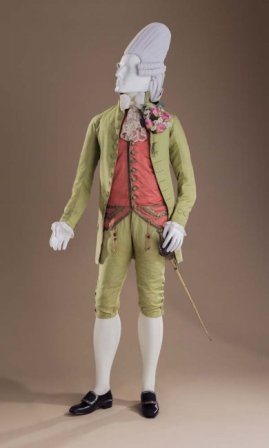
The Macaroni ensemble: Man’s Three-piece Suit, ca. 1770. Sword with Chatelaine, late 18th century. Men’s Pair of Shoe Buckles, late 18th century (LACMA)
Reigning Men: Fashion in Menswear, 1715–2015 explores the history of men’s fashionable dress from the eighteenth century to the present and re-examines the all-too-frequent equation of ‘fashion’ with ‘femininity’.
Beginning with the eighteenth century, the male aristocrat wore a three-piece suit conspicuous in make and style, and equally as lavish as the opulent dress of his female counterpart. The nineteenth-century ‘dandy’ made famous a more refined brand of expensive elegance which became the hallmark of Savile Row. The mid-twentieth-century ‘mod’ relished in the colorful and modern styles of Carnaby Street, and the twenty-first century man—in an ultra-chic ‘skinny suit’ by day and a flowered tuxedo by night—redefines today’s concept of masculinity.
Drawing primarily from LACMA’s renowned permanent collection, Reigning Men makes illuminating connections between history and high fashion. The exhibition traces cultural influences over the centuries, examines how elements of the uniform have profoundly shaped fashionable dress, and reveals how cinching and padding the body was, and is, not exclusive to women. The exhibition features 200 looks, and celebrates a rich history of restraint and resplendence.
This exhibition was organized by the Los Angeles County Museum of Art and made possible by Ellen A. Michelson. Additional support is provided by the Wallis Annenberg Director’s Endowment Fund.
◊ ◊ ◊ ◊ ◊
From Prestel:
Sharon Sadako Takeda, Kaye Durland Spilker, and Clarissa Esguerra, with contributions by Tim Blanks and Peter McNeil, Reigning Men: Fashion in Menswear, 1715–2015 (New York: Prestel, 2016), 272 page, ISBN: 978–3791355207, $55 / £35.
This fully illustrated book accompanies one of the most comprehensive exhibitions dedicated solely to three centuries of men’s fashion. The fashionable male may be making a comeback, but early fashion trends centered around what men—not women—were wearing. This intriguing book traces the history of men’s fashion since the 18th century, when young Englishmen imitated foreign dress and manners after touring the European continent. This phenomenon is only one of many explored in sections titled ‘Revolution/Evolution’, ‘East/West’, ‘Uniformity’, ‘Body Consciousness’, and ‘The Splendid Man’. In addition to numerous illustrations of extant menswear, the book captures the 19th-century dandy, a more restrained brand of expensive elegance which became the hallmark of Savile Row; the post-WWII mod, who relished the colorful styles of Carnaby Street; and the 21st-century man—ultra-chic in a sleek suit by day, wearing a flowered tuxedo by night. Reigning Men illuminates connections between history and high fashion, traces cultural influences over the centuries, examines how uniforms have profoundly shaped fashionable dress, and reveals that women aren’t the only ones who cinch and pad their bodies.
Sharon Sadako Takeda is Senior Curator and Head of the Costume and Textiles Department at the Los Angles County Museum of Art. Kaye Durland Spilker is Curator, and Clarissa Esguerra is Assistant Curator of the Costume and Textiles Department at the Los Angles County Museum of Art. They are the authors of Fashioning Fashion: European Culture in Detail, 1700–1915 (Prestel, 2010).
◊ ◊ ◊ ◊ ◊
Thomas John Bernard, . . . a theatrical costume designer, worked with the curators and conservators of the Costume and Textiles Department at LACMA to draw these patterns approximating the design of garments in the collection.
PDF documents with annotated patterns are available here»
New Book | Von der Kunst des sozialen Aufstiegs
From ArtBooks.com:
Almut Goldhahn, Von der Kunst des sozialen Aufstiegs: Statusstrategien und Kunstpatronage der venezianischen Papstfamilie Rezzonico (Vienna: Böhlau Verlag, 2016), 408 pages, ISBN: 978-3412503529, $135.
 Als Angehörige der ‘nobilità nuova’ hatten es die Rezzonico schwer, sich innerhalb des oligarchischen Systems der Adelsrepublik Venedig zu behaupten. Schon früh orientierten sie sich daher nach Rom, um parallel zur angestrebten Etablierung der Familie in Venedig eine familiäre Verankerung an der Kurie voranzutreiben. Dieses zweigleisige Modell sollte sich schließlich als tragfähig erweisen: 1758 wurde Clemens XIII. Rezzonico zum Papst gewählt. Über einen Zeitraum von 150 Jahren zeichnet das Buch den Aufstieg der Rezzonico von einer venezianischen Kaufmannsfamilie zu einer römischen Papstfamilie nach. Dabei werden die generationen- und systemübergreifenden Etablierungsstrategien der Familie offengelegt und mit ihrer Kunstpatronage abgeglichen, die gezielt zur visuellen Manifestierung ihres sozialen Status eingesetzt wurde. (Studien zur Kunst, 37).
Almut Goldhahn ist Wissenschaftliche Mitarbeiterin in der Photothek des Kunsthistorischen Instituts in Florenz – Max Planck Institut.
New Book | Louis XIV Outside In
From Ashgate:
Tony Claydon and Charles-Édouard Levillain eds., Louis XIV Outside In: Images of the Sun King Beyond France, 1661–1715, (Farnham: Ashgate), 231 pages, ISBN: 978-1472431264, $125.
 Louis XIV—the ‘Sun King’—casts a long shadow over the history of seventeenth- and eighteenth-century Europe. Yet while he has been the subject of numerous works, much of the scholarship remains firmly rooted within national frameworks and traditions. Thus in France Louis is still chiefly remembered for the splendid baroque culture his reign ushered in, and his political achievements in wielding together a strong centralised French state; whereas in England, the Netherlands and other protestant states, his memory is that of an aggressive military tyrant and persecutor of non-Catholics.
In order to try to break free of such parochial strictures, this volume builds upon the approach of scholars such as Ragnhild Hatton who have attempted to situate Louis’ legacy within broader, pan-European context. But where Hatton focused primarily on geo-political themes, Louis XIV Outside In introduces current interests in cultural history, integrating aspects of artistic, literary and musical themes. In particular it examines the formulation and use of images of Louis XIV abroad, concentrating on Louis’ neighbours in northwest Europe. This broad geographical coverage demonstrates how images of Louis XIV were moulded by the polemical needs of people far from Versailles and distorted from any French originals by the particular political and cultural circumstances of diverse nations. Because the French regime’s ability to control the public image of its leader was very limited, the collection highlights how—at least in the sphere of public presentation—his power was frequently denied, subverted, or appropriated to very different purposes, questioning the limits of his absolutism which has also been such a feature of recent work.
Tony Claydon is Professor of Early Modern History at Bangor University, Wales. He is author of several books including, William III and the Godly Revolution; (with Ian McBride) ed., Protestantism and National Identity: Britain and Ireland, c.1650–c.1850; William III: Profiles in Power; and Europe and the Making of England, 1660–1760.
Charles-Édouard Levillain is Professor of History at the Université Paris VII Denis Diderot, France. A historian of early modern Britain and Europe, he works primarily on Anglo-Dutch politics in the late seventeenth and early eighteenth centuries. He is author of Vaincre Louis XIV: Angleterre-Hollande-France: Histoire d’une relation tiangulaire (1665–1688) (Champ Vallon, 2010); and Un glaive pour un royaume: La querelle de la milice dans l’Angleterre du XVIIe siècle (Honoré Champion, 2014).
◊ ◊ ◊ ◊ ◊
C O N T E N T S
List of Illustrations
Notes on Contributors
Acknowledgments
Introduction: Louis XIV Upside Down? Interpreting the Sun King’s Image, Tony Claydon and Charles-Édouard Levillain
1 Image Battles under Louis XIV: Some Reflections, Hendrik Ziegler
2 Francophobia in Late-17th-Century England, Tim Harris
3 ‘We Have Better Materials for Clothes, They, Better Taylors’: The Influence of La Mode on the Clothes of Charles II and James II, Maria Hayward
4 The Court of Louis XIV and the English Public Sphere: Worlds Set Apart?, Stéphane Jettot
5 Popular English Perceptions of Louis XIV’s Way of War, Jamel Ostwald
6 Louis XIV, James II and Ireland, D.W. Hayton
7 Lampooning Louis XIV: Romeyn de Hooghe’s Harlequin Prints, 1688–89, Henk van Nierop
8 Foe and Fatherland: The Image of Louis XIV in Dutch Songs, Donald Haks
9 Amsterdam and the Ambassadors of Louis XIV 1674–85, Elizabeth Edwards
10 Millenarian Portraits of Louis XIV, Lionel Laborie
Index
New Book | The Forge of Vision: A Visual History of Modern Christianity
From the University of California Press:
David Morgan, The Forge of Vision: A Visual History of Modern Christianity (Los Angeles: University of California Press, 2015), 407 pages, ISBN: 978-0520286955, $40 / £28.
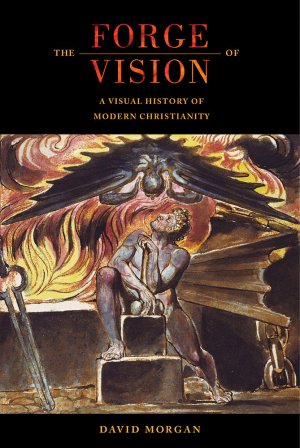 Religions teach their adherents how to see and feel at the same time; learning to see is not a disembodied process but one hammered from the forge of human need, social relations, and material practice. David Morgan argues that the history of religions may therefore be studied through the lens of their salient visual themes. The Forge of Vision tells the history of Christianity from the sixteenth century through the present by selecting the visual themes of faith that have profoundly influenced its development. After exploring how distinctive Catholic and Protestant visual cultures emerged in the early modern period, Morgan examines a variety of Christian visual practices, ranging from the imagination, visions of nationhood, the likeness of Jesus, the material life of words, and the role of modern art as a spiritual quest, to the importance of images for education, devotion, worship, and domestic life. An insightful, informed presentation of how Christianity has shaped and continues to shape the modern world, this work is a must-read for scholars and students across fields of religious studies, history, and art history.
David Morgan is Professor of Religious Studies at Duke University, with a secondary appointment in the Department of Art, Art History, and Visual Studies. He is the author of The Embodied Eye: Religious Visual Culture and the Social Life of Feeling and The Sacred Gaze: Religious Visual Culture in Theory and Practice, and coeditor of the journal Material Religion.
◊ ◊ ◊ ◊ ◊
C O N T E N T S
List of Illustrations
Acknowledgments
Introduction
I Word and Image
1 The Shape of the Holy
2 The Visible Word
II The Traffic of Images
3 Religion as Sacred Economy
4 The Agency of Words
5 Christianity and Nationhood
6 The Likeness of Jesus
7 Modern Art and Christianity
Conclusion
Notes
Selected Bibliography
Index
Year-End Gift Ideas
I’ve had good intentions of pulling this together for weeks, and now it’s surely of almost no use to anyone in terms of gift ideas. Still, it allows me to expand a bit on the usual scope of the blog, and please, by all means chime in with comments for the brilliant suggestions I should have included! -CH
◊ ◊ ◊ ◊ ◊
From Little, Brown, and Company:
Stacy Schiff, The Witches: Salem, 1692 (New York: Little, Brown, and Company, 2015), 512 pages, ISBN: 978-0316200608, $32.
 The Pulitzer Prize-winning author of Cleopatra, the #1 national bestseller, unpacks the mystery of the Salem Witch Trials. It began in 1692, over an exceptionally raw Massachusetts winter, when a minister’s daughter began to scream and convulse. It ended less than a year later, but not before 19 men and women had been hanged and an elderly man crushed to death. The panic spread quickly, involving the most educated men and prominent politicians in the colony. Neighbors accused neighbors, parents and children each other. Aside from suffrage, the Salem Witch Trials represent the only moment when women played the central role in American history. In curious ways, the trials would shape the future republic. As psychologically thrilling as it is historically seminal, The Witches is Stacy Schiff’s account of this fantastical story-the first great American mystery unveiled fully for the first time by one of our most acclaimed historians.
Stacy Schiff is the author of Véra (Mrs. Vladimir Nabokov), winner of the Pulitzer Prize; Saint-Exupéry, Pulitzer Prize finalist; A Great Improvisation: Franklin, France, and the Birth of America, winner of the George Washington Book Prize; and Cleopatra: A Life. Schiff has received fellowships from the Guggenheim Foundation and the National Endowment for the Humanities and an award in literature from the American Academy of Arts and Letters. Named a 2011 Library Lion by the New York Public Library, she lives in New York City.
◊ ◊ ◊ ◊ ◊
From Knopf:
Sven Beckert, Empire of Cotton: A Global History (New York: Knopf, 2014), 640 pages, ISBN: 978-0375414145, $35.
 The empire of cotton was, from the beginning, a fulcrum of constant global struggle between slaves and planters, merchants and statesmen, workers and factory owners. Sven Beckert makes clear how these forces ushered in the world of modern capitalism, including the vast wealth and disturbing inequalities that are with us today.
In a remarkably brief period, European entrepreneurs and powerful politicians recast the world’s most significant manufacturing industry, combining imperial expansion and slave labor with new machines and wage workers to make and remake global capitalism. The result is a book as unsettling as it is enlightening: a book that brilliantly weaves together the story of cotton with how the present global world came to exist.
Sven Beckert is the Laird Bell Professor of American History at Harvard University. Holding a PhD from Columbia University, he has written widely on the economic, social, and political history of capitalism. He has been the recipient of numerous awards and fellowships, including from Harvard Business School, the Dorothy and Lewis B. Cullman Center for Scholars and Writers at the New York Public Library, and the Charles Warren Center for Studies in American History. He was also a fellow of the American Council of Learned Societies and the John Simon Guggenheim Memorial Foundation. He lives in Cambridge, Massachusetts.
◊ ◊ ◊ ◊ ◊
From Rizzoli:
Princess Gloria von Thurn und Taxis and John Richardson, with photographs by Todd Eberle, The House of Thurn und Taxis (New York: Skira Rizzoli, 2015), 240 pages, ISBN: 978-0847847143, $85.
 Adventure through the princely Thurn und Taxis estate, an enchanted palace where 1,000 years of history meets a thoroughly modern family. For 200 years the Thurn und Taxis family have called the palace of St. Emmeram home. Regarded as one of Germany’s finest examples of historicist architecture, the Regensburg residence’s myriad rooms trace centuries of distinctive styles: a Romanesque-Gothic cloister built between the twelfth and fourteenth centuries, a neo-Renaissance marble staircase, a number of Rococo and neo-Rococo staterooms, and a Baroque library frescoed in 1737. Celebrated photographer Todd Eberle captures the confluence of high art and grand architecture within the 500-room palace to reveal the curious tale of the Thurn und Taxis family. Complete with stately portraits and scenes of life at St. Emmeram, this monograph offers a glimpse into the world and glamour of one of the most important dynasties of the European aristocracy.
Sir John Richardson is a British art historian and Picasso biographer. Princess Gloria von Thurn und Taxis is the matriarch of the princely house of the Thurn and Taxis. André Leon Talley is an author and contributing editor of Vogue. Alexander Count von Schoenburg is a journalist and author. Elisabeth von Thurn und Taxis is an author and writer for Vogue.
◊ ◊ ◊ ◊ ◊
From Flammarion:
A Day at Château de Vaux-le-Vicomte (Paris: Flammarion, 2015), 192 pages, ISBN: 978-2080201997, $35.
 An insider’s tour of the magnificent seventeenth-century castle and gardens, conceived by Le Vau, Le Brun, and Le Nôtre, that inspired the great châteaux of Europe. Vaux le Vicomte’s rich history began in 1641, when infamous finance minister Nicolas Fouquet bought the estate and enlisted architect Louis Le Vau, decorator Charles Le Brun, and garden designer André Le Nôtre to transform it into a lavish residence. His extravagance piqued Louis XIV’s jealousy, and he was thrown into prison for mishandling funds. The château inspired the design of Versailles and was later home to the great chef Vatel, who famously died for his art. This volume traces the château’s history from the seventeenth century through the Belle Époque, World War I, and its public opening in 1968. Exclusive photography and archival documents offer unprecedented access to the château, furnishings, and gardens, and illuminate the extraordinary secrets of court life and centuries of celebrations that include the enchanting candlelit tours held today.
Alexandre de Vogüé, Jean-Charles de Vogüé and Ascanio de Vogüé are brothers who together manage the Vogüé family estate. In 2012, they began to successfully develop a range of business ventures at the Vaux le Vicomte château. Alexandre, Jean-Charles and Ascanio are fifth generation members of the de Vogüé family. Bruno Ehrs is a lifestyle and architectural photographer based in Stockholm, Sweden. His photographs have been featured in over twenty solo exhibitions and have appeared in numerous magazines and books, including One Savile Row (Flammarion 2014). He has also published several art volumes of his work.
◊ ◊ ◊ ◊ ◊
From Other Press:
Chantal Thomas, The Exchange of Princesses, translated by John Cullen (New York: Other Press, 2015), 336 pages, ISBN: 978-1590517024, $17.
 Set in the French and Spanish courts of the eighteenth century, this novel is based on a true story about the fate of two young princesses caught in the intrigues and secrets of the moment. Philippe d’Orléans, the regent of France, has a gangrenous heart—the result of a life of debauchery, alcohol, power, and flattery. One morning in 1721, he decides to marry eleven-year-old Louis XV to the daughter of Philippe V of Spain, who is only four. Orléans hopes this will tie his kingdom to Spain. But were Louis to die without begetting an heir—the likeliness of which is greatly increased by having a child bride—Orléans himself would finally be king. Orléans tosses his own daughter into the bargain, the twelve-year-old Mlle de Montpensier, who will marry the Prince of Asturias, the heir to the Spanish throne. The Spanish court enthusiastically agrees and arrangements are made. The two nations trade their princesses in a grand ceremony in 1722, making bonds that should end the historical conflict. Nothing turns out as expected.
Chantal Thomas is a noted philosopher and writer. She has taught at a number of American universities and is the author of twenty-five works, including novels, histories, short stories, plays, and essays. Her internationally acclaimed novel Farewell, My Queen, a fictional account of Marie Antoinette’s final days in Versailles, won the Prix Femina in 2002 and was made into an award-winning film by Benoit Jacquot, and starred Diane Kruger. A film adaptation of The Exchange of Princesses, to be directed by Marc Dugain, is currently in the works.
John Cullen is the translator of many books from Spanish, French, German, and Italian, including Philippe Claudel’s Brodeck, Juli Zeh’s Decompression, Antonio Skármeta’s A Distant Father, and Yasmina Reza’s Happy Are the Happy. He lives in upstate New York.
◊ ◊ ◊ ◊ ◊
From The Getty:
Bruno Gibert, A King Seen from the Sky (Los Angeles: J. Paul Getty Museum, 2015), 32 pages, ISBN-13: 978-1606064603, $17.
 This delightful book by award-winning children’s book author and illustrator Bruno Gibert is inspired by the true story of the first flight of living creatures in a handmade aircraft. On September 19, 1783, the Montgolfier brothers demonstrated their new invention, the hot-air balloon or montgolfière, at the Palace of Versailles before a large crowd, including Louis XVI and Marie Antoinette. Considered too dangerous for human passengers, the experimental vessel carried a sheep, a duck, and a hen in its basket. The balloon flew for about eight minutes, covered a distance of roughly two miles, and reached an altitude of more than 1,500 feet before landing safely. The animals’ balloon ride caused a sensation and the first human flight followed a few months later.
By the end of 1783, Louis XVI had ennobled the Montgolfier family in recognition of the brothers’ important achievements, which perhaps prompted a royal celebration for the animals like the one depicted in the book. In Gibert’s fantasy, the animals anger the king at the fete by describing him as “no bigger than the tiniest snail” when viewed from high above the ground, and Louis imprisons them in the Bastille. While the direct role of talking animals in the storming of the Bastille in 1789 can’t quite be supported by historical evidence, this book does vividly evoke the stirring developments in aeronautics that took place right around the time of the French Revolution. Ages five to seven.
Bruno Gibert is a children’s book author and illustrator; he also writes novels for adults. His book Le Petit Gibert Illustré received the Prix Coup de Coeur du Salon de Montreuil in 2010.
◊ ◊ ◊ ◊ ◊
From Frances Lincoln:
Anna Keay and Caroline Stanford, Landmark: A History of Britain in 50 Buildings, 50 Years of the Landmark Trust (London: Frances Lincoln, 2015), 288 pages, ISBN: 978-0711236455, $40.
 This engaging and sumptuously illustrated book celebrates the Landmark Trust’s achievement in the protection of British heritage since the Trust was established 50 years ago. From a medieval hall house to the winner of the 2013 Stirling Prize for Architecture, 50 buildings rescued by Landmark from threatened oblivion are presented here that vividly illustrate the history of Britain from 1250 to the present day.
Presented in the order in which they were built, the selected buildings include the unusual, the fantastic, the spectacular, the utilitarian and the enchanting, each one offering a fascinating glimpse into the past of the British people. In telling the stories of how the buildings came to be, how they were used and how they were adapted by subsequent generations, this book brings history to life through the evidence in the buildings our ancestors have left behind. Examples include a 15th-century inn in Suffolk, an Elizabethan hospital in Yorkshire, a lighthouse on Lundy and an Italianate railway station. The Landmark Trust’s often heroic rescue of each of these buildings is also placed in the context of the Trust’s own evolution to date and the history of British conservation practice.
Anna Keay is a historian with a professional specialism in historic buildings. She has a BA in Modern History from Oxford University, and a PhD in 17th-century British history from the University of London. Formerly a curator at Hampton Court Palace and Curatorial Director of English Heritage, she is now Director of the Landmark Trust. Her books include The Magnificent Monarch (2008), about King Charles II; The Elizabethan Tower of London (2001) and The Crown Jewels (2011). She is also a regular contributor to TV and radio. She divides her time between London and King’s Lynn, Norfolk.
Caroline Stanford has been Historian to the Landmark Trust since 2001. She holds a BA in Modern History from Oxford University, an MA in Early Modern History from London University, and an MSc in Historic Conservation from Oxford Brookes University. She has researched many of the Trust’s buildings, participating in Landmark’s rescue of some of Britain’s finest buildings at risk. This combination of academic research and applied practice allows her to write and contribute widely across all building types and periods to all types of media.
◊ ◊ ◊ ◊ ◊
Available from Pentreath & Hall (I can’t say enough good things about both Pentreath’s blog and his shop in London):
John Rocque’s Plan of the Cities of London and Westminster, and Borough of Southwark, 1746, in 24 sheets, £175.
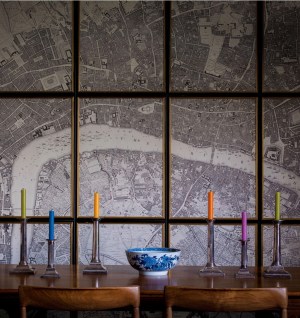 This reproduced publication, measuring 32.5″ (82.5 cm) wide by 22″ (55.9 cm) high, consists of: a cover sheet; an introduction by James Howgego, a past Keeper of Prints and Pictures at the Guildhall Library, London; a key sheet and 24 map sheets, at a scale of 26″ to a mile. The map sheets form a grid eight across and three high, with the image on each sheet being approximately 27″ (68.6 cm) high by 19″ (48.3 cm) wide, thus forming a map area of approximately 12′ 8″ (386 cm) by 6′ 8″ (203 cm) if trimmed and assembled. If the two outer columns were ignored (and their borders transferred to the second and seventh columns), the assembled map area becomes approximately 9′ 6″ (290 cm) wide by 6′ 8″ (203 cm).
The original image was captured, in 1970, by photographic process, which, after being cleaned up and all trace of colouring removed (again by photographic process), resulted in a positive film the same size as the original. This film was then used to create lithographic plates, from which the 1971 print run was taken. The current print run used a digital image, which has been printed lithographically. The Plan is printed on 140 gsm acid free paper, sidestitch bound in 285 gsm card covers.
Exhibition | Strength and Splendor: Wrought Iron

Florist’s Sign and Bracket, 18th century, France, wrought iron and rolled iron, cut, polychromed, and gilded; fastened with rivets and rings. Sign: 28 × 21 × 5 inches (71.5 × 52.6 × 12.5 cm), bracket: 33 × 52 × 2 inches (84 × 132.5 × 6 cm) (Rouen: Musée Le Secq des Tournelles, inv. LS 2011.0.199)
◊ ◊ ◊ ◊ ◊
Now on view at The Barnes Foundation:
Strength and Splendor: Wrought Iron from the Musée Le Secq des Tournelles, Rouen
The Barnes Foundation, Philadelphia, 19 September 2015 — 4 January 2016
Curated by Judith Dolkart with Anne-Charlotte Cathelineau
The world’s most important collection of wrought iron objects—door knockers, garden implements, jewelry, keyhole escutcheons, locks, bas reliefs, signs, strongboxes, surgical tools—from the Musée le Secq des Tournelles, Rouen will complement one of the most intriguing collections at the Barnes Foundation: the 887 pieces of European and American metalwork that punctuate the Foundation’s signature wall arrangements of old master and modern paintings.

Escutcheon, 18th century, France, wrought iron and rolled iron, stamped and with openwork, 19.3 × 16.4 × 0.8 cm (Musée Le Secq des Tournelles, Inv. LS S.N.3)
Albert C. Barnes underscored the formal affinities that these objects shared with the “motives and arabesques” in the paintings in his Gallery, neither identifying individual objects nor explaining their use. Often, he combined disparate objects—shoe buckles and door hinges, ladles and hasps—to create new forms. In a 1942 letter to the American artist Stuart Davis, Barnes noted that the anonymous craftsman of such functional items was “just as authentic an artist as a Titian, Renoir, or Cézanne.”
This exhibition will explore the fabrication, function, and intricate ornamentation of approximately 150 masterworks from the Musée Le Secq des Tournelles, Rouen. They range in date from the Middle Ages to the early 20th century, and they show iron as unexpectedly versatile, with its capacity to convey both masculine heft and an impossibly fragile delicacy that is hard to square with its industrial image. Objects ennobled with silver and gold inlays show iron as more than base metal. Some are deadly serious in their efficacy; others delight as much by their wit as by their exquisite intricacy—locks that represent their own function, for example, one with a built-in faithful guard dog or one with spring-loaded manacles ready to catch a lock-pick—an 18th-century sign in the shape of a greyhound that looks like something Calder might have made two centuries later, an early electrified bat-shaped night-light.
Assembled in the 19th century by Jean-Louis-Henri Le Secq Destournelles (1818–1882), the celebrated photographer of French architectural monuments, and his son Henri (1854–1925), the Le Secq collection was shown to great acclaim at the Exposition Universelle in 1900 and installed until the 1920s at the Musée des arts décoratifs in Paris. In the early 1920s, Le Secq acquired the deconsecrated church of Saint-Laurent in Rouen, where he lived and arranged his extensive collection of European and Middle Eastern objects by type, in distinctive, often symmetrical, wall arrangements and in custom-made vitrines. Barnes, who traveled frequently to France as he built his collection, is believed to have visited Rouen to see this impressive holding. The exhibition will be accompanied by a catalogue containing an essay on Barnes’s collecting of metalwork, one on the collection at Musée Le Secq des Tournelles, and short essays on groups of works, and an illustrated glossary of technical terms.
The exhibition is curated by Judith F. Dolkart, the Mary Stripp & R. Crosby Kemper Director of the Addison Gallery of American Art at Phillips Academy, Andover, MA, and former Deputy Director of Art and Archival Collections and Gund Family Chief Curator at the Barnes Foundation. An expert on the art and culture of 19th-century France, Dolkart graduated from Phillips Exeter Academy in 1989 and received an A.B. in fine arts in 1993 from Harvard-Radcliffe College, where she examined the work of Frank Stella for her thesis. In 1997, she earned an M.A. from the University of Pennsylvania. During her 2013 fellowship at the Center for Curatorial Leadership, Dolkart was mentored by the director of the Harvard Art Museums and had a week-long residency with the director of the Metropolitan Museum of Art. She is currently a Ph.D. candidate in the history of art at the University of Pennsylvania.
Anne-Charlotte Cathelineau, curator in charge of the objets d’art at the Musée Le Secq des Tournelles, selected the objects included in Strength and Splendor and authored the catalogue’s essay on the holdings in Rouen, as well as several entries on individual objects.
◊ ◊ ◊ ◊ ◊
The catalogue is available from The Barnes Foundation:
Anne-Charlotte Cathelineau, with contributions by Richard Wattenmaker, François Boyenval, Hélène Thomas, and Bruno Varin, Strength and Splendor: Wrought Iron from the Musée le Secq des Tournelles, Rouen (Philadelphia: The Barnes Foundation, 2015), 175 pages, ISBN: 978-0984857869, $65.
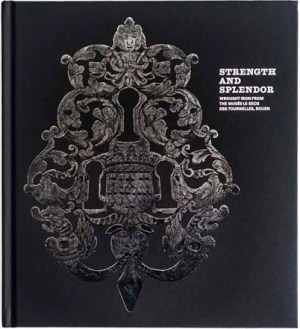 The Le Secq collection is the most important holding of wrought iron in the world, combining artistic virtuosity, technological innovation, and whimsy. It was created by Jean-Louis Henri Le Secq Destournelles (1818–1882) and his son Henri-Jean Le Secq des Tournelles (1854–1925). The older Le Secq focused on masterpieces—exceptional objects. The younger Le Secq inherited his father’s enthusiasm and assembled an encyclopedic array of adornments, instruments, and tools, which he catalogued like natural history specimens. He gave the collection to the city of Rouen, where it has been spectacularly displayed in the deconsecrated church of Saint-Laurent since 1921. This catalogue covers some 150 of the most magnificent objects in the Le Secq collection, classed in ten categories—including locks and keys, decorative plaques, and everyday objects—with essays on the history of the Le Secq collection and on the place of
metalwork in the Barnes Foundation.
New Book | Exhibiting the Empire
From Manchester UP (and now 50% off at Oxford UP’s sitewide sale) . . .
John MacKenzie and John McAleer, eds., Exhibiting the Empire: Cultures of Display and the British Empire (Manchester: Manchester University Press, 2015), 288 pages, ISBN: 978-0719091094, $110.
 Exhibiting the Empire considers how a whole range of cultural products from paintings, prints, photographs, panoramas and ‘popular’ texts to ephemera, newspapers and the press, theatre and music, exhibitions, institutions and architecture were used to record, celebrate and question the development of the British Empire. The empire was exhibited for a variety of reasons: to promote trade and commerce; to encourage emigration and settlement; to assert, project and cement imperial authority; to digest and display the data and specimens derived from various voyages of exploration and missionary endeavours undertaken in the name of empire; to celebrate and commemorate important landmarks, people or events in the imperial pantheon. By considering a broad sweep of different media and ‘imperial moments’, this collection highlights the contingent and changing nature of imperial display, as well as its continuing impact in Britain throughout (and beyond) the country’s imperial meridian. Exhibiting the empire represents a significant and original contribution to our understanding of the relationship between culture and the British Empire.
Written by leading scholars from a range of disciplinary backgrounds, individual chapters bring fresh perspectives to the interpretation of media, material culture and display, and their interaction with the history of the British Empire. Exhibiting the Empire will be essential reading for scholars and students interested in British history, the history of empire, art history, and the history of museums and collecting.
John M. MacKenzie is Emeritus Professor of Imperial History at Lancaster University and holds Honorary Professorships at the universities of Aberdeen, St Andrews and Stirling, as well as an Honorary Fellowship at Edinburgh University. John McAleer is Lecturer in History at the University of Southampton.
◊ ◊ ◊ ◊ ◊
C O N T E N T S
Introduction: Cultures of Display and the British Empire, John MacKenzie and John McAleer
1 An Elite Imperial Vision: Eighteenth-Century British Country Houses and Four-Continents Imagery, Stephanie Barczewski
2 Exhibiting Exploration: Captain Cook, Voyages of Exploration and the Culture of Display, John McAleer
3 Satirical Peace Prints and the Cartographic Unconscious, Douglas Fordham
4 Sanguinary Engagements: Exhibiting the Naval Battles of the French Revolutionary and Napoleonic Wars, Eleanor Hughes
5 Empire under Glass: The British Empire and the Crystal Palace, 1851–1911, Jeffrey Auerbach
6 Ephemera and the British Empire, Ashley Jackson and David Tomkins
7 Exhibiting the Empire in Print: The Press, the Publishing World and the Promotion of ‘Greater Britain’, Berny Sèbe
8. Exhibiting the Empire at the Delhi Durbar of 1911: Imperial and Cultural Contexts, John MacKenzie
9. Elgar’s Pageant of Empire, 1924: An Imperial Leitmotiv, Nalini Ghuman
10. Representing ‘Our Island Sultanate’ in London and Zanzibar: Cross-currents in Educating Imperial Publics, Sarah Longair
Index
Exhibition | Transparent Art: Rock Crystal Carving
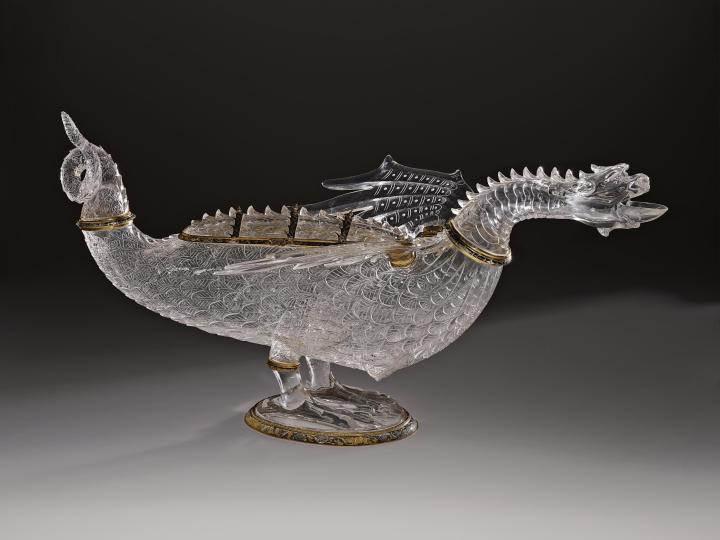
Vase in the shape of a dragon or ‘caquesseitão’; Milan, workshop of the Miseroni, possibly Gasparo Miseroni (act. 1550–70) (?) Rock crystal; second half of the 1500s (Madrid: Museo Nacional del Prado)
◊ ◊ ◊ ◊ ◊
Now on view at the Prado, this exhibition of sixteenth-century carved rock crystal includes items from the collection of the Grand Dauphin (1661–1711). The show also provides a convenient occasion to draw attention to the Prado’s newly designed website, which particularly showcases images. While such a feature might seem obvious for a museum website, it’s hardly been true in most cases to date (the press release detailing the site’s key features is available here).
From the Prado:
Transparent Art: Rock Crystal Carving in Renaissance Milan
Museo Nacional del Prado, Madrid, 14 October 2015 — 10 January 2016
Curated by Letizia Arbeteta Mira
The present exhibition offers visitors a unique opportunity to see a little known chapter in art history, namely that of carving hyaline quartz or rock crystal, a technique for which Milan was particularly celebrated in the second half of the 16th century. Due to their value, both material and artistic, these works were only within the reach of monarchs and the highest ranks of the European aristocracy.
 The exhibition includes six magnificent examples loaned from two of the most important historical collections: that of the Medici, now in the Museo degli Argenti in Florence, and the collection of Louis XIV, now in the Musée du Louvre in Paris. Another fourteen splendid pieces, now in the Prado, come from the collection assembled by the Grand Dauphin of France, son of Louis XIV, which was in part inherited by Philip V, the first Spanish Bourbon monarch, in 1711. The latter group, known as ‘The Dauphin’s Treasure’, entered the Prado in 1839. Although somewhat reduced over the course of its eventful history, it still includes important objects, particularly those in rock crystal. In total it has 47 hyaline quartz vessels, 2 in citrine quartz and 1 in smoky quartz. Various academic studies have attributed these pieces to leading workshops and masters, almost all of them Milanese.
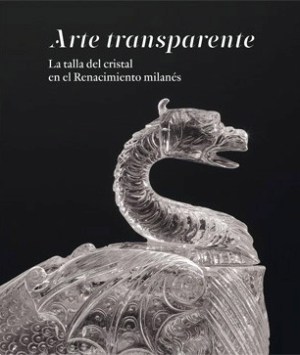
Letizia Arbeteta Mira, Arte transparente: La talla del cristal en el Renacimiento milanés (Madrid: Museo del Prado, 2015), 160 pages, ISBN: 978-8484803362, 39€.
Exhibition | Drawn from Courtly India
Press release (6 November 2015) from the Philadelphia Museum of Art:
Drawn from Courtly India: The Conley Harris and Howard Truelove Collection
Philadelphia Museum of Art, 6 December 2015 — 27 March 2016
Curated by Ainsley Cameron
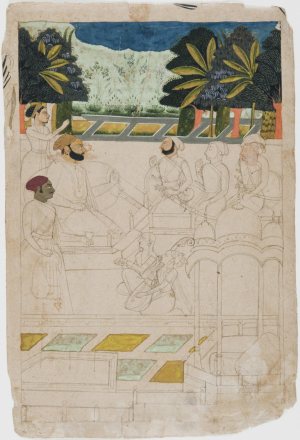
A Prince and Courtiers in a Garden, ca. 1720–30, with later additions, India (Jodhpur or Bikaner, Rajasthan) (Philadelphia Museum of Art, 2013-77-31).
The Philadelphia Museum of Art presents an exhibition of rare and masterful drawings created in the workshops of royal Indian courts over the course of four centuries. Drawn from Courtly India: The Conley Harris and Howard Truelove Collection features a wide range of sketches, preparatory studies, and compositional drawings that vividly depict mythological themes, verdant landscapes and architectural settings, portraits of prominent rulers, and scenes from the lives of Indian nobility. The Museum acquired these important works in 2013, many as a gift, and is presenting the collection in this exhibition for the first time.
While Indian paintings have long been sought after by museums and individual collectors, there has been only a limited interest in drawings. Yet drawings may be wonderful works of art in their own right, yielding a remarkable amount of information about workshop practices and artistic process. Conley Harris, a landscape painter, and the late Howard Truelove, an architectural designer, shared a passion for drawing. They began collecting Indian drawings after being inspired by their travels throughout that country. The collection they assembled over the course of more than a decade provides new insights into the artistic practices of the royal workshops that developed over generations, and offers fresh perspectives on Indian painting. Many of the works to which these collectors were drawn were created during the eighteenth century in the Hindu courts of western India and the Himalayan foothills, an area including the present-day states of Rajasthan, Himachal Pradesh and Jammu-Kashmir.
Timothy Rub, the George D. Widener Director and CEO, stated: “The ongoing development of the Museum’s collection has always represented our partnership with great collectors who have been as passionate as we are about sharing with everyone the finest works of art. In this regard we are especially fortunate to have acquired the marvelous collection assembled by Conley Harris and Howard Truelove, and we are enormously grateful to the collectors. This collection adds a new and important dimension to our holdings of Indian art, which is one of the most important in the country. It also enables us to bring to a broader audience this fascinating and delightful aspect of South Asia’s artistic heritage.”
The first section of the exhibition will feature a group of finished drawings and explore the relationship between court artists and their royal patrons. A second will focus on the innovative workshop process, examining how artists developed and revised drawings through techniques such as white wash corrections, color notations, and pouncing. The drawings in this section will highlight not only the artists’ adept handling of the medium, they will also testify to the collaboration of artists employed within a hierarchical workshop structure, demonstrating how skills were conveyed from master to apprentice. A third section, dedicated to the key moment when brush first meets paper, calls attention to the expressive power of the expert brushstroke. The fourth and final section of the exhibition invites visitors to respond to the works on display by creating their own drawings using workshop techniques.
The exhibition is organized by Ainsley M. Cameron, the Museum’s Ira Brind and Stacey Spector Assistant Curator of South Asian Art. She stated: “These works offer new ways of looking and thinking about Indian courtly drawing. People tend to approach the study of paintings or drawings from the perspective of the patron because so many of the artists’ names are unknown, but we are exploring the perspective of the artist, as maker—the gesture of an artist’s hand, the spontaneity of line, and the process through which ideas are born.”
About Conley Harris and Howard Truelove
Based in Boston, artist Conley Harris (born 1945) is a former faculty member of the department of art and art history at the University of New Hampshire. Harris is known for his lyrical landscapes of New England and the American West. Howard Truelove (1946–2012) was an architectural designer and vice president of design at the firm KlingStubbins in Cambridge, Massachusetts. His interior-design work ranged from public spaces in major office buildings to universities and museums. Harris often uses works in their collection as a source of inspiration, creating paintings that not only absorb motifs from South Asian and Persian miniature paintings, but also play with the idea of multiple layers, the palimpsest found in artists’ working sketches and so creatively reinterpreting the historical drawings for a new generation.
◊ ◊ ◊ ◊ ◊
The catalogue is distributed by Yale UP:
Ainsley Cameron, with an essay by Darielle Mason, Drawn from Courtly India: The Conley Harris and Howard Truelove Collection (Philadelphia: Philadelphia Museum of Art, 2015), 160 pages, ISBN: 978-0300215250, $35.
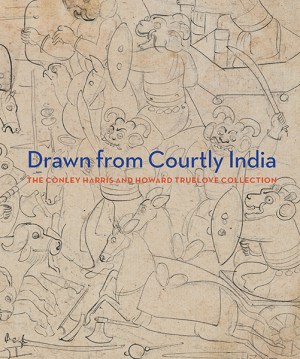 This publication presents the first in-depth survey of the Conley Harris and Howard Truelove Collection of Indian Drawings, which was recently acquired by the Philadelphia Museum of Art. This exceptional collection consists of 65 works on paper created between the 16th and 19th centuries. The Harris-Truelove Collection is uniquely and tightly focused on works from the royal courts of North India, and the majority of these drawings served as preparatory material for the opaque watercolor illustrations that have been widely collected and studied. This catalogue celebrates the assured line of the Indian draftsman and recognizes these drawings as accomplished works of art in their own right. The text details the process and technique involved in their production, and explores what can be revealed by the artist’s hand. The catalogue also contextualizes the role of art production in court culture, and reveals the intricacies of artistic workshop practice.
Ainsley Cameron is the Ira Brind and Stacey Spector Assistant Curator of South Asian Art, and Darielle Mason is the Stella Kramrisch Curator of Indian and Himalayan Art, both at the Philadelphia Museum of Art.










 Enfilade
leave a comment