New Book | Passion and Control: Dutch Architectural Culture
Forthcoming in January from Ashgate:
Freek Schmidt, Passion and Control: Dutch Architectural Culture of the Eighteenth Century (Farnham: Ashgate, 2016), 362 pages, ISBN: 978-0754635819, $120.
 Passion and Control explores Dutch architectural culture of the eighteenth century, revealing the central importance of architecture to society in this period and redefining long-established paradigms of early modern architectural history. Architecture was a passion for many of the men and women in this book; wealthy patrons, burgomasters, princes and scientists were all in turn infected with architectural mania. It was a passion shared with artists, architects and builders, and a vast cast of Dutch society who contributed to a complex web of architectural discourse and who influenced building practice. The author presents a rich tapestry of sources to reconstruct the cultural context and meaning of these buildings as they were perceived by contemporaries, including representations in texts, drawings and prints, and builds on recent research by cultural historians on consumerism, material culture and luxury, print culture and the public sphere, and the history of ideas and mentalities.
Freek Schmidt is Associate Professor of Architectural History at Vrije Universiteit Amsterdam, The Netherlands.
◊ ◊ ◊ ◊ ◊
C O N T E N T S
List of Illustrations
Acknowledgments
Introduction
1 Domestic Pleasures
2 Arcadian Territory
3 Royal Ambitions
4 Amateur Passions
5 Reforming Correction
6 Space for Experiment
7 Distinguished Sociability
Epilogue
Bibliography
Index
New Book| Luca Carlevarijs
From Artbooks.com:
Dario Succi, Luca Carlevarijs (Gorizia: Libreria Editrice Goriziana, 2015), 336 pages, ISBN: 978-8861022294, $115.
 La monografia dedicata a Luca Carlevarijs (Udine 1663–1730 Venezia) offre il panorama completo e scientificamente aggiornato sui dipinti del maestro che inaugurò agli inizi del Settecento la gloriosa stagione del vedutismo veneziano. Compilato da Dario Succi, curatore dell’unica mostra finora dedicata all’artista (Padova, Palazzo della Ragione, 1994), il catalogo contiene nella prima parte la ricostruzione dell’itinerario artistico partendo dai famosi porti di mare e dagli spettacolari ingressi solenni degli ambasciatori esteri nel Palazzo Ducale. Fa seguito la schedatura accurata dei 185 dipinti sicuramente autografi presenti nei musei e nelle collezioni private di tutto il mondo, sottoponendo ad una stringente analisi critica le opere pubblicate in precedenza, separandole da quelle dei seguaci. Splendidamente illustrato con 240 immagini a colori anche a doppia pagina, il volume di 340 pagine intende porsi come riferimento ineludibile per gli amanti dell’arte veneziana, oltre che per studiosi, collezionisti, antiquari.
◊ ◊ ◊ ◊ ◊
The monograph devoted to Luca Carlevarijs (Udine Venice 1663–1730) provides a complete overview and scientifically updated on the paintings of the master who ushered in the early eighteenth century the glorious season of Venetian view painting. Compiled by Dario Succi, curator of the only exhibition dedicated to the artist so far (Padua, Palazzo della Ragione, 1994), the catalog contains the first part of the reconstruction of the artistic starting from the famous sea ports and the beautiful solemn entries of the ambassadors Foreign in the Palazzo Ducale. It follows the filing of accurate 185 paintings definitely autographs in museums and private collections around the world, submitting to a stringent critical analysis works published previously, separating them from those of the followers. Beautifully illustrated with 240 color images even double page, the volume of 340 pages intends to become inescapable reference for lovers of Venetian art, not only for scholars, collectors, antique dealers.
New Book | Picturing Marie Leszczinska: Representing Queenship
From Ashgate:
Jennifer G. Germann, Picturing Marie Leszczinska (1703–1768): Representing Queenship in Eighteenth-Century France (Farnham: Ashgate, 2015), 258 pages, ISBN: 978-1409455820, $110.
 Portraits of Queen Marie Leszczyńska were highly visible in eighteenth-century France. Appearing in royal châteaux and, after 1737, in the Parisian Salons, the queen’s image was central to the visual construction of the monarchy. Her earliest portraits negotiated aspects of her ethnic difference, French gender norms, and royal rank to craft an image of an appropriate consort to the king. Later portraits by Maurice-Quentin de La Tour, Carle Van Loo, and Jean-Marc Nattier contributed to changing notions of queenship over the course of her 43 year tenure. Whether as royal wife, devout consort, or devoted mother, Marie Leszczinska’s image mattered. While she has often been seen as a weak consort, this study argues that queenly images were powerful and even necessary for Louis XV’s projection of authority. This is the first study dedicated to analyzing the portraits of Leszczynska. It engages feminist theory while setting the queen’s image in the context of portraiture in France, courtly factional conflict, and the history of the French monarchy. While this investigation is historically specific, it raises the larger problem of the power of women’s images versus the empowerment of women, a challenge that continues to plague the representation of political women today.
Jennifer G. Germann is Assistant Professor in the Department of Art History at Ithaca College.
◊ ◊ ◊ ◊ ◊
C O N T E N T S
List of Illustrations
Acknowledgments
Introduction
1 Framing Queenship in France
2 Incorporating Marie Leszczinska
3 Sons and Mothers
4 Gendering the French monarchy
5 The Queen’s New Image
Epilogue: Memorializing Marie Leszczinska
Bibliography
Index
New Book | The Wonder of the North
From Boydell Press:
Mark Newman, The Wonder of the North: Fountains Abbey and Studley Royal (Woodbridge: Boydell Press, 2015), ISBN: 978-1843838838, 406 pages, $60 / £30.

Dubbed the ‘Wonder of the North’ in 1732, the National Trust’s Fountains Abbey and Studley Royal Estate (now a World Heritage Site) encompasses one of the largest, most magnificent and beautiful designed landscapes ever created. This richly illustrated volume charts the landscape’s history from the first arrival of prehistoric hunters, via medieval monasticism, the Dissolution of the monasteries, eighteenth-century aestheticism and scandal, and the first ages of mass tourism, to the present day. At the heart of the story lies the rise and fall of England’s largest Cistercian monastery and how that shaped the origins of the Aislabie family’s breathtaking gardens. Their Studley Royal was at the forefront of every emergent landscape gardening fashion between 1670 and 1800. The book also describes the dramatic history of the family and the monumental scale of their achievements in this field, extending over many dozens of square miles of North Yorkshire—far beyond the limits of the garden as it is seen today (reduced to serve the more limited needs of Victorian day-trippers). The Wonder of the North brings social and garden history together with archaeology to reveal Fountains Abbey and Studley Royal—too often seen as ‘just’ a ruined medieval monastery—as one of the world’s greatest artistic creations.
Mark Newman has been the National Trust’s archaeological adviser for Fountains Abbey and Studley Royal estate since 1988. He was also resident there, living in Fountains Hall from 1988 to 1995.
◊ ◊ ◊ ◊ ◊
C O N T E N T S
1 Preface: The ‘Wonder of the North’
2 Priming the Canvas: Natural and Man-Made Landscapes before 1132
3 Utility and Sanctity: Fountains Abbey and its Surroundings, 1132–1540
4 From Dissolution to Resurrection: The Manors of Fountains and Studley, 1539–1667
5 Founding a Dynasty: The Emergence of Studley Royal
6 Emerging Wonders: The Unfolding of a Designed Landscape, 1723–42
7 Filling the Landscape: William Aislabie at Studley, 1742–67
8 Beyond Studley’s Domain: Kirkby Fleetham, Hackfall, Laver Banks and Fountains
9 Estates Combined: Fountains and Studley, 1768–81
10 Arcadia Declining: The Estate in the Earlier Nineteenth Century
11 A Place of Popular Resort: The Rising Tide of Visitors
12 Relicts of Our Own Days
13 Conclusion: A Future for Studley Royal
New Book | Noah’s Ark: Essays on Architecture
From The MIT Press:
Hubert Damisch, Noah’s Ark: Essays on Architecture, edited and introduced by Anthony Vidler, translated by Julie Rose (Cambridge: The MIT Press, 2016), 392 pages, ISBN: 978-0262528580, $31.
 Trained as an art historian but viewing architecture from the perspective of a ‘displaced philosopher’, Hubert Damisch in these essays offers a meticulous parsing of language and structure to ‘think architecture in a different key’, as Anthony Vidler puts it in his introduction. Drawn to architecture because it provides ‘an open series of structural models’, Damisch examines the origin of architecture and then its structural development from the nineteenth through the twenty-first centuries. He leads the reader from Jean-François Blondel to Eugène Viollet-le-Duc to Mies van der Rohe to Diller + Scofidio, with stops along the way at the Temple of Jerusalem, Vitruvius’s De Architectura, and the Louvre. In the title essay, Damisch moves easily from Diderot’s Encylopédie to Noah’s Ark (discussing the provisioning, access, floor plan) to the Pan American Building to Le Corbusier to Ground Zero. Noah’s Ark marks the origin of construction, and thus of architecture itself. Diderot’s Encylopédie entry on architecture followed his entry on Noah’s Ark; architecture could only find its way after the Flood.
In these thirteen essays, written over a span of forty years, Damisch takes on other histories and theories of architecture to trace a unique trajectory of architectural structure and thought. The essays are, as Vidler says, ‘a set of exercises’ in thinking about architecture.
Hubert Damisch is Emeritus Professor of the History and Theory of Art at the École des Hautes Études en Sciences Sociales, Paris. Over the course of a long and distinguished career, he has held posts at Cornell University, Columbia University, and the Center for Advanced Studies in the Visual Arts, Washington. He is the author of The Origin of Perspective, The Judgment of Paris, Skyline: The Narcissistic City, and A Theory of Cloud: Toward a History of Painting.
Anthony Vidler is Dean and Professor of the Irwin S. Chanin School of Architecture at The Cooper Union, New York. He is the author of Warped Space: Art, Architecture, and Anxiety in Modern Culture (2000), and The Architectural Uncanny: Essays in the Modern Unhomely (1992), both published by The MIT Press, and other books.
Exhibition| Wordplay: Matthias Buchinger’s Drawings
Press release (19 November 2015) from The Met:
Wordplay: Matthias Buchinger’s Drawings from the Collection of Ricky Jay
The Metropolitan Museum of Art, New York, 5 January — 11 April 2016
Curated by Freyda Spira with Femke Speelberg and Jennifer Farrell

Approximately 22 drawings by the 18th-century German artist Matthias Buchinger (1674–1739), who was born without hands or feet, will be presented in Wordplay: Matthias Buchinger’s Drawings from the Collection of Ricky Jay, opening on January 5, 2016. Despite his disabilities, Buchinger was celebrated in his own time as a draftsman and calligrapher as well as a magician and musician, and poems were written in Europe about his many talents and achievements. Known as ‘the Little Man of Nuremberg’, because he was only 29 inches tall, Buchinger was said to have performed for German emperors, European princes, and for King George I of England. He was also a frequent guest at noble houses in England and Ireland, and performed at local fairs and inns from Amsterdam and Stockholm to Leipzig and Paris.
The Metropolitan Museum’s two drawings by Buchinger will be displayed alongside some 20 works from the collection of Ricky Jay, the celebrated illusionist, actor, and author. Framing Buchinger’s stupendous works, which were composed largely through calligraphy and micrography (employing minuscule script to create abstract shapes or figurative designs), will be works from the Metropolitan Museum’s collection that will demonstrate text as image. These additional works will include late medieval manuscripts, Renaissance typographical prints, 17th-century writing books, and contemporary works on paper.
Wordplay: Matthias Buchinger’s Drawings from the Collection of Ricky Jay is organized by Freyda Spira, Associate Curator with Femke Speelberg and Jennifer Farrell, also Associate Curators, of the Metropolitan Museum’s Department of Drawings and Prints.
The New York Times architecture critic Michael Kimmelman and Ricky Jay will discuss Matthias Buchinger in a ‘MetSpeaks’ ticketed talk on January 21, 2016.
◊ ◊ ◊ ◊ ◊
The accompanying publication is due out next March from Siglio:
Ricky Jay, Matthias Buchinger: The Greatest German Living (New York: Siglio Press, 2016), 160 pages, ISBN: 978-1938221125, $40.
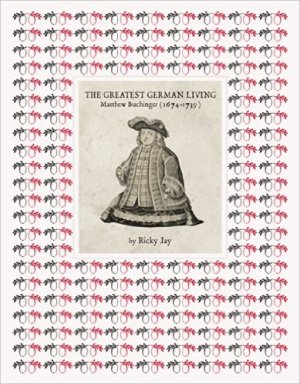 Matthias Buchinger (1674–1739) performed on more than a half-dozen musical instruments, some of his own invention. He exhibited trick shots with pistols, swords and bowling. He danced the hornpipe and deceived audiences with his skill in magic. He was a remarkable calligrapher specializing in micrography—precise handsome letters almost impossible to view with the naked eye—and he drew portraits, coats of arms, landscapes and family trees, many commissioned by royalty. Amazingly, Matthias Buchinger was just twenty-nine inches tall, and born without legs or arms. He lived to the ripe old age of sixty-five, survived three wives, wed a fourth, and fathered fourteen children.
Accompanying the Metropolitan Museum of Art exhibition Wordplay: Matthias Buchinger’s Inventive Drawings from the Collection of Ricky Jay, this book is a cabinet containing a single, multi-faceted wonder, refracted through acclaimed sleight-of-hand master Ricky Jay’s scholarship and storytelling. Alongside an unprecedented and sumptuously reproduced selection of Buchinger’s marvelous drawings and etchings, Jay delves into the history and mythology of the ‘Little Man’, while also chronicling his encounters with the many fascinating characters he meets in his passionate search for Buchinger.
Ricky Jay, one of the world’s great sleight-of-hand artists, has received accolades as a performer, actor, and author. He was recently profiled on the series American Masters and is the subject of the film Deceptive Practice: The Mysteries and Mentors of Ricky Jay. Jay has written frequently on unusual entertainments, and his Learned Pigs & Fireproof Women and Jay’s Journal of Anomalies were both New York Times ‘Notable Books of the Year’. The former curator of the Mulholland Library of Conjuring and the Allied Arts, he has defined the terms of his profession for the Encyclopedia Britannica and the Cambridge Guide to American Theater.
Exhibition | Schalcken: Painted Seduction
Press release for the exhibition now on view at the Wallraf-Richartz Museum:
Schalcken: Gemalte Verführung / Painted Seduction
Wallraf-Richartz-Museum & Fondation Corboud, Cologne, 25 September 2015 — 24 January 2016

Godefridus Schalcken, Self-Portrait, 1694 (Leamington Spa Art Gallery and Museum)
A lady looking into a mirror in the soft candlelight, proud, a little pert perhaps, but certainly enigmatic. Few artists have matched the ability of Godefridus Schalcken (1643–1706) to capture such magical moments on canvas so powerfully that they still compel attention three centuries later. In autumn 2015 the Wallraf-Richartz-Museum & Fondation Courboud launched in cooperation with the Dordrechts Museum the first-ever exhibition to survey Schalcken’s oeuvre as a whole, inviting a reassessment of this unique painter and seducing visitors to have a detailed look at the charming and enchanting art of Schalcken. More than eighty loans from public and private collections worldwide are on show, a third of his known painted oeuvre. Lenders include the Leiden Collection, New York, The Rose-Marie and Eijk van Otterloo Collection, Naples, Uffizi Florence, Rijksmuseum Amsterdam, Mauritshuis The Hague, National Gallery London, Národní galerie in Prague, Statens Museum Copenhagen, National Gallery of Scotland, Edinburgh, National Gallery of Ireland, Dublin, Ashmolaen Museum, Oxford, Städel Museum, Frankfurt, Hamburger Kunsthalle, Gemäldegalerie Dresden, Staatliche Kunsthalle Karlsruhe and Gemäldegalerie Alte Meister Kassel.
Schalcken will not have seemed predestined for an artistic career when he was born in 1643 into a family headed by a Protestant pastor. At the age of nineteen, following an apprenticeship with Samuel van Hoogstraten, a pupil of Rembrandt, he entered the workshop of Gerrit Dou, the celebrated founder of the school of artists known as the Leiden ‘fine’ painters. Dordrecht, London, The Hague and Dusseldorf were further stages in his impressive career. Despite the political and economic turmoils and an ailing art market: Schalcken established himself as a “self-branded artist”. His paintings fetched top prices and entered the most illustrious collections. Royal clients, such as Florence’s Grand Duke Cosimo III de’ Medici and Elector Palatine Johann Wilhelm in Dusseldorf, helped Schalcken to international fame.
As a master of light, especially candlelight, Schalcken entered the canon of art history and was lauded by art lovers—including even Johann Wolfgang von Goethe. First with the changes in taste that came in the nineteenth century did the ‘typically Dutch’, bourgeois art by painters like Vermeer, Rembrandt and Frans Hals gain in preference. Schalcken’s elegantly painted aristocratic gems languished in obscurity. With the consequence that the artist ranks today among the great unknowns of the Golden Age of Netherlandish painting.
Here in the first ever exhibition of his work, we are invited to set out on a journey of rediscovery. With rarely shown masterpieces, including many works from private collections, it opens up the painter’s rich world of imagery. A world that captivates by its wide range of genres and subjects, its tromp-l’oeil illusionism, and the gallant conversations that Schalcken invites us viewer to join.
The exhibition catalogue, with essays and extensive entries by Guido M.C. Jansen, Wayne Franits, Anja K. Sevcik, Nicole Elizabeth Cook, Eddy Schavemaker, Sander Paarlberg and Marcus Dekiert aims to update the meritorious catalogue raisonée by Thierry Beherman of 1988.
Wayne Franits, et al., Schalcken: Gemalte Verführung (Stuttgart: Belser Verlag, 2015), 312 pages, ISBN: 9783763027217, $88.
Exhibition | Pearls on a String
Press release (24 July 2015) for the exhibition now on view at The Walters:
Pearls on a String: Artists, Patrons, and Poets at the Great Islamic Courts
The Walters Art Museum, Baltimore, 8 November 2015 — 31 January 2016
Asian Art Museum, San Francisco, 25 February — 8 May 2016
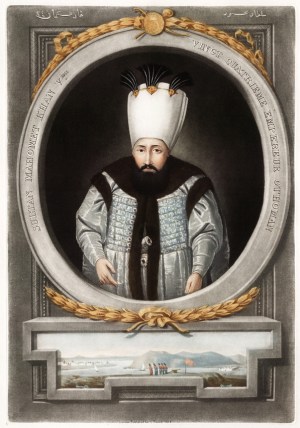
Portrait of Ottoman Sultan Mahmud I, 1815 (Baltimore: The Walters Art Museum)
The great Mughal, Safavid, and Ottoman empires flourished during a time of rapid change and artistic innovation in the Islamic world, as people, ideas, and technologies spread across Europe and Asia. At the heart of the empires’ courts were networks of individuals—writers, poets, artists, craftsmen— who produced extraordinary works of art for the ruling elite. From November 8, 2015, through January 31, 2016, the Walters Art Museum will present Pearls on a String: Artists, Patrons, and Poets at the Great Islamic Courts, the first major exhibition to focus on these influential and often charismatic individuals. The free exhibition features more than 120 works including paintings, calligraphy, textiles, ceramics, and jeweled luxury objects. Dating from the 16th to the 18th century, these exquisite works of art were created in historic India, Iran, and Turkey, a vast geographic area that extends from the Bay of Bengal to the Mediterranean Sea.
“Pearls on a String seeks to broaden public engagement with the cultural histories of Muslim societies by demonstrating how human imagination and collaboration can ignite extraordinary artistic creativity,” said Amy Landau, curator of the exhibition.
Three Vignettes
Pearls on a String is organized in a series of vignettes that spotlight a 16th-century writer, a 17th-century artist, and an 18th-century patron. Through poignant quotes, startling juxtapositions of artwork, and subtle references to the protagonists’ architectural surroundings, the exhibition will offer a rare glimpse into their worlds. The individuals also inform the exhibition’s poetic title: viewed independently, each is a gleaming ‘pearl’, yet collectively they constitute an even more vibrant ‘string of pearls’.
• Writer Abu’l Fazl (1551–1602): A prolific writer, visionary historian and intimate at the court of the third Mughal emperor Akbar in India, he was the most powerful voice in defining Akbar’s policies of political inclusion in the context of a demographically diverse empire.
• Painter Muhammad Zaman (c. 1650–1700): At the court of Safavid ruler Shah Sulayman, this imperial artist radically changed the course of Persian painting by introducing farangi-sazi, a European style, into the Persian tradition.
• Patron Sultan Mahmud I (1696–1754): An Ottoman ruler and active patron of the arts and architecture, this once-forgotten sultan commissioned fanciful jeweled objects as well as lavish libraries and mosques that define Istanbul’s skyline to this day.
“The Walters’ initiative to organize its first international loan exhibition dedicated to Islamic art springs from the quality of the museum’s collection, its intellectual resources and its dedication to providing free access,” said Julia Marciari-Alexander, the Andrea B. and John H. Laporte Director of the Walters Art Museum.
Loans and Support
Loans from national and international institutions include the Victoria and Albert Museum, London; the British Library, London; the Aga Khan Museum, Toronto; the Metropolitan Museum of Art, New York; and the National Gallery of Art, Washington, D.C. Approximately a third of the works are from the collection of the Walters Art Museum, which has one of the most comprehensive collections of Islamic art in North America. The exhibition was organized by the Walters Art Museum in partnership with the Asian Art Museum, and will be on view at the Asian Art Museum in San Francisco February 25 through May 8, 2016.
Pearls on a String has been generously supported by the National Endowment for the Humanities: Celebrating Fifty Years of Excellence; the Institute of Museum and Library Services; the National Endowment for the Arts; the Gary Vikan Exhibition Endowment Fund; Ellen and Edward Bernard; Douglas and Tsognie Hamilton; the Herb Silverman Fund; the Maryland Humanities Council and several anonymous donors.
◊ ◊ ◊ ◊ ◊
The catalogue is distributed by the University of Washington Press:
Amy Landau, ed., Pearls on a String: Artists, Patrons, and Poets at the Great Islamic Courts (Baltimore: Walters Art Museum, 2015), 256 pages, ISBN: 978-0295995243, $60.
 Pearls on a String presents the arts of historical Islamic cultures by focusing on specific people and relationships among cultural tastemakers, especially painters, calligraphers, poets, and their patrons. Through a series of chapters, the book spotlights certain historical moments from across the Islamic world. Each chapter pivots around patrons and their social networks. These independent sections allow different voices and perspectives to emerge, enabling the reader to see that Islamic societies are not monolithic but made up of a tapestry of individuals with distinct and varying views. Pearls on a String pays particular attention to individuals from different sectors of society, giving voice to anonymous artists and translators, merchants, and women of the harem. Islamic historical sources reinforce the book’s themes of writing in Islamic societies, artistic patronage, biographical traditions, and human connectivity.
Amy Landau is associate curator of Islamic and South Asian Art at the Walters Art Museum, Baltimore. Contributors include Paul Losensky, Sussan Babaie, Avinoam Shalem, Glaire Anderson, Mariam Rosser-Owen, Persis Berlekamp, Vivienne Lo, Wang Yidan, Willem Flinterman, Jo Van Steenbergen, David Roxburgh, Qamar Adamjee, Audrey Truschke, Bora Keskiner, Unver Rustem, and Tim Stanley.
New Book | The Bauers: Joseph, Franz & Ferdinand
From Prestel:
Hans Walter Lack, The Bauers: Joseph, Franz & Ferdinand, Masters of Botanical Illustration (London: Prestel, 2015), 496 pages, ISBN: 978-3791354897, $85, £60.
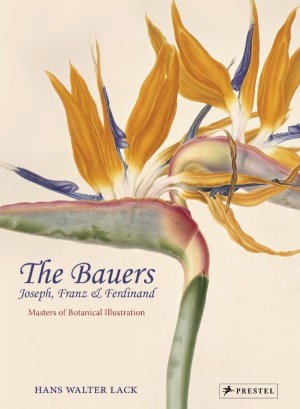 Filled with stunning 18th- and 19th-century illustrations of plants and other living creatures, this book is the first to bring together the life and art of the three Bauer Brothers, who came to be some of the most celebrated botanical artists of all time.
As artists, Joseph, Franz and Ferdinand Bauer were independently successful: Joseph as court painter to the Prince of Lichtenstein; Franz (later Francis) was employed at Kew Gardens as the ‘Botanick Painter to His Majesty’; and Ferdinand’s seminal collection of 1500 paintings created from sketches he made traveling in and around Australia is the first detailed account of the natural history of that continent. Drawn from all known worldwide sources of the Bauers’ extant illustrations, this illustrated history of the Bauers and their work unfolds chronologically, starting with the brothers’ formative years in Feldsberg, Austria, where they produced more than two thousand drawings of plant specimens under the guidance of the local abbot. Learning how to dissect plants as well as how to use microscopes to paint them in intricate detail, the Bauers became well known for their extraordinary precision. Their detail work, along with their incredibly beautiful and highly developed methods of coloring their paintings, comes to life in numerous superbly reproduced illustrations. A celebration of an indelible body of work, this unique volume recalls the Golden Age of botanical artistry through the lives and contributions of the renowned Bauer brothers.
Hans Walter Lack is Director of the Botanic Garden and Botanical Museum in Berlin, Germany. He has written extensively about botanical art.
New Book | Palais Royal: à la table des rois
From BnF:
Alina Cantau, Frédéric Manfrin et Dominique Wibault, Palais Royal: à la table des rois (Paris: Éditions de la Bibliothèque nationale de France, 2015), 224 pages, ISBN: 978-2717726695, 35€.
 De François Ier à Napoléon III, en passant par Louis XIV et Bonaparte, Palais royal invite les gourmands d’images et d’histoire à découvrir la cour de France sous un autre jour : quand elle passe à table. Au fil des siècles et des règnes, la culture culinaire évolue. Les voyages et leur cortège de découvertes viennent métisser les repas, au gré des échanges diplomatiques, des mariages princiers et du commerce. Mais toujours la gastronomie est affaire de plaisir. Comme l’écrit Guy Martin qui signe ici la préface, le palais naît d’une sensibilité, à la fois personnelle et collective, qui se cultive. À l’origine de la « cuisine française », les tables royales de France posaient les bases de ce qui allait faire sa renommée.
Alina Cantau est coordinatrice scientifique Gallica au sein du département de la Coopération à la Bibliothèque nationale de France. En charge de la gastronomie, elle a collaboré à plusieurs revues spécialisées et à l’Agenda gourmand (BnF). Elle a également participé à des actions de valorisation des collections gourmandes de la Bibliothèque nationale de France et de ses partenaires.
Frédéric Manfrin, conservateur, est depuis 2008 chef du service Histoire à la Bibliothèque nationale de France. Il a assuré le commissariat des expositions « Esprit[s] de Mai 68 », « Casanova, la passion de la liberté » et « Été 14 : les derniers jours de l’ancien monde », dont il a également codirigé le catalogue. Il donne depuis quelques années de nombreuses conférences sur l’histoire culturelle et politique de l’Europe aux XVIIe et XVIIIe siècles.
Dominique Wibault, chargée de collection en gastronomie au département Sciences et Techniques de la Bibliothèque nationale de France, a collaboré à l’édition 2015 de l’Agenda gourmand (BnF) et au dossier gastronomie « Du sens aux sens » du numéro 49 de la Revue de la BnF.










 Enfilade
leave a comment