Exhibition | Artist and Empire: Facing Britain’s Imperial Past
Opening this week at Tate Britain:
Artist and Empire: Facing Britain’s Imperial Past
Tate Britain, London, 25 November 2015 — 10 April 2016
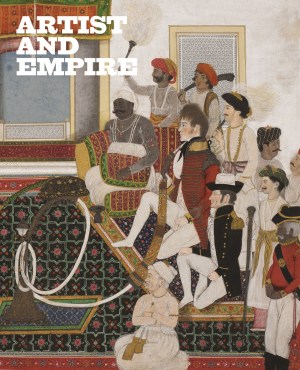 This autumn Tate Britain presents a major exhibition of art associated with the British Empire from the 16th century to the present day. In 21st-century Britain, ‘empire’ is highly provocative. Its histories of war, conquest and slavery are difficult and painful to address but its legacy is everywhere and affects us all. Artist and Empire will bring together extraordinary and unexpected works to explore how artists from Britain and around the world have responded to the dramas, tragedies and experiences of the Empire. Featuring a vast array of objects from collections across Britain, including maps, flags, paintings, photographs, sculptures and artefacts, the exhibition examines how the histories of the British Empire have shaped art past and present. Contemporary works within the exhibition suggest that the ramifications of the Empire are far from over. The show raises questions about ownership, authorship and how the value and meanings of these diverse objects have changed through history, it also asks what they still mean to us today.
Historic works by artists such as Joshua Reynolds and George Stubbs are shown with objects including Indian miniatures and Maori artefacts, as well as contemporary works by Hew Locke and Sonia Boyce. Through this variety of artworks from a complex mix of traditions, locations and cultures the fragmented history of the Empire can be told.
Alison Smith, David Blayney Brown, Carol Jacobi, Artist and Empire: Facing Britain’s Imperial Past (London: Tate, 2015), 240 pages, ISBN: 978-1849763431, $65.
◊ ◊ ◊ ◊ ◊
From Tate Britain:
Artist and Empire: New Dynamics, 1790 to the Present Day
Tate Britain, London, 24–26 November 2015
Tate Britain’s major conference, held in collaboration with Birkbeck, University of London and culture at King’s College London, marks the opening of the exhibition Artist and Empire. Scholars, curators and artists from around Britain and the world consider art created under the conditions of the British Empire, its aftermath, and its future in museum and gallery displays.
Scholarship of art associated with the British Empire has expanded over the last two decades, across a huge span of disciplines and locations. This conference takes the historic opportunity of the exhibition, featuring diverse artists from the sixteenth century to the present day, to bring together people to meet and share the latest research being developed around this subject. The papers, roundtables and audience discussions will consider the cosmopolitan character of objects and images, and the way geographical, cultural and chronological dislocations have in many instances obscured, changed or suppressed their history, significance and aesthetics. We will also explore how approaches to contemporary art, archives, curation and collecting can help develop new ways to look at them now.
T U E S D A Y , 2 6 N O V E M B E R 2 0 1 5
18.00 Opening Conversation
Introduction by Nicholas Serota, Director, Tate
Frank Bowling OBE, Artist and Writer, with Zoe Whitley, Curator, International Art, Tate Modern
W E D N E S D A Y , 2 5 N O V E M B E R 2 0 1 5
9.00 Registration and refreshments
9.30 Introduction
9.40 Panel 1 | Displaced Practices: Artists and Exchanges
Chaired by Felix Driver, Professor of Human Geography at Royal Holloway
• Michael Rosenthal (Emeritus Professor of Art History at the University of Warwick), Augustus Earle: Seeing Straight
• Geoff Quilley (Professor of Art History at the University of Sussex), Inside Empire Looking Out: The View from Dent’s Veranda
• Partha Mitter (Emeritus Professor of Art History at the University of Sussex), Art Education in India
11.20 Refreshment break
11.40 Panel 2 | Moving Objects: Collecting, Archives, Display
Chaired by John Mack, Professor of World Art Studies at the University of East Anglia and Chairman of the Sainsbury Institute for Art
• Alison Inglis (Associate Professor in Art History at the University of Melbourne), Collecting and Displaying British Art in the Australian Colony
• Zachary Kingdon (Curator of the African Collections at the World Museum in Liverpool), Unofficial Exchanges: Investigating West Africans’ Gifts to UK Museums in the Early Colonial Period
• Nick Thomas (Director of the Museum of Archaeology and Anthropology, Cambridge), Artefacts of Encounter: Rethinking Objects and Collections
13.20 Lunch break
14.00 Panel 3 | Face to Face: Figures, Portraits and Identities
Chaired by Elizabeth Edwards, Research Professor in Photographic History and Director of Photographic History Research Centre, De Montfort University
• Temi Odumosu (Marie Curie Postdoctoral Fellow at Copenhagen University), This Is How You See Her? Rachel Pringle of Barbados by Thomas Rowlandson’s Hand
• Gillian Forrester (Senior Curator of Prints and Drawings at the Yale Center for British Art), Noel B. Livingston’s Gallery of Illustrious Jamaicans
• Ruth Phillips (Canada Research Chair in Modern Culture and Professor of Art History at Carleton University), Sir Henry Acland Mi’kmaq Woman from Nova Scotia and a Mi’kmaq Dressed Doll: The Tensions of Imperialism and Indigenous Survivance and Resistance
15.40 Refreshment break
16.00 Plenary: Reflecting on the Future
Chaired by Augustus Casely-Hayford, Historian, Writer and Curator
Catherine Hall, Professor of Modern British Social and Cultural History at University College London
Zareer Masani, Historian and Writer
T H U R S D A Y , 2 6 N O V E M B E R 2 0 1 5
9.00 Registration and refreshments
9.30 Introduction
9.40 Panel 4 | Confronting Empire: Curating Artistic Legacies
Chaired by Sarah Victoria Turner, Assistant Director for Research at the Paul Mellon Centre
• Elisabeth Lalouschek (Artistic Director of the October Gallery)
• Devika Singh (Smuts Research Fellow at the Centre of South Asian Studies, Cambridge University)
10.55 Refreshment break
11.15 Panel 5 | Archived Futures: Mediating Collections and Archives
Chaired by Hammad Nasar, Head of Research and Programmes at the Asia Art Archive in Hong Kong
• Brook Andrew (Artist), Re-envisioning Archives and Aboriginal Culture
• Caroline Bressey (Director of the Equiano Centre, Department of Geography at UCL)
• Shaheen Merali (Writer, Curator and Co-founder of Panchayat), Panchayat
12.55 Lunch break
13.35 Panel 6 | Curating in Transnational Contexts in London
Chaired by Professor Paul Goodwin, Director of the Research Centre for Transnational Art, Identity and Nation (TrAIN) at the University of the Arts London
• The India Festival (Victoria and Albert Museum, June 2015 — March 2016)
Kriti Kapila, Lecturer in Social Anthropology and Law at King’s College, London
• West Africa: Word, Symbol, Song (British Library, October 2015 — February 2016)
Toby Green, Lecturer in Lusophone African History and Culture at King’s College, London, Marion Wallace, Lead Curator, African Collections, British Library, Co-curator
• Artist and Empire: Facing Britain’s Imperial Past (Tate Britain, November 2015 — April 2016)
Javed Majeed, Professor of English and Comparative Literature at King’s College London, Alison Smith, Senior Curator of British Art at Tate Britain
14.50 Refreshment break
15.10 In Conversation: Reflecting on Artists and Empire
Chaired by Achim Borchardt-Hume, Director of Exhibitions, Tate Modern
• Lubaina Himid, MBE (Artist, Curator, Professor of Contemporary Art at the School Art, Design and Fashion University of Central Lancashire)
• Yinka Shonibare, MBE (Artist and Curator)
16.05 Plenary: Reflecting on the Future
Chaired by Paul Gilroy, Professor of American and English Literature, King’s College London
Baroness Lola Young of Hornsey OBE
Mike Phillips, Novelist, Historian and former curator at Tate
Panellist TBC
Exhibition | Italian Dreams: Watteau and French Landscape Painting
From the website for Valenciennes:
Réveries Italiennes: Watteau et les paysagistes français au XVIIIe siècle
Italian Dreams: Watteau and French Landscape Painting in the Eighteenth Century
Musée des Beaux-Arts, Valenciennes, 25 September — 17 January 2016
Curated by Martin Eidelberg
 La Ville de Valenciennes a la chance d’avoir vu naître l’un des artistes français les plus illustres : Jean Antoine Watteau (1684–1721). La réouverture de son musée des Beaux-Arts, qui conserve un ensemble d’œuvres du peintre, est couronnée par le don exceptionnel d’une œuvre tout récemment redécouverte d’Antoine Watteau, La Chute d’eau, rare paysage du peintre des fêtes galantes inspiré des cascades de Tivoli près de Rome, qui témoigne de la fascination de l’artiste pour l’Italie, pays où il n’eut pourtant jamais l’occasion de se rendre !
L’exposition Rêveries italiennes, propose ainsi de souligner les emprunts que le maître fit tout au long de sa carrière au modèle italien, soit à travers l’exemple des peintres vénitiens du XVIe siècle qui constituèrent pour l’artiste une source importante d’inspiration, soit à travers le filtre des œuvres réalisées à Rome par ses contemporains. Autour d’un ensemble de peintures et de dessins d’Antoine Watteau, des œuvres des XVIe, XVIIe et XVIIIe siècles montreront comment ce peintre des songes puisa dans la culture artistique européenne pour créer des œuvres qui ouvriront la voie à une nouvelle école de paysage, née au siècle des Lumières, autour de Natoire, Boucher, Fragonard et Hubert Robert. À partir des rêveries italiennes de Watteau, l’exposition valenciennoise souhaite ainsi éclairer sous un jour nouveau la fécondité d’un modèle artistique qui, bien au-delà d’une iconographie séduisante, mena à l’éclosion du Romantisme.
L’exposition s’intègre dans la programmation liée à l’élection de la cité voisine belge de Mons comme capitale européenne de la culture pour l’année 2015. Elle bénéficie également du soutien exceptionnel du Musée du Louvre, qui a accordé pour l’occasion un prêt conséquent d’œuvres et a proposé, dans le cadre de la programmation du Louvre Lens, une exposition venant en écho à l’initiative valenciennoise, consacrée à Antoine Watteau et la fête galante, Dansez, embrassez qui vous voudrez. Fêtes et plaisirs d’amour au siècle de Mme de Pompadour, du 5 décembre 2015 au 29 février 2016.
Commissariat scientifique
Martin Eidelberg, Professeur émérite d’Histoire de l’Art, Rutgers University
Commissariat général
• Emmanuelle Delapierre, anciennement conservatrice du musée des Beaux-Arts de Valenciennes, actuelle conservatrice du musée des Beaux-Arts de Caen
• Vincent Hadot, directeur du musée des Beaux-Arts de Valenciennes
• Virginie Frelin-Cartigny, Attachée de conservation du Patrimoine, musée des Beaux-Arts de Valenciennes
Martin Eidelberg, Réveries Italiennes: Watteau et les paysagistes français au XVIIIe siècle (Heule: Snoeck, 2015), 163 pages, ISBN: 978-9461612397, 29€ / $55.
More information is available at Culture.Fr, and the press release is available as a PDF file here»
Save Ashgate Publishing
I know many of you are already aware of the bad news regarding the planned closures of Ashgate’s Burlington and UK offices. The online petition now includes 3,700+ signatures (and counting). –CH
Save Ashgate Publishing
Petition to Rachel Lynch, Managing Director, Ashgate Publishing & Managing Director, Humanities & Social Science Books, Taylor & Francis Group Jeremy North
Ashgate Publishing Company was purchased by Informa (Taylor & Francis Publishing) in 2015. On November 24th, 2015, the North American office of the press in Burlington, Vermont will close and Ashgate’s US staff members, including Erika Gaffney, Ann Donahue, Margaret Michniewicz, Alyssa Berthiaume, Kathy Bond Borie, Seth Hibbert, Stephanie Peake, Martha McKenna, Lea Durfee, Suzanne Sprague, and Emilly Ferro will cease to be representatives of Ashgate.
According to an e-mail sent to series editors, plans are still being discussed for Ashgate’s publishing business in the UK. However, information has since emerged that the UK office is scheduled to close in December.
Independent academic presses like Ashgate have offered a safe haven for scholars working in certain subfields as University presses closed entire publishing specializations and fired editorial staff in response to campus austerity measures. Academic presses are more than profit margins, income from the backlist, utility bills, payroll, and marketing campaigns. Ashgate flourished through the bonds formed between editors and authors, the care and attention of copy editors, and above all, the good will of authors and readers. We the undersigned authors, readers, and reviewers of Ashgate books write to voice our appreciation for the accomplishments of Ashgate’s North American office. We urge Taylor & Francis to reverse course immediately and restore Ashgate’s US and UK offices.
New Book | Piranesi’s Lost Words
From Penn State UP:
Heather Hyde Minor, Piranesi’s Lost Words (University Park: The Pennsylvania State University Press, 2015), 264 pages, ISBN: 978-0271065496, $80.
 Giovanni Battista Piranesi was one of the most important artists eighteenth-century Europe produced. But Piranesi was more than an artist; he was an engraver and printmaker, architect, antiquities dealer, archaeologist, draftsman, publisher, bookseller, and author. In Piranesi’s Lost Words, Heather Hyde Minor considers Piranesi the author and publisher, focusing on his major publications from 1756 to his death in 1778. Piranesi designed and manufactured twelve beautiful, large-format books combining visual and verbal content over the course of his lifetime. While the images from these books have been widely studied, they are usually considered in isolation from the texts in which they originally appeared. This study reunites Piranesi’s texts and images, interpreting them in conjunction as composite art. Minor shows how this composite art demonstrates Piranesi’s gift for interpreting the classical world and its remains—and how his books offer a critique of both the Enlightenment project of creating an epistemology of the classical past and how eighteenth-century scholars explicated this past. Piranesi’s books, Minor argues, were integral to the emergence of the modern discipline of art history. Using new, previously unpublished archival material, Piranesi’s Lost Words refines our understanding of Piranesi’s works and the eighteenth-century context in which they were created.
New Book | The Frick Collection: Decorative Arts Handbook
Press release (10 June 2015) from The Frick:
Charlotte Vignon, The Frick Collection: Decorative Arts Handbook (New York: The Frick Collection in association with Scala Arts Publishers, 2015), 172 pages, ISBN: 978-1857599398 $25.
 The unique atmosphere of The Frick Collection has as much to do with the decorative arts as with the old master paintings that line the museum’s walls. Indeed the enamels, clocks and watches, furniture, gilt bronzes, porcelain, ceramics, silver, and textiles far exceed in number, and are the equal in quality, of the works on canvas and panel. The institution announces the publication of the first handbook devoted to the decorative arts in the collection. This long overdue book will help convey the balance among the various art forms represented in the house and provide a valuable introduction to this area. Comments Director Ian Wardropper, “Despite the manifest importance of decorative arts at the Frick, until recently our small staff did not include a specialist in the field. Thanks to an endowment campaign and the generosity of a number of supporters a permanent curatorial position was created in September 2009. With energy and imagination, the first incumbent of this curatorship, Charlotte Vignon, has initiated a series of exhibitions that highlight this aspect of the collection. The present handbook is another indication of her scholarly dedication to the decorative arts.”
The Frick Collection: Decorative Arts Handbook offers fresh insight on various works long in the museum’s holdings and also includes commentary on more recently acquired examples. Exquisitely illustrated with new photography, this paperback volume is available in English and French editions.
Henry Clay Frick: Developing a Decorative Arts Collection
Acquiring paintings preoccupied Henry Clay Frick when he moved to New York in the first years of the twentieth century. While renting William H. Vanderbilt’s mansion at Fifth Avenue and 51st Street, he devoted his attention to collecting masterpieces by Rembrandt, Velázquez, and other masters. As the sumptuous house he constructed at 70th Street took shape between 1912 and 1914, he recognized the need for furnishings of a caliber that matched his painting collection. Interestingly, most of his purchases in this area were made just before or after he began to occupy the house and in a very concentrated period of time.
A trip to London and Paris in the spring of 1914 inspired many of the choices Frick would make for his New York mansion. After meeting Victor Cavendish, the ninth Duke of Devonshire, at Landsdowne House in London and his country house at Chatsworth, Frick acquired from him a suite of tapestry furniture thought to be eighteenth-century Gobelins. Impressed by the Wallace Collection and wishing to emulate it, he set out to acquire high-quality decorative arts of different periods and materials, especially porcelain, oriental carpets, and French Renaissance enamels and furniture, such as pieces made by André-Charles Boulle, with their distinctive turtle-shell and brass veneers. In Paris, through the intermediary of the American decorator Elsie de Wolfe, he purchased French furniture from the collection of Sir John Murray Scott (inherited from Lady Wallace, the widow of the founder of the Wallace Collection). In a single month, he spent more than $400,000, more than he had ever spent on collecting in this field.
In some cases, furniture and decorative arts were assembled to complement specific rooms of the house. Elsie de Wolf, for example, counseled the acquisition of a desk by the great French eighteenth-century cabinetmaker Jean-Henri Riesener together with Sèvres porcelain for Adelaide Frick’s second-floor dressing room, which was lined with wall panels painted by François Boucher’s workshop. The room and its furnishings were transferred to the first floor in 1935. Other great eighteenth-century French furnishings for Adelaide’s dressing room came through Joseph Duveen, then the head of Duveen Brothers. After Fragonard’s cycle of paintings was installed in the drawing room in 1915–16, Duveen sold Frick many more works to embellish its decor. French Renaissance furniture was bought to complement the collection of sixteenth-century enamels acquired in 1916; Henry’s office was transformed into a gallery for its display. The Italian Renaissance cassoni were always intended to be placed beneath masterpieces of painting in the West Gallery or elsewhere.
Carefully selected blocs of decorative arts, such as the forty-six pieces of Limoges enamel Frick acquired through Duveen from the estate of J. Pierpont Morgan, were one means by which the collection grew quickly. Morgan’s death in 1913 gave Frick the opportunity to choose from one of the finest and largest collections in the world just when he was seeking to expand in this area. Another example was the group of fifty Chinese porcelain jars and vases that Duveen had also acquired from Morgan’s estate. Apart from the windfall of the availability of the Morgan collection, Duveen’s own stock was so extensive and of such quality that Frick could buy from him French royal commissions, such as Gilles Joubert’s chest of drawers, which was among some twenty-five pieces of furniture that arrived at Fifth Avenue and 70th Street during the year 1915.
Later Acquisitions
Generous gifts from members of the Frick family and other donors have continued to enrich the decorative arts collection. The founder’s son, Childs, gave about two hundred pieces of Chinese blue-and-white porcelain in 1965, considerably augmenting those works his father had purchased fifty years earlier. In 1999, Winthrop Kellogg Edey’s extraordinary collection of some forty clocks and watches arrived at the Frick. Henry Arnhold has recently given us the Great Bustard from his distinguished and comprehensive collection of Meissen porcelain, and another one hundred and thirty-five works are pledged to the Frick as a bequest. Individual objects of great merit are prized additions to our holdings. Diane Modestini gave us our first piece of Italian majolica in honor of her husband Mario Modestini in 2008. On occasion, acquisitions are also made, such as the unusual vase japon, purchased in 2011.
Exhibition | The Luxury of Time: European Clocks and Watches
From The Met:
The Luxury of Time: European Clocks and Watches
The Metropolitan Museum of Art, New York, 16 November 2015 — 27 March 2016

Clockmaker: Ferdinand Berthoud (French, 1727–1807); Case maker: Balthazar Lieutaud (French, ca. 1720–1780, master 1749). Longcase astronomical regulator (detail), ca. 1768–70. Case: oak veneered with ebony and brass, with gilt-bronze mounts; Dial: white enamel; Movement: gilded brass and steel; Height: 90.5 in. (229.9 cm). The Metropolitan Museum of Art, New York, (1982.60.50).
Time is all around us, displayed on our phones and computers. Today, almost nobody needs to own a watch or a clock to tell the time. Access to the right time is not the luxury it once was. Yet the fascination with clocks and watches persists, and the thriving market for mechanical timekeepers is deeply aware of their history. Clocks and watches have always been about more than just telling time: they have been treasured as objects of desire and wonder, personal items imbued with value that goes beyond pure functionality. As works of art, they represent the marriage of innovation and craftsmanship.
This exhibition explores the relationship between the artistry of the exterior form of European timekeepers and the brilliantly conceived technology that they contain. Drawn from the Museum’s distinguished collection of German, French, English, and Swiss horology from the sixteenth through the nineteenth century, the extraordinary objects on view show how clocks and watches were made into lavish furniture or exquisite jewelry.
The creation of timekeepers required that clockmakers work with cabinetmakers, goldsmiths and silversmiths, enamelers, chasers and gilders, engravers, and even those working in sculpture and porcelain. These craftsmen were tasked with accommodating internal mechanisms by producing cases that, in both shape and function, adapted to timekeeping technologies. Their exteriors are often as complicated as the movements they house. Examining the dialogue between inside and out, adornment and ingenuity, The Luxury of Time
reveals the complex evolution of European clockmaking and
the central place of timekeepers in the history of decorative arts.
◊ ◊ ◊ ◊ ◊
The catalogue is scheduled for publication in February. From Yale UP:
Clare Vincent and Jan Hendrik Leopold, with Elizabeth Sullivan, European Clocks and Watches in The Metropolitan Museum of Art (New York: The Metropolitan Museum of Art, 2016), 288 pages, ISBN: 978-1588395795, $65.
 Among the world’s great technological and imaginative achievements is the invention and development of the timepiece. Examining for the first time the Metropolitan Museum’s unparalleled collection of European clocks and watches created from the early middle ages through the 19th century, this fascinating book enriches our understanding of the origins and evolution of these ingenious works. It showcases 54 extraordinary clocks, watches, and other timekeeping devices, each represented with an in-depth description and new photography showing the exterior as well as the inner mechanisms. Included are an ornate celestial timepiece that accurately predicts the trajectory of the sun, moon, and stars and a longcase clock by David Roentgen that shows the time in the ten most important cities of the day. These works, created by clockmakers, scientists, and artists in England, Germany, France, Italy, and the Netherlands, have been selected for their artistic beauty and design excellence, as well as for their sophisticated and awe-inspiring mechanics. Built upon decades of expert research, this publication is a long-overdue survey of these stunning visual and technological marvels.
Clare Vincent is associate curator, European Sculpture and Decorative Arts, The Metropolitan Museum of Art. J. H. Leopold was former assistant keeper in charge of the horological collections at The British Museum. Elizabeth Sullivan is research associate, European Sculpture and Decorative Arts, The Metropolitan Museum of Art.
New Book | How to Read Chinese Ceramics
Published by The Met and distributed by Yale UP:
Denise Patry Leidy, How to Read Chinese Ceramics (New York: The Metropolitan Museum of Art, 2015), 144 pages, ISBN: 978-1588395719, $25.
 Chinese ceramics are among the most significant and widely collected decorative arts produced anywhere in the world, with a history that spans millennia. Despite the saturation of Chinese ceramics in global culture—in English, the word ‘china’ has become synonymous with ‘porcelain’—the function of these works and the meaning of their often richly decorated surfaces are not always readily apparent.
This new installment in the successful How to Read series enlightens readers on Chinese ceramics of all kinds, using highlights from the outstanding collection of The Metropolitan Museum of Art as a teaching tool. Accessible to a general audience and written by an expert on the subject, this book explains and interprets 40 masterworks of Chinese ceramics. The works represent a broad range of subject matter and type, from ancient earthenware to 20th-century porcelain, and from plates and bowls to vases and sculptural figures. Lavish illustrations showcase these stunning works and the decorations that adorn them, including symbolic scenes, flowers, and Buddhist and Chinese historical figures.
Denise Patry Leidy is curator in the Department of Asian Art, The Metropolitan Museum of Art.
An interview with Leidy is available here»
New Book | Venetian Painting Matters, 1450–1750
Forthcoming from Brepols:
Jodi Cranston, ed., Venetian Painting Matters, 1450–1750 (Turnhout: Brepols, 2015), 200 pages, ISBN: 9782503535265, $115.
 This book brings together essays about painting in Venice during three centuries of remarkable artistic production, influence, and exchange. The chronological scope of the anthology reflects the crucial interrelationship between the life of the arts and the republic, but also indicates the longevity of the distinctive, but not in the least isolated, mode of making and looking that engaged painters and viewers both inside and outside of Venice. The focused themes that emerge in the essays—the artist’s self-perception, the role of innovation and tradition in formal and material aspects of pictorial composition, the artistic exchange between Venice and other cities, both east and west, and the unique political and social pressures on artistic production and reception—reflect the Venetian engagement with many of the central concerns that preoccupied early modern artists. The dialogue established between Venetian art and society underpins all of the essays in the anthology; however, their critical focus remains on the formal, stylistic, and structural aspects of the pictures and how these visual mechanisms express meaning and shape viewer response.
Exhibition | Living for the Moment: Japanese Prints
Press release (5 October 2015) from LACMA:
Living for the Moment: Japanese Prints from the Barbara S. Bowman Collection
Los Angeles County Museum of Art, 11 October 2015 — 1 May 2016

Suzuki Harunobu, Lucky Dream for the New Year: Mt. Fuji, Falcon, and Eggplants, ca. 1768–69 (promised gift of Barbara S. Bowman, Museum Associates/LACMA).
The Los Angeles County Museum of Art (LACMA) presents Living for the Moment: Japanese Prints from the Barbara S. Bowman Collection. The exhibition features over 100 prints of transformative promised gifts of Japanese works to LACMA, representing the work of 32 artists. Included are examples of rare early prints of the ukiyo-e genre (pictures of the floating world); works from the golden age of ukiyo-e at the end of the eighteenth century by Suzuki Harunobu, Kitagawa Utamaro, and Katsukawa Shunshō; and nineteenth-century prints by great masters such as Utagawa Hiroshige, Katsushika Hokusai, Utagawa Kuniyoshi, and others.
Barbara S. Bowman (née Safan) was born in Los Angeles in 1925 and attended the University of Southern California (USC) for a degree in fine art. Barbara became captivated by Japanese woodblock prints early on after receiving two prints as a gift from her mother. She and her husband Morton visited Japan for the first time in 1962, and by 1978 she began actively collecting Japanese woodblock prints. Never intending to have an encyclopedic collection, Barbara sought out scenic designs in superb condition with stellar impressions, as she held the printing process in high esteem. The power of line and the importance of color were and remain defining factors of the collection. Assembled over 35 years, the Barbara S. Bowman Collection includes some of the finest impressions available.
“Living for the Moment represents a momentous gift to the Japanese Art Department of LACMA, in that we can now present the history of Japanese prints with high-quality works of art,” remarks Hollis Goodall, Curator of Japanese Art at LACMA.
Living for the Moment is presented in two locations at LACMA. Commercially printed ukiyo-e, mostly produced in Edo (modern Tokyo), will be displayed chronologically and by artistic group in the Ahmanson Building, level 2. Privately published surimono and theatrical prints of Osaka are installed in the Pavilion for Japanese Art, level 3.
Ukiyo-e developed as an independent genre in painting and book illustration by the late 1600s. The idea of the ‘floating world’ (ukiyo), initially based on a Buddhist phrase referring to the transience of life, was adopted by popular writers to evoke fleeting moments of beauty and pleasure that provided distraction from the cares of a regimented society. Book illustrations on these topics gained such popularity that artists began creating single-sheet woodblock prints to sell. Edo became the center for the production of ukiyo-e prints. In response to government restrictions placed on floating world subject matter in the early 1800s, artists explored new topics such as travel and heroes of ancient lore. Prints were also a perfect medium for artistic experimentation. After a breakthrough by Suzuki Harunobu in 1765, which allowed the production of multiblock color prints, artists explored realism, nature, perspective, framing, and light with a level of intensity that spread their influence not only across Japan but also, after the country opened to foreign trade in 1868, to Europe. There, the Impressionists, struck by the Japanese printmakers’ use of color, atmosphere, and composition, created a watershed style embarking upon Modernism.
The artist Utagawa Hiroshige (1797–1858) was from a samurai family with an inherited position as a fire man in Edo Castle. In 1823 he passed on this job to a relative and became a full-time artist, having been trained by the Utagawa school master, Toyohiro (1773–1828). Hiroshige excelled at evoking the human experience of the landscape, with its varying seasons, times of day, and weather events. His sensitivity toward shifting light is best seen in early impressions of prints where he supervised color choice, as exemplified by his finest print in the Bowman collection entitled, Minowa, Kanasugi, and Mikawashima (1857). In this print, a broad strip of pink marks the horizon. The still-dark middle ground indicates light at daybreak which has not reached the nearby plains, and roofs in the distance already reflect the growing daylight. In his late years, Hiroshige developed a unique viewpoint, looking beyond an object set close at hand to a landscape which receded into deep distance. His framing of subjects directly influenced the Impressionists and Post- Impressionists in Europe, and later Frank Lloyd Wright in the United States.
The majority of ukiyo-e prints were produced by publishers for general sale. Government censors enforced laws restricting the subject matter of prints and their price, by limiting the number of blocks and quality of pigments. These laws were not applied to private groups, who made prints called surimono (printed things) for distribution to a specified clientele. These groups mostly consisted of poets of kyōka (mad verse), which was based on courtly poetry but played with the rules of language and content. Fan clubs for musicians and actors also occasionally commissioned surimono. The heyday of surimono lasted from the late 1700s through the first third of the 1800s, with the majority produced after 1800. These prints were most frequently distributed at the New Year to kyōka group members and would often bear poems related to that season. Printed on thick, luxurious paper, surimono often featured richly hued dyes too expensive for general use and metals such as brass, tin, and copper. Viewing these prints closely, one may also detect exquisite embossed details and areas that mimic the appearance of lacquer.
Surimono artists, led by Katsushika Hokusai (1760–1849), his followers, and contemporaries, drew designs based on the poetry to be printed on the surimono, either portraying, embellishing, or playfully skewing the content with their illustrations. The design was there for the enhancement of the poetry, rather than vice versa. Hokusai’s Salt Shells (Shiogai) from 1821, for example, is a still life that depicts a box of open salt cakes, a pipe case and tobacco pouch attached to a netsuke container, and a small pine tree planted in a bowl. The work is from a series of 36 surimono that included verse by many followers of the noted contemporary poet Yomo no Magao. The series title and poem refer to the New Year game of matching bifurcated shells, each containing a segment of the same poem.
◊ ◊ ◊ ◊ ◊
The catalogue is published by Prestel:
Hollis Goodman with an essay by Joan B. Mirviss, Living for the Moment: Japanese Prints from the Barbara S. Bowman Collection (London: Prestel, 2015), 184 pages, ISBN: 978-3791354729, $65 / £35.
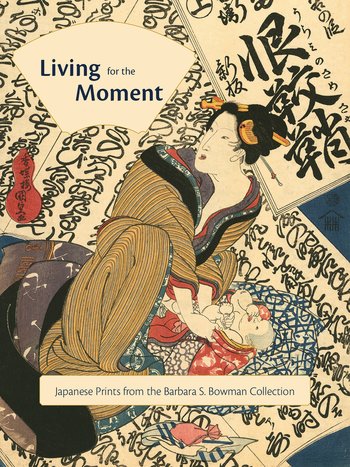 Spanning the late 18th and early 19th centuries, the exquisite examples of Japanese prints included in this book offer insights into the history of an art form and vision that is distinctively Japanese and was highly inspirational to later European painters. Polychrome prints, or ukiyo-e, first appeared in Japan in the late 18th century. Delicately hued and intricate, they depicted landscapes, scenes, and figures that epitomized the country’s idea of ‘the floating world’: a place whose denizens lived for the moment and appreciated the pleasures of the natural world. This volume surveys the prominent Barbara S. Bowman collection of prints notable for a number of reasons: an excellently preserved print of Lucky Dream for the New Year: Mount Fuji, Falcon, and Eggplants by Suzuki Harunobu; a number of surimono, or privately published prints that were created with unusually luxurious materials; and numerous works by Hiroshige and Hokusai, who are considered the masters of the art form. Each of the over one hundred prints in this book is reproduced in large color plates that highlight their subtle beauty and charm and are accompanied by extensive analysis of the pieces’ remarkable qualities. This comprehensive overview of the collection by LACMA curator Hollis Goodall addresses the significance and history of the Bowman collection and the many ways it enhances the museum’s extensive holdings of Japanese art.
Hollis Goodall is curator of Japanese art at the Los Angeles County Museum of Art.
New Book | Sir Joshua Reynolds: Propos sur l’art
Forthcoming from Brepols:
Jan Blanc, Sir Joshua Reynolds: Propos sur l’art (Turnhout: Brepols, 2015), 800 pages, ISBN: 978-2503543376, 175€.
Réunis pour la première fois et présentés de façon systématique et comparative, ces textes offrent une révision complète des théories et des pratiques artistiques du peintre, sir Joshua Reynolds.
 Après la mort de sir Joshua Reynolds, les premiers visiteurs de son atelier y ont découvert, en plus de plusieurs tableaux inachevés et des œuvres de son abondante collection, un nombre considérable de manuscrits—plus de 2000 pages de sa main ou de celle de ses secrétaires. Certains de ces manuscrits ont fait l’objet de publications partielles, tout comme c’est le cas des quelques textes publiés par Reynolds tout au long de sa carrière—pour l’essentiel, ses trois articles pour l’Idler et ses quinze discours académiques. Il n’existait pourtant aucune édition complète de ses écrits, tant en anglais qu’en français.
Présentant pour la première fois l’intégralité des textes connus de sir Joshua Reynolds, qu’ils aient été publiés de son vivant et après sa mort ou restés à l’état de manuscrits, cet ouvrage propose ainsi une révision complète des théories et des pratiques artistiques du peintre, à l’aune de textes connus, méconnus et inconnus. Réunis pour la première fois et présentés de façon systématique et comparative, ceux-ci permettent de mieux éclairer une carrière et une pensée plus cohérentes qu’on ne l’a dit, moins conformiste qu’on ne l’a prétendu. Ils constituent surtout des documents capitaux pour une histoire artistique mais aussi culturelle, sociale, historique, littéraire, théâtrale et politique du Siècle des Lumières.
À travers une présentation strictement chronologique des différents documents, qui mêlent les textes publics ou publiés, les lettres privées ainsi que les notes demeurées confidentielles, il s’agit de souligner la cohérence des idées développées par le premier président de la Royal Academy tout autant que leur évolution et leur adaptation à des publics et des attentes différents. L’ensemble de ces sources fait l’objet d’une présentation qui permet d’en restituer les enjeux, d’en rappeler le contexte d’énonciation et d’en marquer les principaux apports. Par une série de renvois intertextuels, le lecteur pourra également mettre en relation les propos de l’artiste à différents moments de sa vie, afin de mesurer ce qui les sépare ou les réunit.
Par ailleurs, afin que ces textes ne soient pas réduits aux innombrables chapitres d’une théorie de l’art homogène et unifiée qui n’a jamais existé, et arrachée à la pratique d’un peintre qui a constamment cherché à la fonder sur les problèmes strictement artistiques, techniques et artistiques qui se posaient à lui, lorsqu’il concevait un portrait ou une peinture d’histoire, des éléments d’information concernant sa carrière, ses principales œuvres et les débats les entourant ont été insérés entre les textes afin d’en favoriser la compréhension et d’en saisir les enjeux circonstanciels.
Il serait vain, même en une longue préface, de résumer en quelques points des théories artistiques qui s’étalent sur près de 2000 pages et couvrent près d’un demi-siècle, du premier manuscrit connu de la main d’un Reynolds à peine entré dans l’adolescence—un arbre généalogique—à la dernière lettre que nous connaissons du peintre, écrite à peine un mois après avoir proposé—sans succès—sa démission de la Royal Academy. J’ai donc choisi la solution d’un dictionnaire, regroupant les principales notions et les personnages les plus importants que nous pouvons rencontrer au fil des pages écrites par Reynolds, tout au long de sa carrière. J’y insiste sur les problèmes de définition posés par des concepts dont les acceptions ne sont parfois qu’implicites, et sont le plus souvent flottantes, au gré des enjeux et des problèmes contextuels posés à la pratique du peintre. J’y montre aussi que, dans bien des cas, Reynolds fait constamment évoluer sa théorie, en la réélaborant en fonction de ses rencontres mais aussi des résistances ou des débats que ses idées font surgir au sein de l’institution académique, auprès de ses collègues ou dans la presse. Reynolds ne prétend jamais détenir une vérité qu’il cherche à imposer à ses auditeurs ou ses lecteurs—ou à lui-même. Bien au contraire, il trouve, à travers le travail de formulation par l’écrit et de formalisation par l’explicitation théorique les moyens de construire ou de déconstruire cette pensée. Tel est, sans doute, le principal enseignement d’une édition qui, je l’espère, contribuera à montrer que la pensée de sir Joshua Reynolds est l’une des plus audacieuses et des plus ouvertes de son temps.










 Enfilade
leave a comment