New Book | Art in Britain 1660–1815
Scheduled for December publication from Yale UP:
David H. Solkin, Art in Britain 1660–1815 (London: Paul Mellon Centre for Studies in British Art, 2015), 378 pages, ISBN: 978-0300215564, $80.
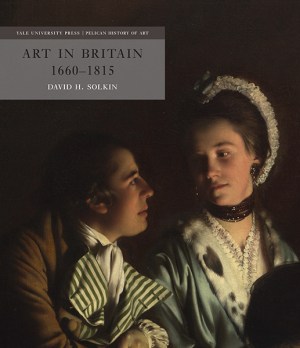 Art in Britain 1660–1815 presents the first social history of British art from the period known as the long 18th century, and offers a fresh and challenging look at the major developments in painting, drawing, and printmaking that took place during this period. It describes how an embryonic London art world metamorphosed into a flourishing community of native and immigrant practitioners, whose efforts ultimately led to the rise of a British School deemed worthy of comparison with its European counterparts. Within this larger narrative are authoritative accounts of the achievements of celebrated artists such as Peter Lely, William Hogarth, Thomas Gainsborough, and J.M.W. Turner. David H. Solkin has interwoven their stories and many others into a critical analysis of how visual culture reinforced, and on occasion challenged, established social hierarchies and prevailing notions of gender, class, and race as Britain entered the modern age. More than 300 artworks, accompanied by detailed analysis, beautifully illustrate how Britain’s transformation into the world’s foremost commercial and imperial power found expression in the visual arts, and how the arts shaped the nation in return.
David H. Solkin is Walter H. Annenberg Professor of the History of Art and Dean and Deputy Director of The Courtauld Institute of Art. His publications include Richard Wilson: The Landscape of Reaction (Tate Gallery, 1982), Painting for Money: The Visual Arts and the Public Sphere in Eighteenth-Century England (Yale University Press, 1993) and Painting out of the Ordinary: Modernity and the Art of Everyday Life in Early Nineteenth-Century Britain (Yale University Press, 2008); he is also the editor and co-author of Art on The Line: The Royal Academy Exhibitions at Somerset House 1780–1836 (Yale University Press, 2001) and Turner and the Masters (Tate, 2009).
New Book | Qing Encounters: Artistic Exchanges
From Getty Publications:
Petra ten-Doesschate Chu and Ning Ding, eds., Qing Encounters: Artistic Exchanges between China and the West (Los Angeles: Getty Publications, 2015), 320 pages, ISBN 978-1606064573, $55.
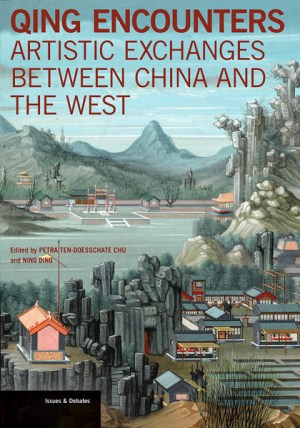 Qing Encounters: Artistic Exchanges between China and the West examines how the contact between China and Europe in the eighteenth and early nineteenth centuries transformed the arts on both sides of the East-West divide. The essays in the volume reveal the extent to which images, artifacts, and natural specimens were traded and copied, and how these materials inflected both cultures’ visions of novelty and pleasure, battle and power, and ways of seeing and representing. Artists and craftspeople on both continents borrowed and adapted forms, techniques, and modes of representation, producing deliberate, meaningful, and complex new creations. By considering this reciprocity from both Eastern and Western perspectives, Qing Encounters offers a new and nuanced understanding of this critical period.
Petra ten-Doesschate Chu is professor of art history and museum studies and director of graduate studies in Museum Professions at Seton Hall University. Ning Ding is professor of art history and theory and vice-dean at the School of Arts, Peking University.
◊ ◊ ◊ ◊ ◊
C O N T E N T S
Foreword
Acknowledgments
Petra ten-Doesschate Chu and Ning Ding, Introduction
Part I: Collection and Display
• Richard Vinograd, Hybrid Space of Encounter in the Qing Era
• Anna Grasskamp, Frames of Appropriation: Foreign Artifacts on Display in Early Modern Europe and China
• Kristel Smentek, Global Circulations, Local Transformations: Objects and Cultural Encounter in the Eighteenth Century
• Mei-Mei Rado, Encountering Magnificence: European Silks at the Qing Court during the Eighteenth Century
Part II: Knowledge and Information Exchange between China and the West
• John Finlay, Henry Bertin and the Commerce in Images between France and China in the Eighteenth Century
• Che-Bing Chiu, Vegetal Travel: Western-European Plants in the Garden of the Emperor of China
• Yuen Lai Winnie Chan, Nineteenth-Century Canton Gardens and East-West Plant Trade
• Marcia Reed, Imperial Impressions: The Qianlong Emperor’s Print Suites
Part III: Modes and Meaning of (Adopted) Techniques of Representation
• Yue Zhuang, Hatching in the Void: Ritual and Order in Bishu Shanzhuang Shi and Matteo Ripa’s View of Jehol
• Ya-Chen Ma, War and Empire: Images of Battle during the Qianlong Reign
• Kristina Kleutgehn, From Science to Art: The Evolution of Linear Perspective in Eighteenth-Century Chinese Art
• Lihong Liu, Shadows in Chinese Art: An Intercultural Perspective
Part IV: Chinoiserie, Européenerie, Hybridity
• Yeewan Koon, Narrating the City: Pu Qua and the Depiction of Street Life in Canton
• Greg M. Thomas, Chinoiserie and Intercultural Dialogue at Brighton Pavilion
• Stacey Sloboda, Surface Contact: Decoration in the Chinese Taste
• Jennifer Milam, Betwixt and Between: ‘Chinese Taste’ in Peter the Great’s Russia
Biographical Notes on Contributors
Illustration Credits
Index
Lecture | Margaret Oppenheimer, ‘Madame Jumel Collects’
Next month at the Mid-Manhattan Library:
Margaret Oppenheimer, ‘Madame Jumel Collects’
Mid-Manhattan Library, New York, 12 November 2015
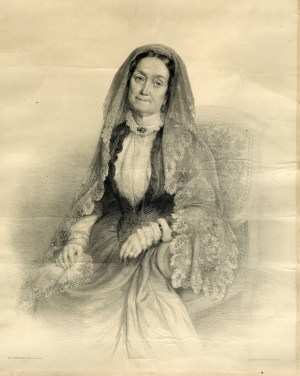
Eliza Jumel, seen in a lithograph she commissioned in 1852 (Collection of the Morris-Jumel Mansion)
The amazing Eliza Jumel—raised in a brothel, indentured as a servant, and confined to a workhouse while her mother was in jail—rose to become one of the richest women in New York. Along the way, she turned herself into an art connoisseur, acquiring more than 240 paintings while living in Paris between 1815 and 1817. In this richly illustrated lecture, art historian Margaret Oppenheimer will bring Jumel’s pioneering collection back to life, discussing the paintings, their owner, and the early nineteenth-century art scene in New York and Paris. Oppenheimer is the author of the new biography The Remarkable Rise of Eliza Jumel: A Story of Marriage and Money in the Early Republic, forthcoming from Chicago Review Press on November 1.
Thursday, November 12, 6:30–8pm; admission is free.
◊ ◊ ◊ ◊ ◊
Margaret A. Oppenheimer, The Remarkable Rise of Eliza Jumel: A Story of Marriage and Money in the Early Republic (Chicago: Chicago Review Press, 2015),
352 pages, ISBN: 978-1613733806, $30.
 Eliza Jumel (1775–1865) was born in poverty in Providence, Rhode Island, and died one of the richest women in New York. During her rise from the workhouse to Paris’s place Vendôme, she acquired a fortune from her first husband, a French merchant, and nearly lost it to her second, the notorious Aaron Burr. Divorcing him promptly amid lurid charges of adultery, she lived on triumphantly to the age of ninety, astutely managing her property and public persona. After her death, a titanic battle over her estate went all the way to the United States Supreme Court . . . twice. During the decades-long fight over Eliza’s dollars, claimants adapted her life history to serve their own ends. Family members described a woman who earned the gratitude of Napoleon I and shone at the courts of Louis XVIII and Charles X. Their opponents painted a less flattering picture: they said Eliza bore George Washington an illegitimate son, defrauded her first husband, and even plotted his death.
Margaret A. Oppenheimer holds a Ph.D. in art history from New York University. She is the author of The French Portrait: Revolution to Restoration (2005), the collaborating writer of the first edition of Art: A Brief History (2000), and a contributor to A Personal Gathering; Paintings and Sculpture from the Collection of William I. Koch (1996). Her articles on eighteenth- and nineteenth-century French art have appeared in Apollo, the Gazette des Beaux-Arts, the Metropolitan Museum Journal, and other publications. In her off-hours from working as a writer and copy editor, she volunteers as a docent at the Morris-Jumel Mansion in New York City, Eliza Jumel’s former home.
Exhibition | Titian to Canaletto: Drawing in Venice
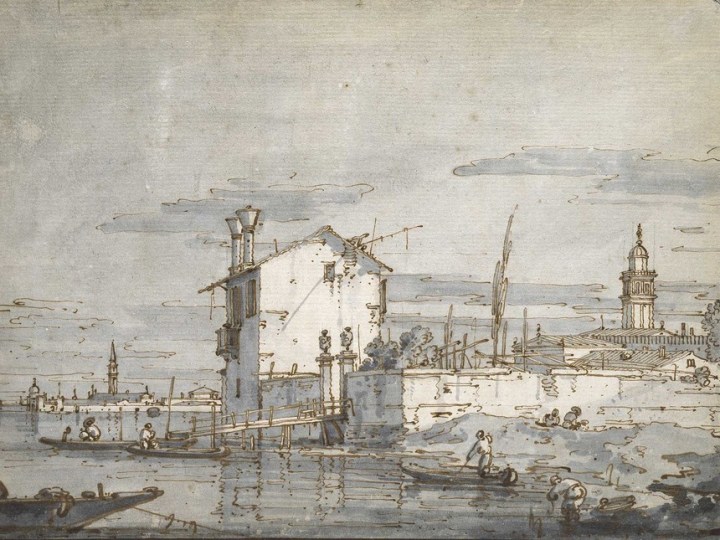
Giovanni Antonio Canal, known as Canaletto (1697‒1768), An Island in the Lagoon, pen, brown ink with grey wash over ruled pencil lines on blue paper, 20 x 27.9 cm (Ashmolean Museum, University of Oxford).
◊ ◊ ◊ ◊ ◊
Press release (28 August 2015) for the exhibition opening this week at the Ashmolean:
Titian to Canaletto: Drawing in Venice
Ashmolean Museum of Art and Archaeology, Oxford, 15 October 2015 — 10 January 2016
Curated by Catherine Whistler
Featuring a hundred drawings from the Uffizi, the Ashmolean, and Christ Church, Oxford, Titian to Canaletto is a groundbreaking exhibition based on new research. Venetian art has long been associated with brilliant colours and free brushwork, but drawing has been written out of its history. This exhibition highlights the significance of drawing as a concept and as a practice in the artistic life of Venice. It reveals the variety of purposes and techniques in drawing from Bellini, Titian and Tintoretto to Tiepolo and Canaletto. In a parallel exhibition, Jenny Saville Drawing, one of the UK’s most celebrated contemporary artists, Jenny Saville, has produced new work on paper and canvas in response to the Venetian Old Masters.
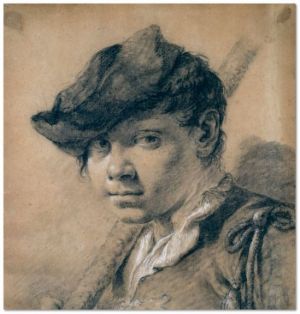
Giovanni Battista Piazzetta (1682‒1754), Head of a Youth, black and white chalks on brownish paper, 31.5 x 29.9 cm (Ashmolean Museum, University of Oxford)
Putting the words ‘drawing’ and ‘Venice’ together seems paradoxical. Writing on Venetian art has located creativity and artistic ambition in painting above all, emphasizing the materiality and sensuous effects achieved by Venetian artists. The intellectual and reflective qualities encapsulated in drawing are seen as irrelevant in the artistic world of Venice. The idea that Venetian artists did not use or value drawing was articulated in Florence, in Giorgio Vasari’s Lives of the Artists of 1568. Vasari’s influential statements were repeated and elaborated by later writers, so that in 1770s London, Joshua Reynolds confidently asserted that artists in Venice did not care about drawing with all of its virtues of discrimination and judgement, and that they went straight to working with brushes on canvas. This potent literary tradition had a major impact on the survival of drawings.
Titian to Canaletto presents new research which traces continuities in Venetian drawing over three centuries, from around 1500 to the foundation of the first academy of art in Venice in 1750. The exhibition emphasizes the role of drawing from sculpture and from life in the education and identities of Venetian artists, and it reveals tensions between theory and practice in the activities of artists and of collectors. Venetian artists used drawing for innovating and experimenting, or as a tool for research and observation; a variety of drawings were made and admired as works of art in their own right. The exhibition poses questions about the survival and value of drawings: does the fact that we have so few by Titian mean that he did not draw? Why were many Venetian drawings thought unworthy of collecting?
Ironically, while the story that Venetian artists did not respect drawing was first told in Florence, one of the world’s great collections of Venetian drawings is held at the Uffizi where many drawings were acquired in the mid-seventeenth century for Leopoldo de’Medici. Not only are there masterpieces by Carpaccio, Bassano, Titian and Tintoretto, and high-quality works by lesser-known seventeenth- century artists, there are also drawings that reveal early attitudes to collecting and connoisseurship. The Uffizi will also lend drawings by Tiepolo that have never been shown before, to be grouped with the Ashmolean’s own superb collection. Pioneering collectors in England owned Venetian drawings, and loans of important works by Veronese and Tintoretto will come from the intact early eighteenth-century collection at Christ Church, Oxford, together with the extraordinary Portrait of a man, by Giovanni Bellini.
Dr Catherine Whistler, Keeper of the Department of Western Art, Ashmolean Museum, and curator of the exhibition, says: “The beauty and visual impact of these drawings speak eloquently of the importance of drawing in Venice. We hope this exhibition will challenge traditional views of Venetian art and provoke new thinking on some of the greatest names in Italian art from the Renaissance to the eighteenth century.”
Dr Alexander Sturgis, Director of the Ashmolean, says: “The Ashmolean is bringing to a close its year of drawings exhibitions with this landmark show. Titian to Canaletto includes some of the Ashmolean’s greatest treasures, brought together with examples from two of the world’s finest collections of Old Master drawings—that of the Uffizi and the Christ Church Picture Gallery. Many of the works in the exhibition have not been displayed in public since the 1950s. The captivating beauty of these drawings is evident in the response they have elicited from one of this country’s most distinguished contemporary artists, Jenny Saville, who has produced a new body of work inspired by pieces in the exhibition and her enduring love of Venetian art.”
In Jenny Saville Drawing, Jenny Saville will present a body of drawings, including several new and unseen works in a dedicated exhibition space that accompanies Titian to Canaletto: Drawing in Venice. The rich material and gestural qualities of Venetian drawings have been an inspiration for the thoughtful yet visceral works on paper and canvas that will be on view. For Jenny Saville, the blurred or grainy charcoal marks and the agile, robust pen lines of Venetian artists such as Titian or Palma Giovane become catalysts for exploring the nature and power of drawing, in new, highly charged works of art.
◊ ◊ ◊ ◊ ◊
The catalogue is distributed by ACC:
Catherine Whistler, ed., Drawing in Venice: Titian to Canaletto (Oxford: Ashmolean Museum/ Woodstocker Books, 2015), 256 pages, ISBN: 978-1854442994, $45.
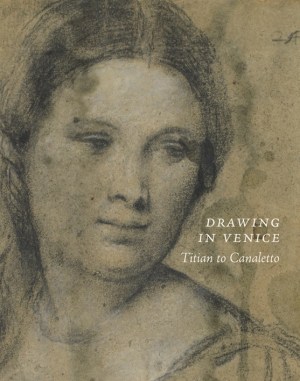 Featuring over a hundred drawings from the outstanding collections of graphic art at the Uffizi, Florence, and the Ashmolean, and Christ Church, Oxford, Drawing in Venice is based on ground-breaking new research and accompanies an Ashmolean-Uffizi collaborative exhibition (2015–16) which traces continuities in Venetian drawing over three centuries, from around 1500 down to the foundation of the first academy of art in Venice in 1750.
Venetian art has long been associated with brilliant colours and free brushwork, but drawing has been written out of its history. This book highlights the significance of drawing as a concept and as a practice in the artistic life of Venice. It reveals the variety of aims, purposes, and techniques in drawing through the works of the Venetian Renaissance masters Giovanni Bellini, Titian, and Tintoretto to those of the great eighteenth-century artists, Giovanni Battista Tiepolo and Canaletto.
Dr Catherine Whistler is Keeper of the Western Art Department at the Ashmolean Museum, University of Oxford. Her previous publications include Michelangelo and Raphael Drawings (1990); Drawings by the Carracci from British Collections (joint author, 1996); Opulence and Devotion: Brazilian Baroque Art (2001); and Graceful and True: Drawings in Florence c.1600 (joint author, 2003).
C O N T E N T S
Essays
1 Catherine Whistler, Drawing in Venice from Titian to Canaletto: Practice and Perception
2 Giorgio Marini, Disegni a stampa: Drawing Practice and Printmaking in Venice from the Sixteenth to the Eighteenth Centuries
3 Marzia Faietti, Giorgio Vasari’s ‘Life of Titian’: Critical Misinterpretations and Preconceptions Concerning Venetian Drawing
4 Jacqueline Thalmann, General John Guise and His Collection of Venetian Drawings
Catalogue Entries
Glossary of Materials and Techniques of Drawing
Artists’ Biographies
Bibliography
New Book | Eternity’s Sunrise: The Imaginative World of William Blake
From Yale UP:
Leo Damrosch, Eternity’s Sunrise: The Imaginative World of William Blake (New Haven: Yale University Press, 2015), 344 pages, ISBN: 978-0300200676, $30.
 William Blake (1757–1827), overlooked in his time, remains an enigmatic figure to contemporary readers despite his near canonical status. Out of a wounding sense of alienation and dividedness he created a profoundly original symbolic language, in which words and images unite in a unique interpretation of self and society. He was a counterculture prophet whose art still challenges us to think afresh about almost every aspect of experience—social, political, philosophical, religious, erotic, and aesthetic. He believed that we live in the midst of Eternity here and now, and that if we could open our consciousness to the fullness of being, it would be like experiencing a sunrise that never ends.
Following Blake’s life from beginning to end, acclaimed biographer Leo Damrosch draws extensively on Blake’s poems, his paintings, and his etchings and engravings to offer this generously illustrated account of Blake the man and his vision of our world. The author’s goal is to inspire the reader with the passion he has for his subject, achieving the imaginative response that Blake himself sought to excite. The book is an invitation to understanding and enjoyment, an invitation to appreciate Blake’s imaginative world and, in so doing, to open the doors of our perception.
Leo Damrosch is Research Professor of Literature, Harvard University. His previous books include Jean-Jacques Rousseau: Restless Genius, a National Book Award finalist; Tocqueville’s Discovery of America; and Jonathan Swift: His Life and His World, winner of the National Book Critics Circle Award in biography and a finalist for the Pulitzer Prize in biography. He lives in Newton, MA.
New Book | Fashion Plates: 150 Years of Style
Due out next month from Yale UP:
April Calahan, edited by Karen Trivette Cannell, with a foreword by Anna Sui, Fashion Plates: 150 Years of Style (New Haven: Yale University Press, 2015), 440 pages, ISBN: 978-0300212266, $150.
 Prior to the invention of photography, European and American magazines used colorful prints to depict the latest fashion trends. These illustrations, known as ‘fashion plates’, conveyed the cutting-edge styles embraced by the fashion-conscious elite and proved inspirational to the upwardly mobile. Fashion Plates: 150 Years of Style is a comprehensive survey containing 200 fashion plates, many reproduced at actual size, from publications dating from 1778 to the early 20th century.
A number of these charming illustrations are extremely rare, and have not appeared in print since their publication in the periodicals in which they first ran. Organized chronologically and featuring both men’s and women’s garments, these lively and colorful vignettes not only are beautiful, but also clearly illustrate the evolution of fashion over time. Many of the plates were produced by important artists of the day, including Léon Bakst, George Barbier, and Georges Lepape. With texts by April Calahan on the social, political, and economic significance of fashion and its industries, and a foreword by award-winning fashion designer Anna Sui, this exquisite slipcased publication fills an important gap in the literature on the history of fashion and provides an entertaining historical overview for the general reader.
April Calahan is a fashion historian, writer and art appraiser, as well as special collections associate at the Fashion Institute of Technology, New York. Karen Trivette Cannell is assistant professor and head of special collections and the archive at the Fashion Institute of Technology, New York. Anna Sui is a fashion designer living in New York City.
Exhibition | The Edible Monument: The Art of Food for Festivals

Marcantonio Chiarini and Giacomo-Maria Giovannini, Disegni del convito fatto dall’illustrissimo signor senatore Francesco Ratta all’illustrissimo publico, eccelsi signori anziani and altra nobilità: terminando il svo confalonierato li 28. febraro 1693 (The Getty Museum). More information is available here.
◊ ◊ ◊ ◊ ◊
The Edible Monument revisits the exhibition mounted at the Getty in 2000, with the publication this fall of an accompanying catalogue.
The Edible Monument: The Art of Food for Festivals
The Getty Research Institute, Los Angeles, 13 October 2015 — 23 March 2016
Detroit Institute of Arts, 16 December 2016 — 16 April 2017
Curated by Marica Reed
Elaborate artworks made of food were created for royal court and civic celebrations in early modern Europe. Like today’s Rose Bowl Parade on New Year’s Day or Mardi Gras just before Lent, festivals were times for exuberant parties. Public celebrations and street parades featured large-scale edible monuments made of breads, cheeses, and meats. At court festivals, banquet settings and dessert buffets displayed magnificent table monuments with heraldic and emblematic themes made of sugar, flowers, and fruit. This exhibition, drawn from the Getty Research Institute’s Festival Collection, features rare books and prints, including early cookbooks and serving manuals that illustrate the methods and materials for making edible monuments.
Edited by Marcia Reed with contributions by Charissa Bremer-David, Joseph Imorde, Marcia Reed, and Anne Willan, The Edible Monument: The Art of Food for Festivals (Los Angeles: Getty Publications, 2015), 192 pages, ISBN 978-1-60606-454-2, $35.
 The Edible Monument considers the elaborate architecture, sculpture, and floats made of food that were designed for court and civic celebrations in early modern Europe. These include popular festivals such as Carnival and the Italian Cuccagna. Like illuminations and fireworks, ephemeral artworks made of food were not well documented and were challenging to describe because they were perishable and thus quickly consumed or destroyed. In times before photography and cookbooks, there were neither literary models nor a repertoire of conventional images for how food and its preparation should be explained or depicted. Although made for consumption, food could also be a work of art, both as a special attraction and as an expression of power. Formal occasions and spontaneous celebrations drew communities together, while special foods and seasonal menus revived ancient legends, evoking memories and recalling shared histories, values, and tastes. Drawing on books, prints, and scrolls that document festival arts, elaborate banquets, and street feasts, the essays in this volume examine the mythic themes and personas employed to honor and celebrate rulers; the methods, materials, and wares used to prepare, depict, and serve food; and how foods such as sugar were transformed to express political goals or accomplishments.
Marcia Reed is chief curator at the Getty Research Institute. She is coeditor of China on Paper (Getty Publications, 2007).
◊ ◊ ◊ ◊ ◊
C O N T E N T S
Acknowledgments
1 Marcia Reed—Food, Memory, and Taste
2 Marica Reed—Court and Civic Festivals
3 Marcia Reed—Feasting in the Streets: Carnivals and the Cuccagna
4 Joseph Imorde—Edible Prestige
5 Charissa Bremer-David—Of Cauliflower and Crayfish: Serving Vessels to Awaken the Palate
6 Anne Willan—Behind the Scenes
Contributors
Illustration Credits
Index
◊ ◊ ◊ ◊ ◊
Note (added 2 November 2016) — The DIA venue was not included in the original posting.
Exhibition | The Fabric of India
I noted this exhibition last fall, but it’s worth following up now that the show is on view at the V&A (3 October 2015 — 10 January 2016). The press release is available as a PDF file here, with information on the catalogue included below. –CH
◊ ◊ ◊ ◊ ◊
From the V&A shop:
Rosemary Crill, The Fabric of India (London: V&A Publishing, 2015), 240 pages, ISBN: 978-1851778539, £30 / $60.
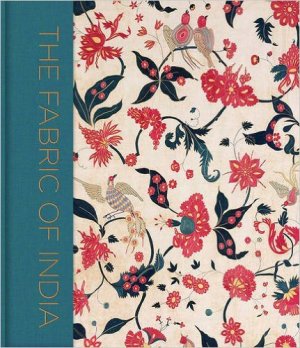 This is the first truly comprehensive book on Indian textiles, featuring stunning examples from all over the country. Lavishly illustrated, it begins with an in-depth exploration of the different materials, techniques, and dyeing processes used in the creation of these sumptuous fabrics before exploring the central importance of cloth to Indian life and culture from ancient times to the present day. Special features focus on objects of historical importance, including a Kashmir map shawl, Tipu Sultan’s tent, and a remarkable 18th-century temple hanging from South India.
While many are familiar with Mughal velvets, western-market chintzes, or rural embroideries, for example, this book will surprise, inspire, delight, and inform with an extraordinary range of material, much of it new. Along with presenting great historical masterpieces, the importance and variety of the basic fibers—silk, cotton, wool—from which Indian textiles are traditionally made is emphasized, and the remarkable techniques of weaving, printing, dyeing, and embroidery that have made them prized across the world are illustrated in specially taken photographs.
Exhibition | Woven Gold: Tapestries of Louis XIV
Press release (30 April 2015) from The Getty:
Woven Gold: Tapestries of Louis XIV
The Getty Center, Los Angeles, 15 December 2015 — 1 May 2016
Curated by Charissa Bremer-David
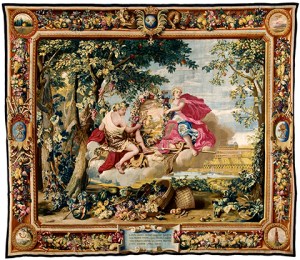
Autumn, after 1664, tapestry, wool, silk and gilt-metal wrapped thread, Gobelins Manufactory, cartoon attributed to Beaudrin Yvart (French, 1611–1690), after Charles Le Brun (French, 1619–1690), The Mobilier National, France. Photo by Lawrence Perquis.
It was during the reign of the Sun King, Louis XIV (r. 1643– 1715), that the art of tapestry weaving in France blossomed. Three hundred years after his death, the Getty Museum will showcase 15 monumental tapestries—from the French royal collection during the reign of Louis XIV. Woven Gold: Tapestries of Louis XIV will be the first major museum exhibition of tapestries in the Western United States in four decades.
During Louis XIV’s time, colorful and glittering tapestries, handwoven after designs by the most renowned artists, were the ultimate expression of status, power, taste, and wealth. The exhibition will feature 15 larger-than-life tapestries ranging in date from about 1540 to 1715 and created in weaving workshops across northern Europe. In an exclusive loan from the French nation, most of the tapestries are from the collection of the Mobilier National, which preserves the former royal collection. Eleven have never before been exhibited in the Unites States. The Getty Museum is supporting the conservation of two of the tapestries.
At the Getty, preparatory drawings, related prints and a life-sized cartoon (oil) will accompany the immense hangings. The tapestries in the exhibition are after works of art by Raphael (Raffaello Sanzio, Italian, 1483–1520), Peter Paul Rubens (Flemish, 1577–1640), Charles Le Brun (French, 1619–1690), and others. They come from the most notable workshops in Europe, including the Gobelins, which rose to preeminence under Louis XIV’s patronage. Several of the best-preserved and most famous examples of Gobelins weaving will be on view in the exhibition.
Woven Gold: Tapestries of Louis XIV is curated by Charissa Bremer-David, curator of sculpture and decorative arts at the Getty, and was organized by the J. Paul Getty Museum in association with the Mobilier National et les Manufactures Nationales des Gobelins, de Beauvais et de la Savonnerie.
◊ ◊ ◊ ◊ ◊
Charissa Bremer-David, with essays by Pascal-François Bertrand, Arnauld Brejon de Lavergnée, and Jean Vittet, Woven Gold: Tapestries of Louis XIV (Los Angeles: Getty Publications, 2015), 168 pages, ISBN: 978-1606064610, $50.
 Meticulously woven by hand with wool, silk, and gilt-metal thread, the tapestry collection of the Sun King, Louis XIV of France, represents the highest achievements of the art form. Intended to enhance the king’s reputation by visualizing his manifest glory and to promote the kingdom’s nascent mercantile economy, the royal collection of tapestries included antique and contemporary sets that followed the designs of the greatest artists of the Renaissance and Baroque periods, including Raphael, Giulio Romano, Rubens, Vouet, and Le Brun. Ranging in date from about 1540 to 1715 and coming from weaving workshops across northern Europe, these remarkable works portray scenes from the bible, history, and mythology. As treasured textiles, the works were traditionally displayed in the royal palaces when the court was in residence and in public on special occasions and feast days. They are still little known, even in France, as they are mostly reserved for the decoration of elite state residences and ministerial offices. This catalogue accompanies an exhibition of fourteen marvelous examples of the former royal collection that will be displayed exclusively at the J. Paul Getty Museum at the Getty Center from December 15, 2015, to May 1, 2016. Lavishly illustrated, the volume presents for the first time in English the latest scholarship of the foremost authorities working in the field.
Charissa Bremer-David is curator in the Department of Sculpture and Decorative Arts at the J. Paul Getty Museum. She is author of French Tapestries and Textiles in the J. Paul Getty Museum (Getty Publications, 1997) and has published extensively on French tapestries.
◊ ◊ ◊ ◊ ◊
Also on view at the Getty
As 2015 is the tercentenary of the death of Louis XIV, several exhibitions at the Getty Center will explore the Sun King’s tremendous influence on Western Art and his distinctive role as collector, heir, and patron of the art of tapestry and other arts.
• A Kingdom of Images: French Prints in the Age of Louis XIV, 1660–1715
16 June to 6 September 2015
• Louis XIV at the Getty
9 June 2015 to 31 July 2016
• Louis Style: French Frames, 1610–1792
15 September 2015 – 3 January 2016
New Book | Conundrum: Puzzles in the Grotesques Tapestry Series
Forthcoming from The Getty:
Charissa Bremer-David, Conundrum: Puzzles in the Grotesques Tapestry Series (Los Angeles: Getty Publications, 2015), 76 pages, ISBN: 978-1606064535, $20.
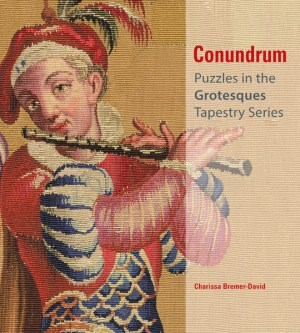 The whimsical imagery of four tapestries in the permanent collection of the J. Paul Getty Museum and currently on display at the Getty Center is perplexing. Created in France at the Beauvais manufactory between 1690 and 1730, these charming hangings, unlike most French tapestries of the period, appear to be purely decorative, with no narrative thread, no theological moral, and no allegorical symbolism. They belong to a series called the Grotesques, inspired by ancient frescos discovered during the excavation of the Roman emperor Nero’s Domus Aurea, or Golden House, but the origins of their mysterious subject matter have long eluded art historians. Based on seven years of research, Conundrum: Puzzles in the Grotesques Tapestry Series reveals for the first time that the artist responsible for these designs, Jean-Baptiste Monnoyer (1636– 1699), actually incorporated dozens of motifs and vignettes from a surprising range of sources: antique statuary, Renaissance prints, Mannerist tapestry, and Baroque art, as well as contemporary seventeenth-century urban festivals, court spectacle, and theater.
Conundrum illustrates the most interesting of these sources alongside full-color details and overall views of the four tapestries. The book’s informative and engaging essay identifies and decodes the tapestries’ intriguing visual puzzles, enlightening our understanding and appreciation of the series’ unexpectedly rich intellectual underpinnings.
Charissa Bremer-David is curator in the Department of Sculpture and Decorative Arts at the J. Paul Getty Museum. She is author of French Tapestries and Textiles in the J. Paul Getty Museum (Getty Publications, 1997) and has published extensively on French tapestries.










 Enfilade
leave a comment