New Book | The Writings of James Barry
From Ashgate:
Liam Lenihan, The Writings of James Barry and the Genre of History Painting, 1775–1809 (Farnham: Ashgate, 2014), 218 pages, ISBN: 978-1409467526, $110.
 Examining the literary career of the eighteenth-century Irish painter James Barry through an interdisciplinary methodology, The Writings of James Barry and the Genre of History Painting, 1775–1809 is the first full-length study of the artist’s writings. Liam Lenihan critically assesses the artist’s own aesthetic philosophy about painting and printmaking, and reveals the extent to which Barry wrestles with the significant stylistic transformations of the pre-eminent artistic genre of his age: history painting. Lenihan’s book delves into the connections between Barry’s writings and art, and the cultural and political issues that dominated the public sphere in London during the American and French Revolutions.
Barry’s writings are read within the context of the political and aesthetic thought of his distinguished friends and contemporaries, such as Edmund Burke, his first patron; Joshua Reynolds, his sometime friend and rival; Mary Wollstonecraft and William Godwin, with whom he was later friends; and his students and adversaries, William Blake and Henry Fuseli. Ultimately, Lenihan’s interdisciplinary reading shows the extent to which Barry’s faith in the classical tradition in general, and the genre of history painting in particular, is permeated by the hermeneutics of suspicion. This study explores and contextualizes Barry’s attempt to rethink and remake the preeminent art form of his era.
Liam Lenihan was National University of Ireland Centennial Postdoctoral Fellow in Irish Studies from 2009 to 2011. He teaches English literature and History of Art at University College Cork.
◊ ◊ ◊ ◊ ◊
C O N T E N T S
Introduction: James Barry’s Writings and the Genre of History Painting
1 Barry’s Inquiry into public taste
2 The Progress of Human Culture as a Narrative of Enlightenment
3 Barry’s Lectures on Painting and the Royal Academy of Arts
4 Wollstonecraft’s Reading of Milton and the Sublime of Barry, Fuseli and Blake
5 Barry’s Self-Portrait as Timanthes and His Tenure as Professor of Painting
Conclusion: History Painting as a ‘Union of Talents’
Works Cited
Index
Display | Jonathan Richardson by Himself
Now on view at The Courtauld:
Jonathan Richardson by Himself
The Courtauld Gallery, London, 24 June — 20 September 2015
Curated by Susan Owens

Jonathan Richardson, Self-Portrait, ca. 1738 (London: The Courtauld Gallery)
Jonathan Richardson the Elder (1667–1745) was one of the most influential figures in the visual arts of 18th-century England. A leading portrait painter, Richardson was also a theorist and an accomplished poet and amassed one of the great collections of drawings of the age.
Towards the end of his life Richardson created a remarkable but little known series of self-portrait drawings. They show Richardson adopting a wide range of poses, guises and dress, in some cases deliberately evoking other artists, such as Rembrandt, whose work he owned. These remarkable drawings show Richardson considering and making visual the different aspects of himself. But much more than this, they were the means with which he reviewed his life and achievements.
Emma Crichton-Miller provides a review of the exhibition for Apollo Magazine’s Muse Room (27 July 2015). . .
Richardson’s habit of self-portraiture, charting his declining physical appearance, was married over a decade to a discipline of almost daily poems, where he examined his state of mind. Indeed as interesting as the images themselves is the intellectual and philosophical hinterland they suggest, which drove this self-made man, an admirer of Milton, who apparently turned down royal patronage, to pursue this humanist practice. . .
The full review is available here»
◊ ◊ ◊ ◊ ◊
From Paul Holberton:
Susan Owens, Jonathan Richardson By Himself (London: Paul Holberton, 2015), 64 pages, ISBN: 978-1907372841, £13.
Jonathan Richardson (1667–1745) was one of 18th-century England’s most significant cultural figures. A leading portrait painter and influential art theorist, he also amassed one of the period’s greatest collections of drawings. But there was another, highly unusual dimension to his pursuits. In 1728, at the age of 61 and shortly before his retirement from professional life, Richardson began to create a remarkable series of self-portrait drawings. Not intended for public display, these works were unguarded explorations of his own character.
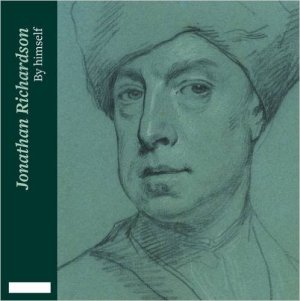 In one of the most astonishing projects of self-examination ever undertaken by an artist, for over a decade Richardson repeatedly drew his own face. His self-portrait drawings are usually dated precisely, and they document, from month to month, his changing state of mind as much as his appearance. Many were drawn in chalks on large sheets of blue paper, from his reflection in the mirror. Some of these are bold and psychologically penetrating, while others, in which he regards his ageing features with gentle but unflinching scrutiny, are deeply touching. A further group of self-portraits is drawn with graphite on small sheets of fine vellum, and in these Richardson often presents himself in inventive and humorous ways, such as in profile, all’antica, as though on the face of a coin or medal; or crowned with bays, like a celebrated poet. Sometimes, too, he copies his image from oil paintings made decades earlier, in order to recall his appearance as a younger man. In this extraordinary series of self-portraits, Richardson offers a candid insight into his mind and personality. Together, these drawings create nothing less than a unique and compelling visual autobiography.
This publication—which accompanies the first ever exhibition devoted to Richardson’s self-portrait drawings, held in the new Gilbert and Ildiko Butler Drawings Gallery at the Courtauld—tells the story of these remarkable works and puts them into the context of his other activities at this period of his life, in particular the self-searching poems he wrote during the same years and often on the same days as he made the drawings. An introductory essay is followed by focused discussions of each work in the exhibition. This part of the book explores the materials and techniques Richardson used, whether working in chalks on a large scale or creating exquisitely refined drawings on vellum. It will also reveal how Richardson modeled some of his portraits on old master prints and drawings, including works in his own collection by Rembrandt and Bernini. The publication brings together the Courtauld Gallery’s fine collection of Richardson’s drawings with key works in the British Museum, the National Portrait Gallery and the Fitzwilliam Museum.
New Book | The Imaginary Orient: Exotic Buildings
From Artbooks.com:
Stefan Koppelkamm, The Imaginary Orient: Exotic Buildings of the 18th and 19th Centuries in Europe (Stuttgart: Axel Menges, 2015), 192 pages, ISBN: 978-3936681772, $78.
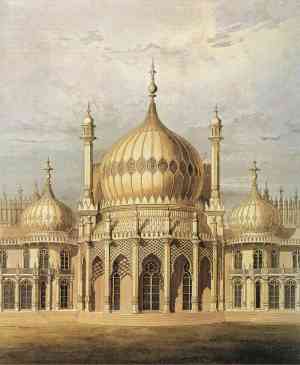 In the eighteenth century the idea of the landscape garden, which had originated in England, spread all over Europe. The geometry of the Baroque park was abandoned in favour of a ‘natural’ design. At the same time the garden became the ‘land of illusion’: Chinese pagodas, Egyptian tombs and Turkish mosques, along with Gothic stables and Greek and Roman temples, formed a miniature world in which distance mingled with the past. The keen interest in a fairy-tale Orient was manifested also in architecture. This ‘Orient’, which could hardly be clearly defined geographically, was characterized by Islamic culture. The Islamic styles seemed especially appropriate for buildings of a secular and cheerful character. The promise of happiness associated with an Orient staged by architectural means was intended to guarantee the commercial success of coffee houses and music halls, amusement parks and steam baths. But even extravagant summer residences and middle-class villas were built in faux-Oriental styles.
◊ ◊ ◊ ◊ ◊
Note (added 21 December 2016) — Barry Bergdoll reviews the book for The Burlington Magazine 158 (December 2016), p. 982:
Published originally in German in 1987 to accompany a series of no doubt delightful exhibitions entitled Exotische Welten-Europäische Phantasien in Stuttgart (Institut für Auslansbeziehungen), this anthology seems to be more concerned with compiling examples than analysing them . . . Sometimes groundbreaking exhibition catalogues are republished years later either because of their historical importance or because greater availability stimulates new research. The decision to translate (more or less) this rather helter-skelter overview into English more than a quarter of a century after its appearance is mystifying . . .
New Book | British Silver: State Hermitage Museum Catalogue
Scheduled for October release, from Yale UP:
Marina Lopato, British Silver: State Hermitage Museum Catalogue (London: The Paul Mellon Centre for Studies in British Art, 2015), 400 pages, ISBN: 978-0300213201, $175.
 Despite its comparatively small size—just over 370 items, dating mainly from the 18th century—the collection of British silver in the Hermitage is renowned for its variety and quality. Over the course of the 18th and 19th centuries, the introduction of European dining habits and Russian Anglophilia contributed to the acquisition of large quantities of British silver. Most of the pieces were functional rather than decorative, such as dinner or toilet services specially commissioned by members of the imperial family and the aristocracy.
Marking the 250th anniversary of the State Hermitage Museum, this catalogue offers a grand presentation of these glorious silver items, supported by new research and documents. In her introduction, Marina Lopato details the complexities of Russian and Hermitage history to set the scene for the objects. Sumptuous illustrations showcase the exceptional nature of the Hermitage’s British silver, most evident in four monumental wine coolers that are among the best known pieces of British silver anywhere in the world.
Marina Lopato is curator of European silver at the State Hermitage Museum, St. Petersburg.
Exhibition | Pompeii and Europe, 1748–1943
Now on view in Naples:
Pompeii and Europe, 1748–1943
Museo Archeologico Nazionale Naples, 27 May — 2 November 2015
Curated by Massimo Osanna
 Pompeii and Europe recounts the fascination that the archaeological site of Pompeii held for artists and the European imagination, from the start of excavations in 1748 to its dramatic bombing in 1943. The exhibition—devised by Massimo Osanna, the Superintendent for Pompeii, Herculaneum and Stabiae—unfolds along a twofold route at the National Archaeological Museum in Naples and simultaneously at the Amphitheater in Pompeii, and joins the program of events planned for Expo Milano 2015 in importance and prestige.
The exhibition evokes the history of the Vesuvian city, an inexhaustible source of inspiration, in a constant comparison between the arts and the excavations; a dialogue between archaeologists and historians of art, architecture and literature, all called on to recount the unique story of the rediscovery of Pompeii.
Promoted by the Superintendency for Pompeii, Herculaneum and Stabiae and the Directorate General of the Great Pompeii Project, with the National Archaeological Museum in Naples, the exhibition—organized by Electa with an exhibition installation by Francesco Venezia—is structured as a true journey, grand and complex, in which Antiquity enters into a dialogue with Modernity, and nature with the arts and archaeology.
◊ ◊ ◊ ◊ ◊
The catalogue is available in English from Artbooks.com:
Massimo Osanna, et al., Pompei and Europe, 1748–1943 (Milan: Electa, 2015), 350 pages, ISBN: 978-8891803627, $75.
The Burlington Magazine, July 2015
The eighteenth century in The Burlington:
The Burlington Magazine 157 (July 2015)
 A R T I C L E S
• Peter Lindfield, “New Light on Chippendale at Hestercombe House,” pp. 452–56.
• Susan Owens, “A Note on Jonathan Richardson’s Working Methods,” pp. 457–59.
• Peter Moore and Hayley Flynn, “John Collett’s Temple Bar and the Discovery of a Preparatory Study,” pp. 460–64.
• Alycen Mitchell and Barbara Pezzini, “‘Blown into Glittering by the Popular Breath’: The Relationship between George Romney’s Critical Reputation and the Art Market,” pp. 465–73.
R E V I E W S
• Charles Truman, Review of Gerhard Röbbig, ed., Meissen Snuffboxes of the Eighteenth Century (Hirmer Verlag, 2013), p. 484.
• Maureen Cassidy-Geiger, Review of Haydn Williams, Turquerie: An Eighteenth-Century European Fantasy (Thames & Hudson, 2014), p. 487.
• J.V., Review of Ian Warrell, Turner’s Sketchbooks (Tate Publishing, 2014), p. 488.
• Robert O’Byrne, Review of the exhibition, Ireland: Crossroads of Art and Design, 1690–1840, p. 509–10.
Exhibition | An Elegant Society: Adam Buck, Artist in the Age of Austen
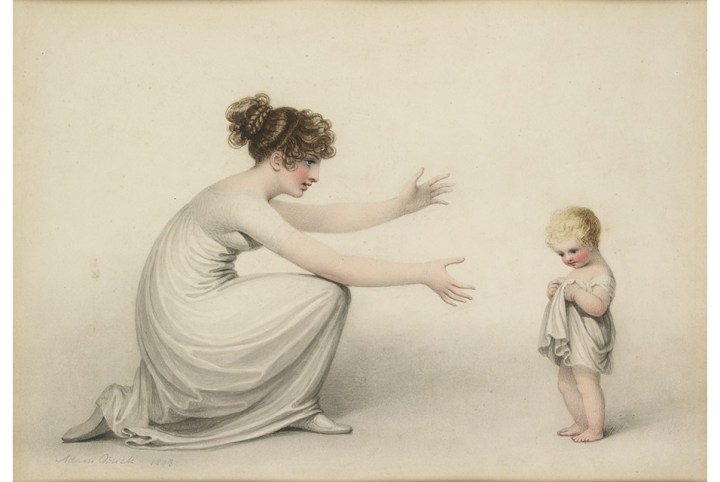
Adam Buck, First Steps, 1808. Watercolour, 28 x 35 cm
(Private Collection)
◊ ◊ ◊ ◊ ◊
Press release (23 April 2015) from the Ashmolean:
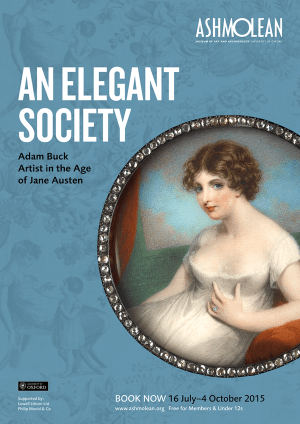
An Elegant Society: Adam Buck, Artist in the Age of Jane Austen
Ashmolean Museum, Oxford, 16 July — 4 October 2015
Crawford Art Gallery, Cork, 4 February — 9 April 2016
Curated by Peter Darvall
Well-known to collectors and Jane Austen enthusiasts, Irish artist Adam Buck (1759–1833) was one of Regency England’s most sought-after portrait painters. He worked in Ireland for twenty years, becoming an accomplished miniaturist; but moved to London in 1795 and immediately gained a roster of star clients including the Duke of York and his scandalous mistress, Mary Anne Clarke. This summer exhibition celebrates Adam Buck’s influence on Georgian art and style, showing over sixty works from private collections including watercolours, small portraits and miniatures, examples of his decorative designs for porcelain and fans, and his prints.
 Buck was born to a family of silversmiths in Cork, the second of four surviving children. His younger brother, Frederick (1765–1840), became an established miniature painter who worked in Cork his entire life. Details of Adam’s career before he moved to London are elusive, but his early work is in many ways that of the quintessential Regency miniaturist. His first known pictures, dating from the late-1770s to the early-1780s, show an innate appreciation of the established Neoclassical style: his sitters are often shown in profile; their gowns styled like Grecian goddesses; group portraits arranged like a frieze. In emigrating to London in 1795, Buck took the route of many fellow Irishmen including several Cork-born artists and writers such as James Barry (1741–1806) and Alexander Pope (1759–1847). Buck’s first London home was in Piccadilly. As soon as he arrived, he began to exhibit at the Royal Academy where he showed a surprising total of 179 works over the following 38 years.
His success as a society artist was almost instant. By 1799 he had executed a full-length portrait of the Prince of Wales in his Garter Robes. He exhibited two portraits of Prince Frederick, Duke of York, at the Royal Academy in 1804 and 1812. Buck was also introduced to Mary Anne Clarke (1776–1852), the most celebrated of the Duke’s well-known mistresses. She was a famous beauty and maintained a fabulous household in London, subsidising her extravagant lifestyle by selling her influence with the Duke who was Commander in Chief of the Army. Rumours claiming that she could obtain commissions and appointments for a fee culminated in a parliamentary enquiry into the Duke’s conduct. While the Duke was ridiculed in caricatures and lampoons, Mary Anne, who put up a spirited defence of her role in the affair, became a public heroine. Her image was circulated in flattering portraits by Buck and other artists which were engraved and widely published. In 1813 she finally overreached herself and was imprisoned for nine months for libel, before leaving the country for Boulogne where she died in 1852.
Buck’s work was made popular largely through prints after his watercolours, chiefly published in London by William Holland and Rudolph Ackermann. His images, refined and elegant, contrasted with the savage caricatures and ribald pictures of contemporary artists like James Gillray and Isaac Cruikshank. The difference was humorously summed up in a Thomas Rowlandson print with the title, Buck’s Beauty and Rowlandson’s Connoisseur (1800), in which a rake in wig and frock coat, one of Rowlandson’s stock characters, leers through an eye-glass at a demure, pink-cheeked girl, drawn in Buck’s distinctive manner. With his name made in association with the colourful ranks of Regency society, Buck, from 1810 onwards, made a new reputation for himself with his sentimental images of women and children under titles such as The First Steps in Life and Mother’s Hope. By 1829 his work had been reproduced by at least twenty-eight different printmakers in England and by several in France and America.
Peter Darvall, Guest Curator, says: “I hope, with this exhibition and monograph on Adam Buck’s work, to bring his art to the attention of a wider audience. Buck was a hugely influential artist during his own time and his elegant portraits of royalty and officers, and his charming illustrations of Georgian life and manners have had an enduring impact on the popular imagination of Regency society.”
◊ ◊ ◊ ◊ ◊
From the Ashmolean shop:
Peter Darvall and Jon Whiteley, Adam Buck, 1759–1833 (Oxford: Ashmolean Museum Publications, 2015), 192 pages, ISBN: 978-1910807002, £20.
Adam Buck (1759–1833) was an Irish portrait painter, print-maker and miniaturist from Cork who migrated to London c.1795. His name is well-known to collectors and historians of British prints and watercolours and for many years his work has appeared regularly in sale catalogues. And yet, while there have been a few short articles published on his contribution to print-making, ceramic decoration and the study of Greek vases, it is surprising that no serious attempt has previously been made to collate the little that is known about his life and work. Moreover, he has never been the subject of a monographic exhibition apart from one at the Leicester Gallery in 1925 and, more recently, a small exhibition at the Cynthia O’Connor Gallery in Dublin in 1984 and another at the Alpine Gallery in London, mounted by Andrew Kimpton, in 1989.
◊ ◊ ◊ ◊ ◊
Note (added 6 February 2015) — At the Crawford Art Gallery, a distilled version of the show is entitled Adam Buck: A Regency Artist from Cork.
Exhibition | Yo, el Rey: La Monarquía Hispànica en el arte
The exhibition press release, via Art Daily (13 July 2015) . . .
Yo, el Rey: La Monarquía Hispànica en el arte
Museo Nacional de Arte, Mexico City, 1 July — 18 October 2015
Curated by Abraham Villavicencio
 The Instituto Nacional de Bellas Artes (INBA) presents the exhibition Yo, el Rey. La Monarquía Hispànica en el arte, curated and produced by the Museo Nacional de Arte. This is a comprehensive exhibit that offers the audience, through national and international masterpieces, a review of the figure of the Hispanic sovereign. The exhibition approaches the mechanisms and representation forms of the monarch with a selection of 200 works, amongst which are paintings, drawings, sculptures, textiles, jewelry, silverware, armors and historic documents.
Important international loans have been obtained through the leadership and management of the Museo Nacional de Arte, which come from the Museo Nacional del Prado, Colecciones Reales del Patrimonio Nacional, Museo de América, and Museo Lázaro Galdiano, from Spain; and The Metropolitan Museum of Art, The Hispanic Society of America and the Philadelphia Museum of Art, from the United States, as well as national collections, such as the National Museum of Art of San Carlos, Museo Nacional del Virreinato, Museo Franz Mayer, and Museo Regional de Querétaro. It also has the invaluable participation of religious institutions: Catedral de Sevilla, Catedral Metropolitana de la Cuidad de México, Templo de San Felipe Neri La Profesa, Museo de la Basílica de Guadalupe and more than 20 private collections.
It is important to address the decisive contribution of the Museo Nacional de Arte to the conservation of our national patrimony, because thanks to this exhibition many pieces have been restored in benefit of a better preservation of novohispanic pieces, among them the Retrato de Carlos III from Juan Patricio Morlete Ruiz.
The exhibition, which was curated by Abraham Villavicencio, Vice-royalty Art curator of the Museo Nacional de Arte, is developed in four thematic cores that revolve around the King as a unifying figure of the American kingdoms, and a vast politic system known as the Hispanic Monarchy.
La herencia iconográfica del pasado antiguo refers to the significance of the founding myths of royalty and kingdom, showing how, through symbolic elements of the Roman, Indigenous and German past, the image of the Hispanic monarch was built.
La efigie real. Recursos plásticos y retóricos suggests the constitution of the sovereign’s body image through attributes denoting power, which enhance the idea of authority among the royal houses of the Spanish Empire: the Habsburgo and the Borbón.
The third core, La monarquía mesiánica y el imaginario religioso, explores the king’s performance as patron of the church through his representation and the narrow link between the state and ecclesiastic institutions.
The exhibition closes with Ecos de la monarquía en el México independiente, in which the figures of Fernando VII, Agustín de Iturbide, and Maximiliano I of Mexico appear as witnesses of the survival of the mythic, politic and religious imageries of the viceroyalty of the Nueva España, even in the independent Mexico.

Jean Ranc Carlos de Borbón y Farnesio, niño (futuro Carlos III de España), hacia 1724. Óleo sobre lienzo. 145.5×116.5cm (Madrid: Prado)
According to Agustín Arteaga, director of the Museo Nacional de Arte, “the topic acquires a new vitality when being presented as an exhibition, not only for the scholars of the viceroyalty but for everyone who wants to familiarize himself with the works that are a part of the . . . past in which an empire, with particular forces and dynamics, was constituted.”
The exhibition articulates the development of political and juridical elements which visitors will be able to appreciate as a rich heritage that seeks to value the Hispanic, novo Hispanic, and Mexican creators as a group with the same political and cultural identity. Therefore, under the same curatorial speech, pieces from some of the most recognized European painters of the XVI and XVII centuries—the Siglo de Oro—up to the XIX century are reunited: Diego Velázquez, Francisco de Goya, Giovanni Battista Tiepolo, Francisco de Zubarán and Jean Ranc, with renowned novo Hispanic and Mexican artists, such as Cristóbal de Villalpando, Juan Correa, Baltasar de Echave Orio, Manuel Tolsá, Santiago Rebull and Felipe Sojo, amongst others.
The exhibition catalogue, with a bilingual edition, conjugates texts of six specialists from the Universitat Autónoma de Barcelona, the Instituto de Investigaciones Históricas of the Universidad Nacional Autónoma de México, the Colegio de México, the Escuela Nacional de Antropología e Historia, the Museo Nacional del Virreinato, and the Museo Nacional de Arte. The publication addresses political, legal, iconographical, and theological dimensions, besides making the historical and artistic transformations obvious with approximately 200 color illustrated pieces that narrate the construction of the image of the Hispanic monarch in the Indias. In addition, all the texts of the exhibit rooms will be displayed in English and Spanish.
The Museo Nacional de Arte recognizes and appreciates the support of: El Patronato del Museo Nacional de Arte, Amigos MUNAL Arte Mexicano: Promoción y Excelencia AC, Iberdrola, British Airways-Iberia, and NH Hotels for the efforts made towards the creation of new projects.
Exhibition | Scottish Artists 1750–1900: From Caledonia to the Continent
Press release (5 May 2015) from the Royal Collection Trust:
Scottish Artists 1750–1900: From Caledonia to the Continent
The Queen’s Gallery, Palace of Holyroodhouse, Edinburgh, 6 August 2015 — 7 February 2016
The Queen’s Gallery, Buckingham Palace, London, 18 March — 9 October 2016

Allan Ramsay, Queen Charlotte with her two Eldest Sons, ca. 1764-69 (London: Royal Collection Trust, RCIN 404922)
From the romantic landscapes of Caledonia to exotic scenes from the Continent, a new exhibition at The Queen’s Gallery, Palace of Holyroodhouse is the first dedicated to Scottish art in the Royal Collection. Bringing together over 80 works, including paintings and drawings by the celebrated artists Allan Ramsay and Sir David Wilkie, Scottish Artists 1750–1900: From Caledonia to the Continent tells the story of royal patronage and of the emergence of a distinctive Scottish school of art.
Allan Ramsay (1713–1784) was the first Scottish artist of European significance. A pre-eminent figure of the Enlightenment, the intellectual movement that swept across Europe in the 18th century, Ramsay maintained close friendships with philosophers such as David Hume and Jean-Jacques Rousseau. In 1760 he was commissioned to paint George III’s State portrait and subsequently became the first Scot to be appointed to the role of Principal Painter in Ordinary to His Majesty. Depicting the King in sumptuous coronation robes and breeches of cloth of gold, Ramsay produced the definitive image of George III and the most frequently copied royal portrait of all time.
Ramsay worked as a court artist, painting members of the royal family and producing copies of the coronation portrait for the King to send as gifts to ambassadors and governors. He enjoyed a good relationship with the Queen Consort, and his painting Queen Charlotte and her Two Eldest Sons, 1764, considered to be among Ramsay’s greatest works, combines the grandeur of a royal portrait with the intimacy of a domestic scene.
Over half a century later, Fife-born artist Sir David Wilkie (1785–1841) gained even wider recognition than Ramsay. His vivid, small-scale scenes of everyday life, inspired by those of the Dutch masters, were shown at the Royal Academy to great acclaim. Wilkie attracted the attention of the Prince Regent (the future George IV), who was acquiring 17th-century Dutch and Flemish genre paintings for his own collection. The artist’s reputation was sealed with two high-profile royal commissions – Blind-Man’s-Buff, 1812, and The Penny Wedding, 1818, which shows the uniquely Scottish custom of wedding guests contributing a penny towards the cost of the festivities and a home for the newly married couple.
George IV’s visit to Scotland in 1822, the first by a reigning British monarch for nearly two centuries, offered a major opportunity for royal patronage. Artists were given prime access to all of the events in the two-week programme, which was masterminded by the writer Sir Walter Scott. The entrance of the King to his Scottish residence is captured in Wilkie’s The Entrance of George IV to Holyroodhouse, 1822–30. The King is shown being presented with the keys to the Palace, while crowds of enthusiastic spectators clamber over every part of the building to see him.
After suffering a nervous breakdown, brought on by overwork and a series of family tragedies, Wilkie set off on a prolonged visit to the Continent. He was one of the first professional artists to visit Spain after the Spanish War of Independence of 1808–14. Wilkie’s travels proved to be a turning point in his art, which became much broader in style and took inspiration from contemporary events. On the artist’s return in 1828, the King summoned Wilkie to Windsor and purchased five continental pictures—A Roman Princess Washing the Feet of Pilgrims, 1827, I Pifferari, 1827, The Defence of Saragossa, 1828, The Spanish Posada, 1828, and The Guerilla’s Departure, 1828—and commissioned The Guerilla’s Return, 1830. The same year, the King appointed Wilkie to the position of Principal Painter in Ordinary, a post that the artist continued to hold under William IV and Queen Victoria.
Queen Victoria and Prince Albert saw their roles as patrons of the arts as part of the duty of Monarchy. Several pictures by Scottish artists were among the birthday and Christmas presents exchanged by the royal couple throughout their married life, including works by Sir Joseph Noël Paton (1821–1901), David Roberts (1796–1864), James Giles (1801–1870) and John Phillip (1817–1867). Queen Victoria had a deep love of Scotland and commissioned artists to record the country’s ‘inexpressibly beautiful’ scenery, including that of her recently acquired estate, Balmoral, in the Highlands. Among those artists was the Glaswegian William Leighton Leitch (1804–1883), who was appointed the Queen’s drawing master in 1846. Of all the Scottish artists whose work was collected by Victoria and Albert, it was William Dyce who was most in tune with Prince Albert’s tastes. Dyce was inspired by the early Italian art so admired by Albert, who purchased Dyce’s The Madonna and Child, 1845, and the following year commissioned a companion picture, St Joseph.
In the same period, the publication of travel books and growing interest in foreign cultures encouraged artists to seek inspiration abroad. David Roberts introduced British audiences to scenes of Egypt and the Holy Land, and was the first independent professional artist to travel extensively in the Middle East. A View of Cairo, 1840, shows the medieval Gate of Zuweyleh, and was one of Roberts’ first paintings of the region to be exhibited. Queen Victoria commissioned two Spanish pictures from Roberts as gifts for Prince Albert: A View of Toledo and the River Tagus, 1841, and The Fountain on the Prado, Madrid, 1841.
In the mid-19th century, there was a growing interest in Spanish culture, which was heavily romanticised in the literature of the day. When the artist John Phillip travelled to the country, his subject-matter changed from Scottish rural scenes to Spanish street life. Queen Victoria commissioned Phillip’s A Spanish Gypsy Mother, 1852, and purchased ‘El Paseo’, 1854, for Prince Albert. The Prince gave the Queen The Letter Writer of Seville, 1854, for Christmas. After a visit to the Royal Academy in 1858, Victoria acquired The Dying Contrabandista as a Christmas gift for the Prince that year. John Phillip was Queen Victoria’s favourite Scottish artist and, on his death in 1867, he was mourned by the monarch as ‘our greatest painter’.
Some notable Scottish works entered the Royal Collection in 1888, on the occasion of the opening of the Glasgow International Exhibition of Science, Art and Industry by the Prince of Wales (the future King Edward VII). This exhibition, held in Kelvingrove Park, was one of a series of international exhibitions and world fairs that dominated the cultural scene in the second half of the 19th century and the largest to be held in Scotland. The Prince and Princess of Wales were presented with ‘two elegant albums of paintings by members of the Glasgow Art Club’, including work by the Glasgow Boys: Sir James Guthrie (1859–1930), EA Walton (1860–1922) and Robert Macaulay Stevenson (1860–1952).
Scottish Artists 1750–1900: From Caledonia to the Continent is part of the Edinburgh Art Festival.
◊ ◊ ◊ ◊ ◊
Distributed in the U.S. by The University of Chicago Press:
Deborah Clarke and Vanessa Remington, Scottish Artists 1750–1900: From Caledonia to the Continent (London: Royal Collection Trust, 2015), 210 pages, ISBN: 978-1909741201, $25.
 Throughout its history, Scotland has produced a wealth of great works of art, and the Scottish Enlightenment in particular provided a powerful impetus for new forms of art and new artistic subjects. This survey of Scottish art in the Royal Collection brings together more than one hundred reproductions of works from the Enlightenment to the twentieth century to highlight the importance and influence of this period, while also sharing recent research on the subject.
The first book devoted to Scottish art in the Royal Collection, Scottish Artists fully explores this rich artistic tradition, incorporating discussions of artists whose inspiration remained firmly rooted in their native land, such as Alexander Nasmyth and James Giles, as well as artists who were born in Scotland and traveled abroad, from the eighteenth-century portraitist Allan Ramsay to David Wilkie, who traveled to London and is well-known for his paintings portraying everyday life. Broadly chronological, the book also traces the royal patronage of Scottish artists throughout the centuries, including works collected by monarchs from George III to Queen Victoria, and the official roles, Royal Limner for Scotland and King’s Painter in Ordinary.
New Title | Sir Robert Walpole’s Silver
From ACC Distribution:
Christopher Hartop, Sir Robert Walpole’s Silver, Special Issue of Silver Studies 30 (Cambridge: John Adamson, 2015), 64 pages, ISBN: 978-0954914431, $25.
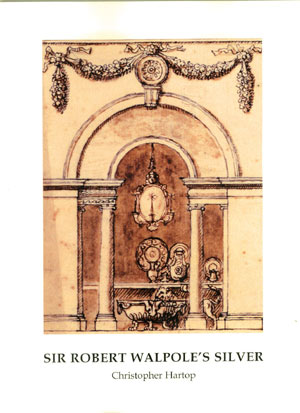 Sir Robert Walpole’s collection of Old Masters, and the building and furnishing of Houghton, the great Palladian house he built in Norfolk, have been the focus of extensive study in recent years, but his silver has not received the same attention. However, the discovery of inventories in the National Archives has allowed a picture to be built up of the sheer scale of Walpole’s silver holdings, which were, like everything else about the man, larger than life. What silver that survives includes some of the most celebrated pieces of Georgian silver, such as the square seal salver made by Paul de Lamerie and engraved by William Hogarth. Walpole probably had more silver than any of his contemporaries with the exception of the king, and the scale of his entertaining at court, in Downing Street and at Houghton was gargantuan.
Christopher Hartop, FSA is the author of numerous books on silver. In 2005 he curated the exhibition Royal Goldsmiths: The Art of Rundell & Bridge 1797–1843. He is a Liveryman of the Worshipful Company of Goldsmiths.
◊ ◊ ◊ ◊ ◊
C O N T E N T S
Chronology of Sir Robert Walpole’s life
Sir Robert Walpole’s Silver
Appendices (including plate in the Strawberry Hill sale, 1842)










 Enfilade
leave a comment