New Book | Global Trade and Visual Arts in Federal New England
From the University Press of New England:
Patricia Johnston and Caroline Frank, eds., Global Trade and Visual Arts in Federal New England (University of New Hampshire Press, 2014), 296 pages, ISBN: 978-1611685848 (hardback), $85 / ISBN: 978-1611685855 (paperback), $45 / ISBN: 978-1611685862, $45 Ebook.
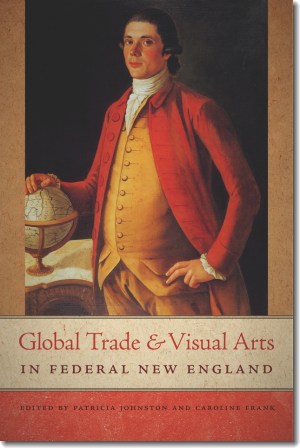 A highly original and much-needed collection that explores the impact of Asian and Indian Ocean trade on the art and aesthetic sensibilities of New England port towns in the late eighteenth and early nineteenth centuries. This diverse, interdisciplinary volume adds to our understanding of visual representations of economic and cultural changes in New England as the region emerged as a global trading center, entering the highly prized East Indies trades. Examining a wide variety of commodities and forms including ceramics, textiles, engravings, paintings, architecture, and gardens, the contributors highlight New Englanders’ imperial ambitions in a wider world.
Patricia Johnston is professor of art history and Rev. J. Gerard Mears, S.J., Chair in Fine Arts at the College of the Holy Cross. Caroline Frank teaches American studies at Brown University.
◊ ◊ ◊ ◊ ◊
C O N T E N T S
Acknowledgments
Introduction: Emerging Imperial Aesthetics in Federal New England—Patricia Johnston and Caroline Frank
Part I: Political Geographies
• The Art of Tea, Revolution, and an American East Indies Trade—Caroline Frank
• West from New England: Geographic Information and the Pacific in the Early Republic—David Jaffee
• The Forgotten Connection: The Connecticut River Valley and the China Trade—Amanda E. Lange
Part II: Commodities
• Salem’s China Trade: ‘Pretty Presents’ and Private Adventures—Jessica Lanier
• ‘Shipped in Good Order’: Rhode Island’s China Trade Silks—Madelyn Shaw
• The Story of A’fong Moy: Selling Chinese Goods in Nineteenth-Century America—Nancy Davis
Part III: Domesticating Asia
• Cultivating Meaning: The Chinese Manner in Early American Gardens—Judy Bullington
• ‘Lavish Expenditure, Defeated Purpose’: Providence’s China Trade Mansions—Thomas Michie
• Fabrics and Fashion of the India Trade at a Salem Sea Captain’s Wedding—Paula Bradstreet Richter
Part IV: Global Imaginaries
• Drawing the Global Landscape: Captain Benjamin Crowninshield’s Voyage Logs—Patricia Johnston
• Capturing the Pacific World: Sailor Collections and New England Museums—Mary Malloy
• Beyond Hemp: The Manila-Salem Trade, 1796–1858—Florina H. Capistrano-Baker
Part V: Global Productions
• Osceola’s Calicoes—Elizabeth Hutchinson
• From Salem to Zanzibar: Cotton and the Cultures of Commerce, 1820–1861—Anna Arabindan-Kesson
• Luxury and the Downfall of Civilization in Thomas Cole’s Course of Empire—Alan Wallach
Contributors
Index
Exhibition | Treasure Ships: Art in the Age of Spices

Scenes of Traders in Nagasaki, mid-eighteenth century, detail from a pair of hand scrolls, opaque watercolour, ink and gold on paper, box, wood, paper and ink, each 313 x 35 cm (Art Gallery of South Australia, Adelaide)
◊ ◊ ◊ ◊ ◊
Press release (April 2015) from the Art Gallery of South Australia:
Treasure Ships: Art in the Age of Spices
Art Gallery of South Australia, Adelaide, 13 June — 30 August 2015
Art Gallery of Western Australia, Perth, 10 October 2015 — 31 January 2016
Curated by James Bennett and Russell Kelty
Treasure Ships: Art in the Age of Spices is the first exhibition on view in Australia to present the complex artistic and cultural interaction between Europe and Asia from the sixteenth to the nineteenth centuries—a period known as the Age of Spices. The exhibition includes 300 outstanding and rarely seen works of ceramics, decorative arts, furniture, metalware, paintings, prints, engravings and textiles from both public and private collections in Australia, India, Portugal, Singapore and the United States.
Nick Mitzevich, Director, Art Gallery of South Australia sees this landmark exhibition and its publication as highlighting the Gallery’s international reputation for presenting spectacular exhibitions of historical Asian and European art. Treasure Ships showcases a diverse collection of luxury objects, many of which have never previously been seen on public display in Australia. This has been made possible through the extensive cooperation and support the Gallery has received from institutions, collectors and scholars in Portugal, India, Singapore, Indonesia and the United States, as well as the partnership with the Art Gallery of Western Australia. The Gallery’s two curators James Bennett and Russell Kelty have worked researching the exhibition for over three years, and their professional commitment has ensured the success of this much-anticipated exhibition.

China and Europe–Japan, Surcoat (jinbaori), with mon, late 18th century with 19th-century repairs, brocade created in China, velvet and factory print created in Europe, possibly France, garment constructed in Japan, cotton, wool, silk, velvet, metallic thread, natural dyes, supplementary weft and plain weave, wood, 101 x 85 cm (Helen Bowden Gift Fund 2015, Art Gallery of South Australia, Adelaide)
The works of art selected reveal how the international trade in spices and other exotic commodities inspired dialogue between Asian and European artists, a centuries old conversation whose heritage is the aesthetic globalism we know today. Europe’s infatuation with pepper, nutmeg and cloves has often been explained in terms of the necessity to preserve cooked foods in the days before the invention of refrigeration. “This is a half-truth, which takes little account of the complex reasons the condiments of luxury and status were so avidly sought, often at great expense to human lives,” said Bennett.
The exhibition commences with the small country of Portugal. Located on the periphery of Europe, Portugal re-mapped the West’s view of the world and created a mercantile spice empire stretching halfway around the globe during the fifteenth-sixteenth century. In 1498 Vasco Da Gama’s small fleet became the first to reach India, landing with the famous words, ‘we come in search of Christians and spices’. Within a decade, the Portuguese soldier—aristocrat Francisco de Almeida (1450–1510) had ruthlessly seized control of the Indian Ocean spice trade and established Portugal’s permanent presence in Asia that lasted four hundred years.
Treasure Ships also presents the story of the slave trade, piracy and shipwrecks, as well as illustrating the astonishing beauty of Chinese porcelain, known as ‘white gold’, and celebrating the vibrant Indian textiles created for export around the world. There are several highlights in this exhibition including two works from the personal collection of Queen Adelaide (1792–1849), after whom the city of Adelaide was named in 1836: artefacts retrieved from the Batavia, which sank off the Western Australian coast in the seventeenth century, and a magnificent early 19th-century Chinese punchbowl depicting Sydney Cove that locates Australia within this global history.
It is most appropriate that this exhibition should originate in Adelaide as this is the only Australian city founded on the vision of a Eurasian—the surveyor Colonel William Light (1786–1839) whose Mother was of Malaysian descent and whose remarkable self-portrait features in the exhibition said James Bennett.
Treasure Ships also examines the impact of the Age of Spices on the ‘discovery’ of the Australian continent and the commencement of English occupation in 1788. The colonial art of the period displays the aesthetic reverberations that continued in the Australasian region long after European ships had ceased carrying cargoes of nutmeg and cloves.
James Bennett and Russell Kelty, Treasure Ships: Art in the Age of Spices (Adelaide: Art Gallery of South Australia, 2015), ISBN: 978-1921668227, $70.
New Book | The Gentleman’s House in the British Atlantic World
From Palgrave Macmillan:
Stephen Hague, The Gentleman’s House in the British Atlantic World, 1680–1780 (London: Palgrave Macmillan, 2015), 264 pages, ISBN: 978-1137378378, $90.
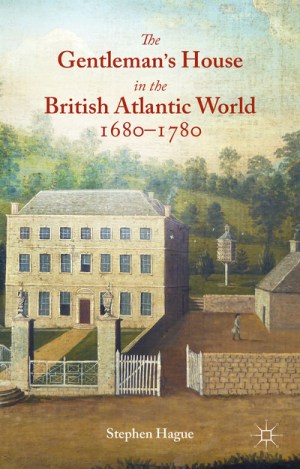 The eighteenth-century Georgian mansion holds a fascination in both Britain and America. Between the late seventeenth century and 1780, compact classical houses developed as a distinct architectural type. From small country estates to provincial towns and their outskirts, ‘gentlemen’s houses’ proliferated in Britain and its American colonies.
The Gentleman’s House analyses the evolution of these houses and their owners to tell a story about incremental social change in the British Atlantic world. It challenges accounts of the newly wealthy buying large estates and overspending on houses and materials goods. Instead, gentlemen’s houses offer a new interpretation of social mobility characterized by measured growth and demonstrate that colonial Americans and provincial Britons made similar house building and furnishing choices to confirm their status in British society. This book is essential reading for social, cultural, and architectural historians, curators, and historic house-enthusiasts.
Stephen Hague teaches modern European, British and British imperial history at Rowan University in New Jersey. Previously, he held the SAHGB Ernest Cook Trust Research Studentship at Oxford University, UK, and is a Supernumerary Fellow of Linacre College, Oxford. He has published essays on the intersection of social, cultural, and architectural history.
◊ ◊ ◊ ◊ ◊
C O N T E N T S
1 Introduction
2 The Gentleman’s House in Context
3 Building Status
4 Situating Status
5 Arranging Status
6 Furnishing Status
7 Enacting Status
8 Social Strategies and Gentlemanly Networks
9 Conclusion
Exhibition | Vices of Life: The Prints of William Hogarth

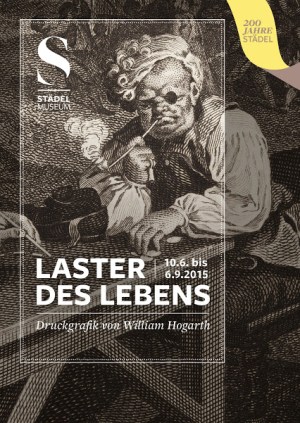
William Hogarth, After (detail), 1736, etching and engraving, 41 x 33 cm
(Städel Museum, Frankfurt am Main)
◊ ◊ ◊ ◊ ◊
Press release for the exhibition now on view at the Städel Museum:
Vices of Life: The Prints of William Hogarth
Laster des Lebens: Druckgrafik von William Hogarth
Frankfurt’s Städel Museum, Frankfurt, 10 June — 6 September 2015
Schloss Neuhardenberg, Brandenburg, TBA
Curated by Annett Gerlach
From 10 June to 6 September 2015—in its bicentennial year ‘200 Years Städel’—Frankfurt’s Städel Museum will be presenting prints by the English painter, engraver and etcher William Hogarth (1697‒1764). Altogether seventy works including the famous printmaking series A Harlot’s Progress (1732), A Rake’s Progress (1735) and Marriage à la Mode (1745) will be on view in the exhibition hall of the Department of Prints and Drawings. These visual novels from the Städel holdings take the fashions, vices and downsides of modern life in the London metropolis as their themes. Hogarth conceived of his artworks as printed theatre of his times and with them he laid the cornerstone for socio-critical caricature in England. The prints owe their special quality to the keen powers of perception and caustic humour of an artist who contributed so greatly to shaping the image of his era that it is still referred to as ‘Hogarth’s England’ today. Executed during Johann Friedrich Städel’s lifetime, the engravings are among the Städel’s oldest holdings and mirror the critical spirit inherent to this institution since its founding.
 William Hogarth was born in London in 1697. In keeping with an early eighteenth-century fashion, his father Richard opened a coffee house at which only Latin was spoken. The business failed, and Richard Hogarth had to serve five years in London’s notorious Fleet Prison for failure to pay his debts. As was usual at the time, his wife and children had to accompany him. In 1713, after his father’s release, William Hogarth began an apprenticeship as a silver engraver where he also learned the rudiments of the complex techniques of intaglio printing—engraving and etching. Following his seven-year training, he went into business for himself as an engraver and attended the privately run St Martin’s Lane Academy, an art school in London, to acquire the art of painting. In 1724 he also became a member of the academy of royal court painter James Thornhill (1675‒1734), whose daughter Jane he married in 1729. It was not with his paintings, however, that Hogarth achieved a breakthrough with the public, but with the prints made after his works on canvas. With the series A Harlot’s Progress, produced in the early 1730s, he founded a new genre he later dubbed modern moral subjects. Hogarth conceived of these subjects as contemporary, moral-didactic history scenes. He thus took a stand against the hierarchization of the visual arts, a firmly entrenched principle of academy doctrine which granted classical history painting pride of place. With his printmaking works, he succeeded in creating a new, up-to-date genre based on the keen observation of reality. In 1755 Hogarth was elected to the Royal Society of Arts, which he quit again just two years later on account of artistic and personal differences. His appointment as royal court painter followed in 1757, but never led to any commissions. The final years of the artist’s life were overshadowed by bitter disputes between himself and his critics. A stroke in 1763 left Hogarth severely handicapped and he died the following year in his home in Leicester Fields, a district of London.
The presentation in the exhibition gallery of the Department of Prints and Drawings focuses primarily on those of William Hogarth’s printmaking series that earned him international fame: A Harlot’s Progress, A Rake’s Progress und Marriage à la Mode. There is a very simple reason for the fact that his works on paper secured him a place in art history: prints can be circulated far better than paintings. It was by these means that the artist reached the enlightened and educated public of his day in large numbers. Already the first edition of A Harlot’s Progress (1732) comprised 1,240 sold copies. In six episodes, this series describes the rise and fall of a young woman who has come from the country to the city to find work. To earn a living she ends up as a prostitute and lands in prison as a result. The final scene shows the wretched funeral of the protagonist, whose life has already come to an end at the age of twenty-three. Hogarth had numerous real and literary models to look to for his creation of this figure. Inspired by his great interest in the social characterization of his time, he directed his critical, ironical gaze to all strata of society, from the highest nobility to the most abject circumstances. The sick and needy of all generations formed the downside of the economic boom enjoyed by the colonial and commercial metropolis and its many profiteers.
In his second series, A Rake’s Progress (1735), consisting of eight prints, Hogarth tells the story of the social decline of Tom Rakewell, who brainlessly squanders his inheritance and is thrown first into debtors’ prison and then the madhouse. Rakewell’s incarceration on grounds of indebtedness is reminiscent of the artist’s own biography. Entirely unlike his father, however, William Hogarth was an excellent businessman and very clever at taking advantage of the London press—which was flourishing in his day—and its public impact for his own purposes. In newspapers such as the London Daily Post, the General Advertiser or the London Journal he published announcements of his prints and advertised them for subscription.
Hogarth borrowed the title of his third major series, published in 1745, from a comedy by John Dryden (1631‒1700). Marriage à la Mode is about an espousal arranged by the two spouses’ fathers. Neither the bride nor the groom is the least bit interested in the other, both amuse themselves on the side, and the situation comes to a dramatic conclusion. Hogarth’s protagonists feign innocence and practise deception, abandon themselves to their passions and founder on their false ideals. Looking to true stories for orientation and integrating well-known persons and recognizable sites, he warned his public of the dangers of modern life—dangers still very real today. In 1751, with his popular prints Beer Street and Gin Lane, he supported a public campaign against the excessive consumption of gin. The former scene presents the enjoyment of beer as healthy and beneficial in contrast to the destructive effects of gin portrayed in the latter.
From mid century onward, in addition to socio-critical themes Hogarth also devoted himself to matters of national and political relevance, which represent a further focus of the exhibition. In several works, the artist addressed the relationship between France and England, which were at war. The Gate of Calais (1748) was his response to his arrest on suspicion of espionage during one of his trips to France. In 1756, in The Invasion, he again caricatured the French as grotesque, haggard figures who are after the tasty beer and luscious roast beef of the English. Some fifteen years later, in the print The Times, Plate 1 (1762), Hogarth made an urgent appeal for the cessation of the Seven Years’ War.
In 1753, Hogarth published his own art-theoretical deliberations in the book The Analysis of Beauty. In it he concerned himself with the foundations of visual-artistic production and particularly the matter of how to achieve beauty and grace. Hogarth considered the study of nature to be the key to beauty. He called upon his readers to perceive the objects of nature with their own eyes and judge them according to rational criteria. The German writer Christlob Mylius (1722–1754) was in London when Hogarth’s Analysis came out, and he translated it into German the very next year. Johann Friedrich Städel had a copy of this translation in his library, and it will be on display in the show.
In conjunction with the exhibition, the Städel Museum is publishing a catalogue by Annett Gerlach with approximately 50 pages, 10€. Following its presentation at the Städel Museum, the show will be on view at Neuhardenberg Castle. The exhibition is being sponsored by the Hessische Kulturstiftung.
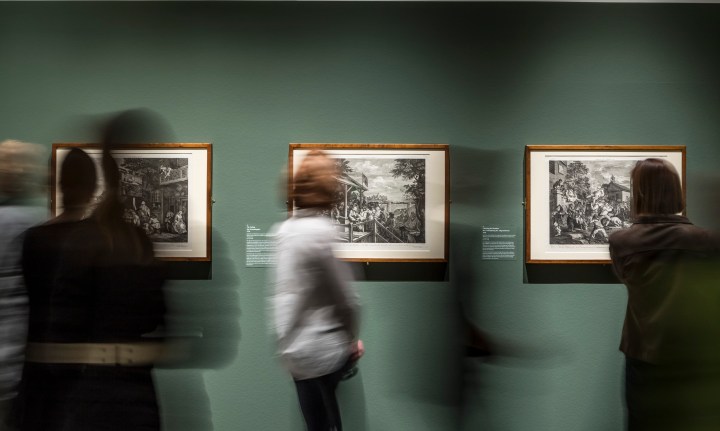
Installation view of the exhibition Vices of Life: The Prints of William Hogarth at Frankfurt’s Städel Museum (June 2015)
New Book | Les Toiles de Jouy: Histoire d’un Art Décoratif, 1760–1821
From Le Comptoir des Presses d’Universités:
Aziza Gril-Mariotte, Les Toiles de Jouy: Histoire d’un Art Décoratif, 1760–1821 (Rennes: Presses Universitaires de Rennes, 2015), 280 pages, ISBN: 978-2753540088, 29€.
 L’ouvrage d’Aziza Gril-Mariotte, abondamment illustré, retrace l’histoire artistique d’une manufacture qui a marqué durablement l’histoire du textile. Toiles de Jouy, jamais dans l’histoire textile un terme n’aura été autant adulé, décrié, transformé car, plus qu’une étoffe, ces mots sont devenus l’expression d’un décor monochrome rouge, perçu comme le symbole d’une époque, le XVIIIe siècle, et l’expression d’un « art de vivre à la française ». L’étude des créations de la manufacture de Jouy et de la politique de son fondateur, Christophe-Philippe Oberkampf, nous emmène dans une aventure industrielle et artistique, bien loin de ces clichés. À partir d’une documentation variée et d’une grande richesse dont les photographies donnent un aperçu, l’auteur renouvelle la connaissance d’une production dont la variété des dessins semble inépuisable. Les archives révèlent les nombreuses collaborations artistiques et l’étude des motifs, les multiples influences, sources iconographiques, idées ou événements à l’origine de ces créations. L’évolution considérable que connaissent ces textiles pendant la durée de fonctionnement de la manufacture, entre 1760 et 1821, reflète les variations du goût et les transformations de la société française entre la seconde moitié du XVIIIe et la première moitié du XIXe siècle. L’histoire de ces toiles imprimées permet de pénétrer au cœur d’une production où art, technique et industrie opèrent de concert, sous l’instigation d’hommes de goût, attentifs aux désirs d’une clientèle diversifiée. Les toiles de Jouy parce qu’elles touchent à des domaines variés, économique, technique, et artistique, s’avèrent un vaste sujet d’étude. Ces dessins continuent aujourd’hui d’inspirer les éditeurs de tissus et les designers, la manufacture de Jouy a marqué durablement, pour ne pas dire éternellement, la création textile.
Aziza Gril-Mariotte est maître de conférences en histoire de l’art à l’université de Haute-Alsace.
◊ ◊ ◊ ◊ ◊
Gril-Mariotte also has this article due out in the fall: “Children and How They Came into Fashion on Printed Textiles between 1770 and 1840,” International Journal of Fashion Studies (October/November 2015). More information about her work is available here.
Exhibition | A Kingdom of Images: French Prints in the Age of Louis XIV

Louis XIV, King of France and Navarre, Robert Nanteuil after Nicolas Mignard, 1661
(Los Angeles: The Getty, 2010.PR.60)
◊ ◊ ◊ ◊ ◊
Press release (27 May 2015) from The Getty:
A Kingdom of Images: French Prints in the Age of Louis XIV, 1660–1715
Getty Research Institute, Getty Center, Los Angeles, 16 June — 6 September 2015
Bibliothèque Nationale de France, Paris, 2 November 2015 — 31 January 2016
Curated by Louis Marchesano, Christina Aube, Peter Fuhring, Vanessa Selbach, and Rémi Mathis
Louis XIV’s imperialist ambitions manifested themselves in every activity under his dominion, which included the production of etchings and engravings. Fully appreciating the beauty and utility of prints, he and his advisors transformed Paris into the single most important printmaking center in Europe, a position the city maintained until the 20th century. Fueled by official policies intended to elevate the arts and glorify the Sun King, printmakers and print publishers produced hundreds of thousands of works on paper to meet a demand for images that was as insatiable then as it is now.
On view at the Getty Research Institute (GRI) at the Getty Center June 16 through September 6, 2015, A Kingdom of Images: French Prints in the Age of Louis XIV, 1660–1715 was organized by the Getty Research Institute in special collaboration with the Bibliothèque nationale de France. This major exhibition surveys printmaking in the era of Louis XIV and commemorates the 300th anniversary of his death.
“In art history, too often certain media are neglected in favor of what is popular, such as painting and sculpture,” said Thomas W. Gaehtgens, director of the Getty Research Institute. “However, the truth is that at a time when France was positioned as the cultural capital of Europe, printmaking asserted itself as a fine art while printmakers successfully inserted themselves into the official art academy that had previously been the stronghold of painters and sculptors. Indeed, our understanding of the history of art and culture in France is a history told in French prints. A Kingdom of Images addresses a significant lacuna in scholarship and shows the rise of French printmaking to be richer and more complex than has been generally recognized.”

Mademoiselle d’Armagnac in a Dressing Gown, Antoine Trouvain, 1695 (Paris: Bibliothèque nationale de France, Département des Estampes et de la Photographie)
A Kingdom of Images features nearly 100 works produced during the golden age of French printmaking—from grand royal portraits to satiric views of everyday life, and from small-scale ornamental designs to unusually large, multi-sheet panoramas of royal buildings. The exhibition was curated by Louis Marchesano, curator of prints and drawings at the GRI; Christina Aube, curatorial assistant at the GRI; prints specialist Peter Fuhring of the Fondation Custodia in Paris; and Vanessa Selbach and Rémi Mathis, curators of seventeenth-century prints at the Bibliothèque nationale de France.
“No other medium served the Crown as well as prints,” said Marchesano. “Through prints, allies and enemies alike bore witness to the refinement of French technical skill, aesthetics, and taste. They not only learned about Louis XIV, they also saw that French fashion, design, and inventiveness had outmatched the rest of Europe. One of the reasons that this period has not been the subject of a large exhibition is that curators and scholars dismissed many of the prints as propaganda, the kind of over-the-top imagery in which the king appears, for example, as a mythological figure or a Roman emperor. While I do not disagree with the ‘propaganda’ label, I would urge viewers to consider the sophistication of both the message and the way that message is delivered. Also, I would argue that we need to think of propaganda in a wider sense. Remember, Louis XIV wanted to demonstrate to the world that France was the new cultural capital and in this respect it was under his reign that prints accomplished two goals. First, as works of art they attained unparalleled artistic sophistication and influence, which we can see for example in the portraits by Robert Nanteuil; and second, they carried a message that the rest of Europe came to envy: France was the center of fashion, design, and elegance.”
The works on display include fashion prints, portraits, religious and moralizing images, maps and views, and works depicting the fine and decorative arts, architecture, and lavish festivals. The first section of the exhibition, ‘Glory of the King’, contains one of the most exquisite portraits of Louis XIV ever created (Nanteuil’s engraving of 1676), along with huge illustrated calendars showing the king in various guises. In one he is a heroic warrior, and in another, an elegant dancer in exquisite garb.
The ‘Fashion’ section contains marvelous works of the greatest rarity, including a pair of figures whose engraved clothing has been replaced with real fabric from the late 1600s. These are commonly referred to as ‘dressed prints’. Images of design and style are not strictly limited to this section, but can be seen throughout the entire exhibition.
The section devoted to architecture highlights Louis XIV’s greatest building programs: the Louvre, the church of the Invalides, and the palace and gardens of Versailles. The megalomaniacal impetus behind the construction of these buildings also informed the unusual monumentality of the prints that represented them; these works were produced by the best printmakers of the day: Etienne Baudet, Antoine Coquart, Pierre Lepautre, and Jean Marot.
For Louis XIV, festivals were one way in which to keep the aristocracy entertained and in line. Festivals had to impress and overwhelm audiences and those organized by the Crown were so costly that they sometimes threatened the budget of the government. The illustrated books designed to record those events, several of which are on display in the ‘Festivals and Events’ section, were made with the highest production values. A notable example is The Pleasures of the Enchanted Island, a publication featuring the etchings of Jean Lepautre, whose work allowed the world to witness the perpetual entertainments of a mythological realm ruled by a benevolent king.
A Kingdom of Images is one four exhibitions across the Getty that mark the 300th anniversary of the death of Louis XIV.
• Coinciding with A Kingdom of Images, the exhibition Louis XIV at the Getty at the J. Paul Getty Museum June 9, 2015 to July 31, 2016 is a special installation in the Museum’s South Pavilion that will focus attention on a variety of extraordinary pieces in the Getty’s collection made during Louis’s lifetime when France became the leading producer of the luxury arts in Europe.
• Louis Style: French Frames, 1610–1792 on view at the Getty Museum September 15, 2015 – January 3, 2016 will draw on the Museum’s large collection of French frames, Louis Style presents a survey of the exquisite carved and gilded frames produced during the reigns of four French kings.
• Woven Gold: Tapestries of Louis XIV, exclusively on view at the Getty Museum December 15, 2015 through May 1, 2016, will be the first major museum exhibition of tapestries in the Western United States in four decades. The exhibition will feature 15 larger-than-life tapestries ranging in date from about 1540 to 1715 and created in weaving workshops across northern Europe. In an exclusive loan from the French nation, most of the tapestries are from the collection of the Mobilier National, which preserves the former royal collection.
Louis XIV Online
Starting May 30, curators and other experts will be blogging regularly about the exhibition and related themes on The Getty Iris under the series title Louis XIV at the Getty. Audiences can join the conversation about the Sun King and his artistic legacy on @thegetty Twitter with the weekly series #SunKingSunday.
◊ ◊ ◊ ◊ ◊
From The Getty Store:
Peter Fuhring, Louis Marchesano, Rémi Mathis, and Vanessa Selbach, eds., A Kingdom of Images: French Prints in the Age of Louis XIV, 1660–1715 (Los Angeles: Getty Publications, 2015), 344 pages, ISBN: 978-1606064504, $80.
 Once considered the golden age of French printmaking, Louis XIV’s reign saw Paris become a powerhouse of print production. During this time, the king aimed to make fine and decorative arts into signs of French taste and skill and, by extension, into markers of his imperialist glory. Prints were ideal for achieving these goals; reproducible and transportable, they fueled the sophisticated propaganda machine circulating images of Louis as both a man of war and a man of culture.
This richly illustrated catalogue features more than one hundred prints from the Getty Research Institute and the Bibliothèque nationale de France in Paris, whose print collection Louis XIV established in 1667. An esteemed international group of contributors investigates the ways that cultural policies affected printmaking; explains what constitutes a print; describes how one became a printmaker; studies how prints were collected; and considers their reception in the ensuing centuries.
A Kingdom of Images is published to coincide with an exhibition on view at the Getty Research Institute from June 18 through September 6, 2015, and at the Bibliothèque nationale de France in Paris from November 2, 2015, through January 31, 2016 (Images du Grand Siècle, l’estampe française au temps de Louis XIV, 1660–1715).
Peter Fuhring works at the Fondation Custodia, Paris, where he is in charge of Frits Lugt’s Marques de collections de dessins & d’estampes. Louis Marchesano is curator of prints and drawings at the Getty Research Institute. Rèmi Mathis and Vanessa Selbach are curators of seventeenth-century prints in the dèpartement des Estampes et de la Photographie at the Bibliothèque nationale de France in Paris, where Vanessa Selbach is also head of the Rèserve and old master prints service.
Exhibition | Fighting History

Gavin Hamilton, Agrippina Landing at Brindisium with the Ashes of Germanicus, 1765–72 (London: Tate)
◊ ◊ ◊ ◊ ◊
Press release (8 June 2015) from Tate Britain:
Fighting History
Tate Britain, London, 9 June — 13 September 2015
Curated by Greg Sullivan with Clare Barlow
Fighting History celebrates the enduring significance and emotional power of British history painting through the ages, from 18th-century history paintings by John Singleton Copley (1738–1815) and Benjamin West (1738–1820) to 20th-century and contemporary pieces by Richard Hamilton (1922–2011) and Jeremy Deller (b.1966). Juxtaposing work from different periods, the exhibition explores how artists have reacted to historical events, and how they capture and interpret the past.
Often vast in scale, history paintings engage with important narratives from the past, from scripture and from current affairs. Some scenes protest against state oppression, while others move the viewer with depictions of heroic acts, tragic deaths and plights of individuals swept up in events beyond their control. Amy Robsart exhibited in 1877 by William Frederick Yeames (1835–1918), which has been newly conserved for this exhibition, casts a spotlight on a historical mystery while John Minton’s (1917–1957) The Death of Nelson 1952 offers a tender perspective on the death of one of England’s greatest naval commanders.
During the 18th century, history painting was deemed the pinnacle of an academic painter’s achievements. These paintings traditionally depicted a serious narrative with moral overtones, seen in John Singleton Copley’s The Collapse of the Earl of Chatham in the House of Lords, 7 July, 1778 1779–80. The way history was presented in these works was not a precise description of events, but aimed more towards the Italian istoria—a narrative that pleased the eye and stimulated the mind.
While some conventional accounts suggest that history painting died off in the 19th century, this exhibition shows the continuing vibrancy of the genre, as new artists have engaged with its traditions to confront modern tragedies and dilemmas. Richard Hamilton’s The citizen 1981–3 offers one illustration of this, highlighting the ‘troubles’ in Northern Ireland in the late 20th century. Jeremy Deller’s The Battle of Orgreave 2001, a re-enactment of the 1984 clash between miners and police in South Yorkshire, is also featured. Comprising a film, map, miner’s jacket and shield amongst other things, the room immerses visitors in a pivotal moment in the history of the miners’ strike. In addition, Malcom Morley’s triptych Trafalgar-Waterloo 2013 venerates Admiral Lord Nelson and the Duke of Wellington, who are separated by a cannon based on one from the HMS Victory protruding from the canvas in the central panel.
The exhibition also compares traditional and contemporary renderings of historical events from scripture, literature and the classical world. There is a room dedicated to interpretations of the Deluge—the biblical flood that symbolises both the end and the beginning of history—including J.M.W. Turner’s (1775–1851) The Deluge 1805 and Winifred Knights’ (1899–1947) The Deluge 1920, which contains unmistakeable references to the former. There is also a section focusing on depictions of antiquity, seen in works such as Sir Edward Poynter’s (1836–1919) A Visit to Aesculapis 1880 and James Barry’s (1741–1806) King Lear Weeping over the Dead Body of Cordelia 1786–8, which frames the Shakespearian tragedy in a scene of ancient Britain.
From Ancient Rome to the Poll Tax Riots, Fighting History looks at how artists have transformed significant events into paintings that encourage us to reflect on our own place in history. It is curated by Greg Sullivan, Curator British Art 1750–1830, Tate Britain with assistance from Assistant Curator Clare Barlow.
◊ ◊ ◊ ◊ ◊
Clare Barlow, Mark Salber Phillips, Dexter Dalwood, and M. G. Sullivan, Fighting History (London: Tate Publishing, 2015), 64 pages, ISBN: 978-1849763585, £13.
Fighting History is the first book to engage with the story of British history painting and its survival into contemporary practice today. Beautifully illustrated with works from the Tate collection, as well as a number of paintings from other institutions and from practicing artists, the book traces the tradition of history painting from the baroque allegory of the seventeenth-century court to contemporary works by Dexter Dalwood, Jeremy Deller, Michael Fullerton, and others. Three short essays address themes in history painting, from the question of the shifting meanings of ‘history painting’ to an account of the great radical artists in the genre. In an interview with Dexter Dalwood, one of Britain’s most celebrated contemporary painters, the artist explains the enduring significance of history painting in twentieth-century art and in his own practice.
Exhibition | Sir Hans Sloane’s Plants on Chelsea Porcelain
From the press release:
Sir Hans Sloane’s Plants on Chelsea Porcelain: A Loan Exhibition
Stockspring Antiques, London, 2–16 June 2015
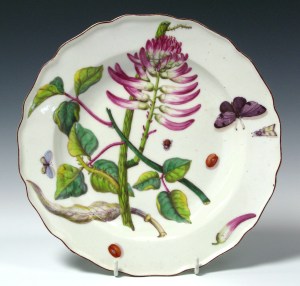
Chelsea plate with a wavy brown-edged rim, painted with a Corallodendron flower, leaves, floret, seed pod and seeds, and two butterflies, ca. 1753–56; Mark: red anchor over 34;
24.5 cm (Private Collection)
The exhibition Sir Hans Sloane’s Plants on Chelsea Porcelain aims to identify the plants on Chelsea porcelain botanical wares and link them to their source drawings and prints—many of which were by G. D. Ehret and were published by Philip Miller in Figures of the most Beautiful, Useful, and Uncommon plants described in the Gardeners Dictionary and other botanical publications of the period. The catalogue includes chapters on Sir Hans Sloane, the Chelsea Physic Garden, and Philip Miller’s role in receiving and propagating the imported plants and seeds from the New World, Africa, and Asia, as well as his influence on garden planting and design in Britain. The exhibition comprises of the loan of over 70 pieces of Chelsea porcelain from private and museum collections, which are shown with their relevant source engravings. Previously only about 10 plants on Chelsea porcelain had been correctly identified and linked to botanical engravings; so the exhibition includes significant new research.
The catalogue by Sally Kevill-Davies is generously sponsored by the Cadogan Estate (email stockspring@antique-porcelain.co.uk to order a copy, £30 + p&p). The exhibition is on view at Stockspring Antiques, 114 Kensington Church St., London W8 4BH, weekdays 10–5.30 and Saturdays 10–4; closed on Sundays.
Sally Kevill-Davies, Sir Hans Sloane’s Plants on Chelsea Porcelain (London: 2015), 229 pages, ISBN: 978-0956570222, £30.
Exhibition | Bread and Wine
From the exhibition press release:
Bread and Wine: Traces of the Eucharist Mystery, 16th–18th Centuries
Pane e vino: Tracce del mistero eucaristico nella pittura a Como dal XVI al XVIII secolo
Cathedral of Como, 9 May — 31 October 2015
Curated by Eugenia Bianchi and Andrea Straffi
 La mostra Pane e vino: Tracce del Mistero eucaristico nella pittura a Como dal XVI al XVIII secolo, visitabile dal 9 maggio al 31 ottobre 2015 presso la cattedrale di Como, è uno dei fulcri del progetto Pane e vin non ci mancava: Uomini e merci in movimento tra campi, botteghe e chiese nel Comasco, promosso dal Centro studi ‘Nicolò Rusca’ in occasione di EXPO 2015. Con un allestimento appositamente ideato per gli spazi della cattedrale e un ricco apparato di testi e immagini, vengono illustrate trenta opere—tra dipinti e affreschi dal XVI al XVIII secolo—scelte all’interno del patrimonio artistico comasco per il loro contenuto esplicitamente eucaristico o per la presenza di segni e simboli che rimandano a quel Mistero. La tematica dominante della mostra è infatti l’Eucaristia, come si trova rappresentata o evocata nei dipinti che arricchiscono le chiese di Como e della sua provincia, a memoria di un popolo di fedeli desiderosi di abbellire e impreziosire i propri luoghi di culto con immagini di profondo significato teologico.
Non si tratta però di una mostra esclusivamente iconografica. Il valore aggiunto di questa iniziativa è offerto dai risultati delle ricerche storico-artistiche, che hanno permesso di aggiornare lo stato delle conoscenze su opere già note e di recuperare dall’oblio opere mai valorizzate e collocate spesso in contesti defilati rispetto ai più tradizionali circuiti turistici. Del Gonfalone di sant’Abbondio, realizzato da Morazzone per la confraternita del Santissimo Sacramento in cattedrale, si è trovata, ad esempio, la fonte iconografica (il testo di Nicola Laghi, I Miracoli del Santissimo Sacramento, Venezia 1597); nell’oratorio della Madonna Nera di Einsiedeln a Rogaro di Tremezzo si è scoperta una coppia di tele del valsesiano Giuseppe Antonio Pianca, artista originalissimo nel contesto barocchetto lombardo, di cui finora non si conosceva alcuna opera comasca; il San Carlo Borromeo comunica gli appestati della parrocchiale di San Gerardo a Olgiate Comasco dà invece un volto a Ludovico Mascarone, pittore probabilmente milanese noto solo a livello documentario. Ancora, è emersa a Bregnano una tela di Francesco Innocenzo Torriani e trova un’attribuzione più verosimile il ciclo con le Storie di san Rocco della chiesa di San Giacomo a Livo, da riferire al solo Ambrogio Arcimboldi e alla sua bottega.
La mostra non vuol essere un’iniziativa fine a sé stessa. Piuttosto è un caloroso invito a percorrere un ‘viaggio’ nei luoghi indicati, per prendere visione delle opere nel loro contesto, così da “toccare con mano” quell’imprescindibile rapporto, tra manufatto e luogo sacro, che va inevitabilmente a perdersi quando la fruizione avviene in un museo. Solo in questo modo prende effettivo risalto quell’hic et nunc che è insito nel ‘visibile parlare’ adottato dalla Chiesa nella sua storia millenaria al fine di diffondere e rendere comprensibile a tutti le verità del Vangelo.
Contestualmente alla mostra e per tutta la sua durata, sarà possibile visitare la Sacrestia dei Mansionari, eccezionalmente aperta per l’occasione. Sotto il suggestivo affresco con l’Incoronazione della Madonna di Morazzone e circondati da alcuni dipinti della collezione donata nel 1683 alla cattedrale di Como dal nobile comasco Giacomo Gallio, verranno esposte alcune antiche suppellettili legate alla liturgia eucaristica (calici, ostensori, pissidi, ecc. dal XVI al XIX secolo) e documenti della Confraternita del Santissimo Sacramento esistente in cattedrale.
◊ ◊ ◊ ◊ ◊
The catalogue is available from artbooks.com:
Eugenia Bianchi and Andrea Straffi, Pane e Vino: Tracce del Mistero eucaristico nella pittura a Como dal XVI al XVIII secolo (Milan: Silvana: 2015), 144 pages, ISBN: 978-8836631339, $45.
 Il catalogo della mostra Pane e vino: Tracce del mistero eucaristico nella pittura a Como dal XVI al XVIII secolo è dedicato a trenta opere—tra dipinti e affreschi dal XVI al XVIII secolo—scelte all’interno del patrimonio artistico comasco per il loro contenuto esplicitamente eucaristico o per la presenza di segni e simboli che rimandano a quel mistero. Il filo conduttore del volume è infatti l’eucarestia, come si trova rappresentata o evocata nei dipinti che arricchiscono le chiese di Como e della sua provincia, a memoria di un popolo di fedeli desiderosi di abbellire e impreziosire i propri luoghi di culto con immagini ricche di significato teologico.
Exhibition | Canaletto: The Triumph of Light

Canaletto, Capriccio, A Palladian Design for the Rialto Bridge, with Buildings, 1744, 90 x 130 cm (London: The Royal Collection, RCIN 404029) © Her Majesty Queen Elizabeth II 2014.
◊ ◊ ◊ ◊ ◊
From the Centre d’Art de l’Hôtel de Caumont:
Canaletto, Rome—Londres—Venise: Le Triomphe de la Lumière
Centre d’Art de l’Hôtel de Caumont, Aix-en-Provence, 6 May — 13 September 2015
Curated by Bozena Anna Kowalczyk
Giovanni Antonio Canal, known as Canaletto (1697–1768), is recognised as the emblematic figure of the veduta genre, the most admired Venetian artistic creation of the 18th century in Europe. This inaugural exhibition at the art centre of the Hôtel de Caumont aims to provide new insights into the complete works of Canaletto, with a particular interest in the treatment of light in the Venetian master’s paintings. Fifty paintings and drawings from international public and private collections will present Canaletto the man and the different phases of his artistic career, in Rome, London and Venice.
We initially discover Canaletto’s first activity, as a painter of theatre scenery, carried out in collaboration with his father Bernardo Canal and his brother Cristoforo. Opera librettos on which Canaletto’s name appears will be exhibited alongside his first capricci, full of musical influences, painted in 1720–1722, and the first views of Venice, composed according to the criteria for staging.
The exhibition continues with a presentation of the major undertakings of Canaletto’s youth: the views of Venice commissioned by Joseph Smith (1722–1723), Joseph Wenzel of Liechtenstein (1723) and Stefano Conti (1725–1726), are large scale canvases that bear witness to the skill of the young painter.
Canaletto’s visit to England, his contact with new landscapes and the light of the Thames, led to changes in his palette and his touch. A series of paintings and drawings show the new solutions he adopted to capture the atmosphere and spirit of England. Canaletto painted London and lingered over Westminster Bridge, the second bridge over the Thames, then under construction. He also painted the English countryside, travelling as far as outskirts of Scotland to depict Alnwick Castle, home of the Duke of Northumberland.
A special section is devoted to technical experiments conducted by the artist throughout his career. Canaletto conceived a systematic and scientific way to rework drawings that had been made outdoors by means of a camera obscura (dark chamber). An example of the camera obscura used by the painter is presented next to a facsimile that allows the visitor to visualise for himself what the painter would see when using this device. A reproduction of pages from his sketchbook, as well as a film, illustrate the technical work of the artist during his portrayal of views of Venice.
This exhibition is also the occasion to conduct for the first time a comprehensive study of the last years of Canaletto in Venice. The works accomplished after his return from London at the end of 1755 illustrate Canaletto’s new interests and his response to the new artistic climate in Venice, where Francesco Guardi (1712–1793) was making a name for himself. Particular attention is devoted to the artist’s tireless passion for the study of new effects of light and atmosphere. The greatest international museums have granted their support. Among them: the Royal Collection and the National Gallery of London, the Metropolitan Museum of New York, the Uffizi Gallery of Florence as well as the Ca’Rezzonico of Venice.
◊ ◊ ◊ ◊ ◊
From artbooks.com:
Bozena Anna Kowalczyk, ed., Canaletto, Rome—Londres—Venise: Le Triomphe de la Lumière (Antwerp: Mercatorfonds, 2015), 224 pages, ISBN: 978-9462300835, 45€ / $85.
 For the inaugural exhibition at the Centre d’Art de l’Hôtel de Caumont in Aix-en-Provence, Mercatorfonds presents the first French monograph on Canaletto, and the first worldwide following the Metropolitan Museum’s publication in 1989. Numerous recent shows, focusing on specific aspects of Canaletto’s work or simply on his depictions of Venice, are a clear indication of the public’s interest in the painter’s oeuvre. This volume introduces the reader to Canaletto and, by tracing the various phases of his artistic path, provides a complete overview of his work. To highlight the development of Canaletto’s tastes, his reactions to Venice’s artistic and cultural trends and the atmosphere of England—where he worked for nine years—the paintings and drawings shown here have been selected from among the artist’s most remarkable pieces.










 Enfilade
leave a comment