New Book | Artful Virtue
From Ashgate:
Leslie Ellen Brown, Artful Virtue: The Interplay of the Beautiful and the Good in the Scottish Enlightenment (Farnham: Ashgate Publishing, 2015), 284 pages, ISBN: 978-1472448484, $120.
 During the Scottish Enlightenment the relationship between aesthetics and ethics became deeply ingrained: beauty was the sensible manifestation of virtue; the fine arts represented the actions of a virtuous mind; to deeply understand artful and natural beauty was to identify with moral beauty; and the aesthetic experience was indispensable in making value judgments. This book reveals the history of how the Scots applied the vast landscape of moral philosophy to the specific territories of beauty—in nature, aesthetics and ethics—in the eighteenth century. The author explores a wide variety of sources, from academic lectures and institutional record, to more popular texts such as newspapers and pamphlets, to show how the idea that beauty and art made individuals and society more virtuous was elevated and understood in Scottish society.
Leslie Ellen Brown is Professor Emerita of Music at Ripon College. Her earliest publications were in the field of early eighteenth-century French opera, with her later work concentrating on eighteenth-century Scottish studies.
◊ ◊ ◊ ◊ ◊
C O N T E N T S
Introduction
1 The Senses
2 Virtue
3 Beauty
4 Sentiment
5 Taste
6 Experience
7 Cultivation
8 Traditions
Afterword
Select Bibliography
Index
Exhibition | Handel: A Life with Friends
From the Handel House Museum:
Handel: A Life with Friends
Handel House Museum, London, 1 July 2015 — 10 January 2016
Curated by Ellen Harris
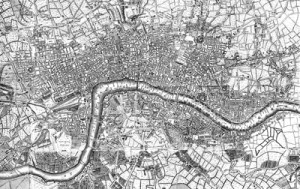 What was it like to live next to the great composer Handel? Who would call at his house? Who did he visit? In this new exhibition, Handel scholar Ellen Harris will explore the composer’s domestic life at 25 Brook Street and the many friends and neighbours who visited him at the new, fashionable residential district called ‘May Fair’.
Handel’s music brought this disparate group of men and women together, as amateur performers in their own homes and as audiences at performances of his operas and oratorios. With important loans from national, local and private collections, the exhibition—inspired by Ellen Harris’s new book George Frideric Handel: A Life With Friends—will offer a rare glimpse into the public and private lives of some of Handel’s closest friends.
◊ ◊ ◊ ◊ ◊
From Norton:
Ellen T. Harris, George Frideric Handel: A Life with Friends (New York: Norton, 2014), 496 pages, ISBN: 978-0393088953, $40.
 An intimate portrait of Handel’s life and inner circle, modeled after one of the composer’s favorite forms: the fugue.
During his lifetime, the sounds of Handel’s music reached from court to theater, echoed in cathedrals, and filled crowded taverns, but the man himself—known to most as the composer of Messiah—is a bit of a mystery. Though he took meticulous care of his musical manuscripts and even provided for their preservation on his death, very little of an intimate nature survives.
One document—Handel’s will—offers us a narrow window into his personal life. In it, he remembers not only family and close colleagues but also neighborhood friends. In search of the private man behind the public figure, Ellen Harris has spent years tracking down the letters, diaries, personal accounts, legal cases, and other documents connected to these bequests. The result is a tightly woven tapestry of London in the first half of the eighteenth century, one that interlaces vibrant descriptions of Handel’s music with stories of loyalty, cunning, and betrayal.
With this wholly new approach, Harris has achieved something greater than biography. Layering the interconnecting stories of Handel’s friends like the subjects and countersubjects of a fugue, Harris introduces us to an ambitious, shrewd, generous, brilliant, and flawed man, hiding in full view behind his public persona.
Ellen T. Harris is professor emeritus at MIT and has served on the music faculties of Columbia University and The University of Chicago. Her previous books include Handel as Orpheus: Voice and Desire in the Chamber Cantatas, and she has spoken at Lincoln Center and appeared on PBS NewsHour and BBC Radio 3. She lives in Newton, Massachusetts.
Exhibition | Pope Pius VII and Napoleon at Fontainebleau
From Napoleon.org and the Château de Fontainebleau:
Pie VII Face à Napoléon: La Tiare dans les Serres de l’Aigle
Château de Fontainebleau, 28 March — 29 June 2015
Curated by Christophe Beyeler and Jean Vittet
The Château of Fontainebleau hosted Pope Pius VII twice: first as a guest as he travelled to Napoleon’s coronation in 1804 and then as prisoner between 1812 and 1814. From 1796 until 1814, Rome and Paris were most notably embroiled in a bitter struggle over iconography. The exhibition at Fontainebleau looks at their diplomatic gifts, stolen artistic treasures, and the official French propaganda celebrating the Concordat of 1801 and defending the invasion of the Papal States in 1808 and the arrest of Pius VII in 1809. Napoleon I and Pius VII finally came head-to-head in 1812 at Fontainebleau. The exhibition contains nearly 130 items, some never displayed before, including loans from the Vatican museum and the papal sacristy.
◊ ◊ ◊ ◊ ◊
Le château de Fontainebleau a accueilli par deux fois le pape Pie VII, comme hôte sur le chemin du sacre en 1804, puis comme prisonnier entre 1812 et 1814. L’appartement des Reines-Mères, baptisé depuis lors « appartement du Pape », en conserve aujourd’hui le souvenir.
 Fontainebleau est à cet égard l’un des lieux qui incarne le mieux les relations tumultueuses entre Rome et Paris, dont l’une des expressions est la « guerre d’image » que se livrent les deux puissances, de 1796 à 1814.
L’exposition évoque d’abord la mainmise des Français sur quelques-uns des trésors de la collection pontificale, la célébration du concordat de 1801 par l’imagerie officielle ou encore l’iconographie subtile des cadeaux diplomatiques lors du sacre de 1804. La guerre de propagande, qui atteint son paroxysme avec l’invasion des États pontificaux en 1808 et l’arrestation de Pie VII en 1809, est ensuite décryptée à travers l’image d’une Rome antique renaissant grâce au « César moderne ». Le Pape, retenu à Savone depuis 1809, est conduit à Fontainebleau en 1812, où les deux protagonistes s’affrontent. L’Empereur parvient à arracher en janvier 1813 un éphémère concordat au Pape qui, libéré en 1814, est accueilli à Rome par une imagerie triomphaliste.
Près de 130 œuvres, parmi lesquelles des acquisitions inédites, ainsi que des prêts exceptionnels des musées du Vatican ou de la Sacristie pontificale, illustrent un affrontement où se combinent enjeux religieux, politiques et artistiques. En écho, sur les lieux mêmes de sa détention, les éléments retrouvés et restaurés du mobilier qu’a connu Pie VII sont rassemblés pour la première fois depuis le Premier Empire.
The 13-page press package is available here»
◊ ◊ ◊ ◊ ◊
The catalogue is available from Dessin Original:
Christophe Beyeler, ed., Pie VII Face à Napoléon: La Tiare dans les Serres de l’Aigle (Paris: RMN, 2015), 248 pages, ISBN: 978-2711862474, 39€.
The Burlington Magazine, April 2015
The eighteenth century in The Burlington:
The Burlington Magazine 157 (April 2015)
 A R T I C L E S
• Marie-Anne Dupuy-Vachey, “Fragonard’s ‘Fantasy Figures’: Prelude to a New Understanding,” pp. 241–47.
• Yuriko Jackall, John K. Delaney, and Michael Swicklik, “Portrait of a Woman with a Book: A Newly Discovered ‘Fantasy Figure’ by Fragonard at the National Gallery of Art, Washington,” pp. 248–54.
R E V I E W S
• Richard Wrigley, “Reassessing François-André Vincent,” — Review of recent exhibitions of Vincent’s work at Montpellier, Tours, and Paris and two books: Jean-Pierre Cuzin, François-André Vincent, 1746–1816: Un Peintre entre Fragonard et David (Arthéna, 2013) and Elizabeth Mansfield, The Perfect Foil: François-André Vincent and the Revolution in French Painting (University of Minnesota Press, 2012), pp. 265–68.
• François Marandet, Review of Christian Michel, L’Académie Royale de Peinture et de Sculpture (Librairie Droz, 2012), p. 276.
• Julia Poole, Review of Joanna Gwilt, Vincennes and Early Sèvres Porcelain from the Belvedere Collection (V&A Publishing, 2014), pp. 276–77.
• Stephen Duffy, Review of France Nerlich and Alain Bonnet, eds., Apprendre à Peindre: Les ateliers Privés à Paris, 1780–1863 (Université Francois Rabelais, 2013), p. 277.
• Reinier Baarsen, Review of the exhibition Eighteenth Century, Birth of Design, Furniture Masterpieces, 1650–1789 / 18e, aux sources du design, chefs-d’œuvre du mobilier 1650 à 1790 (Château de Versailles, 2014–15), pp. 285–86.
• Gauvin Alexander Bailey, Review of the exhibition With Body and Soul / Mit Leib und Seele (Munich: Kunsthalle, 2014–15), pp. 286–88. Available at The Burlington website for free.
• Xavier Salomon, Review of the exhibition Goya’s Tapestry Cartoons in the Context of Court Painting / Goya en Madrid: Cartones para Tapices (Madrid: Prado, 2014–15), pp. 290–91.
• Catherine Whistler, Review of the exhibition, The Poetry of Light: Venetian Drawings from the National Gallery of Art, Washington / La Poesia della Luce: Disegni Veneziani dalla National Gallery of Art di Washington (Venice: Museo Correr, 2014–15), pp. 293–94.
New Book | Animal Companions: Pets and Social Change
From Penn State UP:
Ingrid H. Tague, Animal Companions: Pets and Social Change in Eighteenth-Century Britain (University Park: Penn State University Press, 2015), 320 pages, ISBN: 978-0271065885, $70.
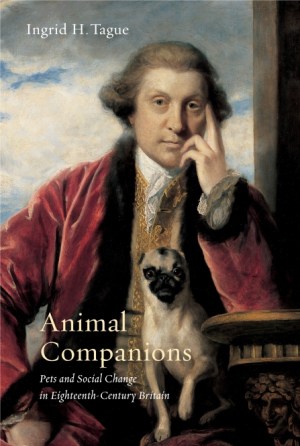 Although pets existed in Europe long before the eighteenth century, the dominant belief was that pet keeping was at best frivolous and at worst downright dangerous. In Animal Companions, Ingrid Tague explores the eighteenth-century conversation about the presence of pets in British society and the ways in which that conversation both reflected and shaped broader cultural debates. Tague argues that pets, as neither human nor fully part of the natural world, offered a unique way for Britons of the eighteenth century to articulate what it meant to be human and what their society ought to look like.
Having emerged from the Malthusian cycle of dearth and famine at the end of the seventeenth century, England became the wealthiest nation in Europe, with unprecedented access to consumer goods of all kinds. And closely connected with these material changes was the Enlightenment, with its implications for contemporary understanding of religion, science, and non-European cultures. All these transformations generated both excitement and anxiety, and they were reflected in debates over the rights and wrongs of human-animal relationships. Looking at a wide variety of texts, Tague shows how pets became both increasingly visible indicators of spreading prosperity and catalysts for debates about the morality of the radically different society emerging in this period.
Ingrid H. Tague is Associate Dean of Arts, Humanities, and Social Sciences and Associate Professor of History at the University of Denver.
◊ ◊ ◊ ◊ ◊
C O N T E N T S
List of Illustrations
Acknowledgments
Introduction
1 The Material Conditions of Pet Keeping
2 Domesticating the Exotic
3 Fashioning the Pet
4 A Privilege or a Right?
5 Pets and Their People
Epilogue
Notes
Bibliography
Index
New Book | Romanticism and Caricature
From Cambridge UP:
Ian Haywood, Romanticism and Caricature (New York: Cambridge University Press, 2013), 242 pages, ISBN: 978-1107044210, £60.
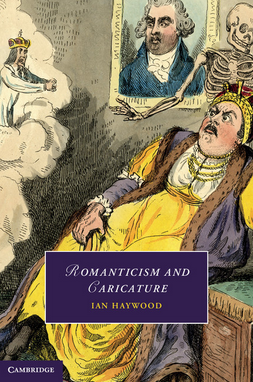 Ian Haywood explores the ‘Golden Age’ of caricature through the close reading of key, iconic prints by artists including James Gillray, George and Robert Cruikshank, and Thomas Rowlandson. This approach both illuminates the visual and ideological complexity of graphic satire and demonstrates how this art form transformed Romantic-era politics into a unique and compelling spectacle of corruption, monstrosity and resistance. New light is cast on major Romantic controversies including the ‘revolution debate’ of the 1790s, the impact of Thomas Paine’s ‘infidel’ Age of Reason, the introduction of paper money and the resulting explosion of executions for forgery, the propaganda campaign against Napoleon, the revolution in Spain, the Peterloo massacre, the Queen Caroline scandal, and the Reform Bill crisis. Overall, the volume offers important new insights into the relationship between art, satire and politics in a key period of history.
Ian Haywood is Professor of English and Co-Director of the Centre for Research in Romanticism at the University of Roehampton. He co-edited, with John Seed, The Gordon Riots: Politics, Culture and
Insurrection in Late Eighteenth-Century Britain (Cambridge University
Press, 2012).
◊ ◊ ◊ ◊ ◊
C O N T E N T S
Introduction: The Recording Angel
1 Milton’s monsters | James Gillray, Sin, Death and the Devil (1792)
2 Lethal money: forgery and the Romantic credit crisis | James Gillray, Midas (1797), George Cruikshank and William Hone, Bank Restriction Note (1819)
3 The aesthetics of conspiracy | James Gillray, Exhibition of a Democratic Transparency (1799)
4 The spectral tyrant: Napoleon and the English dance of death | Thomas Rowlandson, The Two Kings of Terror (1813)
5 The spectropolitics of Romantic infidelism | George Cruikshank, The Age of Reason (1819)
6 The British inquisition | George Cruikshank and William Hone, Damnable Association (1821)
7 The return of the repressed: Henry Hunt and the Reform Bill crisis | William Heath/Charles Jameson Grant, Matchless Eloquence (1831).
Notes
Select Bibliography
Index
Exhibition | Charles de La Fosse: The Triumph of Color
Now on view at Versailles:
Charles de La Fosse, le triomphe de la couleur
Château de Versailles, 24 February — 24 May 2015
Musée des Beaux-Arts, Nantes, 19 June — 20 September 2015
Curated by Béatrice Sarrazin, Adeline Collange-Perugi, and Clémentine Gustin-Gomez
 Although almost forgotten over the past two centuries, Charles de La Fosse (1636–1716) introduced a great many new ideas during the reign of Louis XIV, of whom he was a contempory. His work bears testimony to the artistic development of Charles Le Brun under whom he studied, and that of Antoine Watteau, a close friend. Considered to be one of the greatest painters of his time, Charles de La Fosse contributed to all the royal worksites at the Tuileries, the Palace of Versailles and the Invalides, while still devoting a large amount of time to private commissions. His body of work is equally exceptional for his numerous drawings, in particular those using the ‘trois crayons’ technique (black, red, white).
Charles de La Fosse’s work can be admired throughout the Palace, as an introduction to the monographic exhibition devoted to him in Madame de Maintenon’s Apartement. The display of major compositions in the Royal Chapel, the Diana Room and the Apollo Room—restored for the occasion—reveals La Fosse to be one of the main creators behind the decoration in Versailles.
The exhibition at the end of the tour of the State Apartments highlights the different aspects of the artist’s talent, inspired by the masters of the Académie (Poussin and Le Brun), and strongly influenced by contact with Venetian (Titian and Veronese) and Flemish (Rubens and Van Dyck) paintings to produce light seductive paintings with glowing colours. Preferring colour to lines, La Fosse’s work was extremly innovative and makes him one of the great pioneers of the 18th century.
A colloquium Charles de La Fosse et les arts en France autour de 1700 is scheduled for 18–19 May 2015 (see the website for the Centre de recherche du château de Versailles).
The full press packet for the exhibition is available as PDf file here»
◊ ◊ ◊ ◊ ◊
From Dessin Original:
Béatrice Sarrazin, Adeline Collange-Perugi et Clémentine Gustin, Charles de La Fosse (Paris: Somogy, 2015), 240 pages, ISBN: 978-2757209158, 35€.
 Publié à l’occasion de la première exposition monographique consacrée à Charles de La Fosse, l’ouvrage met en lumière les différentes facettes du talent de l’artiste qui, puisant ses racines chez les maîtres de l’Académie (Nicolas Poussin et Charles Le Brun), sait se renouveler au contact de la peinture vénitienne (Titien et Paul Véronèse) et flamande (Pierre Paul Rubens et Antoine Van Dyck) pour créer une peinture séduisante et légère, aux coloris chatoyants. Favorisant la couleur plutôt que la ligne, l’œuvre de La Fosse, extrêmement novatrice, fait de ce peintre l’un des grands précurseurs du XVIIIe siècle.
Quelque peu tombé dans l’oubli ces deux derniers siècles, Charles de La Fosse (1636–1716) est pourtant le grand introducteur des idées nouvelles sous le règne de Louis XIV dont il est l’exact contemporain. Son œuvre témoigne de l’évolution de la création artistique, de Charles Le Brun, dont il fut l’élève, à celle d’Antoine Watteau, un ami proche. Considéré comme l’un des meilleurs peintres de son temps, Charles de La Fosse participe à tous les chantiers royaux des Tuileries, du château de Versailles et des Invalides, tout en consacrant une grande part de son activité aux commandes privées. Son œuvre est aussi remarquable par ses nombreux dessins, notamment ceux à la technique des trois crayons (pierre noire, sanguine, rehauts de blanc).
◊ ◊ ◊ ◊ ◊
S O M M A I R E
Charles de La Fosse tel qu’en lui-même, ALAIN MÉROT
Charles de La Fosse: un parcours novateur, CLÉMENTINE GUSTIN-GOMEZ
Charles de La Fosse à Versailles, BÉATRICE SARRAZIN
Charles de La Fosse: de Le Brun à Louvois, NICOLAS MILOVANOVIC
Charles de La Fosse: Les amours des dieux, ADELINE COLLANGE-PERUGI
Entre ligne et couleur: Réflexions sur les dessins de Charles de La Fosse, BÉNÉDICTE GADY
Charles de La Fosse en son temps, FRÉDÉRIQUE LANOË
Un coup de tonnerre (ou plutôt un coup de foudre), PIERRE ROSENBERG
New Book | Charles-Joseph Natoire and the Académie de France in Rome
The latest volume in the Oxford University Studies in the Enlightenment (previously SVEC) book series:
Reed Benhamou, Charles-Joseph Natoire and the Académie de France in Rome: A Re-evaluation (Oxford: Voltaire Foundation, 2015), 254 pages, ISBN: 978-0729411622, £60 / €83 / $89.
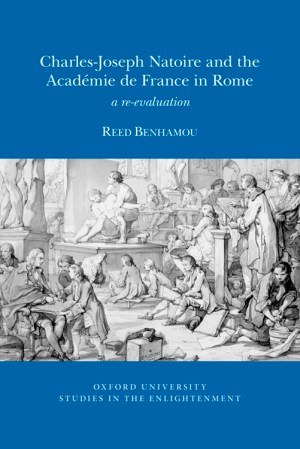 In 1752 Charles-Joseph Natoire, then a highly successful painter, assumed the directorship of the prestigious Académie de France in Rome. Twenty-three years later he was removed from office, criticised as being singularly inept. What was the basis for this condemnation that has been perpetuated by historians ever since? Reed Benhamou’s re-evaluation of Natoire’s life and work at the Académie is the first to weigh the prevailing opinion against the historical record.
The accusations made against Charles-Joseph Natoire were many and varied: that his artistic work was increasingly unworthy of serious study; that he demeaned his students; that he was a religious bigot; that he was a fraudulent book-keeper. Benhamou evaluates these and other charges in the light of contemporary correspondences, critics’ assessment of his work, legal briefs, royal accounts and the parallel experiences of his precursors and successors at the Académie. The director’s role is shown to be multifaceted and no director succeeded in every area. What is arresting is why Natoire was singled out as being uniquely weak, uniquely bigoted, uniquely incompetent. The Charles-Joseph Natoire who emerges from this book differs in nearly every respect from the unflattering portrait promulgated by historians and popular media. His increasingly iconoclastic students rebelled against the traditional qualities valued by the French artistic elite; the Académie went underfunded because of the effects of war and a profligate king, and he was caught between two competing institutional regimes. In this book Reed Benhamou not only unravels the myth and reality surrounding Natoire, but also also sheds light on the workings of the institution he served for nearly a quarter of a century.
Reed Benhamou is a Professor Emerita at Indiana University. Her research focuses on the educational programmes offered by royal, municipal and private art academies in Paris, Rome and the French provinces. Her many publications include Regulating the Académie: Art, Rules, and Power in Ancien Régime France, SVEC 2009:08.
◊ ◊ ◊ ◊ ◊
C O N T E N T S
Introduction
Part I, 1700–1751
1 In the bosom of the family (Natoire, 1751)
2 His gift for painting (d’Antin, 1723)
3 The brilliant verve of Natoire and Boucher (Locquin, 1912)
4 Natoire is the most qualified (Tournehem, 1750)
Part II, 1752–1777
5 It seems necessary to pass some time in Rome (Perrault, 1664)
6 A deep understanding of what is required (d’Antin, 1708)
7 My position requires it (Natoire, 1755)
8 Completely inadequate for a difficult time (Lecoy, 1874)
9 This strayed lamb (Natoire, 1753)
10 Never a more singular case (Mémoires secrets, 1768)
11 I’ve been advancing money to the Academy for a long time (Natoire, 1773)
12 I must obey and conform (Natoire, 1775)
Appendix 1: Natoire and art (1737–1777)
Appendix 2: Natoire and money (1752–1777)
Bibliography
Index
New Book | The Cambridge Companion to the French Enlightenment
From Cambridge UP:
Daniel Brewer, ed., The Cambridge Companion to the French Enlightenment (New York: Cambridge University Press, 2014), 265 pages, hardback ISBN: 978-1107021488, $80 / paperback ISBN: 978-1107626140, $30.
 The Enlightenment has long been seen as synonymous with the beginnings of modern Western intellectual and political culture. As a set of ideas and a social movement, this historical moment, the ‘age of reason’ of the seventeenth and eighteenth century, is marked by attempts to place knowledge on new foundations.
The Cambridge Companion to the French Enlightenment brings together essays by leading scholars representing disciplines ranging from philosophy, religion and literature, to art, medicine, anthropology and architecture, to analyse the French Enlightenment. Each essay presents a concise view of an important aspect of the French Enlightenment, discussing its defining characteristics, internal dynamics and historical transformations. The Companion discusses the most influential reinterpretations of the Enlightenment that have taken place during the last two decades, reinterpretations that both reflect and have contributed to important re-evaluations of received ideas about the Enlightenment and the early modern period more generally.
Daniel Brewer, Department of French and Italian, University of Minnesota, has published widely in the area of eighteenth-century French literature and culture. He is author of The Enlightenment Past: Reconstructing Eighteenth-Century French Thought (Cambridge University Press, 2008) and co-editor of L’Esprit Créateur: The International Quarterly of French and Francophone Studies.
◊ ◊ ◊ ◊ ◊
C O N T E N T S
Chronology
1 Daniel Brewer, The Enlightenment Today?
2 Antoine Lilti, Private Lives, Public Space: A New Social History of the Enlightenment
3 Andrew Curran, Anthropology
4 Paul Cheney, Commerce
5 J. B. Shank, Science
6 Dan Edelstein, Political Thought
7 Julie Candler Hayes, Sex and Gender, Feeling and Thinking: Imagining Women as Intellectuals
8 Charly Coleman, Religion
9 Jennifer Milam, Art and Aesthetic Theory: Claiming Enlightenment as Viewers and Critics
10 Thomas DiPiero, Enlightenment Literature
11 Stéphane Van Damme, Philosophe/Philosopher
12 Downing A. Thomas, Music
13 Anthony Vidler, Architecture and the Enlightenment
14 Anne Vila, Medicine and the Body in the French Enlightenment
15 Charles W. J. Withers, Space, Geography, and the Global French Enlightenment
Further Reading
Exhibition | George Morland: In the Margins
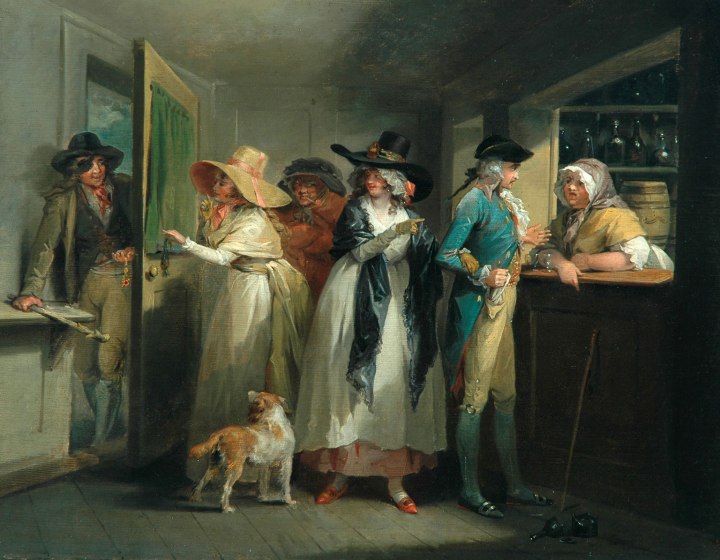
George Morland, Easy Money, 1788 (Huddersfield Art Gallery)
◊ ◊ ◊ ◊ ◊
Now on view at the University of Leeds:
George Morland: In the Margins
The Stanley & Audrey Burton Gallery, University of Leeds, 18 March — 11 July 2015
Curated by Nicholas Grindle
This exhibition looks at migrants and margins in the work of the painter George Morland (1763–1804), a popular painter whose lifestyle and early death earned him lasting notoriety. Over 250 of his works are held by public collections in the UK and US alone. His paintings of smugglers, gypsies, pedlars, soldiers, and families, which represent some of his best compositions, as well as how they mirrored his own life, raise compelling questions about who, and where, is ‘marginal’ in society. There has been no exhibition of his work since a small show in Reading in 1975 and no substantial discussion of his work since a thesis written in Stanford in 1977 and a chapter in John Barrell’s book Dark Side of the Landscape in 1980. His pictures resonate with contemporary issues such as migration and marginality in a way that was not evident thirty years ago.
The exhibition will run at The Stanley & Audrey Burton Gallery from 18 March 2015 until 11 July 2015, with a possible UK tour from August 2015 onwards.
◊ ◊ ◊ ◊ ◊
A symposium is scheduled for the end of May:
Bohemians and Marginal Communities in the 18th Century: George Morland in Context
The Stanley & Audrey Burton Gallery, University of Leeds, 29 May 2015
The Stanley & Audrey Burton Gallery presents a free symposium, bringing together academic discussion of the work of late 18th-century English painter George Morland. To coincide with our current exhibition George Morland: In the Margins, the Gallery is delighted to welcome experts and academics from a range of fields, to discuss the wider context of Morland’s work. These speakers will include the exhibition’s guest-curator Dr Nick Grindle (UCL); Professor of History of Art at Oxford Brookes University, Christiana Payne; social geographer, Dr Martin Purvis; independent art historian, Dr Anthony Lynch; and UEA MPhil student Francesca Bove.
The speakers will address representations of social margins in Morland’s artistic output and look at the parallels between his life and works. What can his representation of gypsies, smugglers, pedlars and families tell us about the societal conditions of the late 1800s and how do they reflect our own times? Morland was living on the brink of industrialisation, witnessing an increasingly capitalist culture and significant, sudden movements of people around the country; conditions which are still relevant to modern-day Britain. The worries of Morland’s contemporaries about the moral character and palatability of his works raises questions surrounding class relations and art’s role as social commentary and criticism.
Friday, 29 May 2015, 9:00–17:00. Free, though booking is essential. This event is kindly supported by the Paul Mellon Centre for Studies in British Art.
More information about programming for the exhibition is available here»
◊ ◊ ◊ ◊ ◊
The catalogue is available from the University of Leeds online bookstore:
Nicholas Grindle, ed., with essays by David Alexander, Kerry Bristol, Sue Ecclestone, Nicholas Grindle, and Martin Purvis, George Morland: Art, Traffic and Society in Late Eighteenth-Century England (Leeds: The Stanley & Audrey Burton Gallery, 2015), 99 pages, ISBN: 978-1874331544, £12.
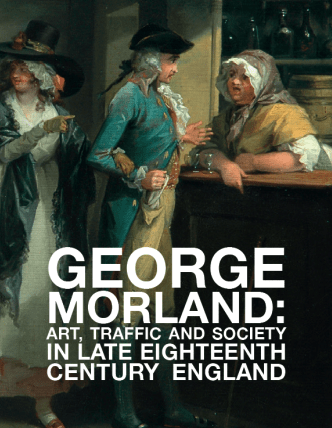 George Morland: Art, Traffic and Society in Late Eighteenth-Century England looks at the life and work of popular painter George Morland (1763–1804), whose remarkable talent, prodigious output, bohemian lifestyle and early death earned him lasting notoriety. Morland was the most infamous artist in Britain at the time of his death in 1804. His paintings enjoyed a stellar reputation, which was enhanced by stories about his fabulous earnings, prodigal spending, legendary drinking, and staggering debt. He was renowned for his associations with smugglers, gypsies and pugilists, as well as his constant attempts to evade his creditors. His best work is breathtaking in its ambition and execution, while the popularity of his drawings, paintings, and the prints after his work rose throughout his lifetime. Within months of his death, no fewer than four books had been published packed with anecdotes—many apocryphal—about his life and work. No other artist of the late eighteenth and early nineteenth centuries commanded such a profile.
Morland was reputed to have painted thousands of canvases and made hundreds of drawings. But in spite of his immense popular and critical stature, recent scholarly attention has been patchy, and this is the first publication to seriously review the artist in over thirty years. It includes five new essays which use recent perspectives in historical geography and studies of print and exhibition culture to help us look in new ways at his work and practice, as well as catalogue entries that bring scholarship on his paintings up to date.










 Enfilade
leave a comment