The Burlington Magazine, March 2015
The eighteenth century in The Burlington:
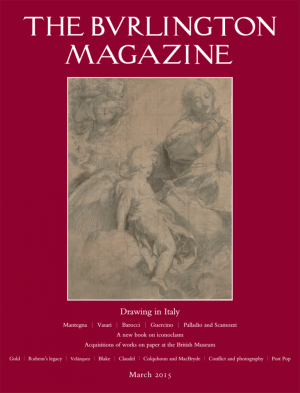
The Burlington Magazine 157 (March 2015)
 A R T I C L E S
• Veronica Maria White, “Guercino’s Beggar Holding a Broken Jug: A Drawing from the Gennari Inventory of 1719,” pp. 169–71.
• Andrew Hopkins, “Palladio and Scamozzi Drawings in England and Their Talman Marks,” pp. 172–80.
• Andrea Tomezzoli, “From Venice to Newport: A Painting by Giambettino Cignaroli Lost and Found,” pp. 181–85.
R E V I E W S
• Simon Watney, Review of Stacy Boldrick, Leslie Brubaker, and Richard Clay, eds., Striking Images: Iconoclasms Past and Present (Ashgate Publishing, 2013), pp. 186–89. Available at The Burlington website for free.
• David Scrase, Review of Laura Giles, Lia Markey, and Claire Van Cleave, eds., Italian Master Drawings from the Princeton University Art Museum (Yale University Press, 2014), pp. 197–98.
• Frances Parton, Review of the exhibition Gold (London: Queen’s Gallery, 2014–15), p. 202.
• David Scrase, Review of the exhibition William Blake: Apprentice and Master (Oxford, Ashmolean, 2014–15), pp. 206–07.
ASECS Awards, 2014–15
A selection of this year’s ASECS awards that particularly relate to landscapes, images, objects, and material culture:
2014–15 Louis Gottschalk Prize
 Vittoria Di Palma, Wasteland: A History (New Haven: Yale University Press, 2014).
The American Society for Eighteenth-Century Studies awards annually the Louis Gottschalk prize to the best scholarly book on an eighteenth-century subject. The 2015 Gottschalk prize has been awarded to Vittoria Di Palma for Wasteland: A History (Yale University Press, 2014), an elegant, probing, and timely account of how the emerging discourse of modern aesthetics in Britain was inseparably intertwined with interest in certain ‘unimproved’ types of land. Di Palma’s work, which conjoins the resources of art history, landscape and garden studies, the history of science, and more disciplines still, is a scholarly tour-de-force that synthesizes disparate studies of subjects ranging from land enclosure to the sublime in order to shed new light on the prehistory of our current ecological challenges.
2014–15 James L. Clifford Prize
Paola Bertucci, “Enlightened Secrets: Silk Intelligent Travel, and Industrial Espionage in Eighteenth-Century France” published in Technology and Culture 54 (October 2013): 820–52.
Bertucci offers a critical examination of the relationship between the openness of academic knowledge and the secrecy of state affairs in the age of Enlightenment. Using the silk manufacturing industry of France and Piedmont as an example, she explores the ways in which technical intelligence was gathered under the guise of academic exchange and demonstrates that the seeming openness of academic culture was one of the resources that intelligent travelers mobilized to serve the state in secret.
2014–15 Women’s Caucus Editing and Translation Fellowship
There were five very fine submissions this year for the Women’s Caucus Editing and Translation Prize. The selection committee—which consisted of Katherine Binhammer, Katharine Kittredge, and Mary Trouille (Chair)—was especially impressed by the proposals submitted by Aileen Douglas and Catherine Sama. Since no prize was given last year, the Women’s Caucus kindly agreed to allow our committee to award a $1,000 prize to both Professors Douglas and Sama. Catherine Sama is Professor of Italian at the University of Rhode Island in Providence. She has published widely on eighteenth-century Italian women writers and artists. The title of her project is “Rosalba Carriera (1673–1757): Correspondence of a Venetian Artist.”
2014–15 Innovative Course Design Competition
Michael Gavin, “Modeling Literary History: Quantitative Approaches to the Enlightenment”
Estelle Joubert, “Music in the Global Eighteenth Century: A New Course Proposal”
Sean Silver, “The Novel and the Museum”
New Book | Four Centuries of Quilts
From Yale UP:
Linda Baumgarten and Kimberly Smith Ivey, with a foreword by Ronald Hurst, Four Centuries of Quilts: The Colonial Williamsburg Collection (New Haven: Yale University Press, 2014), 356 pages, ISBN: 978-0300207361, $75.
 Quilts are among the most utilitarian of art objects, yet the best among them possess a formal beauty that rivals anything made on canvas. This landmark book, drawn from the world-renowned collection of the Colonial Williamsburg Foundation, highlights the splendor and craft of quilts with more than 300 superb color images and details. Fascinating essays by two noted scholars trace the evolution of quilting styles and trends as they relate to the social, political, and economic issues of their time.
The collection includes quilts made by diverse religious and cultural groups over 400 years and across continents, from the Mediterranean, England, France, America, and Polynesia. The earliest quilts were made in India and the Mediterranean for export to the west and date to the late 16th century. Examples from 18th- to 20th-century America, many made by Amish and African-American quilters, reflect the multicultural nature of American society and include boldly colored and patterned worsteds and brilliant pieced and appliquéd works of art.
Grand in scope and handsomely produced, Four Centuries of Quilts: The Colonial Williamsburg Collection is sure to be one of the most useful and beloved references on quilts and quilting for years to come.
Linda Baumgarten is curator of textiles and costumes, Kimberly Smith Ivey is curator of textiles and historic interiors, and Ronald Hurst is the Carlisle H. Humelsine Chief Curator and vice president of collections, conservation, and museums, all at Colonial Williamsburg.
New Book | A Natural History of English Gardening, 1650–1800
Scheduled for June publication, from Yale UP:
Mark Laird, A Natural History of English Gardening, 1650–1800 (London: The Paul Mellon Centre for Studies in British Art, 2015), 464 pages, ISBN: 978-0300196368, $75.
 Winner of the 2013 David R. Coffin Publication Grant, given by the Foundation for Landscape Studies.
Inspired by the pioneering naturalist Gilbert White, who viewed natural history as the common study of cultural and natural communities, Mark Laird unearths forgotten historical data to reveal the complex visual cultures of early modern gardening. Ranging from climate studies to the study of a butterfly’s life cycle, this original and fascinating book examines the scientific quest for order in nature as an offshoot of ordering the garden and field. Laird follows a broad series of chronological events—from the Little Ice Age winter of 1683 to the drought summer of the volcanic 1783—to probe the nature of gardening and husbandry, the role of amateurs in scientific disciplines, and the contribution of women as gardener-naturalists. Illustrated by a stunning wealth of visual and literary materials—paintings, engravings, poetry, essays, and letters, as well as prosaic household accounts and nursery bills—Laird fundamentally transforms our understanding of the English landscape garden as a powerful cultural expression.
Mark Laird is a historic landscape consultant and garden conservator and teaches landscape history at the Graduate School of Design, Harvard University. Previous books include The Flowering of the Landscape Garden: English Pleasure Grounds, 1720–1800 and Mrs. Delany and Her Circle.
New Book | George Hadfield: Architect of the Federal City
From Ashgate:
Julia King, George Hadfield: Architect of the Federal City (Farnham: Ashgate, 2014), 282 pages, ISBN: 978-1472412744, $120.
 During his lifetime, the work of architect George Hadfield (1763–1826) was highly regarded, both in England and the United States. Since his death, however, Hadfield’s contributions to architecture have slowly faded from view, and few of his buildings survive. In order to reassess Hadfield’s career and work, this book draws upon a wide selection of written and visual sources to reconstruct his life and legacy. After a general introduction, the book outline Hadfield’s early years and looks in detail at the extant major buildings in Washington, D.C. that he worked on: the Capitol, Arlington House, and Old City Hall. Hadfield’s contributions to the Capitol and other Federal buildings are fully researched and assessed for the first time, and Arlington House is shown to have been much more influential than has been appreciated hitherto. New material is presented on City Hall, another major and unjustly neglected contribution to the architecture of Washington. The complicated interlocking circles of his family and friends, his fellow architects, and his patrons and clients, including the transatlantic connections, are also explored, revealing much about the course of his career and
American architecture in general.
Subsequent chapters and the catalogue explore the other projects that Hadfield was involved with, ranging from office buildings, jails, theatres, factories, and banks to a mausoleum and monuments. The book ends with a reassessment of Hadfield’s qualities and influence, arguing that these were greater than is often acknowledged. By offering explanations as to why his work was particularly admired by contemporaries, it is concluded that Hadfield’s architectural style has been influential from his own times to the present and has been disseminated throughout the United States.
Julia King has taught at universities in Great Britain and America. She has worked on projects in conservation, historic preservation, archives, and architectural history on both sides of the Atlantic, writing and lecturing widely on art and architectural history in both countries.
◊ ◊ ◊ ◊ ◊
C O N T E N T S
Introduction
1 Family and Early Life
2 Education, Training, and Early Career
3 The US Capitol
4 Federal Buildings
5 Houses in America
6 City Hall
7 Life in Washington, Public and Commercial Buildings
8 Mausoleum and Monuments
9 Legacy
10 Conclusion
Appendix
Catalogue Raisonné
Select Bibliography
Index
New Book | The Sixtus Cabinet at Stourhead
Available from Philip Wilson and the National Trust (with a preview at Emile de Bruijn’s Treasure Hunt). . .
Simon Swynfen Jervis and Dudley Dodd, Roman Splendour, English Arcadia: The English Taste for Pietre Dure and the Sixtus Cabinet at Stourhead (London: Philip Wilson, 2015), 304 pages, ISBN: 978-1781300244, £45.
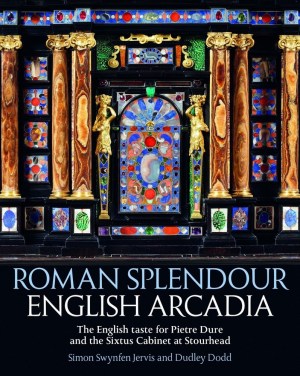 At Stourhead in Wiltshire, the Palladian mansion contains an extraordinary Roman cabinet glittering with gilt-bronze mounts, semi-precious stones and elaborate architectural ornament. Its façade conceals over 125 more-or-less secret drawers. The cabinet was brought to Stourhead in 1740 by Henry Hoare ‘the Magnificent’, of the Hoare banking dynasty; he had purchased it in Rome as made for Pope Sixtus V, the great rebuilder, whose papacy, from 1585–90, coincided with the Spanish Armada. The superb quality of the ‘Sixtus Cabinet’ became apparent during restoration in 2006–7 and this prompted an investigation into its history.
This book commences with a comprehensive account of the insatiable English taste for Italian pietre dure, from the 16th to the 20th centuries, and follows with a survey of the Roman pietre dure industry, hitherto unjustly neglected by comparison with Florence. A description and stylistic analysis of the cabinet itself precedes a trail of detection which takes it back to Pope Sixtus’s Roman villa, and then explores its tortuous descent through the Pope’s family to sale in 1740. Henry Hoare’s grand tour and his purchase of the cabinet led to its installation in a cabinet room at Stourhead, surrounded by Old Masters and with a new pedestal of triumphal arch form, incorporating reliefs of Pope Sixtus and his Roman monuments. Later his great-nephew, Sir Richard Colt Hoare created a new cabinet room, with embellishments by Thomas Chippendale the Younger. Horace Walpole and William Beckford were among the admirers of the cabinet, the focus of this remarkably wide-ranging study of Italian and English artistry, patronage and taste.
New Book | British Models of Art Collecting and the American Response
From Ashgate:
Inge Reist, ed., British Models of Art Collecting and the American Response: Reflections Across the Pond (Aldershot: Ashgate, 2014), 282 pages, ISBN: 978-1472438065.
 British Models of Art Collecting and the American Response: Reflections Across the Pond presents 14 essays by distinguished art and cultural historians. Collectively, they examine points of similarity and difference in the approaches to art collecting practiced in Britain and the United States. Unlike most of their Continental European counterparts, the English and Americans have historically been exceptionally open to collecting the art made by and for other cultures. At the same time, they developed a tradition of opening private collections to a public eager for educational and cultural advancement. Approximately half the essays examine the trends and market forces that dominated the British art collecting scene of the nineteenth century, such as the Orléans sale and the shift away from aristocratic collections to those of the new urban merchant class. The essays that focus on American collectors use biographical sketches of collectors and dealers, as well as case studies of specific transactions to demonstrate how collectors in the United States embraced and embellished on the British model to develop their own, often philanthropic approach to art collecting.
Inge Reist, PhD Columbia University, is Director of the Center for the History of Collecting, The Frick Collection and Frick Art Reference Library, New York.
◊ ◊ ◊ ◊ ◊
C O N T E N T S
Introduction, Inge Reist
Part I—Reflections Across the Pond
1 Pictures across the Pond: Perspectives and Retrospectives, Sir David Cannadine
2 The Revolving Door: Four Centuries of British Collecting, James Stourton
Part II—The British Model: Conversing with History
3 The Orléans Collection arrives in Britain, Jordana Pomeroy
4 James Irvine: Picture Buying in Italy for William Buchanan and Arthur Champernowne, Hugh Brigstocke
5 Aristocrats and Others: Collectors of Influence in 18th-Century England, Arthur MacGregor
6 A Decade of Change and Compromise: John Smith (1781–1855) and the Selling of Old Master Paintings in the 1830s, Julia Armstrong-Totten
7 ‘Le Goût Rothschild’: The Origins and Influences of a Collecting Style, Michael Hall
8 The 4th Marquess of Hertford and Sir Richard Wallace as Collectors: Chalk and Cheese? Or Father and Son?, Jeremy Warren
9 Collecting and Connoisseurship in England, 1840–1900: The Case of J. C. Robinson, Jonathan Conlin
Part III—Americans Embrace and Embellish the British Model
10 British Aspirations on the Chesapeake Bay: Robert Gilmor, Jr (1774–1848) of Baltimore and Collecting in the Anglo-American Community of the New Republic, Lance Humphries
11 The London Picture Trade and Knoedler & Co: Supplying Dutch Old Masters to America, 1900–1914, M. J. Ripps
12 The One That Got Away: Holbein’s Christina of Denmark and British Portraits in The Frick Collection, Ross Finocchio
13 The Long Good-bye: Heritage and Threat in Anglo-America, Neil Harris
14 Henry E. Huntington: An American Model for Collecting Art and Instituting Cultural Philanthropy, Shelley Bennett
Bibliography
Index
New Book | The Portrait Bust and French Cultural Politics
From Brill:
Ronit Milano, The Portrait Bust and French Cultural Politics in the Eighteenth Century (Leiden: Brill, 2015), ISBN: 978-9004276246 / E-ISBN: 978-9004276253, 125€ / $174.
 In The Portrait Bust and French Cultural Politics in the Eighteenth Century, Ronit Milano probes the rich and complex aesthetic and intellectual charge of a remarkably concise art form, and explores its role as a powerful agent of epistemological change during one of the most seismic moments in French history. The pre-Revolutionary portrait bust was inextricably tied to the formation of modern selfhood and to the construction of individual identity during the Enlightenment, while positioning both sitters and viewers as part of a collective of individuals who together formed French society. In analyzing the contribution of the portrait bust to the construction of interiority and the formulation of new gender roles and political ideals, this book touches upon a set of concerns that constitute the very core of our modernity.
Ronit Milano is a faculty member in the Department of the Arts, Ben-Gurion University of the Negev, Israel. She has published several articles on the French pre-Revolutionary portrait bust and is currently writing a book on contemporary art installations in eighteenth-century sites.
◊ ◊ ◊ ◊ ◊
C O N T E N T S
List of Illustrations
Acknowledgments
Introduction
1 ‘He is a Philosopher’: Individual versus Collective Identity
2 Decent Exposure: Bosoms, Smiles and Maternal Delight in Female Portraits
3 Between Innocence and Disillusion: Representations of Children and Childhood
4 Transitional Identities: Family Structure, the Social Order, and Alternative Masculinities at the Dawn of Modernity
5 The Face of the Monarchy: Court Propaganda and the Portrait Bust
Conclusion
Bibliography
Index
Exhibition | On the Road to Italy: Robert to Corot
Now on view at Amiens:
Sur la route d’Italie: Peindre la nature d’Hubert Robert à Corot
Musée d’Art et d’Archéologie d’Évreux, 26 April — 21 September 2014
Musée de Picardie, Amiens 13 February — 31 May 2015
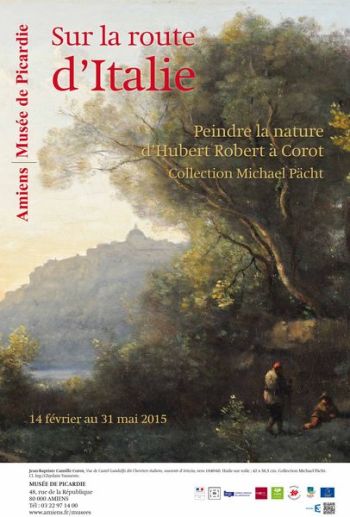 Pour la première fois, la collection de paysages français de l’éditeur Michael Pächt est présentée au public dans une exposition événement organisée en partenariat avec l’Institut national du patrimoine et le musée d’Art et d’Archéologie d’Evreux. Fasciné par le paysage français de la fin du XVIIIe siècle et de la première moitié du XIXe siècle, grand admirateur de Corot, dont il a rassemblé quelques-unes des plus belles pages peintes sur le motif, Michael Pächt a retracé, au gré d’achats guidés par la passion de l’amateur, une chaîne iconographique, stylistique et humaine, dont les relations maître-élève et les amitiés constituent les maillons. Les affinités électives entre artistes, les parentés, les héritages et les ruptures reprennent vie, introduisant le visiteur dans l’intimité qui se crée entre le peintre et la Nature.
D’Hubert Robert à Corot en passant par Michallon, Bidault, Granet et Rousseau, la collection Pächt nous plonge dans la grande aventure de la peinture de plein air à travers les oeuvres de ceux qui firent le voyage en Italie avant de trouver une terre d’élection dans la forêt de Fontainebleau, en Picardie ou dans le Sud de la France. Une centaine d’oeuvres, peintures, dessins, estampes, ainsi que quelques rares clichés-verre de Corot et de Rousseau, viennent animer la Galerie Puvis de Chavannes le temps d’un partage entre un amateur et un public auquel il livre un peu de sa passion.
Paysages français des collections du Musée de Picardie
L’exposition se prolonge avec une sélection de peintures choisies dans les réserves parmi les plus grands chefs-d’oeuvre du musée. Cet accrochage met également à l’honneur les esquisses inédites de Charles Larivière et d’Albert Maignan qui laissèrent de leur séjour en Italie, aux deux extrémités du XIXe siècle, des toiles imprégnées de la lumière du Sud.
Commissariat général
Olivia Voisin, conservateur du patrimoine, chargée du département Beaux-Arts
Florence Calame-Levert, directrice du musée d’Évreux
François Bridey, directeur adjoint du musée d’Évreux
Commissariat scientifique
Gennaro Toscano, directeur du département des conservateurs, Institut national du patrimoine, Paris
◊ ◊ ◊ ◊ ◊
Published by Gourcuff Gradenico and available from Artbooks.com:
Gennaro Toscano, Sur la route d’Italie: Peindre la nature d’Hubert Robert à Corot (Montreuil, Gourcuff Gradenico, 2014), 180 pages, ISBN: 978-2353401789, 29€.
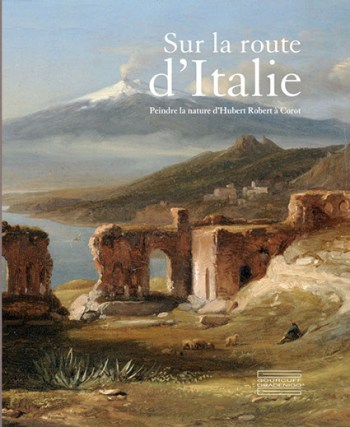 Cet ouvrage présente un ensemble extraordinaire de paysages d’artistes français ayant effectué le voyage en Italie (fin XVIIIe et xixe siècle). Les quelque 26 artistes renommés (Hubert Robert, Granet, Constantin d’Aix, Bertin, Michallon, Corot, Coignet, Rousseau Harpignies…) présents dans la collection ont la caractéristique commune d’avoir peint la nature en plein air en France et en Italie. Montée en partenariat avec l’Institut national du patrimoine (Inp), une exposition se déroulera du 26 avril au 14 septembre 2014 au musée d’Art, Histoire et Archéologie d’Évreux, puis au printemps 2015 au musée de Picardie à Amiens. Cet ensemble de paysages peints en France et en Italie est pour la première fois présenté au public et permet de s’interroger sur la constitution d’une collection particulièrement riche.
En marge de l’exposition, les services de la direction de la culture et de la ville d’Evreux et d’Amiens métropole s’associent pour programmer une «saison italienne». Plusieurs événements verront donc le jour au musée et dans d’autres institutions italiennes, permettant d’explorer la thématique du voyage en Italie ou d’éclairer les relations artistiques entre la France et l’Italie (littérature, Beaux-Arts, musique). Richement illustrée cette publication, solide du point de vue scientifique, s’adresse aussi à un public large et constitue une réflexion sur la peinture de paysage du XVIIIe au xixe siècle.
New Book | Painting 1600–1900: Art and Architecture of Ireland
Distributed by Yale UP:
Nicola Figgis, ed., Painting 1600–1900: Art and Architecture of Ireland (London: The Paul Mellon Centre for Studies in British Art, 2014), 600 pages, ISBN: 978-0300179200, $150.
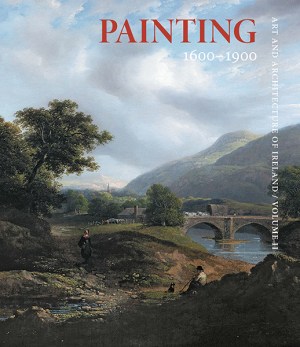 Art and Architecture of Ireland is an authoritative and fully illustrated survey that encompasses the period from the early Middle Ages to the end of the 20th century. The five volumes explore all aspects of Irish art—from high crosses to installation art, from illuminated manuscripts to Georgian houses and Modernist churches, from tapestries and sculptures to oil paintings, photographs and video art. This monumental project provides new insights into every facet of the strength, depth and variety of Ireland’s artistic and architectural heritage.
Painting 1600–1900: Art and Architecture of Ireland
The volume is divided into two sections. The first contains thematic essays, ranging widely from exhibiting practices to the social history of Irish art, revealing how pictures were produced, acquired and traded in Ireland. The varied texts reflect the decision to be inclusive in determining ‘Irishness’—the volume considers painters born in Ireland who spent their careers abroad, as well as visiting artists to Ireland. The second section is devoted to biographical entries, largely based on W.G. Strickland’s biographies of artists (Dublin and London, 1913), but updated to include extensive recent research. More than 300 entries provide information on Irish painters of the seventeenth, eighteenth and nineteenth centuries, a critical period that saw the development of easel painting, patronage, the exploration of antiquarianism and a search for the pictorial expression of national identity. The biographies offer a rich compendium of Irish experience; while some of the artists lived with worldly success and fame, others suffered disappointment and failure. All the entries are based on original research, much of it undertaken in hitherto unexplored archives. It seems appropriate given Ireland’s economic, political and social history, that the story told by this volume is one of exodus, exchange and international endeavour.
Nicola Figgis is a lecturer at the School of Art History and Cultural Policy, University College, Dublin, specialising in 17th–19th-century Irish painting and aspects of the Grand Tour. She is co-author, with Brendan Rooney, of Irish Paintings in the National Gallery of Ireland, volume i (2002).










 Enfilade
leave a comment