Editorial | Digital Textbooks / Thomas Buser’s History of Drawing

Jacques-Louis David, The Intervention of the Sabine Women, 1794. Black chalk, pen and black ink, gray wash with white heightening on two sheets and five fragments of paper pasted together, 25.7 x 34 cm (Paris: Louvre; photo: T. Le Mage).
Click here for more information.
◊ ◊ ◊ ◊ ◊
As someone regularly faced with assigning new editions of textbooks that seem increasingly overpriced, I wonder how long it will be until resources such as the basic art history survey text are available digitally for free. Yes, these are choppy waters—pedagogically, methodologically, ideologically, and as business practice—further complicated by recent legislation, primarily from California: SB48 signed into law in 2010 along with SB 1052 and SB 10532 signed in 2012. But I think the stakes are high in our getting this right.
Thomas Buser’s History of Drawing, which surveys Western drawing from the fifteenth to twentieth centuries, seems worth noting to me as an early example of what we might see more of in the coming years. I imagine most instructors would assign pieces in conjunction with other materials, but the price (free) facilitates such flexibility. If students in a studio drawing course are introduced to eighteenth-century artists they otherwise wouldn’t know about, that seems useful to me. In the context of a survey, I can imagine building one or two individual class sessions around the topic of drawing with this as a starting point for students. While there aren’t notes—an all too common and unfortunate characteristic of the textbook genre that could be rectified in the digital realm—there is a reasonably extensive bibliography, excluding (at least presently) the twentieth century.
With permissions an ever moving target, we’ve made huge strides during the last decade toward more open policies. Buser has adopted an approach that likely wouldn’t work with publishers (or profits) involved, but again this strikes me as a gain. If the image selection is admirable, in most cases the image quality is not. On the other hand, Buser’s text is also a work in progress, one of the biggest advantages of this new format.
I don’t usually voice opinions too loudly here (I try not to voice many opinions even softly and I’m certainly not speaking on behalf of HECAA), but here’s my concern: if art history—and I have in mind a discipline much larger than the eighteenth century—doesn’t move toward more affordable digital options, we will be further marginalized, characterized as an intellectual luxury, available only to a small, elite segment of higher education. At least at its best, the museum as an institution is premised on public access; it’s time we find some way to extend this vision to introductory art history texts.
–Craig Hanson
◊ ◊ ◊ ◊ ◊
From Busser’s History of Drawing:
History of Drawing is a textbook and reference book available free to anyone who loves drawings. . . .Thomas Buser earned his doctorate in Art History from NYU’s Institute of Fine Arts in 1974. He taught courses in Baroque Art and the course History of Prints and Drawings at the University of Louisville until his retirement in 2005. He has published Religious Art in the Nineteenth Century in Europe and America (two volumes, 2002) and the textbook Experiencing Art Around Us (second edition, 2006).
New Book | The Marble Index: Roubiliac and Sculptural Portraiture
From Yale UP:
Malcolm Baker, The Marble Index: Roubiliac and Sculptural Portraiture in Eighteenth-Century Britain (London: The Paul Mellon Centre for Studies in British Art, 2015), 420 pages, ISBN: 978-0300204346, £50 / $85.
 Providing the first thorough study of sculptural portraiture in 18th-century Britain, this important book challenges both the idea that portrait necessarily implies painting and the assumption that Enlightenment thought is manifest chiefly in French art. By considering the bust and the statue as genres, Malcolm Baker, a leading sculpture scholar, addresses the question of how these seemingly traditional images developed into ambitious forms of representation within a culture in which many core concepts of modernity were being formed. The leading sculptor at this time in Britain was Louis François Roubiliac (1702–1762), and his portraits of major figures of the day, including Alexander Pope, Isaac Newton, and George Frederic Handel, are examined here in detail. Remarkable for their technical virtuosity and visual power, these images show how sculpture was increasingly being made for close and attentive viewing. The Marble Index eloquently establishes that the heightened aesthetic ambition of the sculptural portrait was intimately linked with the way in which it could engage viewers familiar with Enlightenment notions of perception and selfhood.
Malcolm Baker is distinguished professor of art history at the University of California, Riverside.
◊ ◊ ◊ ◊ ◊
C O N T E N T S
1 Introduction: Addressing the Sculptural Portrait
Part I Characteristics: The Bust and the Statue as Genres
2 The Place of Sculptural Portraiture
3 Sculptural Conventions and Meaning
4 Setting up the Bust and the Statue
5 Making Images
Part II Exemplary Cases: Sitters, Patrons, Sculptors and Viewers
6 A Portrait Sculptor, his Sitters and his Viewers: Roubiliac and his Career
7 Celebrating the Illustrious
8 Groups, Networks, and Connections
9 Contemporary Heads
Appendices
Notes
Bibliography
Illustration credits
Index
A detailed table of contents is available (as a PDF file) here»
New Book | Architecture 1600–2000: Art and Architecture of Ireland
From Yale UP:
Edited by Rolf Loeber, Hugh Campbell, Livia Hurley, John Montague, and Ellen Rowley, Architecture 1600–2000: Art and Architecture of Ireland (London: The Paul Mellon Centre for Studies in British Art, 2014), 600 pages, ISBN: 978-0300179224, $150.
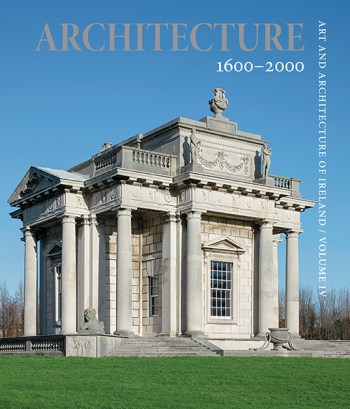 Art and Architecture of Ireland is an authoritative and fully illustrated survey that encompasses the period from the early Middle Ages to the end of the 20th century. The five volumes explore all aspects of Irish art—from high crosses to installation art, from illuminated manuscripts to Georgian houses and Modernist churches, from tapestries and sculptures to oil paintings, photographs and video art. This monumental project provides new insights into every facet of the strength, depth and variety of Ireland’s artistic and architectural heritage.
Architecture, 1600–2000 is the most complete survey of architecture in Ireland ever published. The essays in this volume cover all aspects of Ireland’s built environment, not only buildings but infrastructure, landscape development, public and private construction and much else. The volume challenges and expands the traditional understanding of Irish ‘architecture’, giving novel and exciting interpretations of the field and, by means of many striking illustrations, encourages us to think anew about the environment that surrounds us.
Rolf Loeber holds professorships at the University of Pittsburgh, where he oversees research on the causes of crime as well as mental health problems in young people. He has published extensively on Irish architecture, the history of fiction, and social, economic and plantation history. Hugh Campbell is professor of architecture at University College, Dublin, where he is currently head of the School of Architecture. He has published extensively on subjects from Irish architecture and urbanism to photography and urban space. Livia Hurley is an architect and architectural historian working in private practice in Dublin. Her research interests include urban history and the study of industrial sites and monuments. John Montague is assistant professor in the College of Architecture, Art and Design at the American University of Sharjah, UAE. His research interests include medieval and early modern architecture, and urban mapping. He is co-author, with Colm Lennon, of John Rocque’s Dublin: A Guide to the Georgian City (Dublin, 2010). Ellen Rowley is an architectural historian, researching 20th-century architecture in Ireland and beyond. She has written extensively on architectural modernism and edited a collection of Irish architectural writing: Patterns of Thought (2012). She is a research fellow at Trinity College Dublin.
New Book | Nathaniel Clements: Politics, Fashion, and Architecture
Published by Four Court Press and available from Artbooks.com (the book launch takes place in Dublin on Thursday, 12 February 2015 at the Royal Irish Academy) . . .
Anthony Malcomson, Nathaniel Clements (1705–77): Politics, Fashion, and Architecture in Mid-Eighteenth-Century Ireland (Dublin: Four Courts Press, 2015), 290 pages, ISBN: 978-1851829149, €55 / $75.
 This book argues that Nathaniel Clements was an enlightened patron of architecture, not a practising architect, and that he influenced upper-class residential development in Dublin and popularised a particular form of Palladian ‘villa-farm’ (or modest country house) partly because of who he was—a high-ranking and well-connected government official and an arbiter of fashion and taste. The two places where his architectural influence is still strongly felt today are the high-fashion enclave of Henrietta Street, Dublin, of which he created about one-third in the period 1733 c.1740, and the Phoenix Park, of which he was Ranger, where he made important improvements to the landscape and where he built in 1752–57 a new Ranger’s Lodge which forms the nucleus of today’s Áras an Uachtaráin. The book provides a detailed analysis of these aesthetic achievements and (following Clements’ death) of the re casting of the Ranger’s Lodge as a British viceregal residence during the period 1782–c.1800. It concludes with a broader discussion of the ‘amateur’ tradition in British and Irish architecture and of Clements’ place among the ‘amateurs’ who dominated the art form in the decades before the coming-of-age of a fully-fledged architectural profession.
Anthony Malcomson was director of the Public Record Office of Northern Ireland from 1988 until 1998, and during a career in archives which began in 1967 has sorted and listed the papers from c.75 Irish country houses. His publications, mainly based on the evidence of this material, include Nathaniel Clements: Government and the Governing Elite in Ireland, 1725–75 (2005), Virtues of a Wicked Earl: The Life and Legend of William Sydney Clements, 3rd Earl of Leitrim, 1806–78 (2009), and John Foster (1740–1828): The Politics of Improvement and Prosperity (2011).
New Book | Perronneau: Un Portraitiste dans l’Europe des Lumières
Published by Arthena and available from Artbooks.com:
Dominique d’Arnoult, with a preface by Xavier Salmon, Perronneau, ca. 1715–1783: Un portraitiste dans l’Europe des Lumières (Paris: Arthena, 2015), 440 pages, ISBN: 978-2903239541, 130€ / $190.
 Le portrait, particulièrement le portrait au pastel, connaît une vogue considérable dans une Europe du XVIIIe siècle où l’on ne dénombre pas moins de deux mille portraitistes. Succédant à Hyacinthe Rigaud (1659–1743) et à Nicolas de Largillierre (1656–1746), puis à Jean-Marc Nattier (1685–1766), deux grandes figures dominent la scène française au milieu de ce siècle : Maurice Quentin Delatour et Jean-Baptiste Perronneau, son cadet d’une dizaine d’années.
Perronneau reçoit sa formation de dessinateur à Paris où il se fait rapidement remarquer. Agréé à l’Académie royale de peinture et de sculpture en 1746, il y est reçu en 1753 avec ses portraits à l’huile du peintre Jean-Baptiste Oudry et du sculpteur Lambert Sigisbert Adam. Dans la tradition de l’Académie, Perronneau s’emploie à donner un prolongement à l’art de grands maîtres comme Van Dyck et Rembrandt, interprété dans un esprit nouveau.
Ses portraits vont être le plus souvent figurés en buste, peints au pastel ou à l’huile. L’enjeu alors est de concilier la ressemblance avec la science picturale propre à la grande peinture, tout en donnant une impression de facilité, voire une forme de désinvolture (la sprezzatura), qui doit dissimuler le travail de l’artiste. C’est un art qui doit de plus rencontrer la satisfaction du modèle. À la cour de Versailles comme à la ville, il est alors de bon goût de ne pas laisser paraître son rang sur son portrait : la simplicité est à la mode. Perronneau y excelle, sachant donner à des portraits travaillés au cours d’un grand nombre de séances l’impression qu’ils sont réalisés dans l’instant. Il devient ainsi l’un des peintres favoris du public du Salon du Louvre de 1746 à 1765.
La rivalité entre Perronneau et Delatour va s’afficher pendant plus de vingt ans au cours desquels l’un et l’autre vont exposer plus de cent portraits au Salon. Delatour ira même jusqu’à se confronter à son rival en 1750, en faisant exposer son autoportrait à côté de son propre portrait demandé à Perronneau. Les carrières des deux artistes restent cependant distinctes: Delatour peint la famille royale et la Cour, Perronneau préfère trouver une clientèle dans les capitales provinciales et étrangères. Ses modèles appartiennent à des milieux sociaux divers, aussi bien à la grande aristocratie qu’au monde du négoce ou à celui des arts.
C’est la vision d’une autre France, d’une autre Europe que celle habituellement représentée par ses rivaux qui apparaît sous les pastels et les pinceaux de Perronneau, celle d’un monde des Lumières en mouvement. En butte à la critique qui lui reproche notamment de choisir des modèles inconnus du grand public à partir de 1767 et voyant sa position à Paris compromise, Perronneau prend le parti de s’éloigner de la capitale et de la France où il ne revient plus qu’épisodiquement après 1773. Ses itinéraires le conduiront alors dans les villes européennes où résident les grands négociants et financiers, en Hollande et en Allemagne essentiellement. À la fin de sa vie, il entreprend un long voyage à Saint-Pétersbourg et Varsovie, avant de s’éteindre à Amsterdam en 1783.
New Book | Back to the Garden: Nature and the Mediterranean World
From Yale UP:
James H. S. McGregor, Back to the Garden: Nature and the Mediterranean World from Prehistory to the Present (New Haven: Yale University Press, 2015), 384 pages, ISBN: 978-0300197464, $38.
 The garden was the cultural foundation of the early Mediterranean peoples; they acknowledged their reliance on and kinship to the land, and they understood nature through the lens of their diversely cultivated landscape. Their image of the garden underwrote the biblical book of Genesis and the region’s three major religions.
In this important melding of cultural and ecological histories, James H. S. McGregor suggests that the environmental crisis the world faces today is a result of Western society’s abandonment of the ‘First Nature’ principle—of the harmonious interrelationship of human communities and the natural world. The author demonstrates how this relationship, which persisted for millennia, effectively came to an end in the late eighteenth century, when ‘nature’ came to be equated with untamed landscape devoid of human intervention. McGregor’s essential work offers a new understanding of environmental accountability while proposing that recovering the original vision of ourselves, not as antagonists of nature but as cultivators of a biological world to which we innately belong, is possible through proven techniques of the past.
James H. S. McGregor is the author of five books on world cities. He is emeritus professor of comparative literature at the University of Georgia and lives in Cambridge, MA.
Exhibition | Shoes: Pleasure and Pain

Pale-blue shoes, silk satin with silver lace and braid, diamond and sapphire buckles, England, 1750s (London: V&A: T.70+A—1947; M.48+A—1962). Photographed on the mantelpiece in The Norfolk House Music Room, the British Galleries at the V&A.
◊ ◊ ◊ ◊ ◊
Press release from the V&A:
Shoes: Pleasure and Pain
Victoria & Albert Museum, London, 13 June 2015 — 31 January 2016
The Bowes Museum, Barnard Castle, County Durham, 11 June — 9 October 2016
Peabody Essex Museum, Salem, Massachusetts, 9 November 2016 — 12 March 2017
Savannah College of Art and Design, Savannah, Georgia, March — June 2017
Curated by Helen Persson
The transformative power of extreme footwear will be explored in the V&A’s summer 2015 fashion exhibition, Shoes: Pleasure and Pain. More than 200 pairs of historic and contemporary shoes from around the world will be on display, many for the first time. The exhibition will explore the agonizing aspect of wearing shoes as well as the euphoria and obsession they can inspire.
The V&A’s shoe collection is unrivalled, spanning the globe and over 2000 years. For Shoes: Pleasure and Pain, curator Helen Persson has delved into this, other international collections and the wardrobes of private individuals to select an exceptional range of shoes from a sandal decorated in pure gold leaf originating from ancient Egypt to futuristic looking shoes created using 3D printing.
 Shoes worn by or associated with high profile figures including Marilyn Monroe, Queen Victoria, Sarah Jessica Parker, and the Hon Daphne Guinness will be shown as well as famous shoes, such as the ballet slippers designed for Moira Shearer in the 1948 film The Red Shoes. Footwear for men and women by 70 named designers including Manolo Blahnik, Christian Louboutin, Jimmy Choo, and Prada will be on display. Historic lotus shoes made for bound feet and 16th-century chopines, silk mules with vertiginous platforms designed to lift skirts above the muddy streets, will also feature.
Exhibition curator, Helen Persson, said: “Shoes are one of the most telling aspects of dress. Beautiful, sculptural objects, they are also powerful indicators of gender, status, identity, taste and even sexual preference. Our choice in shoes can help project an image of who we want to be.”
The exhibition will be shown over two floors. The luxurious, boudoir design of the ground floor gallery will examine three themes: transformation, status, and seduction.
‘Transformation’ will present shoes that are the things of myth and legend, opening with different cultural interpretations of the Cinderella story from across the globe. It will explore the concept of shoes being empowering as passed down through folklore, illustrated by the Seven League Boots from the ‘Hop o’ My Thumb’ tale, and how this feeds into contemporary marketing for such things as football boots and the concept of modern-day, fairy-tale shoemakers, whose designs will magically transform the life of the wearer.
‘Status’ will reveal how impractical shoes have been worn to represent privileged and leisurely lifestyles—their design, shape and material can often make them unsuitable for walking—and how shoes also dictate the way in which the wearer moves, how they are seen and even heard. Shoes on display will include Indian men’s shoes with extremely long toes, noisy slap-sole shoes worn in Europe during the 17th century and the now infamous Vivienne Westwood blue platforms worn by Naomi Campbell in 1993. ‘Status’ will also demonstrate how historically shoe fashions originated from the European royal courts, while today the focus has shifted to famous shoe designers. Desirable shoes such as the ‘Pompadour’, worn by trend-setting women in the 18th-century French court will sit together with designs by the some of the most well-known names in fashion today, including Alexander McQueen and Sophia Webster.
Within ‘Seduction’, the shoes represent an expression of sexual empowerment or a passive source of pleasure. Like feet, shoes can be objects of fetishism. High Japanese geta, extreme heels, and tight-laced leather boots will be on display as well as examples of erotic styles channeled by mainstream fashion in recent years.
In contrast, the laboratory style setting of the first floor gallery is dedicated to dissecting the processes involved in designing and creating footwear, laying out the story from concept to final shoe. This will be enhanced by films and animations that peel back the layers of a shoe and reveal how they are made. The displays will show how makers combine traditional craftsmanship with technological innovation and how they unite function with art.
Designer sketches, materials, embellishments and shoe lasts, such as the lasts created by H. & M. Rayne for Princess Diana, will be on show, alongside ‘pullovers’ from Roger Vivier for Christian Dior. The section will highlight the makers’ ingenuity in creating innovative styles and dealing with the structural challenges of creating ever higher heels and more dramatic shapes and will feature filmed interviews with five designers and makers.
The exhibition will go on to examine shifts in consumption and production—with examples from an 18th-century ‘cheap shoe warehouse’, one-off handmade men’s brogues and trainers made in China. It will also look at the future of shoe design, with experiments of material and shapes, moulding and plastics. On display will be footwear that pushes the boundaries of possibility, including the form-pressed ‘Nova’ shoes designed by Zaha Hadid with an unsupported 16cm heel and Andreia Chaves’ ‘Invisible Naked’ shoes that fuse a study of optical illusion with 3D printing and high quality leather making techniques. The last section of the exhibition will look at shoes as commodities and collectibles. Six different people’s collections will be presented from trainers to luxury footwear.
Sponsored by Clarks, supported by Agent Provocateur, with additional thanks to the Worshipful Company of Cordwainers
Note (added 14 June 2016) — Venues updated to reflect the latest schedule.
◊ ◊ ◊ ◊ ◊
A preview of the accompanying publication is available via Issuu:
Helen Perrson, ed., Shoes: Pleasure and Pain (London: V&A Publishing, 2015), 176 pages ISBN: 978-1851778324, £25 / $40.
 Beautiful, sculptural objects, shoes are powerful indicators of gender, status, identity, taste, and even sexual preference. Our choice in shoes can be aspirational, even fantastical—and projects an image not just of who we are, but who we want to be. Feet are made for walking, but shoes may not be. Featuring extensive new photography, this is a beautiful and authoritative guide to the history and culture of footwear. Iconic creations by celebrated designers sit alongside masterpieces by unknown craftsmen in this book.
Embracing both men’s and women’s footwear, from the Chinese lotus shoe to laser-printed contemporary shoes-as-sculpture, Shoes: Pleasure and Pain engages with the cultural significance of shoes—the source of their allure, how they are made, and the people who buy and wear them. Contributors from a wide range of disciplines consider subjects as diverse as ballet slippers and fetishism, shoes and ceramics, traditional shoemaking, and the obsessive shoe collector. The book also includes a comprehensive discussion of the history of shoe design, and case studies including Marie-Antoinette’s shoe collection and the footwear of the Maharajas.
Helen Persson is curator of Chinese textiles and dress in the V&A’s Asian Department.
◊ ◊ ◊ ◊ ◊
C O N T E N T S
Helen Persson, Introduction
Part 1: The Lure of Shoes
Hilary Davidson, Shoes and Magical Objects
Elizabeth Semmelhack, The Allure of Height
Rowan Bain, Status and Power in the Hamam
Divia Patel, Bling: Footwear of the Maharajas
Cassie Davies-Strodder, Shoes and Sex
Valerie Steele, Ballet Shoes and Fetishism
Rowan Bain, The Shoe and the Body
Part 2: Art and Innovation
Naomi Braithwaite, Shoe Design: Creativity and Process
Helen Persson, The Beauty of Shoemaking
Jana Scholze, Extreme Future
Sonia Solicari, The Shoemaker and the Ceramicist
Joanne Hackett, Plastic Galore
Christopher Breward, Men in Heels
Part 3: Shoe Obsession
Cally Blackman, The Rise of the Celebrity Shoe Designer
Giorgio Riello, Production for Consumption
Kirstin Kennedy, Cracowes and Duckbills
Helen Persson, Lotus Shoes for the Masses
Kimberly Chrisman-Campbell, Marie Antoinette’s Love of Shoes
Karin M. Ekström, The Show Cabinet: Collectors Case Study
Notes
Bibliography
Parts of a Shoe
Glossary
Index
Acknowledgements
Picture Credits
New Book | The Smile Revolution in Eighteenth-Century Paris
From Oxford UP:
Colin Jones, The Smile Revolution in Eighteenth-Century Paris (New York: Oxford University Press, 2014, 256 pages, ISBN: 978-0198715818, £23 / $40.
 You could be forgiven for thinking that the smile has no history; it has always been the same. However, just as different cultures in our own day have different rules about smiling, so did different societies in the past. In fact, amazing as it might seem, it was only in late eighteenth century France that western civilization discovered the art of the smile. In the ‘Old Regime of Teeth’ which prevailed in western Europe until then, smiling was quite literally frowned upon. Individuals were fatalistic about tooth loss, and their open mouths would often have been visually repulsive. Rules of conduct dating back to Antiquity disapproved of the opening of the mouth to express feelings in most social situations. Open and unrestrained smiling was associated with the impolite lower orders.
In late eighteenth-century Paris, however, these age-old conventions changed, reflecting broader transformations in the way people expressed their feelings. This allowed the emergence of the modern smile par excellence: the open-mouthed smile which, while highlighting physical beauty and expressing individual identity, revealed white teeth. It was a transformation linked to changing patterns of politeness, new ideals of sensibility, shifts in styles of self-presentation—and, not least, the emergence of scientific dentistry. These changes seemed to usher in a revolution, a revolution in smiling. Yet if the French revolutionaries initially went about their business with a smile on their faces, the Reign of Terror soon wiped it off. Only in the twentieth century would the white-tooth smile re-emerge as an accepted model of self-presentation.
In this entertaining, absorbing, and highly original work of cultural history, Colin Jones ranges from the history of art, literature, and culture to the history of science, medicine, and dentistry, to tell a unique and untold story about a facial expression at the heart of western civilization.
Colin Jones is Professor of History at Queen Mary University of London. He has published widely on French history, particularly on the eighteenth century, the French Revolution, and the history of medicine. His books include The Medical World of Early Modern France (with Lawrence Brockliss, 1997); The Great Nation: France from Louis XV to Napoleon (2002); and Paris: Biography of a City (2004: winner of the Enid MacLeod Prize). He is a Fellow of the British Academy and Past President, Royal Historical Society.
◊ ◊ ◊ ◊ ◊
C O N T E N T S
Introduction
1: The Old Regime of Teeth
2: The Smile of Sensibility
3: Cometh the Dentist
4: The Making of a Revolution
5: The Transient Smile Revolution
6: Beyond the Smile Revolution
Postscript: Towards the Twentieth-Century Smile Revolution
Notes
Index
Exhibition | Fashioning the Body: An Intimate History of the Silhouette
Press release for the upcoming exhibition at the BGC:
Fashioning the Body: An Intimate History of the Silhouette
Musée des Arts Décoratifs, Paris, 5 July — 24 November 2013
Bard Graduate Center, New York, 3 April — 26 July 2015
Curated by Denis Bruna
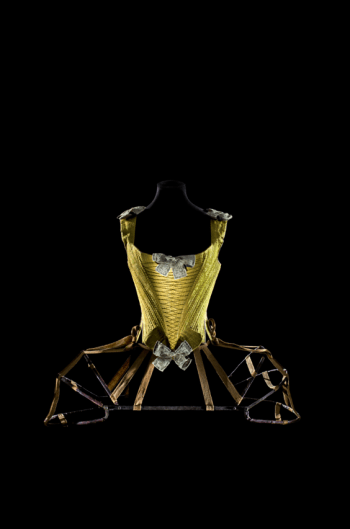
Whalebone corset. France, ca. 1740–60. Silk satin damask, braided silk, linen bows covered in silk and decorated with metallic thread, whalebone, linen lining. Les Arts Décoratifs, PR 995.16.1. Articulated pannier. France, ca. 1770. Iron covered with leather, fabric tape. Les Arts Décoratifs, depot du musée national du Moyen Âge-Thermes et hotel de Cluny 2005, Cluny 7875. Photographer: Patricia Canino.
Having garnered high acclaim at the Musée des Arts décoratifs in Paris in 2013, the exhibition Fashioning the Body: An Intimate History of the Silhouette will be on display at the Bard Graduate Center from April 3 through July 26, 2015. The exhibition will present the many devices and materials that women and men have used to shape their silhouettes from the seventeenth century to today, including panniers, corsets, crinolines, bustles, stomach belts, girdles, and push-up brassieres. The exhibition will also look at how lacing, hinges, straps, springs, and stretch fabrics have been used to alter natural body forms.
Curated by Denis Bruna, curator of pre-19th-century fashion and textile collections at the Musée des Arts décoratifs and professor at the École du Louvre, the exhibition will explore the history of what has long been ‘behind the scenes’ in clothing and fashion—far beyond the corset, the best-known device for shaping the figure. This show, which draws heavily on the Paris museum’s unrivaled costume collection, is the first of its kind, and the Bard Graduate Center will be its only venue in North America.
Although a broad array of silhouette-shaping garments has evolved over the course of fashion history, and techniques have been refined, the purpose of such garments has remained consistent: to flatten the stomach, compress the waist to the point of hollowing it out, support the bust, lift the breasts (and sometimes flatten them), and add curves to the hips. In short, comfort was superseded by appearance until about 1900, when couturiers such as Paul Poiret launched, however fleetingly, a vogue for ‘natural’ lines.
The tricks for fashioning women’s bodies have always confounded belief, from the earliest boned bodices through today’s push-ups. Spread across three floors of the Bard Graduate Center Gallery’s townhouse, Fashioning the Body opens with the seventeenth-century silhouette, exemplified by a rare women’s Spanish doublet, which was internally reinforced to be more rigid. Structured with armatures and other mechanisms, the garments of the eighteenth century enforced the erect posture prized first by the aristocracy and later by an influential bourgeoisie in order to convey a sense of superiority through the display of an idealized physical form. The epitome of the transformed female silhouette is the late eighteenth-century formal or court dress, examples of which will be on display alongside the undergarments that molded their distinctive silhouettes. In men’s fashion, the exhibition explores how padded jackets provoked arched torsos; how calf enhancers, stomach belts, and codpieces were worn; and how variations on these enhancements continued into the nineteenth century and beyond. The exhibition will also include garments for children, who wore corsets beginning in the seventeenth century.
Fashioning the Body continues into the nineteenth century, in which the corset held tyrannical sway, embodying the voguish insistence on a ‘wasp waist’, accentuated by the excessive ballooning of crinoline. After 1870 this kind of boned hoopskirt disappeared and was replaced by the bustle—also known as the faux-cul (fake buttocks), ‘shrimp tail’, or strapontin (jump seat)—which gave women an odd and sinuous profile reminiscent of a goose. Undergarments were never as abundant or as concealed as they were in the nineteenth century. The exhibition will continue with the brassiere and girdle, including examples used by men, and eventually the bust-enhancing and push-up bras of today. These devices were designed to create a plunging look for even the slimmest figures, reflecting the dictates of the canons of beauty at a time when bodies are modeled more by diets, body building, and surgery than by clothing.
In addition to complete outfits shaped by these hidden structural contraptions, the exhibition will also feature moving mannequins wearing mechanized reconstructions of panniers, crinolines, and bustles in order to show how the undergarments worked. The exhibition space will also include an area where visitors can try on specially made replicas of corsets, eighteenth-century panniers, and crinolines in order to understand the workings of these structures, which have played such an important role in the history of fashion.
Denis Bruna has a doctorate in history from the University of Paris I Panthéon-Sorbonne. He joined Les Arts Décoratifs in 2011 as curator of textile and fashion collections before the nineteenth century. He is also a professor and director of research in the history of fashion, costume, and textiles at the École du Louvre. His research focuses on the history and iconography of the costume, dress, and customs of the body. He has published several books and was the curator of the 2012 exhibition Fashioning Fashion: Two Centuries of European Fashion 1700–1915.
The Bard Graduate Center is a graduate research institute in New York City. The Center’s Gallery exhibitions and publications, MA and PhD programs, and research initiatives explore new ways of thinking about decorative arts, design history, and material culture. Founded in 1993, the BGC is an academic unit of Bard College. Fashioning the Body is the third in a series of collaborations between the Musée des Arts décoratifs and the Bard Graduate Center, which included Chinese Cloisonné (2011) and Discovering the Secrets of Soft-Paste Porcelain at the Saint-Cloud Manufactory, ca. 1690–1766 (1999).
The Musée des Arts décoratifs, housed in the Louvre building, is a unique, private institution composed of a specialized library, teaching facilities, and an ensemble of prestigious museums, including the Musée Nissim de Camondo and the Musée des Arts décoratifs. The Musée des Arts décoratifs fulfills a unique role in the French cultural landscape. Its six thousand objects on view in 10,000 square meters of exhibition space highlight the skills of craftsmen through the centuries, the evolution of styles, technological innovation, and the creativity of artists in enriching our day-to-day environ- ment. It is the only museum able to pay tribute to all the great names that have forged the history of French taste, from Boulle, Sèvres, Aubusson, Christofle, Lalique, and Guimard to Mallet Stevens, Le Corbusier, Perriand, and Starck. The museum’s chronological itinerary guides visitors through all the major styles and movements, from Gothic to Louis XVI, Art Nouveau, Art Deco, and modern design. Les Arts Décoratifs also boasts exceptional fashion and textile collections, among the finest in the world, and a vast collection of advertising posters, films, and objects. The wealth of these collections enables Les Arts Décoratifs to run a program of ten to fifteen thematic and monographic exhibitions covering every historic and contemporary aspect of the decorative arts.
◊ ◊ ◊ ◊ ◊
The Bard Graduate Center, in collaboration with Yale University Press, will publish an English-language version of the book that accompanied the exhibition in Paris, which is now out of print:
Denis Bruna, ed., with photographs by Patricia Canino, Fashioning the Body: An Intimate History of the Silhouette (New Haven: Yale University Press, 2015), 272 pages, ISBN: 978-0300204278, $50.
 This unique survey offers fascinating insights into the convoluted transformations employed by both men and women to accommodate the fickle dictates of fashion. With high design, wit, and style, Fashioning the Body tracks the evolution of these sartorial devices—from panniers, crinolines, and push-up bras to chains, zippers, and clasps—concealed beneath outer layers in order to project idealized figures. Women’s corsets constricted waists; exaggerated buttocks and hips counterbalanced jutting bust lines; and chic, aerodynamic silhouettes compressed breasts and flattened bellies. Yet masculine fashion has been no stranger to these tortuous practices. Men flaunted their virility by artificially broadening their shoulders, applying padding to their chests, and slipping codpieces over their groins. With more than 200 beautiful illustrations—including reproductions of superb historic advertisements—Denis Bruna reveals the industry and art of these contrivances meant to entice and beguile as well as assert status and power. Contemporary haute-couture designers Thierry Mugler, Jean Paul Gaultier, Rei Kawakubo for Comme des Garçons, Christian Lacroix, and Vivienne Westwood are featured in this indiscreet tour of intimate fashion history.
Exhibition | Fantastical Worlds: Adam Friedrich von Löwenfinck
From the Staatliche Kunstsammlungen Dresden:
Fantastical Worlds: Painting on Meissen Porcelain
and German Faience by Adam Friedrich von Löwenfinck (1714–1754)
Zwinger, Dresden, 1 October 2014 — 22 February 2015

Adam Friedrich von Löwenfinck, Meissen, 1734
To mark the 300th anniversary of the birth of Adam Friedrich von Löwenfinck, the Porzellansammlung of the Staatliche Kunstsammlungen Dresden presents a comprehensive exhibition of this artist’s oeuvre, bringing together around 100 selected porcelain and faience exhibits from the Dresden Porzellansammlung, private collections and renowned museums, including the Metropolitan Museum of Art, New York, the Rijksmuseum, Amsterdam, the Reiss-Engelhorn Museum, Mannheim, and the Museum für Kunst und Gewerbe, Hamburg.
Adam Friedrich von Löwenfinck (1714–1754) was one of the most important ceramic painters of the eighteenth century. He began his career at the Meissen Porcelain Manufactory in 1728, but by 1736 had fled to escape restrictions on his artistic development and difficult working conditions in the painters’ workshops. His life then took an adventurous path to a succession of faience manufactories, starting with Bayreuth and moving on by way of Fulda to Strasbourg-Haguenau. Due to his exceptional artistic abilities, but also to his guile and lack of scruples, Löwenfinck eventually rose from lowly journeyman painter to manufactory director.
Inspired by the painted decoration on Chinese and Japanese porcelain in the collection of August the Strong, he created a fantastic world inhabited by vibrantly colourful, fabulous creatures. He later took these exotic motifs, as well as his knowledge of both East Asian and European flower painting, with him as he travelled, transferring them from one workplace to the next. As Löwenfinck did not sign his works, for a long time it was impossible to attribute them with any certainty: as a result, his oeuvre long remained completely unrecognised, even among specialists.
The life and works of this exceptional artist were the focus of several years of research conducted by the Porzellansammlung of the Staatliche Kunstsammlungen Dresden. The results of this project are now presented in a comprehensive anniversary exhibition. Systematic evaluation of archive sources, including manufactory reports and case files, shed light on previously little known aspects of social conditions in the porcelain and faience manufactories of the time, and enabled a fundamental and thorough reassessment of his work.
◊ ◊ ◊ ◊ ◊
◊ ◊ ◊ ◊ ◊
From Arnoldsche Art Publishers:
Ulrich Pietsch, Phantastische Welten: Malerei auf Meissener Porzellan und deutschen Fayencen von Adam Friedrich von Löwenfinck, 1714–1754 (Stuttgart: Arnoldsche Art Publishers, 2014), 384 pages, ISBN: 978-3897904200, 78€.
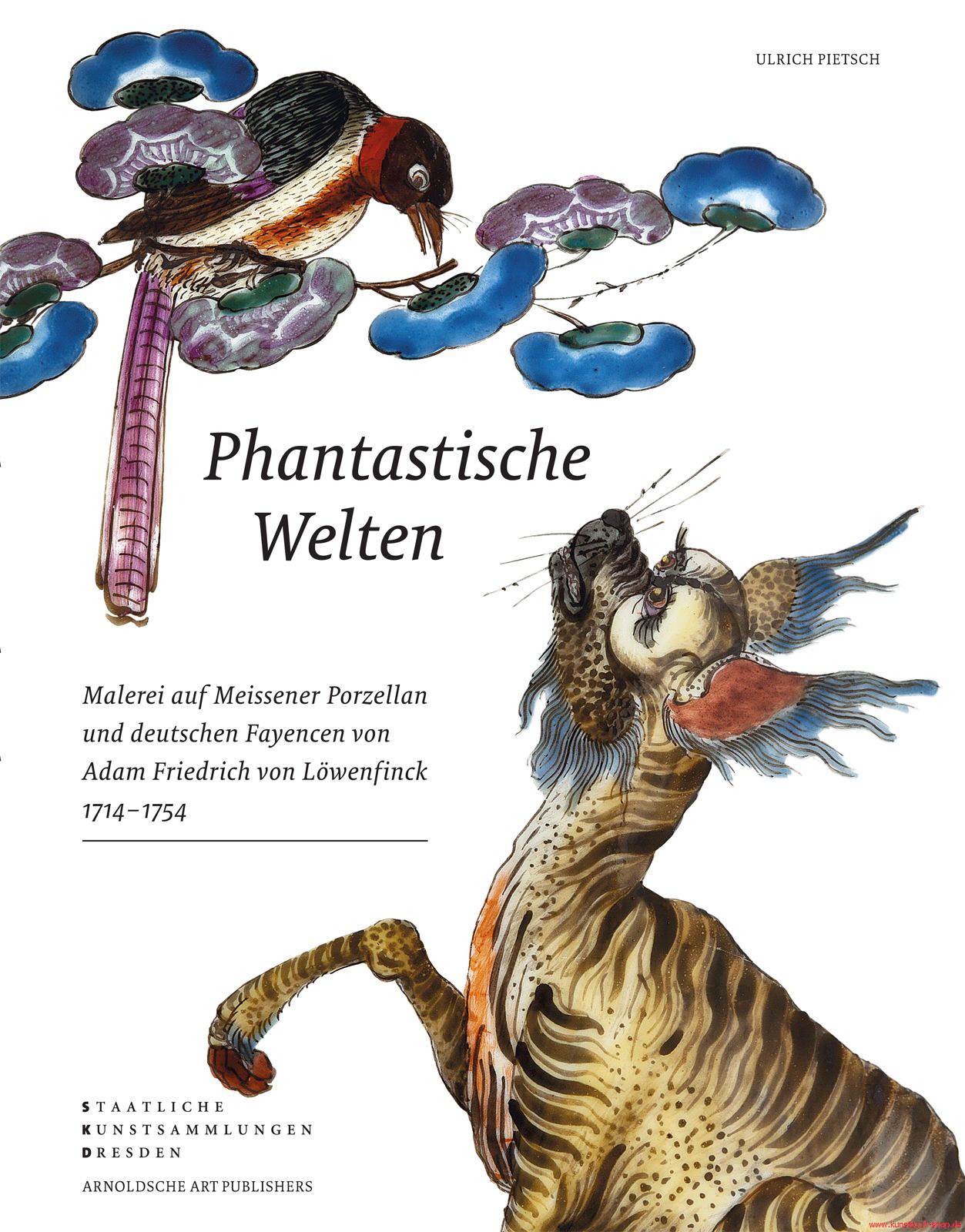 Adam Friedrich von Löwenfinck (1714–1754) war einer der bedeutendsten Keramikmaler des 18. Jahrhunderts. Er begann seine Karriere 1728 in der Porzellan-Manufaktur Meissen, die er wenige Jahre später wieder verließ, um der Einschränkung seiner künstlerischen Entfaltung und den schwierigen Arbeitsbedingungen in den Malerstuben zu entfliehen. Sein abenteuerlicher Lebensweg führte ihn in verschiedene Fayence-Manufakturen, darunter Bayreuth, Ansbach, Fulda, Höchst und Straßburg-Haguenau. Aufgrund seiner außergewöhnlichen künstlerischen Fähigkeiten, aber auch durch Geschick und Skrupellosigkeit stieg Löwenfinck schließlich vom einfachen Malergesellen in die Position eines Manufakturdirektors auf. Löwenfinck ist bekannt für seine fantastische Welt bunt schillernder und märchenhafter Fabeltiere. Er beeinflusste und prägte nachhaltig die Keramikmalerei seiner Zeit und wirkte stilprägend auf viele andere Manufakturen des 18. Jahrhunderts in Europa. Aufgrund fehlender Künstlersignaturen ist sein Werk umstritten und wurde bislang kontrovers diskutiert.
Die vorliegende Publikation ist das Ergebnis eines mehrjährigen Forschungsprojektes der Porzellansammlung Dresden, mit der nun erstmals eine grundlegende Untersuchung der Biografie und des OEuvres Adam Friedrich von Löwenfincks vorgelegt wird.










 Enfilade
3 comments